
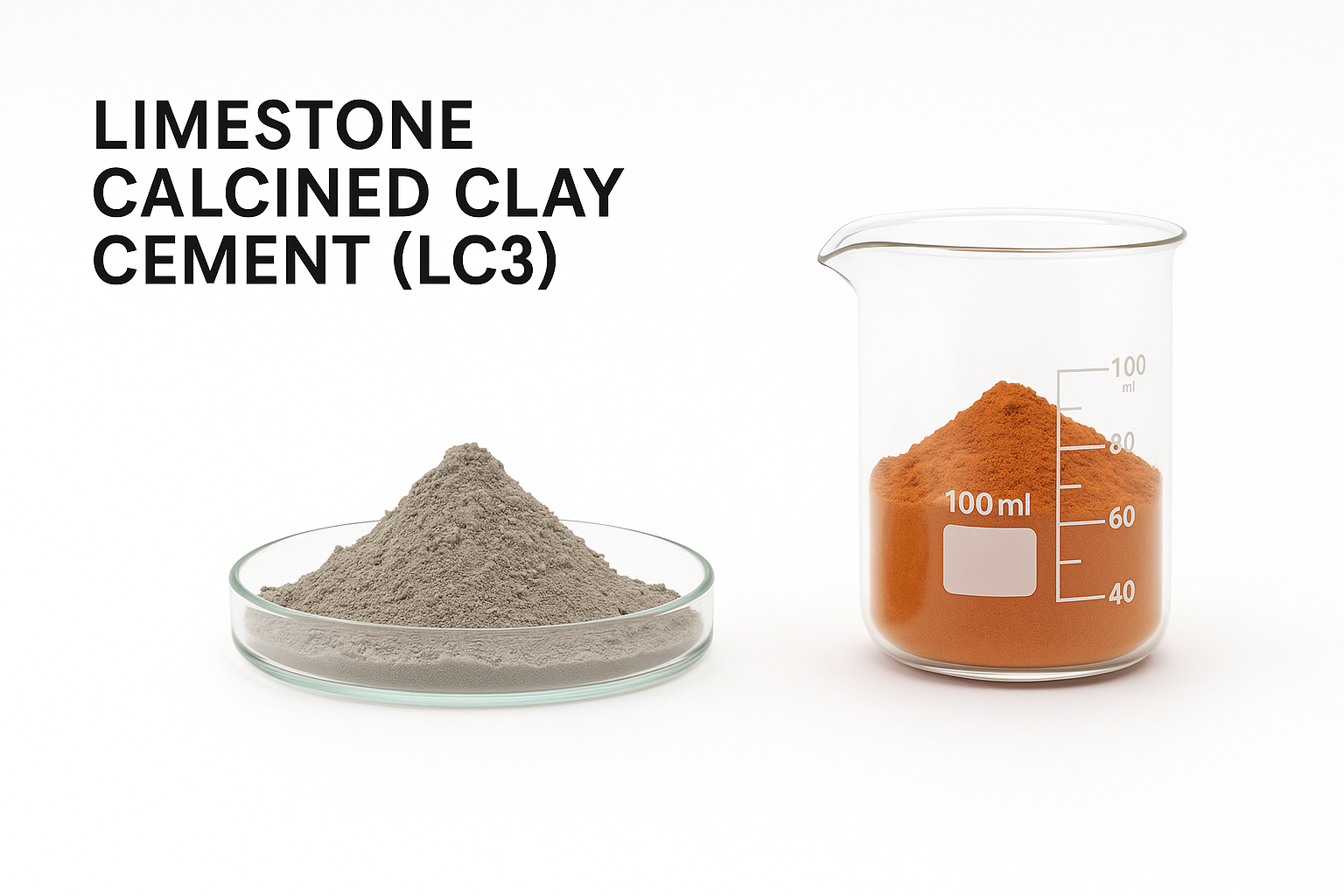
LC3 Cement, Explained Like a Builder: What It Is, Where It Wins, and How to Specify It
LC3 (Limestone Calcined Clay Cement) is the simplest big step concrete has taken in years: swap a large chunk of clinker for finely ground limestone and low-temperature calcined clay, keep the strengths you actually need, and cut embodied carbon without reinventing site practice. If you’ve ever tried to sell an owner on lower-carbon concrete and ended up trapped in lab talk, this is the practical version. No greenwash, no magic—just what to expect on drawings, in the mix, and on the slab.
What LC3 Actually Is (and why it isn’t a science fair project)
Traditional Portland cement leans heavily on clinker—the energy-intensive part fired at ~1450°C. LC3 reduces that burden by using two easier ingredients the industry already understands: finely ground limestone and calcined clay, with the clay fired at roughly 700–800°C to form metakaolin. The clinker isn’t gone; it’s just right-sized. In practice, typical LC3 blends land around: limestone 40–50%, calcined clay 20–35%, clinker 15–25%, plus gypsum. The big idea is pozzolanic chemistry—metakaolin reacts with portlandite and water to generate additional C-S-H gel (the glue), while limestone improves particle packing and contributes carboaluminate phases that lock pores and slow ion ingress.
The reason builders like this: you keep a familiar cement framework (ASTM/EN equivalents with local certifications), you don’t need exotic activators, and you can dose admixtures the way your ready-mix supplier already knows. You’re not trying to re-train the entire field crew—just the spec, the submittal, and the curing notes.
Why it matters now (carbon, durability, and supply chains that don’t wobble)
LC3 typically knocks 30–40% off cement-stage CO₂ compared with straight Portland, because you’re firing less clinker and using lower-temperature clay calcination. That’s the headline. The second line matters on jobs: durability. Properly proportioned LC3 mixes show lower chloride diffusion and better sulfate resistance than ordinary Portland of equivalent strength classes. In coastal, de-icing, or wastewater exposures, that translates to slower rebar corrosion and fewer ugly repair cycles. And then there’s availability: limestone is common, and suitable clays exist in many quarries or nearby deposits, which means LC3 isn’t tethered to shrinking fly-ash streams or niche industrial by-products.
If you need to help a client see where “concrete” is already being stretched in credible ways, point them to Concrete in Architecture: Innovations, Applications, and Visionary Designs and Technological Advancements in Architectural Design. Those pieces help non-engineers connect performance to form without glazing over.
How LC3 behaves on site (translated from lab to job trailer)
Mix design first: you’ll see water demand similar to or slightly above Portland depending on clay reactivity and limestone fineness. Modern polycarboxylate superplasticizers work well; start conservatively and let trial batches tune the dosage. Early strength is respectable—good enough for formwork cycles on routine structural elements. At 28 days the compressive numbers typically land where mid-range Portland sits; with proper curing, later-age strength can tick up thanks to ongoing pozzolanic reaction.
Workability feels familiar. Pumping is straightforward because the particle packing improves cohesiveness; bleeding is usually reduced. Finishing doesn’t require a new playbook—what it does require is restraint on water addition (the same discipline you preach on every pour but actually need to enforce here). Curing should be explicit in the spec: continuous moist curing or well-managed curing compounds are your friends. The chemistry will reward you if you don’t let it dry out too fast.
Where LC3 belongs (and where it’s premature)
Use it for structural frames up to the strength classes your local supplier can certify, for slabs-on-grade that fight sulfates and chlorides, for precast façade and panel elements that want low permeability, and for repair overlays in splash or spray zones. It shines in community buildings, mid-rise housing, schools, transit facilities, and coastal works where chloride resistance pays dividends. Pair it with smart detailing—continuous waterproofing, honest cover to steel, and proper joints—and the lifecycle case becomes obvious.
Hold off if you’re chasing ultra-high early strength schedules, niche prestress precast requiring very tight windows, or cores that specify 70–100 MPa cube strengths as routine. You can push LC3 up the ladder with aggressive optimization, but the whole point is mainstream carbon reduction without gymnastics. Use the right tool for the right job.
The cost story (what owners actually hear)
Day-one material pricing can be a notch above commodity Portland depending on local clay and limestone logistics. But delta cost isn’t the only line that matters. Lower kiln energy per ton, reduced clinker content, and shorter haul distances for limestone/clay blends can narrow the gap in regions set up for production. Downstream, the durability curve bends in your favor: slower chloride penetration means fewer deck repairs; better sulfate resistance means fewer sulfate-swollen slabs in problem soils; dense microstructure means coatings and waterproofing live longer. When you roll this up in a straightforward lifecycle model, LC3 routinely looks cheaper over 20–40 years than “cheapest today” Portland.
If you need to translate performance into numbers the finance side respects, keep Life Cycle Assessment Handbook on the desk. Why I recommend it: it’s the kit for turning durability, maintenance, and carbon into comparable dollars.
Spec it clean: a builder’s checklist without the fluff
Keep the spec readable. Call the cement “LC3 blended cement” with the local product designation and list the governing standard and strength class. Require supplier test data for chloride migration (or equivalent), sulfate resistance, and shrinkage; insist on trial batches with your aggregates and admixtures. Spell out curing: time, method, ambient constraints. For reinforcement, detail cover honestly—LC3 isn’t a license to cheat cover. For waterproofing, follow the same belt-and-braces logic you would for Portland, but expect better odds against diffusion.
For clients who want a friendly, big-picture map of their options, share The Complete List of Building Materials: Key Types and Their Applications so they don’t imagine a single product is a silver bullet.
Performance notes you’ll actually use
Chlorides: Proper LC3 shows lower diffusion coefficients than ordinary Portland at like-for-like strength and curing. Translation: longer time to corrosion onset, especially in marine and de-icing exposures. Sulfates: Carboaluminates formed in LC3 blends bind sulfate ions and reduce ettringite risk; field crews will just see fewer ugly heaves where soils are aggressive. Shrinkage: Comparable to Portland when water is controlled; watch early curing just as you would on a hot, dry day. Alkali-silica reactivity: Metakaolin can help bind alkalis; you still follow local guidance for reactive aggregates and lithium mitigation if required. Finish/Color: Slightly warmer hue is common; communicate early with architects if exposed concrete is on the table.
What goes wrong (and how not to be that crew)
The biggest mistakes are the boring ones: adding water to “fix” workability instead of adjusting admixture; skipping curing on a breezy day; assuming all clays are the same and not qualifying the actual source; and trying to hit ultra-high early strength cycles without testing. Fix them with trial batches, a curing plan you actually execute, and a concrete pre-pour meeting where everyone agrees to measure, not guess.
Side-by-side with other “green concretes”
If someone asks “why not geopolymer,” the honest answer is that alkali-activated systems can perform brilliantly in certain exposures (industrial acids, high heat) but rely on caustic activators and tight temperature windows that not every job can support. For a plain-language explainer, see Geopolymer Concrete vs Cement: Which Is Better?. If they ask about fly-ash-heavy mixes (often labeled as “AshCrete”), the constraint is supply—fly ash quality and availability are changing. A clear primer is AshCrete: A Real Alternative to Traditional Concrete.
Curious about carbon-negative options? Ferrock reacts steel dust with CO₂ during cure and packs excellent compressive strength and marine resistance, but production scale and standards are still maturing. Useful overview: Ferrock Concrete: Stronger Than Portland and Built to Store Carbon.
If your project is about resilience and service life, self-healing cements can close micro-cracks and limit ingress. They’re not replacements for detailing, but they stretch maintenance intervals. Start here: Self-Healing Cement: The Future of Resilient Construction.
For a straight survey you can hand to a client who wants the menu before the meal, this roundup is the one: Sustainable Concrete Alternatives | Smarter Choices for Cost, Carbon, and Strength.
Envelope, slabs, and marine—how LC3 lands in real assemblies
Enclosures: Cast-in-place LC3 with robust air- and water-barrier layers gives you an envelope that fights both heat and salt. Pair it with continuous exterior insulation where the energy model demands it; LC3 improves durability, not R-value. Precast LC3 façade units are a smart route for quick enclosure with tight permeability targets.
Slabs: For slabs-on-grade in sulfate soils, LC3 is an easy upgrade if you enforce curing and joints. For suspended slabs, work with your supplier on shrinkage tests and reinforcement ratios; the workflow is the same as Portland—just better chloride/chemistry performance later.
Marine: This is where LC3 earns its keep. Lower chloride ingress means longer rebar life in piers, seawalls, and splash zones. You still need cover, coatings, and good details at penetrations; the difference is the clock runs slower on corrosion.
Admixtures, SCMs, and how LC3 plays with others
LC3 is already a “blended” mindset, but it still pairs well with fly ash, slag, or finely ground glass where available and locally certified. Don’t stack SCMs just because you can—stack them because your exposure class and schedule benefit. Use modern water reducers; consider shrinkage-reducing admixtures if joints and sequencing demand it. If you’re experimenting with crystalline waterproofers, trial them with your exact LC3 product—some blends respond differently to dose.
Quality control that keeps you out of trouble
Run a sequence of trial mixes with your aggregates. Verify slump flow and stability if you’re pouring self-consolidating LC3. Confirm setting times with and without accelerators so your crews aren’t guessing. Lock in a curing protocol (sheets, ponding, compounds) and hold the line. Check permeability numbers in submittals—not because you don’t trust the supplier, but because a good test report becomes your shield when someone tries to “value engineer” back to the cheapest blend with the shortest lifespan.
Communicating LC3 to owners (and making it stick)
Owners care about three lines: upfront cost, schedule, and risk. Your pitch is simple: LC3 holds the schedule (similar early strength classes with planned curing), trims long-term risk (lower ingress, better sulfate resistance), and nudges carbon downward in a way certifications and insurers increasingly reward. When you can, bring a small mock-up or a cured cylinder to meetings—it grounds the conversation. If they want a readable, non-salesy intro to materials that change the outcome, hand them The New Carbon Architecture. Why I recommend it: it’s case-study driven and helps decision-makers understand why blends like LC3 are practical, not trendy.
Repair and retrofit with LC3
You can use LC3-based grouts, repair mortars, and overlays where sulfates or chlorides have punished old concrete. The lower permeability and better binding chemistry help slow further damage. Always test bond to the substrate and get the moisture profile right; any overlay fails if you trap water beneath it. For a designer’s eye on marrying performance and detailing, this is a helpful grounding: Brutalist Architecture: From Yesterday’s Concrete to Today’s Innovation. It’s not about repair, but it reminds teams that material choices echo across decades.
The procurement reality (and keeping submittals tight)
LC3 availability keeps expanding, but it’s still smart to get supplier letters early—source of limestone/clay, calcination method, strength classes, and compliance to your local standard set. Ask for recent permeability, sulfate exposure, and shrinkage test reports using your regional aggregates if possible. Require trial batch reports for the exact admixture combination you plan to run. When those PDFs live in your submittal, reviews go faster and field questions shrink.
If you only remember five things
1) LC3 cuts embodied carbon without changing your whole playbook.
2) Durability in chloride and sulfate exposures is the quiet profit center.
3) Early strengths are workable; curing is non-negotiable.
4) Specify with data, not adjectives.
5) Teach the crew: don’t add water; adjust admixtures.
Books worth having on your shelf (with quick reasons)
- Concrete Microstructure, Properties, and Materials — Why I recommend it: translates pore structure and durability into details you can actually draw.
- Building Materials in Civil Engineering — Why I recommend it: wide view of performance topics (fire, durability) that frame LC3’s benefits.
- Structures: Or Why Things Don’t Fall Down — Why I recommend it: the most readable logic of load paths and failure; great for junior staff and clients alike.
- Carbon Capture and Storage — Why I recommend it: situates cement choices inside broader carbon strategy—useful when owners ask about offsets vs reductions.
- 3D Concrete Printing Technology — Why I recommend it: if you’re exploring thin-wall, layered concrete, LC3’s rheology and curing make more sense after this.
- Green Building Fundamentals — Why I recommend it: bridges rating systems, incentives, and spec language so LC3 gets credit where it should.
- FIELD PICK: Modern Concrete Construction Manual — Why I recommend it: DETAIL’s classic—turns material properties into assemblies and details you can copy with a straight face.
- Life Cycle Assessment Handbook — Why I recommend it: the model builder for cost and carbon beyond day one.
- Sustainable Construction: Green Building Design and Delivery — Why I recommend it: makes policy and carbon pathways legible to project managers.
- Building Green — Why I recommend it: crisp case studies; shows what paid off and what didn’t when teams changed mixes.
- ACI Manual of Concrete Practice — Why I recommend it: still the clause book; helps you defend LC3 details to anyone who only speaks “Portland.”
- MUST READ: Why Buildings Fall Down — Why I recommend it: sober stories of failure that remind teams why specs and curing aren’t paperwork.
- Materials for Sustainable Sites — Why I recommend it: where LC3, LCAs, and actual site decisions meet.
Related
- Concrete in Architecture: Innovations, Applications, and Visionary Designs
- Brutalist Architecture: From Yesterday’s Concrete to Today’s Innovation
- Technological Advancements in Architectural Design
- The Complete List of Building Materials: Key Types and Their Applications
Sustainable & eco-friendly materials
Material-specific alternatives
- Geopolymer Concrete vs Cement: Which Is Better?
- AshCrete: A Real Alternative to Traditional Concrete
- Biodegradable Cement Future: Can It Replace Portland?
- Ferrock Concrete: Stronger Than Portland and Built to Store Carbon
- Limestone Calcined Clay Cement (LC3): Benefits, Applications, and Innovations
- Self-Healing Cement: The Future of Resilient Construction
FAQ
What is LC3 cement?
A blended cement using limestone and calcined clay to replace much of the clinker. It lowers kiln energy and clinker content while keeping the mechanical performance most projects require.
How much carbon does LC3 save?
Commonly 30–40% lower CO₂ at the cement stage versus pure Portland, contingent on local clay/limestone logistics, kiln efficiency, and electricity mix.
Does LC3 set slower?
Not necessarily. With modern admixtures and proper curing, early strength keeps pace with everyday Portland mixes. Lock in your targets with trial batches.
Is LC3 good in marine or de-icing environments?
Yes—reduced chloride ingress and improved sulfate resistance are core advantages. You still detail cover, joints, coatings, and drainage like your reputation depends on it.
Can I use LC3 for everything?
Use it where its strengths align with your exposure and schedule. For ultra-high early strength or extreme compressive classes, evaluate case-by-case.
Do I need special crews?
No—just disciplined crews. The big lifts are trial mixes, clear curing plans, and the usual “don’t add water—adjust admixture” speech.
What about cost?
Upfront cement pricing may be a bit higher in some markets; lifecycle tends to be lower because of durability and reduced maintenance. Model it and show the curve.