
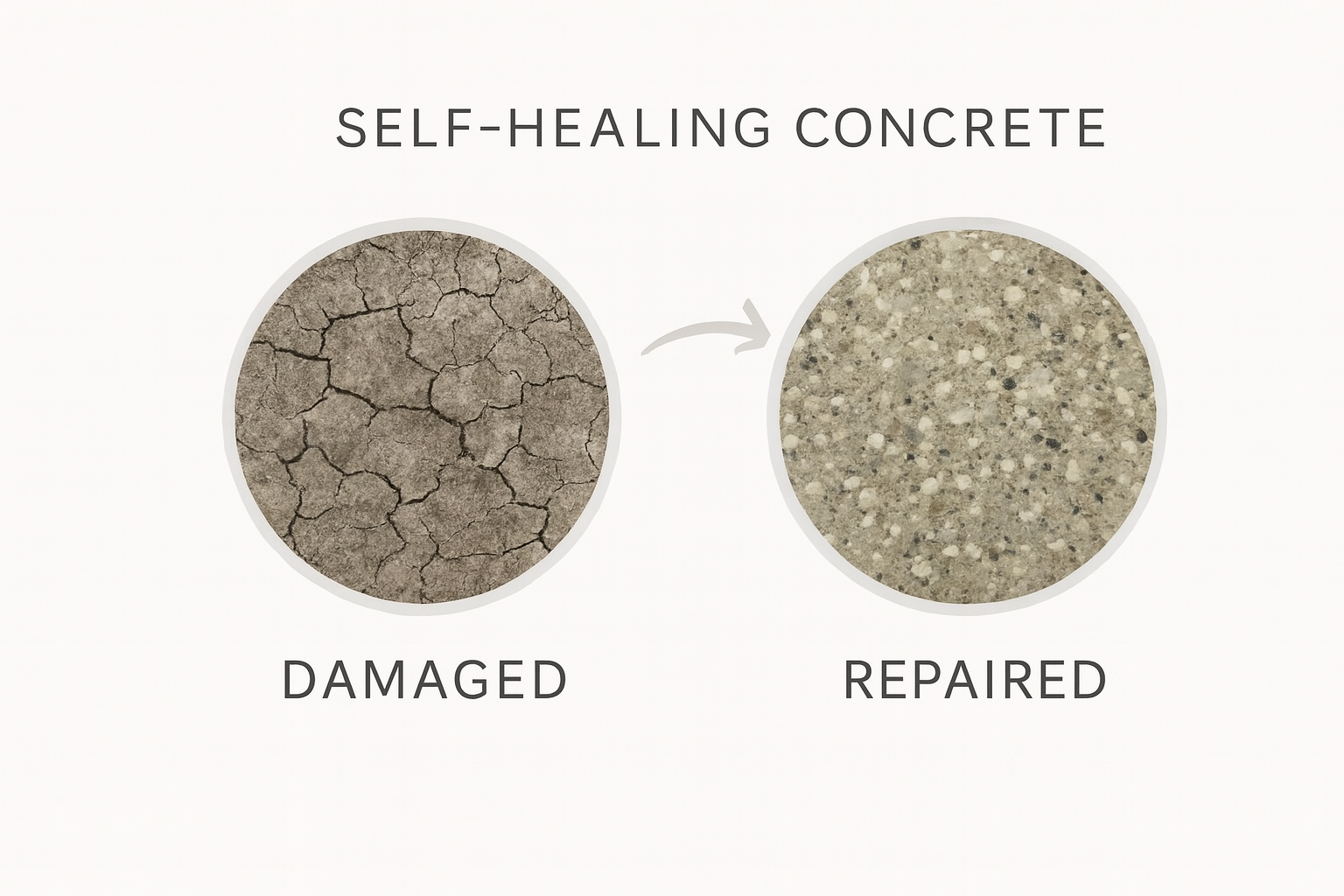
Why We Even Tried It
Concrete cracks. Always has, always will. On jobs I’ve been part of, we’ve patched basements, stitched bridges, grouted tunnels, and none of it felt like a permanent win. A few winters later, the same hairlines come back. So instead of patching forever, we decided to test what it takes to make concrete that heals itself. Not theory—just buckets, mixes, additives, and the mess in between.
What follows isn’t a lab report. These are site notes: how bacterial mixes behaved, what chemical capsules did, where the money went, and what I’d never try again.
The First Trial: Bacterial Healing
We started with bacteria because it sounded almost too simple. Mix in spores, add nutrients, let water wake them up when cracks appear.
What It Took
● Bacillus spores ordered online, about $90 for enough to trial a dozen small molds.
● Alginate beads to keep the bacteria alive during mixing. Think of them as soft shells that burst later.
● A plain cement mix, no fancy admixtures, so we could see the effect.
The Setup
We blended spores into alginate beads first, then folded those into the wet mix. Casting into 6" cubes was straightforward, but the beads tended to float. Lesson one: you have to mix longer and let the slurry settle. A short mix leads to poor distribution. One cube even cured with a pocket of beads at the top—total waste.
The Result
After curing, we forced hairline cracks with a press. Within two weeks, rainwater exposure started closing cracks under 0.5 mm. You could feel the calcium carbonate forming when you scratched it. Anything wider than 1 mm barely sealed. Visually, cracks became faint white lines instead of gaps.
Cost Picture
Additive cost per cubic meter came out almost three times higher than plain concrete. But in damp environments, especially basements, this version worked. We also noticed less efflorescence than control samples—an unexpected side benefit.
FIELD PICK: Self-Healing Materials: Fundamentals, Design Strategies, and Applications – Why I recommend it: the best reference for bacterial mixes, with details you won’t get on jobsite forums.
The Second Trial: Chemical Route
Next round, we swapped biology for chemistry. Sodium silicate and calcium nitrate were the main additives. We used superabsorbent polymers—tiny beads that swell when wet—to hold and release them.
What It Took
● A bag of sodium silicate, $40.
● Calcium nitrate, $25.
● Polymers, surprisingly expensive at $120 a kilo.
The Setup
Mixed dry chemicals with cement and sand, added the polymers last. Casting was smooth, though workability dropped fast. Slump tests were disappointing—barely 3 inches compared to a control mix at 6 inches. We had to add a plasticizer to get a fair pour.
The Result
Controlled cracks (again about 0.5 mm wide) sealed with a gel-like material. Unlike the bacterial test, this healed faster—visible within days—but the finish looked patchy. It held strength, though. Wider cracks over 1 mm did not heal, but at least the cracks didn’t widen further.
Cost Picture
Still high. For large pours, you’d need industrial suppliers, not hobby-shop quantities. But for infrastructure patches or tunnels, this system made sense. We figured on $150 extra per cubic meter when sourced in small lots. That dropped closer to $90 in bulk.
MUST READ: Concrete Microstructure, Properties, and Materials – Why I recommend it: explains the chemistry behind gel reactions, plus clear diagrams for engineers who want proof.
The Third Trial: Capsules
The last trial we ran used epoxy-filled microcapsules. The idea: cracks rupture capsules, epoxy seeps out, bonds, and seals.
What It Took
● Pre-made capsules (research batch). Not cheap: $250 for a small box.
● Standard mix, with capsules sprinkled in by volume.
The Setup
Capsules had to be handled gently. Over-mixing crushed them, under-mixing left clumps. The sweet spot was about five minutes with a paddle mixer. Any longer and half the capsules ruptured in the drum.
The Result
The epoxy did its job. Small cracks sealed clean. But distribution was uneven. Some cracks got lucky, others didn’t. Also, capsules made the mix weaker in compression tests. For slabs under high load, not worth it.
Cost Picture
Not practical yet. But for bridges and highways where shutting down lanes for repairs costs millions, this tech has legs. We logged the trial for future use but wouldn’t spec it yet.
FIELD PICK: 3D Concrete Printing Technology – Why I recommend it: ties capsule systems directly into prefab and additive manufacturing research.
Real Job Takeaways
Bacteria mixes shine in wet conditions (basements, canals, water tanks). Cracks heal naturally, but only when they’re small. Chemical mixes respond faster, more predictable in tunnels or bridges, but they hike costs and need tight quality control. Capsules look flashy but still feel like lab tech. Good in tests, tricky in bulk pours.
On a student housing project we tested, a bacterial mix in foundation walls worked fine. Hairline cracks that usually telegraphed into drywall never showed up. Maintenance budget came in lower than the last project with plain Portland. On a coastal pier repair, chemical mixes were the winner. Salt spray eats rebar fast, and the gel reactions held cracks long enough to delay spalling. Capsules, we’ve only ever used in test slabs. A highway authority wanted data. Cracks sealed, but uneven healing spooked inspectors. Not ready for prime time.
Where It Fits Best
● Bridges and tunnels – chemical or capsule systems pay for themselves by cutting lane closures.
● Basements and tanks – bacteria-based mixes excel because they actually need moisture to work.
● Marine work – still chemical first. Salt destroys bacteria before they can act.
● Heritage buildings – bacterial systems, low-visibility repair that preserves the original look.
If you’re curious how this compares to other concretes: Ferrock Concrete: Stronger Than Portland and Built to Store Carbon, Limestone Calcined Clay Cement (LC3): Benefits, Applications, and Innovations, Geopolymer Concrete vs Cement: Which Is Better?
Cost and Setup
Here’s the blunt truth: none of these mixes are cheap.
● Bacterial additives: add $90–$120 per cubic meter.
● Chemical mixes: closer to $150 extra per cubic meter.
● Capsules: $250+ just for a small trial batch.
Transport, mixing quirks, and training add more. But when stacked against life-cycle costs—fewer repairs, less downtime, better durability—the case strengthens.
MUST READ: Life Cycle Assessment Handbook – Why I recommend it: the only way I’ve found to argue numbers that clients respect.
Mistakes We Made
● Tried to water-cure bacterial concrete like Portland. Wrong. It weakened the matrix.
● Let capsules sit too long in the mixer. Crushed them before they ever hit the form.
● Forgot that waterproofing is still mandatory. Healing concrete slows cracks, but bulk water still ruins jobs.
● Over-sold the effect to a client. Cracks larger than 1 mm do not vanish. Ever.
How to Apply Without Getting Burned
Start with a pilot batch. One cubic yard is enough to see if your team handles it. Train crews for half a day. Old CMU habits don’t transfer here. Use in the right climate. Bacterial systems need damp. Chemical systems hate dry heat. Don’t sell it as “never cracks.” Sell it as “buys time and cuts maintenance.”
FIELD PICKS – Books That Help
Why Buildings Fall Down – Why I recommend it: blunt lessons from failures.
Structures: Or Why Things Don’t Fall Down – Why I recommend it: still the most readable book on stress and cracks.
Green Building Fundamentals – Why I recommend it: practical when speccing sustainable mixes.
ACI Manual of Concrete Practice – Why I recommend it: helps when inspectors only trust Portland.
Final Word
Making self-healing concrete isn’t magic. It’s choosing additives, spending more upfront, and being honest about limits. Small cracks heal, big ones don’t. Costs rise per yard, but drop per decade. If you’re the one explaining this to a client, keep it blunt: healing concrete buys time. That’s the value.
FAQ
Does self-healing concrete really work?
Yes, but only for hairline cracks under about 0.5 mm. Anything larger needs repair.
How long before cracks seal?
Bacteria: about 2–3 weeks in damp conditions. Chemicals: a few days. Capsules: instant if they’re in the right place.
Is it more expensive?
Upfront, yes. Over decades, less. Maintenance cycles drop, which saves money.
Can you use it anywhere?
Not yet. Salt-heavy marine work still kills bacteria. Capsules don’t distribute evenly in big pours. But basements, bridges, and tunnels already benefit.
Can it replace waterproofing?
No. Healing is not sealing. You still need coatings, barriers, and flashing.
Related
Architecture & Design
- Concrete in Architecture: Innovations, Applications, and Visionary Designs
- Brutalist Architecture: From Yesterday’s Concrete to Today’s Innovation
- Technological Advancements in Architectural Design
- The Complete List of Building Materials: Key Types and Their Applications
Sustainable & Eco-Friendly Materials
- Sustainable Concrete Alternatives | Smarter Choices for Cost, Carbon, and Strength
- Geopolymer Concrete vs Cement: Which Is Better?
- AshCrete: A Real Alternative to Traditional Concrete
- Biodegradable Cement Future: Can It Replace Portland?
- Ferrock Concrete: Stronger Than Portland and Built to Store Carbon
- Aerated Autoclaved Concrete (AAC Blocks): What Builders Need to Know
- Limestone Calcined Clay Cement (LC3) Explained in Plain Terms
- Self-Healing Cement: The Future of Resilient Construction