
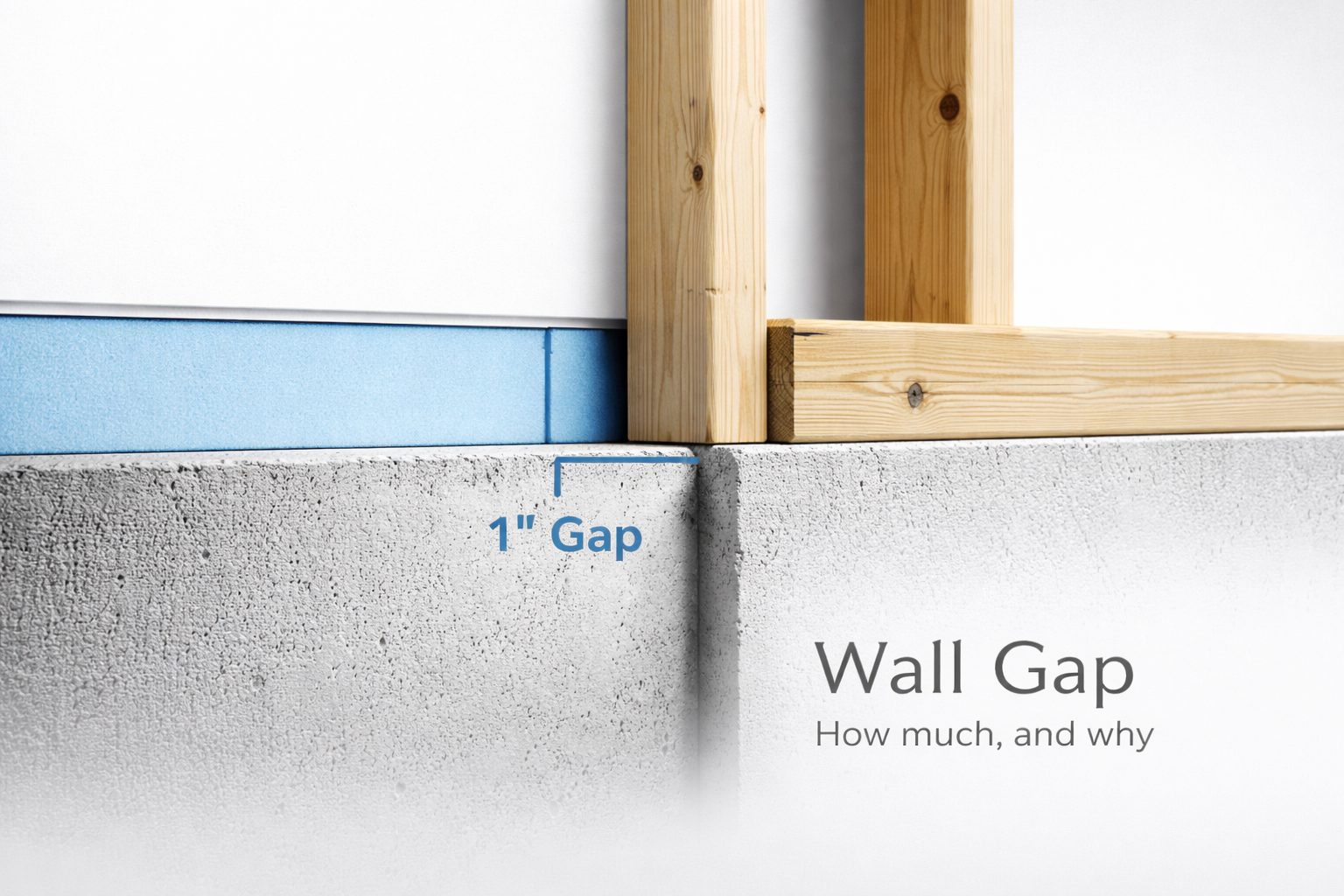
Basement Stud Wall Gap: Stop Guessing and Build to a Control Layer
People obsess over “the gap” like it’s a secret code detail that decides whether a basement stays dry. It’s not. The real goal is simpler: don’t let your stud wall become the wet layer, and don’t build a hidden cold pocket that condenses all winter.
In most modern basements, you’re not “leaving a gap to concrete” anyway. You’re building to a control layer—usually sealed rigid foam or a continuous spray-foam plane.
What this covers
- How much space to leave (by assembly type: foam-first, spray foam, or neither)
- Why big empty voids behind walls turn into moisture problems
- What code typically cares about (in plain language, not code-nerd poetry)
- Framing basement walls for spray foam: sequencing that doesn’t trap moisture
- Cost drivers: what actually moves the price on basement wall framing
The most common misunderstanding

A lot of advice treats the gap like ventilation. “Leave space so it can breathe.”
In real basements, that usually backfires. You don’t get “fresh air.” You get humid interior air circulating behind a wall until it finds the coldest surface (concrete) and drops water there. Then the cavity smells “basementy” forever, because it never actually dries.
The gap is not a moisture strategy by itself. It’s just geometry. The moisture strategy is: water control + air control + insulation location.
The basement physics
Concrete is cold for a lot of the year. Indoor air carries moisture for a lot of the year. When warm, moist air touches a cold surface, you get condensation. Same reason a cold drink sweats in summer.
So your basement wall assembly has one job: keep interior moisture from reaching cold concrete, or make sure the system can dry if a little moisture gets in.
That’s why the “right gap” depends on what you’re doing for insulation and air sealing.
The only 3 setups that matter
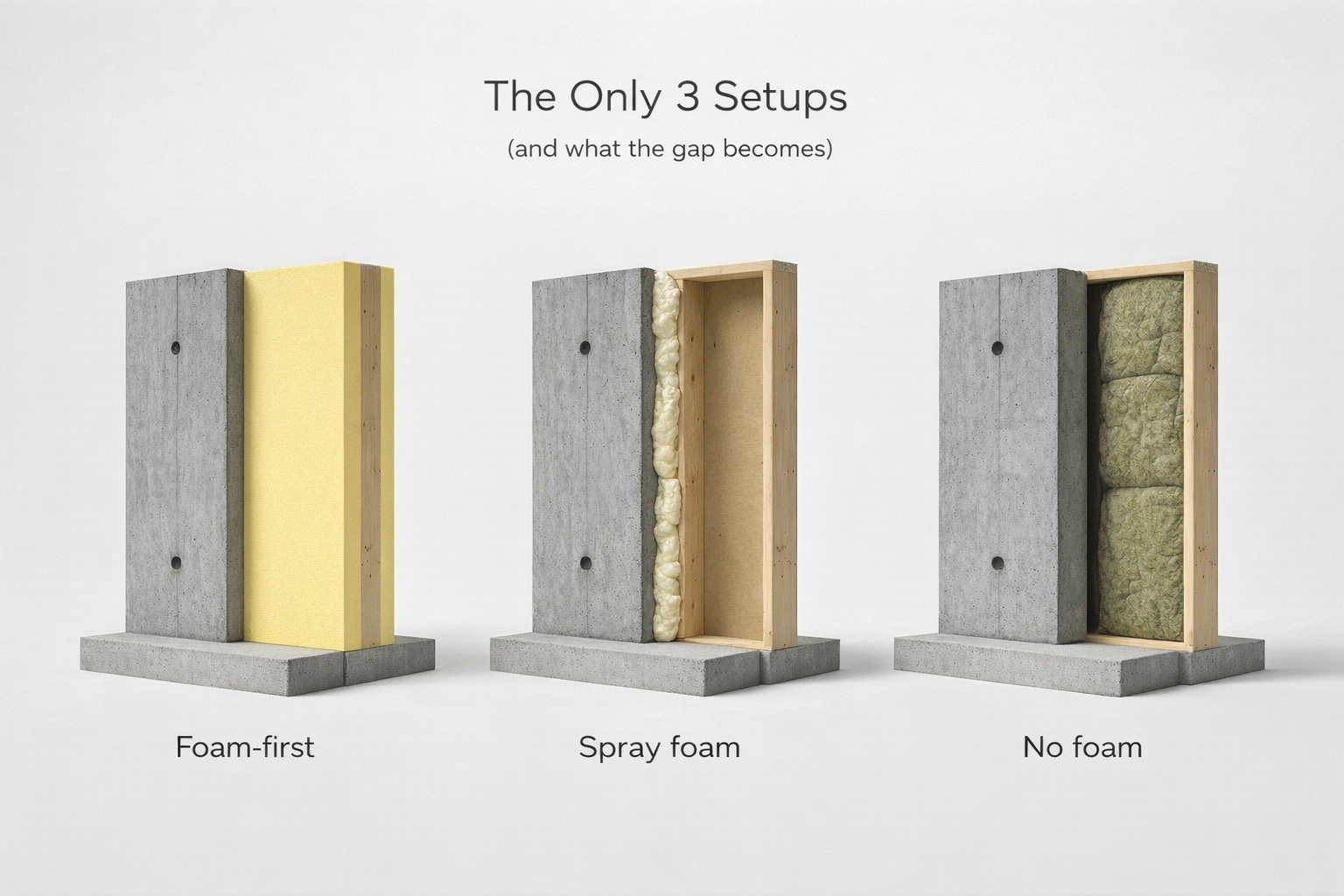
(and what the “gap” becomes in each)
Setup 1: Foam-first (rigid foam against concrete, seams sealed)
This is the clean modern approach: rigid foam goes directly on the concrete, seams are taped/sealed, and the stud wall is built tight to the foam plane (not the bare concrete).
In this setup, the “gap” is basically the foam thickness. The concrete is now “behind” your control layer, and your framing lives on the warmer side where it’s less likely to condense.
Practical gap rule (foam-first): frame close to the foam. Any “gap” is just what you need for plumb—usually small.
Setup 2: Spray foam as the control layer
If you’re using spray foam on the concrete (most commonly closed-cell in basements), the foam itself can be the air + insulation plane when installed properly.
The stud wall still wants to live on the warm side of that plane. You’re framing to a finished foam surface—not “leaving an air gap to concrete.”
Practical gap rule (spray foam): studs can sit close to the cured foam plane. Don’t create a big void behind the wall “just because.”
Setup 3: “No foam” framing (capillary break / treated plate, cavity insulation)
This is the older / more traditional approach: a stud wall is built inboard of the concrete, then the cavity gets insulation, and people argue about poly.
This is also where the internet gets loud—because it can work in some conditions, and fail hard in others.
If you’re doing this, the gap becomes a risk-management move: you want no contact with concrete (capillary + decay control), but you also don’t want a big empty air pocket that becomes a condensation chamber.
So… how much gap should you actually leave?
Here’s the blunt answer: there isn’t one magic number. There are only safe ranges depending on which assembly you’re building.
| Assembly | Where the wall should “land” | What the “gap” really is | What to avoid |
|---|---|---|---|
| Foam-first (rigid foam sealed) | Studs tight to foam plane | Foam thickness (plus tiny plumb tolerance) | Leaving a big void behind studs “to breathe” |
| Spray foam control layer | Studs tight/close to cured foam surface | Foam thickness (plus tiny tolerance) | Framing far off the wall for no reason |
| No-foam cavity approach | Wall inboard, with capillary/decay strategy | Just enough space to stay off concrete + stay straight | A deep hidden void that stays cold and damp |
Decision rule: a small intentional separation is fine. A big empty void is not. If you can stick your hand behind the wall and feel cold concrete like an exposed surface, you’re probably building a condensation chamber.
Framing basement walls against concrete (what actually holds up)
If you’re finishing a basement wall against concrete, there are a few moves that show up in “good basements” again and again. Different builders argue details, but the failures look weirdly similar.
1) Keep wood out of direct contact trouble.
That can mean sealed rigid foam behind the wall, or it can mean a capillary break + treated bottom plate where required. The point is: wood sitting in persistent damp is not a “maybe problem.” It’s a schedule problem… just delayed.
2) Treat air sealing as a first-class layer.
Basements don’t fail because the stud is “wrong.” They fail because humid air reaches cold surfaces. If you keep air from freely moving into cold pockets, you cut condensation risk dramatically.
3) Don’t trap a wet cavity.
Basements are not the place for “seal everything and pray.” If you don’t understand your vapor control strategy for your climate and assembly, don’t default to interior poly. Build something that can dry.
If you want the bigger map for sequencing (water first, then air sealing/insulation logic, then framing), park this alongside: your basement finishing order decision map.
Framing basement walls for spray foam (the sequence that avoids regret)
Spray foam makes people overconfident. It feels like a magic material. It isn’t. It’s just an insulation + air control layer with its own rules.
What works cleanly
- Fix bulk water first (leaks, seepage, wet wall base). Foam is not a leak repair.
- Spray foam the concrete wall as a continuous plane (don’t pepper it and call it “done”).
- Frame your stud wall to the finished foam plane, keeping the cavity on the warm side.
- Plan wiring and backing zones early (TVs, cabinets, rails). Foam doesn’t solve fastening.
What causes the “why is my new basement gross?” moment
- Foam applied over damp problems you didn’t solve.
- A stud wall framed far off the foam creating a big hidden air pocket.
- Finishing materials installed before the space is humidity-stable.
Also: spray foam often triggers code details around ignition/thermal barriers and fire safety. That’s jurisdiction-dependent. Don’t freestyle it—ask your inspector what they expect before walls are closed.
Vapor barrier behind framed basement walls (the part that starts fights)
Online, “vapor barrier” gets used like it means “plastic sheet on the warm side.” That’s only one version.
The safer way to think: air leakage moves way more moisture than vapor diffusion in typical houses. So air sealing usually does more heavy lifting than interior poly.
In foam-first or properly executed spray-foam assemblies, the control layer is often already doing the job people mistakenly assign to interior polyethylene.
In a no-foam cavity approach, interior poly can be risky if it traps moisture in the wrong layer for your climate. The “right” answer changes with region, insulation type, and whether the basement is conditioned.
Decision rule: if you can’t draw your wall section and point to where it dries, don’t add another sheet layer just because someone on the internet said “always.”
What does code typically require for basement wall framing?
Codes vary by jurisdiction, and inspectors vary by… personality. But the big themes are consistent:
- Decay protection: wood in contact with concrete/masonry in moisture-prone locations often needs to be preservative-treated or otherwise protected.
- Fire blocking / draft stopping: basements create long concealed cavities, and inspectors routinely flag missing blocking.
- Insulation and vapor control: requirements depend on the adopted code, climate zone, and assembly approach.
- Electrical protection: wiring needs to be protected from sharp edges (steel) and from physical damage.
If you want the studs/plates basics without turning this page into a glossary, link your refresher here: studs, plates, and blocking basics. For official manuals and reference docs, use the standards library.
Cost to frame basement walls (what actually drives it)
“How much does it cost?” is always the question—because framing feels like the first visible step. But the price swings mostly come from the parts people pretend are optional.
Cost drivers that actually matter
- Assembly choice: foam-first and spray foam change materials, labor, and detailing.
- How much backing you need: cabinets, TV walls, rails, storage systems = more blocking/plywood.
- Wall height + complexity: soffits, mechanical jogs, weird corners, and openings add time.
- Moisture fixes: drainage, dehumidification, leak repairs (often bigger money than studs).
- Local labor rates: this is the silent driver that makes online averages feel fake.
Decision rule: don’t price “framing” as studs-only. Price it as: framing + backing + anchors + moisture/air details you’re committing to. If you want accuracy, get 2–3 local quotes and ask each bidder what wall assembly they assumed. If you want the line items laid out in one place, use this framing + drywall cost breakdown.
The “wow” section: the 30-second sketch test that catches bad basement walls
Before you buy lumber, draw your wall section in 30 seconds. No art. Just layers.
- Concrete wall
- What touches the concrete (foam? spray foam? nothing?)
- Where air sealing lives (tape? foam? sealant?)
- Where the stud wall lands (tight to foam? floating? inboard?)
- Where the assembly can dry (and to which side)
If your sketch has a big hidden air pocket with cold concrete on one side and interior humidity on the other, you just drew the problem.
Short checklist (use this today)
- After a heavy rain: check wall base for damp bands, puddles, efflorescence.
- Decide your control layer first (rigid foam sealed, spray foam, or another system).
- Frame to the control layer—not to bare concrete.
- Avoid deep hidden voids behind stud walls.
- Plan backing zones now (TVs, cabinets, rails, storage).
- Confirm bottom-plate strategy (capillary break / treated plate expectations locally).
- Don’t default to interior poly unless your assembly and climate support it.
- Do fire blocking and draft stopping before drywall.
- Make humidity stable before closing walls (dehumidifier / ventilation plan).
FAQ
How much space should I leave between the concrete wall and framing?
Build to a control layer. If you’re foam-first or using spray foam, the “gap” is basically the foam thickness and your stud wall can sit tight to that foam plane. If you’re not using foam as the control layer, you still want to stay off concrete—but don’t create a big empty void that stays cold and damp.
Do I need a vapor barrier behind framed basement walls?
It depends on climate and assembly. The common mistake is installing interior polyethylene in a setup where it traps moisture. Air sealing and correct insulation placement usually matter more than adding plastic. If you can’t explain where the wall dries, don’t add layers blindly.
How do you frame basement walls if you’re using spray foam?
Fix bulk water first, then spray foam as a continuous plane, then frame to the cured foam plane (keeping the cavity on the warm side). Don’t frame a wall far off the foam “for airflow.” That often creates a cold, damp pocket instead.
What does code typically require for basement wall framing?
Typically: decay protection for wood in contact with concrete/masonry where required, fire blocking/draft stopping in concealed cavities, and insulation/vapor control rules that vary by climate zone and adopted code. Inspectors can be strict in basements because once drywall is up, problems get hidden.
How much does it cost to frame basement walls?
The number swings based on assembly choice (foam-first vs cavity), backing needs (TV/cabinets/rails), complexity (openings/soffits), and local labor rates. The only way to get a real answer is local quotes—with each contractor stating what wall assembly they assumed.
Should basement studs touch concrete?
In many assemblies, no. Direct contact raises moisture/condensation risk and can trigger decay issues. If someone is doing it, there should be an explicit capillary/decay strategy and a drying plan—not just “it’s fine.”
How do you frame a basement wall against concrete if you’re stick framing (wood studs)?
The safest common approach is foam-first: sealed rigid foam on the concrete, then the wood wall inside that plane. Stick framing can last, but it needs a moisture and air-control plan that keeps the wood out of the wet layer.
Wood studs or metal studs for a basement?
Wood is easier for doors, trim, backing, and DIY correction. Metal is straighter and consistent for drywall. Neither one fixes moisture. Choose for function and finishing, then keep humidity controlled.
What is a floating basement wall and do I need one?
It’s a detail that allows slab movement without crushing the wall. It’s common in regions with seasonal slab heave or expansive soils. Many basements never need it. If your region talks about it often, learn the local method and why it exists before copying it.