
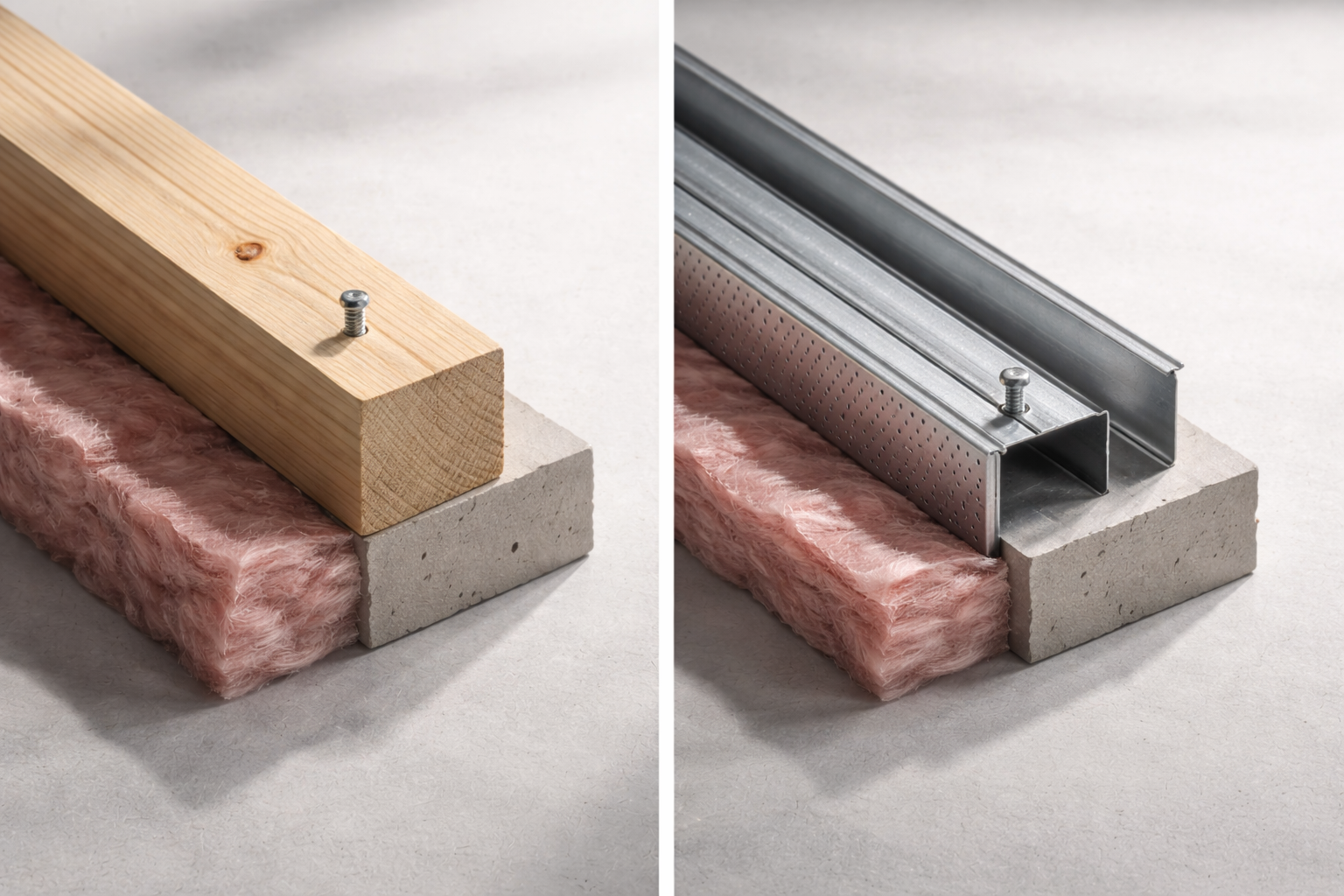
Wood Studs vs. Metal Studs: What Holds Up (and What Bites You Later)
This argument never dies because both sides are half right. Wood is fast and forgiving, and it’s easy to build walls you can hang real weight on without planning every attachment point. Metal is straight, clean, and it doesn’t twist the way bargain lumber can when humidity swings.
The catch: neither one rescues a bad wall assembly. Especially in basements. If the space still behaves like a damp cave, the stud choice is a distraction.
So this isn’t “which is better.” It’s which one creates fewer problems for your situation—basement vs. above grade, load-bearing vs. partition, damp risk vs. dry, DIY weekend vs. crew production, and whether you need walls that take abuse (cabinets, handrails, TVs, kids, storage).
First: what people mean by “metal studs”
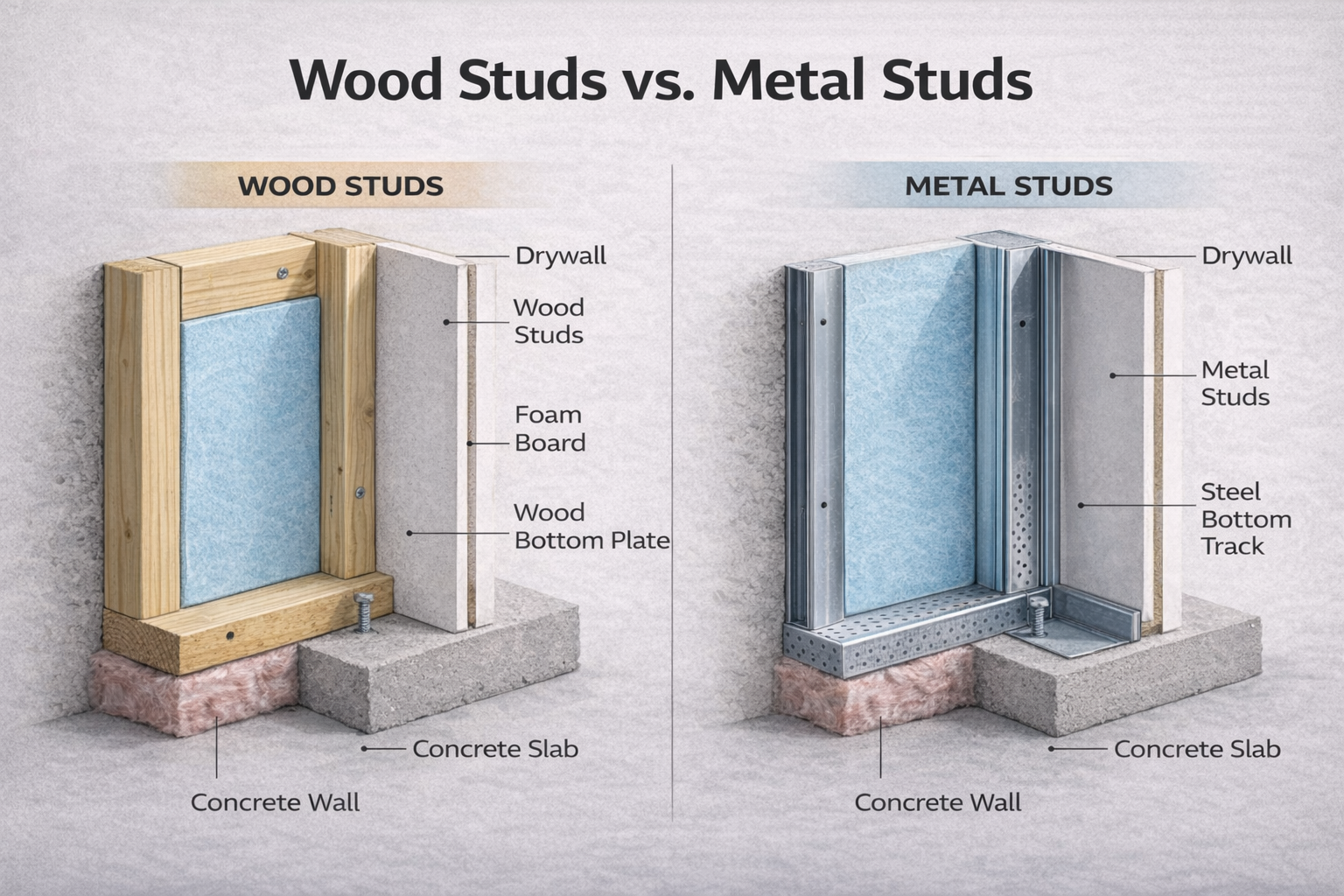
Most homeowners mean light-gauge cold-formed steel studs — the thin C-shaped studs and U-shaped tracks sold at big-box stores. They come in different thicknesses (“gauge”), and that matters. The light stuff is usually for non-load-bearing partitions. Heavier gauges exist for structural framing, but that’s a different scope and usually an engineered one.
If you want the formal language behind steel framing systems, it lives in AISI cold-formed steel framing standards (S240, S230, etc.). Those standards sit underneath how steel stud framing is designed and specified in North America.
The honest decision: where each stud type wins
If you skim nothing else, skim this. Then read the section that matches your project.
| Reality | Wood studs usually win when… | Metal studs usually win when… |
|---|---|---|
| Speed + forgiveness | You’re DIY, walls aren’t perfect, you need shims and “close enough.” | You’re building long straight partitions fast and clean. |
| Moisture risk | You can keep wood off concrete and control humidity. | You’re in a basement that trends damp and you want rot resistance (still need air sealing + insulation right). |
| Hanging heavy stuff | Cabinets, handrails, TV mounts, shop storage — daily abuse. | You’re okay adding backing/plywood or planning attachment points early. |
| Flat walls | You can pick decent lumber and crown it, but it can still move. | You want straight, consistent studs that don’t twist on you. |
| Tools + fasteners | Nails/screws, normal blades, normal boxes, fewer specialty bits. | You’re comfortable with snips, self-tappers, and protecting wiring at punch-outs. |
| Thermal bridging | Wood is less conductive, small advantage in certain assemblies. | Steel works fine if it’s on the warm side and you’re not bridging exterior with it. |
| Cost volatility | Lumber is stable in your market. | Lumber prices are spiking and steel is steady/available. |
Basements: the real problem is not the stud — it’s the wall assembly
Basements fail in a predictable way: concrete stays cold, indoor air carries moisture, and someone builds a wall that lets humid air touch cold surfaces. Then you get condensation, musty smell, and the “why is my brand-new basement gross?” moment.
Steel studs don’t rot, so people assume they’re safer. Sometimes they are. But steel still lives in the same humidity, and if the assembly is wrong you can still get mold on drywall, wet insulation, rusted fasteners, and a wall cavity that never dries.
If your basement has bulk water (leaks, seepage, puddles, efflorescence), the studs are a distraction. Fix water first. Always.
If you want a quick refresher on studs/plates/blocking without turning this into a glossary, start here: wall framing basics.
Wood studs in basements: what works, what fails
Wood in basements can last a long time — but only if you stop pretending the concrete is “dry enough” and build with that in mind.
What works
Keep wood off concrete. That usually means rigid foam (sealed) against the concrete, then studs built inside that plane. At minimum, use a capillary break and the right bottom plate where code and conditions call for it.
Assume lumber moves. You can frame a clean wall and still watch studs crown or twist over time if the material is wet, cheap, or stored badly. Pick straighter stock, crown your studs consistently, and don’t trap wet wood behind poly and hope for the best.
Hanging stuff is easy. Wood wins here. Cabinets, handrails, shelves, heavy doors — you can anchor almost anywhere and you’re not constantly hunting for special anchors or adding blocking after the fact.
What fails (over and over)
“I’ll insulate later.” Later becomes impossible at rim joists, corners, and tight runs. Then you get cold stripes and condensation exactly where you can’t fix it without opening walls.
Organic materials against cold concrete. Even if it “seems fine,” that’s the mold recipe: paper-faced drywall or fiberglass touching a cold, damp wall.
Trapping moisture with the wrong vapor strategy. Basements are climate- and jurisdiction-sensitive. If you’re not sure, build assemblies that can dry, and treat air sealing as the main control layer (because it usually is).
Metal studs in basements: what they solve, what they don’t
The pro-steel argument is consistent: people are tired of warped lumber, worried about rot, and they like straight walls. Fair. The pushback is also consistent: people hate how flimsy it feels during framing and they get burned when it’s time to hang anything heavy.
What metal studs do well
They stay straight. You don’t fight crowned studs the same way. For long runs, it can feel like cheating.
They don’t rot. If your basement runs humid, steel can be a reasonable risk reduction — as long as you still manage humidity and build the assembly correctly.
Drywall can finish clean. Layout is consistent. Finishing is predictable once you’re used to the fastening.
Where steel studs punish you
“Why is this wall so floppy?” Cheap light-gauge studs are not wood. They behave differently. Until drywall is on, a steel partition can feel weak. After drywall, the wall acts like a system and stiffens up.
Hanging heavy things becomes a planning exercise. Cabinets, wall-mounted vanities, TV brackets, storage tracks — you need backing or you need to plan attachment points early. If you skip this, you’ll be fighting anchors later.
Sharp edges + wiring reality. Not hard, but different. Protect wires at knockouts, don’t leave burrs, and use the right screws. People mess this up when they’re tired and rushing.
Corrosion is not a myth. Galvanizing helps, but a basement that stays damp (or sees occasional water) can still corrode components over time. The fix is the boring one: keep water out, control humidity, don’t set tracks in standing water, and use appropriate materials for the exposure.
The review questions to answer before you commit
Before you choose wood or steel, answer these like a cranky inspector:
- Is this wall load-bearing? If yes, don’t freestyle. Structural cold-formed steel framing is a real system with real standards and details.
- Is this a basement wall against concrete? If yes, your insulation + air sealing strategy matters more than stud material.
- What will be hung on this wall? Cabinets/rails/TV/storage = wood is simpler, or you plan backing early.
- Do you have a humidity problem? If yes, solve that regardless of studs.
- Do you need speed and straightness, or abuse resistance? That question alone decides a lot.
Fastening, detailing, and little stuff that becomes big stuff
Fasteners
Wood is forgiving. Steel is picky. With steel studs, you’re living in the world of self-tapping screws and correct screw selection. Use the wrong screws and you’ll strip, spin, and waste time.
Blocking and backing
Wood walls let you cheat later. Steel walls punish “later.” If you don’t add backing now, you’re opening walls later or installing ugly surface-mounted solutions. Plan for: handrails, TV mounts, cabinets, vanities, closet systems, heavy doors.
Sound
Both systems can be quiet or loud depending on the assembly. If sound matters, think: insulation in cavities + resilient separation (when needed) + fewer rigid bridges. Don’t expect stud type alone to solve it.
Fire
Steel is noncombustible, sure. But in typical residential walls, fire performance is usually about the assembly (gypsum layers, penetrations, continuity, fireblocking), not just the stud material.
Cost: the part everyone argues about and nobody calculates
“Steel is cheaper” and “wood is cheaper” can both be true depending on the month. What people miss when comparing:
- Accessories: track, screws, clips, bushings, specialty fasteners.
- Backer material: plywood/wood blocking for anything heavy.
- Labor time: if you’re slower with steel, it costs you.
- Waste: warped wood vs. steel cutoffs (depends on layout discipline).
If you’re DIY, time is cost. If you’re paying a crew, time is literally cost.
RECOMMENDED TOOL
A solid reference to keep you from guessing mid-project. → Building Codes Illustrated
What I’d pick in the most common scenarios
1) Basement finish, typical concrete wall, you want it to last
Decide the wall assembly first (water control, air sealing, insulation strategy). Then:
- If you want easy hanging and “normal wall behavior”: wood studs, kept off concrete, with the right decay protection where required.
- If you want straight walls and reduced rot anxiety: steel studs, but plan backing zones and treat humidity as a first-class problem.
2) Interior partitions in a dry space (not a basement)
Steel can be great here. Straight, fast, clean. Just don’t assume it’s automatically “better.” It’s just a different set of trade-offs.
3) Anything load-bearing
Default to wood in typical residential unless you have a designed steel framing system and you’re following the standards and details. Cold-formed steel structural framing exists for a reason, and it’s not the same thing as big-box partition studs.
MUST READ
If you want the rulebook on the shelf (because inspectors and plan reviewers reference it). → International Residential Code (IRC)
FAQ
Are metal studs better for basements?
They’re more rot-resistant and usually straighter. But they don’t solve moisture. If your assembly lets humid air hit cold concrete, you can still end up with moldy drywall and wet insulation. Fix water and humidity first.
Do steel studs rust in a basement?
They can, depending on exposure. Galvanized coating helps, but a basement that stays damp (or sees periodic water) raises corrosion risk. The durable answer is still boring: keep bulk water out, manage humidity, and don’t trap wet conditions.
Can I hang cabinets on metal studs?
Yes—if you plan for it. Add plywood backing or solid blocking where the cabinets and rails land. If you skip this, you’ll be fighting anchors later.
Are metal studs strong enough for a wall that feels “solid”?
Once drywall is on, the wall acts like a system and feels much stiffer than the bare frame. Light-gauge studs can feel flimsy during framing. Don’t judge steel partitions mid-build.
Which is easier for DIY?
Most DIYers move faster with wood because the tools and “fix-it-as-you-go” habits are simpler. Steel is doable, but it’s less forgiving if you don’t plan backing, use correct screws, and protect wiring.
Is wood framing allowed in basements?
Yes, commonly—often with requirements around decay protection where wood contacts concrete/masonry or sits in high-risk locations. Exact rules depend on the adopted code and local interpretation.
References
- AISI cold-formed steel framing standards (S240/S230 and related)
Use it for: the baseline language behind cold-formed steel stud systems. - American Wood Council (AWC)
Use it for: recognized wood design standards and framing practice documents. - AWC Wood Frame Construction Manual (WFCM) access portal
Use it for: wood framing guidance context for one- and two-family dwellings (as adopted/used in your jurisdiction). - North Carolina Office of State Fire Marshal — code interpretations/clarifications
Use it for: an example of how a state AHJ publishes clarifications tied to adopted code language. - Canada’s building codes hub (CBHCC)
Use it for: the official entry point to Canada’s national model code system. - Canadian Wood Council — lumber grades overview
Use it for: what “stud” grade and framing grades mean in practice.