
Average Cost to Frame and Drywall a Basement
(Plus What Changes the Price Fast)
I’ve done this kind of work for over a decade. At this point, I can usually take one look and get a rough sense of what a basement build-out is going to cost.
I’m not expecting you to hit that level just by reading this. The goal is simpler: focus on what actually moves the price, so you can estimate realistically, stop underbidding the job, and avoid the mistakes that get expensive later.
People ask for “the average cost” to frame and drywall a basement like it’s one clean number. It isn’t. The real number depends on what you mean by “basement,” what you mean by “framing,” and whether the quote is honest about the annoying parts—bulkheads, weird mechanicals, crooked walls, and all the time lost to details nobody sees.
This page is the money map. Not the pretty version. The version that helps you read a quote, catch missing scope, and build a budget that survives inspection and winter humidity.
What this covers
- Typical pricing ranges for framing and drywall (and what those ranges assume)
- How contractors measure basements (why “square feet of floor” can mislead)
- What spikes the cost: soffits, doors, window returns, fire blocking, and weird ceiling height
- “Frame only” vs “frame + insulate + air/vapor control + drywall” as separate scopes
- Quote rules so you can compare bids without guessing
First: the price ranges (so you’re not blind)
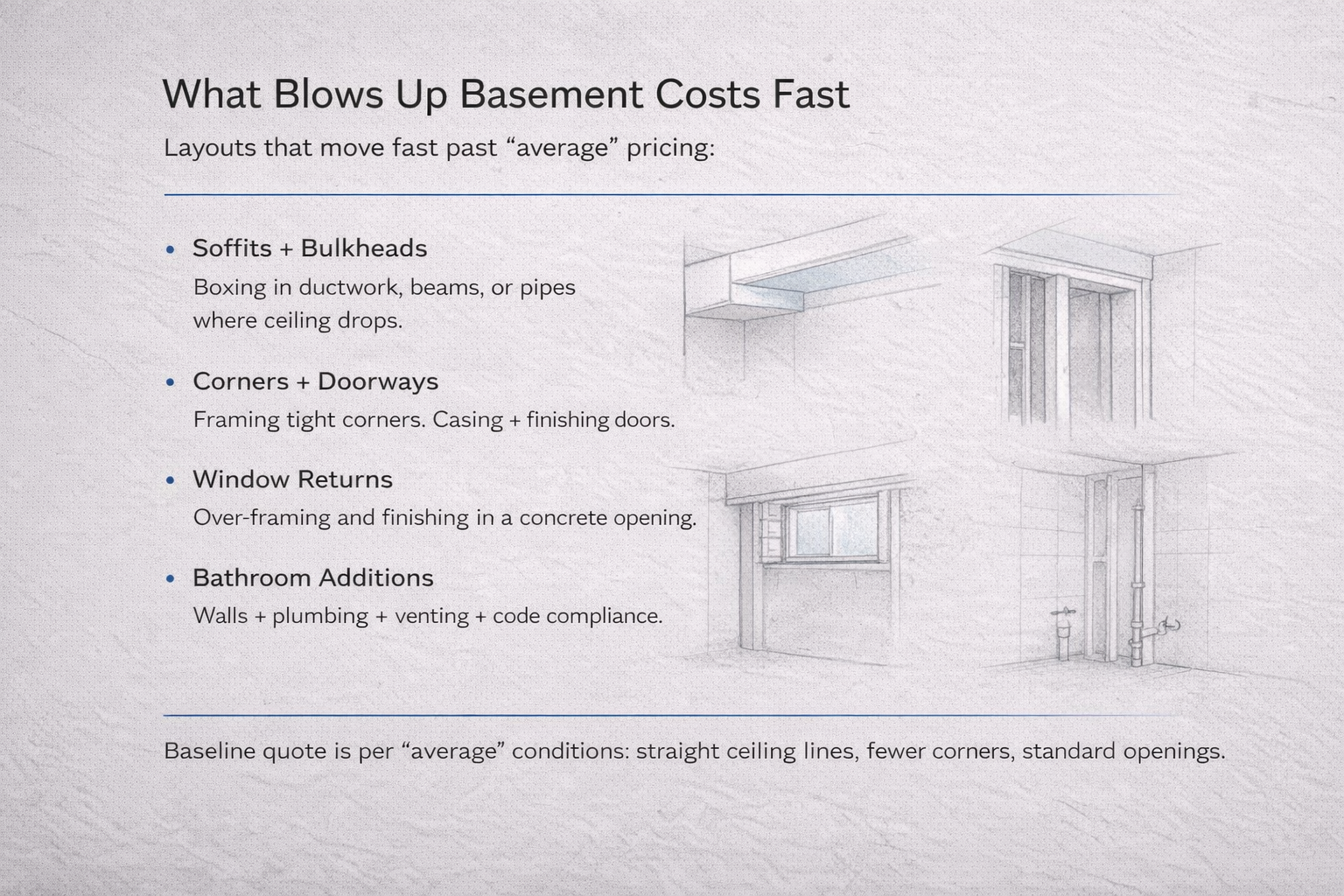
These are typical ranges. Not promises. They assume a “normal” basement: decent access, no major water issues, and no weird structural surprises. The second you add a bathroom, a bunch of doors, a low ceiling full of ductwork, or a maze of soffits—you’re not in “average” anymore.
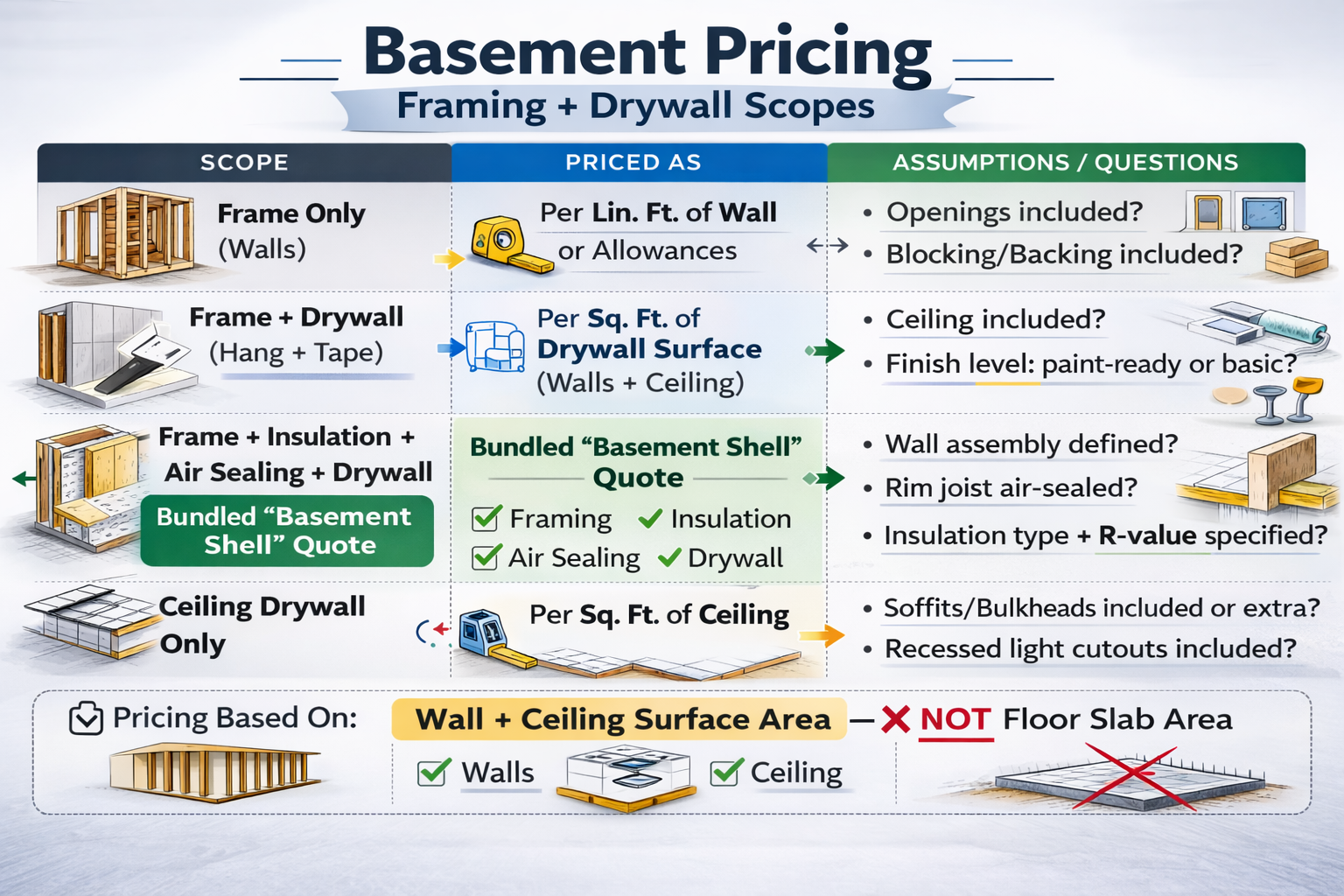
One important thing before you read any quote: framing and drywall are priced off walls and ceilings, not the floor slab. “$X per square foot” can mean two completely different things depending on who’s talking.
| Scope | How it’s usually priced | What the range assumes (and what to ask) |
|---|---|---|
| Frame only (walls) | Per linear foot of wall or per “finished area” | Basic partitions + perimeter framing, minimal soffits. Ask: how many doors/openings are included, and is blocking/backing included? |
| Frame + drywall (hang + tape) | Per sq ft of drywall surface (walls + ceiling), not floor area | Normal ceiling height, straightforward layout, standard finish level. Ask: is the ceiling included, and what finish level is “tape” (paint-ready or basic)? |
| Frame + insulation/air control + drywall | Bundled “basement finishing shell” quote | Moisture plan is included and done correctly (not “we’ll spray foam something later”). Ask: what’s the perimeter wall assembly, and is the rim joist air-sealed? |
| Ceiling drywall only | Per sq ft of ceiling | Open spans, limited obstacles, reasonable access for sheets/lift. Ask: are soffits/bulkheads included or extra? |
If you want a baseline on what’s actually happening inside the walls (studs, plates, blocking, where mistakes usually start), keep this bookmarked: wall framing basics (studs, plates, blocking).
How basements get measured (and how people get tricked)
The most common pricing confusion is this: homeowners talk in floor square feet. Contractors price the work based on what they’re actually building and covering.
Drywall is a good example. Drywall cost isn’t “your basement is 800 sq ft, therefore drywall is X.” Drywall is walls + ceiling, plus all the little returns, corners, and soffit faces nobody counts until they’re hanging sheets at 10pm.
Simple way to think about it
If your basement is a clean rectangle, your drywall surface area can easily be 2.5–4x the floor area once you count: the ceiling, the perimeter walls, interior partitions, and soffits.
This is why two basements with the same floor area can price out totally differently: one is open concept with a painted ceiling; the other is chopped into rooms with doors, returns, bulkheads, and closets.
The stuff that spikes cost fast (and why)
These are the budget-killers. Not because they’re “hard,” but because they’re slow. They add cuts, corners, backing, and a ton of finish work. That’s labor, not magic.
Soffits / bulkheads
Every soffit is framing + drywall on multiple faces + extra joints to tape. And if the soffit runs through door openings or changes height, it gets even slower.
Doors (especially multiple doors)
Doors are more than an opening. You’re paying for layout accuracy, headers, jack/king studs, trimmers, drywall returns, and finishing. Multiply that by five doors and you feel it.
Window returns and deep jambs
Basements often have small windows with thick concrete around them. Finishing that cleanly takes time. It’s a lot of tight cuts and fussy drywall work.
Fire blocking and inspection details
Fire blocking is one of those “invisible” items that becomes expensive when it’s left too late. It’s cheap when the framing is open. It’s stupid when you’re cutting finished drywall to add it.
If you’re trying to read code language without drowning, this internal is a good starting point: building codes explained in plain English.
Frame-only vs. “real framing” (the scope trap)
A lot of basement quotes look cheap because they quietly exclude the things that make a basement work long-term. The most common example: “framing” that ignores moisture, air sealing, and insulation logic.
Frame-only usually means
- Stud walls, plates, basic openings
- No insulation strategy
- No rim joist air seal plan
- No vapor/air control responsibility
Frame + insulation/air control usually means
- Rim joist addressed early (not “later”)
- Perimeter wall strategy decided before framing traps anything
- Insulation installed without gaps you can’t access later
- Clear scope for vapor/air control (whatever is appropriate for the assembly and climate)
If your basement has any water history, do not treat “finishing” as a cover-up. Fix the water first. A framing job can look perfect and still rot quietly behind it.
RECOMMENDED TOOL
One solid reference you can beat up with sticky notes. Not for “reading for fun.” For catching problems before you pay for them.
→ 2021 International Residential Code (IRC) on Amazon
Drywall finish level changes labor (and people forget that)
“Drywall” is not one product. It’s a finish standard. And that standard decides how many hours get burned in mud, sanding, and cleanup. Hanging sheets is the fast part. Making it look clean under real lighting is the slow part.
If you’re doing a basic storage/mechanical space, you can live with a rougher finish. If this is living space with painted walls and pot lights, you’re paying for a higher finish whether you admit it or not.
Quick finish-level translation (what people actually mean)
- “Hang only”: Sheets are up. No tape, no mud. Looks like a jobsite forever.
- Basic tape (rough): Joints covered, but not refined. Fine behind paneling, utility rooms, or heavy texture.
- Paint-ready walls (typical living space): Taped, mudded, sanded properly so paint doesn’t scream at you. This is where most basements should land.
- High-end / critical lighting finish: More passes, more detail work, more time. Used when you have long sightlines, smooth walls, dark paint, or aggressive side-light.
Why the price jumps
The jump isn’t just “more mud.” It’s more passes (coat → dry → sand → coat → dry → sand), more control at corners, more time fixing waves, and more time protecting the space from dust.
Lighting is the snitch
Strong side-light exposes everything: pot lights near walls, wall washers, big basement windows, even a lamp grazing across a wall. If you have hard lighting, you need a better finish or you will see every joint forever.
The quote mistake people make
Two contractors can both say “drywall included,” but one is pricing a rough finish and the other is pricing paint-ready. That’s why the numbers look insane until you compare finish level.
If you want one simple rule: ask what “done” looks like. “Paint-ready?” “Texture?” “Ceiling included?” “Soffits included?” Get the words on paper.
A quick way to sanity-check a quote (without being a contractor)
You don’t need to know everything. You just need to stop accepting vague scope. A clean quote has clear boundaries.
Questions that force clarity
- What exactly is included? Frame only? Insulation? Vapor/air control? Fire blocking? Ceiling drywall?
- How are soffits handled? Included? Extra? “TBD” is not a number.
- How many doors/openings are assumed? If you add one later, what happens to price?
- What finish level is drywall? And is the ceiling included?
- Who handles backing/blocking? TVs, cabinets, vanities, handrails.
If two quotes differ by a lot, it’s usually not because one guy is “honest” and the other is “greedy.” It’s because the scope is different and nobody wrote it down clearly.
Mini budget build (a real-world way to estimate)
Here’s a practical method that gets you closer than guessing: build your estimate from the pieces that actually take time.
Step 1: Count linear feet of walls
Perimeter walls + interior partitions. That’s your framing “spine.” Add complexity for: closets, jogs, tiny rooms, angled walls.
Step 2: Count openings
Every door/window opening adds labor. Track them explicitly.
Step 3: Decide ceiling plan
Drywall ceiling? Drop ceiling? Painted open ceiling? This one choice can swing your number hard.
Step 4: Add “detail tax”
Soffits, returns, fire blocking, backing, tight corners, low ceiling gymnastics. If you ignore these, your estimate will be fantasy.
Common pricing myths (that get people burned)
“It’s just a basement. It’s cheaper.”
Sometimes yes. Often no. Basements are full of obstacles and humidity risk. The labor can be worse than a clean above-grade space.
“We’ll insulate later.”
Later becomes impossible at the rim joist and behind tight corners. If the insulation plan isn’t decided early, you’ll pay twice.
“Drywall is drywall.”
Level of finish matters. Lighting matters. Ceiling height matters. The number of corners matters.
FAQ
(real questions people keep asking)
What’s the biggest cost driver: size or complexity?
Complexity. A smaller basement chopped into rooms with soffits and lots of doors can cost more than a larger open one.
Is it cheaper to do framing first and figure out the rest later?
It can look cheaper on paper, but it’s a common way to get trapped into bad insulation and air-sealing decisions. The expensive part is fixing it after drywall is up.
Why do quotes vary so much for the “same” basement?
Because they’re not actually quoting the same scope. One includes ceiling drywall and soffits. The other excludes them and calls it “standard.”
Should I drywall the ceiling or use a drop ceiling?
Drywall looks cleaner and feels more “finished,” but access to mechanicals becomes harder. Drop ceilings cost differently and can save headaches later if you expect changes or service work.
Do I need fire blocking in basement framing?
In most jurisdictions, yes—how and where depends on the assembly and code. Don’t treat it as optional or “inspection week” work.