
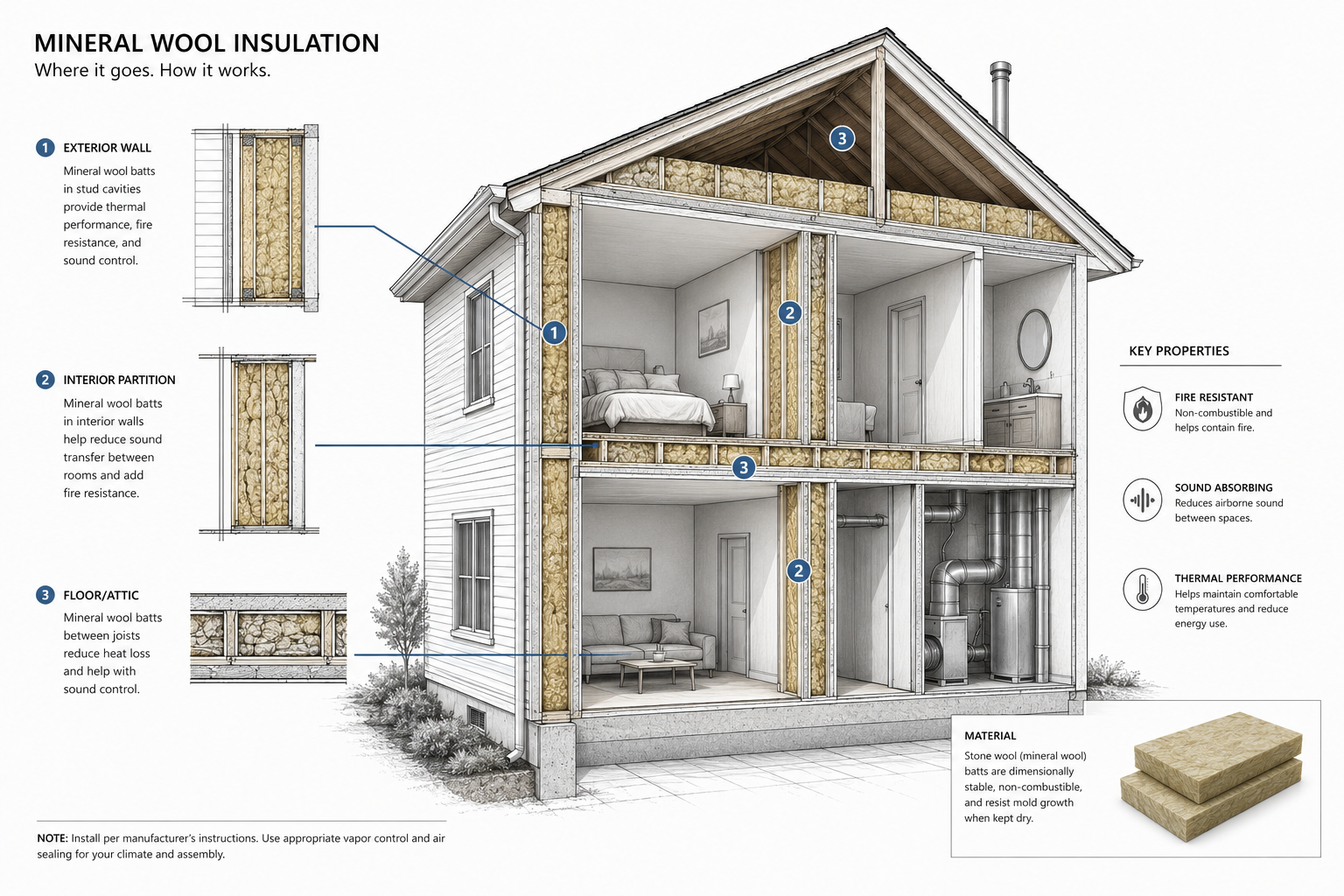
Illustration by ArchitectureCourses.org. Mineral wool insulation is commonly used in wall, floor, ceiling, and attic cavities where fire resistance, sound control, and thermal performance matter.
Loose-fill mineral wool is blown insulation made from spun mineral fibers. It is usually chosen for attics, awkward cavities, and projects where fire performance and sound control matter. In the right space, it can work very well.
It is not the right answer everywhere. Loose fill helps when coverage is the problem. It does not fix air leaks, roof leaks, or a wall assembly that needs a different kind of insulation altogether.
If you are still comparing the full field, start with The Complete List of Thermal Insulation Materials. If the decision is mostly about health and safety, What Is the Safest Insulation to Use? is the better next read.
What Loose-Fill Mineral Wool Is
Loose-fill mineral wool is made from spun mineral fibers, usually based on basalt rock, slag, or a similar raw material mix. Instead of coming as batts or rigid boards, it is installed as a loose blown insulation.
That format changes where it makes sense. Loose fill is good at filling irregular spaces and covering awkward areas around framing, wiring, ducts, and odd attic geometry. It is not magic. It is just better than batt insulation in places where batt insulation tends to leave voids.
Depending on the product, mineral wool usually lands in the low-to-mid R-4 range per inch. That matters, but coverage matters too. In messy spaces, even coverage is often where loose fill earns its cost.
Why People Choose It
Most people end up here for one of four reasons: fire resistance, sound control, moisture tolerance, or a general dislike of cheap insulation that gets installed badly and blamed later.
Mineral wool has a stronger reputation than fiberglass in a few places for good reason. It is non-combustible. It handles sound better. It does not slump the same way some low-cost insulation jobs do. It is also less bothered by incidental moisture than materials that lose performance fast once they get damp.
That does not mean the product solves every problem. In a lot of houses, the bigger loss is still unsealed attic bypasses, wind washing at the eaves, or moisture getting into the building from somewhere insulation was never going to fix.
Where Loose Fill Works Best
Open Attics
This is the cleanest use case. Open attic floors, uneven framing, hard-to-reach corners, and places where you want continuous coverage are where loose fill starts to make obvious sense.
Batts are easy to price and easy to talk about. They are also easy to gap, compress, or fit badly around obstacles. Loose fill handles that better.
Awkward Shapes and Interrupted Cavities
If the geometry is messy, blown insulation gets more attractive. Pipes, wires, weird framing pockets, and interrupted spaces are all places where neat batt installation starts to fall apart.
Projects Where Sound Matters
Mineral wool is one of the better insulation materials when you care about sound as well as heat flow. Loose fill is not always the best soundproofing format, but the mineral wool family is still strong in that category. If sound is a major reason you are looking at it, read Can Mineral Wool Insulation Double as a Soundproofing Solution?.
Fire-Driven Decisions
This is another real strength. Mineral wool is one of the materials people step up to when fire performance matters more than basic first cost. If that is the main filter, the better next page is How Does Mineral Wool Handle Fire?.
Where To Be Careful
Wet Assemblies
Mineral wool handles incidental moisture better than some insulation products, but that does not make it a waterproofing plan.
If the attic is taking roof leaks, if the basement wall is wet, or if the crawl space has standing water, insulation is not the first move. Fix the water source first. Spending money on insulation before that is backward.
Closed Wall Retrofits
Loose fill can work in walls, but this is where installation quality starts to matter a lot more. Coverage, density, settling, and access all get harder once you leave an open attic and move into enclosed cavities.
If the wall is already open, compare the loose-fill option against batts or boards before assuming blown insulation is the best answer.
Budget-First Jobs
Mineral wool is rarely the cheapest option on the list. Sometimes it is worth the premium. Sometimes it is not.
If the job is a straightforward attic top-up in a dry house and cost is driving everything, cellulose or fiberglass may still be the more realistic answer. That does not make them better. It makes them cheaper.
A Quick Comparison That Helps
| Situation | Loose-Fill Mineral Wool | Main Advantage | Main Limitation |
|---|---|---|---|
| Open attic with awkward framing | Strong fit | Covers irregular areas better than many batt installs | Still needs air sealing first |
| Wall retrofit | Possible, but more conditional | Can fill hard-to-reach cavities | Installation quality matters more |
| Fire-conscious project | Strong fit | Non-combustible material | Cost may rise fast |
| Sound-sensitive space | Good candidate | Better acoustic performance than many cheap options | Format still depends on the assembly |
| Wet basement or crawl space problem | Not the first move | Handles incidental moisture better than some products | Will not solve water entry |
| Lowest-cost insulation job | Mixed | Better fire and sound profile | Usually costs more than fiberglass |
Loose Fill Mineral Wool vs. Fiberglass
This is the comparison most readers are really making.
Loose-fill mineral wool usually wins on fire performance, sound control, and general toughness. Fiberglass usually wins on price, availability, and ease of finding an installer who already works with it.
That is why the better question is not “Which one is best?” It is “What matters most on this job?” If you are insulating near a shared wall, a fire-rated area, or a space where sound or moisture tolerance matters, mineral wool gets more attractive. If it is a basic budget attic job, fiberglass stays in the conversation.
If you want to compare mineral wool with lower-impact options too, move next to Natural Insulation Materials or Sustainable Insulation.
Install It Badly and the Product Gets Blamed
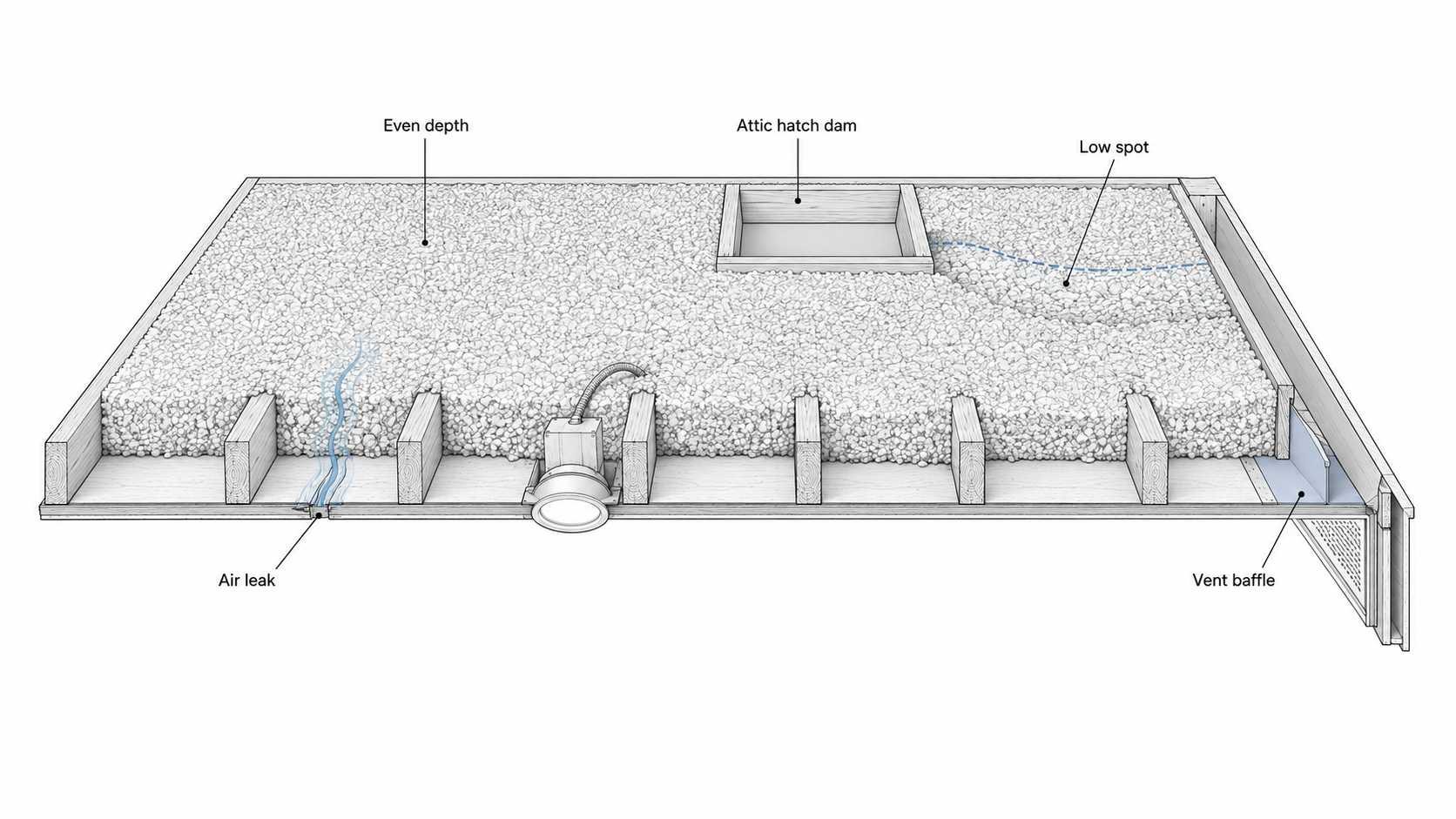
Illustration by ArchitectureCourses.org. Loose-fill mineral wool works best when the attic floor has even insulation depth, sealed air leaks, a raised hatch dam, and clear soffit ventilation.
Loose-fill mineral wool performs well when the depth is right, the coverage is even, and the air leaks below it have already been dealt with. Skip those steps and the insulation takes the blame for a problem that started earlier.
The common mistakes are not exciting, but they matter: uneven depth, missed corners, blocked vents, sloppy prep, and no air sealing before the material goes down. Do not pay for premium insulation and then ignore the boring steps that make it work.
DIY or Pro?
DIY is possible in an open attic if the access is decent and the prep work is done properly.
But loose fill is less forgiving than people think. Coverage has to be consistent. Depth has to be checked. Safety gear still matters. If the project involves enclosed walls, difficult access, or a house with active moisture problems, professional installation is usually the safer bet.
When Another Insulation Type Makes More Sense
Choose something else when loose fill is solving the wrong problem.
If you need a low-cost attic top-up and nothing more, cellulose or fiberglass may be enough. If you need a rigid, deliberate wall build-up, batts or boards may be easier to control. If the project is driven by natural-material priorities, pages like Hemp Insulation or Hemp Insulation vs. Rockwool are probably closer to the real decision.
What To Read Next
- Rockwool Blown Insulation if you want the brand-specific branch.
- How Does Mineral Wool Handle Fire? if fire resistance is the main reason you are here.
- Can Mineral Wool Insulation Double as a Soundproofing Solution? if sound control is part of the job.
- Hemp Insulation vs. Fiberglass if you are weighing safer or lower-impact alternatives.
- The Complete List of Thermal Insulation Materials if you want the full field instead of one product family.
FAQ
What is loose-fill mineral wool insulation made of?
It is made from spun mineral fibers, usually based on basalt rock, slag, or similar raw materials.
Where does it work best?
Open attics are usually the strongest fit. That is where loose fill can cover awkward framing, odd corners, and gaps that batt insulation often handles badly.
Is it better than fiberglass?
In some ways, yes. Mineral wool usually does better with fire, sound, and general durability. Fiberglass is still cheaper and easier to source, so the better material depends on what is driving the job.
Can it get wet?
It handles incidental moisture better than some insulation products, but that is not a reason to ignore leaks or damp assemblies. If water is still getting into the building, fix that first.
Does it settle?
Usually less than some loose-fill alternatives, which is part of its appeal.
Is it safe to handle?
Safer than some people assume, but not something to install bare-handed and breathe dust from. Gloves, eye protection, and a mask still make sense.
Is it worth the extra cost?
It can be. The premium makes more sense when you care about fire performance, sound control, or long-term stability. It makes less sense when the job is simple and budget is the only real filter.