
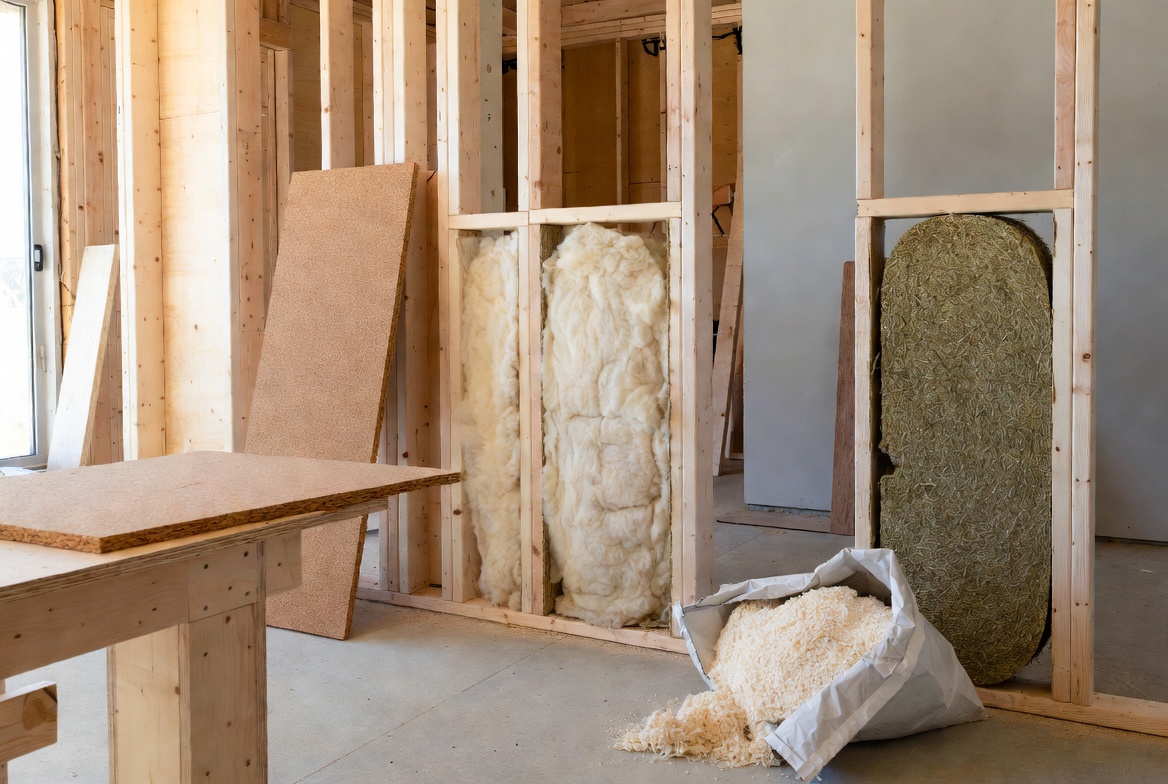
Natural insulation can work very well, but the material has to fit the assembly.
Sheep’s wool, hemp, cork, cellulose, wood fiber, recycled cotton, and straw-based systems do not behave the same way. Some need more thickness. Some handle moisture better. Some make more sense in attics than in walls, roofs, or floors.
What matters is where the insulation is going, how the assembly dries, and what the job can support in cost, fire treatment, and installation quality.
Read This Next: for the broader sustainability angle, read Sustainable Insulation That Saves Energy and Cuts Costs. For the wider insulation field beyond natural products, read The Complete List of Thermal Insulation Materials: Types, Uses, and Best Practices.
What Are Natural Insulation Materials?

Natural insulation materials are insulation products made from plant fibers, animal fibers, recycled paper, or other low-impact sources that are renewable, biodegradable, or less chemically intensive than many conventional options.
In practice, that usually means materials such as sheep’s wool, hemp fiber, cork, wood fiber, cellulose, recycled cotton, and straw-based systems. Some are fully natural. Some are recycled rather than natural. Some need fire or pest treatment to be viable in real buildings. That does not make them bad choices, but it does mean the label alone is not enough.
The main reason people look at this category is simple: they want insulation that performs well without defaulting straight to fiberglass, foam, or more chemically intensive assemblies.
Why People Look at Natural Insulation
The appeal is easy to understand. Natural insulation often promises a better mix of lower impact, better handling, and more forgiving moisture behavior.
- Lower-impact sourcing: many products come from renewable or recycled feedstocks.
- Health and handling: some are easier to work with and less irritating during installation.
- Moisture behavior: some natural fibers can buffer moisture better than conventional batts.
- Sound control: dense fiber products often help with acoustics as well as thermal performance.
- Building compatibility: natural materials are often preferred in breathable wall systems, retrofits, and some heritage work.
None of that means natural insulation wins every comparison. Some products cost more. Some need more thickness. Some are harder to source. A better choice on paper can still be the wrong one for the actual wall or roof.
Types of Natural Insulation Materials
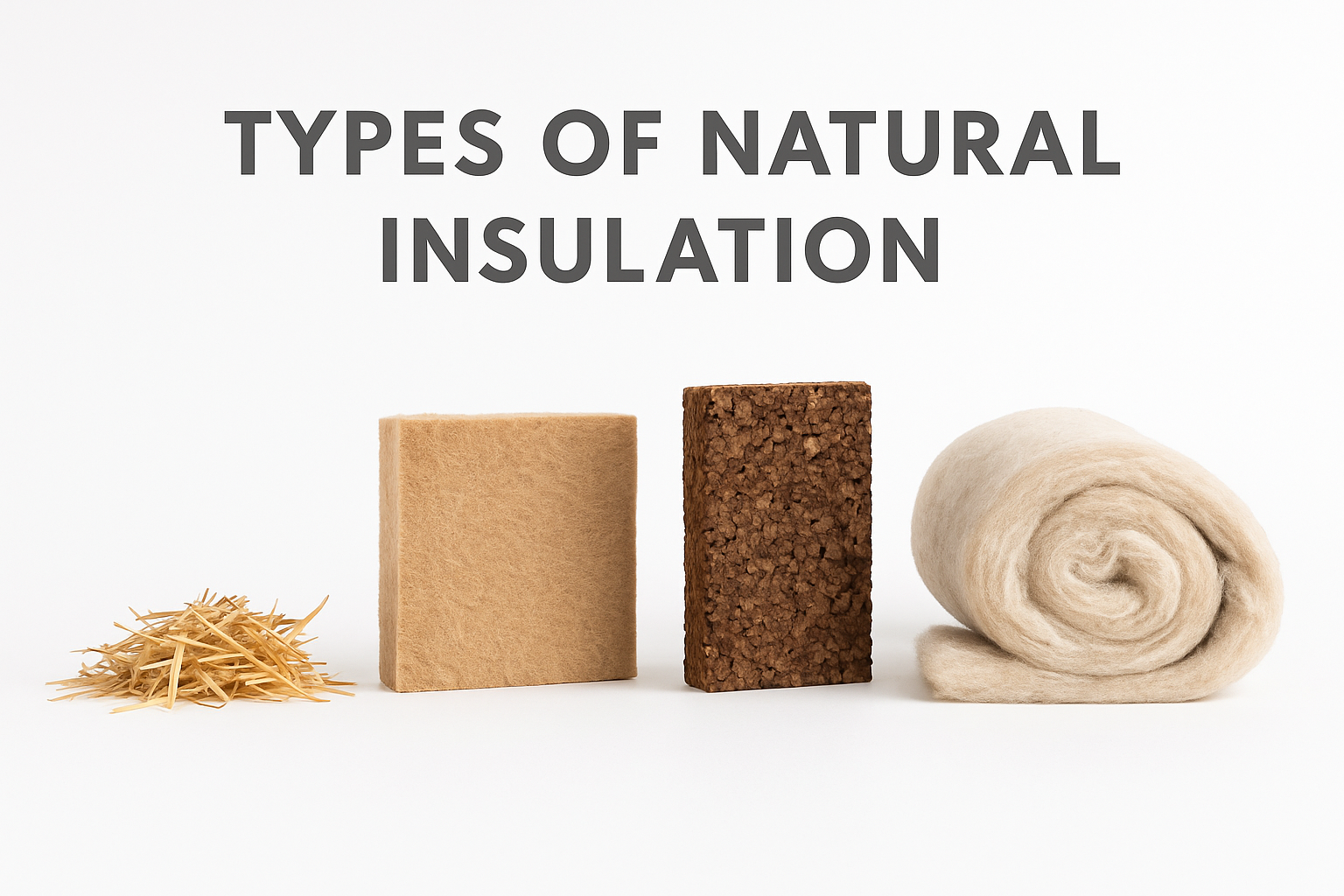
These are the materials most readers are usually trying to compare.
Sheep’s Wool Insulation
Sheep’s wool is one of the better-known natural insulation products. It is renewable, biodegradable, and valued for its ability to buffer moisture while still insulating reasonably well.
- Usually good for: walls, ceilings, lofts, and some timber-frame assemblies.
- Main strengths: moisture buffering, decent thermal performance, lower-irritant handling.
- Watch for: price, availability, and whether the product thickness matches the target assembly.
Hemp Insulation
Hemp insulation gets attention for good reason. It is plant-based, breathable, and often chosen for assemblies where moisture behavior and lower synthetic content matter. Hemp shows up as batts, mats, and hemp-lime systems, which do not all behave the same way.
- Usually good for: framed walls, roofs, floors, and some breathable retrofit assemblies.
- Main strengths: renewable source, moisture tolerance, strong sustainability appeal.
- Watch for: cost, local availability, and the fact that hemp-lime wall systems are not the same thing as hemp batts.
Worth knowing: if hemp is the main comparison, the next page to read is Hemp Insulation: Why Are Builders Switching to It?.
Cork Insulation
Cork is harvested from the bark of cork oak trees, which makes it renewable when managed properly. It is one of the more appealing options for readers who want a durable material that also helps with sound control.
- Usually good for: floors, walls, ceilings, and selected retrofit conditions.
- Main strengths: renewable source, acoustic value, useful moisture resistance compared with some other natural materials.
- Watch for: cost and making sure the available thickness is enough for the thermal target.
Cellulose Insulation
Cellulose is made largely from recycled paper and is one of the most practical lower-impact insulation choices on the market. It is not glamorous, but it is often one of the easiest sustainable products to justify on cost, availability, and coverage.
- Usually good for: attics, dense-pack walls, and some floor or roof cavities.
- Main strengths: recycled content, broad availability, strong coverage in irregular spaces.
- Watch for: settling, moisture exposure, and poor installation density.
Wood Fiber Insulation
Wood fiber boards and batts are widely discussed in high-performance and low-impact building circles because they combine breathability, decent thermal performance, and useful acoustic behavior.
- Usually good for: walls, roofs, and exterior or interior build-ups in breathable assemblies.
- Main strengths: vapor openness, density, sound control, good fit in some low-carbon assemblies.
- Watch for: cost, sourcing, and whether the rest of the wall is designed to work with that drying strategy.
Recycled Cotton or Denim Insulation
Recycled cotton insulation is typically made from reclaimed fabric and treated for fire resistance. People tend to like it because it is easier to handle than fiberglass and often performs well acoustically.
- Usually good for: interior walls, attics, and selected retrofit cavities.
- Main strengths: recycled content, decent sound absorption, easier handling.
- Watch for: thickness, availability, and not ignoring moisture just because the material feels safer to touch.
Straw Bale
Straw bale sits closer to the natural-building end of the category. It can deliver strong wall performance in the right system, but it is not a drop-in substitute for standard batt insulation.
- Usually good for: thick custom wall systems and natural building projects.
- Main strengths: agricultural byproduct use, strong insulation potential in thick walls, low embodied energy appeal.
- Watch for: wall thickness, detailing, moisture management, and project type. It is not the default answer for a typical renovation.
Emerging Materials Like Mycelium
Mycelium-based panels and other bio-based experimental products are interesting, but they are not mainstream insulation choices yet. They matter more as emerging materials to watch than as standard recommendations for most homes.
Typical R-Value Ranges
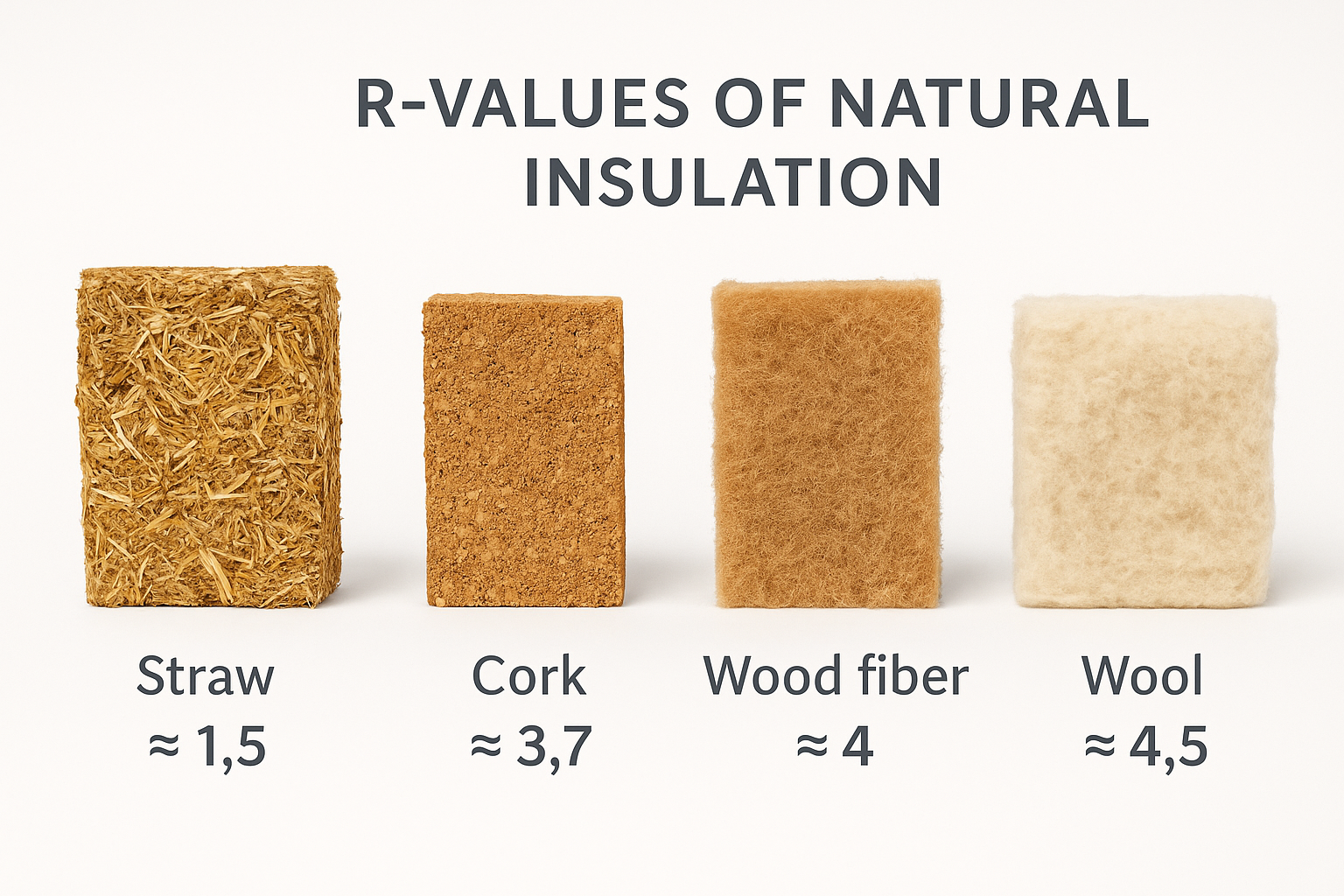
R-value varies by product, density, and manufacturer, so exact numbers should always be checked against the specific product data sheet. Still, the rough ranges help sort the field.
- Sheep’s wool: often around the mid-R-3 to low-R-4 range per inch.
- Hemp batts: commonly around the mid-R-3 to low-R-4 range per inch.
- Cork: usually in the mid-R-3 to low-R-4 range per inch.
- Cellulose: often in the low-to-mid-R-3 range per inch.
- Wood fiber: commonly in the mid-R-3 range per inch.
- Recycled cotton: often in the mid-R-3 range per inch.
- Straw bale: wall performance depends heavily on thickness and assembly, so per-inch comparisons are less useful than full-wall performance.
The bigger point is this: natural insulation can perform well, but some materials need more depth than foam-based products to reach the same target. That trade-off matters in thin walls and tight roof build-ups.
Where Natural Insulation Works Best
Walls
Walls are where natural insulation often makes the most sense. Hemp, wood fiber, cellulose, sheep’s wool, and recycled cotton all show up here. The real question is not just R-value. It is air sealing, cavity depth, moisture behavior, and how the wall dries.
Attics
Attics are often one of the easiest places to use lower-impact insulation, especially cellulose and wool-type products. The mistake is assuming more material fixes a leaky attic. Air sealing still comes first.
Floors
Cork and hemp can make sense in floor assemblies, especially where sound reduction matters too. Underfloor conditions, sag resistance, and moisture exposure matter more than the marketing copy.
Roofs
Roof assemblies are less forgiving. Thickness, ventilation path, condensation control, and climate matter more here than almost anywhere else. A natural material can still be the wrong choice if the roof cannot dry safely.
Older and Breathable Buildings
Natural insulation is often a better fit in older buildings and breathable wall systems where trapped moisture is the bigger long-term risk. That does not make every natural product automatically safe for restoration work, but it explains why the category comes up so often in that conversation.
How to Choose Wisely
Most bad choices happen because people ask for the greenest material before they ask what the assembly needs.
- Check the thermal target: not every natural insulation product gives the same performance per inch.
- Check moisture behavior: some materials buffer moisture well, but that does not excuse poor detailing.
- Check fire and code requirements: natural does not mean exempt from treatment, finishes, or approval requirements.
- Check thickness: some low-impact materials need more space than higher-performance foams.
- Check local supply and cost: a great product that is hard to source or priced out of the job may not be the right answer.
One more thing: if the bigger question is not just natural insulation but sustainable material choices across the whole project, Materials Selection: Best Practices for Architectural Design and Sustainability is the stronger next read.
What to Watch For
Natural insulation can be excellent. It can also be oversold.
- Do not buy the story and ignore the assembly. Moisture still wins that argument.
- Do not assume natural means maintenance-free. Some products need careful detailing to perform well long term.
- Do not assume greener means highest R-value. Some natural materials trade peak thermal efficiency for lower impact, better moisture behavior, or easier handling.
- Do not ignore installation quality. Gaps, compression, and weak air sealing still ruin performance here just as they do with conventional insulation.
What to Read Next
If you are still narrowing the options, the best next page depends on what you are trying to solve.
- Sustainable Insulation That Saves Energy and Cuts Costs — best next read if you want the bigger environmental and cost picture.
- Hemp Insulation: Why Are Builders Switching to It? — useful if hemp is the main product you are comparing.
- Hemp Building Materials Explained: Uses, Benefits, and Cost Breakdown — helpful if the question is broader than insulation alone.
- The Complete List of Building Materials: Key Types and Their Applications — a better next step if you are comparing insulation to other material choices across the build.
- The Complete List of Thermal Insulation Materials: Types, Uses, and Best Practices — the right page if you want to compare natural products against the full insulation field.
That is usually the better way to use a page like this. Start broad here. Then move into the branch that matches the job in front of you.
FAQ
What are natural insulation materials?
Natural insulation materials are products made from plant fibers, animal fibers, recycled paper, or other lower-impact sources used to reduce heat flow in walls, roofs, floors, and ceilings.
What is the best natural insulation?
There is no universal winner. Sheep’s wool, hemp, cork, cellulose, and wood fiber all make sense in the right assembly. The best choice depends on moisture exposure, thickness available, budget, and how the wall or roof is supposed to dry.
Is natural insulation as effective as fiberglass?
It can be, but not always at the same thickness or cost. Some natural materials perform in a similar range, while others need more depth to reach the same target. Assembly quality still matters more than the material label alone.
Does natural insulation handle moisture well?
Some natural insulation materials handle moisture better than people expect. Wool, hemp, and wood-fiber systems are often chosen partly for that reason. But no insulation fixes bad detailing, trapped water, or poor drying paths.
Is natural insulation fire-resistant?
Some products perform well in fire, and some rely on treatment or protective layers. Fire performance is product-specific, so the correct answer is always to check the tested system and local code requirements rather than assume.
What is the cheapest natural insulation?
Cellulose is often one of the easiest lower-impact options to justify on cost and availability. Straw can also be inexpensive in the right type of project, but it is much more system-dependent.
Which natural insulation is best for old houses?
That depends on the wall and moisture behavior, but natural materials are often considered for older buildings because breathable assemblies matter more there. Wood fiber, sheep’s wool, cork, hemp, and lime-compatible systems come up often in that context.