
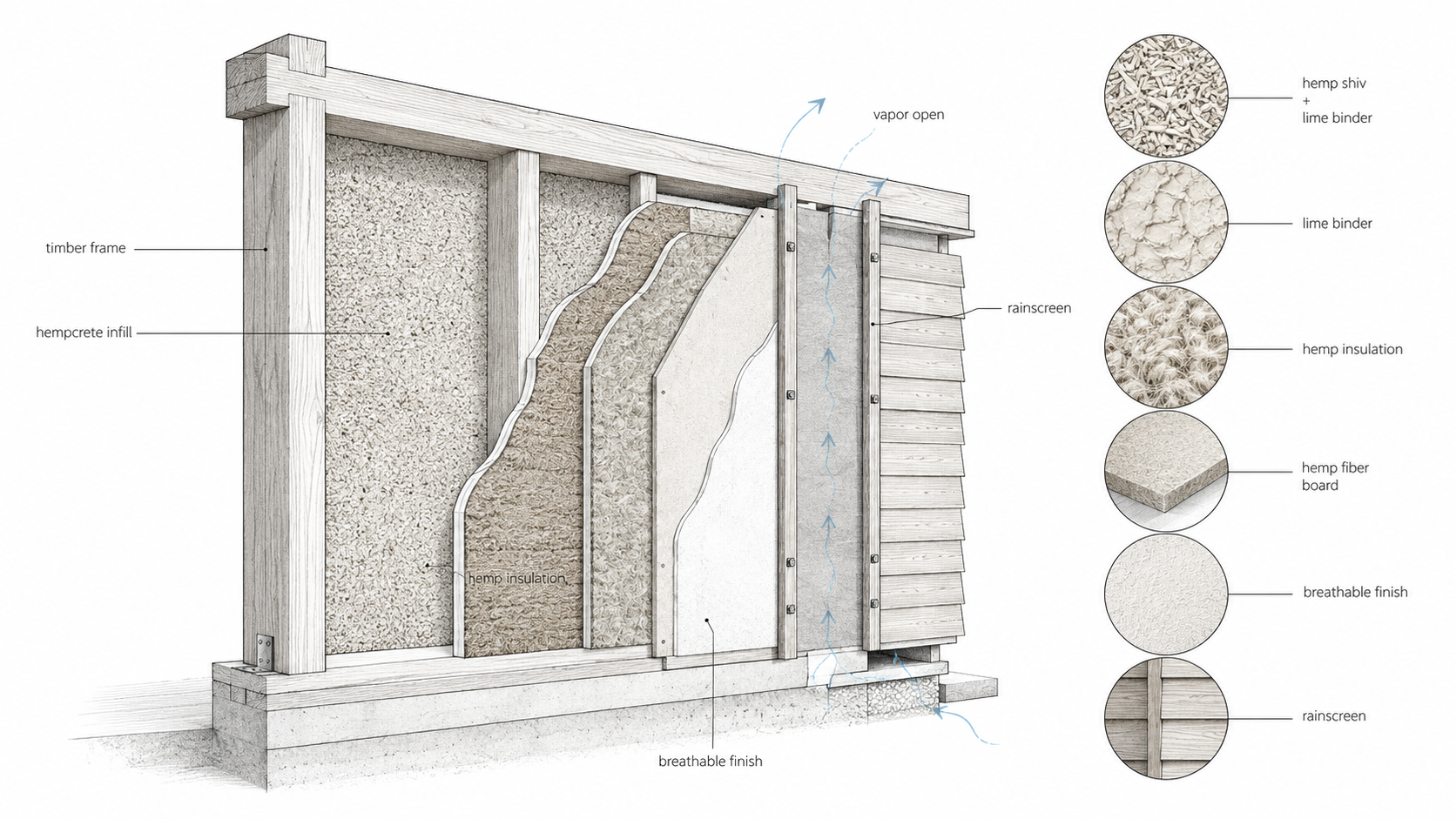
Illustration by ArchitectureCourses.org. Hemp building materials work as part of a breathable wall system. The timber frame carries the load, while hempcrete, hemp insulation, boards, plaster, and rainscreen layers handle enclosure, moisture, and thermal performance.
Hemp is not one material, and that is where most projects get into trouble.
Hemp-lime wall infill behaves differently from insulation batts. A fiberboard panel is not a structural panel. And the thing that usually slows a hemp job down is not the product. It is the wall thickness nobody priced, the crew that has never detailed it, or the supply chain that looked reliable until it was not.
If the question is mainly insulation, go next to Hemp Insulation: Why Are Builders Switching to It?. If the goal is the broader natural-material context, go to Natural Building Materials: A Comprehensive Guide for Builders and Students.
What Counts as Hemp Building Materials?
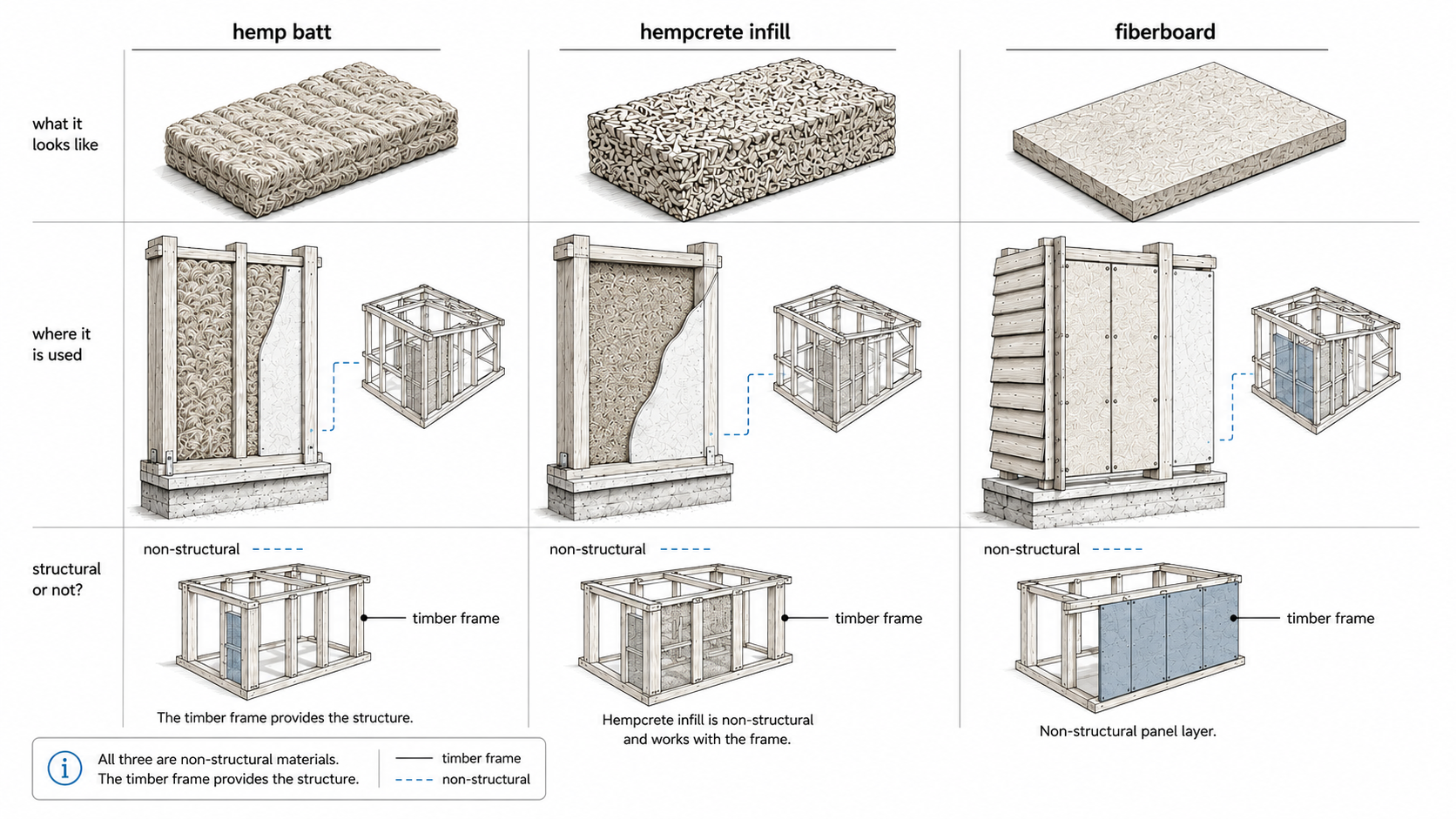
Illustration by ArchitectureCourses.org. Hemp batt, hempcrete infill, and hemp fiberboard do different jobs. In all three cases, the timber frame carries the structure while the hemp-based material works as insulation, infill, or panel layer.
Hemp products do different jobs, and the differences matter early.
Hemp-lime wall systems
This is the category most people mean when they say hempcrete. It is usually a mix of hemp hurd and a lime-based binder used as non-structural wall infill, cast around framing or formed into blocks. It is valued for breathability, thermal performance, and moisture moderation, but it is not a replacement for structural framing.
Hemp insulation batts, rolls, and panels
These products are closer to the insulation conversation than the wall-system conversation. They are usually chosen for framed walls, roofs, and floors where lower synthetic content, easier handling, and vapor-open assemblies matter.
Hemp fiberboards and interior panels
These are compressed-fiber products used for interior linings, partitions, acoustic layers, and some finish applications.
Hemp-based composites and specialty products
This category includes composite panels, interior products, and newer manufactured materials that use hemp fiber as part of a broader mix. Some look promising, but many are still too product-specific to treat as a standard default.
Where Hemp Makes the Most Sense
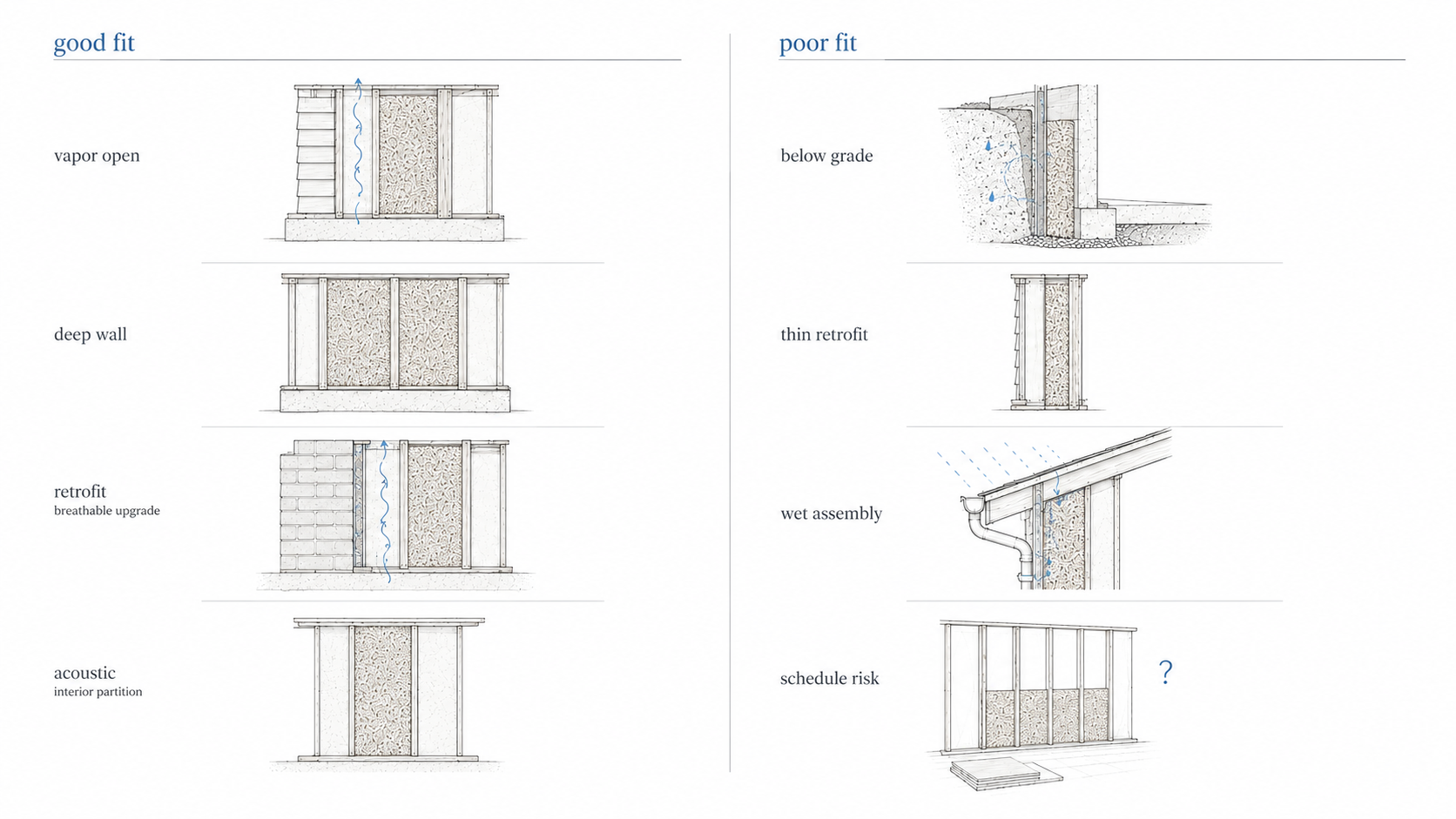
Illustration by ArchitectureCourses.org. Hemp building materials work best in vapor-open walls, deeper assemblies, breathable retrofits, and interior acoustic partitions. They are a poorer fit below grade, in very thin retrofits, in wet assemblies, or on jobs where the crew does not know the system.
Breathable wall systems
Hemp makes the most sense in assemblies that are meant to stay vapor-open and moisture-tolerant. That is why it shows up so often in sustainable builds, low-toxicity projects, and some retrofit work in older buildings.
Projects where indoor comfort matters beyond raw R-value
A lot of hemp’s appeal is not just the thermal number. It is the quieter feel of fiber insulation, the lower-irritant handling, and the way some hemp-based assemblies buffer humidity better than more sealed systems.
Projects already leaning natural or low-impact
Hemp makes more sense when it is part of a full materials strategy. If the project is already moving toward lime plasters, timber framing, wood fiber, cork, or other lower-impact decisions, hemp fits more naturally than it does in a random half-conventional assembly.
Teams willing to build differently
Hemp works better when the architect, builder, and owner all understand that the wall build-up, detailing, and schedule may differ from a standard fiberglass-and-drywall job.
Where Hemp Gets Sold Too Hard
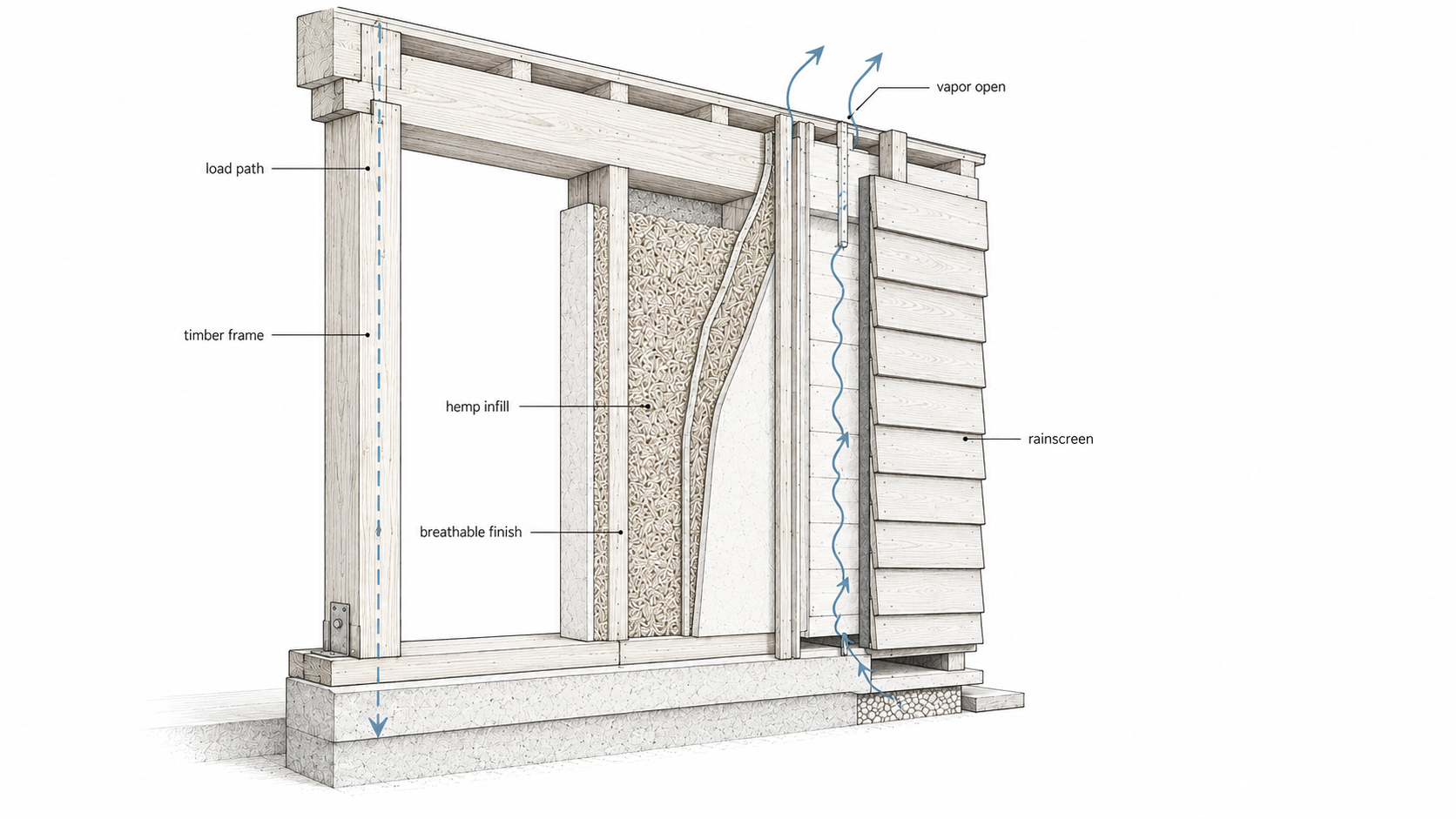
Illustration by ArchitectureCourses.org. Hemp infill belongs inside a wall system. The timber frame carries the load, while breathable finishes, rainscreen cladding, and vapor-open layers help the wall dry.
Hemp is useful. It is not a miracle material.
- It does not solve a bad assembly. If the wall cannot dry, the detailing is sloppy, or water is already getting in, hemp will not rescue the project.
- It is not automatically the cheapest green option. In many markets, cellulose still wins that conversation more easily.
- It is not always the thinnest path to performance. Some hemp products need more depth than high-performance foam products to hit the same thermal target.
- It is not friction-free with code and trades. A material can be technically viable and still be unfamiliar to the people pricing, installing, or inspecting it.
That is usually where hemp jobs go right or wrong.
What Slows a Hemp Job After You Say Yes
The hard part is usually not the sales pitch. The hard part starts after the material is chosen.
The wall gets thicker than people expected
Hemp-lime and other vapor-open natural wall systems often want more depth than a standard framed wall with conventional cavity insulation. That affects window returns, sill details, trim depth, attachment points, and interior floor area. This is the sort of thing people notice late, after drawings start tightening up.
The schedule gets less forgiving
Some hemp-based assemblies depend on curing, drying, sequencing, and weather protection in a way standard dry construction does not. That can be fine on the right job. It can also become the part that holds everything else up.
The mechanical and attachment details get awkward
Cabinets, heavy fixtures, and service runs need to be resolved early. A hemp wall can work well, but those details need to be solved before framing starts, not shrugged off and patched later.
The team may not know the system well
This is one of the real project killers. Even if the product is good, a builder who has never detailed it, a sub who treats it like a standard cavity fill, or an inspector who has not seen it before can slow the job down fast.
The supply chain can be the real problem, not the material
In some regions, the issue is not whether hemp works. The issue is whether the right product, binder system, installer, and support are actually available when the job needs them. That is a much more useful warning than another vague paragraph about sustainability.
What Usually Changes the Cost
The old “cost per square foot” summary is too thin to be useful here. Hemp pricing moves for reasons that matter to the assembly, not just the material label.
- Product type: hemp insulation batts, hemp-lime infill, fiberboards, and specialty composites do not price the same way.
- Wall thickness and build-up: more depth changes framing, openings, finishes, and labor.
- Labor familiarity: a crew pricing an unfamiliar system will usually protect itself.
- Regional supply: availability still changes the equation a lot.
- What it replaces: if hemp allows you to simplify another layer or avoid a separate finish strategy, the comparison changes.
The better question is not “What does hemp cost?” It is “What does this full wall, roof, or floor assembly cost compared with the version I would otherwise build?”
How to Decide Whether Hemp Belongs in Your Project
- Start with the assembly, not the material. Wall, roof, floor, retrofit, new build, interior partition: the location changes the answer.
- Decide what you are really buying. Lower embodied impact, easier handling, vapor openness, acoustic comfort, lower synthetic content, or just a sustainability story.
- Check who is actually building it. A good material with a confused team is still a bad project.
- Resolve thickness and detailing early. Window jambs, service runs, cabinet loads, and drying strategy are not side issues.
- Compare it against the real alternatives. Hemp is not competing with fantasy. It is competing with cellulose, mineral wool, wood fiber, cork, foam, and standard framed assemblies people already know how to build.
If you need a faster comparison against other lower-impact insulation paths, read Natural Insulation Materials: Types, Benefits, and Practical Tips and Sustainable Insulation That Saves Energy and Cuts Costs.
When Another Material Is the Better Answer
Hemp is not the right answer when the job needs the thinnest possible insulation, the fastest possible install, the cheapest possible cavity fill, or a team that only wants conventional details.
In those cases, cellulose, mineral wool, wood fiber, cork, or even a more standard wall strategy may be the cleaner move. That does not make hemp worse. It just means material honesty matters more than material branding.
What to Read Next
- Hemp Insulation: Why Are Builders Switching to It? — best next read if your decision is really about insulation, not the full hemp materials category.
- Hempcrete: The Green Revolution in Construction — better if the project is moving toward hemp-lime walls or infill.
- Natural Insulation Materials: Types, Benefits, and Practical Tips — useful if you want to compare hemp with cork, wool, cellulose, wood fiber, and other lower-impact options.
- Materials Selection: Best Practices for Architectural Design and Sustainability — the right next step if the question is broader than hemp and you are weighing the full project palette.
- Hemp Insulation Companies: Best Providers, Costs, and Benefits Across the USA — useful if you are already shopping suppliers instead of just learning the category.
FAQ
Are hemp building materials structural?
Some hemp-based products are used inside structural systems, but hemp-lime wall infill itself is not the same thing as a primary load-bearing frame. That distinction matters early.
Is hemp just another insulation material?
No. Hemp shows up in several categories, including insulation batts, hemp-lime wall systems, fiberboards, and specialty composites. Treating all of them like one product leads to bad decisions.
Do hemp materials work in humid climates?
They can, but only if the assembly is designed and ventilated properly. Breathable does not mean careless.
Is hemp automatically cheaper over time?
Not automatically. Some projects save money through comfort, durability, or a cleaner assembly. Others get more expensive because the team, sourcing, or detailing is not lined up.
What is the biggest mistake people make with hemp materials?
Buying the sustainability story before they understand the wall, the installer, the drying sequence, and the details that make the system work.
What is the best hemp product to start with?
Usually hemp insulation or a hemp-lime wall conversation, depending on whether the project is assembly-specific or whole-wall specific. Start there instead of trying to compare every hemp product category at once.