
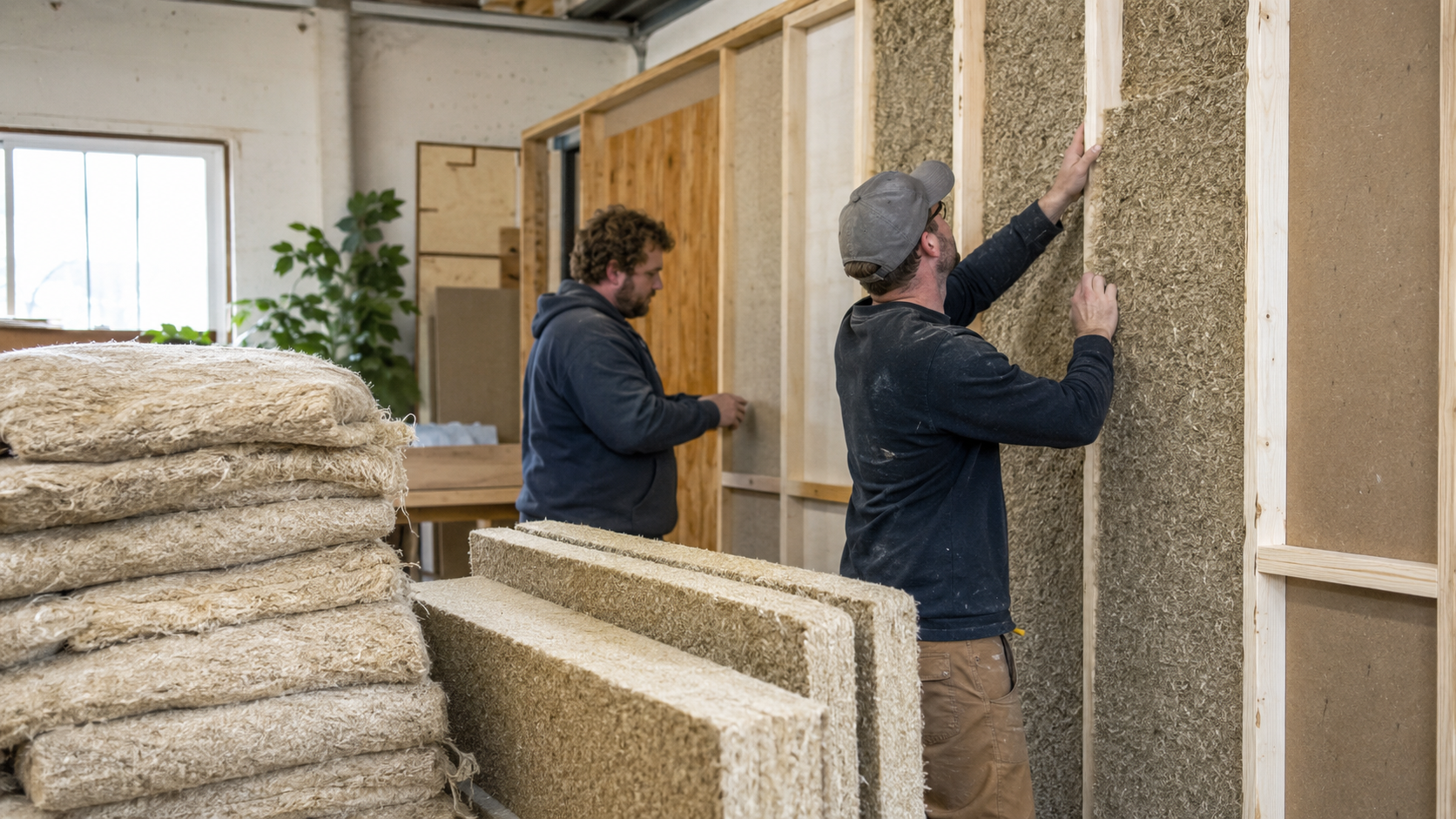
Hemp insulation companies in the U.S. do not all sell the same thing, and that is where most buyers lose time.
Some sell batt insulation for framed walls. Some sell hemp-lime systems for cast walls or blocks. Some supply raw hurd. Some are builders or trainers. Treating them as comparable brands before sorting that out usually means pricing the wrong product for the job.
If you want the product background first, read Hemp Insulation: Why Are Builders Switching to It?. If you are comparing hemp against other natural options, Natural Insulation Materials: Types, Benefits, and Practical Tips is the better next page.
Quick Answer
If you want a true U.S. hemp batt insulation brand, the clearest direct product play is still HempWool by Hempitecture. Hempitecture markets HempWool as a batt-style hemp fiber insulation for walls, floors, ceilings, attics, and partition walls, with published thermal performance around R-3.7 per inch. The company says it manufactures in Jerome, Idaho and distributes through warehouses around the country.
If you want hemp-lime wall systems rather than batt insulation, the market shifts. In that lane, companies such as American Lime Technology and Hemp Building Company are more relevant, because they focus on hemp-lime materials, system support, training, and installation rather than standard batt insulation.
If you need raw hemp hurd or feedstock for manufacturing or hemp-lime supply, a company like South Bend Industrial Hemp belongs in the conversation, but it is not the same thing as buying a finished batt insulation brand.
What Counts as a Hemp Insulation Company in the U.S.?
In this market, there are really four different company types:
- Finished insulation brands selling batts or similar products.
- Hemp-lime system suppliers selling binder, hurd, blocks, or wall systems.
- Builders and trainers who help you install hemp-based assemblies.
- Raw-material processors supplying hemp fiber or hurd upstream.
A lot of bad buying decisions start when those categories get blurred together. A builder may be excellent at hempcrete and still not sell batt insulation. A processor may supply hurd for manufacturing and still not be the company you want for a residential retrofit.
Who Actually Sells What
| Company | Main Product Path | Best Fit | Main Caution |
|---|---|---|---|
| Hempitecture / HempWool | Hemp batt insulation | Buyers who want a real batt product for framed cavities | Not every product on the site is hemp; their newer blow-in line is cellulosic, not hemp |
| American Lime Technology | Tradical Hemcrete hemp-lime system | New builds or retrofits using hemp-lime walls, floors, or roofs | Not a batt-insulation company; system choice changes wall build-up and schedule |
| Hemp Building Company | Materials, blocks, installation, training | Projects needing hemp-lime help, workshops, or build support | More of a system/build partner than a national shelf-product brand |
| South Bend Industrial Hemp | Hemp fiber and hurd supply | Manufacturers, builders, and hemp-lime supply chain buyers | Upstream material source, not the same as buying finished batt insulation |
| Texas Healthy Homes | Natural building and hemp-lime build route | Texas clients wanting a design-build path | Builder route, not a national packaged insulation brand |
That table is the most important filter on the page. It is the difference between shopping for a product and shopping for a whole building method.
Brand Reviews
Hempitecture / HempWool
Hempitecture is the clearest U.S. name if your target is batt-style hemp insulation. The company markets HempWool as a friction-fit hemp fiber batt for wood and metal framing systems, with common cavity uses in walls, floors, ceilings, attics, and partition walls. Published thermal performance is about R-3.7 per inch. Hempitecture also says it operates a production facility in Jerome, Idaho and has multiple distribution points around the country.
The good part is obvious: this is a real product line, with installation guides, product documents, and a clear use case for buyers who want something that installs more like standard batt insulation. The company also has more public-facing technical material than most hemp brands in the U.S. market.
The main caution is that not every product under the Hempitecture umbrella is hemp insulation. Their newer FiberFill blow-in product is described by the company as a cellulosic natural insulation made from FSC-certified wood chip residues, not a hemp blow-in product. That matters because buyers often assume a hemp brand sells only hemp. It does not.
American Lime Technology
American Lime Technology matters if the project is really about hemp-lime construction. The company describes itself as the North American distributor of Tradical Hemcrete, and its product line is aimed at insulating walls and insulation layers for floors and roofs.
This is not the same purchase as buying hemp batts for a 2x wall. If you are looking at American Lime Technology, you are usually moving into a system decision that affects framing, wall thickness, curing time, finish layers, and often contractor selection too. That can be the right move, but it is a bigger move than many buyers expect.
Hemp Building Company
Hemp Building Company is best understood as a materials, installation, and training route, not just a simple product brand. The company says it provides materials, installation, plastering, consultation services, and workshops, and it now offers hemp-lime blocks in addition to other natural building materials.
That makes it useful for buyers who are past the “what is hemp insulation?” stage and into the harder stage: “who can help me build this correctly?” For a lot of U.S. hemp projects, that is the real bottleneck. The material exists. The experienced crew does not always exist nearby.
South Bend Industrial Hemp
South Bend Industrial Hemp belongs on the list because it sits closer to the raw-material side of the U.S. hemp building supply chain. The company describes hemp uses that include construction materials such as hempcrete and insulation, and notes hemp hurd cellulose can be used in products such as fiberboard, stucco, and cement-related materials.
This is where buyers need to stay sharp. A company like this can be important to the market without being the company that ships you finished batt insulation for a normal residential wall retrofit.
Texas Healthy Homes
Texas Healthy Homes is not a packaged hemp batt brand, but it matters in this review because many buyers searching “hemp insulation companies” are really looking for a way to build with hemp, not a pallet of insulation only. Texas Healthy Homes positions itself as a natural-building design and build company in Texas, with strong emphasis on non-toxic materials and long-life construction. USHBA-related coverage has also tied the company to built hemp projects in Texas.
Red Flags Buyers Should Watch
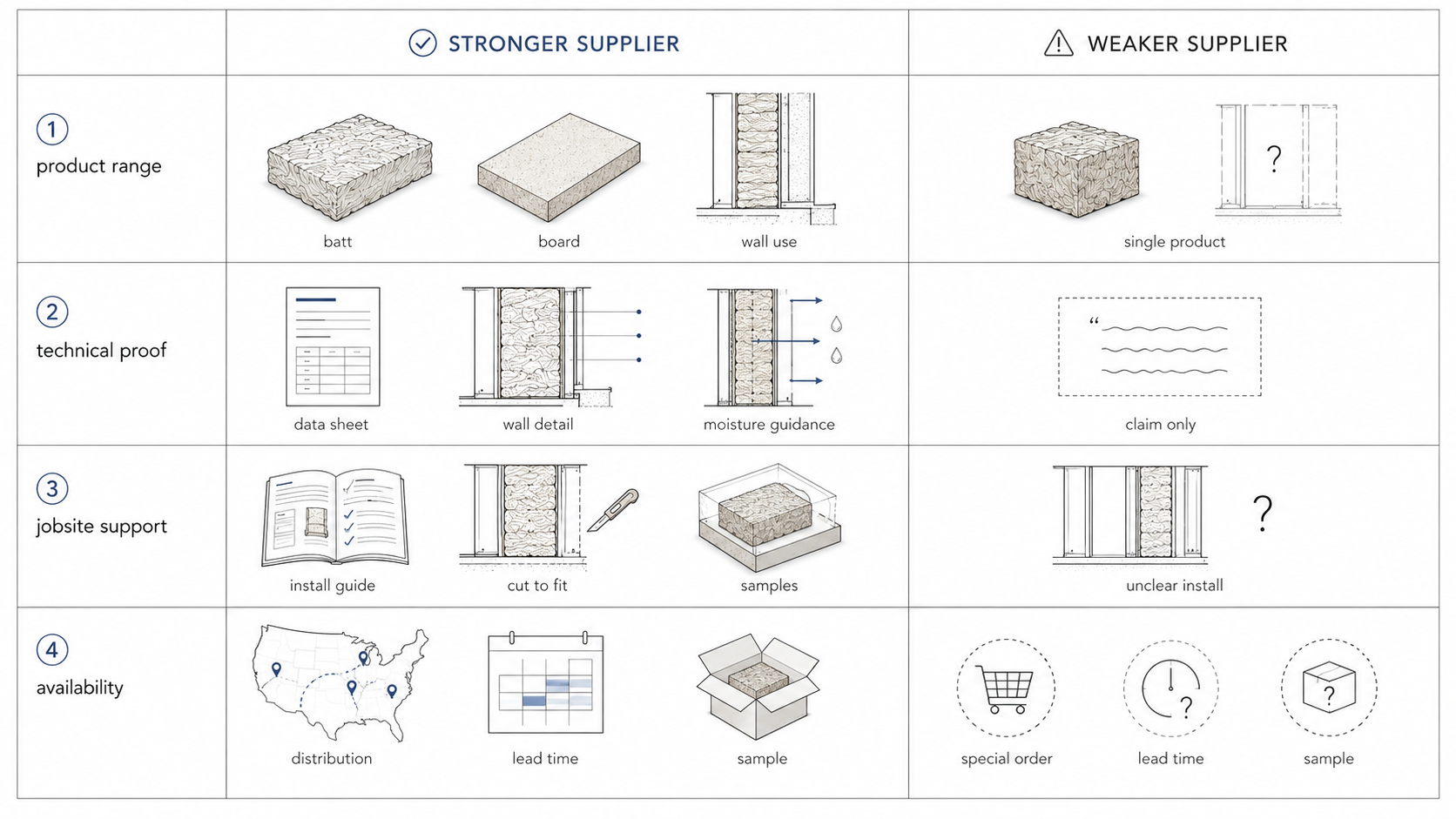
Illustration by ArchitectureCourses.org. A stronger hemp insulation supplier provides more than a batt or board. Product range, technical data, wall details, installation guidance, samples, lead-time clarity, and distribution support all reduce risk before the material reaches the jobsite.
1. The site says hemp, but the product path is not batt insulation
This is the biggest one. Some companies sell hemp-lime systems, some sell raw hurd, some teach workshops, and some sell finished batts. That is not a small distinction. It changes freight, installer needs, wall depth, and the whole scope of the job.
2. The brand talks about hemp, but the newer product line is something else
This is where buyers get lazy and pay for it. A bio-based company may expand into cellulosic or wood-fiber products. That is fine. But do not assume the whole catalog is hemp just because the company started with hemp. Hempitecture is the clearest example of why you have to read the actual product page.
3. No technical data sheet, no real comparison
If the seller cannot show thicknesses, intended applications, installation guidance, and at least basic thermal information, slow down. A good story is not enough.
4. No one is talking about wall build-up changes
Hemp-lime systems can be good. They also change jamb depth, trim, drying time, sequencing, and often framing decisions. If a company talks only about carbon and comfort and says nothing about those knock-on effects, the sales pitch is incomplete.
5. The company is really a builder, but you are treating it like a commodity product supplier
That mismatch wastes time fast. Builders and trainers are valuable. They are just a different kind of company than a manufacturer or stocking distributor.
6. You are assuming code acceptance is automatic everywhere
Hemp-lime has made real progress in U.S. model codes. The 2024 IRC includes Appendix BL Hemp-Lime (Hempcrete) Construction, and USHBA notes that it allows prescriptive use in some one- and two-family conditions, especially in lower seismic situations, while taller or higher-risk situations still move into engineered territory. But model code acceptance is not the same thing as every local jurisdiction being equally familiar with it.
The Part Buyers Usually Learn Late
The biggest surprise is not usually the material. It is the jobsite effect of choosing the material.
With hemp batts, the surprise is often lead time, freight, and the reality that the U.S. market is still thin compared with fiberglass or mineral wool.
With hemp-lime, the surprise is usually bigger: wall thickness, curing time, finish compatibility, and the need for a team that has done it before. That is the part many softer reviews skip, and it is the part that changes budget and schedule.
Who Each Route Fits Best
Choose Hempitecture / HempWool if you want the cleanest U.S. path to batt-style hemp insulation and you need something that fits a more normal insulation buying process.
Choose American Lime Technology if you are committed to a hemp-lime system and you already understand that this is a wall-system decision, not just an insulation swap.
Choose Hemp Building Company or a similar build-support route if the bigger problem is execution, not just sourcing.
Look at South Bend Industrial Hemp if you are upstream in manufacturing, hurd supply, or custom hemp-lime sourcing.
Look at Texas Healthy Homes if you are in Texas and need a natural-building path rather than a simple box-product purchase.
What To Read Next
- Hemp Insulation: Why Are Builders Switching to It? — the best next read if you are still comparing hemp insulation itself.
- Hemp Insulation vs. Fiberglass: Which is Safer for Your Home? — useful if the real comparison is hemp versus a standard batt product.
- Hemp Insulation vs. Rockwool: Which Insulation Wins for Your Home? — the better next step if fire, sound, and performance are the real decision points.
- Hempcrete: The Green Revolution in Construction — go here if your project is really about hemp-lime walls, not batts.
- Sustainable Insulation That Saves Energy and Cuts Costs — useful if cost and sustainability matter more than hemp specifically.
FAQ
What is the best hemp insulation company in the USA right now?
If you mean finished batt insulation, Hempitecture is the clearest direct answer because HempWool is a defined batt product with technical documents and national distribution language on the company site.
Are hemp insulation companies and hempcrete companies the same thing?
No. Some overlap, but they are not the same market lane. Batt insulation, hemp-lime systems, raw hurd supply, and installation support are different businesses.
Is hemp insulation widely available in the U.S.?
More available than it used to be, yes. Widely stocked like fiberglass, no. Buyers should still expect a thinner supply chain and should check freight and lead time early.
What is the biggest red flag when shopping hemp insulation?
Confusing the company type. A lot of buyers think they are comparing batt brands when they are really comparing a batt product, a hemp-lime system supplier, a builder, and a raw-material processor.
Is hemp-lime in U.S. code now?
It has a real foothold. The 2024 IRC includes Appendix BL for hemp-lime construction, but local adoption, familiarity, and engineering requirements still vary by project and jurisdiction.
What should I ask before I buy?
Ask what exact product you are buying, where it is meant to go, what documents exist, what the lead time is, and whether the company is selling a finished insulation product, a wall system, or just raw material.