
The Mix, the Build Sequence, and the Mistakes That Slow the Job
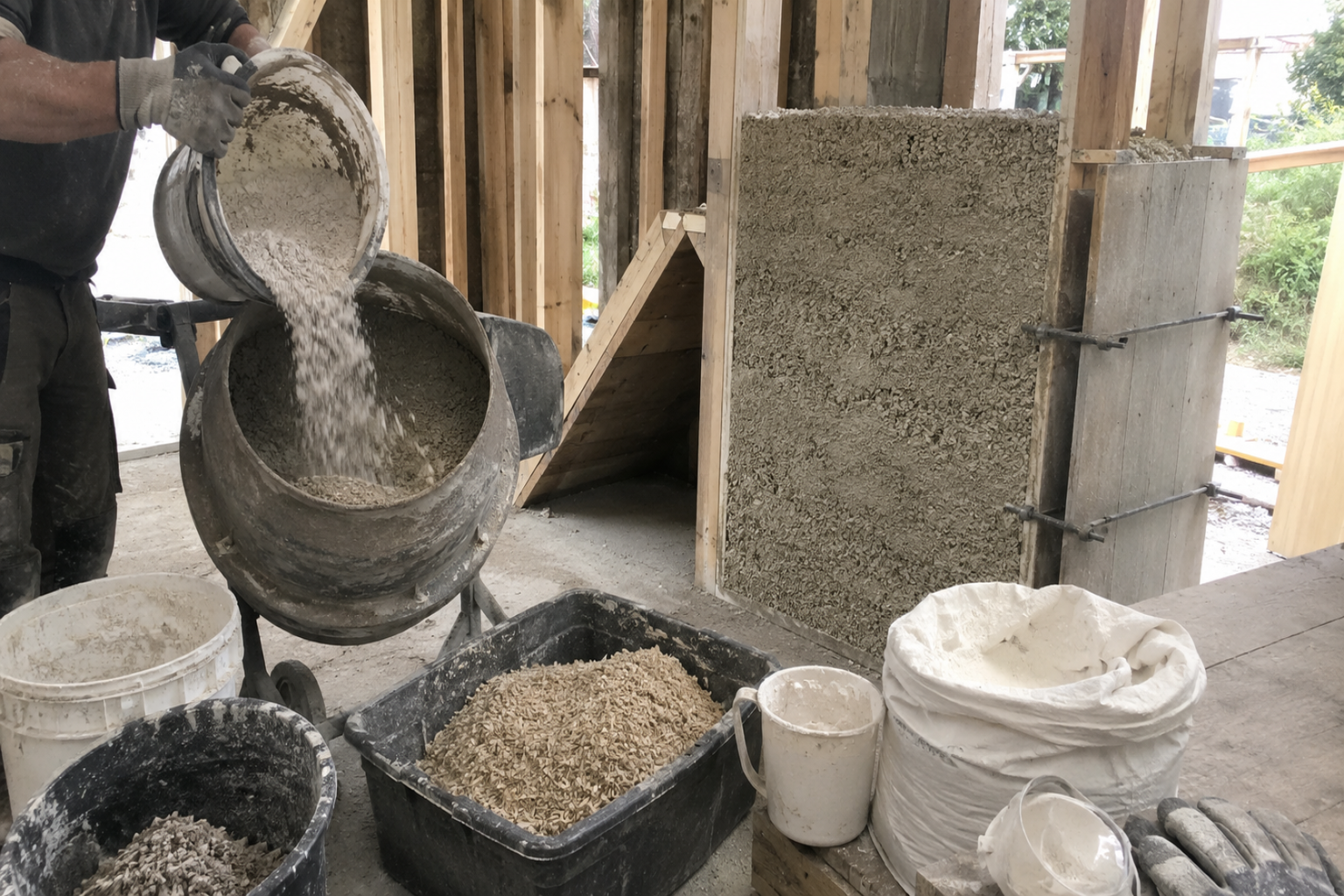
The mix is often too wet.
That is the first sign the crew is treating hempcrete like concrete. Then the shuttering moves, corners get messy, the lift dries slowly, and someone starts packing the wall too hard.
Hempcrete needs a ready frame, planned openings, clean shuttering, the right binder, and a light hand.
Do not start mixing while pipes, wires, boxes, and edges are still being figured out. Get the wall ready first. Then mix, place, tamp lightly, and leave it enough time to dry.
For the broader wall-system view, start with hempcrete. This article stays on the hands-on question of making and placing cast-in-place hempcrete.
What you are really making

Hempcrete is a non-load-bearing wall infill made from hemp hurds, a lime-based binder, and water. The usual cast-in-place version gets packed around a timber frame or other structural frame, then finished with a breathable plaster or render.
That sounds basic. It is. But it matters because it clears up the first bad assumption: the wall fill is not doing the same job as a concrete wall, a CMU wall, or a framed wall full of batts.
The frame carries the structure. The hemp-lime does the infill work. It helps with insulation, moisture buffering, and temperature swing. It also gives you a monolithic wall body that feels different from cavity insulation.
That does not mean every hempcrete wall gets built the same way. Cast-in-place, sprayed, block, and panel systems all exist. Most people searching how to make hempcrete are asking about cast-in-place work, so that is the method covered here.
If the decision is still about hemp as a material family, not this specific wall mix, use hemp building materials first.
The mix is not one fixed recipe
This is where many hempcrete jobs start with a bad assumption. Someone finds one clean ratio online and treats it like the whole specification.
It is not.
The stable part is the material family: hemp hurds, a lime-based binder, and water. The moving part is the actual binder system, the wall density, the placement method, the tested assembly, and the manufacturer’s instructions.
That means a blog ratio should never become the job spec. Real binder manufacturers publish their own mixing instructions, and code language now ties permitted work to approved materials, tested samples, and approved application methods.
| What stays the same | What changes | Why it matters |
|---|---|---|
| Hemp hurds, lime-based binder, and water | The exact binder formula | Different binder systems want different water and hurd loading |
| Non-load-bearing wall infill | Wall density and thermal target | Over-dense walls lose some of what makes hempcrete useful |
| Placed around a structural frame | Hand-cast, spray, block, or panel method | The mixing and placement sequence changes with the method |
| Needs a breathable finish | The timing of that finish | Closing the wall too early traps moisture and slows the job |
A good way to think about it is this: there is no universal hempcrete recipe in the same way there is no universal drywall mud recipe. There is a material family, a method, and a product-specific instruction set.
One current U.S. binder system, for example, uses one 50-pound bag of binder, about 11 gallons of water, and 15 kilograms of hemp hurds. That is useful as a real-world example. It is not permission to ignore the binder you are actually using.
What has to be ready before you mix
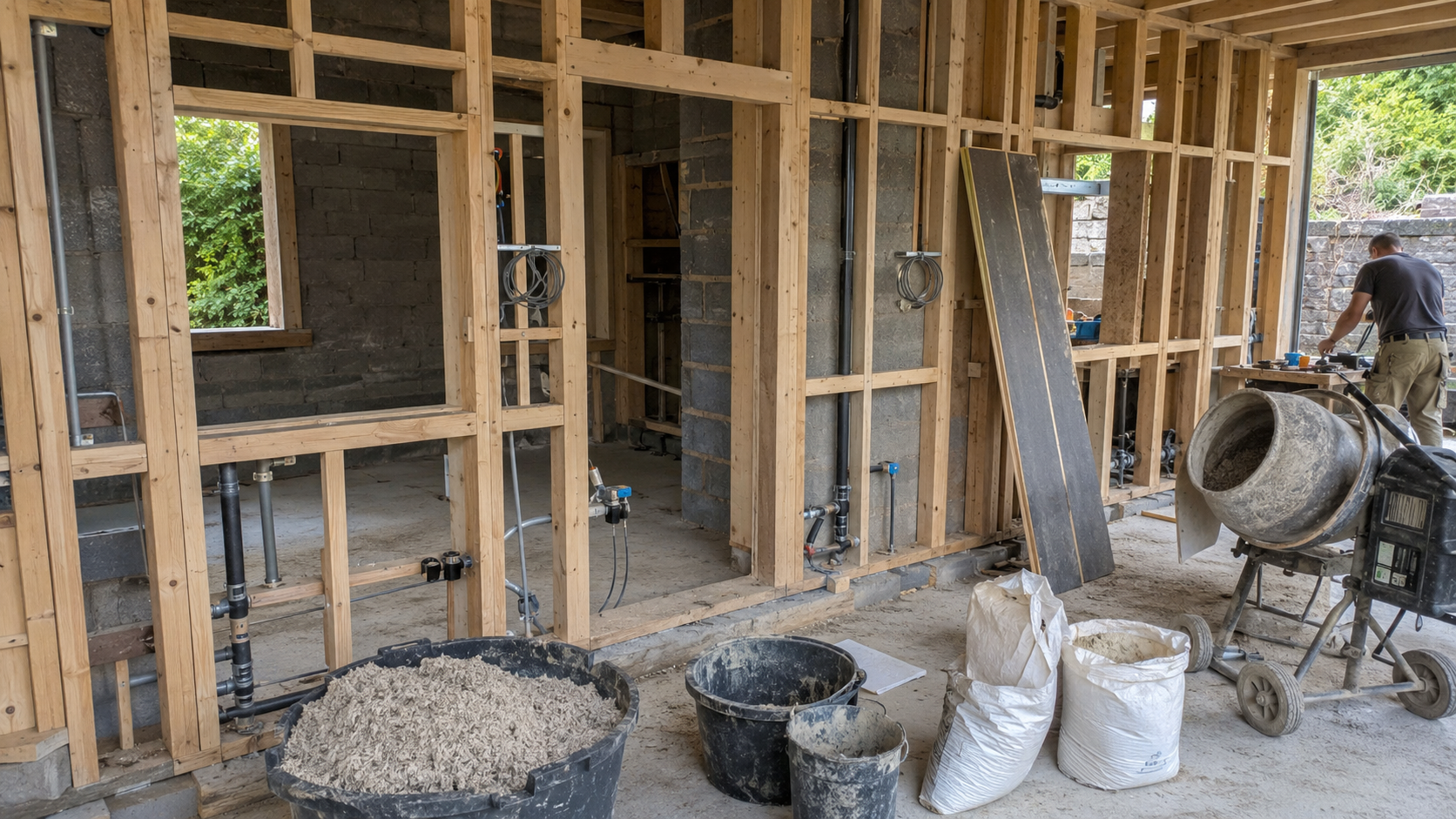
Hempcrete is usually not the first thing that happens on the wall. It is one of the things that happens after a few other decisions are already locked.
Before the first batch is mixed, these need to be ready:
- The structural frame.
- The bottom-of-wall detail.
- Roofing or reliable weather protection.
- Rough openings for doors and windows.
- Sleeves, conduits, boxes, and service paths that need to be in or against the wall.
- The shuttering or formwork.
- A drying plan.
If those are not ready, the wall fill starts carrying decisions it was never meant to carry.
That shows up later in ugly ways. An electrician wants a new route after the wall is in. A box lands where the tamping should have been clean. A sill detail is still guessing about splashback. The general contractor wants the finish coat on before the wall has dried far enough. None of that is a hemp problem. It is a sequence problem.
For the wider context on breathable assemblies, see natural building materials. Hempcrete gets much less forgiving once the sequencing slips.
The basic cast-in-place sequence
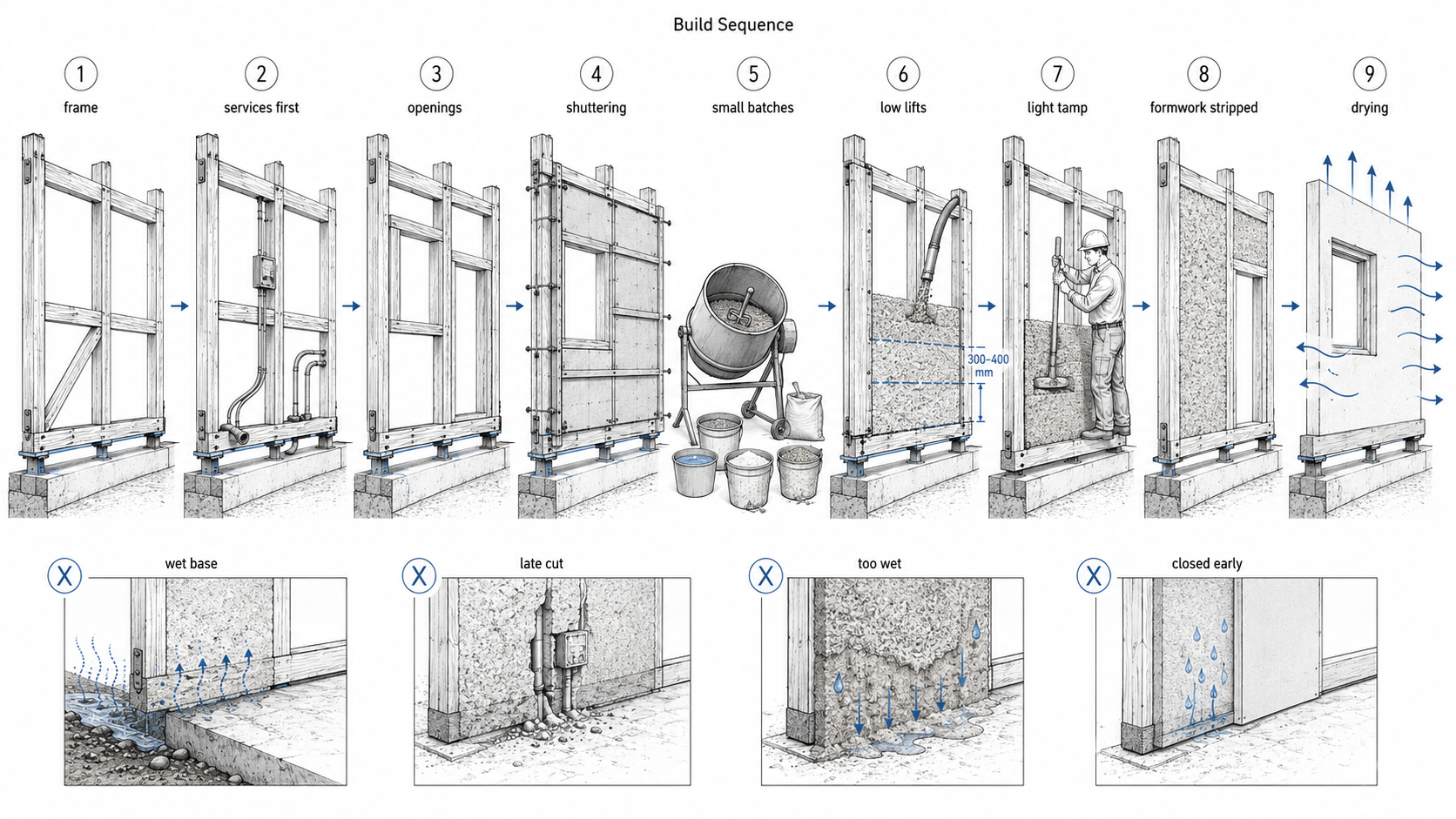
The build sequence is not complicated. It just needs discipline.
1. Set the frame and protect the base
Hempcrete should not sit where splashback, standing water, or slab moisture can keep feeding the bottom of the wall. You need a clean base detail before anything else. That usually means getting the wall up off the slab or foundation in a controlled way and making sure the bottom edge is not the wettest part of the assembly.
This is one of those details that gets ignored because it is boring. Then the wall goes in, the grade is still wrong, and the lower section spends every storm getting hit harder than the upper wall.
2. Finish the rough openings
Door and window openings need to be real openings, not rough intentions. Hempcrete around openings can crack or get messy if the edge conditions are weak. The opening detail, water management, and support conditions need to be decided before placement.
3. Run sleeves, conduits, and boxes first
Do not treat the wall like a place to casually bury future services.
If wiring, plumbing, telecom, or ducts will be in or against the infill, get that organized first. Sleeves and conduits are easier to plan now than to carve into a half-dried wall later. Current code language requires mechanical, electrical, and plumbing components in or in contact with hemp-lime infill to be isolated in sleeves, pipes, conduits, tubing, or another approved separation method. That is not trivia. It changes the wall sequence.
4. Set the shuttering
For hand-cast work, the wall needs forms that hold shape and do not deform under the pressure of wet mix. Good shuttering is not decorative. It is what keeps the wall straight, keeps the lift height under control, and stops the crew from chasing a bulged face later.
5. Mix small, consistent batches
The safest habit is still the obvious one: mix small enough that the crew can place what comes out before the batch starts changing on you.
Hempcrete is not the place for heroic batch sizes when the day is hot, the crew is slow, or the wall detail is awkward.
6. Place in lifts and tamp lightly
Hand-cast work goes in lifts. Current code language for hand-cast hemp-lime limits those lifts to 4 inches. That gives you a useful field rule even if you are working outside a formal permitted path: small lifts are easier to place evenly and easier to tamp without crushing the wall too dense.
Light tamping is the point. Stable wall. No large voids. Not brute-force compaction.
7. Strip forms on time, not by panic
Removable forms usually come off early, often within a day or per the binder manufacturer’s specification. But that does not mean every part of the wall is ready at the same speed. Support around openings may need longer. That is exactly where people get impatient and start wrecking clean work.
8. Let the wall dry before you close it up
Hempcrete is where schedule optimism goes to die. The wall may dry to the touch in about a week under good conditions. That is not the same thing as being ready for finish.
The wall still needs airflow, time, and restraint from everyone else on site.
The part that gets missed before the first batch shows up
What usually goes wrong is not the hurd. It is the prep.
Boxes get placed too late. Service routes are still changing. The frame is ready but the wall crew still does not know where the pipe sleeve needs to land. Somebody assumes the electrician can “just cut it in later.” That is a bad assumption with almost any low-density wall infill. It is a worse one here because the wall still needs to dry and stay breathable.
Another miss is access. Hempcrete is physically simple, but it is still material handling. Bags, hurd, water, mixer, form boards, wheelbarrows, tampers, cleanup. If the access path is tight, wet, or shared with too many other trades, the whole job slows down.
Then there is the schedule problem that shows up three weeks later. The wall is in, but the site program still thinks it is ready to move at framed-wall speed. Now the plasterer, painter, or interior finish crew is waiting on moisture, and everyone acts like the wall is late. It is not late. The schedule was wrong.
The mix itself is not usually the job-killer. The sequencing around the mix is.
Where jobs start going sideways
Most bad hempcrete work is not mysterious. It usually comes from the same handful of mistakes.
| What people do | What it causes | Better move |
|---|---|---|
| Add extra water to make the batch easier | Slow drying, slumping, weaker wall body | Follow the binder spec and adjust in small moves, not panic pours |
| Tamp it like concrete | Over-dense wall, worse thermal performance, harder drying | Light, even tamping just to stabilize the lift |
| Mix too much at once | Lost workability and inconsistent placement | Size batches to the actual crew and wall speed |
| Ignore base detail and splash risk | Wet lower wall, ugly repairs, durability trouble | Get the base and drainage right before placement |
| Close the wall too early | Trapped moisture and finish problems | Let the wall dry and check moisture before finishing |
The other common mistake is trying to make hempcrete solve the wrong problem. It is not a foundation material. It is not a below-grade waterproofing move. It is not a fast-track commercial enclosure system. It is a breathable, non-load-bearing infill material with a different pace and a different logic from standard cavity insulation.
The part nobody budgets right: drying time
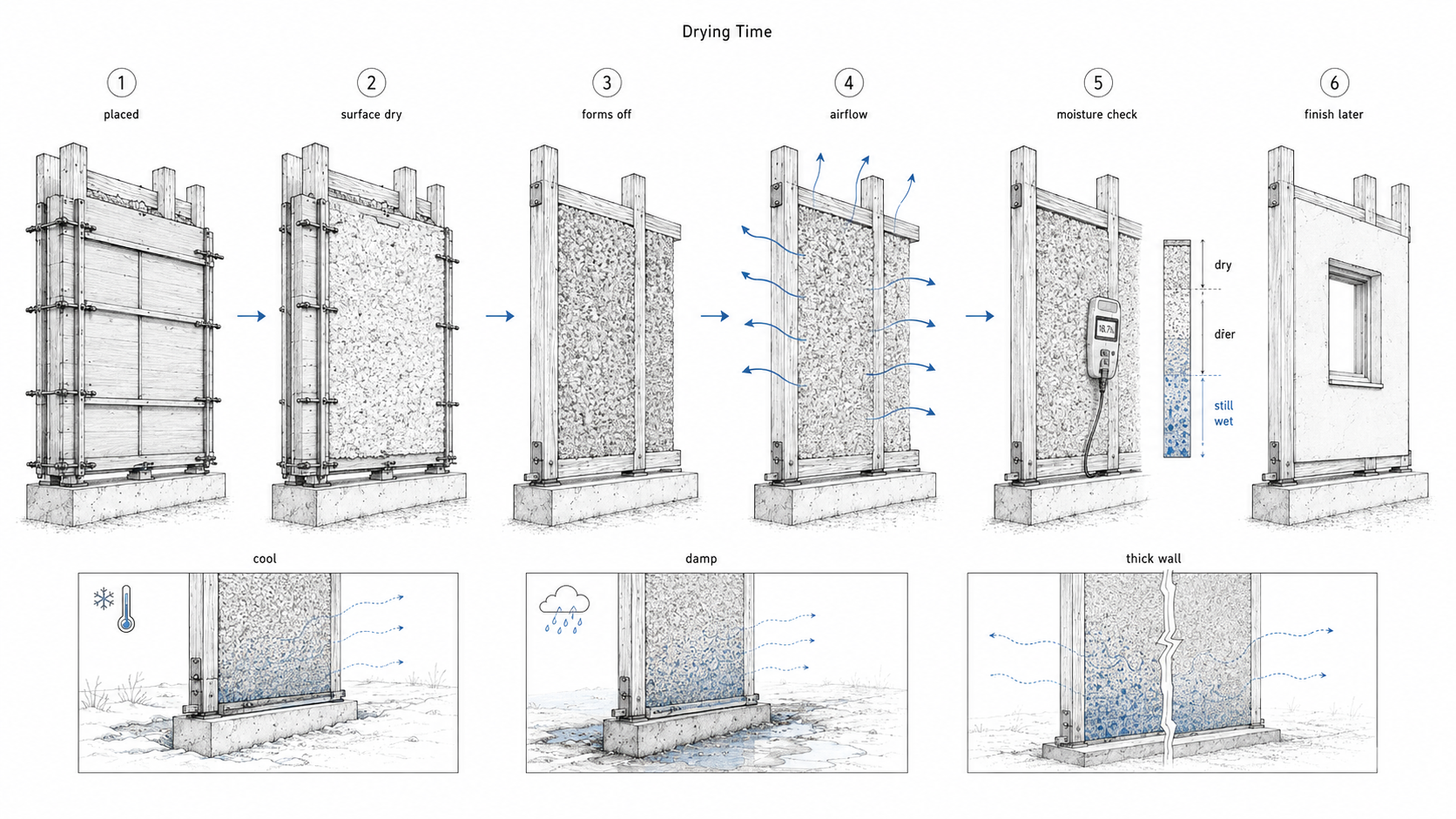
Hempcrete does not behave like concrete. It does not behave like drywall. It definitely does not behave like batt insulation.
That matters most after placement, when people start asking how soon the wall can be closed, rendered, or handed off to the next trade.
Australian hemp masonry guidance notes that hemp masonry usually dries to touch in about 7 days, while the curing process can take 3 months. That gap is where bad schedules get exposed. A wall that feels dry on the surface is not the same thing as a wall that is ready for the next layer.
In current U.S. code language, finishes go on only after the wall moisture content is low enough. That is the right way to think about it. Not “it looks dry.” Not “the crew wants the forms back.” Moisture content.
If the job is in a cool, damp season or the site has poor airflow, drying becomes the part that drags the whole wall system out. That is not a reason to avoid hempcrete. It is a reason to stop pretending it runs on framed-wall speed.
If the decision is still about overall envelope strategy, sustainable insulation is useful context. Hempcrete makes more sense when the project can tolerate a slower wall cycle.
Do this instead of this
| Do this | Instead of this | Why |
|---|---|---|
| Choose a binder system and follow its instructions | Using a generic online recipe as the whole plan | Binder systems vary, and the water/hurd load is not universal |
| Get the frame, sleeves, and shuttering ready first | Thinking the wall can absorb unfinished decisions | Late changes around services and openings create rework |
| Place small lifts and tamp lightly | Forcing large lifts and heavy compaction | Dense walls dry slower and perform worse |
| Leave time for real drying | Scheduling finish trades like this is a standard framed wall | The wall may feel dry long before it is finish-ready |
| Use breathable finishes | Closing the wall with impermeable coatings | The wall works because moisture can move through it |
What hempcrete does well
It fills a wall in a way batt insulation does not. It gives you a single infill body instead of a cavity stuffed between thin layers. It helps moderate humidity. It gives some thermal mass. It can make a house feel quieter and steadier through the day.
It also sits well inside the larger natural-material conversation because it does not ask the wall to work by trapping everything behind impermeable layers. That is one reason it keeps getting attention from designers already interested in natural insulation materials and other vapor-open wall systems.
What it does badly is just as important.
What hempcrete does badly
It does not carry a structure by itself. It does not like rushed schedules. It does not solve below-grade water. It is not the cheapest way to insulate a wall. It is not the easiest system to hand off to a random crew that has never seen it before.
And it is not the right answer when the project really wants a simple framed wall with fast dry-in and standard trade sequencing.
That is where a more conventional insulation approach may make more sense. Hemp insulation is closer to that conversation than cast-in-place hempcrete. Same plant family. Different wall logic.
FAQ
Can I just mix hempcrete like a normal concrete batch?
No. The materials, consistency, and compaction target are different. You are aiming for an even, lightly compacted wall infill, not a dense structural pour.
Can I use any lime I find locally?
No. Use the binder specified for the system you are building. The whole wall depends on that choice, and generic lime substitutions can change drying, strength, workability, and finish timing.
Can I run wiring later if I forgot something?
You can cut into the wall later, but that is exactly the kind of avoidable rework that makes the job uglier and slower than it needed to be. Sleeves, conduits, boxes, and service routes should be planned before placement.
How long before I can finish a hempcrete wall?
Longer than most schedules want. Dry-to-touch is not the same as cured or finish-ready. The answer depends on thickness, airflow, season, wall exposure, and the binder system.
Can hempcrete replace fiberglass or mineral wool in every project?
No. It is a different wall approach. If the project needs speed, thinner walls, or standard trade sequencing, a batt or board insulation system may still be the better move.
Do I need to render exterior hempcrete?
Usually yes. Exterior hempcrete needs a breathable protective finish. Leaving it exposed like an unfinished novelty wall is not good practice.
Can hempcrete be structural?
Do not write the spec that way unless you are using a system with its own verified structural path. Normal cast-in-place hemp-lime wall work is treated as nonstructural infill, with the frame carrying the structure.
What is the easiest way to ruin a hempcrete wall?
Too much water, too much compaction, bad sequencing around services, poor base detailing, or closing the wall before it has dried enough.
Read This Next
- Hempcrete — for the broader wall-system overview.
- Hemp Building Materials — if you are still comparing hemp as a material family.
- Natural Building Materials — for the larger breathable-wall context.
- Sustainable Insulation — if the decision is still about overall envelope strategy.
- Hemp Insulation — if you need a simpler insulated-frame approach.
- Hemp Insulation vs. Fiberglass — useful when the real choice is hemp-lime versus a simpler insulation system.
- Is Hemp Insulation Flammable? — for fire-safety questions around hemp-based wall systems.
References
- International Code Council, 2024 International Residential Code, Appendix BL: Hemp-Lime (Hempcrete) Construction.
- International Code Council, Appendix BL hemp-lime installation language, including mix, formwork, MEP separation, and hand-cast lifts.
- LimeWorks.us, Ecologic™ HempCrete Binder Platinum product sheet.
- YourHome, Australian Government, Hemp masonry.
- US Hemp Building Association, Hemp-lime appendix published in 2024 U.S. model residential housing codes.