


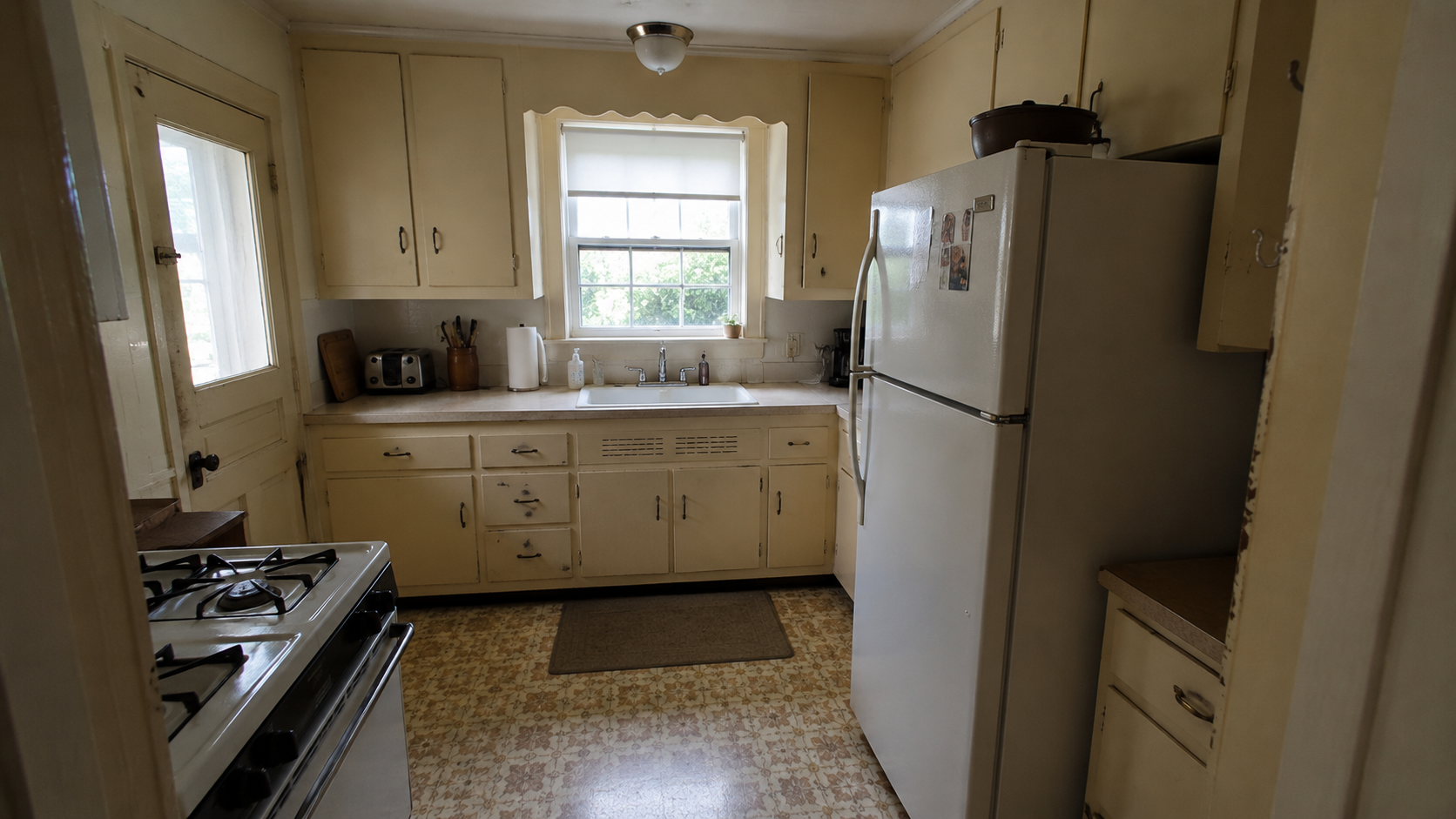
A 1940s kitchen can waste money fast.
The room is small, so the job looks small. That is where people get caught.
New floor. New cabinets. Better lights. Maybe open one wall. It sounds manageable until the old cabinets come out and the room stops lying. The wiring is older than expected. The vent path is weak. The sink move pulls in plumbing and patch work. What looked like a finish job starts touching systems, structure, and money.
The best 1940s kitchen remodels do not try to turn a tight room into a fake new-build showpiece. They fix movement, light, storage, and service problems first. Then they decide what is worth replacing.
If you want the decade background first, start with 1940s house styles. That helps you read the house before you start changing walls, windows, cabinets, and openings.
If the whole house is in play, not just the kitchen, read renovating a 1940s house. It covers what usually gets expensive late, what to fix first, and where old-house scope starts widening.
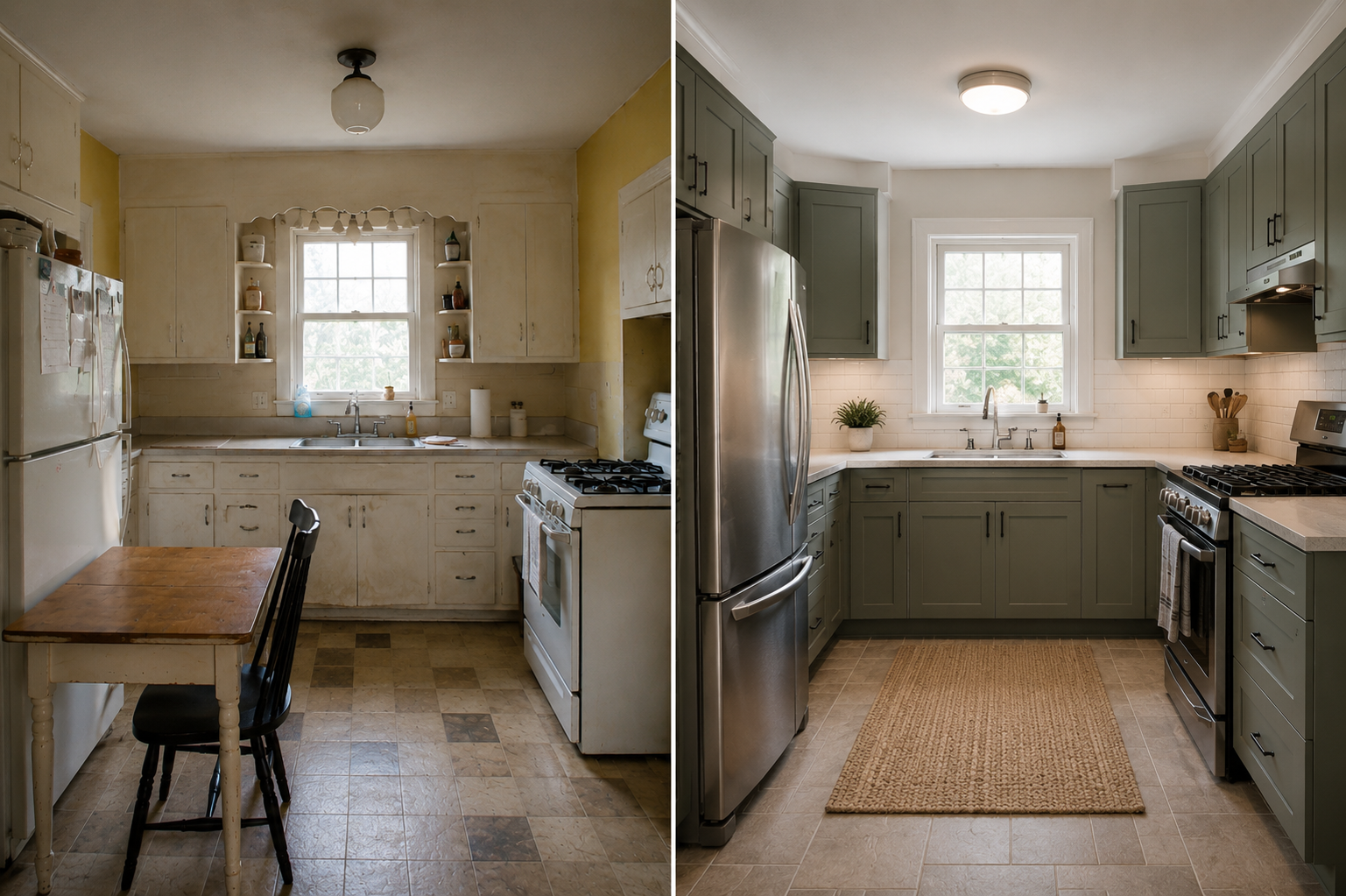
Image by ArchitectureCourses.org. A smart 1940s kitchen update does not need to make the room bigger. The stronger version improves light, storage, and flow without pushing the house into the wrong style.
Read the room first
Not every 1940s kitchen is the same. Some still lean toward the 1930s: tighter, more formal, more separated from dining. Some already lean toward the 1950s, with a little more openness and easier yard connection.
That difference matters. A compact, quiet house usually looks worse when somebody drops in a giant island, strips out every divider, and forces the room to behave like a much newer house. If the house already has a looser late-1940s feel, you have more room to open it carefully. The mistake is not updating it. The mistake is reading the decade wrong, then spending money to make the kitchen fight the rest of the house.
Fix the path before the surfaces
A lot of bad kitchen remodels start with finishes. The real problem is often movement.
Can two people pass each other without turning sideways? Does the refrigerator door block the main route? Is there landing space beside the sink and range, or does everything collapse into one tight corner? Does somebody coming in from outside with groceries hit a chair, an appliance door, or a bad turn?
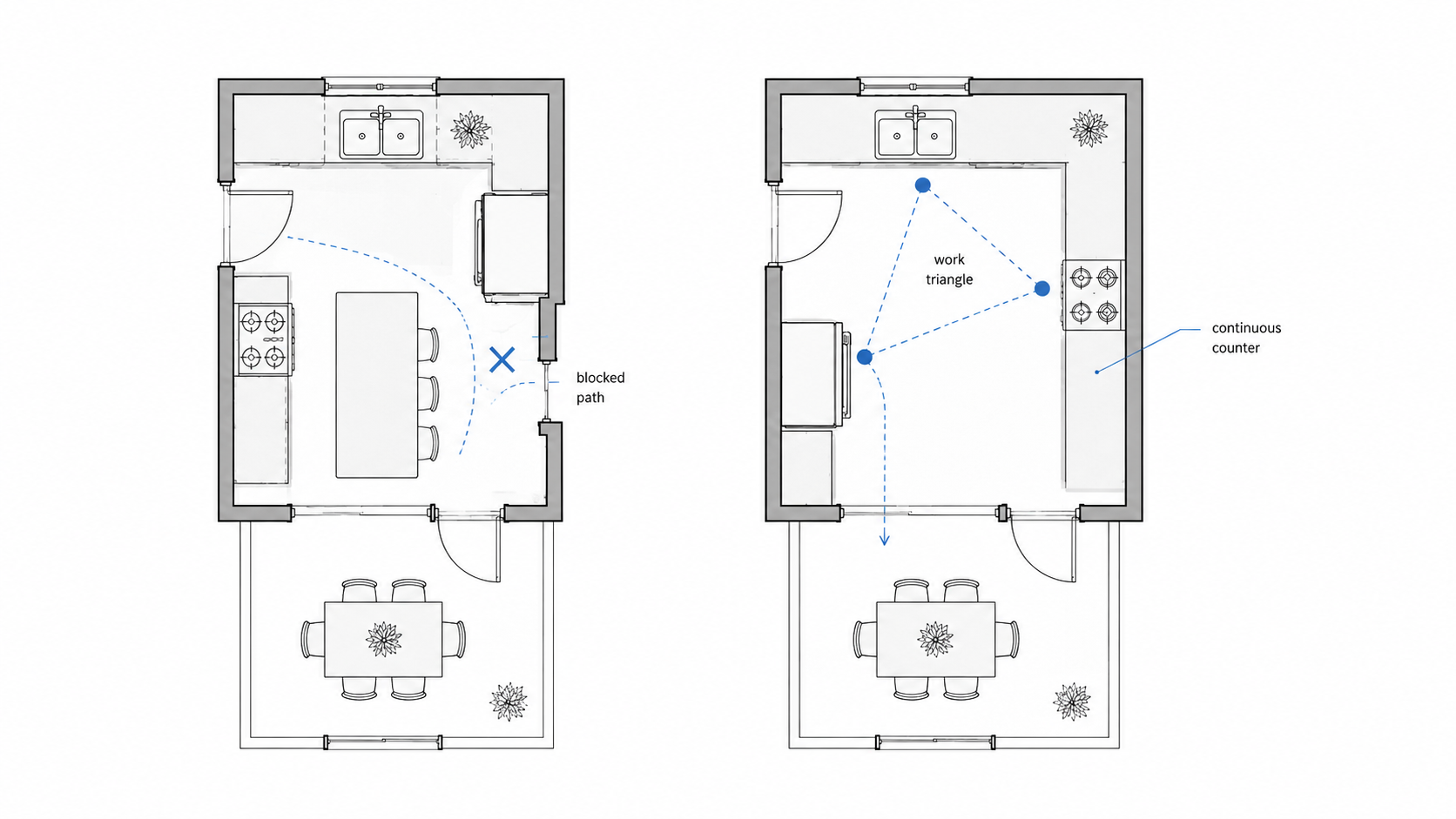
Illustration by ArchitectureCourses.org. In a small 1940s kitchen, fixing the path between sink, stove, refrigerator, and dining area matters more than forcing in a large island.
| Kitchen move | What it helps | What it can widen |
|---|---|---|
| Move the refrigerator | Improves circulation and daily use | Cabinet changes, outlet changes, patch work |
| Move the sink | Can improve counter layout and window use | Plumbing, venting, flooring, wall repair |
| Open part of a wall | Can improve light and connection to dining | Structure, beam work, ceiling repair, lost cabinet wall |
| Add an island | Can add work surface and storage | Blocked circulation, blocked service access, crowded appliance doors |
| Replace the window | Can improve comfort and reduce drafts | Trim, siding, plaster, smaller glass area if done badly |
Most 1940s kitchens improve more from one or two smart moves than from a full rewrite.
Keep the parts that still work
Not every old cabinet is worth saving. Not every old window is precious. But a lot of 1940s kitchens lose money when the remodel starts by throwing out everything that looks dated before anyone asks what is still doing a useful job.
Keep the parts that still earn their place. A sink window that still gives the room daylight. A breakfast nook that still fits daily life. Cabinet boxes that are plain but solid. A doorway to dining that already makes sense. Even modest trim can matter if it keeps the kitchen tied to the rest of the house instead of making it look like a different decade was dropped into the middle of it.
The point is not preservation for its own sake. The point is sequence. Replacing a sound element can create patch work, filler pieces, trim changes, smaller glass area, or wasted money without solving the actual problem.
The cabinet quote is not the kitchen budget
This is one of the easiest ways to misread a kitchen renovation. The cabinet number looks like the job, so people start building the whole budget around it.
Then the old kitchen comes out and the room stops being neat. The walls are not straight. The floor does not run under everything you thought it did. Old outlets need to move. The backsplash zone is rougher than expected. Filler strips, trim pieces, patching, leveling, and small corrections start stacking up around the cabinet install. None of that sounds dramatic by itself. Together, it is how the quote starts drifting.
The protective move is simple: treat the cabinet price as one line item, not the project total. Ask early what is excluded, what has to be patched first, and what happens if the walls, floor, or electrical are worse than they looked with the old kitchen still in place.
What the number usually looks like
If you need a rough U.S. planning anchor, broad 2025 remodel data puts many kitchen remodels in the mid-five figures. That is only a starting point.
The number that matters in a 1940s kitchen is not the national average. It is how fast the room stops being a finish job. National consumer cost guides put many kitchen remodels around the mid-$20,000s on average, with a common range running from the mid-teens into the low $40,000s. Remodeling’s national benchmark for a midrange minor kitchen remodel is just under $27,500. Once you add sink moves, electrical upgrades, weak floors, or wall openings, you are not in the easy lane anymore.
| Planning marker | What it means | Why it misleads in old kitchens |
|---|---|---|
| National average remodel range | Useful as a starting point only | Does not capture hidden old-house repair work well |
| Minor midrange benchmark | Closer to a keep-the-footprint job | Still assumes fewer surprises than many 1940s rooms deliver |
| Wall opening or plumbing move | Changes the job type | Now structure, venting, patching, and finish spread outward |
Use the broad numbers to keep yourself from fantasy budgeting. Do not use them as a bid.
The sink move is where the room starts touching the house
This is where budgets often break.
Moving the sink sounds small. Better view. Better counter run. Better cabinet layout. On paper it looks like a smart move.
Then the wall opens. The drain path is awkward. The vent is weak or wrong. The floor has old repair work where the previous sink or dishwasher leaked. The new layout now needs plumbing, patching, and maybe subfloor work before the nice part of the job even starts.
The same thing happens when the range moves. Now the hood path changes. Electrical changes. Wall finish changes. Landing space changes. What looked like a finish decision becomes a systems decision.
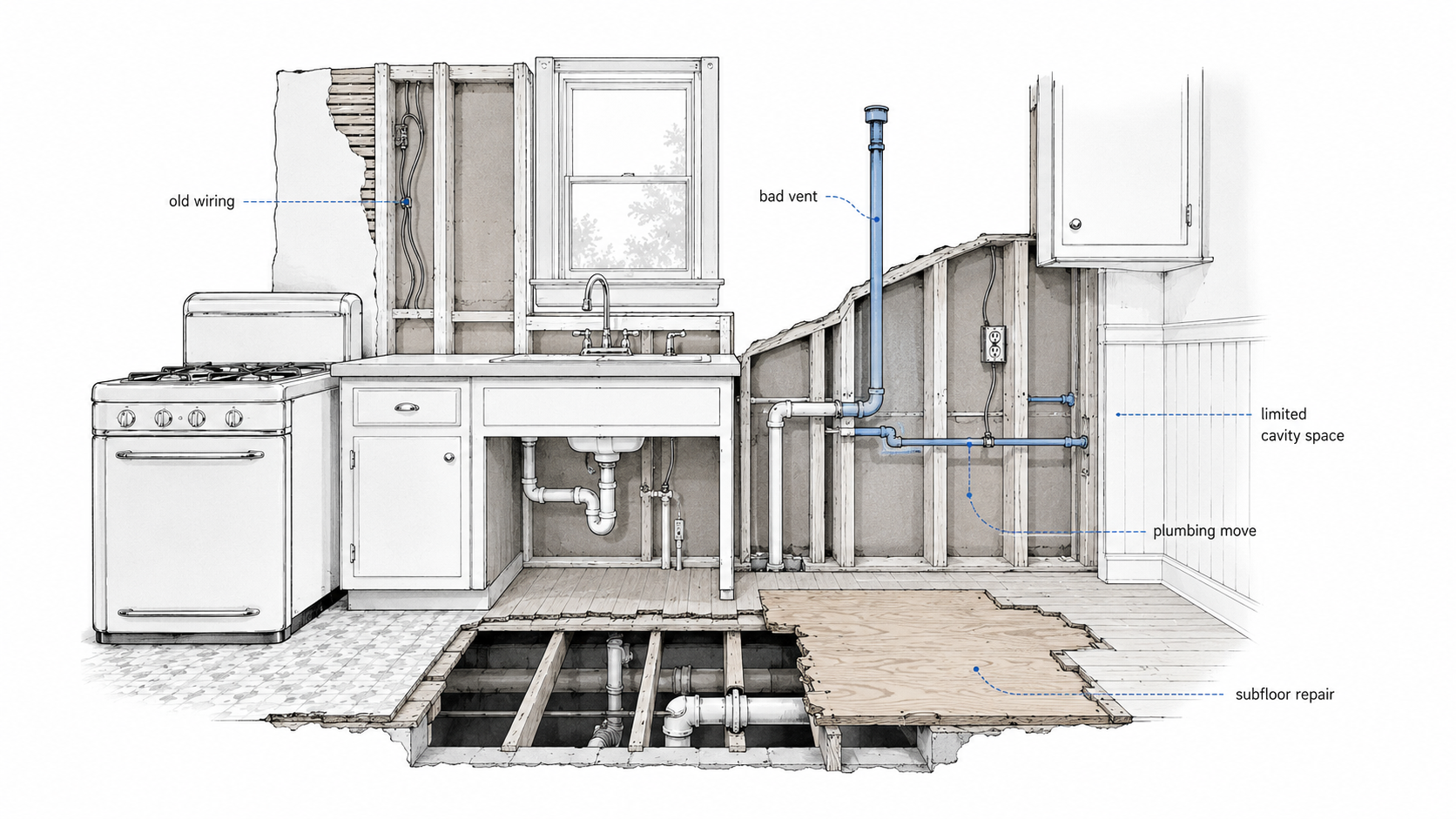
Illustration by ArchitectureCourses.org. Moving a sink or range in a 1940s kitchen can expose old wiring, bad venting, limited wall space, patched plumbing, and subfloor repair that were never visible in the first quote.
That does not mean never move a sink or range. It means price the boring work first. The hidden cost is usually not the fixture. It is what the fixture makes you touch.
Wider is not always better
A lot of 1940s kitchen advice still acts like the answer is simple: remove the wall and the room is fixed.
Sometimes that helps. More often, it just spreads the problem out.
If the wall is doing nothing important and the kitchen is dark and cut off, opening part of it can be worth the trouble. But a full opening can also erase the best cabinet wall in the room, drag in beam work, and leave you with less useful storage, less controllable mess, and a bigger repair zone than the kitchen alone would have created.
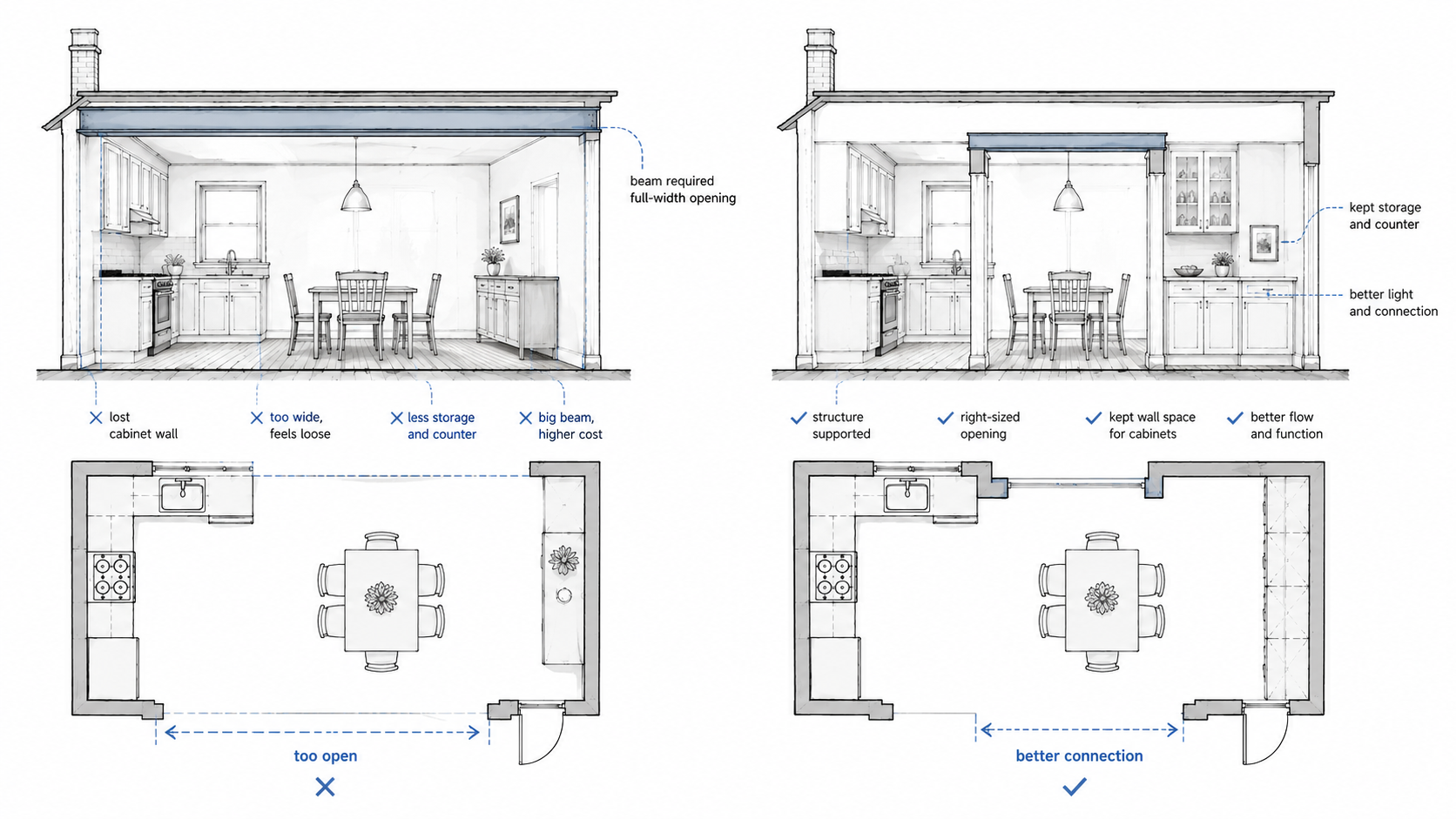
Illustration by ArchitectureCourses.org. A wider kitchen opening is not always better. In a small 1940s house, a selective opening can improve light and connection while keeping cabinet space, structure, and cost under control.
The question is not whether the wall can come out. The question is what the room loses when it does.
Before you treat the opening like a simple carpentry move, check load-bearing vs non-load-bearing walls. Even when the wall is not carrying major load, the finish and layout consequences are still real.
An island can kill the aisle
Small 1940s kitchens get over-islanded all the time.
The island looks like the upgrade. More storage. More seating. More resale. But in a truly small kitchen, it can choke the room. Refrigerator door open on one side, dishwasher open on the other, somebody standing at the sink, and suddenly the route through the room is gone. That is not a design disagreement. That is a daily-use failure.
It also blocks service access. Base cabinets become harder to reach. Appliance repair gets tighter. Trash pullouts and lower drawers start fighting the same narrow strip of floor. The room feels more expensive and less usable at the same time.
Most of these kitchens do better with cleaner counter runs, better drawers, a small table, or a narrow work surface that does not pretend the room is bigger than it is. The room has to earn an island.
That one window does more work than it looks
A lot of 1940s kitchens depend on one modest sink window to keep the room from feeling shut in.
That is why bad replacement work hurts more than people expect. Insert replacements shrink the glass area. Thick trim builds inward. The room gets darker while the quote still calls it an upgrade.
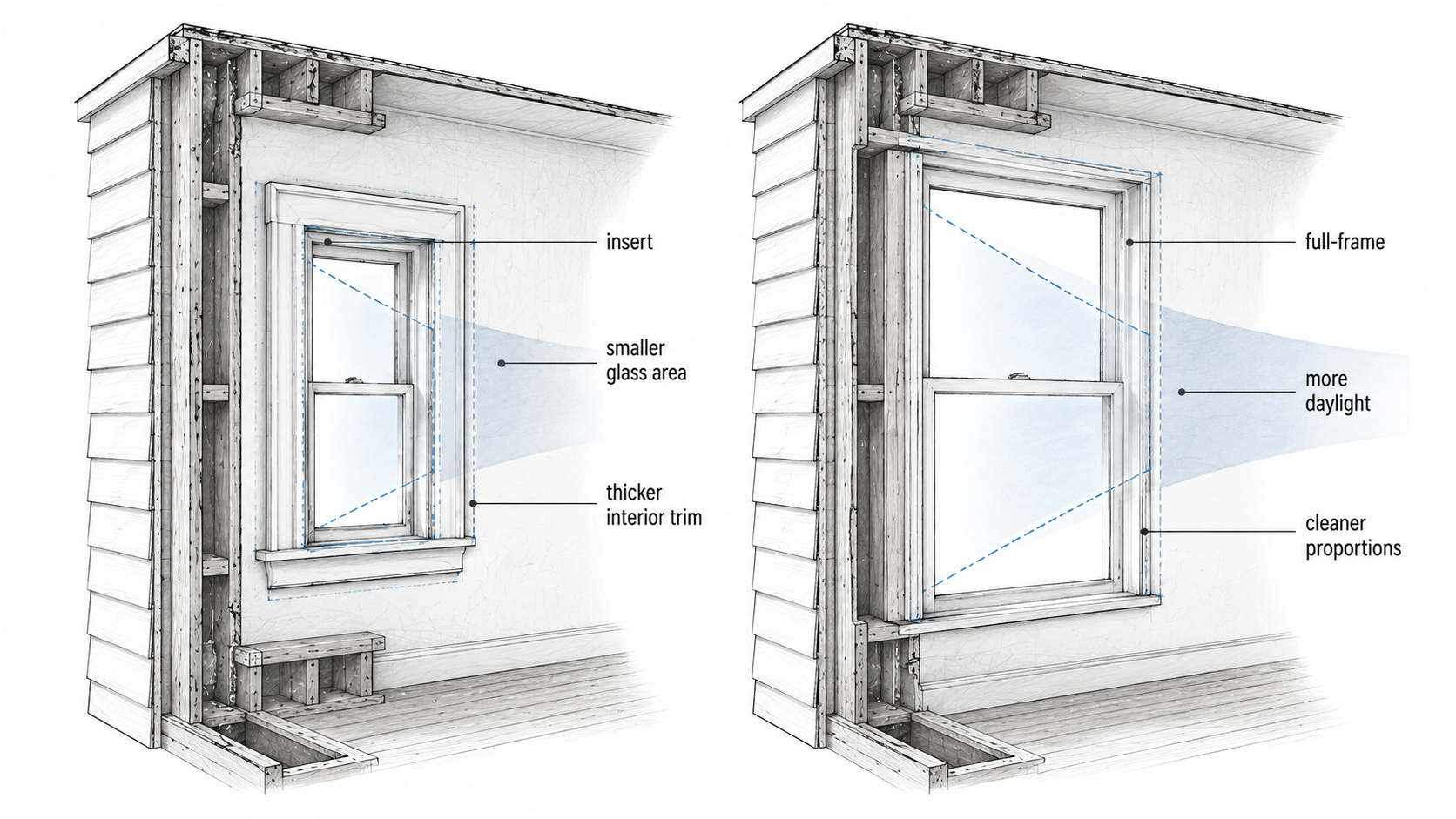
Illustration by ArchitectureCourses.org. Insert replacement windows can save work at the opening, but they often reduce glass area and daylight compared with a full-frame repair or replacement.
If the window is still sound enough to repair, repair may be the better move. If it truly needs replacement, scope the opening honestly and read wooden window frame replacement before you approve a shortcut that leaves the room with less daylight than it had before.
The old floor can stop the job cold
This is another place where small kitchens stop behaving like small projects.
Late-1940s floor layers can hide more than wear. Old sheet goods, mastics, and some floor tiles may need to be treated as a hazardous-material question before they become a demolition question. Even when the real issue is not asbestos, the floor can still decide the scope because it is patched badly, uneven, soft near the sink run, or not built to support what the new finish wants.
Do not assume the floor is just a cosmetic layer. If there is any reason to suspect older hazardous material, stop grinding, scraping, and sanding until it is checked properly. If the floor is weak, repair the floor first. Everything above it waits.
Small kitchens go upside down fast
This is the part people usually find out late.
Because the room is small, owners assume the budget risk is small too. But a kitchen is tied to whole-house systems. One small room can still widen electrical, plumbing, venting, wall repair, floor repair, and window work.
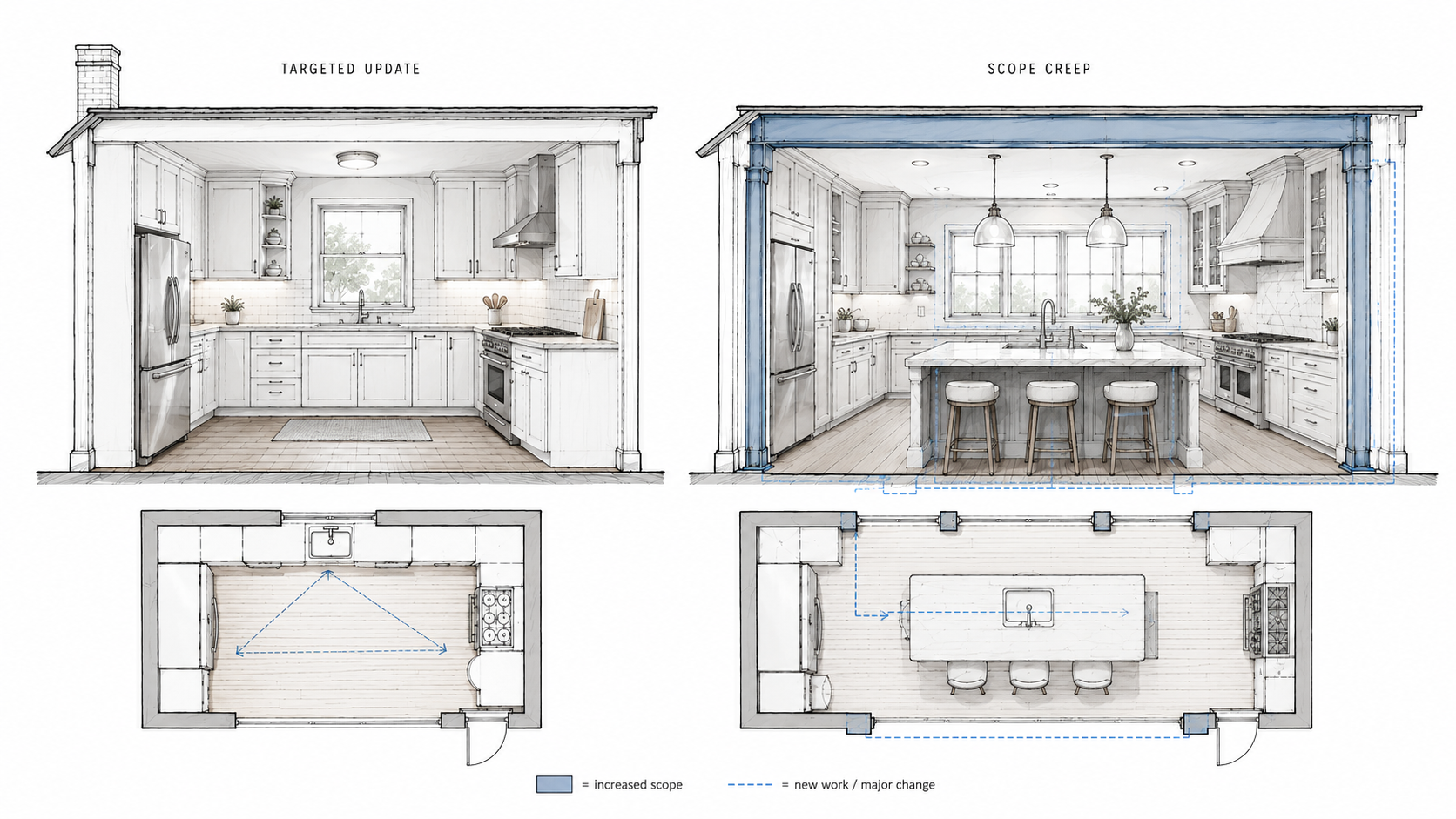
Illustration by ArchitectureCourses.org. A small 1940s kitchen can become financially upside down when a focused update turns into structural widening, a larger island, window changes, and major new work.
That is how a modest kitchen becomes financially upside down. The finish area is small. The repair logic is not.
The check is blunt. Ask whether the next dollar is making the kitchen work better or just making it look more expensive. Those are different jobs. Small old kitchens punish that confusion fast.
Spend here before the countertops
If the budget is not endless, spend in this order:
- Layout and circulation. If the room still moves badly, the remodel will still feel bad.
- Electrical and venting. This is the boring work that makes the kitchen feel dependable.
- Window and daylight problems. A small kitchen gets claustrophobic fast when light gets worse.
- Cabinet and storage fixes. Good storage helps more than fancy surfaces.
- Countertops, backsplash, and decorative finish moves. These come later.
That order is less exciting, but it keeps the room from becoming a prettier version of the same old problem.
If the problem is water, stop decorating around it
If the floor near the sink feels soft, the exterior wall stays cold and stained, or the room smells off after rain, stop treating it like a finish issue. Kitchens do not usually advertise water trouble cleanly. They just keep absorbing money until someone opens the right spot.
Diagnosis first. Find the source. Then price the repair.
If the problem is broader than the kitchen, start with basement groundwater leaks or water in a crawl space after rain before you build over symptoms.
FAQ
How much does a 1940s kitchen remodel usually cost?
As a rough U.S. planning range, many kitchen remodels still land in the mid-five figures. A straightforward keep-the-footprint job can stay closer to the broad national averages. Once the room starts touching plumbing, electrical, wall openings, or weak floors, the number can move fast. Use national averages as a reality check, not as a quote.
Can I keep the original layout?
Yes, and in a lot of 1940s kitchens that is the smarter move. If the room’s main failure is storage, light, or appliance placement, keeping the basic plumbing and wall logic can save money without freezing the room in time.
Should I open a 1940s kitchen to the dining room?
Sometimes. Only if the opening improves light and movement without destroying the best cabinet wall or dragging structural work into a room that could have improved more cheaply another way.
Are old 1940s kitchen cabinets worth saving?
Sometimes. If the boxes are sound and the layout still helps, repair can beat replacement. If the storage is bad and the room is fighting itself, sentiment will not fix that.
What if the old floor tile might contain asbestos?
Treat that as a stop sign, not a side note. Do not grind, scrape, or sand first and ask questions later. Have the material checked and let that answer decide the demolition method.
Is a sink move worth it?
Only when the layout gain is real enough to justify the plumbing, venting, flooring, and patch work that usually come with it.
What is the biggest kitchen mistake in a 1940s house?
Treating a small room like it needs a giant modern solution. These kitchens usually improve more from better planning than from bigger gestures.
Read This Next
If your house still needs the bigger renovation picture first, read 1940s house styles and renovating a 1940s house to place the kitchen in the right decade logic and the right project order.
If a wall opening is part of the plan, check load-bearing vs non-load-bearing walls before you price it like a drywall job.
If the window over the sink is part of the scope, read wooden window frame replacement before you approve insert units that shrink the light.