

If you're thinking about enrolling in architecture school just for the prestige, I urge you to read this first.
I'm not saying prestige is a bad reason, but it's not enough. After a year or two—which is usually how long it takes for someone to realize this field isn't for them—you’re going to quit. And losing one or two years of your life is no joke.
Forget what they say about needing to be a math genius or a flawless artist. It's not true. Yes, both have their place, but you don’t need to be Einstein or Michelangelo. You just need to know enough to think, sketch, test, and make decisions.
What really matters is passion. A real interest in space, materials, problem-solving, and how buildings work. And yes, a theoretical mind—someone who enjoys connecting ideas, systems, and concepts. Some of the best architects aren’t math prodigies or sketchbook wizards. They’re people who care deeply about the built world and think clearly about how to shape it. The math can be learned. The drawing gets better. But the mindset? That’s the part you can’t fake.
So, Why Study Architecture?
Architecture makes you understand space, light, people, and how they all connect. So what? Well, for one thing, it has to do with one of the big four—shelter, food, water, and air. Shelter is a basic human need.
And yeah, the safe definition still works: it’s a mix of art, science, and storytelling. At least until a genius like Zaha Hadid shows up and gives us a new, sharper definition of what architecture can be. But trust me, you don’t just draw plans—you design how people live and feel inside them. And that’s big. Really big.
Every city, house, and street you walk through was designed by someone who studied architecture. I know you already know that, but that’s not the point. The problem is that most architecture goes completely unnoticed. Ninety-nine percent of what’s built fades into the background. We pass it every day without thinking about who designed it or why it feels the way it does. That’s the real loss—when people stop seeing how space affects their lives.
If you’ve ever noticed how sunlight falls into a quiet library or why some houses feel warm and others don’t, you already think like an architect. And we need people like you, my friend, to join the field. Get it?
Why Architecture Is Still One of the Smartest Fields to Learn
What Architecture Really Does to You
Here’s what nobody tells you: studying architecture rewires your brain. You start walking slower. You stare at corners longer. You sit in cafés just to watch how light hits a wall.
It’s not obsession—it’s calibration.
You start seeing the world in sections and plans. You notice cracks in sidewalks, roof lines, shadow angles, noise reflections. You can’t turn it off. And that’s the real shift: you stop consuming spaces and start reading them.
It messes with you in good ways. You stop blaming people for bad moods and start blaming bad lighting. You stop saying “that building is ugly” and start asking “what problem was it trying to solve?” You start understanding why things feel the way they do. That’s design literacy. Once you get it, you can’t go back.
That’s why architecture school isn’t just about drawings or buildings. It’s about learning how to see—really see. Most people walk through life 99% blind to the spaces around them. You won’t anymore. That’s your edge. That’s your curse. That’s your gift.
FIELD NOTE: Try this for a week. Pick one space you walk through daily—your kitchen, your hallway, your bus stop. Spend five minutes just observing: light, sound, materials, movement. Then sketch it from memory. Do that seven days straight. You’ll realize how much you’ve been missing. That’s the moment you stop being a visitor and start becoming a designer.
8 Real Reasons to Study Architecture
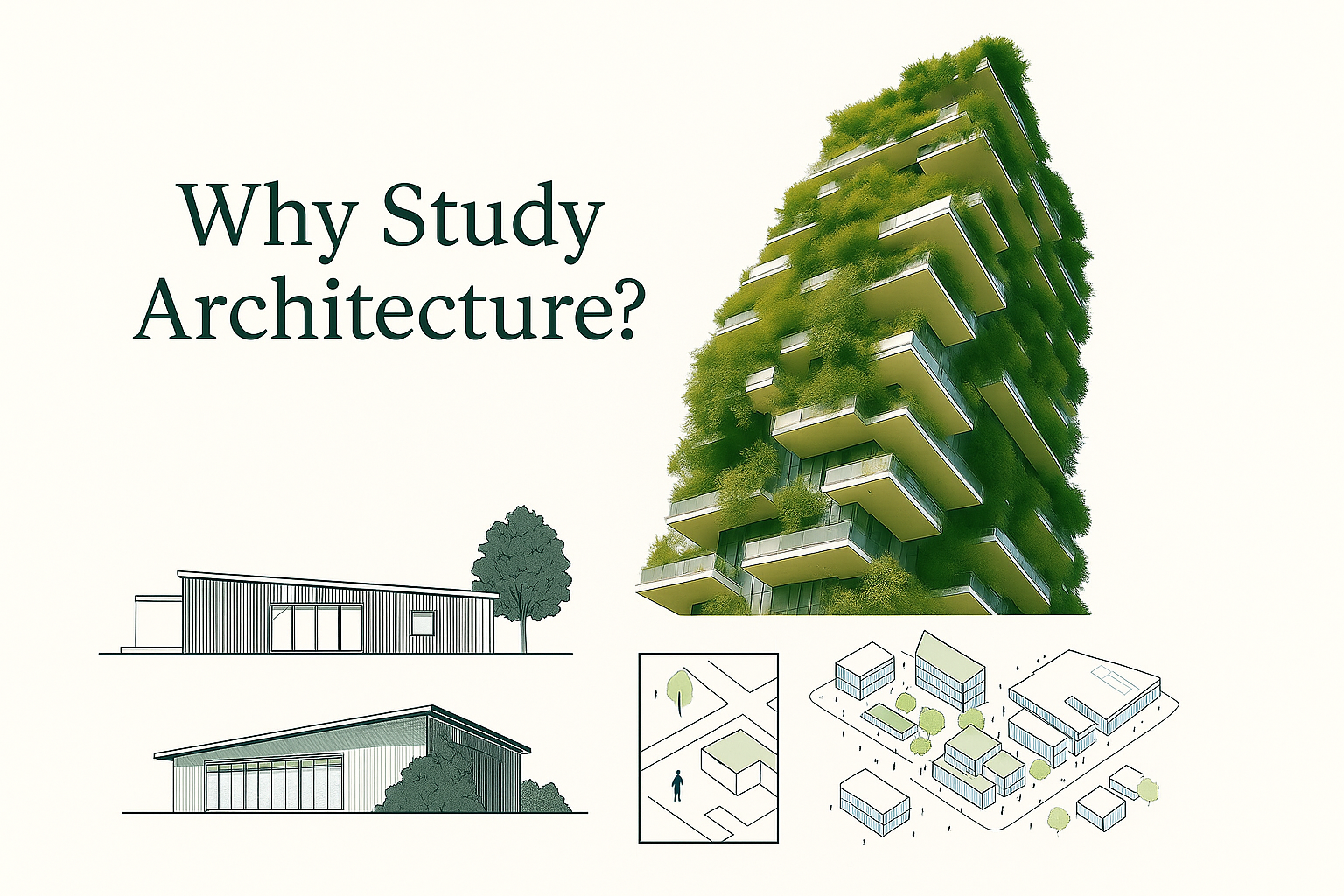
1. What Architecture Really Teaches You
When you start an architecture course, you think it’s about drawing buildings. It’s not. It’s about learning how to think. You’ll draw, yes, but you’ll also study people, physics, cities, history, and climate. Every design you make must balance what looks good and what actually works.
Architects are part artist, part engineer, part psychologist. We design for emotions as much as for structure. You’ll sketch a plan and then ask, “how will this space make someone feel?” That’s a question few fields let you explore.
STUDIO PICK: Form, Space and Order by Francis D.K. Ching — simple drawings that explain how space, rhythm, and structure connect. Buy on Amazon.
2. Learning to See Differently
Architecture trains your eyes. You stop seeing walls and start seeing how light hits them. You notice why one house feels calm and another feels cold. The best architects notice tiny details others ignore. A door handle, a window height, the way sound travels in a hall — those choices build atmosphere.
Want to practice early? Try the easy architecture drawing guide. Drawing what you see helps you understand why spaces feel a certain way. It’s not about talent. It’s about attention.
MUST READ: The Architecture of Happiness by Alain de Botton — about how buildings reflect who we are and what we value. Get it here.
3. Creativity That Solves Problems
Studying architecture means using creativity to fix real issues. You’ll work with limits: budgets, rules, materials, weather. That’s where design gets interesting. How do you make something useful and still beautiful? How do you add style without waste?
You’ll learn how form and function talk to each other. A curved wall might bounce sound in a concert hall. A narrow window might cool a desert home. Every shape has a reason. That kind of design thinking is what employers in every creative field look for now.
For quick ideas on how design shapes daily life, read Form in Architecture. It explains how proportions, flow, and structure all connect to comfort.
4. Buildings That Change How People Live
Architecture is one of the few careers that touches everyone. A bad building hurts. A good one helps. You’ll learn how to design schools that feel open, hospitals that heal faster, and homes that feel calm. You’ll see how design affects behavior and community.
Take sustainability seriously early on. Buildings create nearly 40 percent of global emissions. Studying sustainable design teaches you how to design for less waste and more life — better insulation, smarter materials, and spaces that work with nature instead of fighting it.
FIELD PICK: Cradle to Cradle: Remaking the Way We Make Things — the book that changed how designers think about reuse and waste. See it on Amazon.
5. So Many Paths, Not Just One
Architecture school opens doors far beyond architecture firms. Graduates work in urban planning, furniture design, construction, digital modeling, and even film sets. Some move into policy or sustainability research. The thinking you learn—systemic, visual, and human—fits many roles.
Check architecture career paths for real examples. You’ll see how some alumni end up managing cities while others build small design studios or work in 3D visualization. There’s room for every type of brain.
MUST READ: Designing Design by Kenya Hara — how simple ideas and clarity lead to good work. Buy on Amazon.
6. The Skills You Keep Forever
Even if you change careers later, what you learn in architecture stays useful. You’ll get good at solving complex problems, presenting ideas, managing stress, and working with different people. Those skills translate everywhere — from business to filmmaking.
You’ll also learn discipline. Deadlines in studio are brutal. But they teach you how to finish, not just start. The projects that push you the hardest are the ones that stay in your mind years later.
When pressure hits, use the guide on planning and habits for architects. It breaks down how to keep creativity steady under stress.
7. Touching Reality: From Paper to Place
In a world full of screens, architects still build things you can walk inside. That’s rare. You’ll draw lines on paper and then step into them years later. Seeing someone use your space—kids playing in a courtyard, a couple living in a home you designed—feels different from any digital job.
Every material you pick tells a story. Wood ages. Metal shines. Concrete stays quiet. Learning how building materials behave is like learning vocabulary. Each one changes how the final space feels.
FIELD TOOL: Visual Handbook of Building and Remodeling by Charlie Wing — a clear, visual reference for how real materials come together. Get it here.
8. The Hard Parts Nobody Warns You About
Architecture school will test you. You’ll have long nights, harsh critiques, and deadlines that seem impossible. That’s normal. Every architect goes through it. What matters is learning how to handle feedback and keep moving.
Critiques are not personal. They’re how your ideas grow. Learn to listen, take notes, and revise. You’ll become sharper, faster, calmer. These habits make you better than any grade ever will.
Balance matters too. Don’t let studio eat your life. Work, rest, repeat. The best architects have rhythm, not burnout. Use the architecture student survival guide for simple ways to manage stress and deadlines without losing your mind.
How to Start Before College
If you’re still in high school or just curious, start small. Try a short online class or weekend workshop. These free and low-cost architecture courses will help you test if design thinking feels right for you.
Start drawing what you see every day—your street, a park, your house corner. Read stories about how cities were built. Visit buildings and notice how they sound and smell, not just how they look. That’s real design training.
RECOMMENDED TOOL: 5-Minute Sketching: Architecture by Liz Steel — quick lessons to build confidence without fancy tools. Buy on Amazon.
A Real Moment That Changes Everything

Every architect remembers one small moment that locked them in. For me it was standing under a skylight during my first internship. The light hit the floor just right, and I realized someone had planned that beam of light years before I ever saw it. That’s design. Quiet but powerful.
You’ll have your own version of that. It might be a model that finally fits, a concept that suddenly makes sense, or a stranger smiling inside a space you helped create. That’s the payoff for all the stress and hours—it lasts.
If you want to read how other architects found their voice, check architecture degrees and student stories. It shows how paths differ but the passion stays the same.
The Quiet Truth
Architecture teaches patience. You plan for years before you see results. You learn to explain ideas, take criticism, and still care. You’ll spend nights sketching under bad light, drinking bad coffee, wondering why you chose this path. And then one day, you’ll stand in a space that used to be a drawing, and it will all make sense.
That’s why we study architecture. Not for fame or money, but to make something real that helps people live better. It’s messy, beautiful work. Start small. Stay curious. Keep building.
MUST READ: The Timeless Way of Building by Christopher Alexander — a gentle reminder that good architecture is built on human feeling, not trend. Buy it here.
FAQ
Real Questions from Future Architecture Students
Is architecture hard to study? Yes, but it’s worth it. Expect long hours and creative pressure, but also moments that make it all click. The workload is heavy because you learn art, engineering, and theory at once.
Do I need to be good at math? Basic math and geometry help. You’ll use numbers for structure, scale, and cost. You don’t need to love calculus—just be curious about how things fit and balance.
What tools do I need for first year? A sketchbook, mechanical pencil, cutting mat, model knife, and a decent laptop. Check the architecture student materials list for a full setup.
Can I study architecture online? Yes. Some accredited online architecture degrees combine design studios, digital tools, and mentorship. They work well if you need flexible hours.
What careers can I pursue later? Besides becoming an architect, you can work in urban design, interiors, sustainable planning, furniture design, construction management, or 3D visualization. See high paying architecture jobs for ideas.
Is architecture worth it financially? It takes time. You don’t get rich fast. But once licensed, architects earn stable, good pay and can branch into teaching, consulting, or development. The growth comes from experience and reputation.