

An architecture degree does not lock you into one job.
It can lead to licensed practice, design firms, BIM, construction, planning, real estate, visualization, teaching, product work, government, sustainability, and some tech-adjacent roles. But that does not mean every path is equally easy, equally paid, or equally connected to architecture.
The useful question is not “What can I do with an architecture degree?” The better question is: which parts of architecture do you actually want to keep using?
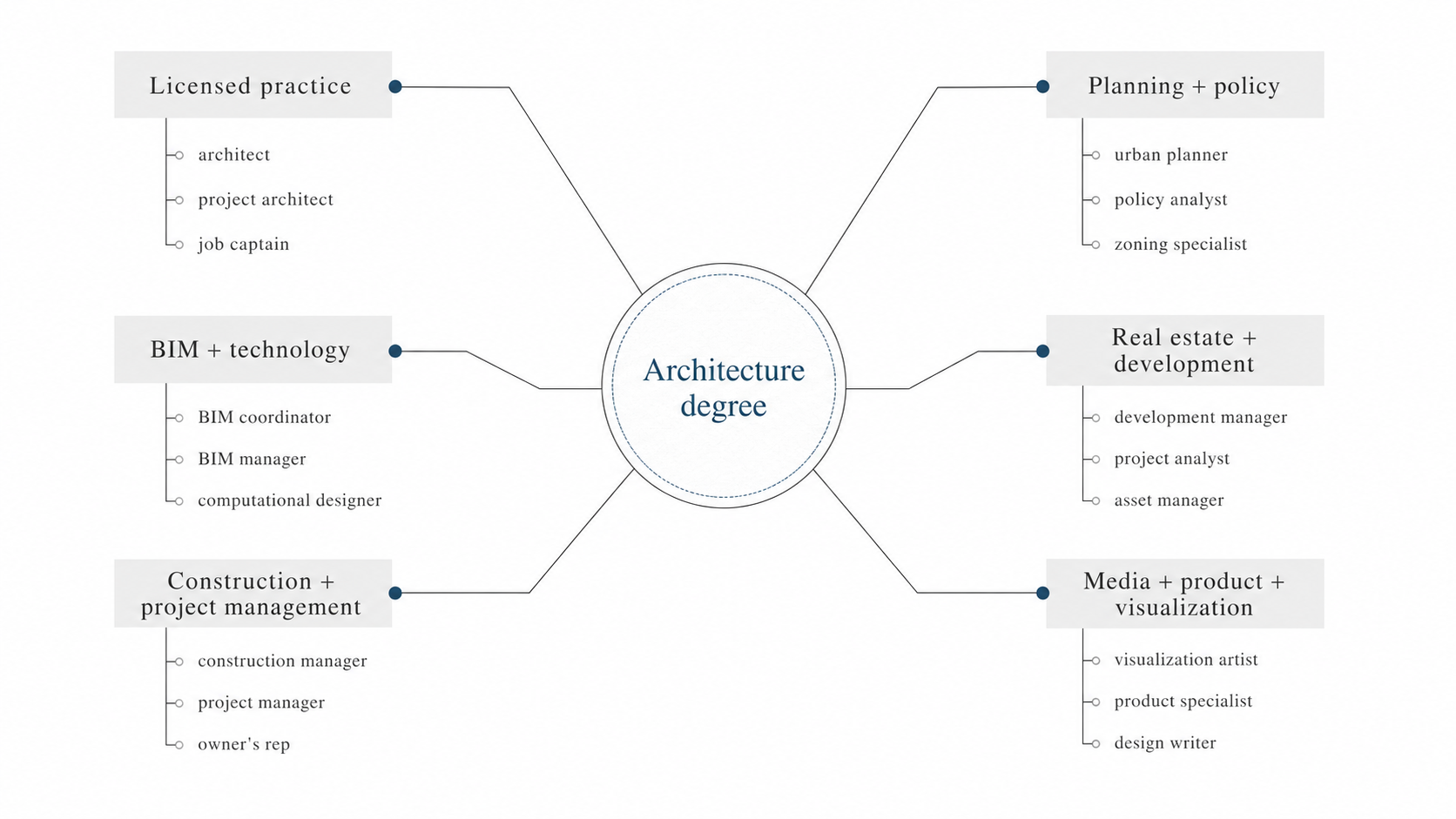
What an architecture degree actually gives you
Architecture school does not only teach people to draw buildings. It teaches a way of thinking under pressure.
You learn how to work with space, structure, light, circulation, materials, site limits, budgets, clients, regulations, deadlines, and feedback. You learn to explain ideas visually. You learn to revise. You learn to make decisions when there is no perfect answer.
Those skills are useful beyond traditional architecture practice. But they are not magic. A degree alone does not make you qualified for every design, tech, or development job. You still have to translate the training into a role employers understand.
| Architecture skill | Where it transfers | What employers need to see |
|---|---|---|
| Spatial thinking | Planning, interiors, game environments, real estate, workplace strategy | Clear layouts, user flow, diagrams, and built examples. |
| Visual communication | Visualization, branding, presentations, design strategy, teaching | Strong portfolio pieces that explain the problem, not only pretty images. |
| Technical documentation | BIM, drafting, construction coordination, code consulting | Clean drawings, model discipline, details, and accuracy. |
| Systems thinking | Urban planning, sustainability, operations, real estate development | Ability to connect design choices to cost, people, approvals, and long-term use. |
| Project coordination | Construction management, owner’s representation, project management | Evidence that you can manage scope, deadlines, consultants, and decisions. |
| Design under constraints | Product design, UX, service design, workplace strategy | Examples of solving real constraints, not just open-ended concepts. |
The traditional architecture path
The most direct path is still architecture practice.
That can mean working in a firm as an architectural designer, intern architect, project designer, project architect, senior architect, associate, or principal. In the United States, the licensed path usually involves education, experience, examination, and state registration. NCARB’s current experience program is AXP, and it requires 3,740 documented hours across practice areas.
This path makes sense if you want professional responsibility for buildings. It also makes sense if you can tolerate the long training period before the title, authority, and salary catch up.
| Architecture-practice role | What the work looks like | Who it fits |
|---|---|---|
| Architectural designer | Design support, modeling, drawings, presentations, and early documentation. | People who want to stay close to design while building office experience. |
| BIM or production staff | Revit models, drawing sets, details, schedules, and coordination support. | People who like accuracy, tools, drawing logic, and technical production. |
| Project architect | Consultant coordination, code issues, drawing review, deadlines, and construction questions. | People who can manage messy information without losing control. |
| Senior architect | Leadership, client trust, staff mentoring, technical judgment, and quality control. | People ready for responsibility, not just better titles. |
| Principal or firm owner | Clients, fees, staffing, risk, business development, and firm direction. | People who understand that firm ownership is business, not just design. |
The traditional path is not dead. But it is not the only path, and it is not automatically the best fit for everyone with an architecture degree.
Design careers outside architecture firms
Some architecture graduates still want design work, just not the full architecture-office grind.
That can lead into interiors, furniture, product design, exhibitions, set design, lighting, wayfinding, or workplace strategy. These paths keep parts of architectural thinking but change the scale, pace, clients, and deliverables.
| Career path | Why architecture helps | Trade-off |
|---|---|---|
| Interior design or interior architecture | Space planning, human scale, circulation, materials, lighting, and details. | May involve finishes, furniture, client taste, and fast revisions more than building form. |
| Furniture or product design | Proportion, materials, form, ergonomics, modeling, and fabrication thinking. | You need manufacturing, pricing, prototyping, and market awareness. |
| Exhibition or museum design | Spatial storytelling, visitor flow, lighting, display logic, and atmosphere. | Often project-based and deadline-heavy. |
| Set or production design | World-building, scale, mood, drawing, model-making, and visual logic. | Less permanence, more speed, storytelling, and production constraints. |
| Lighting design | Understanding space, mood, surfaces, daylight, and user experience. | Requires technical lighting knowledge, software, codes, and fixture coordination. |
| Workplace strategy | Space planning, user research, office behavior, hybrid work, and organizational needs. | More consulting and research, less pure design authorship. |
These can be strong options for people who like design but do not want to spend their whole career chasing permits, construction documents, and firm hierarchy.
BIM, visualization, and design technology careers
This is one of the most practical alternative zones for architecture graduates.
Architecture offices, developers, contractors, and consultants all need people who understand buildings and digital tools. A person who knows Revit, Rhino, Grasshopper, Enscape, Twinmotion, Unreal Engine, data workflows, or coordination logic can move into technical roles that may pay better than general junior design work.
| Role | What the job does | What makes it real, not hype |
|---|---|---|
| BIM coordinator | Manages models, standards, drawing output, coordination, and model health. | Firms pay for fewer mistakes, cleaner workflows, and better coordination. |
| BIM manager | Sets office standards, trains teams, manages templates, and supports delivery. | This becomes valuable when tied to project delivery, not just software support. |
| Computational designer | Uses parametric tools, scripting, and analysis to generate or test design options. | Useful when it solves facade, geometry, planning, or performance problems. |
| Architectural visualization artist | Creates still images, animations, diagrams, and marketing visuals. | Strong portfolios matter, but deadlines and revisions can be intense. |
| XR or real-time environment designer | Builds spaces for VR, AR, walkthroughs, games, sales suites, or training. | Works best with game-engine skill and real spatial judgment. |
| Digital twin or building data specialist | Connects models, assets, operations data, and facility information. | More technical and operational than traditional design work. |
The important distinction is this: design technology is not a shortcut around learning. It is a specialization. It rewards people who can combine architecture knowledge with tools, data, coordination, and patience.
Construction and project management paths
Some architecture graduates discover they like the building side more than the studio side.
That can lead into construction management, owner’s representative work, project management, field coordination, estimating, scheduling, or design-build roles. BLS lists construction managers at a May 2024 median wage of $106,980, but that is a broad occupation number, not a guarantee for every architecture graduate moving into construction.
This path can be a good fit if you like real constraints: site conditions, cost, sequencing, trades, approvals, weather, and schedule pressure.
| Role | Why architecture training helps | Reality check |
|---|---|---|
| Construction manager | You can read drawings, understand design intent, and talk to architects and contractors. | The work is less about design authorship and more about cost, schedule, risk, and people. |
| Owner’s representative | You understand what consultants are saying and can protect the client’s interests. | You need strong communication, contracts, budget awareness, and calm judgment. |
| Design-build coordinator | You can connect design decisions to construction logic earlier. | Fast decisions and trade coordination can be stressful. |
| Estimator or preconstruction support | You understand drawings, assemblies, scope gaps, and design intent. | Requires cost databases, quantity takeoff, and practical construction knowledge. |
| Site coordinator | You can translate between drawings and field problems. | Less desk design, more site pressure and schedule conflict. |
This can be a smart path for people who get frustrated by drawings that never meet the real world. Construction roles show you quickly what works, what fails, and what costs money.
Urban planning, policy, and government work
Architecture graduates often understand land, buildings, public space, density, circulation, and human scale. That can transfer into urban planning, housing policy, zoning, public-sector review, transportation planning, resilience work, and community development.
Urban planning is its own profession, not just architecture at city scale. BLS lists urban and regional planners at a May 2024 median wage of $83,720, but planning jobs often require planning knowledge, policy writing, public process experience, GIS, or a planning degree depending on the role.
| Path | Architecture connection | What you may need to add |
|---|---|---|
| Urban planner | Land use, density, streets, housing, public space, and development logic. | Planning law, policy writing, GIS, public engagement, and sometimes a planning degree. |
| Housing policy analyst | Understanding unit layouts, building types, zoning limits, and feasibility. | Policy research, data, public funding, and affordability frameworks. |
| Permit or design review staff | Drawing literacy, code awareness, and design judgment. | Local regulations, review process, and public-sector communication. |
| Resilience or climate planning | Site thinking, flood risk, heat, materials, infrastructure, and urban form. | Climate data, policy, grant programs, and infrastructure coordination. |
This path usually fits people who care less about designing one building and more about shaping many decisions around buildings.
Real estate and development careers
Real estate can be a powerful direction for architecture graduates, but it is not the same as design.
Developers think in land, approvals, financing, risk, construction cost, rent, sale value, timing, and market demand. Architecture training helps because you can see what a site could become. But you need to learn money, not just design.
| Role | How architecture helps | What changes |
|---|---|---|
| Real estate development analyst | You understand site potential, building types, planning constraints, and design trade-offs. | Spreadsheets, pro formas, financing, risk, and market data matter more. |
| Development manager | You can manage architects, consultants, approvals, and design decisions. | Your job becomes owner-side decision-making, not drawing. |
| Asset or property strategy | You understand building value, space use, renovation potential, and user experience. | More operations, leasing, maintenance, and investment logic. |
| Feasibility consultant | You can test what fits on a site and what constraints matter early. | You need cost, zoning, market, and approval awareness. |
This path can pay well, but it can also disappoint people who still want design control. Development is about decisions, risk, and returns. Design is part of the equation, not the whole equation.
Media, teaching, writing, and architecture communication
Some architecture graduates are better at explaining architecture than practising it inside a firm.
That can lead to teaching, writing, content strategy, journalism, publishing, course creation, museum interpretation, public education, or design research. This path can work, but it is usually entrepreneurial, unstable, or slow to build.
| Path | Why architecture helps | Risk |
|---|---|---|
| Architecture writer or editor | You understand buildings, drawings, design language, and the mistakes non-specialists make. | Pay varies widely. Many roles are freelance or content-based. |
| Course creator or educator | You can teach design process, software, portfolio building, or building knowledge. | You need audience trust, clear teaching, and distribution. |
| Museum or exhibition educator | You can turn space, history, and design into public learning. | Often requires public-programming or curatorial experience. |
| Architecture media strategist | You can help firms explain their work clearly and visually. | Requires writing, marketing, positioning, and business sense. |
This path fits people who can communicate clearly and build trust. It does not fit people who only want to escape practice without learning a new business model.
Tech careers for architecture graduates
Architecture graduates can move into tech, but this section needs honesty.
“Tech” is not one job. UX design, product management, digital twins, proptech, game environments, real estate software, spatial computing, and AI tools all need different skills. An architecture portfolio alone will not automatically get someone hired into tech.
The strongest bridge is usually spatial problem solving plus a real technical skill: UX research, product strategy, data, scripting, game engines, Revit APIs, GIS, or building-performance tools.
| Tech-adjacent path | Where architecture helps | What you must add |
|---|---|---|
| UX or product design | User flow, systems thinking, diagrams, and design critique. | UX research, interface design, product metrics, and digital case studies. |
| Proptech or real estate software | Understanding buildings, owners, leasing, planning, and users. | Product thinking, SaaS basics, market problems, and customer research. |
| Game environment design | Scale, atmosphere, circulation, believable spaces, and world-building. | Unreal, Unity, Blender, level design, and game production pipelines. |
| AI space-planning tools | Layout logic, zoning, adjacency, circulation, and human use. | Data, product testing, scripting, and workflow design. |
| Digital twin or smart-building tools | Building systems, model structure, space data, and operations awareness. | Facility data, sensors, software platforms, and asset management logic. |
The right move is not to claim “architecture equals tech.” The right move is to build a bridge with proof: a portfolio project, a tool, a case study, a workflow, or real experience solving a tech-adjacent built-environment problem.
Careers people overhype
Some career lists make everything sound easy. That is not useful.
Yes, architecture graduates can become game designers, futurists, founders, consultants, product designers, or innovation leads. But most of those jobs require extra skills, extra proof, or a difficult transition period.
| Overhyped path | Reality check |
|---|---|
| “Design futurist” | Real roles exist, but they are rare. You need research, strategy, writing, and credibility, not just speculative sketches. |
| “Architect founder” | Architecture teaches problem solving, but a business still needs customers, pricing, sales, delivery, and cash control. |
| “Game environment architect” | Possible, but game studios hire for game-engine skill, production speed, and level-design understanding. |
| “AI building analyst” | Useful direction, but you need building performance knowledge, data literacy, and real tools. |
| “Product designer” | Architecture helps with form and systems, but you still need product-market fit, prototyping, manufacturing, or UX skill. |
These paths are not fake. They are just not automatic. The people who make them work usually add a second skill and show evidence.
How to choose the right path

Do not choose only by what sounds impressive.
Start with what you actually want to do every day. Do you want to draw? Coordinate? Build? Manage? Write? Teach? Sell? Code? Analyze? Visit sites? Work with clients? Run a business?
| You like... | Look at... | Avoid assuming... |
|---|---|---|
| Designing spaces | Architecture firms, interiors, exhibition design, workplace strategy. | That every design job gives full creative control. |
| Software and systems | BIM, computational design, digital twins, visualization, proptech. | That tools alone replace building knowledge. |
| Real construction | Construction management, design-build, owner’s rep, site coordination. | That construction roles are less complex than studio roles. |
| City-scale problems | Urban planning, housing policy, resilience, public-sector work. | That planning is just architecture at a bigger scale. |
| Money and decisions | Real estate development, feasibility, asset strategy. | That design taste alone is enough. |
| Explaining ideas | Teaching, writing, media, public education, course creation. | That communication paths are easier to monetize. |
The best path is usually the one where your architecture training solves a real problem for someone willing to pay for it.
What to build before switching paths
If you want to move outside traditional practice, do not only rewrite your resume. Build proof.
- For BIM: show clean model workflows, coordination examples, templates, clash logic, or standards.
- For visualization: show before-and-after scenes, lighting studies, narrative images, animation, or real-time environments.
- For planning: show maps, policy summaries, housing studies, zoning diagrams, or community research.
- For construction: show drawing literacy, schedule awareness, site problem solving, and coordination examples.
- For real estate: show feasibility studies, site yield tests, pro forma basics, market logic, and approval risk.
- For tech: show a case study, prototype, UX flow, data workflow, plug-in idea, or tool that solves a built-environment problem.
- For teaching or media: show clear explanations, tutorials, articles, diagrams, or a small audience that trusts your work.
Architecture graduates often think their degree explains everything. It does not. Employers need to see how your architecture background becomes useful in their world.
FAQ
What can you do with an architecture degree besides become an architect?
You can work in BIM, construction management, urban planning, interiors, visualization, real estate development, owner’s representation, product design, game environments, teaching, writing, sustainability, or design technology. Some paths need extra training or a stronger portfolio.
Is an architecture degree useful outside architecture?
Yes, but only if you translate it. The degree builds spatial thinking, visual communication, technical judgment, and project discipline. Employers outside architecture need to see those skills applied to their problems.
What is the highest-paying career after architecture?
High pay often appears in firm ownership, real estate development, construction management, senior project leadership, BIM management, specialist consulting, and owner-side roles. The highest-paying path depends on market, responsibility, business skill, and risk.
Can architecture graduates work in tech?
Yes, especially in proptech, UX, spatial computing, digital twins, game environments, BIM tools, AI planning tools, and real estate software. But they usually need added proof such as UX case studies, coding, product work, data skills, or game-engine experience.
Is BIM a good career for architecture graduates?
BIM can be a strong career if it goes beyond basic modeling. BIM coordination, standards, clash prevention, model management, and delivery leadership can make someone highly valuable.
Can architecture lead to construction management?
Yes. Architecture graduates often understand drawings, design intent, and coordination, which can help in construction management. They still need to learn cost, schedule, contracts, field operations, and trade coordination.
Can I leave architecture and still use my degree?
Yes. Many people use architecture training in planning, development, visualization, product work, teaching, consulting, construction, or building technology. Leaving traditional practice is not failure if the new role uses your strengths better.
Should I still get licensed if I want an alternative career?
It depends. Licensure matters if you want legal professional authority, firm leadership, stamping responsibility, or traditional practice credibility. It may matter less if you are moving into BIM, tech, media, construction, or development, although the discipline of the path can still help.
Read next
If you want the broader decision before choosing a lane, read architectural career.
If you are still near the beginning of the path, compare options with entry-level architect salary.
If licensure is still on the table, read how to become a licensed architect.
If money is the deciding factor, use high-paying jobs with an architecture degree and compare it with architect salary in New York.
References
Sources used for this article
- U.S. Bureau of Labor Statistics: Architects, Occupational Outlook Handbook
- U.S. Bureau of Labor Statistics: Field of Degree, Architecture
- U.S. Bureau of Labor Statistics: Construction Managers, Occupational Outlook Handbook
- U.S. Bureau of Labor Statistics: Urban and Regional Planners, Occupational Outlook Handbook
- NCARB: AXP Experience Requirements
- NCARB: How to Earn Your Architecture License