
Critical Regionalism in Architecture: A Human-Centered Design Movement
How Critical Regionalism Balances Global Design with Local Identity
Critical Regionalism in Architecture | Frampton, Theory, and Examples
INTRO
What Is Critical Regionalism?
In Plain Definition:
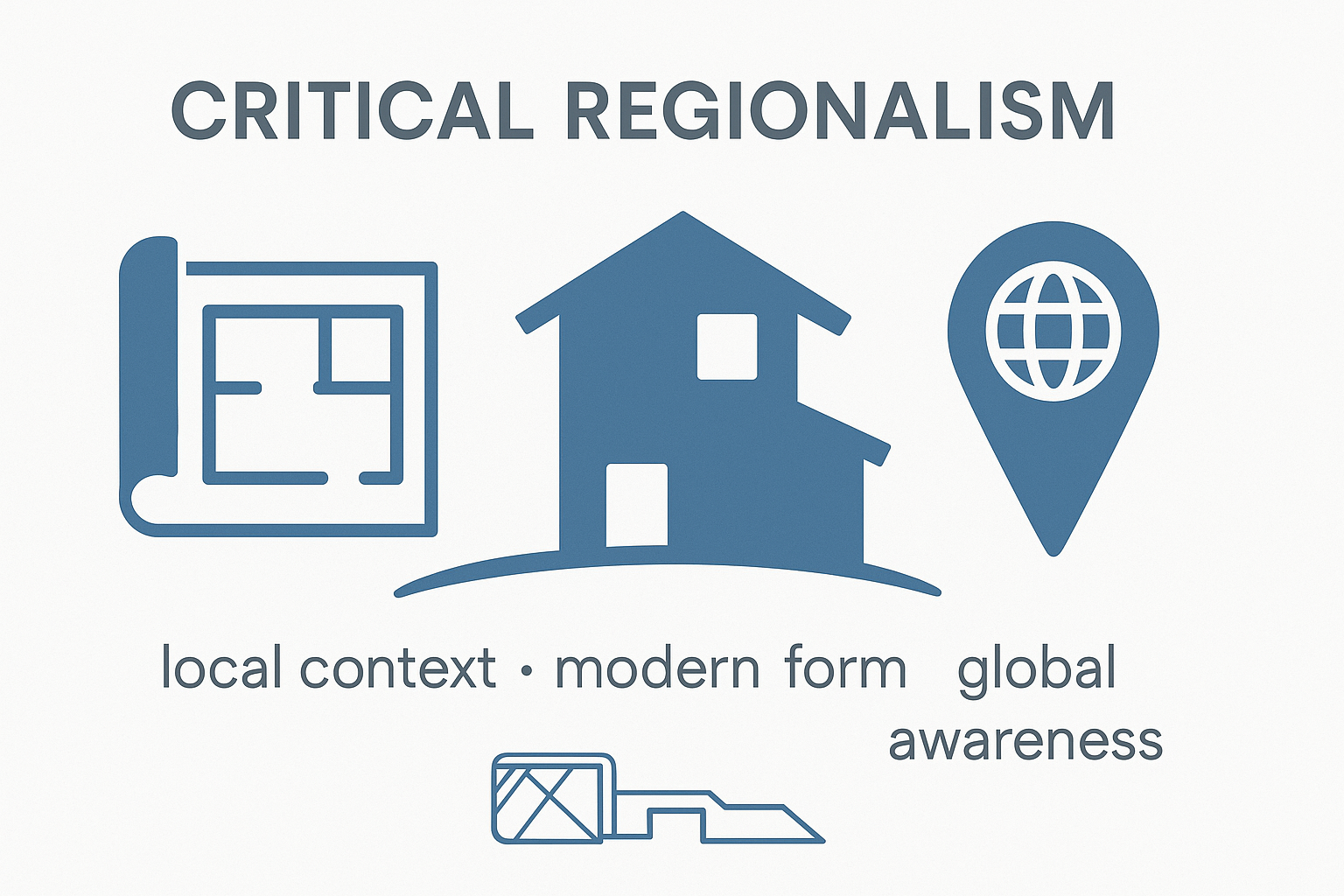
Critical regionalism emphasizes design that thoughtfully responds to local culture, climate, materials, and history, while remaining aware of global architectural ideas.
It challenges the sameness of “anywhere architecture” — buildings that could exist in any city without distinction.
Why This Matters:
In a globalized world where glass towers and prefab structures dominate skylines from Dubai to Dallas, critical regionalism brings back something essential: context.
It asks questions like:
-
What does this region feel like?
-
How do people live here — really?
-
What materials make sense here, environmentally and culturally?
Why It's Not Just Traditionalism:
Critical regionalism doesn’t mean copying old styles or romanticizing the past.
It blends modern design methods with deep respect for place.
So a building might have clean lines and concrete walls — but also use local stone, respond to the wind patterns, or reflect cultural rituals in its layout.
It’s modern, but rooted.
Where the Term Comes From:
The concept was sharpened in the 1980s by architectural theorists Alexander Tzonis & Liane Lefaivre, and later developed and popularized by Kenneth Frampton.
Frampton’s essay “Towards a Critical Regionalism” argued that modern architecture had become too universal, too detached from human scale and geography. He called for a design approach that pushes back — one that’s critical of placelessness, yet doesn’t fall into nostalgic imitation.
Why It’s More Relevant Now Than Ever:
In the age of climate urgency, cultural homogenization, and digital displacement, critical regionalism is more than a style — it’s a mindset.
It respects the land, honors heritage, and questions the default.
It teaches architects — and communities — to ask:
“How can we build in a way that belongs here and now, without losing ourselves in sameness?”
Kenneth Frampton and “Towards a Critical Regionalism”
Who Is Kenneth Frampton?
Kenneth Frampton is a British architectural historian, critic, and professor — best known for his deep analysis of modern architecture and his calls for greater cultural and environmental awareness in design.
He taught for decades at Columbia University and is the author of several foundational books in architecture, including Modern Architecture: A Critical History.
But perhaps his most lasting impact came from one powerful essay:
“Towards a Critical Regionalism: Six Points for an Architecture of Resistance” (1983).
What Was This Essay About?
Frampton wrote his essay in response to two troubling trends he saw in architecture:
-
Global modernism was making cities look the same everywhere — steel and glass buildings ignoring culture, history, and climate.
-
Postmodernism was becoming decorative and superficial — copying old styles without meaning.
So he offered a third way: critical regionalism.
Not a style, but a stance — one that pushes back against the “placelessness” of global design.
Frampton wasn’t saying “build like the old days.”
He was saying: design with the land, with the culture, and with care.
His goal: a kind of architecture that is modern, critical, and rooted — not just copied from international trends.
Frampton’s Six Key Principles (Explained Simply)
Let’s break down the six ideas from Frampton’s essay in everyday language:
1. Resistance to Placelessness
-
Buildings should reflect their specific region, not look like they were copied from a corporate office in another country.
-
A school in Ghana should not feel like a mall in Arizona.
-
Architecture must feel “of its place” — grounded in geography, history, and culture.
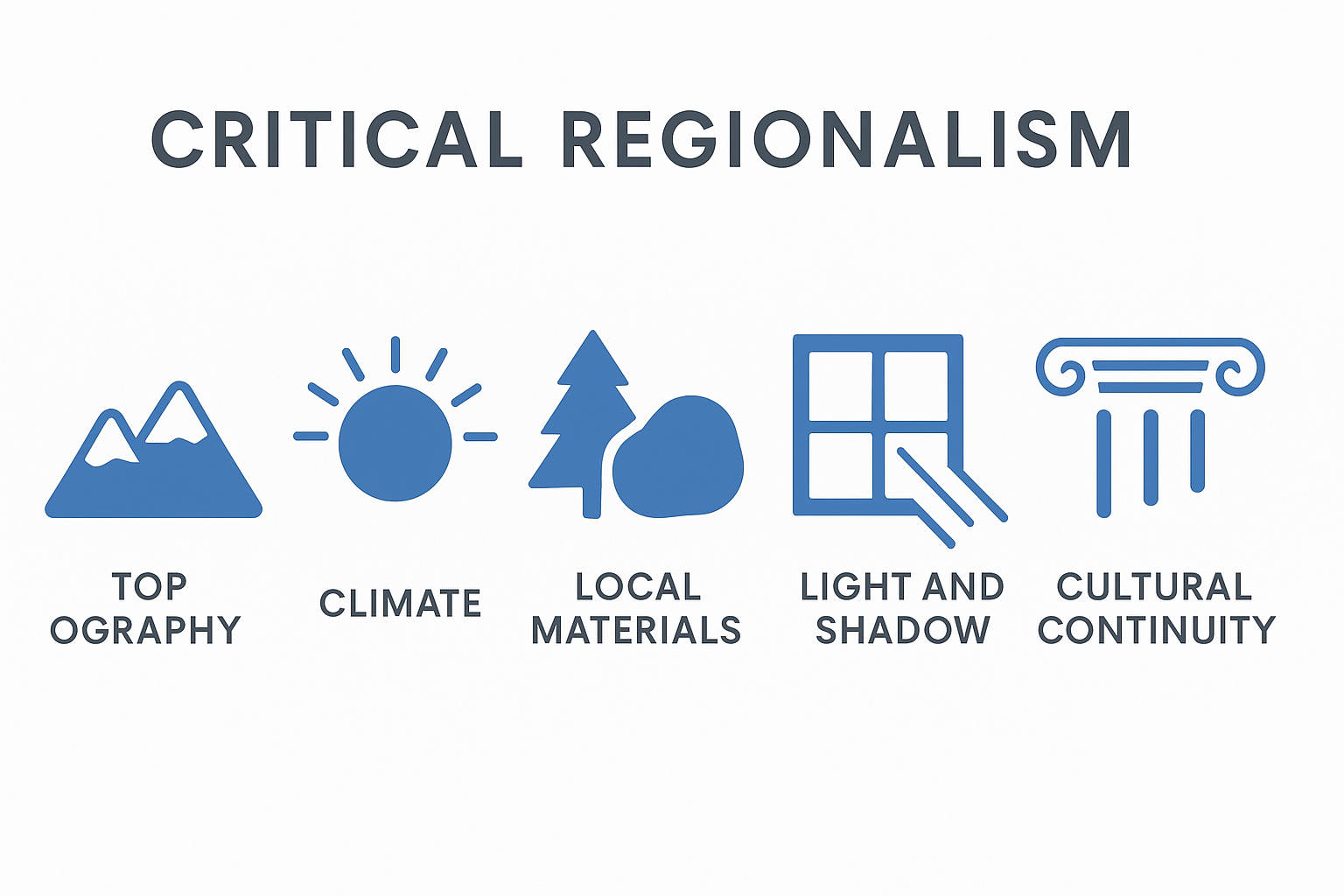
2. Emphasis on Topography and Climate
-
Frampton urged designers to shape buildings with the land, not against it.
-
Take slopes, winds, sun paths, and even local vegetation into account.
-
Architecture should respond to the environment — not flatten or erase it.
3. Tactile and Local Materials
-
He emphasized tectonics — the art of construction.
-
Use real materials that reflect the region: wood, brick, stone, clay — things that age with dignity.
-
Avoid fake finishes or synthetic sameness.
4. Use of Light and Shadow
-
Good architecture uses light like a sculptor — not just for brightness, but for drama, rhythm, and warmth.
-
In hot climates, shade matters. In dark places, light must be invited in.
-
He encouraged rich spatial experiences, not flat lighting schemes.
5. Cultural Continuity Without Nostalgia
-
Don’t copy old buildings — but learn from them.
-
Keep traditions alive through spirit and structure, not surface decoration.
-
Frampton respected local customs, crafts, and building wisdom — but insisted they evolve, not get frozen in time.
6. Architectural Form as Experience
-
Frampton believed form should come from how we move, see, touch, and live — not just abstract geometry.
-
Architecture should be felt through the body, not just drawn on paper.
Frampton’s Big Message
Critical regionalism is about creating buildings that are:
-
Culturally meaningful
-
Physically responsive
-
Modern, but not generic
-
Rooted, but not backward-looking
It’s an architecture of resistance — resisting both the global sameness of modernism and the shallow surface styling of postmodernism.
And it asks one powerful question:
“What would this building look like if it truly belonged here?”
Critical regionalism means designing buildings that fit their local surroundings — the culture, climate, materials, and history of a place — while still using modern ideas.
It avoids the kind of buildings that look the same no matter where they are built.
Top Real-World Examples of Critical Regionalist Architecture
From Kenneth Frampton to modern eco-designs, see how Critical Regionalism challenges globalization by rooting buildings in local context.
Real-World Examples of Critical Regionalism: Tadao Ando and Beyond
How regional thinking builds deeper architecture
Why It Matters
Critical Regionalism isn't just about resisting global sameness — it's about designing buildings that belong. The approach blends modern techniques with respect for local climate, culture, and materials.
When done well, it creates architecture that feels honest, grounded, and human. Here’s how that looks in the real world.
🇯🇵 Awaji Yumebutai – Awaji Island, Japan
Architect: Tadao Ando
Completed: 2000
Type: Public complex (conference center, hotel, memorial, and gardens)
What Makes This Project Special
Awaji Yumebutai was built on a hillside where soil was once stripped for a major construction project. Then the 1995 earthquake hit the region — and the site was reimagined. Instead of just another building, it became a place for reflection, recovery, and public life.
How It Reflects Critical Regionalism
-
Follows the Land
The design respects the slope of the hill. Instead of leveling it, Ando used terraced gardens and staggered steps that move with the terrain. -
Uses Local Materials
Concrete and stone from the region were used in a way that highlights texture, shadow, and craft — not polish or gloss. -
Connects with Nature
Open-air courtyards, reflecting pools, and pathways invite wind, water, and light into the space. Indoors and outdoors feel like one. -
Honors Local Memory
There’s a quiet memorial tucked into the site — not a grand statement, but something people discover and experience at their own pace.
Real Lessons from This Project
-
Let the land shape the design
-
Choose materials that speak to the place
-
Use light and space to slow people down
-
Architecture can hold grief, beauty, and everyday life at once
🇲🇽 Luis Barragán – Mexico
Case Study: Casa Gilardi, Mexico City
What makes it regional:
-
Color and texture: Bold pinks, yellows, and blues reflect Mexican tradition but in modern, abstract forms.
-
Light and shadow: Carefully shaped openings and surfaces create deep contrasts, celebrating sunlight in a very regional way.
-
Material honesty: Stone, stucco, water — used not for ornament, but for feeling.
Why it works:
Barragán merged emotional experience with place-based design. His work shows that modernism can be poetic, not sterile.
🇫🇷 Glenn Murcutt – Australia (yes, French heritage, Aussie master)
Case Study: Marie Short House, New South Wales
What makes it regional:
-
Climate-responsive design: Elevated floors, lightweight corrugated steel, and wide eaves cool the home naturally.
-
Minimal footprint: The house sits lightly on the land, respecting the landscape and rural surroundings.
-
One-man practice: Murcutt designs every detail himself — it’s personal, not corporate.
Why it works:
Murcutt always says, “touch the Earth lightly.” His buildings show that climate is culture — and design should respond to it deeply.
What All These Have in Common
-
They resist global sameness by embracing place.
-
They use simple materials and local techniques in thoughtful ways.
-
They don't copy tradition, but carry its spirit forward.
-
They create spaces where people feel connected — to light, land, and history.
What You Can Learn
For architects, students, and homebuilders alike:
-
Start with what the place demands: climate, sun, land, and culture.
-
Think beyond aesthetics — design should feel true.
-
Choose materials that age well, not just look good.
-
Let light and shadow do the heavy lifting — it’s free, timeless, and powerful.
-
Don’t just borrow styles — build meaning.
Critical Regionalism vs. Modernism: What Sets It Apart?
Critical Regionalism Explained Simply: Origins, Theory, and Practice
The Architecture of Regionalism in the Age of Globalization
How to Stay Rooted When the Whole World Looks the Same
Why Regionalism Emerged in the First Place
After World War II, modern architecture spread fast. Glass boxes, flat roofs, and concrete structures popped up everywhere — from New York to Nairobi. They were efficient, affordable, and easy to replicate. But over time, something got lost: local identity.
Regionalism came as a response to that. It asked a simple question:
What happens to culture when all buildings look the same?
The Modern Problem: Standardization and “Anywhere Architecture”
Today, many cities face the same challenges:
-
Cookie-cutter buildings designed by global firms with no connection to the place
-
Commercial pressures pushing fast, cheap, generic development
-
Local traditions, materials, and climates often ignored
It’s not just a design issue — it’s a cultural one. When buildings ignore their surroundings, people feel disconnected from where they live.
Globalization Isn’t Going Away — So What’s the Answer?
Modern regionalism doesn’t reject technology or progress. It says:
→ Let’s embrace modern tools, but stay rooted in local needs, climates, and cultures.
This doesn’t mean “old-fashioned” or “vernacular.” It means architecture that feels like it belongs. That fits the street. That listens to the wind, light, and language of a place.
Regionalism vs. Critical Regionalism: What’s the Difference?
| Feature | Regionalism | Critical Regionalism |
|---|---|---|
| Focus | Local style, tradition | Deeper cultural + tectonic response |
| Risk | Can become nostalgic or decorative | Avoids kitsch; resists global sameness |
| Use of Materials | Often traditional | Modern but used to express place |
| Key Goal | Express identity | Challenge sameness without falling into pastiche |
Put simply:
-
Regionalism sometimes just copies the past.
-
Critical regionalism thinks harder. It doesn’t imitate — it interprets. It connects local culture, materials, and climate with the tools of modern architecture.
Why This Still Matters Today
In a global world of copy-paste cities and climate urgency, architecture needs to feel grounded, thoughtful, and responsive.
That’s what critical regionalism offers:
-
Respect for place
-
Intelligent use of light, form, and material
-
Buildings that look modern but feel timeless
Modern Regionalism in Practice
The Architecture of Regionalism in the Age of Globalization
How to Stay Rooted When the Whole World Looks the Same
Why Regionalism Emerged in the First Place
After World War II, modern architecture spread fast. Glass boxes, flat roofs, and concrete structures popped up everywhere — from New York to Nairobi. They were efficient, affordable, and easy to replicate. But over time, something got lost: local identity.
Regionalism came as a response to that. It asked a simple question:
What happens to culture when all buildings look the same?
The Modern Problem: Standardization and “Anywhere Architecture”
Today, many cities face the same challenges:
-
Cookie-cutter buildings designed by global firms with no connection to the place
-
Commercial pressures pushing fast, cheap, generic development
-
Local traditions, materials, and climates often ignored
It’s not just a design issue — it’s a cultural one. When buildings ignore their surroundings, people feel disconnected from where they live.
Globalization Isn’t Going Away — So What’s the Answer?
Modern regionalism doesn’t reject technology or progress. It says:
→ Let’s embrace modern tools, but stay rooted in local needs, climates, and cultures.
This doesn’t mean “old-fashioned” or “vernacular.” It means architecture that feels like it belongs. That fits the street. That listens to the wind, light, and language of a place.
Regionalism vs. Critical Regionalism: What’s the Difference?
| Feature | Regionalism | Critical Regionalism |
|---|---|---|
| Focus | Local style, tradition | Deeper cultural + tectonic response |
| Risk | Can become nostalgic or decorative | Avoids kitsch; resists global sameness |
| Use of Materials | Often traditional | Modern but used to express place |
| Key Goal | Express identity | Challenge sameness without falling into pastiche |
Put simply:
-
Regionalism sometimes just copies the past.
-
Critical regionalism thinks harder. It doesn’t imitate — it interprets. It connects local culture, materials, and climate with the tools of modern architecture.
Why This Still Matters Today
In a global world of copy-paste cities and climate urgency, architecture needs to feel grounded, thoughtful, and responsive.
That’s what critical regionalism offers:
-
Respect for place
-
Intelligent use of light, form, and material
-
Buildings that look modern but feel timeless
Säynätsalo Town Hall – Säynätsalo, Finland
Project: Säynätsalo Town Hall
Completed: 1952
Architect: Alvar Aalto
A Civic Building Rooted in Place
Säynätsalo Town Hall is more than just a municipal building; it's a thoughtful integration of modern design principles with local Finnish traditions and materials.
Aalto designed this complex to serve as a hub for the community, housing administrative offices, a library, and residential units.
Key Elements of Critical Regionalism in Säynätsalo Town Hall
-
Integration with the Landscape: The building is nestled into the natural contours of the site, creating a harmonious relationship with the surrounding environment.
-
Use of Local Materials: Aalto employed locally sourced red bricks and timber, grounding the building in its regional context and reflecting Finnish building traditions.
-
Human-Centered Design: The layout includes a central courtyard, providing a communal space that encourages social interaction and reflects the democratic ideals of the society it serves.
-
Attention to Detail: The tactile quality of materials, such as the textured brickwork and wooden interiors, engages the senses and creates a warm, inviting atmosphere.
Significance in Architecture
Säynätsalo Town Hall exemplifies how architecture can be both modern and deeply connected to its locale.
By embracing the principles of critical regionalism, Aalto created a building that resonates with the cultural and environmental context of Finland.
This approach offers a compelling alternative to the homogenizing tendencies of globalized architecture, demonstrating that buildings can be both innovative and rooted in place.
Famous Architects Who Shaped Critical Regionalism
What is Critical Regionalism in architecture? Discover how this theory creates meaningful, place-sensitive buildings across the globe.
Critical Regionalism Architecture Examples
● Tadao Ando (Japan)
-
Use of concrete, light, and Japanese tradition
-
Example: Church of the Light
-
Integration of zen-like simplicity + modern minimalism
-
Regionalism: rooted in place, material, and mood
● Alvaro Siza (Portugal)
-
Example: Boa Nova Tea House
-
Works with local landscape, materials
-
Merges modern forms with contextual sensitivity
● Glenn Murcutt (Australia)
-
Example: Marie Short House
-
Designs for local climate, orientation, airflow
-
“Touch the Earth lightly” philosophy
● B.V. Doshi (India)
-
Example: Sangath Studio
-
Merges traditional Indian elements with modernism
Frampton’s Core Legacy in Regionalist Architecture
-
Frampton’s vision: architects must think globally but build locally
-
How his ideas shaped architectural education
-
Criticism: Is Critical Regionalism too academic? Too vague?
Comparison Table: Critical Regionalism vs. Other Movements
| Feature | Critical Regionalism | Vernacular | International Style |
|---|---|---|---|
| Local Influence | ✓ High | ✓ Very High | ✕ Low |
| Global Awareness | ✓ Moderate | ✕ Low | ✓ High |
| Use of Tradition | ✓ Interpreted | ✓ Direct | ✕ Ignored |
| Sustainability | ✓ Implied | ✓ Strong | ✕ Often lacking |
Real-Life Applications in Today’s Architecture
-
How regionalism is shaping sustainable housing
-
Urban design and zoning implications
-
Passive design strategies from regional cues
For Students and Emerging Architects: How to Apply Critical Regionalism
-
Study the site before sketching
-
Learn local building techniques + materials
-
Use climate, light, topography in your design
-
Respect tradition but avoid mimicry
In Focus: Towards a New Regionalism in the 21st Century
-
Climate change and resource scarcity → regionalism becomes survival
-
Tech and regionalism: can BIM and AI respect localism?
-
Future-forward examples and case studies in developing nations
FAQ | Critical Regionalism Simplified
What is the difference between regionalism and critical regionalism?
→ Regionalism often mimics vernacular. Critical regionalism reinterprets it intelligently in a modern context.
Is critical regionalism a style?
→ No. It’s a design approach, not a look.
What are some famous critical regionalist architects?
→ Kenneth Frampton (theorist), Tadao Ando, Alvaro Siza, Glenn Murcutt, B.V. Doshi
Why is critical regionalism important today?
→ It prevents cultural erasure, reduces environmental damage, and creates meaningful spaces rooted in place.
References and Further Reading
-
The Architecture of Regionalism in the Age of Globalization, Lefaivre & Tzonis
-
Kenneth Frampton, Towards a Critical Regionalism
-
Pritzker Prize speeches by Tadao Ando and B.V. Doshi
Related
Architecture Theory & History
-
Architectural Theory for Beginners: How Ideas Shape Space
A simple intro to how architectural concepts influence the spaces we build. -
Theoretical Frameworks in Design: From Concept to Construction
Understand how design theories guide the full journey from idea to building. -
The Four Essential Design Frameworks: Descriptive, Explanatory, Predictive, Prescriptive
A quick breakdown of four thinking tools architects use to design smarter. -
Architectural History and Theory
A broad overview of key ideas and moments that shaped architectural thinking.
Architecture, Design Theory & Human-Centered Thinking
-
Human Values and Environmental Studies
Looks at how ethics, sustainability, and environment intersect in design. -
Human-Centered Design and Architecture
Explores design that prioritizes people’s needs, comfort, and experience. -
The Role of Humans in the AI Era: Architecture and Design Perspective
Reflects on how human creativity and judgment remain essential in a tech-driven design world. -
Parametric Brick Facade: A Collaboration Between Human Hands and AI Minds
A real-world example of blending human skill with AI to create expressive architecture.
Color & Interior Design
-
Color Theory
The basics of how color works and how designers use it effectively. -
Color Theory and Application in Interior Design
Learn how color choices shape mood and function in interior spaces. -
Color Harmony Theory: A Practical Guide
A hands-on guide to creating pleasing color combinations in design work.
See Also: Critical Regionalism – Kenneth Frampton
Frampton’s idea of Critical Regionalism calls for architecture that blends modern techniques with local culture, climate, and materials—resisting global sameness without falling into nostalgic imitation.