

The Connection Between Human Values and Environmental Studies
Human values influence how we build, design, and respond to the environment. Environmental studies help us understand these decisions, examining how people shape and are shaped by the natural world.
This research explores that intersection—how our beliefs, ethics, and cultural norms impact environmental outcomes, and how modern environmental challenges are reshaping those same values. The goal is to connect theory to real-world decisions that affect architecture, sustainability, and the built environment.
Preface
The pace of innovation in architecture and technology is faster than ever. New materials, methods, and tools—like AI—promise progress, but they also raise serious questions about environmental responsibility.
Change is constant. The only way forward is to make smart, deliberate decisions—backed by knowledge, not noise.
Rushing to apply theory without structure—or chasing trends without considering impact—leads to costly mistakes.
This study focuses on the friction points:
▪ How do values guide—or derail—sustainable decision-making?
▪ What trade-offs are acceptable in the name of progress?
▪ Where does AI help, and where does it complicate human-centered design?
We look at examples from the real world, not just theory. The aim is to offer a grounded, strategic approach—one that respects both human priorities and ecological limits.
This research is part of a collaboration with ArchitectureCourses.org, focusing on courses about architecture, design, human values, sustainability, and other related topics.
Introduction
A. Why Change Is No Longer Optional The pace of technological and environmental shifts isn’t slowing down. In architecture, material science, and sustainability, yesterday’s methods can’t keep up. New materials, climate threats, and population growth are pushing the built environment into unknown territory. What you choose to build with, and how you choose to build, now carries global consequences.
B. Why Human Values Must Be Part of the Equation You can’t build a future worth living in without understanding people—what they care about, how they live, and what they’re willing to protect. Environmental solutions that ignore human behavior or culture rarely stick. And innovation without values? That leads to shortsighted fixes that create bigger problems down the road.
Understanding the Need for a Sustainable Future
Imagine a green arc that links symbols: a solar-roofed home, a handshake, a city, trees, and a person. That’s the challenge: designing a system where sustainability, community, and individual choice are all part of the same conversation.
A. The World Is Changing Fast. Architecture Has to Catch Up.

Tech Is Moving Faster Than the Industry Can Adapt
- New Materials: Carbon-neutral concrete, biocomposites, and recycled cladding are game changers—but they’re not always cost-effective or scalable.
- Smart Buildings: Real-time energy, air, and water monitoring is changing how we run buildings. But these systems require buy-in, infrastructure, and ongoing support.
Real Example:
- The Edge in Amsterdam uses AI-driven systems and sensor networks to cut down on energy use—it’s not just sustainable, it’s responsive.
Environmental Pressure Is Mounting
- Buildings and construction are responsible for 37% of global carbon emissions.
- Materials like concrete and steel drain finite resources. Even sand is becoming scarce.
Real Example:
- In Finland, researchers turned demolition rubble into new concrete—proof that circular construction isn’t just theory.
B. Why Human Values Belong in Environmental Strategy
People Make or Break Every Sustainable System
- Cultural values shape how we build and what we protect.
- Ethics influence whether we recycle, conserve, or exploit.
Data-Driven Insight Isn’t Enough Without Human Insight
- Urban planners and architects need more than statistics. They need to understand how people feel about the spaces they inhabit.
Real Example:
- In rural India, solar microgrids succeeded where other energy projects failed because communities were involved from day one. Locals helped design, maintain, and govern the systems.
What Gets in the Way?
- Clashing Values: Some societies value growth at any cost. Others prioritize nature. Bridging this divide takes skill, not just facts.
- Short-Term Thinking: Profit today often trumps sustainability tomorrow. Policies need to address this imbalance.
Real Example:
- The Amazon: Oil companies want access. Indigenous groups want survival. The stakes are cultural, ecological, and irreversible.
Bottom Line: If you don’t factor in human values, your solution might work on paper—but it won’t survive real-world pressure. Sustainability isn’t just technical. It’s political. It’s emotional. And it has to be built into every decision from the start.
The Role of Human Values in Shaping Environmental Outcomes
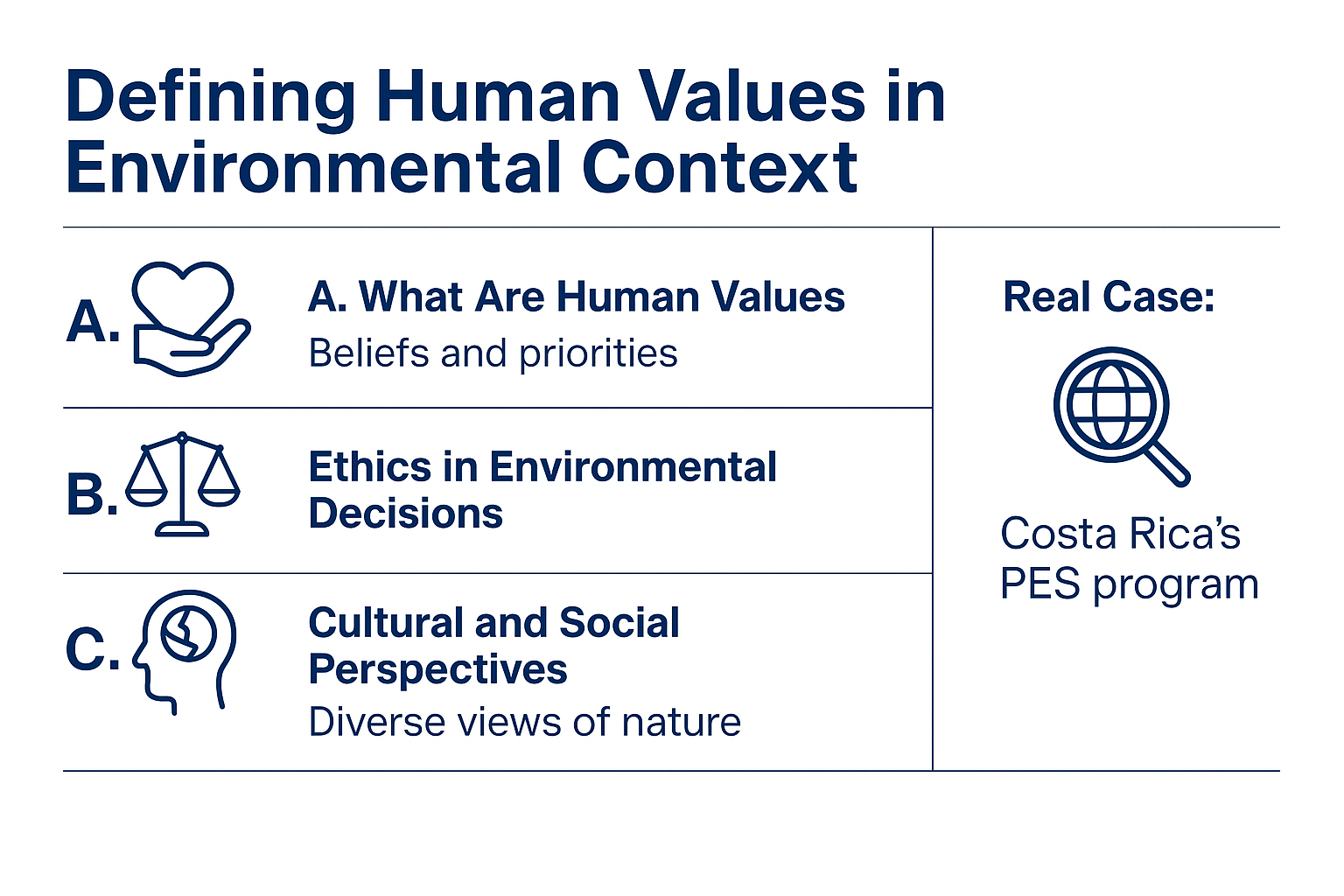
Defining Human Values in Environmental Context
A. What Are Human Values?
Human values are the beliefs and priorities that shape how people treat each other—and the environment. In architecture and planning, they influence everything from land use to energy choices.
Examples:
-
Empathy → Protecting vulnerable species or communities
-
Justice → Fair access to clean water, air, and resources
-
Biodiversity Respect → Valuing all species, not just useful ones
-
Stewardship → Managing land and materials responsibly for the long term
Real Case: The UN’s Sustainable Development Goals (SDGs) embed human values into global policy—linking equity, environment, and ethics.
B. Ethics in Environmental Decisions
Ethics drive the line between acceptable and exploitative. They shape laws, policies, and conflicts when human gain competes with ecological loss.
Real Issues:
-
Deforestation → Short-term logging vs. long-term climate stability
-
Industrial Expansion → Jobs and growth vs. ecosystem collapse
-
Indigenous Rights → Land protection vs. national development
Real Case: In Brazil, court cases over Amazon land show the clash between farming profits and protecting the world’s largest carbon sink.
C. Cultural and Social Perspectives
Different societies value nature in different ways—and those values impact how land is treated.
Examples:
-
Rotational Farming → Indigenous soil-preserving techniques in South America
-
Community Forests → Sacred groves in India protected for spiritual reasons
-
Legal Personhood → In New Zealand, the Whanganui River is legally a person—protecting it based on Māori cultural values
Real Case: Cultural views aren’t just symbolic—they change law, planning, and protection strategies worldwide.
D. Why It Matters in Environmental Studies
Human values aren’t extra—they’re the starting point. They determine how people treat the planet, how policies are formed, and why some solutions succeed while others fail.
Real Outcomes:
-
Spotting the root causes of ecological damage
-
Designing policies that actually work in different cultures
-
Building public support for long-term sustainability
Real Case: Costa Rica’s Payment for Environmental Services (PES) pays communities to protect forests. It works because it aligns local values with global environmental goals.
Bottom Line: If you're not studying human values, you're missing the reason why people act. No amount of data or green tech will solve environmental collapse without understanding what drives human behavior—across cultures, communities, and political systems.
Environmental Studies: Scope and Focus

- A. Multidisciplinary Nature
- Overview of its scope, from ecology and geography to climate policy and sustainability studies.
- Relevance of environmental studies in bridging science, technology, and social issues.
- B. Applications Across Fields
- Practical applications in urban planning, renewable energy, public health, and natural resource management.
- Examples: Sustainable cities integrating green spaces and renewable energy grids.
Details
The Broad Horizons of Environmental Studies
A. Multidisciplinary Nature
Environmental studies encompass a wide range of disciplines, making it one of the most interconnected fields in academia and practice. It draws from natural sciences, social sciences, and policy studies, offering a holistic approach to understanding and addressing environmental challenges.
Key Disciplines Covered:
- Ecology: Examining the relationships between organisms and their environments to understand ecosystems and biodiversity.
- Geography: Mapping how natural and human-made landscapes influence environmental processes.
- Climate Policy: Creating and evaluating frameworks to address global warming and its impacts.
- Sustainability Studies: Developing methods to meet current needs without compromising future generations’ ability to meet theirs.
Relevance:
Environmental studies bridge the gap between science, technology, and social issues, emphasizing the interconnectedness of human behavior and natural systems. For example, understanding how urbanization impacts ecosystems can lead to smarter city planning that balances development with environmental preservation.
Real-World Connection:
The Intergovernmental Panel on Climate Change (IPCC) reports rely on insights from multiple disciplines to propose strategies for mitigating climate change, underscoring the field’s multidisciplinary nature.
B. Applications Across Fields
Environmental studies have practical applications across diverse sectors, impacting daily life and long-term global strategies.
- Urban Planning:
Environmental studies guide the design of sustainable cities that incorporate green infrastructure, renewable energy, and efficient resource management.
Example: Singapore’s urban greening initiatives include rooftop gardens, vertical forests, and water-sensitive urban designs that reduce flooding and improve air quality. - Renewable Energy Development:
Research in environmental studies supports the transition to renewable energy sources like solar, wind, and hydropower.
Example: Germany’s "Energiewende" (energy transition) program integrates solar and wind energy into the national grid, reducing dependency on fossil fuels. - Public Health:
Understanding the relationship between environmental factors and human health, such as the impact of air and water pollution, helps shape health policies.
Example: Environmental studies in Flint, Michigan, highlighted the health crisis caused by lead-contaminated water, leading to national awareness of water safety. - Natural Resource Management:
Environmental studies aid in sustainable resource extraction and conservation, ensuring the long-term availability of critical materials.
Example: Canada’s Boreal Forest Agreement balances industrial forestry operations with conservation goals, protecting biodiversity while supporting economic needs.
The wide-ranging scope and practical applications of environmental studies make it a cornerstone for addressing modern challenges. Connecting diverse disciplines with actionable solutions, it provides a foundation for sustainable urban planning, effective resource management, and improved public health.
Environmental studies empower societies to create thoughtful strategies for a more sustainable and equitable future.
Interconnection Between Human Values and the Environment
- A. Human Values Shaping Environmental Outcomes
- How values influence attitudes, decisions, and policies.
- Examples: Community-driven conservation projects or industrial exploitation of resources.
- B. Environmental Factors Reshaping Human Values
- Natural disasters, climate crises, and pollution influencing societal attitudes and ethics.
- Examples: Public opinion shifts after events like Hurricane Katrina or air pollution crises.
- C. The Bidirectional Relationship
- Understanding the ongoing interplay between human values and environmental conditions.
Details
The Interplay Between Human Values and the Environment
A. Human Values Shaping Environmental Outcomes
Human values profoundly influence how societies interact with the environment. These values shape attitudes, drive decisions, and underpin policies that either protect or exploit natural resources.
- Community-Driven Conservation:
Values such as stewardship and respect for nature lead to grassroots conservation efforts.
Example: In Kenya, the Maasai community initiated conservation projects to protect wildlife, balancing ecological preservation with tourism benefits. - Industrial Exploitation:
Conversely, values prioritizing economic growth over sustainability can result in environmental degradation.
Example: Deforestation in the Amazon often stems from prioritizing agriculture and logging over preserving the world’s largest rainforest, despite its role in climate regulation.
These examples highlight how the values guiding decisions can lead to drastically different environmental outcomes.
B. Environmental Factors Reshaping Human Values
Environmental events and crises have the power to shift societal attitudes, ethical considerations, and even cultural norms.
- Natural Disasters:
Disasters like hurricanes and wildfires often prompt communities to prioritize resilience and environmental awareness.
Example: Hurricane Katrina in 2005 triggered national discussions on climate adaptation and urban planning, leading to stronger flood protection systems in New Orleans. - Pollution and Climate Crises:
Prolonged exposure to environmental issues like air pollution can shift public demand toward cleaner energy and stricter regulations.
Example: Severe air quality issues in Delhi, India, led to widespread protests and the implementation of emergency pollution control measures.
Environmental factors serve as wake-up calls, reshaping values and priorities toward sustainability.
C. The Bidirectional Relationship
The relationship between human values and the environment is not one-way; it is deeply interconnected and constantly evolving.
- How Human Values and the Environment Influence Each Other:
A society valuing environmental stewardship can inspire policies that protect natural ecosystems, which in turn reinforce those values through visible benefits like cleaner air and thriving biodiversity.
Conversely, environmental degradation can challenge societal norms, pushing communities to adopt new values and practices that better align with long-term sustainability.
Example: The Netherlands' embrace of flood resilience has transformed its cultural identity, with values like innovation and sustainability driving world-renowned water management systems.
This ongoing interplay underscores the need to consider human values and environmental factors together when crafting strategies for a more sustainable future.
Human Values and Environmental Ethics
- A. Ethics in Environmental Decision-Making
- Frameworks for addressing dilemmas like balancing development and conservation.
- Examples: Justice in land use, climate refugee policies, and resource distribution.
- B. Aligning Human Values with Environmental Ethics
- Integrating ethical principles into policy and practice for long-term sustainability.
- Examples: The ethics of carbon trading systems and resource-sharing agreements.
Details
A. Ethics in Environmental Decision-Making
Ethical considerations are central to navigating the complex dilemmas posed by environmental decision-making. Frameworks grounded in ethics help weigh competing priorities, such as economic development versus ecological preservation. Justice, equity, and responsibility form the core principles in this process.
Examples:
- Justice in Land Use: Land-use policies often grapple with balancing agricultural expansion with the preservation of natural habitats. For instance, Brazil faces ongoing debates about using Amazon land for farming while protecting its critical role in global climate stability.
- Climate Refugee Policies: Rising sea levels and extreme weather events displace millions of people. Ethical frameworks guide policies that ensure displaced individuals receive fair treatment and support without exacerbating existing inequalities.
- Resource Distribution: Conflicts over water resources in regions like the Nile Basin highlight the need for ethical decision-making to equitably allocate resources among nations and local communities.
B. Aligning Human Values with Environmental Ethics
Integrating human values into environmental ethics ensures that sustainability goals are achieved without losing sight of societal needs and cultural nuances. Aligning values with ethical principles creates long-term solutions that are both effective and equitable.
Examples:
- Carbon Trading Systems: Carbon trading aims to reduce emissions by assigning monetary value to carbon savings, but its ethical implementation requires ensuring that benefits are distributed fairly and do not disadvantage vulnerable populations.
- Resource-Sharing Agreements: Cross-border agreements, like those involving the Mekong River, rely on ethical considerations to balance the needs of upstream and downstream nations while safeguarding ecosystems.
Sustainable Development and Human Values
- A. Value-Based Approaches
- Ethical considerations and social norms in sustainability practices.
- Examples: Programs emphasizing intergenerational equity and biodiversity preservation.
- B. The Role of Education
- Empowering individuals through sustainability-focused curricula.
- Examples: Digital tools like MOOCs, gamified learning, and climate-focused school initiatives.
Details
A. Value-Based Approaches
Sustainability practices grounded in value-based approaches emphasize ethical principles and social norms that respect both human and environmental needs. These approaches recognize that fostering long-term ecological balance requires integrating values such as fairness, responsibility, and respect for nature into decision-making processes.
Examples:
- Intergenerational Equity: Policies and programs designed to ensure that resources are preserved for future generations are critical. For instance, New Zealand’s commitment to its Wellbeing Budget incorporates long-term ecological and societal goals to protect future prosperity.
- Biodiversity Preservation: Conservation initiatives like the Yellowstone to Yukon Conservation Initiative (Y2Y) focus on preserving habitats for wildlife, reflecting a deep respect for biodiversity while balancing human development needs.
B. The Role of Education
Education plays a transformative role in embedding sustainability into societal norms and empowering individuals to take actionable steps toward environmental stewardship. Through innovative teaching methods and accessible platforms, education fosters awareness, critical thinking, and a sense of responsibility toward the environment.
Examples:
- Digital Tools: Massive Open Online Courses (MOOCs) provide globally accessible courses on climate change, sustainable development, and environmental ethics.
- Gamified Learning: Interactive platforms like the “Earth Hero” app engage users in tracking and reducing their carbon footprints, blending education with entertainment to inspire sustainable practices.
- Climate-Focused School Initiatives: Programs like Eco-Schools, a global initiative operating in over 70 countries, teach children practical ways to reduce waste, conserve energy, and protect local biodiversity.
Case Studies
Human Values and Environmental Outcomes
- A. Success Stories
- Examples of shared values driving impactful results.
- Case: The Chipko movement in India protecting forests through community-led efforts.
- B. Lessons from Failures
- How conflicting values and priorities led to environmental degradation.
- Examples: Disputes over deforestation between industrial projects and indigenous communities.
Examining real-world cases where human values have influenced environmental outcomes provides valuable insights into the successes and challenges of conservation efforts.
A. Success Stories
Community-led initiatives often reflect shared values that drive impactful environmental results.
- The Chipko Movement in India: In the 1970s, villagers in the Himalayan region of Uttarakhand embraced trees to prevent government-backed logging. This nonviolent protest, led predominantly by women, successfully halted deforestation and raised awareness about the importance of sustainable resource management.
- Indigenous Stewardship in the Amazon: The Siekopai nation, after 80 years of displacement, is reclaiming their ancestral lands in the Amazon. Their return emphasizes the effectiveness of indigenous stewardship in combating deforestation and preserving biodiversity, showcasing a harmonious relationship between cultural values and environmental conservation. Wired
B. Lessons from Failures
Conflicting values and priorities can lead to environmental degradation, as seen in various disputes.
- Deforestation in Brazil's Amazon: Pressure from cattle ranchers and soybean growers has led several Brazilian states to attempt dismantling rainforest protections. These actions, driven by economic interests, conflict with conservation efforts, resulting in increased deforestation and threatening biodiversity.
- Oil Exploitation in Peru's Amazon: Indigenous leaders from the Wampis Nation have raised concerns about international banks financing oil activities that harm their ancestral rainforests. Despite the environmental and cultural significance of these forests, economic pursuits have led to pollution and degradation, highlighting the clash between industrial interests and indigenous values. AP News
These cases illustrate the critical role that human values play in shaping environmental policies and practices. Aligning economic development with ethical considerations and cultural respect is essential for achieving sustainable environmental outcomes.
Cultivating Pro-Environmental Values in Society
- A. Strategies for Fostering Positive Relationships with Nature
- Public awareness campaigns, education programs, and policy advocacy.
- Examples: Community-driven recycling initiatives and global climate action campaigns.
- B. Engaging Communities in Environmental Advocacy
- Collaborative conservation efforts and grassroots participation.
- Examples: Participatory rural planning for sustainable resource use.
Cultivating pro-environmental values within society is essential for fostering sustainable behaviors and ensuring the health of our planet. This involves implementing strategies that promote positive relationships with nature and actively engaging communities in environmental advocacy.
A. Strategies for Fostering Positive Relationships with Nature
Developing a societal ethos that values environmental stewardship requires comprehensive approaches, including public awareness campaigns, educational programs, and policy advocacy.
- Public Awareness Campaigns: Initiatives like Earth Day mobilize millions globally to participate in environmental activities, raising awareness about issues such as plastic pollution and climate change. For example, Earth Day 2012's "A Billion Acts of Green" campaign inspired individuals and organizations worldwide to undertake over a billion environmental actions, highlighting the collective power of small, positive steps.
- Educational Programs: Integrating environmental education into school curricula fosters early awareness and responsibility. Programs like Eco-Schools engage students in hands-on projects such as recycling and energy conservation, instilling sustainable habits from a young age. Additionally, student eco-clubs organize activities like tree planting and clean-up campaigns, promoting practical environmental stewardship. Southern Public Health
- Policy Advocacy: Advocating for policies that support environmental protection is crucial. Campaigns aimed at banning single-use plastics have led to legislative changes in various regions, reducing plastic waste and encouraging sustainable alternatives. For instance, Mexico City implemented a ban on single-use plastics, starting with plastic bags in 2020 and expanding to items like utensils and straws in 2021, demonstrating the impact of policy advocacy on environmental outcomes.
B. Engaging Communities in Environmental Advocacy
Active community participation is vital for the success of environmental initiatives. Collaborative conservation efforts and grassroots involvement empower individuals to contribute to sustainable resource management.
- Collaborative Conservation Efforts: Community-based participatory climate action involves local stakeholders in planning and implementing environmental projects, ensuring that initiatives align with community needs and values. This approach fosters a sense of ownership and accountability, leading to more sustainable outcomes. Cambridge University Press
- Grassroots Participation: Engaging communities through participatory rural planning allows residents to contribute to decisions about resource use and environmental management. This inclusive approach ensures that diverse perspectives are considered, leading to more equitable and effective environmental strategies. For example, asset-based community development models have been used to increase economic income and well-being in Kenyan agricultural communities, promoting climate-smart agriculture and leveraging local strengths for strategic solutions. SpringerLink
These strategies help foster a deeper sense of environmental responsibility across communities. When people are equipped with knowledge and feel connected to nature, they are more likely to take meaningful steps that ripple outward, creating broader change. Building pro-environmental values isn’t just about saving the planet—it’s about creating a future where everyone benefits from a healthier, more balanced world.
Challenges in Integrating Human Values and Environmental Studies
- A. Identifying Barriers
- Economic, political, and cultural obstacles hindering value-based environmental solutions.
- Examples: Resistance to change in bureaucratic systems and industries prioritizing profits.
- B. Overcoming Societal and Institutional Barriers
- Encouraging inclusivity, cross-sector dialogue, and international cooperation.
- Examples: Policies balancing short-term gains with long-term sustainability goals.
Details
Barriers and Solutions: Integrating Human Values into Environmental Studies
A. Identifying Barriers
Economic, political, and cultural factors often create significant obstacles to implementing value-based environmental solutions.
- Economic Barriers: Industries driven by short-term profits often resist adopting sustainable practices, citing increased operational costs as a drawback. For instance, fossil fuel companies have historically opposed regulations aimed at reducing carbon emissions, prioritizing immediate economic benefits over long-term environmental stability.
- Political Barriers: Bureaucratic resistance and fragmented policies can delay or dilute environmental initiatives. Inconsistent enforcement of environmental laws and competing government priorities further hinder meaningful progress. For example, many nations struggle to align domestic policies with international environmental agreements.
- Cultural Barriers: Deep-seated traditions and consumption habits can conflict with environmental objectives. In regions where resource exploitation is tied to livelihoods or cultural practices, resistance to change can be significant. An example is the overharvesting of marine resources in communities where fishing forms the backbone of local economies.
B. Overcoming Societal and Institutional Barriers
Inclusive approaches, cross-sector collaboration, and global cooperation offer pathways to overcoming these challenges.
- Encouraging Inclusivity: Involving diverse stakeholders ensures that solutions are equitable and culturally sensitive. For example, participatory rural appraisal techniques allow local communities to take active roles in shaping conservation programs that reflect their values and needs.
- Promoting Cross-Sector Dialogue: Facilitating open discussions between governments, private industries, and non-profits helps balance economic and environmental priorities. Collaborative projects, such as the Green Climate Fund, bridge these sectors to finance sustainable initiatives in developing countries.
- Enhancing International Cooperation: Global challenges require unified efforts. The Paris Agreement, which brings together nations to combat climate change, illustrates how international collaboration can drive coordinated action despite varying national interests.
These barriers underscore the complexity of integrating human values into environmental studies. However, addressing them through inclusive policies, dialogue, and global collaboration ensures progress toward sustainability while respecting cultural and economic realities.
Future Prospects: The Role of Technology and Innovation
- A. Leveraging Technology for Environmental Preservation
- Emerging tools like AI for ecosystem monitoring, blockchain for carbon credits, and precision farming.
- Examples: AI predicting deforestation patterns, drones monitoring biodiversity.
- B. Innovations in Education and Advocacy
- Technology expanding access to environmental education through digital platforms and social media.
- Examples: Virtual reality tools simulating climate impacts and online campaigns mobilizing collective action.
Details
Advancements in technology and innovation are pivotal in addressing environmental challenges and promoting sustainability. Emerging tools and educational innovations are reshaping how we monitor ecosystems and engage the public in environmental advocacy.
A. Leveraging Technology for Environmental Preservation
Innovative technologies are enhancing our ability to monitor and protect the environment.
- Artificial Intelligence (AI) in Ecosystem Monitoring: AI algorithms analyze satellite imagery to predict deforestation patterns, enabling proactive conservation efforts. For instance, AI models can forecast areas at high risk of deforestation, allowing for targeted interventions. ForestMap
- Blockchain for Carbon Credits: Blockchain technology ensures transparency and traceability in carbon credit transactions, promoting accountability in carbon offset initiatives. This system helps prevent double-counting and fraud, ensuring that carbon credits represent real emission reductions.
- Precision Farming: Utilizing sensors and data analytics, precision agriculture optimizes resource use, reducing environmental impact. For example, farmers can apply water and fertilizers more efficiently, minimizing runoff and conserving resources.
B. Innovations in Education and Advocacy
Technological advancements are expanding access to environmental education and enhancing advocacy efforts.
- Virtual Reality (VR) in Environmental Education: VR experiences simulate environmental changes, such as ocean acidification, providing immersive learning that fosters environmental awareness. Studies have shown that VR can be a powerful tool for improving environmental learning gains and attitudes. Stanford News
- Online Campaigns Mobilizing Collective Action: Social media platforms facilitate global environmental movements, enabling rapid dissemination of information and coordinated action. Campaigns like the global climate strikes have mobilized millions, demonstrating the power of digital advocacy.
Integrating these technological innovations into environmental strategies offers promising avenues for preservation and education, aligning human values with sustainable development goals.
Conclusion
A. Key Takeaways
Understanding human values is central to fostering ethical and sustainable environmental practices. These values influence behaviors, shape policies, and drive decisions that directly impact the natural world. By examining the interplay between culture, ethics, and technology, we can develop more thoughtful and effective approaches to pressing environmental challenges.
- Culture: Social norms often dictate how resources are managed, preserved, or depleted, underscoring the need to align conservation efforts with local traditions and values.
- Ethics: Decisions about balancing development and environmental preservation are rooted in shared moral principles, guiding sustainable progress.
- Technology: When aligned with human values, advancements like AI, renewable energy, and precision agriculture amplify efforts to mitigate environmental degradation and foster resilience.
B. Call to Collaborative Action
Addressing environmental issues demands concerted efforts across disciplines, communities, and borders. Solutions rooted in shared values not only drive inclusivity but also ensure their long-term viability.
- Community Engagement: Initiatives that prioritize grassroots involvement, such as participatory conservation or local stewardship programs, exemplify the strength of collective action.
- Education and Innovation: Integrating sustainability into educational frameworks and leveraging technology responsibly can empower individuals and communities to enact meaningful change.
This research highlights the crucial connection between human values and the resolution of ecological challenges. A sustainable future depends on integrating ethical governance, innovative technologies, and inclusive education. Connecting these domains creates equitable systems that promote environmental stewardship and strengthen resilience for future generations.
Explore Further
Related
- Human-Centered Design and Architecture
- Introduction to Architecture: A Beginner’s Guide to Building Design
- Architectural Design Basics: From Concept to Construction
- Kevin Lynch's 5 Elements of a City | Guide to Urban Design
- Why Old-School Architecture Can't Compete Anymore
- Why Architects Still Matter in the AI Age: Craft vs Code
Books:
Expanding your understanding of environmental ethics and human values can be significantly enhanced by engaging with the following key texts:
1. Human Value, Environmental Ethics and Sustainability: The Precautionary Ecosystem Health Principle
Author: Mark Ryan
Series: Values and Identities: Crossing Philosophical Borders
This book addresses the complex ethical questions surrounding environmental protection, such as the intrinsic versus economic value of nature and the balance between current needs and those of future generations. Ryan introduces the Precautionary Ecosystem Health Principle (PEHP) as a cohesive approach to navigate these challenges, offering a detailed philosophical framework to inform sustainability theory and environmental policy.
2. Human-Environment Relations: Transformative Values in Theory and Practice
Editors: Emily Brady and Pauline Phemister
This anthology explores the dynamic interplay between human values and the environment, proposing the concept of 'value-space'—an ethical communicative zone where values are exchanged between humans and their surroundings. The contributors examine how societal norms are projected onto the environment and how these projections can lead to transformative practices in environmental ethics.
3. Environmental Ethics: A Very Short Introduction
Author: Robin Attfield
Publication Date: 2018
Attfield provides a concise overview of environmental ethics, discussing the values and principles involved in addressing environmental issues like pollution, species loss, and climate change. This introduction is ideal for readers seeking to understand the foundational concepts of environmental ethics.
4. Respect for Nature: A Theory of Environmental Ethics
Author: Paul Taylor
Taylor's seminal work defends biocentric ethics, arguing that all living things possess moral value. This book is essential for understanding the philosophical underpinnings of environmental ethics.
5. The Oxford Handbook of Environmental Ethics
Editors: Stephen M. Gardiner and Allen Thompson
Publication Date: 2017
This comprehensive volume compiles over thirty contributions that explore various aspects of environmental ethics, from foundational theories to contemporary debates. It's a valuable resource for in-depth study of the field. Oxford Academic
Engaging with these texts will provide a robust foundation in environmental ethics, offering diverse perspectives and frameworks to understand the intricate relationship between human values and the environment.
Environmental Studies General Courses:
- Environmental Studies: Definition, Scope, and Importance
- The Built Environment as a Social Determinant of Health
- Impact of the Built Environment on the Natural Environment
Policy and Governance
- Environmental Policy and Governance:
Understand how local, national, and international policies shape environmental decision-making and sustainability efforts.- Key Topics: Regulations like the Paris Agreement, local zoning laws for green spaces, and international cooperation for biodiversity protection.
- Example: The Clean Water Act in the United States demonstrates how governance structures enforce ecological preservation.
- Environmental Justice and Equity:
Explore how marginalized communities are disproportionately affected by environmental hazards. Advocate for inclusive policies that address systemic inequities.- Key Topics: Pollution in low-income neighborhoods, indigenous land rights, and equitable climate adaptation strategies.
- Example: Flint, Michigan’s water crisis underscores the need for equitable environmental policies.
Climate Action
- Climate Change Mitigation and Adaptation:
Learn strategies for addressing climate change, including renewable energy adoption, carbon sequestration, and infrastructure resilience.- Key Topics: Solar and wind energy, reforestation, and flood-resistant urban design.
- Example: The Netherlands’ flood management systems are global benchmarks for climate adaptation.
- Corporate Sustainability and Corporate Social Responsibility (CSR):
Examine how businesses integrate sustainability into operations through green supply chains, renewable energy usage, and transparent sustainability reporting.- Key Topics: ESG (Environmental, Social, Governance) standards, waste reduction in manufacturing, and carbon-neutral initiatives.
- Example: Patagonia’s commitment to sustainable sourcing and recycling programs showcases effective CSR.
Ecological Restoration and Resource Management
- Ecological Restoration and Conservation:
Discover methods for rehabilitating degraded ecosystems and conserving biodiversity.- Key Topics: Wildlife corridors, wetland restoration, and endangered species recovery programs.
- Example: Yellowstone’s wolf reintroduction project demonstrates how conservation efforts can restore ecological balance.
- Ecosystem Services and Natural Capital:
Explore the economic and ecological value of ecosystem services like pollination, water purification, and carbon storage.- Key Topics: Integrating natural capital into economic models and decision-making.
- Example: Costa Rica’s Payment for Ecosystem Services (PES) program rewards farmers for reforesting land.
Technology and Innovation
- Green Technology and Sustainable Innovation:
Examine the latest advancements in green technologies that reduce environmental impacts.- Key Topics: Circular economy models, green architecture, and renewable energy storage innovations.
- Example: Tesla’s solar roof tiles combine energy generation with sustainable home design.
- Urban Planning and Sustainable Cities:
Learn about strategies for building resilient and environmentally friendly cities.- Key Topics: Smart growth, green infrastructure, and equitable transit systems.
- Example: Singapore’s vertical gardens and integrated public transit system highlight innovative urban sustainability.
Education and Public Awareness
- Environmental Education and Public Awareness:
Explore how education and campaigns foster environmental literacy and behavior change.- Key Topics: School sustainability programs, community outreach, and digital advocacy campaigns.
- Example: The Eco-Schools program teaches students actionable steps to improve their local environments.
- Environmental Health and Risk Assessment:
Investigate the intersection of environmental quality and public health, including the effects of pollution and climate change.- Key Topics: Risk assessment models, air and water quality monitoring, and public health policy.
- Example: Studies linking air pollution in urban centers to respiratory diseases drive stricter air quality standards.
Rsources
To deepen your understanding of environmental studies, consider exploring the following resources, which provide comprehensive insights into various topics:
1. Environmental Policy and Governance
- Environmental Policy Overview: This article from Encyclopaedia Britannica discusses how governmental and organizational measures address the effects of human activities on the environment. https://www.britannica.com/topic/environmental-policy
- Environmental Law and Governance: The United Nations Environment Programme (UNEP) outlines the importance of strong environmental laws and governance in achieving sustainable development. https://www.unep.org/topics/environmental-law-and-governance
2. Climate Change Mitigation and Adaptation
- NASA's Climate Change Solutions: NASA provides an overview of strategies for reducing greenhouse gas emissions and adapting to climate impacts. https://climate.nasa.gov/solutions/adaptation_mitigation/
- World Resources Institute on Climate Strategies: This article discusses approaches that simultaneously achieve climate mitigation and adaptation. https://www.wri.org/insights/5-strategies-achieve-climate-mitigation-and-adaptation-simultaneously
3. Environmental Justice and Equity
- Land Back Movement: An exploration of the movement to return ancestral lands to Indigenous tribes and its environmental implications. https://www.vox.com/down-to-earth/386056/land-back-movement-climate-change-tribal-sovereignty
- Environmental Justice Initiatives: An article discussing the Environmental Protection Agency's efforts in addressing environmental justice, particularly in marginalized communities. https://www.theatlantic.com/ideas/archive/2025/09/michael-regan-epa-environmental-justice-lawsuit/679941/
4. Ecological Restoration and Conservation
- The Bahamas' Debt-for-Nature Swap: An initiative where The Bahamas refinanced part of its debt to fund marine conservation and climate change mitigation. https://apnews.com/article/ed89e57b81133d5790163f798f64dc1b
- COP29 Achievements: A summary of outcomes from the COP29 conference, focusing on global climate finance targets and conservation efforts. https://www.thetimes.co.uk/article/cop29-what-was-achieved-and-what-remains-to-be-done-7lghvmrd5
5. Green Technology and Sustainable Innovation
- Sustainability Reporting Challenges: An article discussing the complexities British businesses face with new sustainability reporting standards. https://www.thetimes.co.uk/article/sustainability-rules-will-be-a-headache-for-british-business-lpc3vmfqc
- Business Schools and ESG: An examination of how European and American business schools differ in integrating Environmental, Social, and Governance (ESG) principles. https://www.ft.com/content/ad8d7119-5c58-4f6a-a35e-af766a8c2ea4
6. Environmental Education and Public Awareness
- Environmental Policies and Evaluation: The Organisation for Economic Co-operation and Development (OECD) provides insights into how environmental policies can drive the green transition. https://www.oecd.org/en/topics/environmental-policies-and-evaluation.html
- Adaptation Principles: The World Bank outlines six ways to build resilience to climate change, emphasizing the role of public awareness and education. https://www.worldbank.org/en/news/feature/2020/11/17/the-adaptation-principles-6-ways-to-build-resilience-to-climate-change
These resources offer valuable perspectives and data to enhance your understanding of environmental studies and the multifaceted challenges and solutions in this field.