
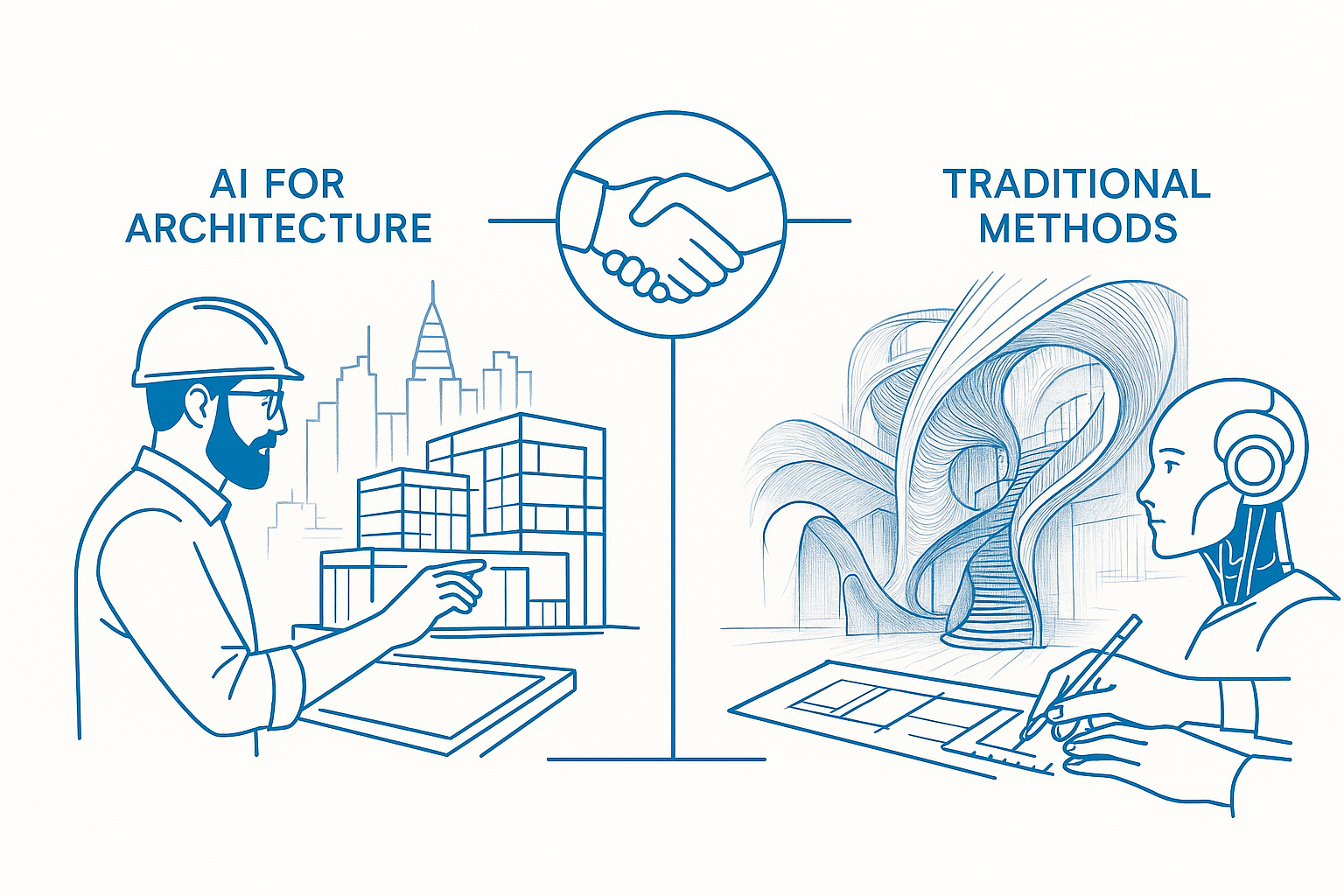
Architecture’s tools have gone from drafting tables to data sets.
Two decades ago, architects sketched by hand, built physical models, and relied on craftsmanship. Their work was defined by experience and attention to detail.
Now, most firms run design processes through AI, 3D printing, AR, and VR. These tools speed up work, cut errors, and let you test ideas instantly. Younger architects use them without thinking; many veterans find them hard to learn.
This is about keeping up with new tools.
But does that make old-school architects obsolete? Or do they still offer judgment, cultural insight, and design sense that no software can match?
Experience still matters.
The future needs both tech-savvy makers and those who understand the human side of design.
Where Human Insight Outperforms Algorithms

Let’s be clear: AI is powerful. It can optimize building layouts, simulate sun exposure, and crunch data faster than any human.
But it can’t understand people.
It doesn’t grasp what a home means—the emotional weight of a staircase, the unspoken rules of cultural respect, or how space reinforces identity. That takes human experience.
A Real Story: Designing for Family and Honor
Where Experience Beats Algorithms
In many Arab households, placing parents in care homes is simply unthinkable. Family isn’t a unit—it’s a legacy. Parents live with their children, and homes must be designed to reflect that responsibility, dignity, and balance.
My friend Amjad, an architect from the Middle East, took on that challenge firsthand.
He needed to design a house where his parents would live downstairs, central to daily life, while he and his family lived upstairs. The tension was obvious: How do you give elders the respect of proximity without crowding the younger generation’s privacy?
Amjad didn’t just solve the problem—he elevated it.
He placed a wide indoor balcony upstairs, just above the living room where his parents spent most of their day. From that space, he could sit with his kids and still engage with his parents below—sharing moments, laughter, and presence without intrusion.
But there was more. That open balcony became a quiet buffer between generations. When Amjad walked through its doorway, he entered a fully private apartment, complete with bedrooms and kitchen. Independent. Separated—but never disconnected.
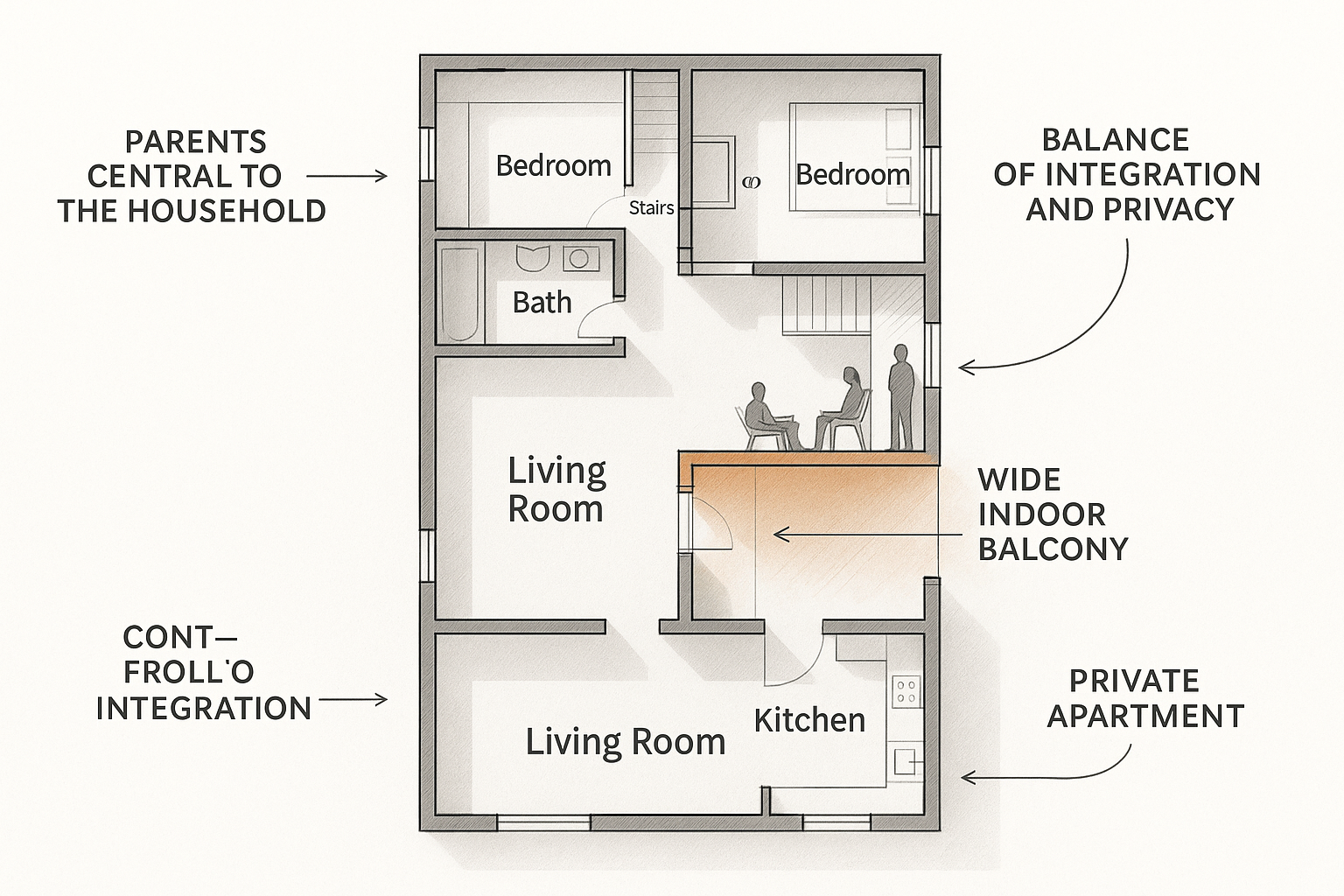
It was architectural empathy in action.
A machine wouldn’t suggest a balcony for emotional continuity.
Amjad did—because he lives the culture, understands its layers, and respects the people who move through those walls.
What Machines Miss
No algorithm would know that family honor can live in a floor plan. Or that a living room might double as a cultural stage. These insights come from lived experience, not predictive models.
AI divides space. Architects understand its meaning.
Related: Human-Centered Design and Architecture
How Veteran Architects Can Team Up with Tech
You don’t drop hand-drawing or model-making—you add tech to the mix. Here’s how experienced architects can plug into modern tools and make both stronger.
-
Bring Culture into the Code
Seasoned architects know local customs and family dynamics. Feed that insight to your AI partners. For example, a firm in Dubai had its senior architect work directly with its AI-driven layout tool so it wouldn’t propose designs that clash with multigenerational households. -
Mentor the Tech-Savvy Juniors
Young architects jump on every new plugin—but they miss the real-world pitfalls. Set up regular review sessions where veterans critique digital models, flagging issues like daylight glare or awkward traffic flow that software often overlooks. -
Anchor Restoration and History
Old-school pros carry decades of case studies in their heads. Loop them into BIM and heritage-preservation projects to verify that virtual reconstructions match the original materials and methods—saving time and avoiding costly rework on sites like century-old town halls. -
Guide AI Development
Instead of treating AI as a black box, put veteran architects on the development team. Their on-site notes on client needs—privacy curves, noise buffers, cultural sightlines—become the guardrails that keep algorithms from spitting out generic, one-size-fits-all layouts.
Bottom Line:
Tech handles the heavy lifting. Veterans supply the real-world filters. Together, you end up with faster workflows and designs that actually work for people.
See also: User-Centered Design Principles
Real-Life Example: Blending Tradition with Tech
The concept is already happening.
Japan’s Fusion of Old and New
Architects there ran their plans through 3D software to nail structural details. Then they dropped in tatami rooms, sliding shoji screens, and a tiny rock garden by hand. The result feels rooted in tradition, even though it started in a computer model.
Multi-Gen Homes in the U.S.
An AI tool mapped out walls and doors for three generations under one roof—but it ignored noise and sightlines. A seasoned architect stepped in, adding small “buffer zones” (think half-walls and pocket doors) so grandparents and grandkids could share space without stepping on each other’s toes.
Amjad’s Balcony Solution
He used VR to test floor heights and circulation. Once that was locked in, he sketched an indoor balcony by hand—positioned so his parents were always in view, yet his apartment felt private. Tech gave him precision; his experience gave him heart.
In each case, tech handled the heavy lifting. The old-school insight made the space feel like home.
Related: Why Architects Still Matter in the AI Age: Craft vs Code
Why We Need Both Old-School and Tech-Savvy Architects
Machines crunch data, run simulations, and spit out layouts in seconds. But they can’t feel a space, read the light at dusk, or know why a family gathering room needs a hidden alcove for grandpa’s prayers. That’s where veteran architects come in.
-
Tech tools handle the heavy lifting: code checks, clash detection, daylight analysis.
-
Experienced architects bring judgment, cultural nuance, and design sense no algorithm can match.
When you pair quick, accurate software with decades of real-world insight, you get buildings that are both efficient and emotionally grounded. Tech drives precision; people drive meaning.
Bottom Line
Great architecture needs both horsepower and heart. Use tech to speed up and check the work—but keep human wisdom at the core.
FAQ
Q: Can AI replace experienced architects?
No. AI speeds up tasks, but it can’t read a client’s cultural needs, navigate local politics, or foresee how a space will feel at 3 AM.
Q: How do you blend old methods with new tools?
Have seniors review AI outputs. Use hand sketches to refine digital models. Hold joint workshops where veterans critique VR walkthroughs.
Q: What’s one concrete benefit of pairing them?
Fewer costly change orders. Tech catches technical conflicts early; human vets catch the subtle issues—like privacy lines or ritual pathways—that software misses.
Q: How do younger architects learn from veterans?
Set up mentorships: pair junior designers on every AI project with a veteran for weekly feedback. Rotate assignments so tech experts lead sometimes and seniors lead others.
Q: How do you measure success?
Track two metrics:
-
Error rate in construction documents (should drop).
-
Post-occupancy feedback from users on comfort, flow, and cultural fit (should improve).