
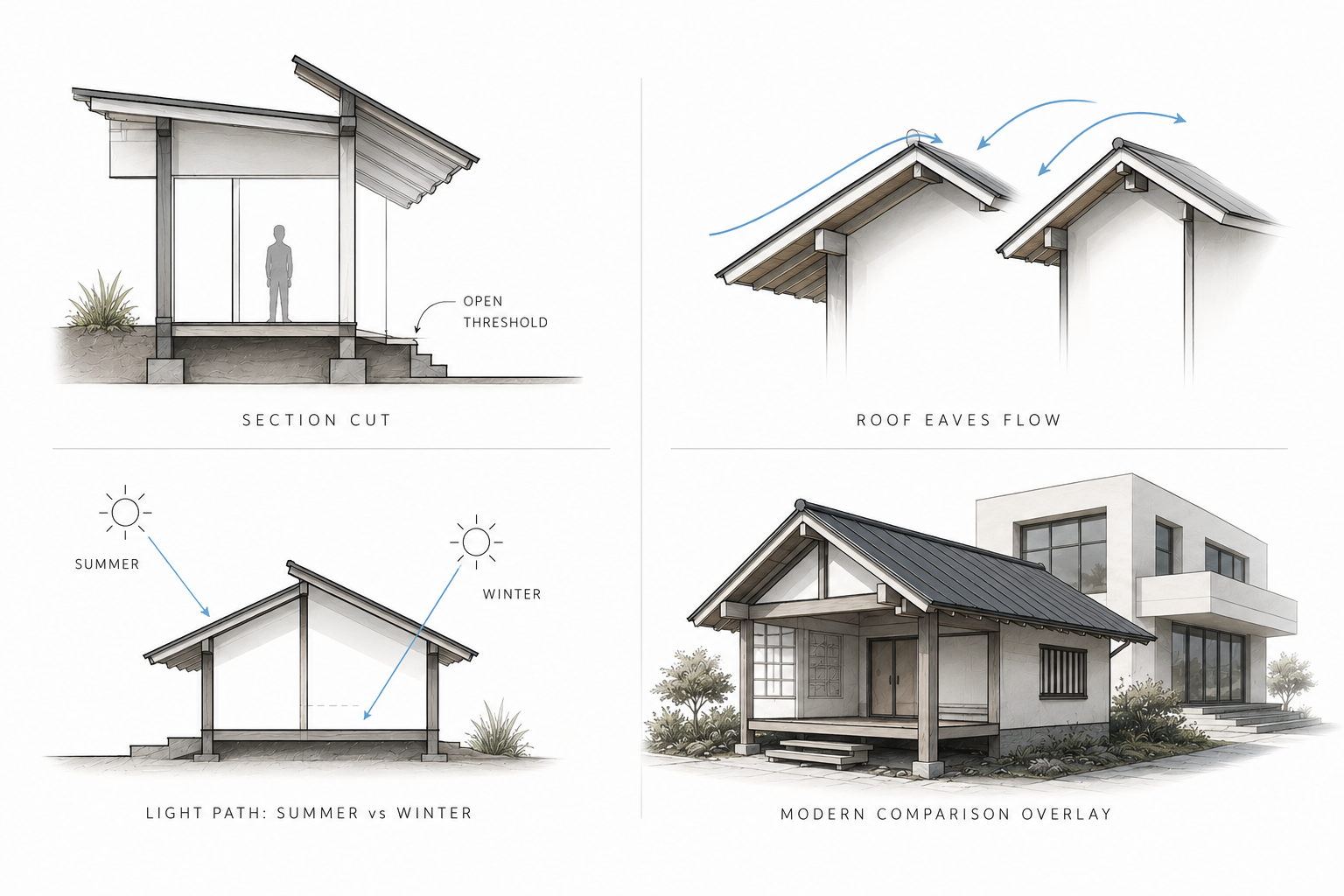
Illustration by ArchitectureCourses.org. Traditional Japanese architecture often uses deep eaves, raised thresholds, shaded sections, and seasonal light control in ways that still influence modern house design.
Japanese interiors solve small-space problems well.
They make tight rooms feel open without feeling empty. They stay calm without becoming cold. They use layout, light, material, and restraint to do work that many modern interiors try to solve with more furniture, more walls, and more decoration.
That is why this style gets copied so often, and why it goes wrong so often too. The mistake is usually the same: people copy the surface and miss the logic.
If you want the broader house system first, start with Japanese Traditional Houses and History of Traditional Japanese Architecture. This page stays narrower. It is about what people get wrong in Japanese interiors, and what the house was doing instead.
Book pick:
Japanese Homes and Their Surroundings
Still one of the best broad books for understanding the traditional house as a working system instead of a mood board.
What Goes Wrong First
The first problem is simple. A lot of “Japanese-inspired” interiors are built like normal Western rooms with Japanese props dropped into them.
Add a bamboo plant. Add pebble trays. Add a low table. Add slatted wood. Maybe a paper lamp. It reads Japanese for about three seconds, then it falls apart because the room still behaves like the same rigid room it was before.
Traditional Japanese interiors were not built around props. They were built around flexible use, filtered light, low visual noise, careful thresholds, and rooms that could change through the day. That is why fixed room labels do not map neatly onto the Japanese house. The interior works because the plan is less rigid, not because the furniture is lower.
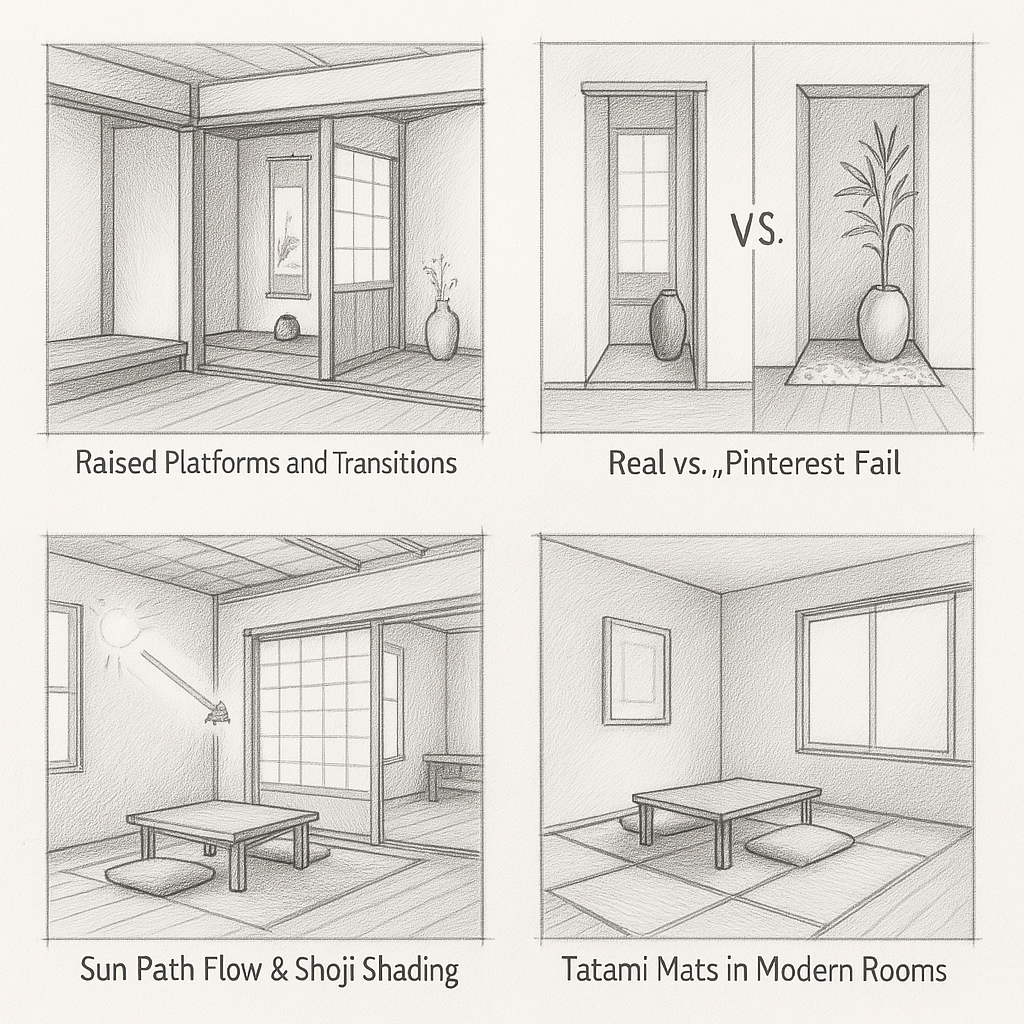
Image by ArchitectureCourses.org. Raised platforms, shoji screens, tatami mats, and alcoves work best when they shape the room and the transition, not just the decoration.
| Common mistake | What goes wrong | Better move |
|---|---|---|
| Decorative bamboo-and-pebble corners | The room reads themed instead of lived-in | Use fewer objects and let one focal area carry the room |
| Dark boxed minimalism | The room feels heavy and shut down | Use filtered daylight, soft surfaces, and lighter partitions |
| Flat floors everywhere | The plan loses hierarchy and threshold clarity | Use level changes, material changes, or a clear entry break |
| Too many lines and textures | The calm disappears under design noise | Let one material lead and keep the rest quiet |
Four Common Mistakes in Modern Japanese Interiors
1. Random Bamboo, Pebbles, and Spa Corners
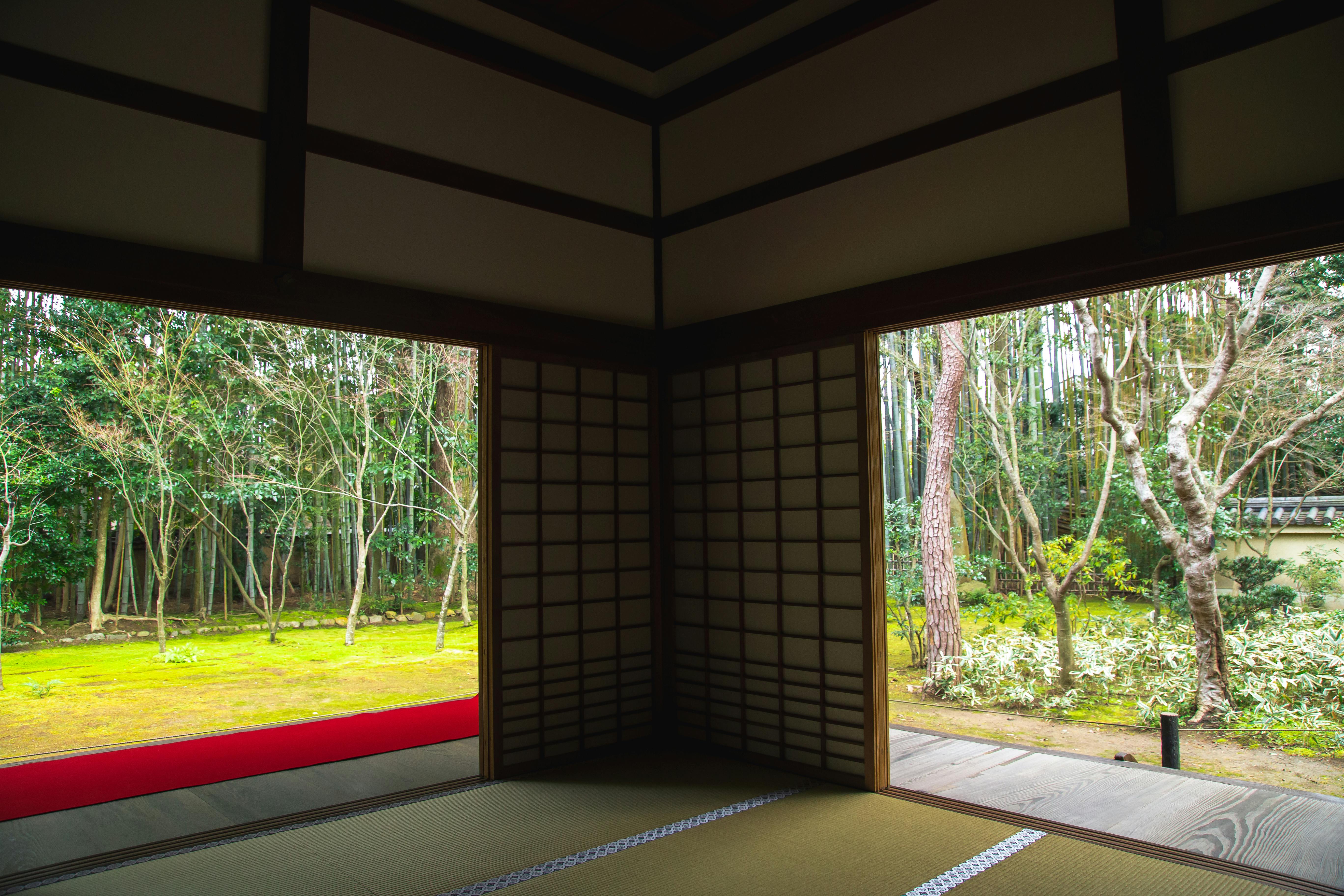
A traditional washitsu stays calm through proportion, open floor area, and clear room order, not through decorative overload.
This is one of the fastest ways to make a room feel fake. The space ends up looking like a hotel waiting area or a themed corner in a furniture showroom.
The issue is not bamboo or stone by themselves. The issue is that they get used as signals without doing any architectural work. The room still has bad flow, awkward furniture spacing, cluttered surfaces, and no real hierarchy.
Do this instead:
- Use real materials where they count: wood, paper-like diffusing surfaces, plaster, stone, natural fiber.
- Keep one area quiet enough to hold attention without loading the whole room.
- Use an alcove, shelf, or wall recess as a focal point instead of scattering decorative objects around the room.
2. Dark, Enclosed “Minimalist” Rooms
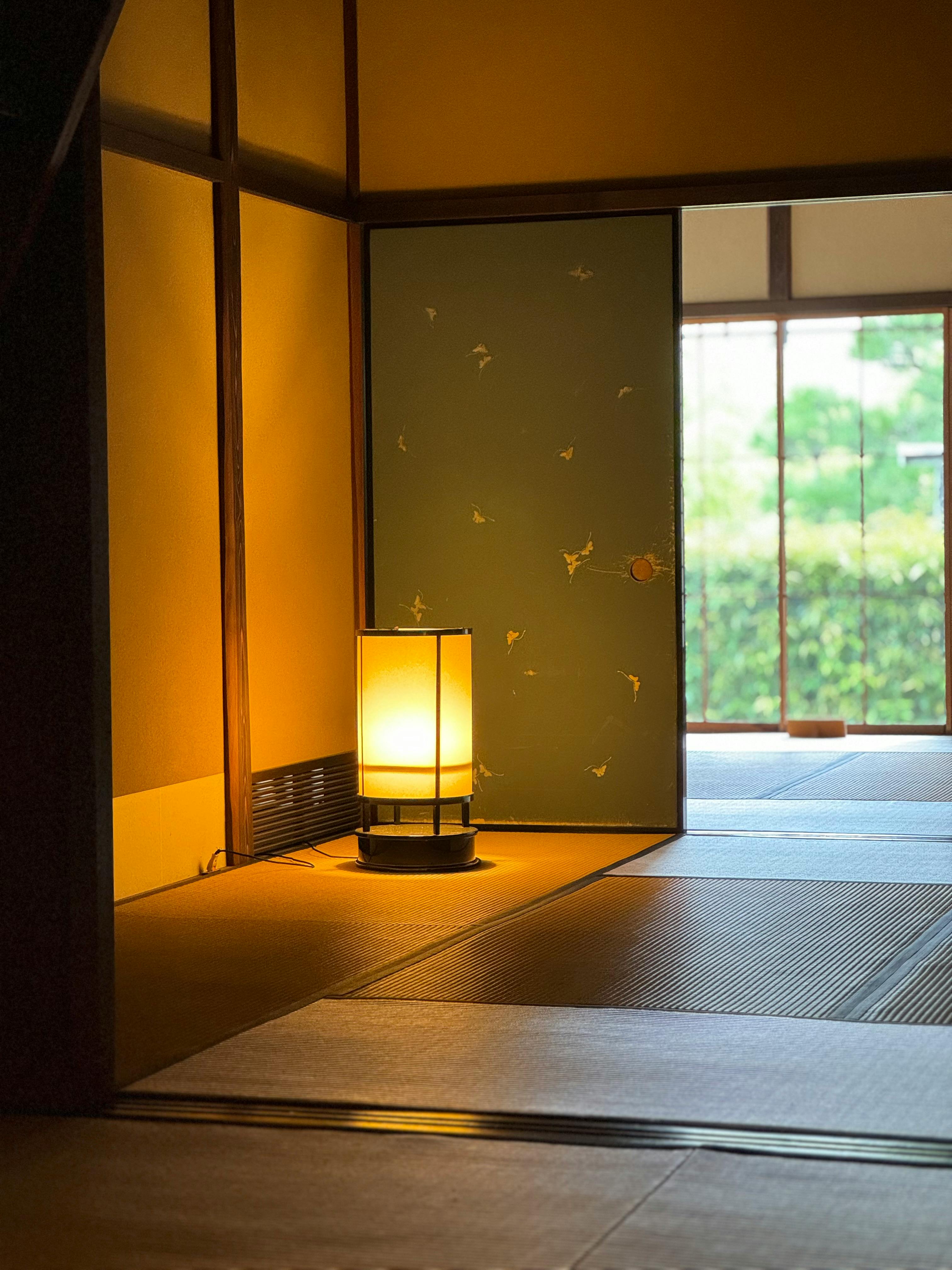
Traditional Japanese interiors use softened daylight and edge spaces such as the engawa to keep rooms calm without shutting them down.
People hear “minimal” and make the room darker, emptier, and more sealed. That misses the point.
Traditional Japanese rooms are not dead spaces. They use filtered light, not no light. They use soft boundaries, not heavy enclosure. A room can be quiet without becoming a shadow box.
Do this instead:
- Diffuse daylight with screens, curtains, or translucent surfaces instead of blacking the room out.
- Use warm wood with off-white plaster or paper-like finishes so the room stays light but not glossy.
- Let one side of the room open toward a garden, court, deck, or edge zone whenever you can.
3. Flat Floors With No Thresholds
Many modern interiors keep everything on one plane and then wonder why the room has no character.
Traditional Japanese interiors often use floor changes, platform zones, sunken entries, hearth conditions, and material shifts to tell you how the room works. Those moves guide use without needing extra walls.
Do this instead:
- Use a clear genkan-like entry break if shoes, dirt, and street life need to be separated from the main room.
- Use a raised tatami platform, a lowered conversation zone, or even a simple material change to mark a shift in use.
- Let the floor do some of the organizing work instead of asking furniture to do all of it.
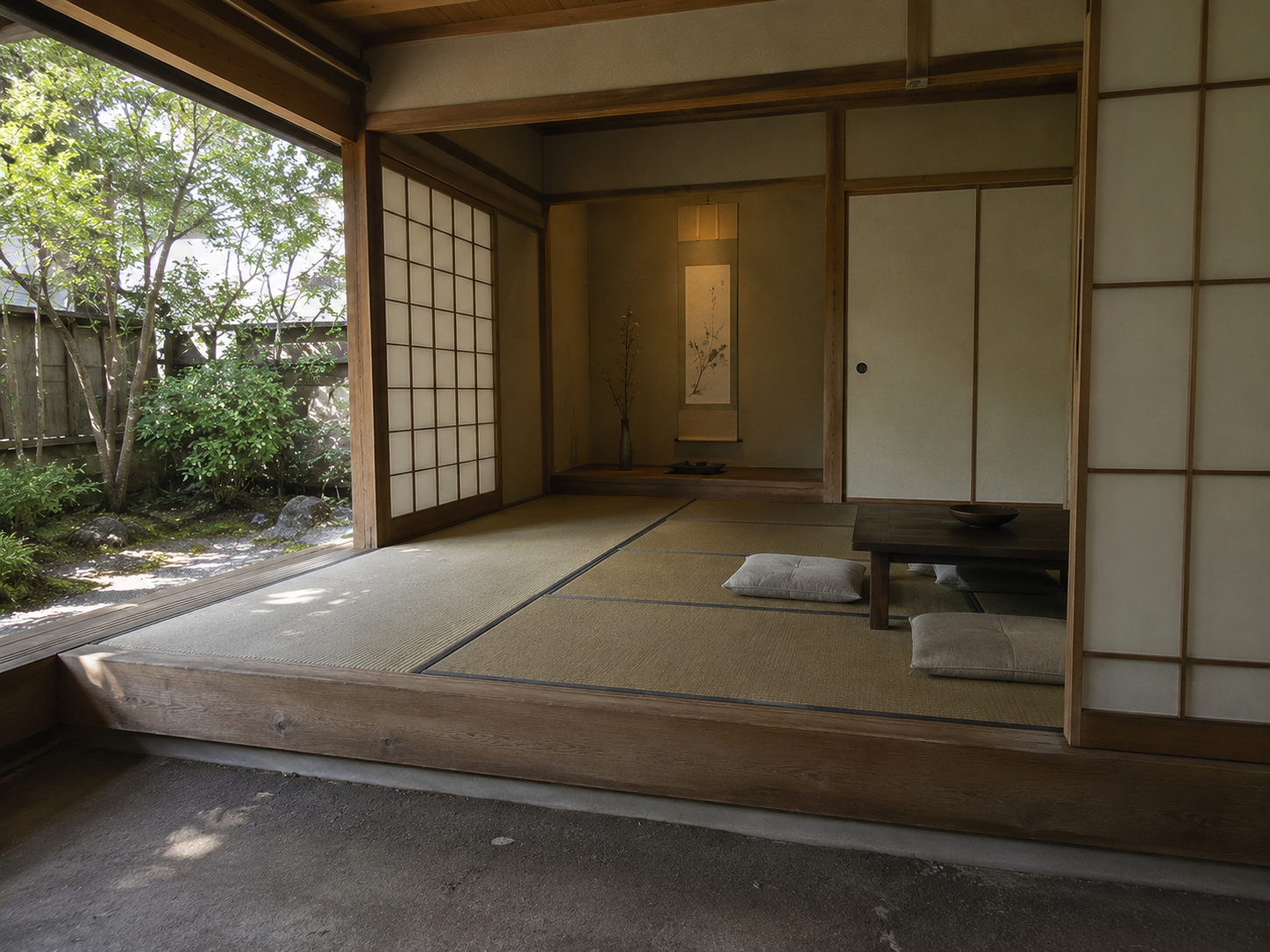
Image by ArchitectureCourses.org. A raised tatami platform works as a real room zone, with a clear step, timber threshold, shoji screens, and a lower adjacent floor.
4. Overdesigned Interiors
Japanese-inspired interiors lose their strength when every surface tries to speak at once.
Too many slats, too many textures, too many built-ins, too many “statement” pieces. This kills the room faster than most people expect.
Japanese interiors are controlled, but they are not busy. They use asymmetry, but not chaos. They use emptiness, but not neglect. The room has to feel deliberate.

Do this instead:
- Let one material lead.
- Keep storage quiet and built in where possible.
- Use open floor area as part of the design, not as unfinished leftover space.
Fusuma Changes How a Room Works
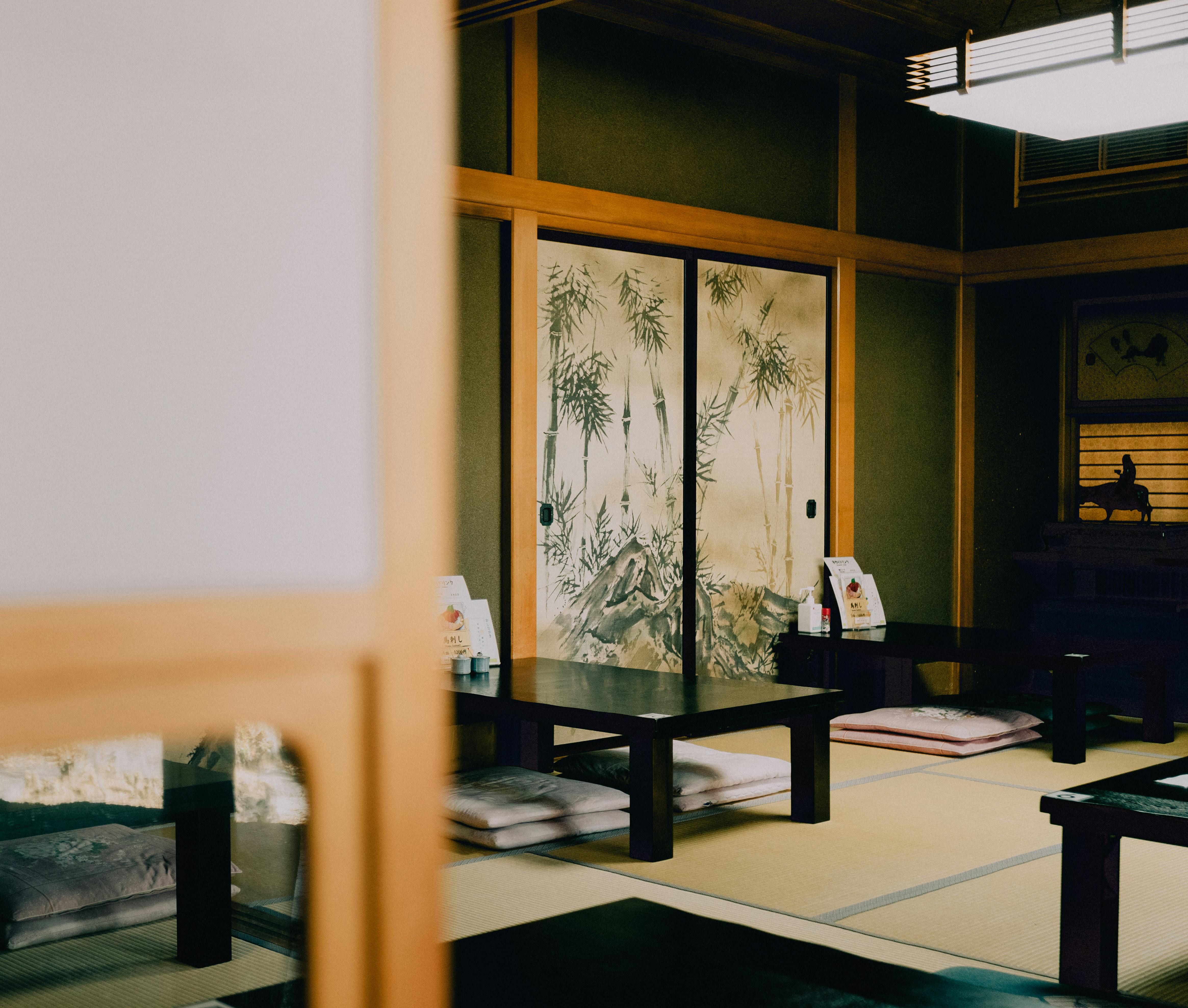
Fusuma panels turn one room into several rooms, or several rooms into one larger space, without the heaviness of fixed partitions.
Fusuma are one of the clearest examples of what modern imitations often miss. These are not decorative panels. They are movable walls.
That matters because they change how the home behaves. One room can become a guest room, then a family room, then a sleeping space, then a quiet room again. The architecture holds the flexibility. The room does not need to be permanently labeled.
If you are working on a modern interior, this is one of the best lessons to borrow. A flexible space usually performs better than a room locked into one use. That is also why traditional Japanese house layout feels so different from a standard Western room schedule.
What to borrow from fusuma:
- Sliding partitions instead of swing doors where flexibility matters.
- Hidden storage so the room can reset fast.
- Fewer fixed furniture pieces in rooms that need to change through the day.
Technical book:
Measure and Construction of the Japanese House
Best fit if you want measured drawings, room order, and the construction logic behind the traditional house.
Engawa Fixes the Edge

The engawa is not a standard porch. It is a narrow, shaded edge zone that connects room, weather, garden, and circulation.
If there is one feature modern imitations flatten badly, it is the engawa.
It is not just a porch. It is a transition strip between interior and exterior, private room and garden edge, enclosure and airflow. It helps the house breathe. It slows movement. It lets light, shadow, and weather sit close to the room without fully entering it.
That is why the engawa matters so much. It is one of the best examples of how Japanese interiors and exteriors are not treated as separate worlds.
Do not turn it into:
- a regular hallway
- a sunroom packed with furniture
- a glassed-in buffer that kills the outdoor edge
Do use it as:
- a shaded circulation band
- a place to sit near weather and light
- a narrow overlap between room and site
Tatami Is a Planning System, Not Decor
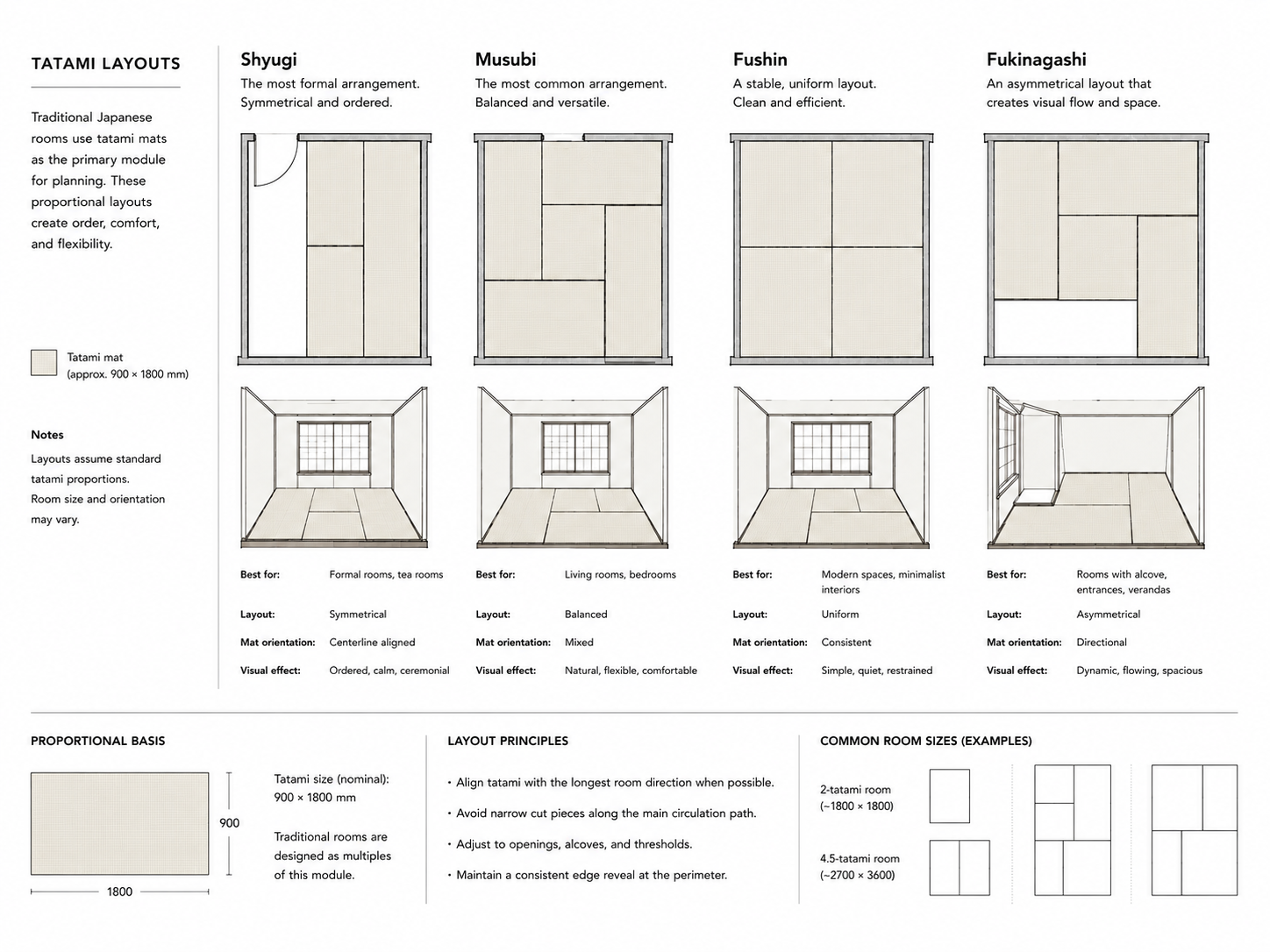
Illustration by ArchitectureCourses.org. Tatami layouts use mat proportion and orientation to organize the room, not just cover the floor.
One of the worst ways to use tatami is to treat it like a rug.
Tatami works as a module. It shapes room proportion, seating logic, circulation, and placement. In other words, it helps organize the room before furniture ever enters the conversation.
That is why badly researched tatami layouts feel wrong even when the materials look expensive. The issue is not the mat. The issue is the geometry.
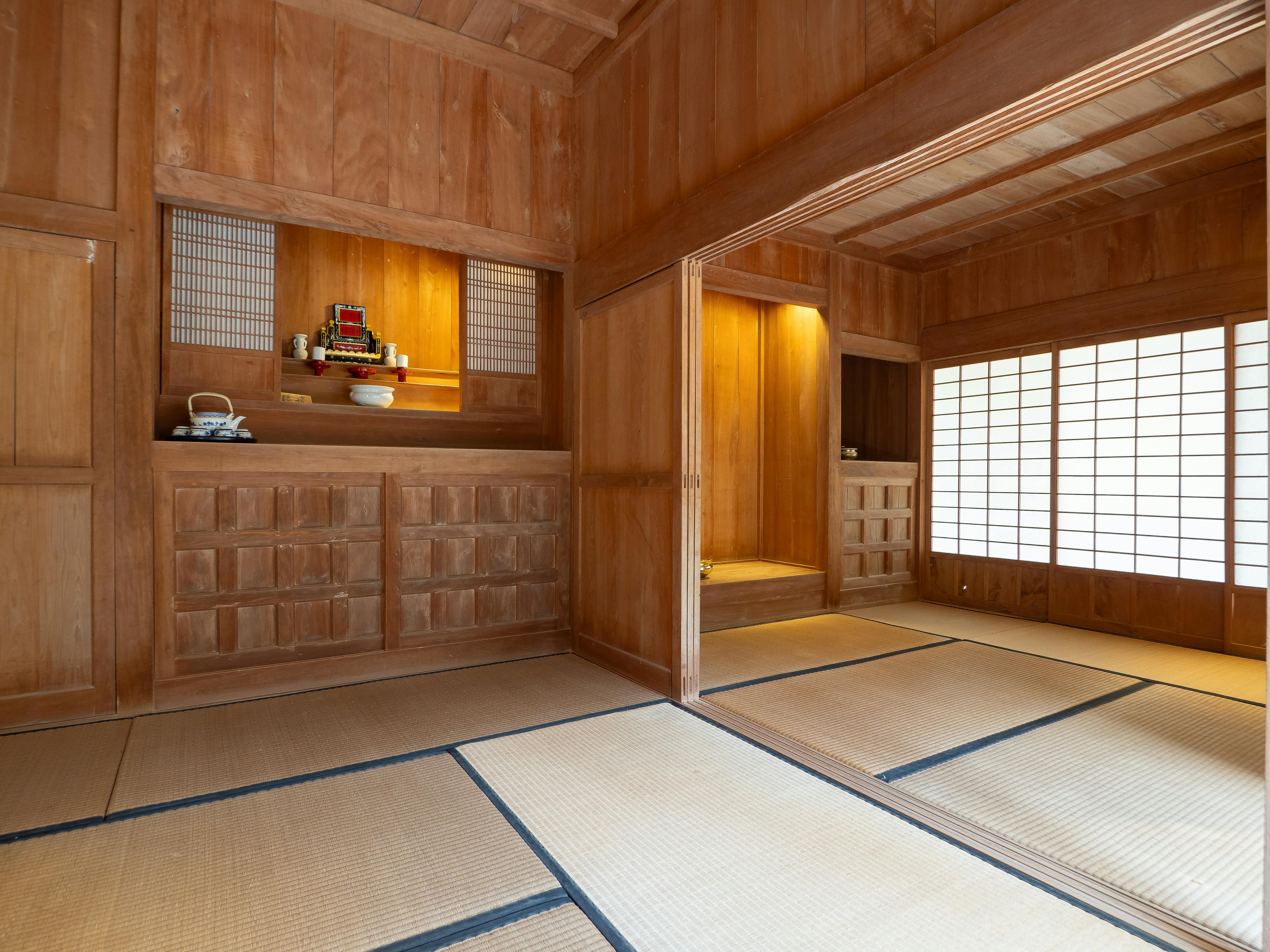
Traditional room planning depends on disciplined proportion. The floor module, the alcove, the openings, and the seating zone all work together.
Even if you never install tatami, you can still learn from its logic:
- use a repeatable planning module
- align furniture and openings to a visible room order
- avoid random leftover dimensions
- let the room read as one composition instead of a pile of parts
Space Should Not Be Overfilled
A lot of this comes back to one idea: space is not a void that needs constant filling.
In Japanese design, Ma gives value to the interval between things. The pause matters. The open patch of floor matters. The quiet wall matters. The unfilled zone is doing work.
That is why these rooms often feel calmer than rooms with the same square footage elsewhere. The eye has somewhere to rest. The body has room to move. The room can change use without first being cleared of too much stuff.
This does not mean emptiness for its own sake. It means the room is not overassigned. That is a different idea, and it is much more useful.
How to Borrow the Logic Without Faking the Look
You do not need to rebuild a farmhouse in Kyoto to use this well. But you do need to borrow the right things.
- Keep the room flexible. Use sliding partitions, built-in storage, and fewer fixed uses.
- Filter light. Do not rely on glare or blackout. Use soft daylight.
- Make thresholds visible. Use floor changes, edge zones, entries, and transitions with purpose.
- Choose fewer materials. Let wood, plaster, paper-like surfaces, and natural fibers do the work.
- Leave room unfilled. Not every wall needs furniture and not every surface needs display.
If you also want the outer shell side of the problem, Japanese Style House Exterior is the right next page. Interior calm works better when the roof, edge conditions, and openings are doing their part too.
Visual reference:
The Japanese House: Architecture and Interiors
A good visual companion if you want built examples without drifting into lifestyle fluff.
FAQ
What is the biggest mistake in Japanese interior design?
The biggest mistake is copying the look without copying the spatial logic. Low furniture, wood slats, and paper lamps do not fix a room with bad flow, bad light, and no flexibility.
Are Japanese interiors supposed to be dark?
No. They are usually built around softened and filtered light, not absence of light.
What makes a Japanese room feel calm?
Clear room order, low visual noise, flexible use, soft light, fewer objects, and stronger thresholds all help.
What is fusuma used for?
Fusuma are sliding opaque partitions that let rooms open up or close down depending on use, privacy, and time of day.
Why is the engawa important?
It creates a usable edge between the room and the outside. It helps with circulation, shading, airflow, and the house’s relationship to the garden or site.
Can you use Japanese interior ideas in a modern home?
Yes, but the best results come from borrowing the planning logic, not just the styling cues.