

Interior design gets messy when every choice feels equally important.
The sofa, wall color, rug, light fixture, shelves, art, handles, curtains, tile, budget, client opinion, and trend you saw last night all start fighting for attention. That is when a room stops being designed and starts being negotiated.
Good interior design needs an order. Not a rigid formula. An order.
Start with what the room has to do. Then solve the layout. Then light, storage, materials, color, and décor. When that order gets reversed, the project starts wasting money: paint tries to fix layout, accessories try to fix storage, and a new sofa tries to fix a room that was never planned properly.
The strongest interiors are not built by choosing more. They are built by deciding what matters first.

The Interior Design Order That Prevents Most Mistakes
The biggest mistake is choosing visible things before solving the room.
Paint, furniture, tile, and décor feel exciting because they show up in photos. But they should not lead the project. A beautiful color cannot repair bad circulation. An expensive sofa cannot fix the wrong scale. A perfect rug cannot solve poor lighting. A minimalist room can still fail if there is nowhere to put daily life.
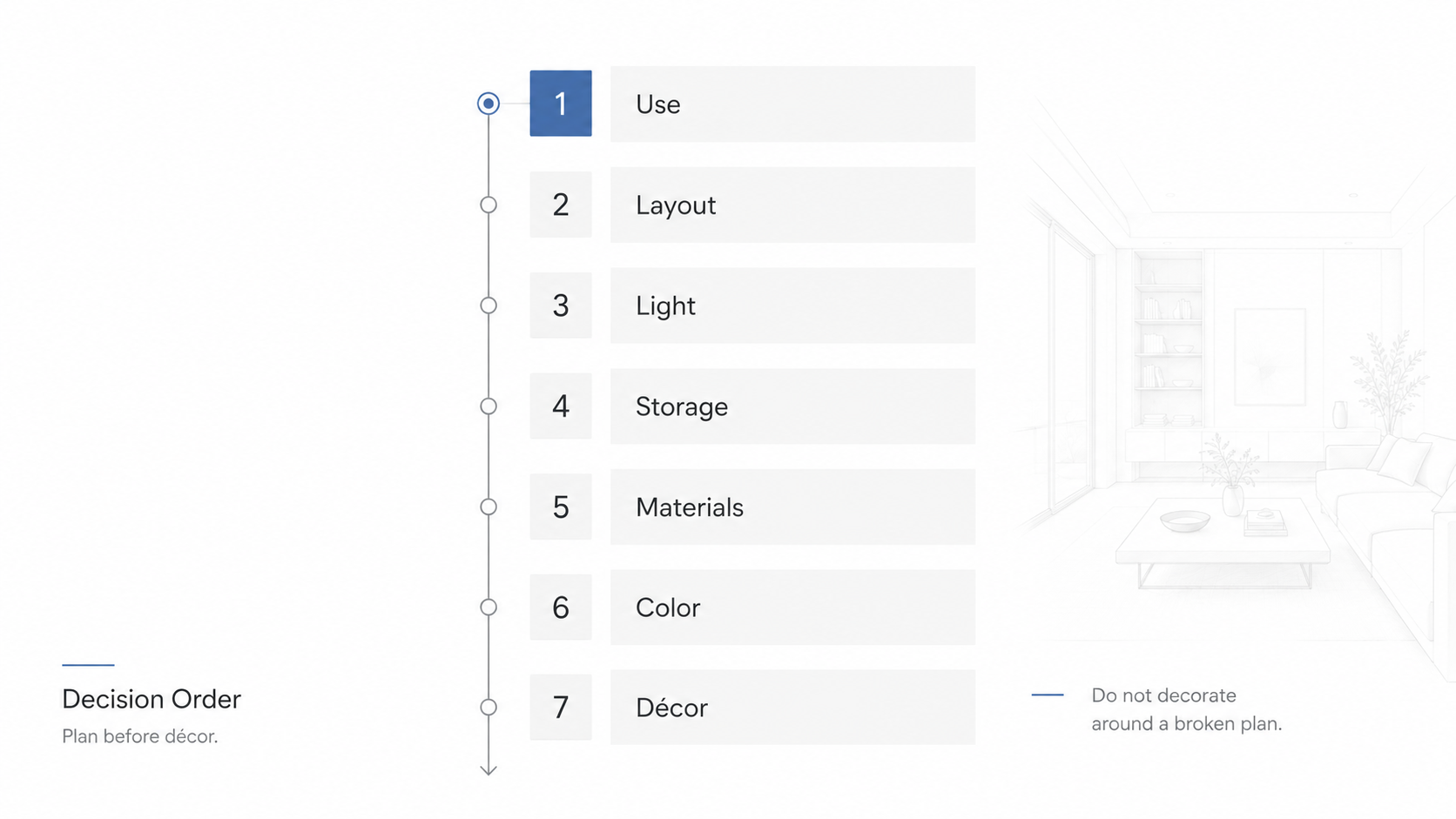
Use this order:
- Use: What must the room do every day?
- Layout: Where do people move, sit, sleep, eat, work, or gather?
- Light: What happens in morning, afternoon, evening, and at night?
- Storage: Where does the mess actually go?
- Materials: What can handle wear, cleaning, moisture, pets, children, sun, or rental use?
- Color: What supports the light, materials, and mood?
- Décor: What adds personality without undoing the room?
This order works for a professional project, a school project, or a homeowner planning one room at a time. It keeps small choices from taking over large ones.
Start with Use, Not Style
Before choosing a style, ask what the room has to do.
A living room may need to handle television, guests, children, reading, pets, storage, and a clear path to the kitchen. A bedroom may need darkness, quiet, clothing storage, a small work corner, or space for two people to move without bumping into furniture. A student project may need a strong concept, but the plan still has to explain how a person enters, sits, works, rests, and leaves.
Style should support those needs. It should not cover up a weak room.
This is where many projects go wrong. The decision starts with “modern,” “minimal,” “cozy,” “industrial,” or “luxury,” but the room itself has not been solved. Then every choice becomes cosmetic. The designer keeps changing colors because the layout is wrong. The homeowner keeps buying décor because the storage is missing. The student keeps adding visual drama because the plan has no clear use.
Start with the job of the room.
- Who uses it? One person, a family, guests, clients, children, tenants, or students?
- What happens there every day? Eating, resting, working, studying, entertaining, cleaning, storing, moving through?
- What is failing now? Too dark, too crowded, no storage, bad circulation, noisy, cold, hard to clean?
- What cannot change? Budget, structure, windows, doors, plumbing, rental rules, existing furniture, deadlines?
Once those answers are clear, the room starts making some decisions for you.
Layout Is the First Design Test
A room can look good in a photo and still be annoying to live in.
That usually means the layout was treated as decoration instead of planning. A good layout answers simple questions. Can you walk through the room without squeezing around furniture? Can two people use the space at the same time? Is the main seat facing something useful? Does the dining chair pull out? Can a drawer open fully? Can the bed be made without crawling around it?
These questions sound basic. That is why they get skipped.
For professionals, layout is where trust is built. Clients may react to colors first, but they live with circulation every day. For students, layout is where a concept proves it can become interior design instead of just a mood. For homeowners, layout is where money is saved because the project stops chasing decorative fixes.
A simple test helps: draw the room and mark the movement paths before choosing anything else.
- If the path from door to sofa cuts through the conversation area, the layout is not finished.
- If the desk faces glare all afternoon, the layout is not finished.
- If the coffee table looks right but blocks knees, the layout is not finished.
- If a storage piece solves clutter but makes the room feel tighter, the layout is not finished.
Do not decorate around a broken plan.
Scale Comes Before Style
The right style in the wrong size still fails.
A beautiful sofa can ruin a room if it blocks circulation. A dining table can be the perfect material and still be too wide for chairs to pull out. A rug can be expensive and still make the furniture look like it is floating. A pendant light can be trendy and still hang at the wrong height.
Scale is not glamorous, but it decides whether a room feels calm or awkward.
Before buying anything large, check the clearances. Walk the path. Open the drawers. Pull out the chairs. Measure the bed wall. Tape the rug size on the floor. Good interiors often feel effortless because someone tested the awkward parts before the pretty parts were chosen.
Light Changes Every Interior Decision
Color is not fixed. It changes with light.
A warm white can look soft in morning light and yellow under cheap bulbs at night. A gray can look calm in a bright room and dead in a north-facing room. Dark green can feel rich in a room with good daylight and heavy in a room with one small window.
That is why paint should not be chosen from a tiny chip in a store. Samples need to be tested on the wall, near the trim, beside the floor, and under the actual lighting. Look at them during the day and again at night.

Lighting also decides whether a simple room feels calm or unfinished.
One ceiling light rarely works by itself. Most rooms need layers: general light, task light, and softer light. A kitchen needs work light. A living room needs lamps. A bedroom needs light that can be used from bed. A bathroom needs face lighting, not only a bright ceiling fixture behind your head.
Professionals should show lighting early because it affects every finish. Students should draw light as part of the design, not as a late symbol on a plan. Homeowners should budget for lamps, dimmers, bulbs, and fixture placement before spending everything on furniture.
Storage Is Not a Bonus
Storage is not the unglamorous part you add at the end. It is one of the reasons a room works.
A living room with no storage becomes cluttered. A bedroom with poor clothing storage never feels calm. A kitchen with too few drawers becomes frustrating no matter how good the cabinets look. A bathroom with no place for daily items turns every surface into a shelf.
The storage question is simple: where does daily life go when nobody is cleaning for a photo?
- Where do shoes, bags, chargers, remotes, blankets, toys, books, mail, towels, tools, and cleaning supplies land?
- Which items need to be hidden?
- Which items need to be reached every day?
- Which items are only kept because no one has decided where they belong?
If the room looks good only when everything is removed from it, the design is not finished.
Materials Have Consequences
Materials are not just appearance. They decide cleaning, sound, glare, wear, comfort, and maintenance.
Open shelving looks light until the dishes collect dust. A white sofa looks calm until the dog jumps on it. Black fixtures look sharp until water spots show every day. Gloss tile looks clean until glare becomes annoying. A delicate rug looks beautiful until dining chairs chew up the edge.
None of these choices are automatically wrong. They just have consequences.
Professionals should explain maintenance before approval. Students should show that material choices have behavior, not just appearance. Homeowners should ask how the finish cleans, wears, fades, scratches, stains, and ages.
A good interior is not only beautiful on installation day. It still works after six months of use.
Elements and Principles Still Matter
Interior design is not only taste. It uses basic elements and principles: line, shape, texture, color, balance, rhythm, proportion, unity, and emphasis.
But those tools should not float by themselves. A strong room does not use “texture” because texture is on a checklist. It uses texture because the room needs warmth, grip, softness, shadow, or contrast. A room does not use “emphasis” just to make one object loud. It uses emphasis to tell the eye where to land first.

This is useful for students because it turns abstract studio language into a decision tool. It is useful for professionals because it gives better words for client presentations. It is useful for homeowners because it explains why a room with many nice things can still feel wrong.
The parts need an order. Otherwise, the room becomes a collection.
Simplicity Is a Decision Tool, Not a Style Costume
Simplicity does not mean the room has to be empty, beige, expensive, or cold.
Simplicity means the room is not fighting itself.
A simple interior can be traditional, modern, rustic, industrial, colorful, or quiet. The point is not to remove personality. The point is to remove confusion.
A room feels simpler when the main decisions agree with each other: the furniture fits the scale, the palette belongs to the light, the storage handles daily clutter, and the decorative pieces have breathing room. That is different from copying a minimalist image and hoping it works.

Minimalism can be useful because it forces discipline. With fewer elements, weak decisions are exposed. The chair has to be the right size. The floor has to work. The wall color has to respond to light. The art has to matter. There is less to hide behind.
But minimalism is not automatically better. A family room with no storage is not simple. It is unfinished. A rental apartment with no soft surfaces may look clean but sound harsh. A student project with empty space may look controlled but fail if the empty space has no reason.
Simplicity works when it clarifies use.
How Professionals Should Make Interior Decisions
Professional designers need a decision process because design is not only taste. It is communication, budget control, risk control, and client management.
A client may want the latest look, a family-friendly room, a tight budget, fast installation, durable materials, and a magazine finish. Those goals may not all fit together. The designer’s job is not to say yes to every desire. The job is to rank the goals and explain the trade-offs.
A professional decision should be tested against four things:
- Function: Does it improve how the room works?
- Budget: Does it protect the money for the most important work?
- Installation: Can it be built, delivered, fitted, cleaned, repaired, or replaced?
- Longevity: Will it still make sense after the trend fades?
A strong professional does not present twenty options for every decision. That creates anxiety. Present a clear direction, one close alternative, and the reason the main option is stronger.
Too many options can make the client feel included at first, then abandoned later. They start asking friends, scrolling for more references, and second-guessing the whole project. The designer loses the room.
Good editing is part of the service.
How Students Should Make Interior Decisions
Students often overdesign because school rewards visible effort. More diagrams, more materials, more concept language, more dramatic moves. But more is not always stronger.
A student interior project should make one clear argument.
What is the main idea? How does the plan support it? How does the light support it? How do the materials support it? What did you leave out because it weakened the idea?
That last question matters. Design school is not only about adding. It is about editing.
Students should also stop treating mood boards as the design. A mood board is a reference. The design is the space.
The room still needs scale, sections, furniture logic, light, storage, thresholds, and material behavior. If the project only works as a collage, it is not finished.
How Homeowners Should Make Interior Decisions
Homeowners usually overthink interiors for a different reason: the choices cost real money.
A designer can move on to the next project. A homeowner has to live with the sofa, the floor, the tile, the paint, and the bill. That pressure makes every decision feel permanent.
The way through it is to separate expensive decisions from easy-to-change decisions.
- Hard to change: flooring, built-ins, tile, plumbing, electrical, major furniture, window treatments, custom work.
- Easier to change: paint, pillows, lamps, side tables, art, bedding, small rugs, accessories.
Spend more time on the hard-to-change decisions. Move faster on the flexible ones.
Do not buy small décor to avoid making the larger decision. A basket will not fix a room with no storage. New pillows will not fix a sofa that is the wrong size. A trendy wall color will not fix poor lighting.
Buy slowly where mistakes are expensive.
When to Stop Changing the Design
Overthinking often continues because there is no stopping rule.
Stop changing the design when the main problems are solved and the remaining changes are only small preference swaps.
Ask:
- Does the layout work?
- Does the room have enough light for how it is used?
- Is there a place for daily clutter?
- Do the main pieces fit the scale of the room?
- Do the materials suit the people using the space?
- Does the palette work in the actual light?
- Is the budget still protecting the important decisions?
If the answer is yes, stop redesigning the whole room.
You can still adjust art, lamps, styling, and small accessories later. Not every idea needs to enter this project. Some ideas belong in the next room, the next client project, the next school assignment, or the next version of your own home.
Saving an idea is not failure. It is editing.
A Practical Example: The Rug Decision
Say you are choosing between two rugs for a living room.
Rug A is calm, durable, the right size, and fits the furniture plan. Rug B is more exciting, more colorful, and would photograph better, but it competes with the art and makes the room feel busier.
The weak way to decide is to ask which rug is more beautiful.
The stronger way is to ask what the room needs.
If the room already has strong art, warm wood, and several textures, Rug A may be the better decision. It supports the room. If the room is plain, lacks a focal point, and needs energy, Rug B may be right.
The question is not “Which one do I love more?”
The question is “Which one helps this room do its job?”
A Practical Example: The Paint Color Decision
Paint color is one of the most overthought interior decisions because it feels simple but changes with light, floor color, trim, furniture, and time of day.
Do not choose paint in isolation.
Put the sample near the floor, trim, sofa, cabinets, or main material it has to live beside. Look at it in daylight and at night. Then choose the color that makes the whole room feel settled, not the color that looks best on its own.
For professionals, this prevents client panic after the first coat. For students, it teaches color as part of spatial atmosphere. For homeowners, it saves repainting because the store chip looked different from the wall.
What Great Interior Design Does Better
Great interior design is not just prettier. It is more resolved.
It has fewer weak compromises. The layout, light, materials, storage, and furniture scale are working together. The room feels calm because the decisions are not arguing.
Average interiors often have good individual pieces but no order. A nice chair, a nice rug, a nice lamp, a nice wall color — but the room still feels off. That usually means the pieces were chosen separately instead of as part of one decision system.
Great interiors also know when to be quiet.
Not every wall needs a feature. Not every corner needs a plant. Not every surface needs styling. Empty space can be useful if it gives the room balance, movement, and rest.
But empty space should be intentional. A blank wall caused by indecision is not the same as restraint.
Quick Decision Rules for Any Interior Project
- Fix the layout before choosing color. Color cannot repair bad circulation.
- Choose scale before style. The right style in the wrong size still fails.
- Test finishes in the actual room. Light changes everything.
- Protect storage early. Clutter ruins good design faster than almost anything.
- Spend more time on permanent choices. Move faster on things that are easy to change.
- Use trends as accents, not foundations. The room should still work when the trend is gone.
- Stop when the room works. Endless changes can weaken a good design.
FAQ
Why do interior design decisions feel so hard?
They feel hard because many choices affect each other. A sofa affects layout. Layout affects lighting. Lighting affects color. Color affects materials. Once you understand the order, the decisions become easier.
Should I choose furniture or paint first?
Choose the layout and major furniture direction first. Paint should respond to the room’s light, flooring, furniture, and materials. Paint is easier to change than a sofa, floor, or built-in.
Is minimalism the best approach to interior design?
Minimalism can help because it forces clearer decisions, but it is not the only good approach. A room can be colorful, layered, or traditional and still be well designed if the choices are controlled and useful.
How many options should a designer show a client?
Enough to show judgment, not enough to create confusion. A clear main recommendation with one or two alternatives is often stronger than presenting ten similar options.
What is the biggest mistake homeowners make?
Buying small decorative items before solving the main problem. If the room lacks storage, light, or a working layout, accessories will not fix it.
What is the biggest mistake students make?
Treating the concept image as the design. A strong interior project still needs plan logic, scale, light, material behavior, and a clear reason for every major move.
What to Remember
Interior design gets easier when decisions happen in the right order.
Start with use. Solve the layout. Study the light. Plan storage. Choose materials that can survive the room. Then choose color and décor.
That order works for professionals managing clients, students building stronger projects, and homeowners trying to make good choices without wasting money.
The goal is not to make the room look empty. The goal is to make the room stop fighting itself.