
The Rise of Biophilic Cities: Exploring Nature-Inspired Urban Planning
Bringing Nature Back to Cities: A Biophilic Revolution
It is starting to feel like a basic human right to live in a sustainable city, isn’t it? Access to clean air, trees on your block, and shade that doesn’t come from a billboard should not feel like luxuries. In smog-heavy cities, people are already treating it like a fight. In greener places like Vancouver, Melbourne, or Oslo, residents are starting to expect it.
That is where the idea of biophilic cities comes in. Cities built not just with roads and towers, but with forests, wetlands, and rooftop gardens woven into their bones. Cities where you don’t need a car to find a park. Where a walk to work doubles as time in nature.
This is not green garnish. It is survival planning. Cities are hotter, denser, and more stressful than ever. If we are going to pack people this tight, we need to rethink what “urban” means.
How the World’s Greenest Cities Are Planned
Biophilic Cities List: The Best Models for Future Urban Living
Green Cities for a Greener Future
Picture skyscrapers wrapped in vertical forests. Picture rooflines covered in meadows. Picture streets cooled not by air conditioning, but by tree canopies. That is the promise of biophilic urban design.
And it is not a fringe experiment. Singapore, San Francisco, and Milan have already rewritten their skylines with greenery. Oslo treats its forests like city infrastructure. Melbourne has a target to double tree canopy by 2040. These places are not just adding parks—they are reprogramming what a city can be.
What Is a Biophilic City?
A biophilic city is one that doesn’t treat nature as an add-on. It builds nature into the grid itself.
● Green roofs and walls filter air and cool buildings.
● Urban wetlands and rain gardens manage water instead of concrete drains.
● Tree corridors and city forests connect people with wildlife.
● Natural materials and light shape how buildings feel from the inside out.
The aim is not just beauty. It is healthier air, cooler summers, better biodiversity, and less stress on the people who live there.
Related: Eco-Friendly House Without the Green Guilt
Why They Work
Biophilic cities are not utopian. They are practical.
● Cleaner air. Plants filter fine particles and produce oxygen.
● Lower heat. Shade trees and green roofs reduce the urban heat island effect.
● Mental health. Dozens of studies show contact with greenery lowers anxiety, blood pressure, and depression.
● Biodiversity. Green corridors let birds, insects, and animals thrive even in dense cores.
● Social connection. Parks and gardens pull people outside and together.
The big idea: cities do not have to fight nature. They can work with it.
Related: Clay in Architecture Explained with Examples Old and New
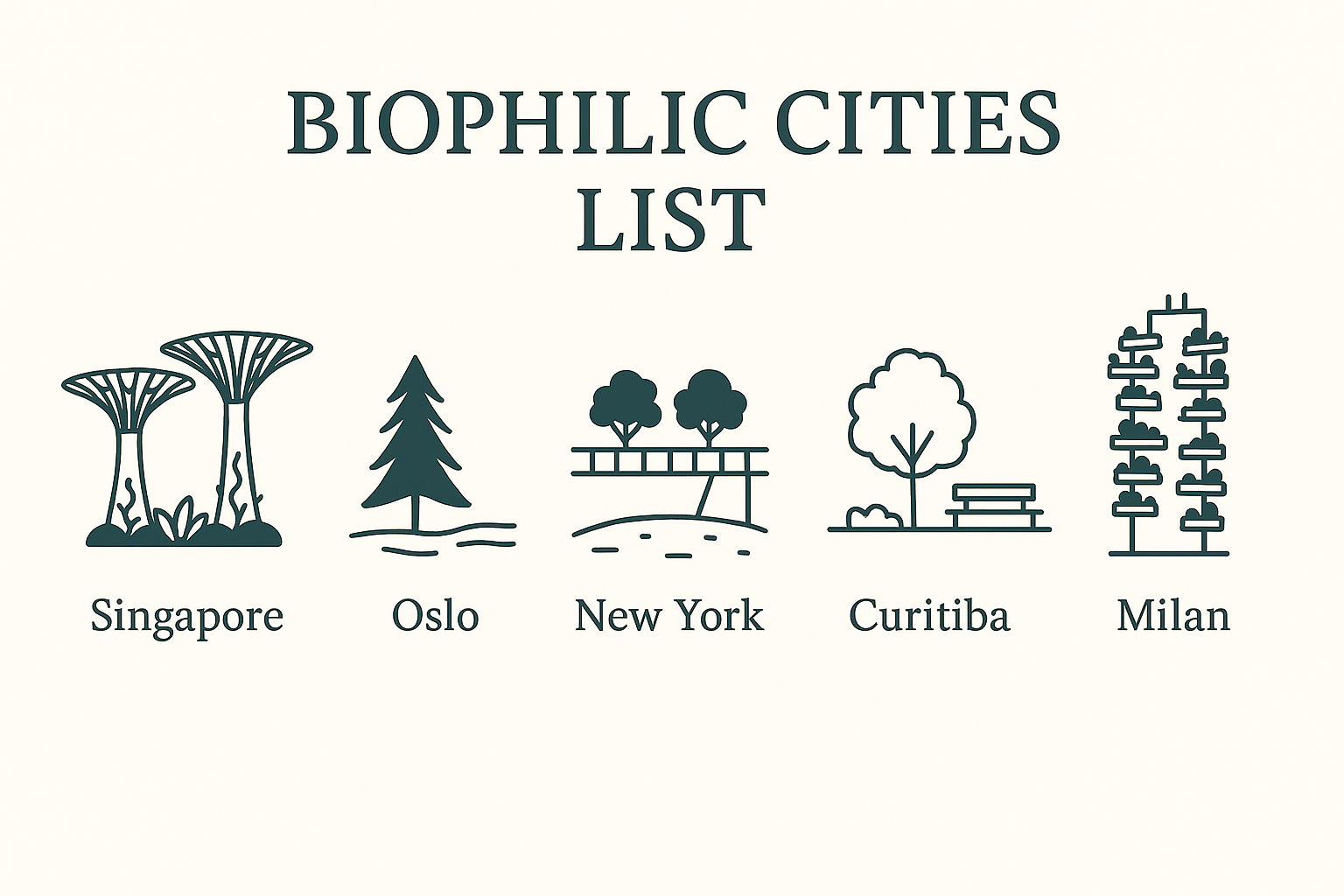
Biophilic Cities List: 13 Places Where Nature Shapes Urban Life
Global Examples of Greener Urban Design
Biophilic Cities in Action
Singapore
Singapore brands itself “A City in a Garden.” Half the land is covered in green space. Gardens by the Bay, with its Supertrees, mixes spectacle with solar power and water collection. The Oasia Hotel Downtown by WOHA is basically a vertical rainforest in the middle of the CBD.
What architects learn here: go vertical. In land-squeezed cities, walls and roofs are your forest.
San Francisco, USA
Salesforce Park is a four-block-long garden built on top of a transit terminal. It holds over 600 trees and 16,000 plants above downtown streets. Pair that with Golden Gate Park—1,000 acres of designed wilderness—and you get a city that breathes.
What planners learn here: use infrastructure as landscape. A roof, a rail line, or a flood channel can double as green space.
Oslo, Norway
Oslo has forests and fjords literally inside its borders. Ninety percent of residents live within a short walk of green space. The Fjord City project turned industrial waterfront into parks, bike paths, and habitat.
Lesson: protect natural borders. Once forests are paved, they are gone. Oslo wrote them into city law.
Wellington, New Zealand
Wellington links bush reserves, mountain trails, and coastal walkways directly into the urban grid. Wildlife like native birds are returning to the core.
Lesson: don’t separate “city” and “nature.” Seamless boundaries keep both healthier.
You might like: Eco-Friendly House Without the Green Guilt
Portland, USA
Portland pioneered bioswales and rain gardens along streets. Tanner Springs Park is an urban wetland that filters stormwater while offering a place to sit. Forest Park, inside city limits, is one of the largest urban forests in the U.S.
Lesson: treat water like an ally, not a problem. Design it into public space.
Milan, Italy
Milan’s Bosco Verticale—two residential towers covered in 800 trees and 15,000 plants—changed how the world imagines high-rises. It cut CO2, provided shade, and became an icon.
Lesson: even polluted, dense cities can go biophilic. You just need bold design.
Melbourne, Australia
Melbourne’s Green Infrastructure Plan is blunt: plant more trees or cook. The city set a canopy goal of 40% by 2040. Public spaces are being rebuilt with shade as a design driver.
Lesson: use tree canopy as climate defense.
Biophilic Cities List: Real Examples of Nature Integrated Into Cities
Vancouver, Canada
Stanley Park may be the best-known example, but Vancouver has been folding nature into its master plan for decades. False Creek projects mix water management with urban farming.
Lesson: put food, water, and green corridors at the core of zoning.
Curitiba, Brazil
Curitiba tied parks and transport together. Flood-prone land was turned into green space instead of pipes. Its bus rapid transit system is legendary for cutting car use.
Lesson: design multiple wins. A park can absorb water, cut traffic, and give people a place to walk.
Freiburg, Germany
The Vauban neighborhood banned cars, added solar panels, and built homes with passive standards. Rolf Disch’s Heliotrope house rotates with the sun to maximize energy capture.
Lesson: biophilia is not just trees. It is energy, light, and mobility.
London, UK
London has made green roofs standard in many zones. Projects like Thames Estuary 2100 fold flood defense into new green corridors.
Lesson: climate resilience and nature go hand in hand.
See also: Methods of Sustainable Construction: What Works, What Wastes Money
Seattle, USA
Seattle runs rain gardens down residential blocks. Developers must meet green building codes. Parks and forests are stitched into neighborhoods.
Lesson: rules matter. Policy makes design stick.
Amsterdam, Netherlands
Amsterdam plans floating neighborhoods to deal with rising seas. Its planners treat water as urban structure, not threat.
Lesson: adapt, don’t resist. Biophilic design is climate design.
You might like: Why Biophilic Cities Are the Future of Urban Planning
Surprising Ways Nature is Changing Cities
● Milan’s Bosco Verticale absorbs 30,000 tons of CO2 annually and created a mini-ecosystem in two towers.
● Singapore’s Supertrees generate solar power and collect rain. They are functional infrastructure disguised as spectacle.
● Oslo’s forests double as flood defense and daily recreation.
● Portland’s wetlands filter runoff cheaper than pipes.
Nature is not decoration. It is doing work.
Why Living in a Biophilic City Matters
● Health. Lower stress, better air, more daylight.
● Climate defense. Shade, water, and green buffers keep cities cooler and safer.
● Activity. Parks and trails make walking and cycling natural habits.
● Value. Properties near green space sell higher and hold value.
● Community. Shared gardens and parks create social glue.
This is not just about nice views. It is about survival in an urban future.
Who Makes It Happen
● Governments. They set canopy targets, flood policies, and building codes.
● Architects. They design green towers and parks that become icons.
● Engineers. They make sure living walls don’t collapse and wetlands actually filter.
● Citizens. They push, vote, and maintain. Without demand, projects stall.
Traditional City vs. Biophilic City
| Feature | Traditional City | Biophilic City |
|---|---|---|
| Green Space | Parks as add-ons. Often small or disconnected. | Green woven through everything: parks, roofs, corridors, wetlands. |
| Air Quality | Polluted, little filtering. Heat and smog build fast. | Trees, walls, and wetlands actively clean air and cool streets. |
| Building Design | Concrete boxes, sealed from outside. | Buildings interact with light, plants, and water. Green walls, daylight, natural airflow. |
| Water Management | Pipes, drains, flood defenses. | Rain gardens, wetlands, and green roofs handle stormwater naturally. |
| Climate Resilience | Vulnerable to heatwaves, flooding, smog. | Cooler streets, flood absorption, and natural buffers built in. |
| Health Impact | Stress, higher respiratory issues, sedentary lifestyle. | Lower stress, better lungs, more outdoor activity encouraged. |
| Biodiversity | Minimal. Wildlife pushed out. | Birds, insects, and plants reintroduced through corridors and parks. |
| Social Life | People gather in malls or cars. | People meet in gardens, parks, and shared green plazas. |
| Property Value | Drops near polluted or overheated zones. | Higher near green spaces, long-term value stability. |
| Identity | City known for buildings and roads. | City known for its forests, gardens, and green innovation. |
Final Word
The rise of biophilic cities is not a trend. It is a correction. For a century we built walls against nature. Now we are breaking them back down.
Cities that fold in forests, wetlands, and gardens are not just nicer to live in. They are more resilient, healthier, and more human.
The future of urban life is not endless towers and heatwaves. It is shade, air, and space to breathe. That is the real biophilic revolution.
FAQs
1. What exactly is a biophilic city?
A biophilic city is one where nature isn’t an afterthought. It’s built into the fabric of daily life—green roofs, tree corridors, water systems, and places where people and wildlife share space.
2. How is this different from just a “green city”?
A green city usually adds parks and trees. A biophilic city goes deeper—nature runs through every block, every building, every system.
3. Do biophilic cities really improve health?
Yes. People living close to green space report lower stress, lower blood pressure, and better mental health. Doctors in Singapore even prescribe “nature walks” as part of treatment.
4. Are they only for wealthy cities like Singapore?
No. Curitiba in Brazil proved you can do it on a budget by turning flood-prone land into public parks instead of expensive concrete defenses.
5. What is the biggest mistake cities make when trying to “go biophilic”?
Treating it like decoration. A few rooftop gardens don’t make a city biophilic. It has to be systemic—water, air, mobility, housing all tied to nature.
6. How expensive is it to build a biophilic city?
Upfront costs are higher, but maintenance is often cheaper. Green roofs last longer than standard roofs. Trees reduce cooling bills. Water-sensitive design saves flood costs.
7. Do biophilic designs increase property values?
Almost always. Homes near parks or green corridors consistently sell higher and faster.
8. Can older cities retrofit into biophilic ones?
Yes, but it takes planning. London is layering green roofs onto old buildings. New York transformed an abandoned railway into the High Line, now one of its top public spaces.
9. What role do architects play?
We set the framework. Think Stefano Boeri’s Bosco Verticale in Milan or WOHA’s towers in Singapore—where design choices make plants structural, not ornamental.
10. What role do engineers play?
They make it work. A vertical forest looks good, but without drainage systems, soil anchors, and irrigation, it collapses. Engineers turn vision into safe practice.
11. Can citizens push for biophilic cities?
Absolutely. Community gardens, park cleanups, or just lobbying for tree planting programs all add up. Many projects start with residents, not governments.
12. Do biophilic cities reduce climate risk?
Yes. Trees cut heat islands, wetlands absorb floods, and vegetation slows stormwater. Oslo uses forest corridors as its climate defense.
13. What about biodiversity?
Biophilic cities create habitats where birds, bees, and insects return. Milan’s Bosco Verticale attracted dozens of species within two years.
14. How do water systems fit in?
Rain gardens, bioswales, and wetlands treat water naturally. Portland’s Tanner Springs Park filters stormwater and doubles as a public park.
15. Are there cultural barriers to biophilic design?
Sometimes. In dense cities like Tokyo, space is limited. But vertical gardens and rooftop farms adapt the idea to tight footprints.
16. Do green roofs actually work in cold climates?
Yes, but they need different plants. In Toronto, sedum is used on thousands of roofs because it survives harsh winters.
17. Do green buildings require more maintenance?
They require different maintenance. You need gardeners instead of just HVAC techs. But many systems—like natural ventilation—actually lower long-term costs.
18. What about pests? Do more plants mean more bugs?
If designed right, no. Healthy ecosystems balance pests with predators. Singapore’s vertical gardens attract birds and lizards that keep pests in check.
19. Are biophilic projects just for rich districts?
They shouldn’t be. Some of the most successful projects are in lower-income neighborhoods, where health and heat relief are most needed.
20. Do kids benefit from biophilic cities?
Yes. Kids in green neighborhoods have higher test scores, less ADHD symptoms, and more physical activity.
21. What is the best-known biophilic city right now?
Singapore is the model. It branded itself as a “City in a Garden” and delivered with laws, not slogans.
22. What is the biggest challenge in the US?
Car dependency. Green corridors and compact cities support biophilia better than sprawling suburbs.
23. Are there biophilic cities in Europe?
Yes. Oslo, Freiburg, and Milan are leaders. London is catching up with its green roofs push.
24. How long does it take to shift a city toward biophilia?
Decades. Singapore started in the 1960s. But smaller projects like pocket parks or river restorations can show results in just a few years.
25. Does biophilic design save energy?
Yes. Plants insulate buildings, trees shade streets, and natural ventilation reduces reliance on AC.
26. Can biophilic ideas work in desert cities?
Yes. Abu Dhabi is experimenting with shaded walkways, native plants, and water-sensitive design to cool public areas without massive energy use.
27. What about food production?
Urban farms, rooftop gardens, and vertical farming are common in biophilic cities. They reduce transport emissions and reconnect people to food.
28. Do biophilic spaces reduce crime?
Studies suggest yes. Well-maintained parks and green corridors create community presence and reduce stress, both linked to lower crime.
29. Are biophilic cities only about public spaces?
No. Private housing, offices, and schools are part of it. Many schools now integrate courtyards, gardens, and daylight for student well-being.
30. Do biophilic designs age well?
Better than concrete-only ones. Plants grow, adapt, and refresh the look of a city.
31. How do biophilic cities handle traffic and transport?
They favor walking, cycling, and public transport. Trees and green buffers also make streets safer and calmer.
32. What’s the connection between mental health and biophilia?
Direct exposure to greenery reduces cortisol. People report feeling calmer and more restored after even 20 minutes in a green space.
33. How do developers react to biophilic requirements?
Some resist higher upfront costs. But many adopt it because tenants demand it, and properties command higher rents and values.
34. Are biophilic cities the same as smart cities?
Not exactly. Smart cities rely on tech. Biophilic cities rely on nature. But the best cities combine both.
35. Can biophilic cities exist in dense megacities like New York or Tokyo?
Yes, through vertical forests, rooftop farms, and pocket parks. The High Line in New York is a perfect example.
36. Do biophilic ideas work in small towns?
Yes. Small towns can re-green main streets, restore rivers, or connect neighborhoods with greenways.
37. What kind of jobs do biophilic cities create?
Landscape architects, arborists, green roof contractors, urban farmers, ecological engineers, and maintenance crews.
38. What’s the risk of greenwashing?
High. Cities sometimes brand themselves “biophilic” after adding token projects. Real biophilia is systemic and long-term.
39. What’s the future of biophilic cities?
Integration. Expect cities to treat trees, wetlands, and biodiversity as critical infrastructure—just as vital as sewers or power lines.
How to Learn More About Biophilic Design
ArchitectureCourses.org provides free online courses specifically focused on sustainable and biophilic design.
- Biophilic: Enhancing Well-being Through Nature in Architecture and Interior Design
- Biophilic Design: How Biophilic Design is Reshaping Our Cities
- 14 Patterns of Biophilic Design: Merging Nature with Cutting-Edge Architectural Trends
- Biophilic Architecture
- Biophilic Architecture vs. Sustainable Architecture
- Biophilic Interior Design: Nature’s Influence on Indoor Spaces
- Biophilic Office Design: Enhancing Workspaces with Nature
- Biophilic Cities
- Biodegradable Cement: Berst Sustainable Alternatives to Traditional Concrete