
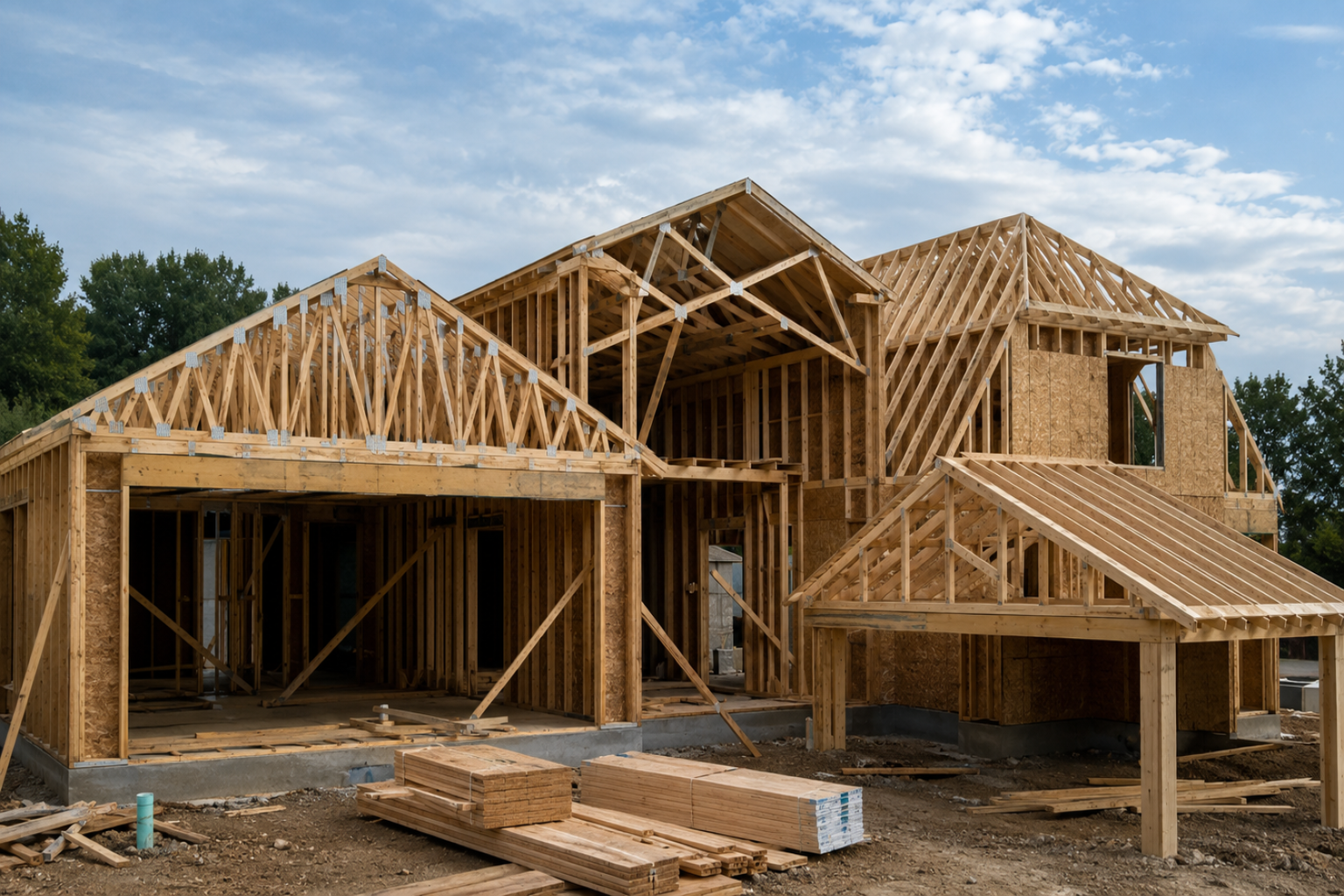
Structural Truss Types and Where They Work
Trusses do not all solve the same problem.
Some are built for light residential roofs. Some are built for longer spans, heavier loads, or cleaner open space below. Wood and steel trusses can both work well, but they do not behave the same way, cost the same way, or fit the same jobs.
That is where the real choice starts. Pick the right truss and the structure works cleanly. Pick the wrong one and the job gets heavier, more expensive, or harder to build than it needed to be.
Start with the main truss types, where each one fits, and what changes when the material, span, or use changes.

If you are here because you need the residential side first, start with Residential Roof Trusses Design. If you want the broader roof-only page, use Roof Trusses. This page stays broader than both.
Start Here: The Main Truss Families
| Truss Type | Best Fit | What It Does Well | Where It Starts Going Wrong |
|---|---|---|---|
| King post | Short spans, sheds, porches, small roofs | Simple and economical | Runs out of reach fast |
| Queen post | Moderate spans | More reach without too much complexity | Not the cleanest answer once spans grow |
| Gable | Standard residential roofs | Simple roof form and easy drainage | Can feel too generic for more complex roof plans |
| Hip | Wind-prone houses and more wrapped roof forms | Balanced roof shape and better edge behavior | More framing complexity |
| Fink | Ordinary residential roof systems | Efficient and common | Not the best for usable attic or vaulted rooms |
| Scissor | Vaulted ceilings and lifted interior volume | Creates ceiling space without switching to rafters | Gets tighter for insulation and services |
| Flat roof truss | Low-slope commercial and some modern roof systems | Wide spans with a low roof profile | Drainage problems if slope is ignored |
| Gambrel | Barns, loft roofs, attic-heavy forms | Creates more usable roof space | Awkward proportions if forced onto the wrong building |
| Pratt | Bridge and longer-span work | Clear force pattern and proven long-span logic | Can be overkill where a simpler system works |
| Howe | Heavier loads and some long spans | Works well under heavier conditions | Not always the most efficient light-duty choice |
| Warren | Evenly distributed loads and bridge work | Simple repeating geometry and good material use | Less forgiving under strong point-load conditions |
| Bowstring | Large open rooms and long-span specialty buildings | Wide clear spans and strong visual form | Needs careful support and proportion control |
That table is the fast read. The rest of the page is where those categories start to separate.
What Trusses Are Doing
A truss is a structural frame that uses straight members and triangulated geometry to move loads to the supports efficiently.
That matters because a truss is not just a shape. It is a decision about span, material, weight, joint behavior, bracing, and buildability. A good truss saves material, keeps the load path clear, and makes the structure easier to build. A bad one can look neat on paper and still create trouble on site.
For roof work, the usual questions are pitch, ceiling shape, span, cost, and installation speed. For bridge or long-span work, the questions shift toward force pattern, member efficiency, durability, and connection strategy. The logic is the same. The consequences get bigger.
If you want the broader fundamentals first, Truss Design 101 is the better side road. This page is more about family types and where they belong.
Common Roof Truss Types
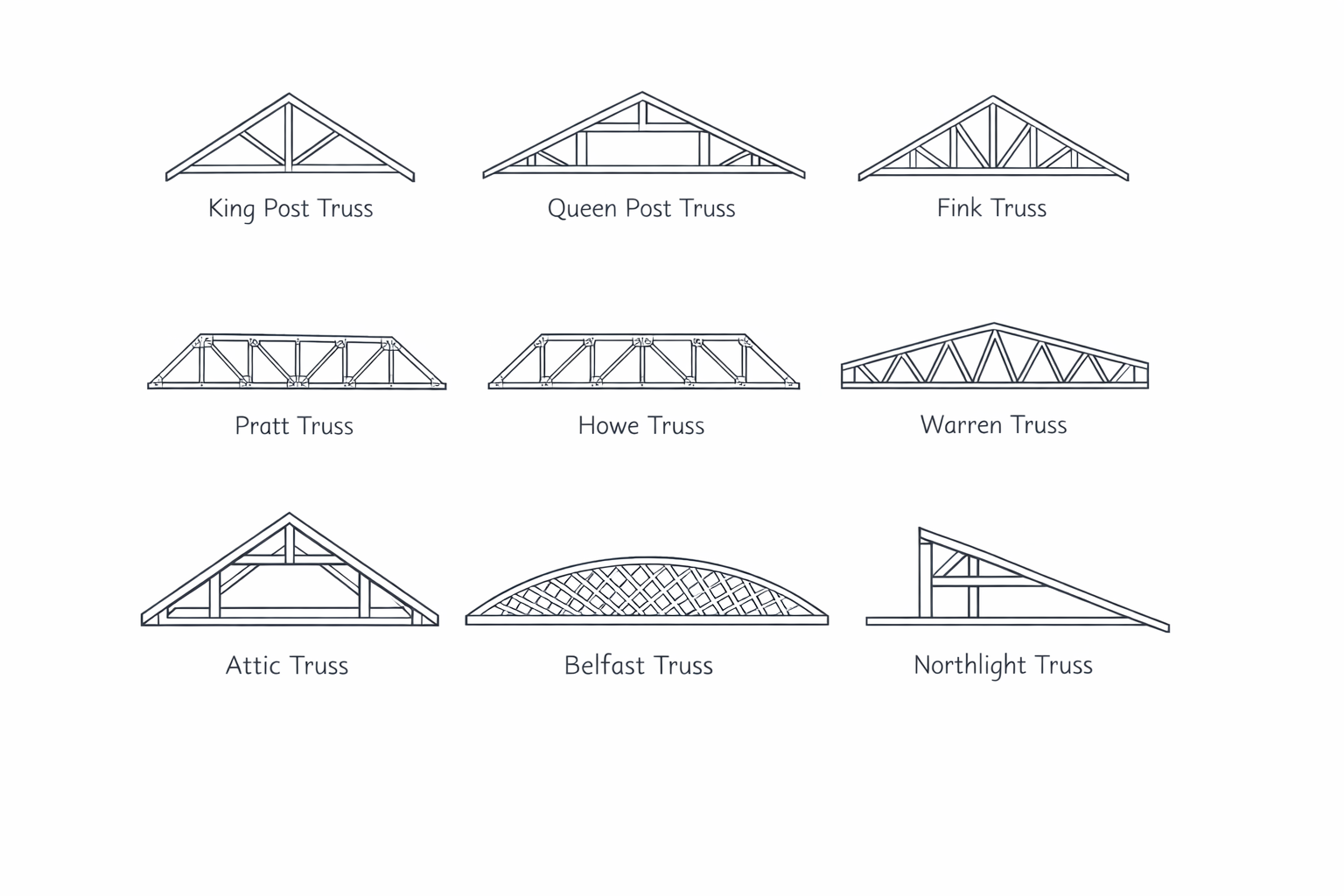
Illustration by ArchitectureCourses.org. Comparison of nine common truss types, including king post, queen post, Pratt, Howe, Warren, attic, Belfast, and northlight forms.
When most people search for truss types, they are really talking about roof trusses first.
King post truss
This is one of the simplest trusses and one of the oldest. It works for short spans, small roofs, sheds, porches, and modest outbuildings. It is easy to understand, easy to build, and still useful where the span stays honest.
The problem is not quality. It is range. Once the roof gets bigger, the king post stops being the clean answer. For the dedicated page, use King Post Truss.
Gable roof trusses

Gable trusses are the standard pitched roof answer for a lot of houses. They are direct, familiar, and easy to coordinate. Water sheds cleanly, the roof form is easy to read, and the structure does not usually ask for heroic solutions.
That is why they keep showing up. They are the workhorse.
Hip roof trusses

Hip roof trusses slope on all sides, which changes both the look and the wind behavior of the roof. They are common where the roof wraps the whole building more evenly or where the building wants a more settled roof form than a straight gable gives.
They can be the better answer in exposed wind conditions, but they also make the framing package more involved.
Fink trusses
Fink trusses are one of the most common residential truss forms because they are efficient, familiar, and economical. They work well on standard house roofs where nobody is asking the roof to create usable attic volume or a dramatic interior ceiling.
They are common for a reason. They do the ordinary job well. For the dedicated page, use Fink Trusses Explained.
Scissor trusses
Scissor trusses are used when the room wants more volume below the roof. The bottom chords rise instead of staying flat, which creates a vaulted ceiling without switching fully into a rafter-based roof.
They are a good answer when ceiling height matters. They are a bad answer when someone forgets that insulation space, service paths, and geometry all tighten up. Use Scissor Trusses for the deeper page.
Flat and low-slope trusses

Flat roof trusses are not truly flat in any practical sense. They are low-slope roof systems that still need drainage, layout discipline, and clean support logic. They are common in commercial buildings and in some modern house forms where the low profile matters.
The mistake is treating flat like dead level. Water does not forgive that. Use Sloping Flat Trusses when the issue is low-slope roof framing rather than broad truss comparison.
Gambrel trusses
Gambrel trusses belong where attic space, loft volume, or barn-like roof form is part of the point. They create more usable space inside the roof than a simpler pitch usually does.
They work well when the building wants that profile. They look forced when the house does not.
Bridge and Long-Span Truss Types
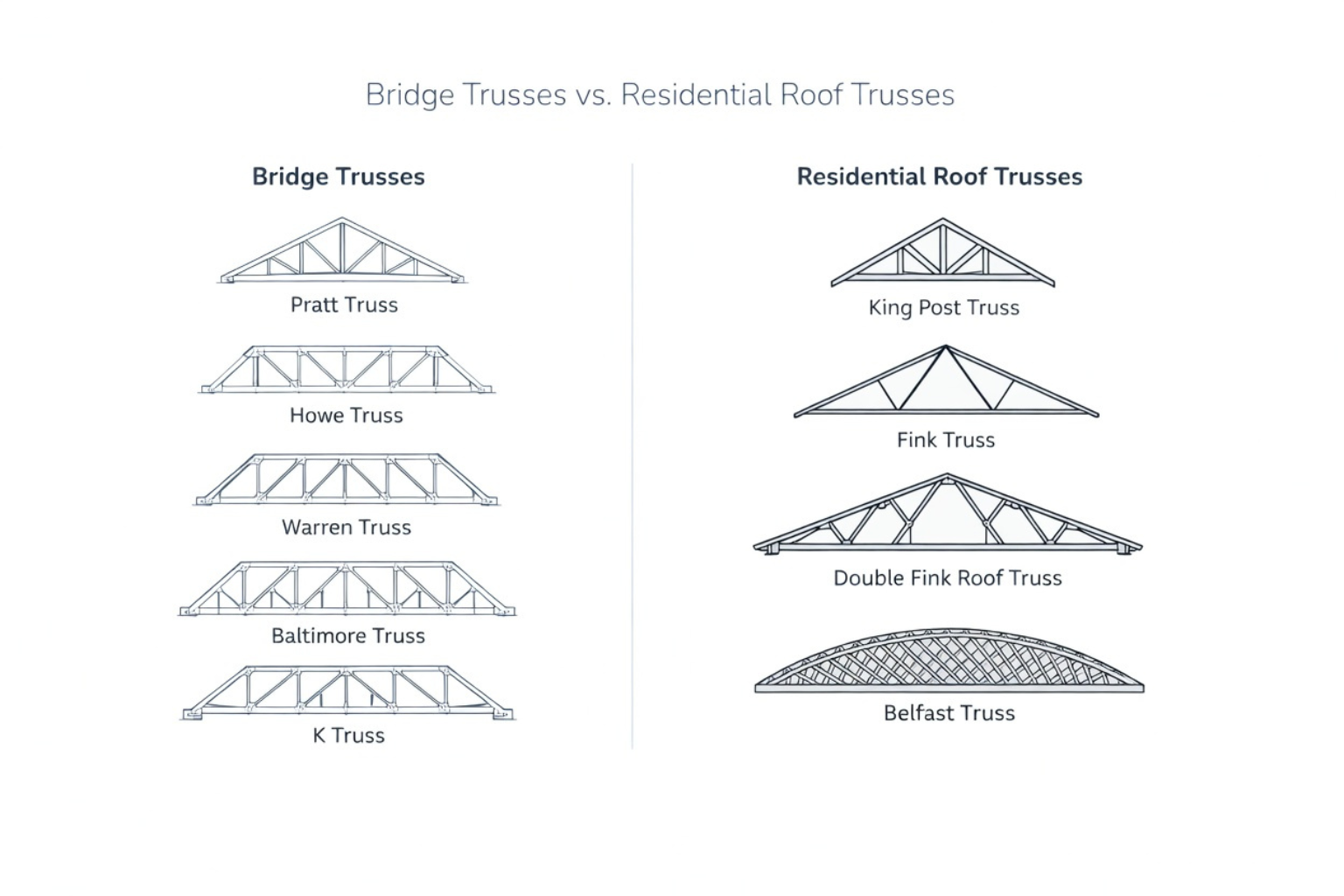
Illustration by ArchitectureCourses.org. Side-by-side comparison of common bridge trusses and residential roof truss types, including Pratt, Howe, Warren, Baltimore, K, king post, Fink, double Fink, and Belfast forms.
Roof trusses are only half the picture. Some truss names matter because of bridge work and longer spans.
Pratt truss
Pratt trusses are common in bridge discussions because they handle longer spans clearly and efficiently. The force pattern is easy to teach and easy to read, which is one reason the type keeps showing up in structural education.
Howe truss
Howe trusses are another long-span family that often comes up in heavier structural conditions. They are not the right answer for everything, but they make sense when the load condition wants that force pattern.
Warren truss
Warren trusses use repeating triangular geometry and are often valued for even load distribution and clean material use. They are one of the simplest comparison types when people are learning how bridge trusses differ from roof trusses.
Bowstring and other specialty long-span trusses
Bowstring trusses are used where the building wants a large open space and a strong curved profile at the same time. Gyms, hangars, and other large open rooms are the kind of places where they belong.
The useful split is simple: roof trusses are usually about covering a building economically. Bridge and long-span trusses are more directly about force efficiency over longer distance with fewer supports.
Steel vs Timber Trusses
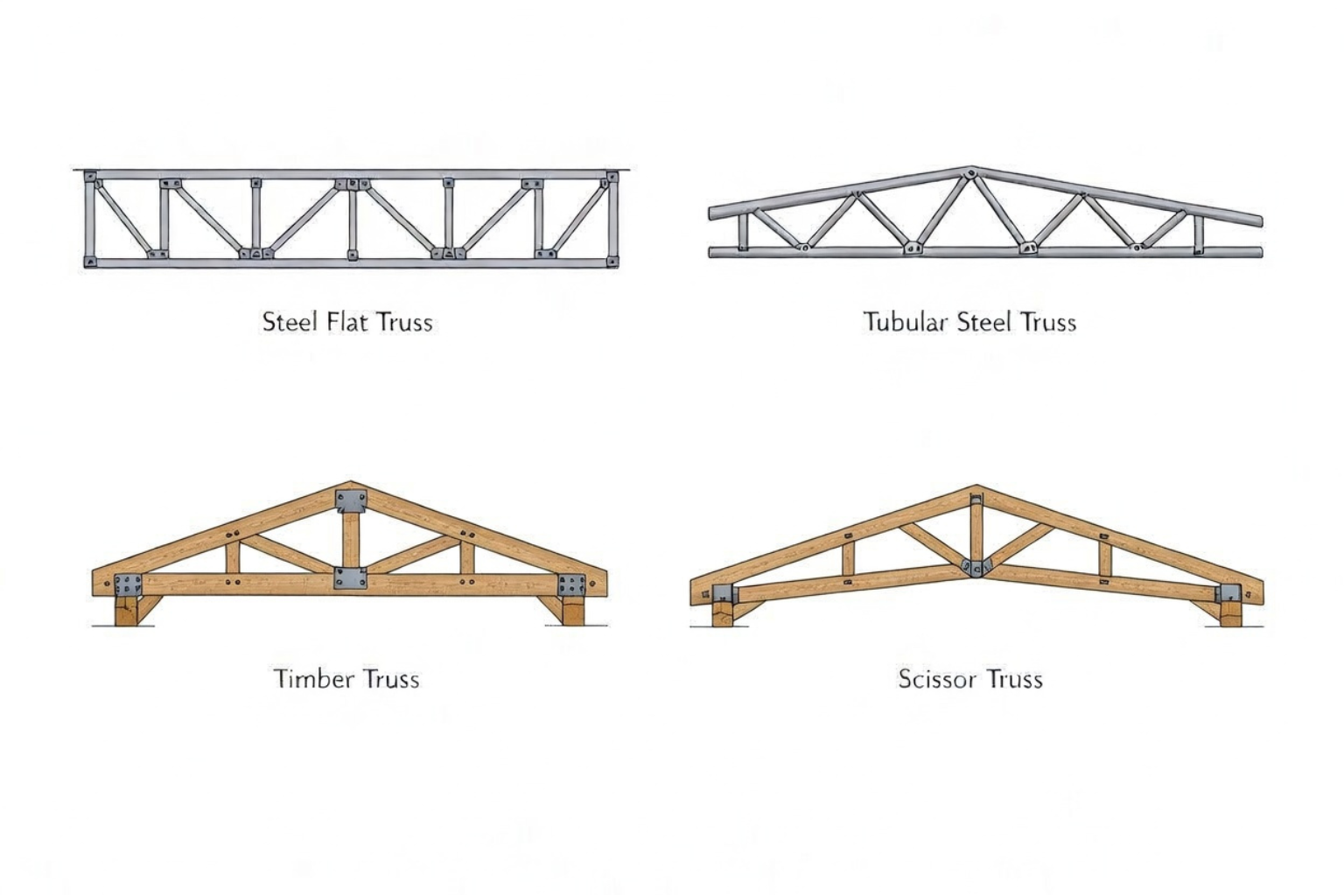
Illustration by ArchitectureCourses.org. Side-by-side comparison of flat steel, tubular steel, timber, and scissor truss systems.
Material changes the whole truss conversation.
| Question | Steel Trusses | Timber Trusses |
|---|---|---|
| Best fit | Long spans, industrial buildings, large commercial roofs | Homes, custom rooms, exposed-framing projects, smaller spans |
| Main strength | High strength-to-weight ratio and long-span efficiency | Warm appearance and easier visual integration in rooms |
| Main risk | Corrosion, bad detailing, thermal movement | Moisture, movement, poor joinery, weather exposure |
| Typical use | Commercial roofs, hangars, industrial and larger span work | Houses, cabins, halls, barns, exposed interior work |
Steel often wins when span and load get serious. Timber often wins when the truss is part of the room and not just part of the roof. If the project is clearly moving to steel, use Steel Truss Design. If the job is timber-led, use Timber Trusses Explained.
This is also where people choose badly. They pick timber for a job that really wants long-span steel, or they jump to steel when the room is asking for exposed wood and the span never needed the heavier move.
Specialized Trusses
Some trusses only make sense when the roof, room, or span is asking for something more specific.
Attic trusses
These are used when the roof needs to hold structure and also create usable space inside the truss zone. They are deeper, heavier, and more demanding than a standard house truss, but they solve a clear problem when attic room or storage is part of the plan.
Mansard trusses
Mansard trusses support a more complex roof profile and are often tied to buildings that want usable upper-floor space inside a steeper and more layered roof form. They are less common in ordinary houses, but they matter when the roof shape is doing more than covering the building.
Bobtail attic trusses
These show up where the attic shape or one-sided roof condition is doing something more specific than a standard symmetric attic truss. They belong on more particular projects, not as a default choice.
Mono-pitch trusses
These work where a single-slope roof is the point, such as lean-tos, sheds, additions, and some modern roof forms. They can be clean and economical when the building suits them.
Bowstring and curved specialty trusses
These belong where the span wants a big open room and the roof shape is meant to help define the space. Gyms, hangars, halls, and some specialty public buildings are where they make the most sense.
Specialized does not mean better. It usually means the standard answer stopped being enough and the project started asking for something more exact.
Where Choice Goes Wrong
Most bad truss choices do not fail because the names were confusing. They fail because the wrong question got asked.
- Choosing by looks only. The shape may suit the elevation and still be the wrong structural answer.
- Ignoring span limits. A small truss does not become a long-span truss because someone wants it to.
- Ignoring drainage. Low-slope and flat-roof systems pay for this first.
- Ignoring the room below. A truss affects ceiling shape, services, insulation, and attic use, not just the roof line.
- Picking timber or steel too early. Material should follow the structural and architectural job, not just preference.
- Forgetting installation. A clean design that turns ugly on site is still a bad choice.
If the next question is connection logic instead of type selection, go to Roof Truss Details. If the issue is bracing, use Truss Lateral Bracing or Types of Truss Bracing.
Do This Instead of This
| Do This | Instead of This | Why |
|---|---|---|
| Use a king post or other simple truss on a short-span roof | Force a bigger, heavier truss where it is not needed | Simple roofs do not need complicated answers |
| Use scissor trusses when the room wants volume | Expect a standard truss to create a vaulted ceiling cleanly | The ceiling shape changes the whole system |
| Use flat or low-slope trusses with drainage planned early | Treat flat like level and hope the roofing fixes it | Water finds lazy design fast |
| Use steel when span and load clearly demand it | Push timber past what the project really wants | Long-span work punishes weak material decisions |
| Use a specialized truss only when the roof or room earns it | Pick a specialty truss because it sounds impressive | More specific systems come with more consequences |
FAQ
What is the most common type of roof truss?
In ordinary residential work, common pitched roof trusses such as gable-related and Fink-based forms show up constantly because they are efficient and economical.
What is the strongest type of truss?
There is no single strongest type in the abstract. Strength depends on span, load, material, geometry, support conditions, and connection quality.
Which truss is best for a vaulted ceiling?
Scissor trusses are one of the most common answers because they create interior volume while keeping the roof structurally organized.
What is the difference between roof trusses and bridge trusses?
Roof trusses are usually focused on covering buildings efficiently. Bridge trusses are more directly about longer spans, moving traffic loads, and long-span structural efficiency.
Are steel trusses better than timber trusses?
Not across the board. Steel is often better for bigger spans and heavier loads. Timber is often better where exposed structure, house scale, or room character matters.
What truss is best for a barn or loft roof?
Gambrel trusses are a common answer because they create more usable space inside the roof form.
Can one page cover every truss type?
Not deeply. A broad page like this can sort the families and explain where they fit. Specific truss pages are still better once the project narrows down.
What usually causes problems with truss choice?
Choosing by looks, ignoring span and load, forgetting drainage, and treating the truss like it only affects the roof instead of the whole structure below it.
Read This Next
If the next step is the residential side, go to Residential Roof Trusses Design. If you want the broader roof-only explainer, use Roof Trusses. If the job is timber-led, read Timber Trusses Explained. If the roof is moving into vaulted space, use Scissor Trusses. And if the project is clearly on the steel side, go to Steel Truss Design.