
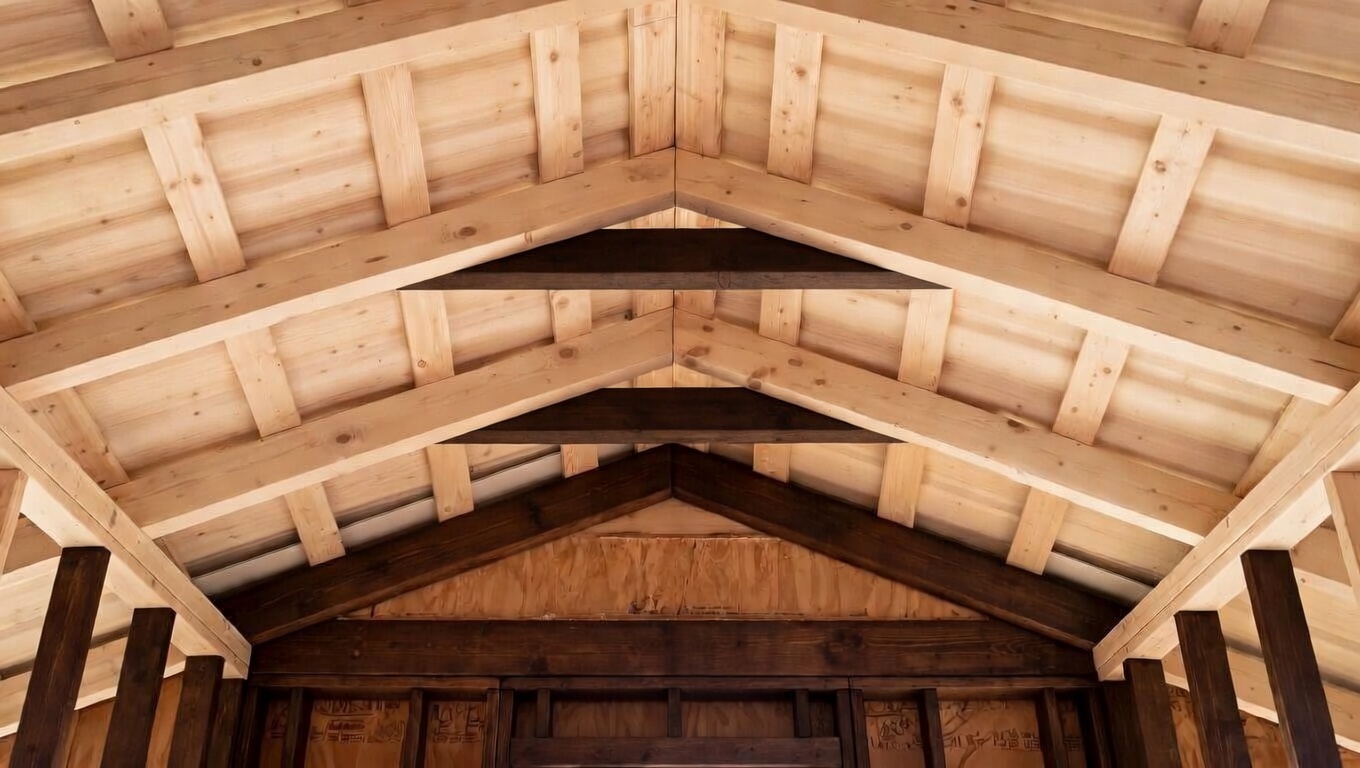
Image by ArchitectureCourses.org. Exposed timber roof framing with collar ties set high in the vaulted ceiling. Collar ties sit high near the ridge in vaulted roofs and do a different job than lower rafter ties.
Some vaulted ceilings use collar ties. Some do not. What matters is how the roof stays stable once the ceiling opens up.
That is where the framing changes. Collar ties can still help near the ridge in some roofs, but they do different work than lower rafter ties or ceiling joists. If the lower ties disappear and nothing else takes over that job, the walls can start taking thrust they were never meant to take.
So the answer depends on the roof structure as a whole: ridge beam or ridge board, rafter span, roof pitch, wind, and whether the roof still has a proper way to control outward thrust..
What Collar Ties Do

Illustration by ArchitectureCourses.org. Collar ties are shown high between opposing rafters near the ridge.
Collar ties are horizontal members installed high in the roof, usually between opposing rafters near the ridge.
- They help resist separation near the ridge.
- They can improve upper-roof stability in uplift-related conditions.
- They belong to the upper part of the roof framing, not the lower thrust-control system.
That last point matters. Collar ties are not there to stop the exterior walls from spreading.
Collar Ties Are Not Rafter Ties
| Member | Main job | Typical location |
|---|---|---|
| Collar tie | Helps resist separation near the ridge | Upper part of the roof |
| Rafter tie | Helps keep rafters from pushing the walls outward | Lower part of the roof |
| Ridge beam | Carries vertical roof load | At the ridge, with real support below |
A vaulted ceiling puts this distinction under pressure because the lower part of the roof is exactly the part many owners want to clear out. That does not make the lower structural job disappear.
For the broader comparison, see Rafter Ties vs. Collar Ties. If the question is how the roof is supported at the top, continue with Ridge Beams.
When a Vaulted Ceiling Can Still Use Collar Ties
A vaulted ceiling can still include collar ties when the roof design benefits from upper restraint near the ridge and the load path has already been resolved correctly.
- Roofs with a structural ridge beam may still use collar ties as part of the upper framing strategy.
- Steeper roofs can use collar ties where upper-roof restraint matters.
- Wind-exposed roofs may benefit from properly detailed upper ties and connectors.
- Exposed timber ceilings sometimes keep visible ties for both structure and appearance, but the structural role still has to be clear.
In those cases, collar ties can make sense. The mistake is assuming that because they are visible and near the ridge, they are the main thing holding the whole roof together.
When Collar Ties Are Not Enough
If the lower ties have been removed and the roof still wants to push outward, collar ties are not the answer. They sit too high to do that lower thrust-control job effectively.
A vaulted ceiling usually ends up needing one of these paths:
- A structural ridge beam with real support below.
- A tied-rafter system that still keeps the lower thrust under control.
- An engineered alternative such as steel tension members or a different framing system.
If none of those conditions are resolved, the roof can still open the walls slowly over time, even if collar ties remain in the upper roof.
What Usually Goes Wrong
- Removing lower ties and assuming collar ties will do the same job
- Using a ridge board where the roof really needs a structural ridge beam
- Placing collar ties too high or too lightly to do meaningful work
- Opening the ceiling without rethinking the full load path
- Assuming the roof looks stable because it looks clean
Most of these roofs do not fail dramatically on day one. They start with wall movement, drywall cracking, trim opening up, or a ridge line that slowly changes shape.
Do You Need Collar Ties in a Vaulted Ceiling?
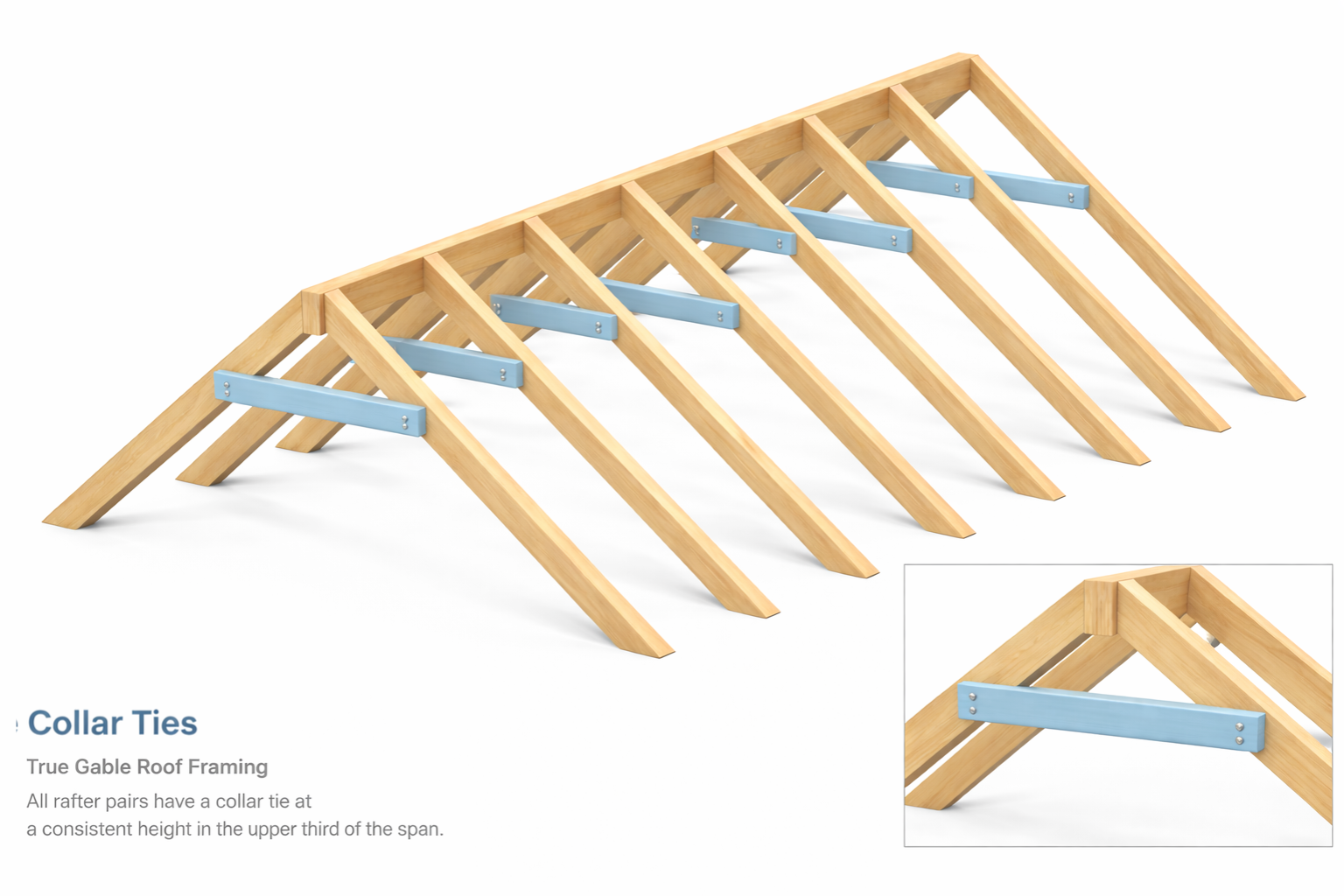
Illustration by ArchitectureCourses.org. This framing diagram shows collar ties placed high in the roof, close to the ridge line.
| Condition | Likely answer | What matters most |
|---|---|---|
| Vaulted ceiling with structural ridge beam | Maybe | Whether upper-roof restraint is still part of the design |
| Vaulted ceiling with ridge board only | Often not enough by themselves | The roof may still need lower ties or a different structural answer |
| Open ceiling with long spans | Depends on engineering | Span, support path, and roof thrust matter more than appearance |
| Decorative exposed ties only | Only if they are truly structural | A decorative beam is not a structural fix |
A vaulted ceiling does not automatically require collar ties, but it does require a complete structural strategy. Collar ties may be part of that strategy. They are rarely the whole answer by themselves.
Ridge Beam vs. Ridge Board
This is underneath most vaulted-ceiling confusion.
A ridge board mainly gives opposing rafters a place to meet. A structural ridge beam carries load. If the roof is being opened up and the lower ties are disappearing, that difference stops being academic very quickly.
If the roof is still depending on opposing rafters to balance each other, the lower tie strategy matters. If the ridge beam is truly structural and supported correctly, the framing logic changes. The same ceiling shape can be safe in one house and a slow problem in another.
This gets clearer once you understand ridge beam vs. ridge board.
Before You Remove Any Ties
- Confirm whether the ridge is structural or not.
- Find out what is currently stopping wall spread.
- Check whether the roof is acting like a tied-rafter system.
- Do not assume visible upper ties are solving the lower load path.
- For larger spans or altered framing, get engineering input before demolition starts.
If the roof already has local bracing or connector issues, it is worth reviewing Metal Rafter Braces, How to Install Metal Rafter Braces, and Types of Truss Bracing as part of the wider roof-stability picture.
FAQ
Can a vaulted ceiling work without collar ties?
Yes, in some roof designs. But it still needs a complete structural strategy, often involving a structural ridge beam or another engineered solution.
Do collar ties stop walls from spreading?
No. They are not a substitute for lower rafter ties or other thrust-control measures.
Can collar ties be decorative and structural at the same time?
Yes, but only when they are sized, located, and connected as real structural members. Decorative beams alone do not solve roof loading.
What is the biggest mistake in vaulted-ceiling framing?
Removing lower ties without replacing the structural job those ties were doing.
Do all vaulted ceilings need a ridge beam?
No, not all. But once lower ties are removed or the roof framing changes, the ridge strategy becomes one of the first things that has to be checked.