

Image by ArchitectureCourses.org. Metal rafter braces reinforce roof framing and help control movement at critical connection points.
Metal rafter braces are used when the roof needs more than a basic nailed wood connection.
The problem is that not all metal hardware at the roof is doing the same job. Some pieces resist uplift, some reinforce a connection, and some help control movement or stability. Trouble starts when they all get lumped together as if they are interchangeable.
For the bigger roof-framing picture, go to roof structure.
What Metal Rafter Braces Do
Metal rafter braces reinforce the connection or restraint around rafters so the roof framing stays more stable under load.
- They help limit movement at weak connection points.
- They improve resistance to uplift in high-wind conditions.
- They can stiffen rafter-to-plate or rafter-to-beam connections.
- They help reduce long-term drift in roof framing that is vulnerable to shifting.
What they do not do is magically fix a bad roof design. If the roof needs a different structural strategy, better hardware alone will not solve that problem.
When Metal Rafter Braces Make Sense
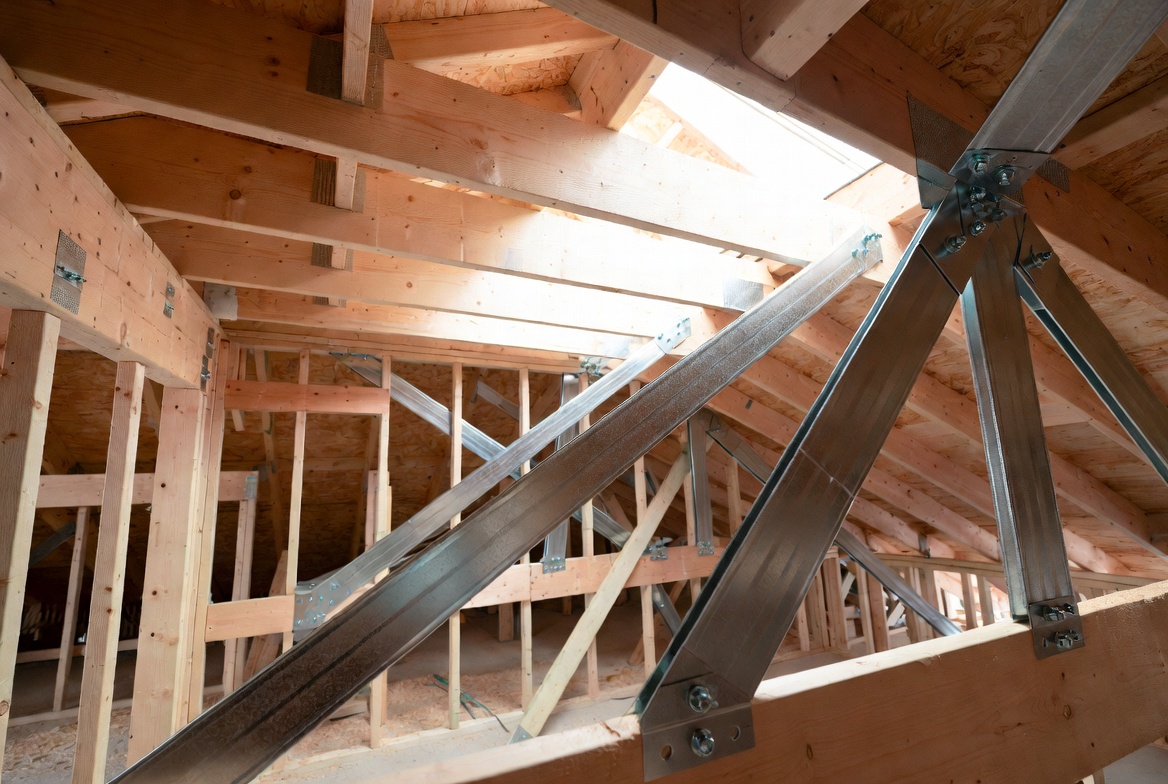
Image by ArchitectureCourses.org. Engineered metal roof braces reinforce a complex wood-framed attic structure.
| Condition | Why metal bracing helps | What to watch |
|---|---|---|
| High-wind areas | Improves uplift resistance and connection reliability | Check local fastening and connector requirements |
| Longer spans or heavier roof loads | Connections need more help staying tight and stable | Do not use hardware as a substitute for proper sizing |
| Renovation work | Metal braces can help strengthen existing framing without rebuilding everything | Make sure the surrounding wood is still sound |
| Complex framing conditions | Adjustable or specialty braces can solve awkward connection points | Custom geometry still needs structural logic |
| Moisture-prone or exposed conditions | Galvanized or stainless hardware can outlast improvised wood reinforcement | Corrosion protection matters |
In other words, metal rafter braces make the most sense where the connection detail is the weak point, not where the whole roof system is fundamentally wrong.
Not Every Metal Part at the Roof Does the Same Job

Image by ArchitectureCourses.org. Metal roof hardware can reinforce different parts of the framing, but each type solves a different problem.
| Type | Main job | Best use |
|---|---|---|
| Hurricane ties | Secure rafters to wall plates against uplift | High-wind and coastal regions |
| Angle or corner braces | Stiffen local rafter connections | General reinforcement at joints |
| Strap ties | Help tie members together across a joint or load path | Longer restraint lines or uplift details |
| Adjustable braces or brackets | Allow controlled positioning in custom framing | Renovation and non-standard geometry |
| Cross or diagonal metal bracing | Helps resist lateral movement across the framing | Large spans, exposed conditions, or added stiffness |
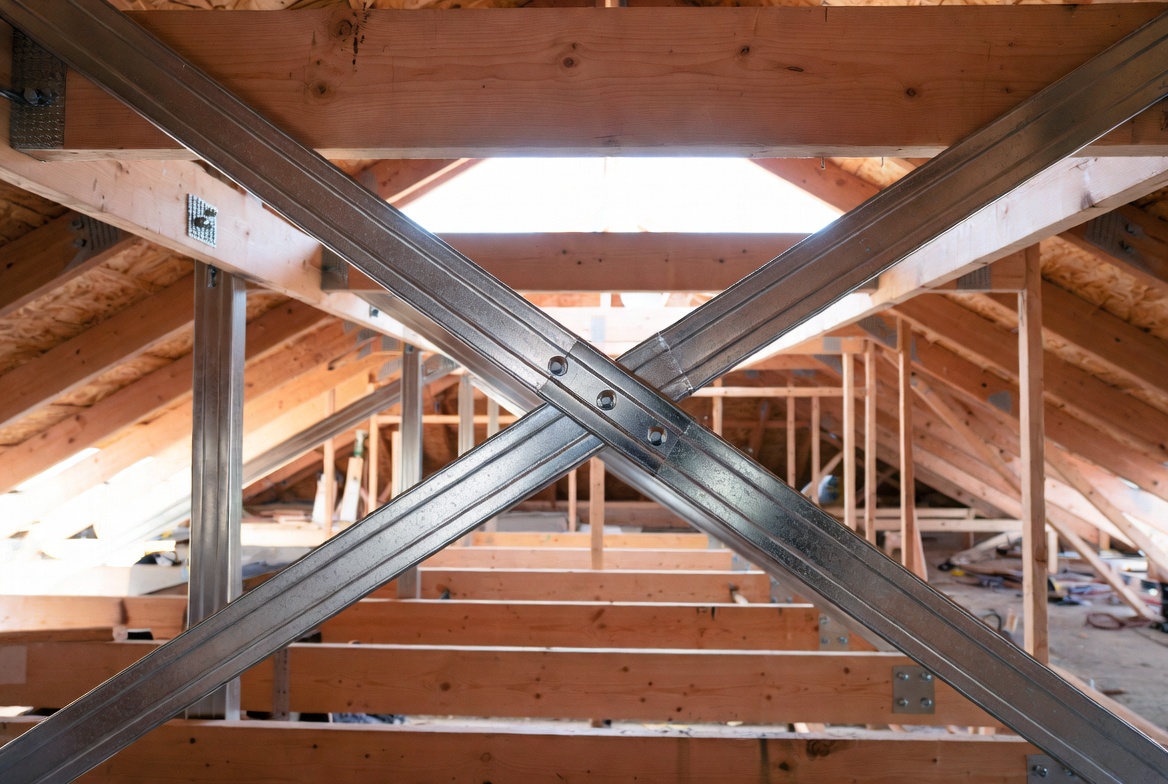
Image by ArchitectureCourses.org. Metal cross-bracing helps stiffen the roof frame and control lateral movement.
A hurricane tie is not the same thing as a diagonal brace. A strap tie is not the same thing as a ridge connector. If you are dealing with broader roof-plane stability, go next to Truss Lateral Bracing, Understanding Diagonal Truss Bracing, and Metal T-Bracing in Roof Construction.
Metal vs. Wood Bracing
Metal is not always better. But it is often better at the exact places where wood connections get weak, sloppy, or repetitive.
- Metal wins on connection precision. Factory-made holes and rated hardware remove a lot of guesswork.
- Metal wins on tensile performance. That matters in uplift and tie-down conditions.
- Wood can still make sense for broader field bracing, blocking, or temporary restraint where a full connector is not the point.
- Metal usually needs less bulk to do the same local connection job.
Where wood still has an edge is flexibility on site. It is easy to cut, easy to modify, and familiar to most crews. But when the connection needs to be rated, repeatable, or wind-resistant, metal usually becomes the cleaner answer.
Installation Basics
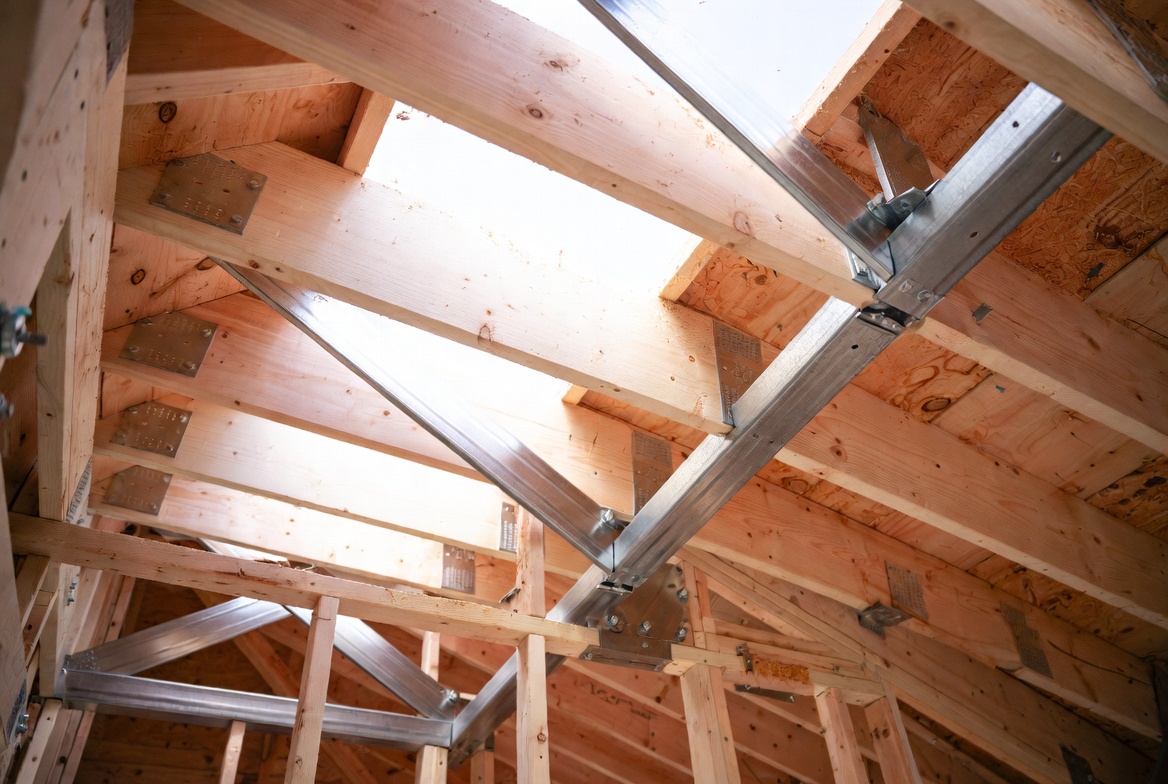
Image by ArchitectureCourses.org. A metal roof brace connects into the sloped framing with bolts and steel plates.
Metal rafter braces only work if the framing is straight enough and the fasteners are correct.
- Lay out the connection first. Do not start fastening before confirming the rafters are where they should be.
- Use the fastener type the brace was designed for. Hardware rated for structural screws should not be guessed into place with random nails.
- Keep the brace tight to the framing. Gaps reduce the quality of the connection.
- Check plumb and alignment before locking the joint in place.
- Inspect after installation. A brace that looks installed but is under-fastened is not doing the same job.
If you want the dedicated installation page, continue with How to Install Metal Rafter Braces Like a Pro.
Corrosion, Climate, and Product Choice
Climate changes the right brace.
In coastal or high-humidity areas, corrosion protection becomes part of the structural decision. In hurricane-prone areas, uplift hardware matters more. In snow-heavy climates, the issue shifts toward load, stiffness, and connection durability under repeated seasonal movement.
- Coastal or humid areas: galvanized or stainless options matter more.
- High-wind zones: hurricane ties and rated uplift connections move to the front of the list.
- Snow country: look harder at deformation, connection slip, and long-term load cycling.
- Fire-prone dry climates: durability and heat exposure can shape the hardware choice too.
That is why buying the cheapest brace in the aisle is not the same thing as choosing the right one.
Where Problems Usually Start
- Using the wrong brace for the job.
- Under-fastening the hardware.
- Installing braces on rafters that were already misaligned.
- Using non-galvanized hardware where moisture will win.
- Assuming a local metal brace solves a larger roof-bracing problem.
- Ignoring code requirements in wind-exposed regions.
Most failures here are not dramatic at first. The roof just keeps moving a little. Then the connection starts opening, the wood starts crushing or shifting, and the problem becomes more expensive than the original hardware ever was.
When Metal Rafter Braces Are Not Enough
There are roofs where the problem is bigger than a brace.
If the rafters are undersized, the ridge strategy is wrong, the walls are moving, or the roof needs broader lateral control, adding metal braces at a few joints may help locally but still fail structurally as a full answer.
That is the point where you stop shopping for hardware and start rethinking the roof system. If the issue is rafter thrust, continue with Roof Tie Beams. If the issue is roof spread at the rafter level, compare with Rafter Ties vs. Collar Ties. If the issue is edge-wall movement, look at Gable Braces.
FAQ
Are metal rafter braces better than wood braces?
For many connection-level reinforcement jobs, yes. They are usually stronger, more precise, and more repeatable. But they do not replace every kind of wood field bracing.
Do metal rafter braces help in hurricanes?
Yes, when the correct uplift-rated brace or tie is used and installed with the right fasteners.
Can I add metal braces to an existing roof?
Often, yes. Retrofit reinforcement is one of the reasons these products are useful. But the surrounding framing still has to be sound enough to receive them.
Do all roofs need metal rafter braces?
No. They are useful where the connection or local restraint needs improvement. Not every roof needs them, and not every roof problem is solved by them.
What is the biggest mistake with metal rafter braces?
Using the wrong type of hardware for the structural problem and fastening it like generic sheet metal instead of structural hardware.