
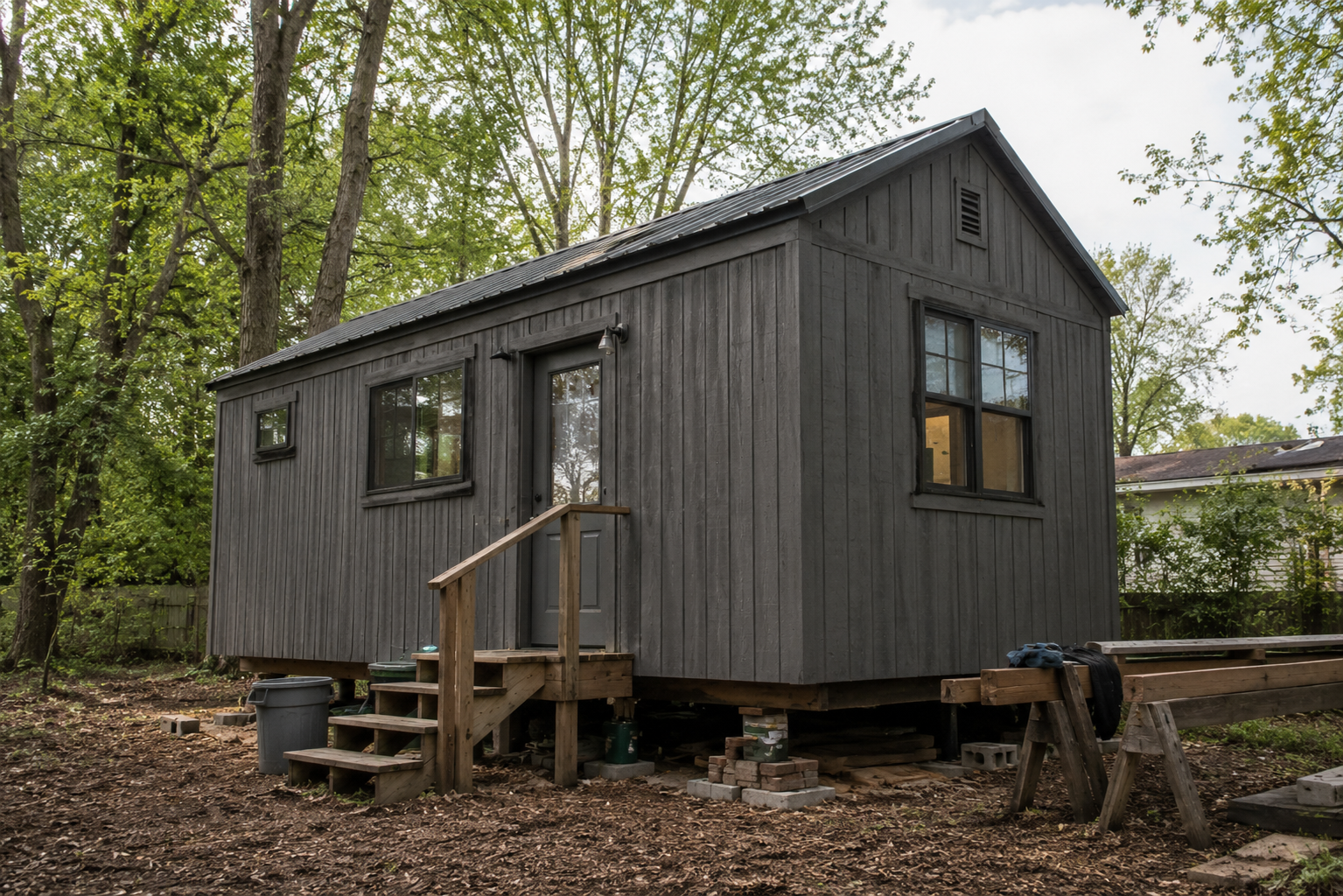
400 Sq Ft Tiny House Cost in 2026: The Real Numbers, Not the Sticker Price
A 400 sq ft tiny house sounds small enough to price with one clean number.
That is where the budget usually starts lying.
The floor area is small. The expensive parts are not. You still need a roof, foundation or trailer, kitchen, bathroom, heating, cooling, wiring, plumbing, windows, permits, delivery, and a legal place to put the home. None of that shrinks neatly just because the house is only 400 square feet.
In the U.S. in 2026, a realistic 400 sq ft tiny house lands somewhere between $80,000 and $160,000 fully finished, before land. Owner-finished shells and used units can come in lower. Foundation-based, custom, cold-climate, or off-grid builds run higher — sometimes a lot higher. The useful question is not "what is the average cost." The useful question is: what is included in the number, and what is the real five-year cost after the build?
If you are still sorting out the category, start with What Is a Tiny House?. For the wider tiny-home cost picture, the companion piece is Tiny Home Cost Breakdown.
400 Sq Ft Is Small, but Not Automatically Cheap
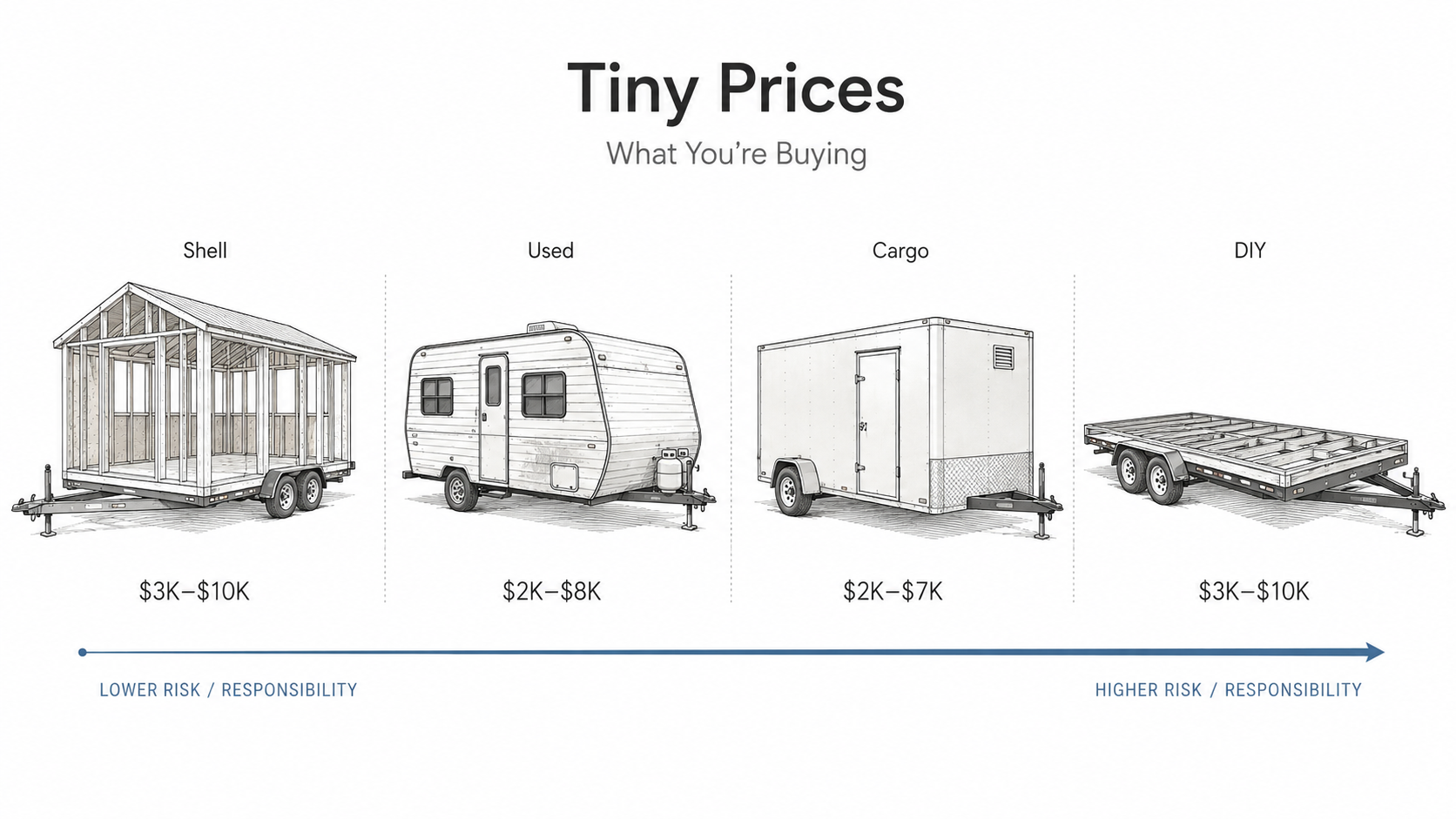
Illustration by ArchitectureCourses.org. A tiny home price depends less on the label and more on what is already included: structure, trailer, systems, storage, kitchen, bath, mobility, and repair risk.
A 400 sq ft tiny house is large enough to behave like a compact small home rather than a weekend shed. That helps daily life. It hurts fantasy budgeting.
At this size, most buyers want a real bathroom, a usable kitchen, enough storage, a sleeping area that does not feel like punishment, and a living space that can hold more than one person without rearranging furniture every time someone moves. Each expectation adds money.
These are U.S. planning ranges for fully finished 400 sq ft tiny houses in 2026. Not quotes. Use them to size the budget before talking to builders.
| Build path | Typical U.S. planning range | What the number usually means | Where the surprise comes from |
|---|---|---|---|
| Owner-finished shell | $40,000–$80,000 | Basic structure, roof, enclosure, trailer or simple base, unfinished interior | Wiring, plumbing, insulation upgrade, cabinets, bath, heating, and rework |
| Finished tiny house on wheels | $80,000–$140,000 | Complete THOW with kitchen, bath, insulation, finishes, trailer, basic systems | Weight control, delivery, setup, skirting, parking rules, winter package |
| Prefab or modular tiny home | $90,000–$170,000 | Factory-built or panelized home with more predictable shell quality | Foundation, crane, delivery, hookups, permits, stairs, decks, site prep |
| Foundation-based tiny house or ADU build | $130,000–$250,000+ | House-like build with foundation, code path, utilities, and inspections | Land, trenching, sewer or septic, frost depth, inspections, local labor |
| High-spec custom, off-grid, or cold-climate build | $160,000–$300,000+ | Better windows, stronger envelope, solar, batteries, custom storage, upgraded systems | The systems package starts costing like a real house |
The low end of each row is not fake. It is usually incomplete. It may be a shell, a used unit, a heavy-DIY project, or a build that still needs the expensive parts.
The Fixed Costs Do Not Shrink
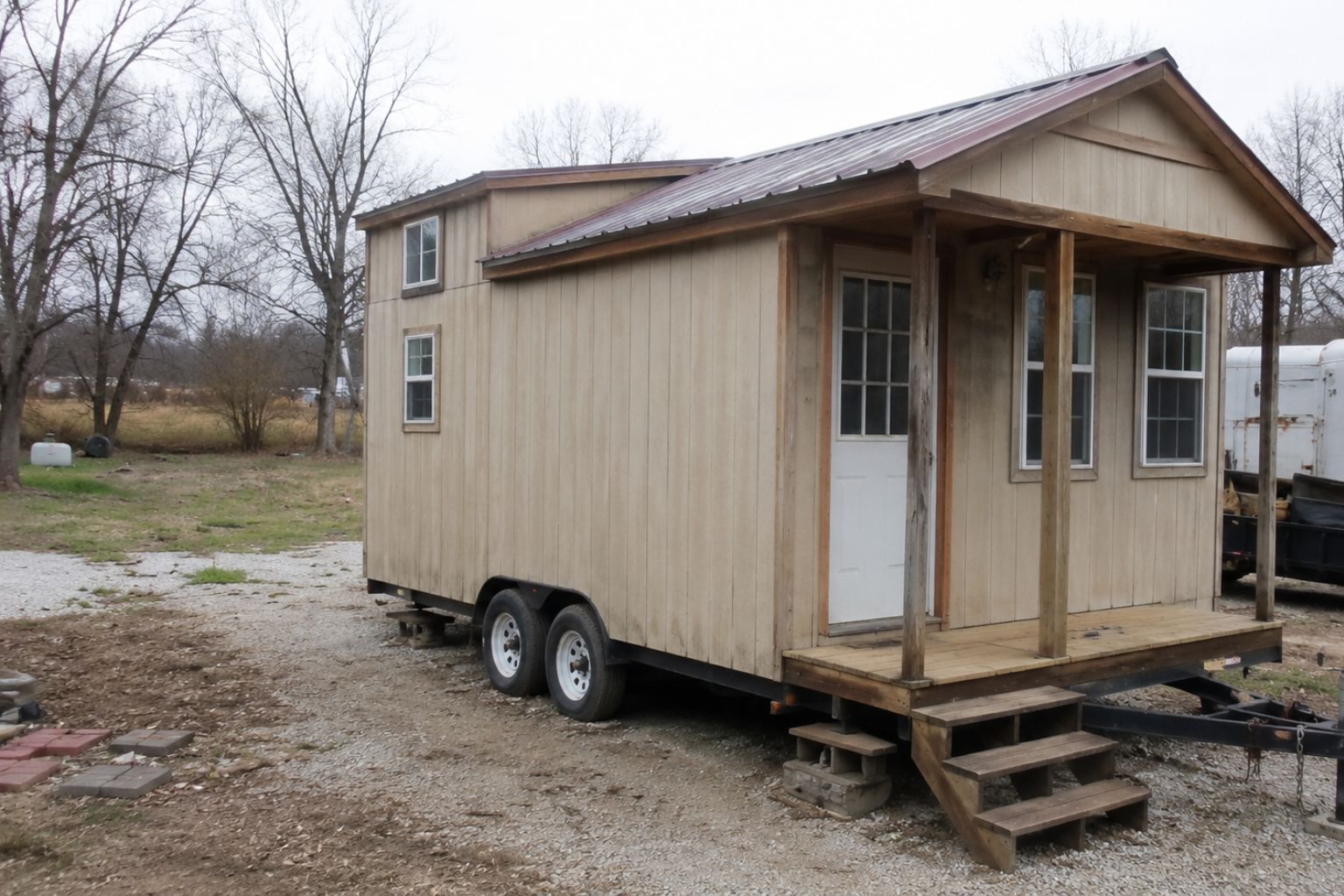
Image by ArchitectureCourses.org. A low-cost tiny house on wheels should be checked like a trailer and a small building: frame, roof, siding, windows, stairs, and basic livability all matter.
A 400 sq ft tiny house has a cost problem that larger houses hide better.
The kitchen still needs cabinets, counters, a sink, appliances, power, plumbing, ventilation, and clearances. The bathroom still needs waterproofing, drainage, exhaust, hot water, heat, and service access. The electrical panel still needs a place to live. The roof still needs to keep water out. The windows still need flashing that does not leak in year three.
Those fixed costs are why tiny homes often look expensive per square foot. You are not buying empty floor area. You are buying a small building with the hard parts squeezed together.
The mistake is treating a tiny house like a downsized regular house and expecting the budget to scale with floor area. It does not. A bathroom is a bathroom whether it sits in 4,000 square feet or 400. The plumbing, the ventilation, the waterproofing, and the labor hours are nearly identical. The only thing that shrinks is the square footage, and the square footage was never the expensive part.
The Cost-Per-Square-Foot Reality
Most 400 sq ft tiny houses end up costing $200 to $400 per square foot fully finished.
Traditional new construction in the U.S. ran around $150 to $250 per square foot in recent years for a typical single-family home. So per square foot, a tiny house often costs more than a regular house, not less.
This catches people every time. They expect a small house to be a cheap house. The total dollar amount is usually lower than a 2,000 sq ft build. But the per-square-foot number is higher because the fixed costs concentrate into less floor area.
If you see a tiny house advertised at $100 per square foot, the number is hiding something. It is probably a shell, a kit, an owner-finished project at a partial state, or it does not include the trailer, foundation, delivery, hookups, or systems package. Ask what is in the number before believing it.
The Four Numbers to Price Separately
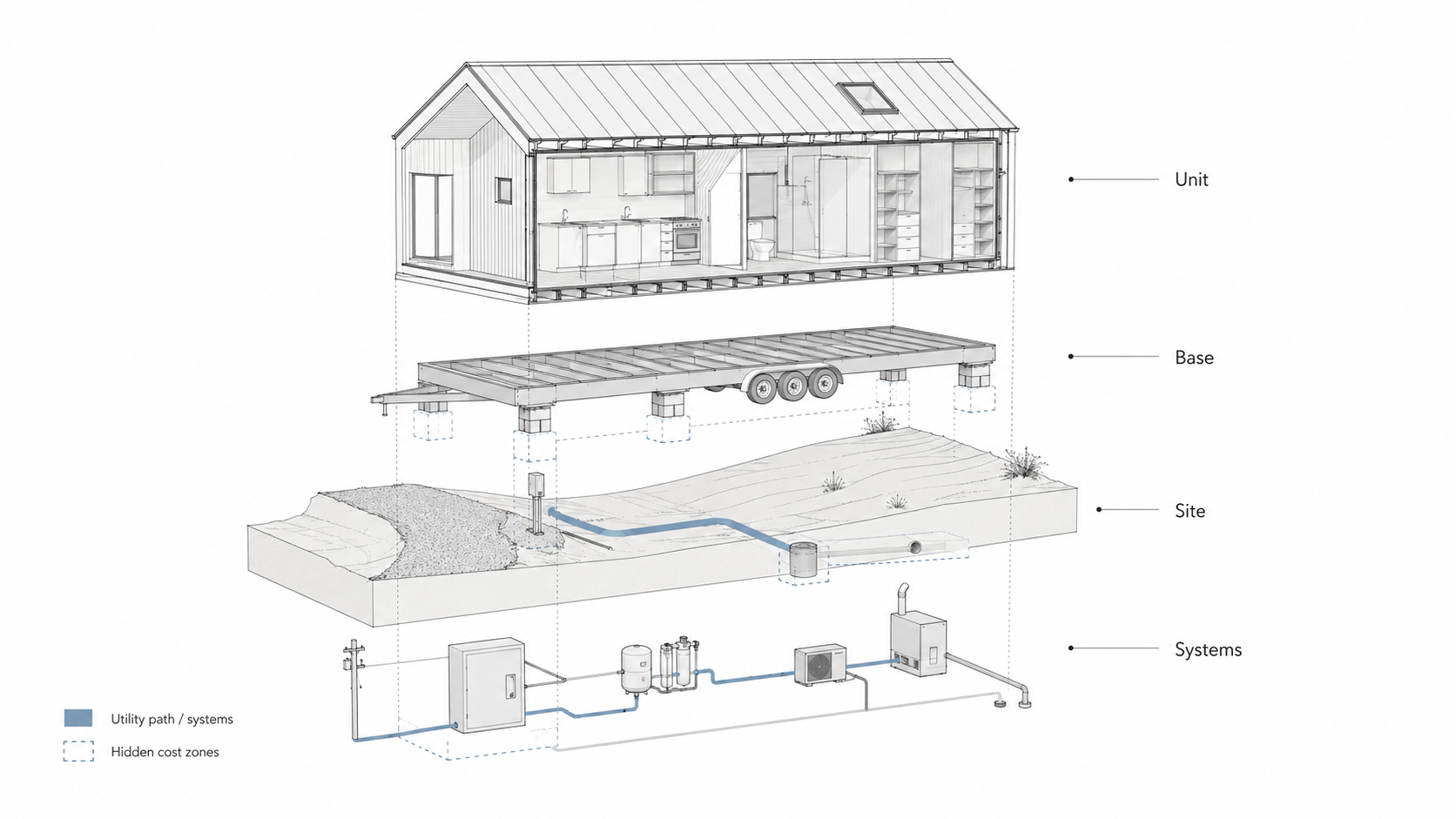
Illustration by ArchitectureCourses.org. A 400 sq ft tiny house price starts with the unit, but the budget often moves at the base, site work, utility trench, and systems hookups.
Do not ask for one tiny-house number. Ask for four.
The first is the unit. The second is the base. The third is the site. The fourth is the systems package. When those get blended together, the quote can look cleaner than the real project. Separating them is how you find out where the money is actually going.
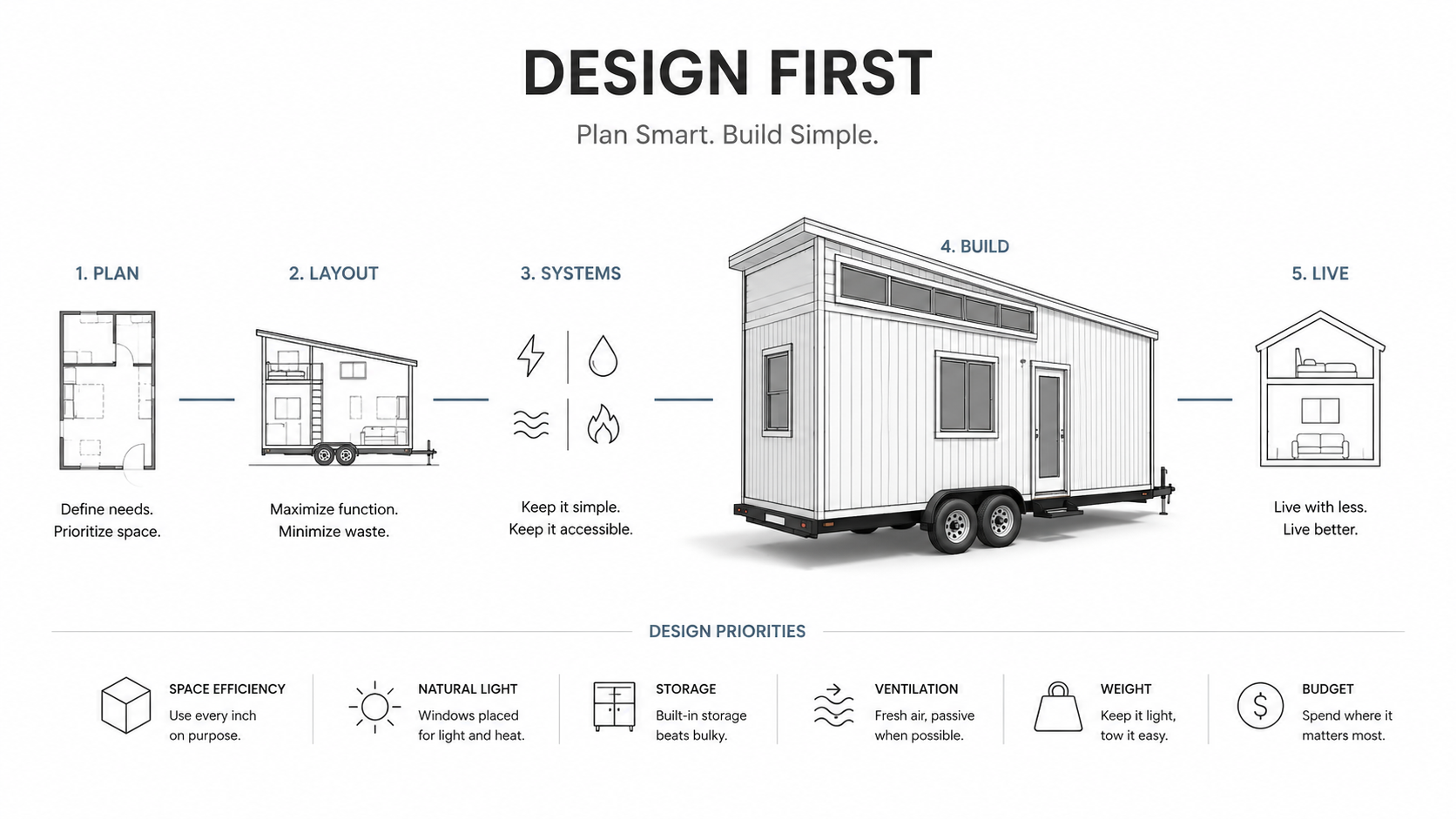
Illustration by ArchitectureCourses.org. A budget tiny home works best when the plan, layout, systems, weight, ventilation, storage, and build details are designed before money goes into materials.
| Number | What it includes | Question to ask |
|---|---|---|
| Unit cost | Shell, framing, roof, windows, interior, kitchen, bath, basic systems | Is this finished, dried-in, or only partly complete? |
| Base cost | Trailer, slab, piers, crawl space, frost protection, tie-downs, skirting | What physically carries the building? |
| Site cost | Access, grading, drainage, permits, setbacks, delivery, trenching | Can the home legally and physically sit there? |
| Systems cost | Power, water, sewer or septic, heat, cooling, ventilation, batteries, tanks | What keeps it usable in bad weather? |
That fourth number is where tiny-house budgets get embarrassed most often. A small building with bad systems is still uncomfortable, damp, hard to maintain, or illegal to use. The systems are not the optional luxury part. They are the part that decides whether the home is livable in February.
On Wheels or Foundation Changes the Math
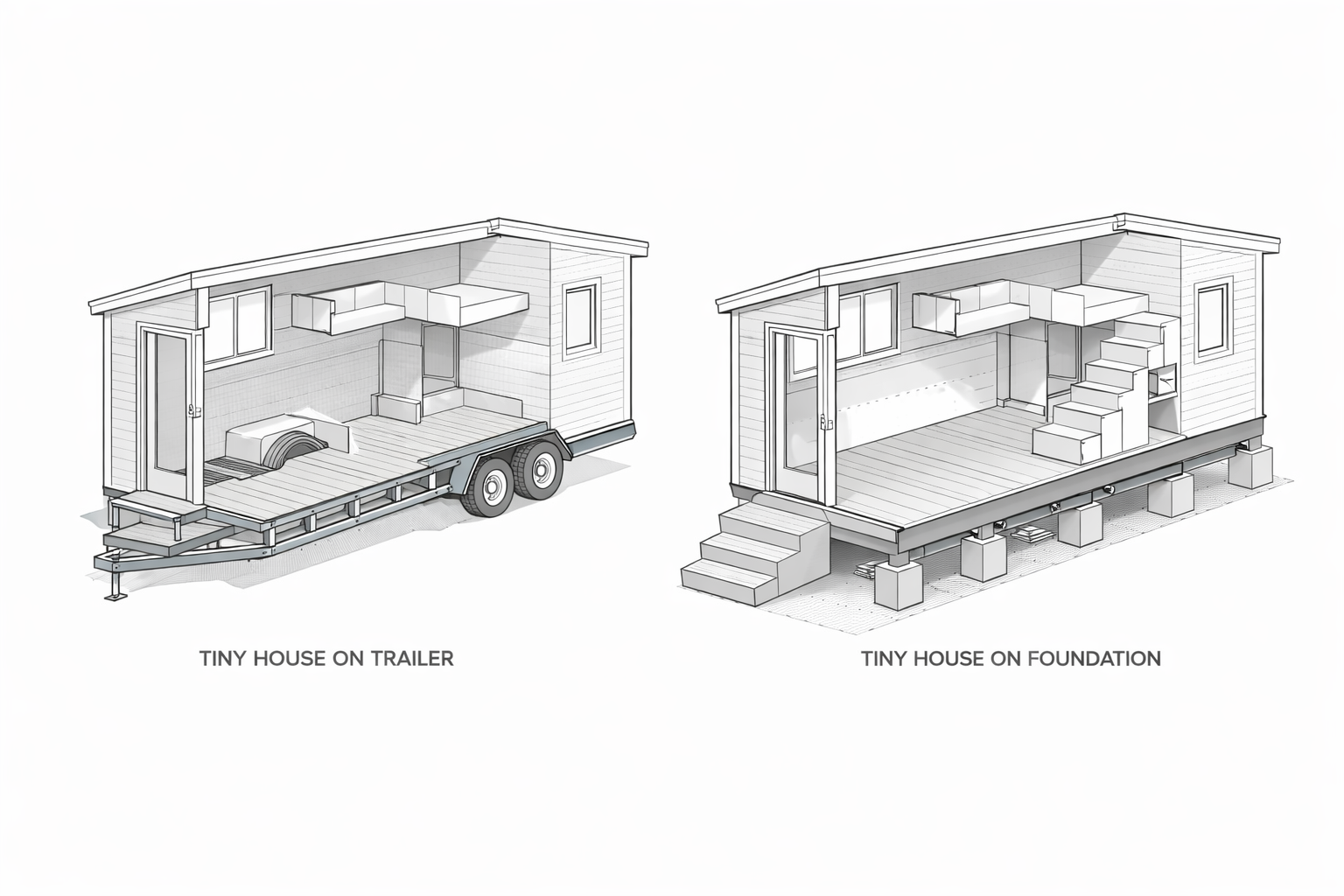
Illustration by ArchitectureCourses.org. Trailer-based tiny houses have tighter floor and height limits than tiny houses built on permanent supports.
A 400 sq ft tiny house on wheels and a 400 sq ft tiny house on a foundation are not the same budget.
The wheels version can look cheaper because it skips some foundation work. But it brings trailer rating, weight, towing, insurance, parking, registration, stairs, skirting, anchoring, and legal-use questions. A 400 sq ft THOW also pushes into heavier trailer territory, which means stronger axles, higher tow ratings, and more careful weight distribution during the build. That is engineering, not decoration, and it costs money.
The foundation version costs more up front but often behaves more like real housing. Easier to insulate properly. Easier to connect to utilities. Easier to finance through a conventional path. Easier to maintain. And in most places, easier to live in full-time without fighting a zoning officer every six months.
If you are leaning toward wheels, read Everything About Tiny Houses on Wheels and Regulations for Tiny Houses on Wheels. If you already own land, I Own Land and Want to Build a House covers the site side before you assume it is simple.
Financing Is the Wall Most Buyers Hit Late
This is the section most cost articles skip, and it is the section that decides whether the project actually happens.
Conventional mortgages mostly do not work on tiny houses on wheels. Banks underwrite mortgages against permanent structures on titled land. A THOW is legally closer to a recreational vehicle than a house. That means most buyers cannot walk into a credit union and get a 30-year fixed-rate mortgage on a $120,000 tiny house on a trailer. The bank says no, the buyer is surprised, and the timeline collapses.
The financing paths that do work for 400 sq ft tiny houses, in rough order of preference:
- Cash. Cleanest, fastest, no banker conversations. Hard to assemble unless you sold a previous home or have savings.
- RV loan on a certified THOW. Available through some lenders for units built to RVIA or NOAH standards. Terms typically 10 to 20 years, higher rates than mortgages, often 7 to 12 percent in the current environment.
- Personal loan or home equity line. Works if you already own real estate. Rates and terms vary widely. The advantage is speed. The disadvantage is shorter payback and higher monthly cost.
- Manufactured home loan. Possible for some foundation-set tiny houses that meet HUD or modular standards in your state. Closer to a conventional mortgage but with stricter underwriting.
- Builder financing. A few tiny-house manufacturers partner with lenders to offer in-house options. Convenient. Often more expensive over the loan term than working with your own bank.
- Conventional mortgage. Only available on foundation-set tiny houses that meet local code as permanent dwellings, sit on titled land, and qualify for an appraisal. This is the cheapest financing if you can get there.
The financing path often decides the build path. If the only loan you can get is an RV loan, the home needs to be a certified THOW, which means the builder must hold the right certifications. If you want a conventional mortgage, the home needs to sit on a real foundation with a real address. Neither path is wrong. They just lead to different builds and different five-year costs.
I would not pick a builder before talking to a lender. The financing answer rules out half the builders before you visit the first one.
Where the Budget Leaks
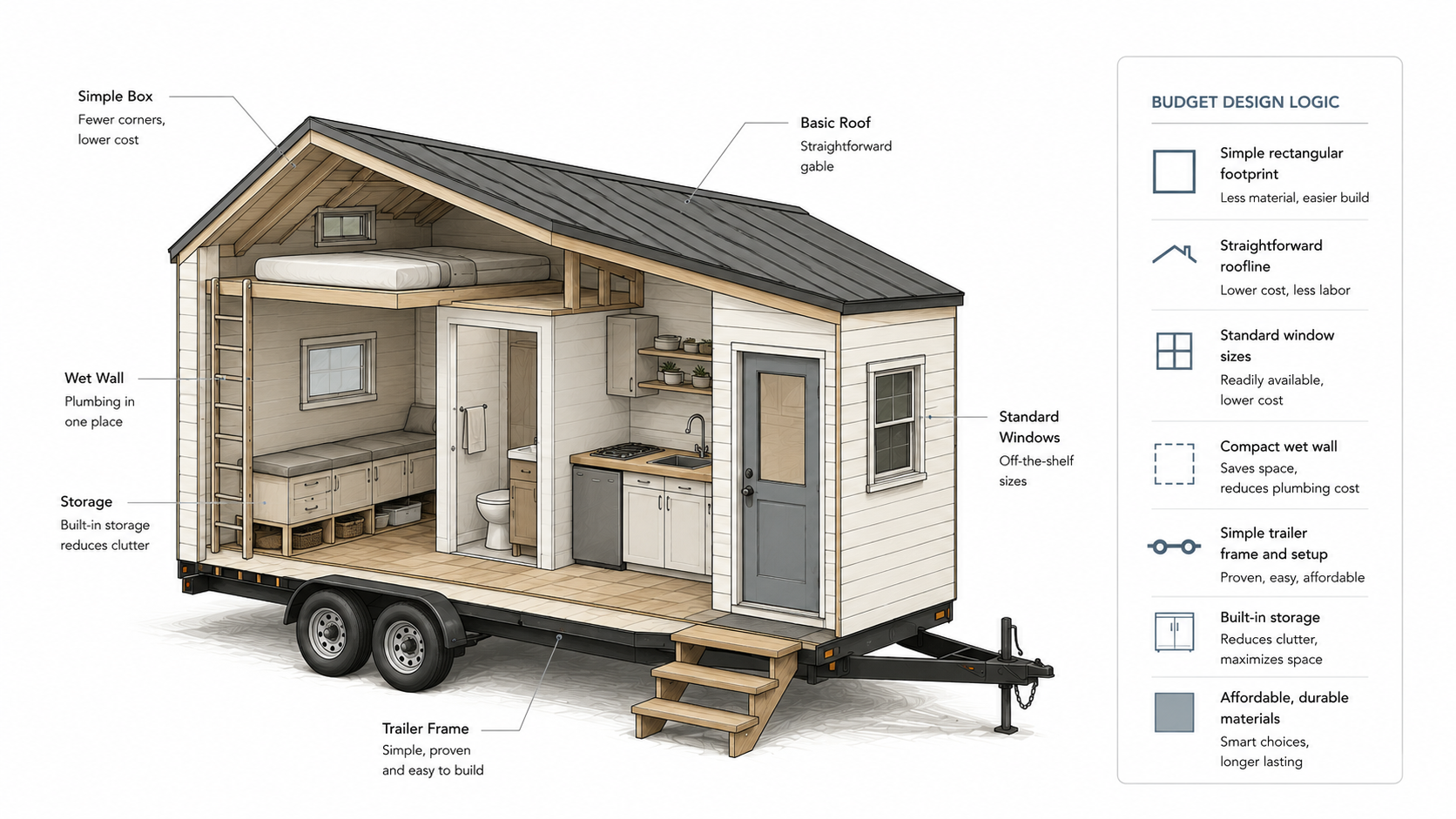
Illustration by ArchitectureCourses.org. Keeping a tiny house affordable usually comes from simpler geometry, one compact plumbing wall, standard windows, and fewer custom structural changes.
Most 400 sq ft tiny-house overruns come from the same places. None of them are dramatic. All of them are predictable.
Too many corners. Every bump-out adds framing, flashing, trim, air-sealing labor, and another place water can find its way in. A clean rectangle costs less, performs better, and is far less likely to leak in year five.
Window upgrades everywhere. One good view window is worth paying for. Glass on every side wrecks insulation performance and adds thousands of dollars in framing and flashing labor. Daylight is free. Heat loss through glass is not.
Custom cabinets too early. Storage matters in 400 square feet — but commissioning custom millwork before the systems layout is settled is one of the most reliable ways to waste five figures. Decide where the plumbing, wiring, and ductwork live first. Cabinetry is the last layer.
Bad wet-wall planning. Spreading plumbing across the plan adds labor, penetrations, freeze risk, and service problems. One compact wet wall serving the kitchen, bath, and water heater is faster to build, easier to insulate, and cheaper to maintain over the life of the home.
The quiet win is boring: simple box, simple roof, one wet wall, standard windows, accessible systems, and enough storage that the place does not become a mess after two weeks.
The Five-Year Cost Is Not the Build Cost
The sticker price is the part everyone discusses. The five-year cost is the part that decides whether the tiny-house decision was actually a good one.
A finished $120,000 tiny house is not a $120,000 commitment. Add insurance, utility hookups, parking or land lease, maintenance reserve, classification-dependent taxes, and the eventual cost of moving or selling it.
Realistic five-year additions for a 400 sq ft tiny house in the U.S.:
Insurance: roughly $600 to $1,800 per year depending on whether the home is on wheels, on a foundation, in a coastal zone, or in a wildfire area. Specialty tiny-house insurance exists but is not cheap. Standard homeowners insurance often refuses to cover a THOW. Five-year total: $3,000 to $9,000.
Property tax or registration: ranges from nearly nothing for some unregistered THOWs to several hundred dollars a year for registered RVs to full property tax for foundation-set tiny houses. This depends entirely on classification and state. Get it confirmed in writing before you buy.
Land lease or parking: if you do not own land, expect $300 to $900 per month in many U.S. markets for a legal tiny-house space with hookups. That alone is $18,000 to $54,000 over five years — easily more than the down payment on the unit itself.
Utilities: a well-built 400 sq ft tiny house in a temperate climate often runs $80 to $150 per month for electricity, propane, water, and sewer. Cold climates or off-grid setups change this significantly.
Maintenance reserve: plan for 1 to 2 percent of build cost per year. For a $120,000 home, that is $1,200 to $2,400 annually. Roof sealants, trailer maintenance, weatherstripping, caulking, appliance replacement, paint touch-ups. These costs do not pause because the house is small.
The honest five-year picture for a $120,000 finished tiny house with a land lease can easily reach $180,000 to $200,000 of total commitment by year five. That is not a reason to skip the project. It is a reason to plan the project at the real number.
Cold Weather Costs More Than People Plan For
A 400 sq ft tiny house in a mild climate is one budget. A 400 sq ft tiny house that needs to survive winter is another.
Cold weather pushes cost into better windows, stronger insulation, air sealing, skirting, heated water lines, protected plumbing, mechanical ventilation, and a real backup heat source. These are not luxury upgrades. They protect the structure from frozen lines, condensation, mold, and uncomfortable indoor swings.
Expect a cold-climate package to add $8,000 to $25,000 over a basic finished build, depending on how aggressive the climate is and how many corners the buyer refuses to cut. Northern U.S. states, mountain towns, and exposed rural sites often price higher than the sunny tiny-house examples used in marketing photography. The house is small. The climate is not.
If you are planning a cold-climate or off-grid setup, Smart Upgrades for Small Spaces covers the envelope side. Compare prefab paths through Prefab Tiny Homes before assuming custom is the only way to get there.
Land and Site Costs Are Not Optional
Old tiny-house math usually treats land like a separate dream.
That is dangerous. A 400 sq ft tiny house needs a legal place to sit, safe access, drainage, power, water, sewage or septic, and enough clearance for delivery or construction. If the site needs grading, trenching, a driveway, a well, a septic system, or a long utility run, the land side can outrun the house budget — sometimes by a lot.
Before buying the unit, get answers to these:
- Can this home legally be placed here, or is the zoning hostile to small dwellings?
- How is it classified — dwelling, ADU, RV, park model, or temporary structure?
- How far are power, water, and waste connections from the building location?
- Can the delivery truck, trailer, or crane physically reach the site?
For the rule side, use Tiny Homes Regulations and Building Codes. For land planning, Building on Your Own Land covers what to confirm before purchase.
Used, DIY, Prefab, or Custom
The cheapest path depends less on the label and more on what risk you are willing to carry.
A used 400 sq ft unit can save real money if the shell is dry, the systems work, and the title or placement path is clean. It can also be a moisture repair wearing fresh paint. Inspect every roof penetration, every window frame, every plumbing seam, and the floor structure under the bathroom. The owner before you may not have known what they were doing, and a tiny house punishes bad work faster than a regular house because there is nowhere for the damage to hide.
DIY can save cash if you already have building skill and time. If you are learning the whole job as you go, the savings often turn into rework. Plan for the project to take twice as long as you think and cost at least 20 percent more than your initial estimate. That is not pessimism. That is industry-standard.
Prefab can cost more than expected once delivery and site work are added, but it reduces schedule chaos and gives you a more predictable shell. The unit price is the part you see in the marketing. The install cost is the part you find out about later. Ask for both.
Custom gives control but every small change costs more inside a compact plan because there is less slack. A 6-inch wall shift in a 2,000 sq ft house is a small thing. A 6-inch shift in a 400 sq ft tiny house can move three other things and add days of labor.
If your real target is compact living rather than extreme tiny living, compare this against Small Houses That Don't Feel Small. Sometimes 500 or 600 square feet ends up cheaper per useful room than forcing 400 to do too much.
Where to Save and Where Not to Touch
There are safe savings and dumb savings. Knowing which is which saves more money than any builder negotiation.
| Save here | Do not cheap out here |
|---|---|
| Paint, trim, simple shelving, owner-installed hardware | Roofing, flashing, weather barrier, air sealing |
| Stock cabinet boxes, standard counters, standard appliance sizes | Electrical panel, circuits, bathroom exhaust, heating and cooling |
| Simple rectangular form, fewer bump-outs, fewer finish changes | Trailer rating, foundation, anchoring, drainage, frost protection |
| Used furniture and non-built-in pieces | Windows, door flashing, wet-area waterproofing, service access |
Money saved on paint stays saved. Money saved on flashing usually comes back as rot. Money saved on ventilation comes back as condensation and mold. Money saved on a weak trailer or undersized foundation comes back as structural trouble that costs more to fix than the original upgrade would have cost.
U.S. Cost Factors That Move the Number
U.S. tiny-house costs move fast because location changes the whole job.
West Coast and mountain-town builds tend to run higher because labor, delivery, snow loads, wildfire detailing, energy code requirements, and site access can stack up. Parts of the Midwest, Texas, and the Southeast may price lower on labor, but humidity, storms, termite risk, zoning, and utility distance still matter. A $90,000 finished THOW from a Texas builder is not the same product as a $90,000 finished THOW built for a Vermont winter, even though the spec sheets look similar from a distance.
For a 400 sq ft tiny house, the biggest U.S. cost swings come from site access (driveway, grading, delivery clearance, crane access), utility distance (power, water, sewer, septic, or well work), climate package (insulation, windows, heat pump, ventilation, freeze protection), and local approval path (whether the home is classified as an ADU, RV, park model, manufactured home, or stand-alone tiny house).
The same 400 sq ft unit can behave like a cheap backyard project on one site and a complicated small build on another. The unit did not change. The site did.
What I Would Price Before Signing Anything
Do not sign based on a pretty floor plan. Price the ugly pieces first.
- The weather shell: roof, windows, siding, underlayment, air sealing, insulation, and flashing details.
- The wet zones: bathroom waterproofing, kitchen plumbing, water heater, drains, exhaust, and service access.
- The base: trailer, slab, piers, skirting, anchors, frost protection, and drainage.
- The site: permits, delivery, driveway, grading, utility runs, septic or sewer, water, and power.
If the quote is vague on those four, the number is not ready and the project is not ready either.
FAQ
How much does a 400 sq ft tiny house cost in 2026?
A realistic U.S. planning range is $80,000 to $160,000 for many finished 400 sq ft tiny homes before major land costs. Simple shells and owner-finished projects can come in lower. Foundation-based, custom, cold-climate, or off-grid builds run higher, sometimes well above $250,000.
Can you build a 400 sq ft tiny house for $50,000?
Sometimes — but usually only as a simple shell, heavy DIY project, used unit, or very basic build with limited site work. A finished full-time home with kitchen, bath, utilities, permits, and good envelope details normally needs more.
Why is a tiny house so expensive per square foot?
Because the expensive parts do not shrink much. Kitchen, bath, roof, windows, electrical, plumbing, heating, ventilation, and site work all still exist. Most 400 sq ft tiny houses end up costing $200 to $400 per square foot, which is often higher per square foot than a traditional house.
Can I get a mortgage on a 400 sq ft tiny house?
Only if the home sits on a permanent foundation on titled land and meets local code as a permanent dwelling. A tiny house on wheels does not qualify for a conventional mortgage in most cases. Most THOW buyers use cash, RV loans, personal loans, or home equity.
What does insurance cost for a 400 sq ft tiny house?
Roughly $600 to $1,800 per year in the U.S., depending on classification, location, and risk exposure. Specialty tiny-house insurance is more expensive than standard homeowners coverage. Standard homeowners policies often will not cover a THOW.
Is 400 sq ft enough for full-time living?
For one person, often yes. For a couple, sometimes — if storage and layout are disciplined. For a family, it gets tight unless the lifestyle is already very pared down.
Is a 400 sq ft tiny house better on wheels or on a foundation?
Wheels help if mobility or temporary placement matters. A foundation usually makes more sense for long-term living, stronger utility connections, better insulation, conventional financing, and a more house-like code path.
What is the biggest hidden cost?
Site work and land lease. Utility distance, septic, sewer, grading, foundation, delivery access, permits, and ongoing parking fees can change the whole budget faster than interior finish choices ever will.
Read Next
For the broader tiny-home cost picture across more sizes, the companion piece is Tiny Home Cost Breakdown.
If the budget is tighter than the ranges above, see Under $10K: Tiny Houses on Wheels You Can Actually Buy before assuming new construction is the only path.
For layout work before pricing, Design Your Own Tiny House is the place to start.
Before signing anything, confirm the rule side through Tiny Homes Regulations and Building Codes.
If 400 square feet is starting to feel too tight, Small Houses That Don't Feel Small covers the 500 to 800 sq ft band that is often cheaper per useful room.