
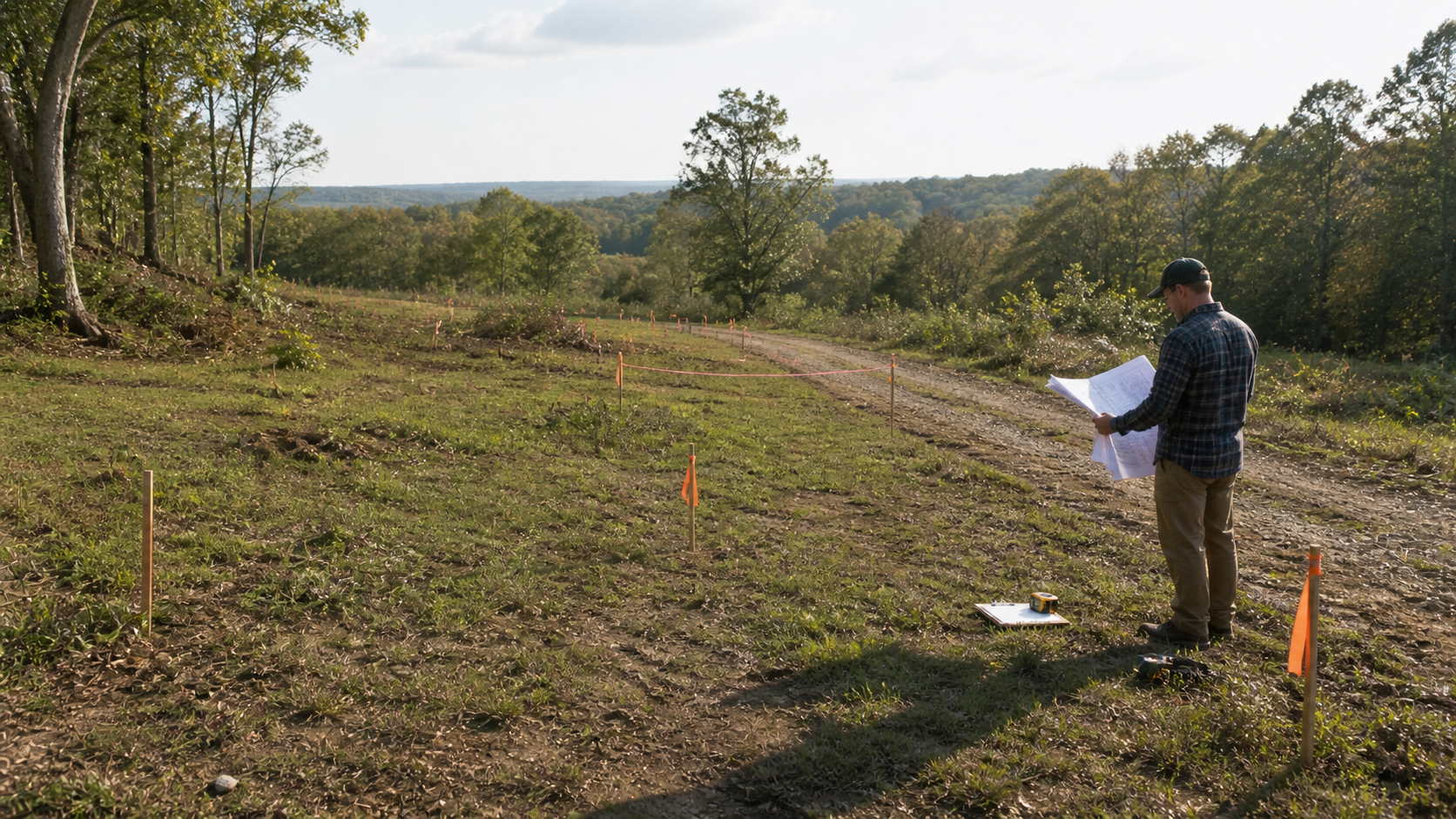
Image by ArchitectureCourses.org. Building on your own land starts with site layout: house placement, driveway access, slope, drainage, setbacks, and where the foundation can realistically go.
Owning the land does not mean you are halfway to owning a house. That is the mistake most people make before they start.
Land is one cost. Getting that land ready to build on — utilities, grading, access, drainage, soil work, permits, engineering — is another cost entirely, and it is often larger than people expect. On raw land with no existing services, site preparation alone can run $30,000 to $80,000 or more before framing starts. On a lot with utilities already at the street, it might be $5,000. That range is the difference between a project that pencils out and one that does not.
The Gap Between Land Cost and Build Cost
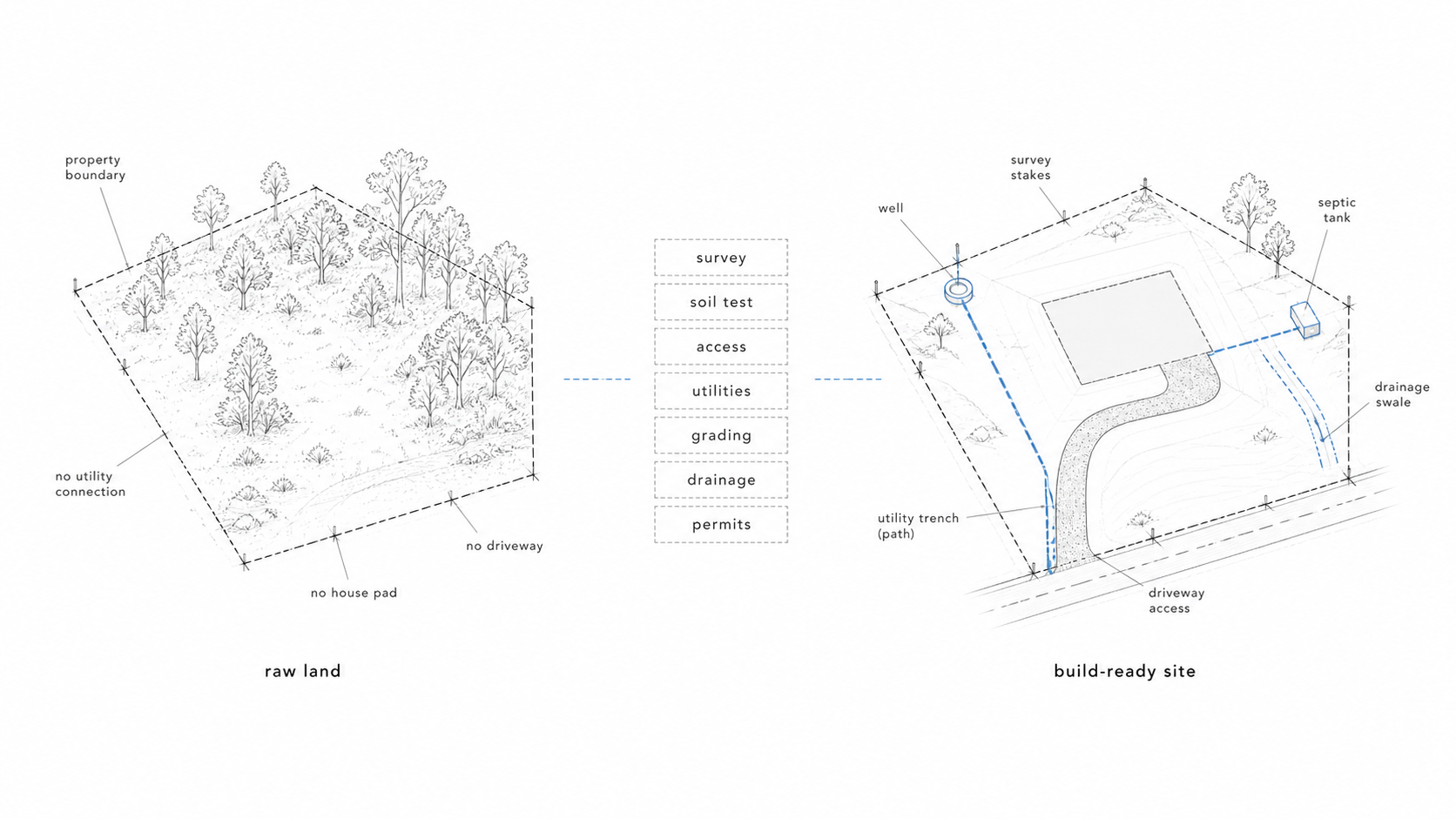
Illustration by ArchitectureCourses.org. Raw land often needs survey work, soil testing, access, utilities, grading, drainage, and permits before it is ready for a house.
People buy land and then budget for construction as if those are the only two numbers. They are not.
Between the land purchase and the first day of framing, there is a layer of costs that does not show up on most home-building websites. Some of these are predictable. Some depend entirely on the specific property.
| Cost category | Typical range | What drives it |
|---|---|---|
| Survey and boundary confirmation | $500–$3,000 | Property size, terrain, whether existing pins are findable |
| Soil testing and geotechnical report | $1,500–$5,000 | Number of borings, depth, lab analysis |
| Septic design and installation (if no sewer) | $8,000–$30,000+ | Soil percolation, system type, local health department requirements |
| Well drilling (if no municipal water) | $5,000–$15,000+ | Depth to water, rock, casing, pump |
| Electric service extension | $2,000–$25,000+ | Distance from nearest transformer, utility policy, underground vs overhead |
| Driveway and access | $3,000–$20,000+ | Length, grade, drainage, base material, paving |
| Clearing and grading | $2,000–$15,000 | Trees, stumps, rock, slope, fill material needed |
| Permits and impact fees | $2,000–$15,000+ | Jurisdiction, house size, utility hookup fees |
On an in-town lot with sewer, water, gas, and electric already at the curb, most of this disappears. On a rural lot five hundred feet from the nearest power line with no perc test on file, it adds up fast. The land might cost $40,000 and the site work might cost another $40,000 before the house starts.
That does not mean rural land is a bad investment. It means the total project cost is land plus site work plus construction, and skipping the middle number is how budgets break early.
What "Buildable" Means Before It Means Anything Else
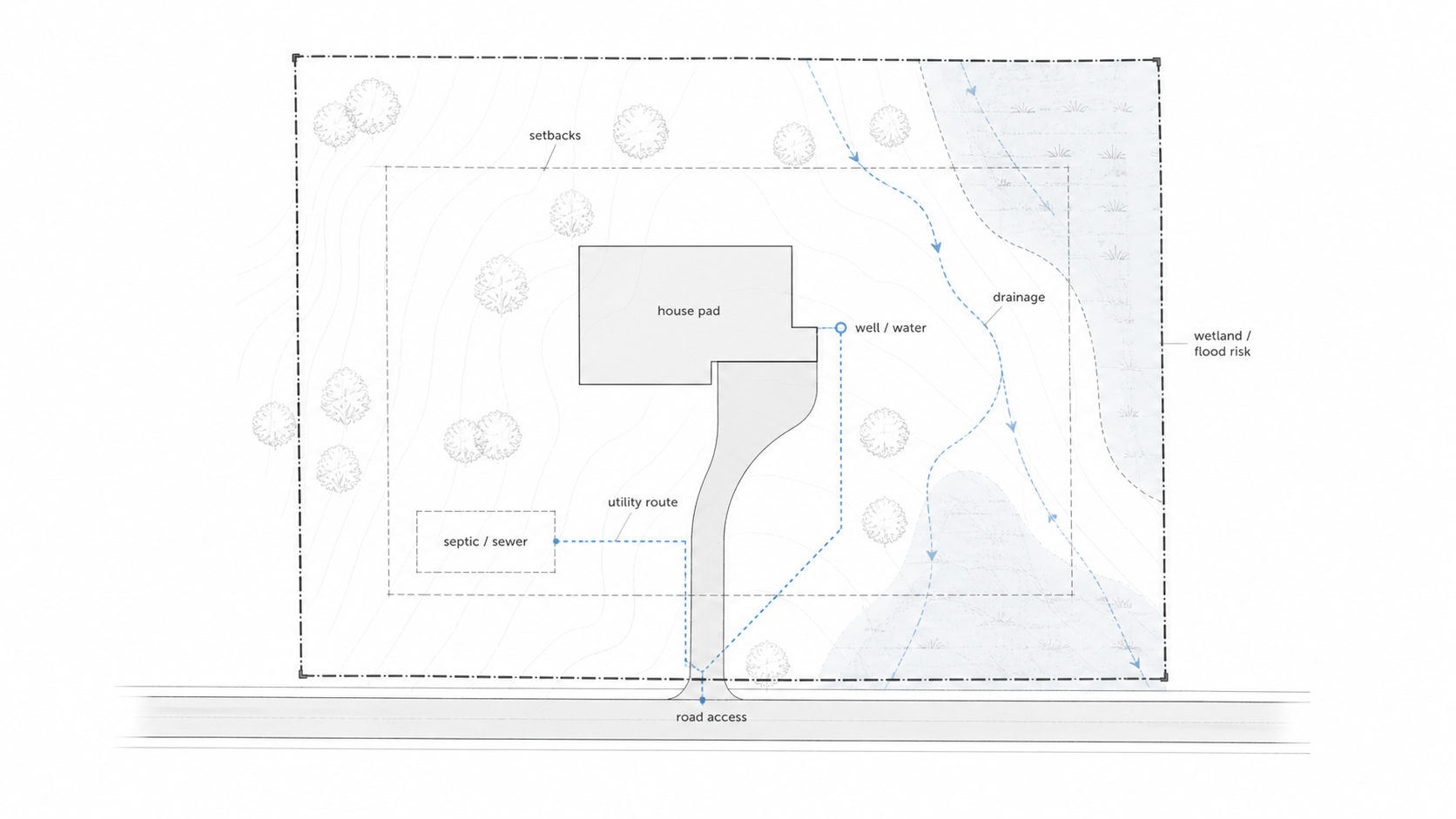
Illustration by ArchitectureCourses.org. A buildable lot has to work beyond the view, with access, setbacks, utilities, drainage, and restricted areas checked before the house plan goes too far.
A piece of land can be beautiful and unbuildable. Or buildable but not for the house you want. Or buildable but only after $50,000 in site work that nobody mentioned during the sale.
Before you commit to a lot — or before you start planning on land you already own — these are the questions that actually matter:
Zoning. Is the land zoned for residential construction? Some parcels are agricultural, conservation, commercial, or have deed restrictions that limit what you can build. Zoning also controls setbacks, height limits, lot coverage, and sometimes even materials. Check with the local planning or zoning office before you draw a single line.
Utilities. Where are water, sewer (or septic suitability), electric, and gas? "Available" does not always mean "at the property line." It can mean "half a mile down the road, and the extension is your cost." Call the utility companies directly and get written estimates. Do not rely on the seller's word.
Access. Does the property have legal road access? A landlocked parcel with no deeded right-of-way is a serious problem. Even with access, building a driveway on a steep or wet site can cost more than people expect.
Soil. Can the ground support a foundation? Can it handle a septic system if there is no sewer? A perc test and a geotechnical report answer these questions. Skipping them is how people discover mid-excavation that they need engineered fill, deep footings, or a completely different septic system than they budgeted for.
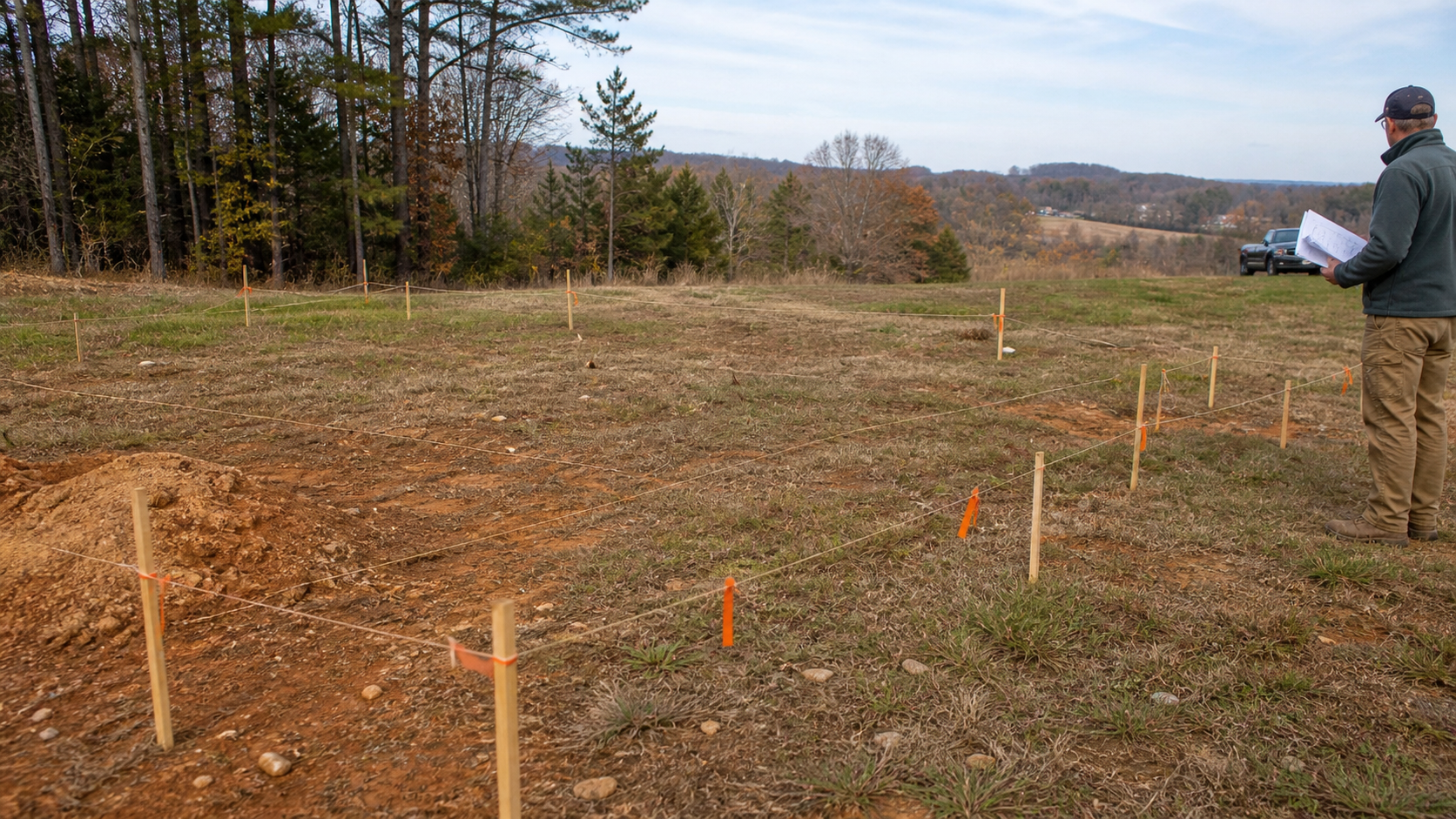
Image by ArchitectureCourses.org. A staked house footprint helps test whether the plan works with the land before excavation, utilities, and foundation layout begin.
The USDA Web Soil Survey gives you a free starting point for understanding what is under the surface before you hire a geotechnical engineer.
Water. If there is no municipal water, you need a well. Well depth varies enormously even within the same county. A neighbor with a 100-foot well does not guarantee yours will not be 300 feet. Get estimates from local well drillers before you finalize your budget.
Floodplain and wetlands. Check the FEMA flood maps and any state or local wetland designations. Building in a floodplain is possible but expensive — elevated foundations, flood insurance, and stricter permitting. Wetland setbacks can reduce your buildable area to something much smaller than the lot size suggests.
When Owning Land Saves Money and When It Does Not
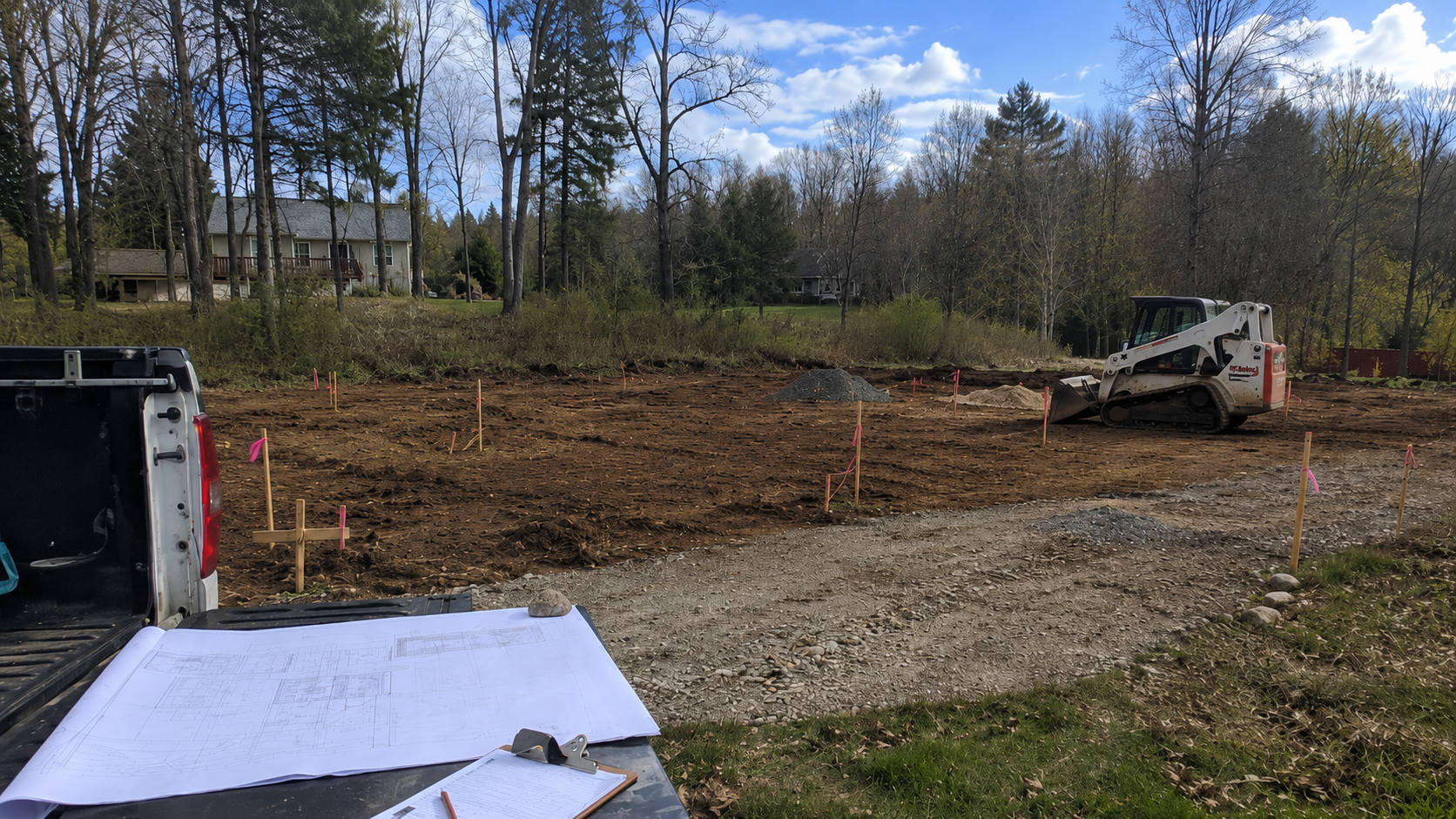
Image by ArchitectureCourses.org. Partly cleared residential lot with survey stakes, gravel access, site plans on a truck tailgate, and a compact track loader parked near the future building area.
The common claim is that building on your own land saves 15–25% compared to buying an existing house. That number can be true. It can also be completely wrong. It depends on what the land needs.
| Scenario | Likely outcome |
|---|---|
| In-town lot, all utilities at the street, flat, no trees, clear title | Building can be cost-competitive with buying, especially if you manage the project yourself |
| Suburban lot in a small development with utilities stubbed to the lot | Usually works well — site costs are predictable and modest |
| Rural lot with well, septic, long driveway, power extension needed | Site work can add $40,000–$80,000+ before construction starts — budget accordingly |
| Inherited or gifted land in a remote area with no services | The land was free but the site work is not — the total cost can exceed buying an existing house in a more accessible location |
| Steep, wooded, rocky, or wet site | Foundation costs rise, access is harder, clearing is expensive — the view may be worth it but the premium is real |
The honest answer is that land ownership saves money when the site is simple and the owner manages well. It costs more when the site is difficult and the owner underestimates what "difficult" means in dollars.
The Sequence Before Construction Starts
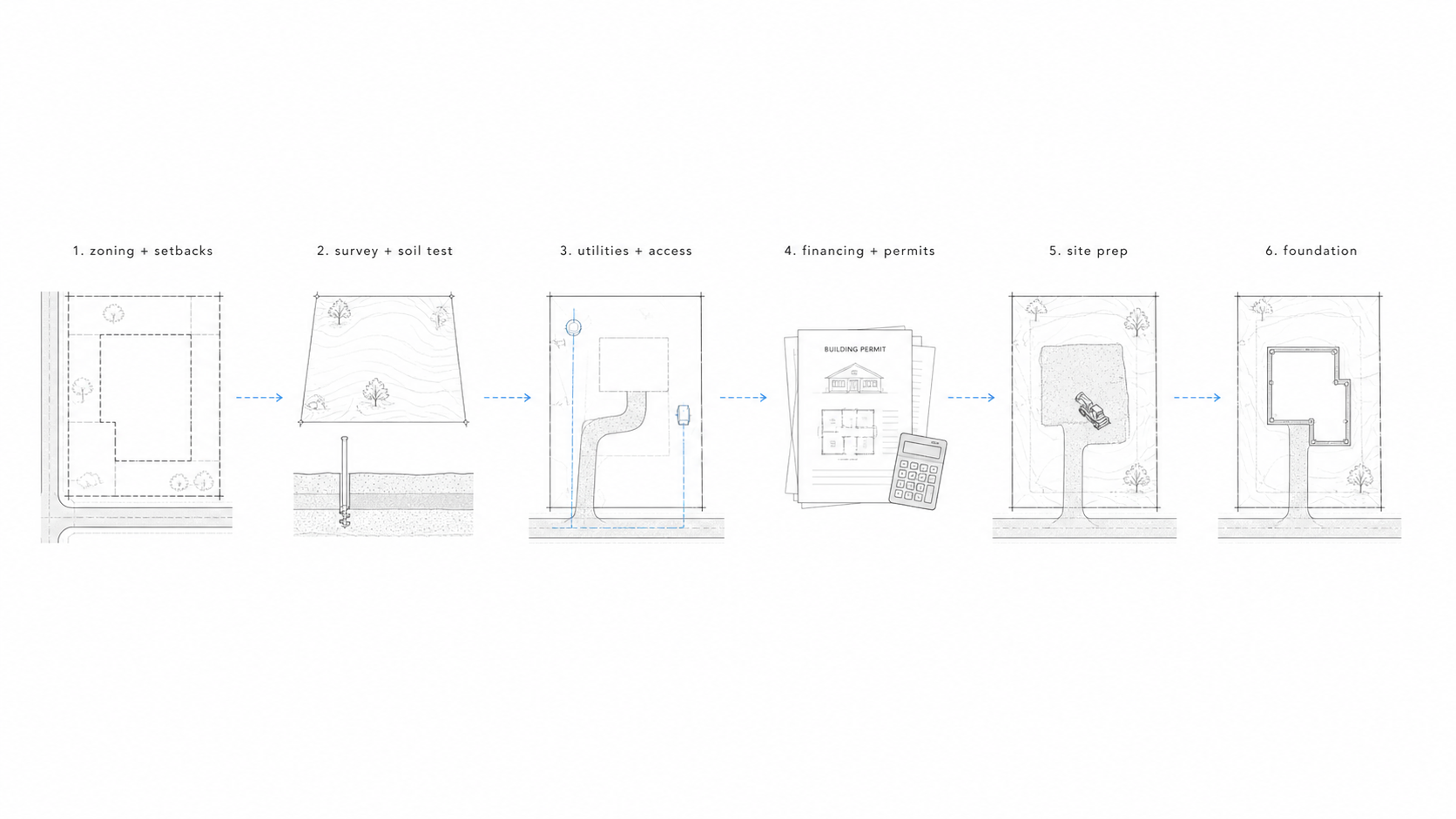
Illustration by ArchitectureCourses.org. Building on your own land usually starts with zoning, survey work, soil testing, utilities, financing, permits, site prep, and foundation planning before framing begins.
Most articles about building on your own land jump straight to house design. The actual sequence starts earlier and is less exciting.
1. Confirm what you can build. Zoning, setbacks, height limits, lot coverage, deed restrictions. This determines the envelope your house has to fit inside. If the zoning does not allow what you want, you either apply for a variance (slow, uncertain) or adjust your plans.
2. Test the site. Soil boring, perc test if septic is needed, survey, and utility verification. These are not optional. They are the difference between a plan that works and a plan that discovers problems during excavation.
3. Secure financing. Construction loans work differently from mortgages. They are typically short-term, have higher interest rates, require larger down payments (often 20–30%), and disburse in draws tied to construction milestones. Many convert to a permanent mortgage after the house is complete. Shop lenders early — not all banks offer construction loans, and the terms vary significantly.
4. Design the house to fit the site. Not the other way around. The house should respond to the topography, orientation, drainage, access, views, and utility locations. A plan that ignores the site will fight it during construction and keep fighting it afterward. This is where working with an architect or experienced designer pays for itself. If you want to start with your own layout first, how to draw your own house blueprints covers the basics of getting a plan on paper before you bring in a professional.
5. Get permits. Building permits, septic permits, driveway permits, utility connection permits. The number varies by jurisdiction. Some counties are straightforward. Some require months of review, especially if there are environmental overlays, historic districts, or planned-unit-development rules. Start this process earlier than you think you need to. For the code side of this, residential building codes covers what most jurisdictions enforce.
6. Sort out insurance before the site opens. You need builder's risk insurance during construction and general liability coverage. If you are hiring subs, verify their insurance before they start. A construction site on your land is your liability. The GC guide covers this in more detail.
7. Prepare the site. Clearing, grading, erosion control, temporary access, utility trenching. This is real construction work and it costs real money. It also has to happen in the right order — you cannot grade a driveway before the utility trenches are dug if they cross the same path.
After all of that, the foundation goes in. For foundation types, soil conditions, and frost-depth decisions, building foundations is the next step. For the full construction sequence from that point forward, building construction process picks up where site work ends.
Construction Loans Are Not Mortgages
This catches people every time. You cannot walk into a bank with raw land and get a standard 30-year mortgage for a house that does not exist yet.
Construction financing usually works one of two ways:
Construction-to-permanent loan. One loan that covers the build and converts to a mortgage when the house is done. This is usually the simpler path. You close once, pay interest only during construction, and convert to principal-and-interest payments after completion. Down payments are typically 20–25% of the total project cost (land plus construction).
Standalone construction loan plus separate mortgage. Two closings. The construction loan covers the build. When the house is finished, you take out a separate mortgage to pay off the construction loan. More paperwork, two sets of closing costs, but sometimes better rates on the permanent side.
Both types require detailed plans, a realistic budget, a builder or GC (some lenders will not finance owner-managed builds), and an appraisal based on the projected completed value. The lender is not financing a dream. They are financing a specific house on a specific lot with a specific cost breakdown.
If you are planning to manage the build yourself, read be your own general contractor before approaching lenders. Some will work with owner-builders. Many will not. Knowing which lenders are open to it saves time.
What People Get Wrong
They budget for the house and forget the site. Site work is not a line item you can estimate later. On difficult land, it can be 15–20% of the total project cost. On easy land, it might be 3%. Either way, it belongs in the budget from day one.
They buy land before checking buildability. A beautiful lot with no perc, no road access, or a floodplain designation is not a building site. It is a problem. Check before you buy, not after.
They assume utilities are close and cheap. "Electric is available" can mean the nearest transformer is 1,200 feet away and the utility wants $18,000 to extend service. Get written estimates from every utility before closing on land.
They design the house before understanding the site. A plan pulled from a magazine or website may not fit the setbacks, may fight the slope, may ignore the best orientation, and may require a foundation system that costs twice what a site-responsive design would need. Design to the land, not despite it.
They underestimate the timeline. From land purchase to move-in, 12–18 months is common for a straightforward project. Complex sites, permit delays, financing complications, or weather can push that to 24 months or more. Do not plan your lease expiration around best-case timing.
Do This Instead of This
| Do this | Instead of this | Why |
|---|---|---|
| Get a soil test and perc test before buying rural land | Assuming the ground will support whatever you build | A failed perc test can make a lot unbuildable for a house with septic |
| Call every utility company and get written cost estimates | Trusting the real estate listing when it says "utilities available" | "Available" and "at the property line" are not the same thing |
| Budget land + site work + construction as one total project cost | Treating land cost and house cost as separate budgets | The gap between them is where budgets break |
| Design the house to fit the site after testing it | Picking a plan from a catalog and forcing it onto the lot | A site-responsive design costs less to build and works better long-term |
| Talk to lenders early about construction loan requirements | Assuming you can figure out financing after the plans are done | Lender requirements affect the builder choice, budget format, and timeline |
| Check zoning, setbacks, and deed restrictions before designing | Drawing the house you want and hoping it fits the rules | A variance is not guaranteed and can add months to the timeline |
Building in Other Countries
The process varies, but the core questions are the same everywhere: can you build on this land, what does the site need, and what does the permit process require?
United Kingdom. You need planning permission from the local planning authority, which can take months and may require design revisions. Building regulations approval is separate and covers structure, fire safety, energy performance, and accessibility. Land with "outline planning permission" already granted is significantly less risky than land without it. The distinction between greenfield and brownfield sites also affects what is permitted and how long approval takes.
Canada. Provincial building codes apply, with municipal permit requirements on top. Cold-climate construction drives insulation, foundation depth, and moisture management decisions. In many provinces, a septic system requires a site evaluation by a licensed installer before the building permit is issued. Utility extension costs in rural areas can be substantial, especially for hydro (electricity) in provinces like Ontario and British Columbia.
Australia. Development applications go through local council, and processing times vary wildly — some councils turn them around in weeks, others take four to six months or longer, especially if the site has overlays for heritage, vegetation, or bushfire. Bushfire Attack Level (BAL) ratings in fire-prone areas directly affect materials, glazing, and construction methods — and can significantly increase costs. Soil classification (reactive clay is common in many parts of Australia) determines foundation design and can push costs up substantially if the site requires deep piers or raft slabs. Water availability and wastewater management are critical in rural and semi-rural builds.
FAQ
Is it cheaper to build on your own land than to buy an existing house?
Sometimes. On a simple lot with utilities at the street, building can cost less than buying — especially if you manage the project carefully. On raw land that needs a well, septic, power extension, and a long driveway, the site work alone can close the gap or eliminate the savings entirely. The answer depends on the specific property.
How much does it cost to build a house on your own land?
Total project costs (land + site work + construction) range widely. In the U.S., construction alone typically runs $150–$400+ per square foot depending on location, complexity, and finish level. Site work on raw land can add $30,000–$80,000 or more. The land cost varies by market. A 1,800-square-foot house on a prepared suburban lot might total $350,000–$550,000 all-in. The same house on rural land with no services could cost $100,000 more because of site preparation.
What should I check before buying land to build on?
Zoning, utility availability (with written cost estimates from each provider), soil conditions, perc test results if septic is needed, road access and legal right-of-way, floodplain status, wetland designations, and deed restrictions. Every one of these can make land unbuildable or significantly more expensive to develop than expected.
Can I build a house on my own land without a contractor?
In most U.S. jurisdictions, homeowners can act as their own general contractor on their primary residence. Some states have restrictions. Construction loans from some lenders require a licensed GC. Being your own GC saves the management fee but requires handling scheduling, procurement, inspections, and every coordination problem that arises. See be your own general contractor for the full picture.
How long does it take to build a house on your own land?
From land purchase to move-in, 12–18 months is typical for a straightforward project with utilities available and permits in order. Complex sites, custom designs, permit delays, or owner-managed builds can extend that to 24 months or more. The construction phase itself is usually 6–10 months. The months before construction — testing, permitting, design, financing — are what people underestimate.
What is a construction loan and how does it work?
A construction loan is short-term financing that covers the cost of building. It disburses in draws tied to construction milestones (foundation complete, framing complete, dry-in, etc.). Interest is charged only on the amount disbursed. After the house is finished, the loan either converts to a permanent mortgage or is paid off with a separate mortgage. Down payments are typically 20–30% of the total project cost.
Read Next
How to Build Your Own House — the full construction guide from planning through completion. Start here once the land decisions are settled.
Be Your Own General Contractor — covers what it takes to manage the build yourself, including scheduling, subs, procurement, inspections, and the honest trade-offs.
How to Draw Your Own House Blueprints — if you want to start with your own layout before bringing in a professional. Covers scale, openings, dimensions, and common mistakes.
Building Construction Process — the full sequence from site work through finishes. Picks up where site preparation ends.
Building Foundations — foundation types, soil conditions, frost depth, and drainage. The first major construction decision after site work is done.
Cost Plan Construction — how to build a real cost plan with cash flow, contingency, and draw schedules instead of a single budget number.
Resources: FEMA Flood Map Service Center · USDA Web Soil Survey · U.S. Department of Housing and Urban Development · National Association of Home Builders · International Code Council