

“Online architecture bachelor’s degree” is not one thing, and that is exactly where people get burned.
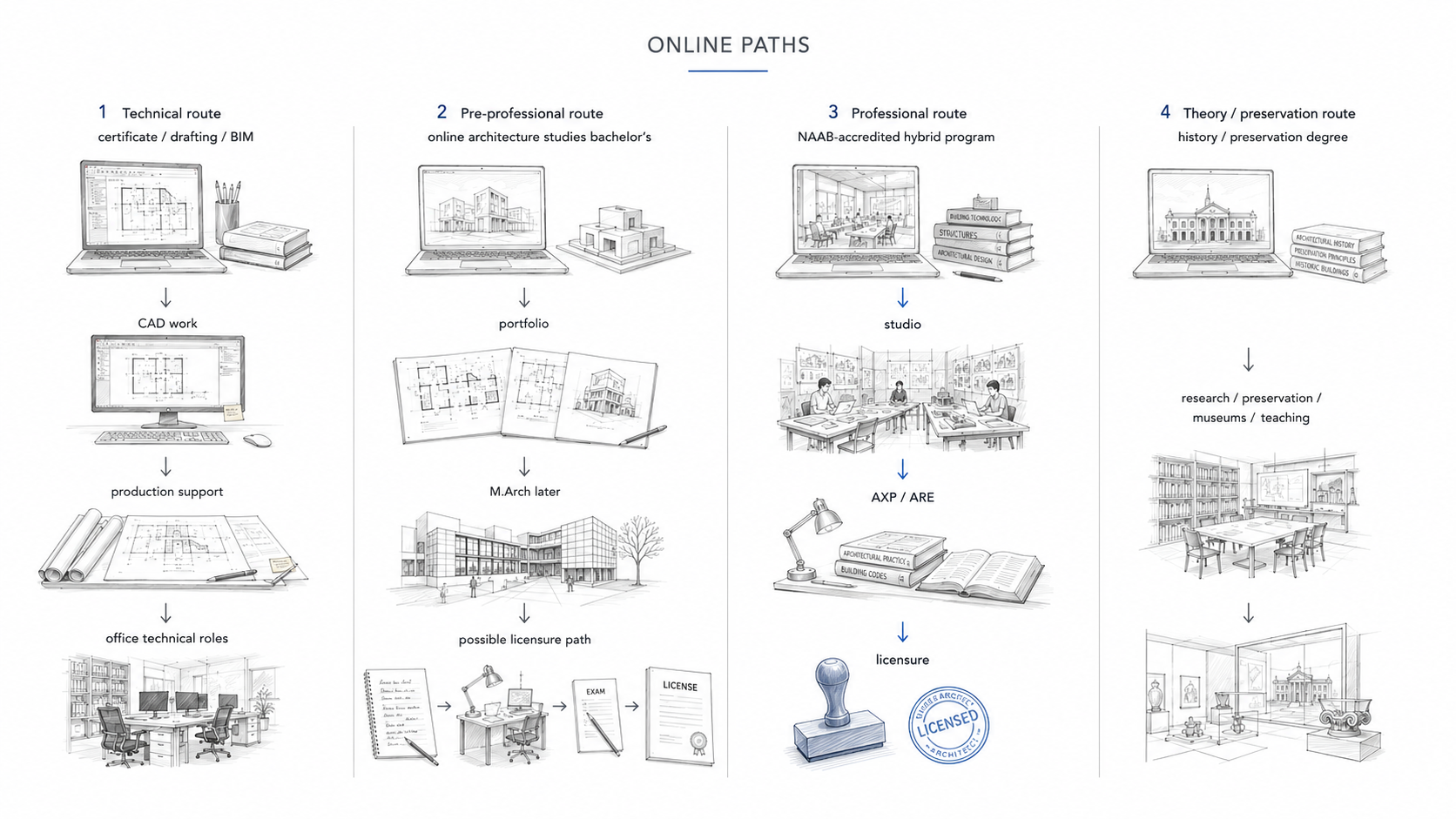
One program is a professional B.Arch that plugs straight into the licensure path. The next is a pre-professional BS or BA that only makes sense if you go on to an M.Arch. Another is closer to design studies, drafting, BIM, sustainability, construction, interiors, or planning support. All of them can be useful. None of them lead to the same place.
So before you compare tuition, rankings, or school names, answer the harder question first: what do you actually need this degree to do? Help you become a licensed architect, get you into graduate school, build a portfolio, qualify you for CAD or BIM work, or open a broader built-environment career? The answer changes which degree you should be looking at — and it is the part most people skip until it has already cost them a year.
The old online architecture advice is too simple
The old line was easy: you cannot become an architect through an online bachelor’s degree. That is too blunt now.
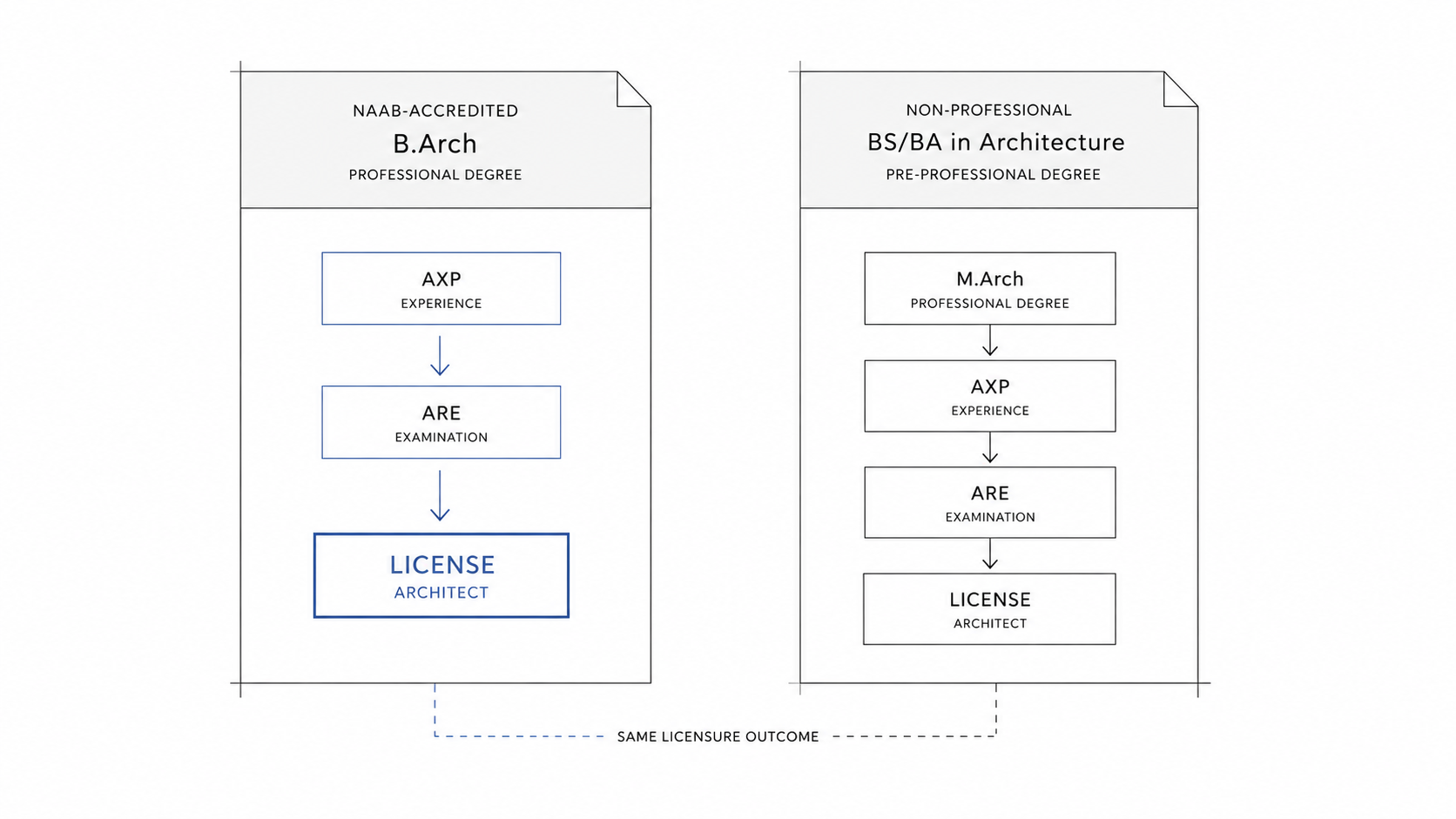
NAAB accredits professional architecture programs — B.Arch, M.Arch, and D.Arch — and NCARB says most U.S. jurisdictions require a degree from a NAAB-accredited program for initial licensure, though some allow other routes. A few schools now run online or flexible professional programs. Plenty of other online bachelor’s programs are still pre-professional or simply architecture-adjacent. The old rule was written before any of that existed.
So the question is not “is it online?” It is narrower and more useful: what is the exact degree, is that exact program professionally accredited right now, and what does your licensing jurisdiction actually require?
Professional degree or stepping-stone degree
An online architecture bachelor’s usually falls into one of four lanes.
| Degree lane | What it usually means | Best fit | Main risk |
|---|---|---|---|
| Online or flexible B.Arch | Professional architecture degree if the specific program is NAAB-accredited | Students who want the most direct undergraduate licensure route | Assuming online delivery removes studio, model, review, or state-board requirements |
| Online BS or BA in architectural studies | Pre-professional architecture education, usually used before an M.Arch | Students who need flexibility and may go to graduate school later | Thinking the bachelor’s alone makes you license-ready |
| Online design studies or built-environment degree | Broader design, sustainability, planning, real estate, or environmental design path | Students interested in the built environment but not necessarily licensure | A vague credential without enough portfolio or technical skill |
| Online drafting, CAD, BIM, or architectural technology route | Technical support path for drawing, documentation, modeling, or production work | Students who want practical job skills faster | Confusing technical drafting work with architect licensure |
The title matters. The accreditation status matters more. A “bachelor’s in architecture” can be a professional B.Arch, a pre-professional BS, a liberal-arts BA, a BFA, a BDes, or some design-related degree sitting beside architecture. Do not choose off the title alone — that is how people end up a year in before they learn the degree does not do what they assumed.
What a NAAB-accredited online B.Arch changes
A NAAB-accredited B.Arch is a different instrument from an online BS or BA in architecture-related studies. In the United States, the accredited professional degree usually satisfies the education requirement for licensure in most jurisdictions. It does not make you an architect the day you graduate — you still owe the experience program, the exams, and your state board’s approval. But it does mean the degree was built as a professional path, not just a design foundation, and that distinction is the whole game.
Before you treat any online B.Arch as your licensure route, confirm all of this:
- The specific program is listed in the NAAB program directory.
- The degree is a professional B.Arch, not only a BS, BA, BFA, or BDes.
- The accreditation is current — not just mentioned in old marketing copy.
- Your state or jurisdiction accepts that path for initial licensure.
- You understand any campus visits, studio reviews, model-making, or live critique requirements.
- The school’s broader institutional accreditation is in good standing, since a school can hold valid NAAB program accreditation while its regional accreditor has flagged it.
Online delivery does not erase the professional path. It does not erase the workload either.
When an online BS or BA makes more sense

A pre-professional online BS or BA can absolutely be the right move — if you need flexibility, already work, live far from a campus, carry family obligations, or want to test architecture before committing to a professional M.Arch.
What separates a strong version from a weak one is whether the program actually gives you four things: serious design studio work, real drawing and representation training, honest portfolio feedback, and a clear route into graduate architecture programs. The weak version talks about architecture and leaves you with no portfolio, no studio discipline, no technical drawing skill, and no obvious next step.
If your plan is a later M.Arch, check the transfer rules and graduate admissions early — before you enroll, not after. A cheap online bachelor’s turns expensive fast if it does not prepare you for the graduate program you actually need.
The online studio problem students discover late
Architecture online is not lectures on a screen. Studio is the hard part, and it does not get easier remotely. You still draw, model, revise, present, take criticism, and defend your decisions — the difference is that much of that feedback arrives through a camera, a screen share, an upload folder, a recorded review, or a live online crit. That changes the work in ways people underestimate.
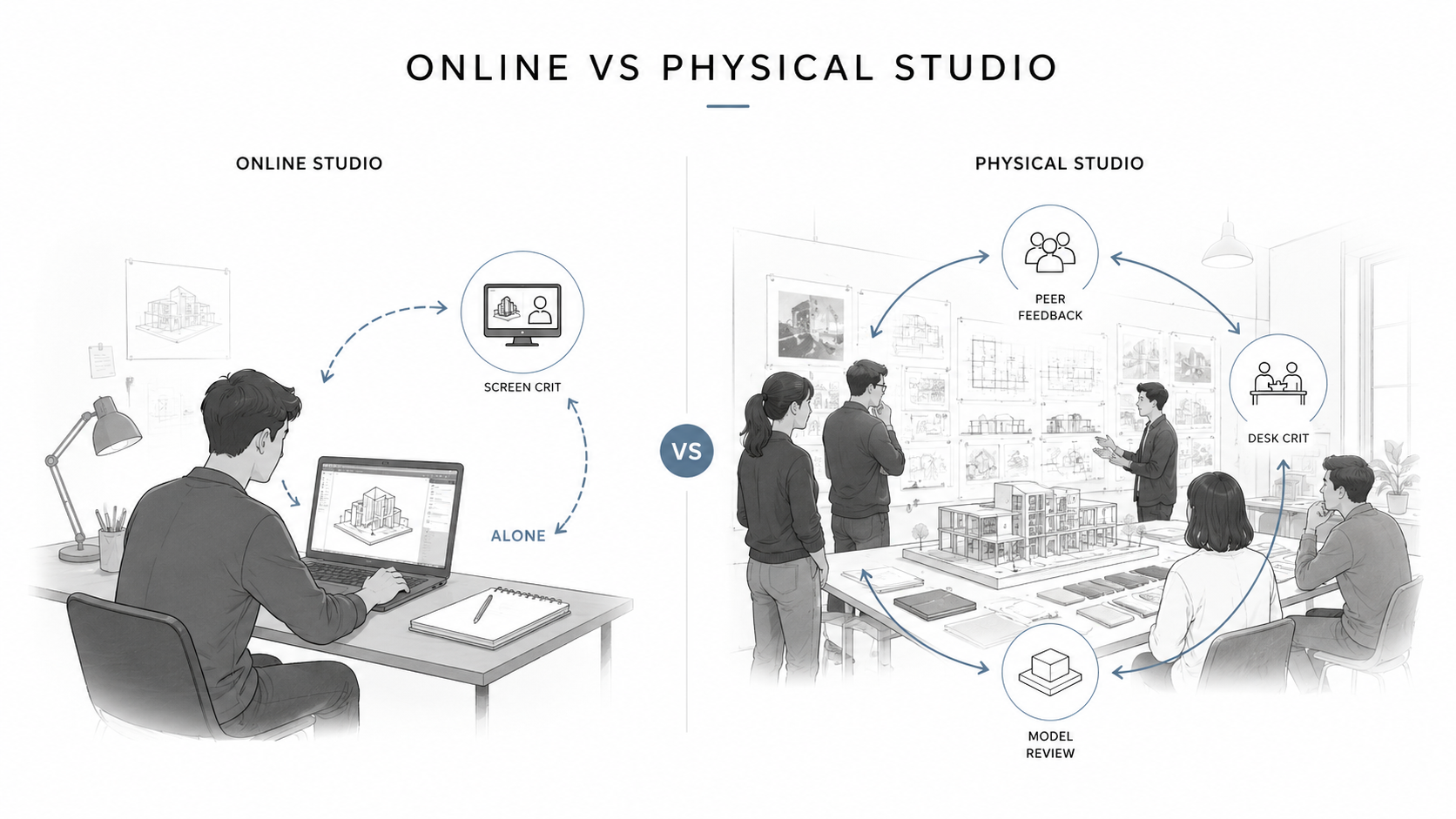
You need a place to build models. You need light good enough to photograph drawings. You need a camera setup that lets reviewers actually see the work, file discipline so nothing gets lost, and time for revisions after critique — not just time to watch the lectures. So ask the school how studio really runs, week to week:
- Are critiques live, recorded, written, or some mix?
- Are there required meeting times, and across which time zones?
- Are physical models required?
- How are pin-ups handled online?
- How often does each student get individual feedback?
- What software and file formats are required?
This is where online programs split. The good ones build a real feedback loop. The weak ones hand you assignments and leave you alone with them.
Program examples to read carefully, not blindly rank
Do not treat these like a top-five shopping list. They are different models solving different problems, and I have lined them up that way on purpose — verify the current details yourself before you act on any of them, because accreditation and program status do change.
| Example | What it shows | What to verify |
|---|---|---|
| Academy of Art University online architecture programs | One of the few schools delivering a NAAB-accredited professional B.Arch largely online, with an IPAL licensure track | Current NAAB status, cost, studio format, state licensure fit — and note its regional accreditor (WSCUC) has the institution on warning, which is worth weighing |
| Boston Architectural College Online BS in Architecture | A pre-professional online BS that BAC says does not prepare you for licensure on its own, but feeds an accelerated two-year M.Arch | That it expects roughly two years of prior architecture/design college to enter, plus transfer fit and total time to the M.Arch |
| ASU Online Architectural Studies (BSD) | A pre-professional architectural studies route with design thinking, representation, and project-based learning, leading toward the professional M.Arch | Portfolio output, studio feedback, graduate admission fit, and software expectations |
| University of Arizona Online Sustainable Built Environments | A fully online, STEM-designated built-environment and sustainability degree — not a professional architecture degree | Whether your goal is sustainability, planning, real estate, or later graduate architecture study, since this path does not lead to licensure by itself |
None of these is automatically the best one. Each just answers a different question, and the trick is matching the model to the question you actually have.
What to check before applying
A serious online architecture page should answer the practical questions before you apply. If it does not, ask admissions directly and get it in writing.
| Question | Why it matters |
|---|---|
| Is this a professional B.Arch or a pre-professional BS, BA, BFA, or BDes? | The answer changes the licensure and graduate-school path. |
| Is the exact program NAAB-accredited? | Institutional accreditation is not the same as professional architecture program accreditation. |
| Are there required campus visits, residencies, or live studio reviews? | “Online” can still mean travel, fixed meeting times, and scheduled critiques. |
| What portfolio will I graduate with? | Architecture careers and M.Arch admissions ride on visible work, not just credits. |
| What software and hardware are required? | Revit, Rhino, Adobe tools, rendering, and large model files can change the real cost. |
| Where do graduates go next? | Job titles and graduate placements show whether the degree works outside the brochure. |
The real cost is not only tuition
Online study can save you housing or a commute, but do not assume it is cheap. Architecture students still need tools: at a minimum, a capable laptop, external backup, drawing supplies, model materials, printing or plotting when it is required, software access, cloud storage, a camera or scanning setup, and a workspace where you can actually build and photograph the work.

A weak laptop becomes a hidden tax. So does a bad desk setup, and so does buying materials one panicked trip at a time. For most students, 16 GB of RAM is the working minimum for design-school software; if you expect Revit, Rhino, large Adobe files, rendering, or several programs open at once, 32 GB is the safer bet. Check the school’s published hardware requirements before you buy anything — the program’s software stack decides what you need, not an affiliate list.
Career paths after an online architecture bachelor’s
Where you land depends on the degree type and the work you graduate with.
| Goal | Better degree fit | What you still need |
|---|---|---|
| Licensed architect path | NAAB-accredited professional B.Arch, or a pre-professional bachelor’s followed by a NAAB-accredited M.Arch | AXP, ARE, and state board approval |
| M.Arch admission | Strong BS, BA, or architectural studies route | Portfolio, prerequisites, references, and a clear graduate-school fit |
| CAD or BIM support | Architectural technology, drafting, BS, or portfolio-heavy design route | Revit, AutoCAD, construction-document literacy, and real drawing samples |
| Sustainability or planning support | Sustainable built environments, planning-adjacent, or environmental design route | GIS, policy, building performance, research, or technical communication skills |
| Interior or spatial design | Interior architecture, design studies, or an architecture-related bachelor’s | Portfolio, materials knowledge, code awareness, and software skill |
Be careful with job titles. “Architect” is a protected, regulated title in many places. A bachelor’s degree can get you working inside architecture offices, but the legal title almost always waits on licensure.
When an online architecture bachelor’s is worth it
It is worth it when it solves a real constraint without weakening the next step — when you need to stay where you live, work while you study, support a family, keep relocation costs down, or build a portfolio before applying to a professional graduate program.
It is a poor choice when you need the traditional studio environment, direct access to local firms, a physical model-shop culture, or a clear licensure route the program cannot actually prove.
Good reasons to choose online
- You need location flexibility.
- You can work independently without losing momentum.
- The program has real studio feedback.
- The degree fits your licensure, M.Arch, or job plan.
- You have budgeted for software, hardware, and model work.
Bad reasons to choose online
- You think it will be easy.
- You have not checked NAAB or graduate-school requirements.
- The program gives vague career outcomes.
- You do not have a place to draw, build, photograph, and present work.
- You are choosing only on price, without checking what happens after graduation.
What students discover after three weeks
The first surprise is the isolation. In a campus studio you absorb a lot just by watching other students struggle, revise, pin up, fail, and get better. Online, that background learning is easy to miss. A good program rebuilds it on purpose — peer review, live critique, shared boards, frequent feedback. A weak one leaves you guessing by yourself.
The second surprise is how physical the work stays. You may study through a screen, but architecture still wants models, drawings, material studies, site observation, and photos of work in progress.
The third surprise is time. Online architecture tends to attract working adults, parents, and career changers, and that can absolutely work — but studio deadlines do not soften because the course is remote. A six-hour design task is still a six-hour design task. Plan the week honestly before you enroll. If you cannot protect real blocks of studio time, the program will find that out fast, and so will you.
How to compare programs without getting sold
Do not start with rankings. Start with the outcome you need, then work backward.
- Decide whether you need a professional architecture degree or a stepping-stone degree.
- Check the exact program in the NAAB directory if licensure matters.
- Read the curriculum, not just the overview page.
- Ask how studio feedback actually works online.
- Look for real student work and graduate outcomes.
- Price the full setup: tuition, hardware, software, supplies, travel, and time away from work.
A serious program makes the path visible. A weak one keeps repeating the same soft words — flexible, creative, innovative, career-ready — and hopes you do not ask what happens after graduation. Those words are not enough to build a decade on.
Common mistakes
| Mistake | Why it hurts | Better move |
|---|---|---|
| Assuming all online architecture bachelor’s degrees are non-professional | A few online or flexible professional routes now exist, so the old rule can be wrong | Check the exact program and its current NAAB status |
| Assuming all online architecture degrees lead to licensure | Many are pre-professional or architecture-related degrees | Separate B.Arch, BS, BA, BFA, BDes, and certificate paths |
| Ignoring studio format | Architecture learning depends on critique, revision, and visible process | Ask how reviews, pin-ups, models, and feedback are handled |
| Buying gear before reading requirements | The wrong laptop or software plan can waste money | Start from the school’s hardware and software requirements |
| Choosing the cheapest degree | A cheap program costs more if it fails to support graduate admission or employment | Compare total path cost and next-step outcomes |
Before You Choose
An online architecture bachelor’s can be a smart path. It can also be the wrong shortcut, and the difference is rarely the brochure.
Choose a professional online or flexible B.Arch only after you have confirmed its current NAAB status and checked your licensing jurisdiction. Choose a BS, BA, BFA, BDes, or built-environment degree when the real goal is graduate school, design support, drafting, sustainability, planning, or a broader built-environment career. The right program is the one that matches your next step — not the one with the cleanest website.
FAQ
Can you earn an architecture bachelor’s degree online?
Yes. Several schools offer online or flexible architecture-related bachelor’s degrees, and a few offer online professional routes. What matters is the exact degree type and its accreditation status.
Can an online architecture bachelor’s lead to licensure?
It can, if the degree is a NAAB-accredited professional B.Arch and your jurisdiction accepts that route. Many online BS, BA, BFA, or BDes programs are not professional licensure degrees on their own.
What is the difference between an online B.Arch and an online BS in architecture?
A B.Arch is a professional architecture degree when the program is NAAB-accredited. A BS in architecture or architectural studies is usually pre-professional, and tends to prepare you for graduate study, design-support work, or related built-environment careers.
Are online architecture degrees respected?
They can be, when the school is legitimate, the program holds the right accreditation for your goal, and your portfolio shows real design ability. Employers and graduate schools look at the work, not just the delivery format.
What jobs can you get after an online architecture bachelor’s?
Depending on the degree and portfolio: design assistant, CAD drafter, BIM technician, planning support, sustainability support, interior design support, or M.Arch applicant. The legal architect title generally requires licensure.
Is online architecture school easier than campus architecture school?
No. The flexibility helps, but studio work, critique, modeling, revisions, and deadlines still demand serious time — and online students need stronger self-management on top of it.
What should I ask before applying?
Whether the program is professional or pre-professional, whether it is NAAB-accredited, how online studio works, what software and hardware are required, whether travel is required, and where graduates actually go next.
Read This Next
- Can You Earn an Architecture Degree Online?
- Types of Architecture Degrees
- Master of Architecture Degree
- Sustainable Architecture Degrees
References
- NAAB Prospective Students: Professional Architecture Degrees
- NAAB Accredited Programs
- NCARB: How to Earn Your Architecture License
- Academy of Art University: NAAB Accreditation
- Boston Architectural College Online Bachelor of Science in Architecture
- ASU Online Bachelor of Science in Design in Architectural Studies
- University of Arizona Online BS in Sustainable Built Environments