

Free online civil engineering courses can help, but only if you take them in the right order.
Do not start with the exciting stuff first. Bridges, road design, big projects, and software look more interesting. But they will not make sense if you cannot explain a force, a moment, a load path, a unit conversion, or a simple beam.
That is where many beginners get stuck. They collect course links, watch a few videos, and still feel lost after three weeks.
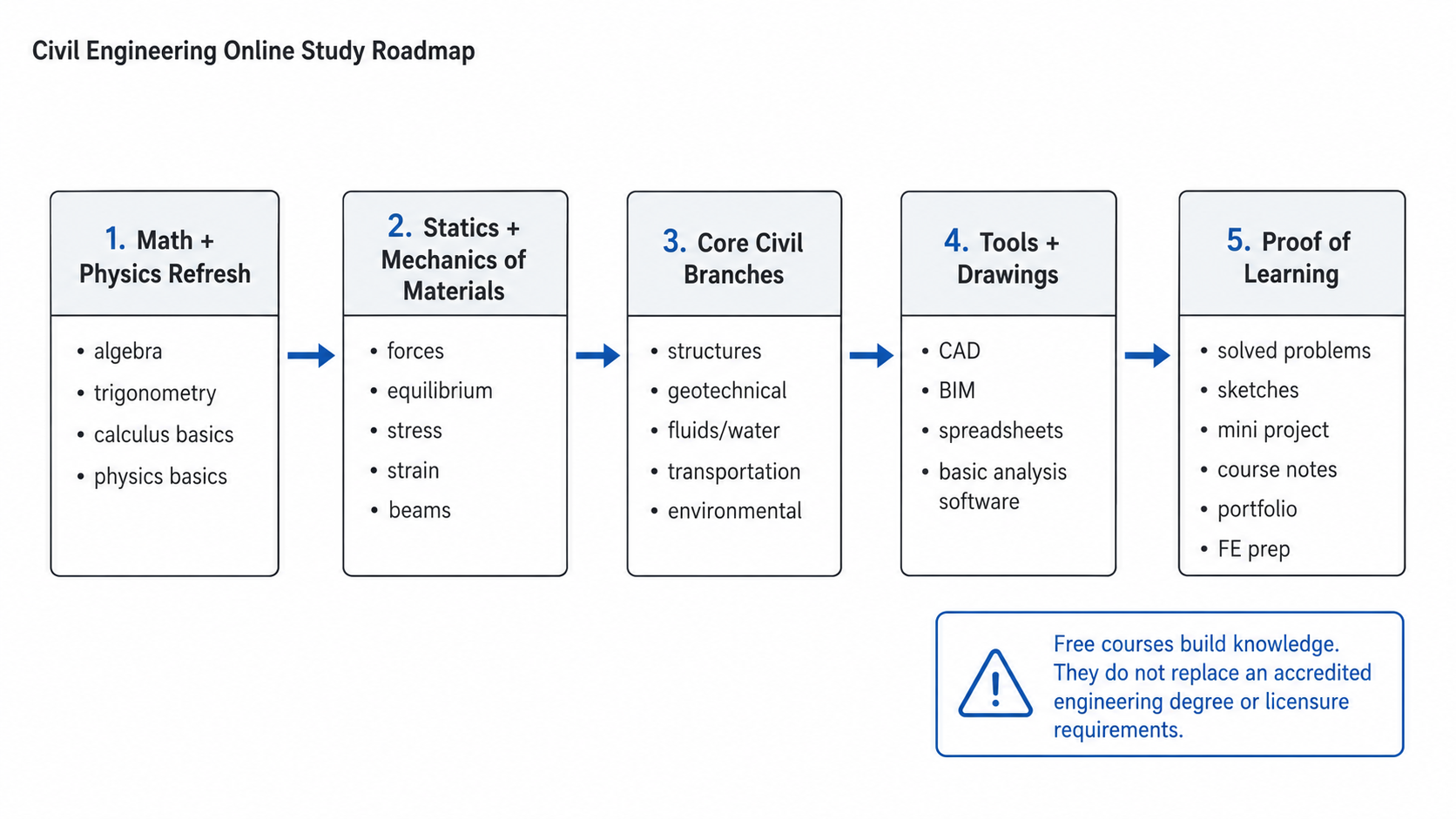
Start with math, units, statics, and mechanics of materials. Then move into structures, soil, water, transportation, environmental systems, construction, drawings, and software.
Free courses are good for learning, review, and testing whether civil engineering fits you. They do not replace an accredited civil engineering degree, supervised experience, or a license where one is required.
Use this page as a study order. Pick one stage. Do the work. Save proof that you learned it. Then move on.
What Free Civil Engineering Courses Are Good For
Free civil engineering courses are useful when the goal is clear. They are weak when they become a way to avoid choosing a path.
| Goal | Free courses can help with | They do not replace |
|---|---|---|
| Testing the field | Basic structures, materials, roads, water, and foundations. | A full degree plan. |
| Preparing for school | Math review, statics, mechanics, drawing terms, and course words. | Labs, graded design work, and formal credit. |
| Supporting architecture or construction work | Load paths, trusses, foundations, drainage, materials, and drawings. | Engineering authority or stamped design. |
| Reviewing for FE Civil | Weak-topic repair, formulas, practice habits, and problem solving. | Eligibility rules or full exam prep. |
| Building proof | Solved problems, notes, sketches, small projects, and course records. | Licensure, supervised experience, or a professional title. |
A course is useful only if it changes what you can solve, draw, explain, or check. Watching videos is not the same as learning civil engineering. You have to work problems.
The License Limit Comes First
Civil engineering is not only a school subject. In many places, it is licensed work.
In the United States, the professional path is usually tied to engineering education, the FE exam, work experience, and the PE exam. State boards set the exact rules. NCEES describes the FE exam as the first step for many people who want to become licensed professional engineers.
Free courses can support that path. They do not give you the legal right to act as the engineer of record.
This matters because civil engineering affects public safety. Bridges fatigue. Slopes move. Retaining walls fail. Foundations settle. Drainage mistakes damage buildings and roads.
A free course can teach you what those problems mean. It does not make you licensed to take responsibility for them.
Use free courses to learn honestly. Do not use them to pretend you have authority you do not have.
Study Civil Engineering in This Order
Civil engineering gets easier when the order is right. If you skip the early work, the later work becomes guessing with better words.
| Stage | Study first | What you should be able to do |
|---|---|---|
| 1 | Math, units, and physics. | Work with forces, moments, vectors, slopes, areas, and unit conversion. |
| 2 | Statics. | Draw free-body diagrams and calculate reactions. |
| 3 | Mechanics of materials. | Understand stress, strain, bending, shear, deflection, and buckling. |
| 4 | Core branches. | Compare structures, soil, water, transportation, environmental, and construction work. |
| 5 | Tools and drawings. | Use CAD, spreadsheets, GIS, BIM, or basic analysis tools without treating software as a shortcut. |
| 6 | Proof of learning. | Keep solved problems, sketches, notes, mini projects, course records, and certificates where useful. |
Do not start with software. Start with the problem.
A structural program can still give you numbers from a bad model. A drawing can look clean and still show the wrong detail. A spreadsheet can look neat and still use the wrong units.
Start With Statics
Statics is the first serious gate. If statics feels vague, most of civil engineering will feel vague too.
Statics teaches supports, reactions, trusses, frames, force balance, and moments. If you want to understand buildings, bridges, towers, retaining walls, roofs, or foundations, start there.
Then move into mechanics of materials. That is where bending, shear, compression, tension, torsion, and deflection start to make sense.
On this site, start with Structural Design, then read Types of Loads in Structural Design. After that, use Structural Analysis and How to Analyze Beams.
For outside study, MIT OpenCourseWare has useful course materials in engineering mechanics, solid mechanics, and structural engineering design.
Then Pick a Branch
Civil engineering has branches. You do not need to choose your whole career on day one, but you should know what each branch is trying to solve.
- Structural engineering: beams, columns, trusses, frames, buildings, bridges, and lateral loads.
- Geotechnical engineering: soil, settlement, bearing, slopes, foundations, and retaining walls.
- Water resources: flow, pressure, drainage, stormwater, pipes, and channels.
- Transportation engineering: roads, intersections, traffic, transit, safety, and movement.
- Environmental engineering: water quality, waste, pollution control, treatment, and public health systems.
- Construction engineering: scheduling, cost, site work, safety, sequencing, and contracts.
If buildings are your interest, read Truss Design 101, Building Materials, and Foundation Building Materials.
Free Online Civil Engineering Courses With Certificate

A certificate can help, but only if it proves something useful.
Some platforms let you study for free and charge for the certificate. Some give a free statement of participation or badge. Some offer strong course materials with no certificate at all.
MIT OpenCourseWare is useful for learning, but OCW does not give MIT credit, degrees, or certificates. OpenLearn offers free courses and gives statements of participation on many courses. edX courses may have a free audit option, but certificates and some graded work are often tied to paid access. Coursera rules vary by course, so check the course page before you plan around it.
Before paying for a certificate, check these points:
- Does the course include assignments, or is it only videos?
- Does the certificate help with school, work, FE review, or CPD?
- Does an employer, school, or board actually care about it?
- Would the money be better spent on a textbook, software, or exam prep?
A certificate without solved work behind it is weak. A small folder of clear calculations, sketches, and notes is stronger.
A 12-Week Online Civil Engineering Study Roadmap
This plan is for beginners, architecture students, drafting students, construction workers, and self-learners. It will not replace a degree. It gives you a path so you stop jumping around.
| Weeks | Focus | Do this | Save this proof |
|---|---|---|---|
| 1–2 | Math and units. | Review algebra, trigonometry, vectors, unit conversion, force, and moment. | One clean note page with worked examples. |
| 3–4 | Statics. | Draw supports, reactions, free-body diagrams, trusses, and frames. | Ten solved free-body diagram problems. |
| 5–6 | Mechanics of materials. | Study stress, strain, bending, shear, torsion, deflection, and buckling. | One beam study with load, shear, moment, and deflection notes. |
| 7 | Structures. | Connect loads to beams, columns, trusses, frames, and bracing. | One load-path sketch of a roof, deck, small building, or bridge. |
| 8 | Soil and foundations. | Learn soil type, bearing, settlement, water, and slope basics. | One foundation failure note showing soil and water risks. |
| 9 | Water and drainage. | Study pressure, flow, stormwater, pipes, open channels, and site drainage. | One drainage sketch for a small site. |
| 10 | Transportation. | Learn traffic flow, intersections, road geometry, safety, and transit basics. | One street-section sketch with lanes, crossings, drainage, and conflict points. |
| 11 | Environmental and sustainability. | Study water quality, waste, materials, resilience, and infrastructure impacts. | One short comparison of two infrastructure choices. |
| 12 | Tools and proof. | Organize notes, solved problems, sketches, course links, and software practice. | A small PDF learning folder. |
The point is not to finish every free civil engineering course online. The point is to finish the right work in the right order.
Free Civil Engineering Software Courses
Software helps after the basics are in place. Before that, it can hide weak understanding.
Start with spreadsheets and CAD before you chase advanced analysis software. Spreadsheets help with units, formulas, checks, and estimates. CAD helps with plans, sections, dimensions, and drawing discipline.
BIM can help with building coordination, but it is not the same as engineering judgment. GIS is useful for transportation, water, planning, and environmental work. Structural analysis software should come after statics and mechanics of materials.
For drawing tools, use Free CAD Tutorials and AutoCAD Basics for Architects and Engineers.
Also check student access before you pay for software. Autodesk, for example, has education access for eligible students and educators, but the rules and products can change.
Best Free Course Sources To Check
Use official, university-backed, or engineering-body sources first. Course marketplaces can help, but read the current course page before trusting the certificate.
- MIT OpenCourseWare: strong for mechanics, structures, transportation, environmental, and civil engineering course materials. It does not give MIT credit or certificates.
- NPTEL: useful for civil engineering lectures from Indian Institutes of Technology and other institutions. Some courses are advanced, so beginners may need math and statics first.
- OpenLearn: useful for beginner engineering study and free statements or badges on many courses.
- edX: useful for university-backed courses. Audit and certificate rules vary, so check the course page.
- Coursera: useful for structured courses and some software or project-management topics. Check whether free access, graded work, and certificates are included.
- ASCE and other engineering bodies: useful for professional development, webinars, and career context. Some training is paid or aimed at practicing engineers.
What To Study Here on ArchitectureCourses.org
ArchitectureCourses.org is useful when you need civil engineering ideas explained through buildings, materials, and site problems.
Use these pages with the outside courses:
- Structural Design for the link between loads, members, and building behavior.
- Types of Loads in Structural Design for dead loads, live loads, wind, seismic, and other force categories.
- Structural Analysis for the bridge between statics and member behavior.
- How to Analyze Beams if bending, shear, and support reactions are still weak.
- Truss Design 101 for triangulation, load paths, and basic structural geometry.
- Building Materials for concrete, steel, wood, masonry, glass, and composites.
- Foundation Building Materials for the connection between soil, concrete, masonry, drainage, and durability.
This site is not a licensing authority. It is a learning companion. Use it to understand the building logic before you go back to the math.
Free CPD, Webinars, and Short Civil Engineering Training
Free CPD courses and civil engineering webinars can be useful, but they are not foundation courses.
A one-hour webinar is good for a narrow update. It might cover a code issue, a sustainability case study, a software workflow, a project lesson, or a public infrastructure topic.
It will not teach statics, soil mechanics, or structural analysis from scratch.
Use short training for narrow problems:
- code or standards updates
- software workflows
- bridge, road, water, or resilience case studies
- professional-development hours if your employer or board accepts them
Check acceptance before you count any certificate as CPD.
Free Online Civil Engineering Degree or Diploma Claims
Be careful with phrases like “free online civil engineering degree” and “free online diploma in civil engineering.” They pull clicks because they sound like a shortcut.
Civil engineering does not work well with shortcuts.
A course can teach a topic. A degree has a different job. It has curriculum, labs, exams, design work, faculty review, accreditation, and a path that may matter for licensure or graduate study.
Before trusting a free online civil engineering diploma or degree, check:
- who grants the credential
- whether the institution is legitimate
- whether the program is accredited for your country or licensing goal
- whether credits transfer
- whether employers or boards recognize it
If the program cannot answer those questions clearly, do not build a career plan around it.
How To Show What You Learned
Keep proof as you study. Do not rely only on course badges. Save work that someone can read.
- one page of free-body diagram examples
- one beam bending or load-path explanation
- one soil and foundation failure note
- one drainage sketch for a small site
- one street-section or traffic observation
- one materials comparison
- one list of courses completed, skipped, and still needed
A small folder like that is useful for a teacher, employer, mentor, or your own review. It also tells you what you actually learned. That is better than remembering that you once watched a lecture about it.
What To Avoid
- Do not collect course links and call it study.
- Do not start with bridge design, seismic design, or finite element software before statics.
- Do not assume a certificate means career-ready.
- Do not buy software before checking student access and course requirements.
- Do not mix up civil engineering, architecture, drafting, and construction management as if they were the same job.
The common failure is simple: sampling everything and finishing nothing.
References and Course Sources
- MIT OpenCourseWare: Civil and Environmental Engineering
- MIT OpenCourseWare: Engineering Mechanics I
- MIT OpenCourseWare: Solid Mechanics
- MIT OpenCourseWare: Structural Engineering Design
- NPTEL Courses
- OpenLearn: Introducing Engineering
- edX: Civil Engineering Courses
- Coursera: Civil Engineering Courses
- ASCE Civil Engineering Body of Knowledge
- NCEES FE Exam
- ABET: Licensure, Registration, and Certification
- Autodesk Education Access
FAQ
Are free online civil engineering courses worth it?
Yes, if you use them to learn the basics, review weak areas, or test whether civil engineering fits you. They are not a replacement for an accredited degree or a license.
What should I learn first in civil engineering?
Start with math, units, physics, statics, and mechanics of materials. Those subjects support structures, soil, water, transportation, environmental work, and construction.
Can I get free online civil engineering courses with certificates?
Sometimes. Certificate rules change by platform. Some courses are free to study but charge for certificates. Some offer free statements or badges. Some provide strong course materials with no certificate.
Can I become a civil engineer through free online courses?
Not by free courses alone. Civil engineering licensure usually depends on formal education, exams, experience, and local rules.
Which free civil engineering course is best for beginners?
Start with engineering mechanics, statics, and mechanics of materials. After that, move into structures, geotechnical, water, transportation, environmental, or construction topics.
Are NPTEL civil engineering courses useful?
Yes, but many are technical. If you are new, review math, units, statics, and mechanics before taking advanced civil engineering lectures.
Are Coursera civil engineering courses free?
It depends on the course. Some courses may have free access to limited material. Certificates, graded work, and full access often require payment. Check the current course page before planning around it.
Should I learn AutoCAD, Revit, Civil 3D, SAP2000, ETABS, or GIS first?
Learn the basics first. CAD and spreadsheets are broadly useful. Structural analysis software should come after statics and mechanics. GIS is useful for transportation, planning, water, and environmental work.