
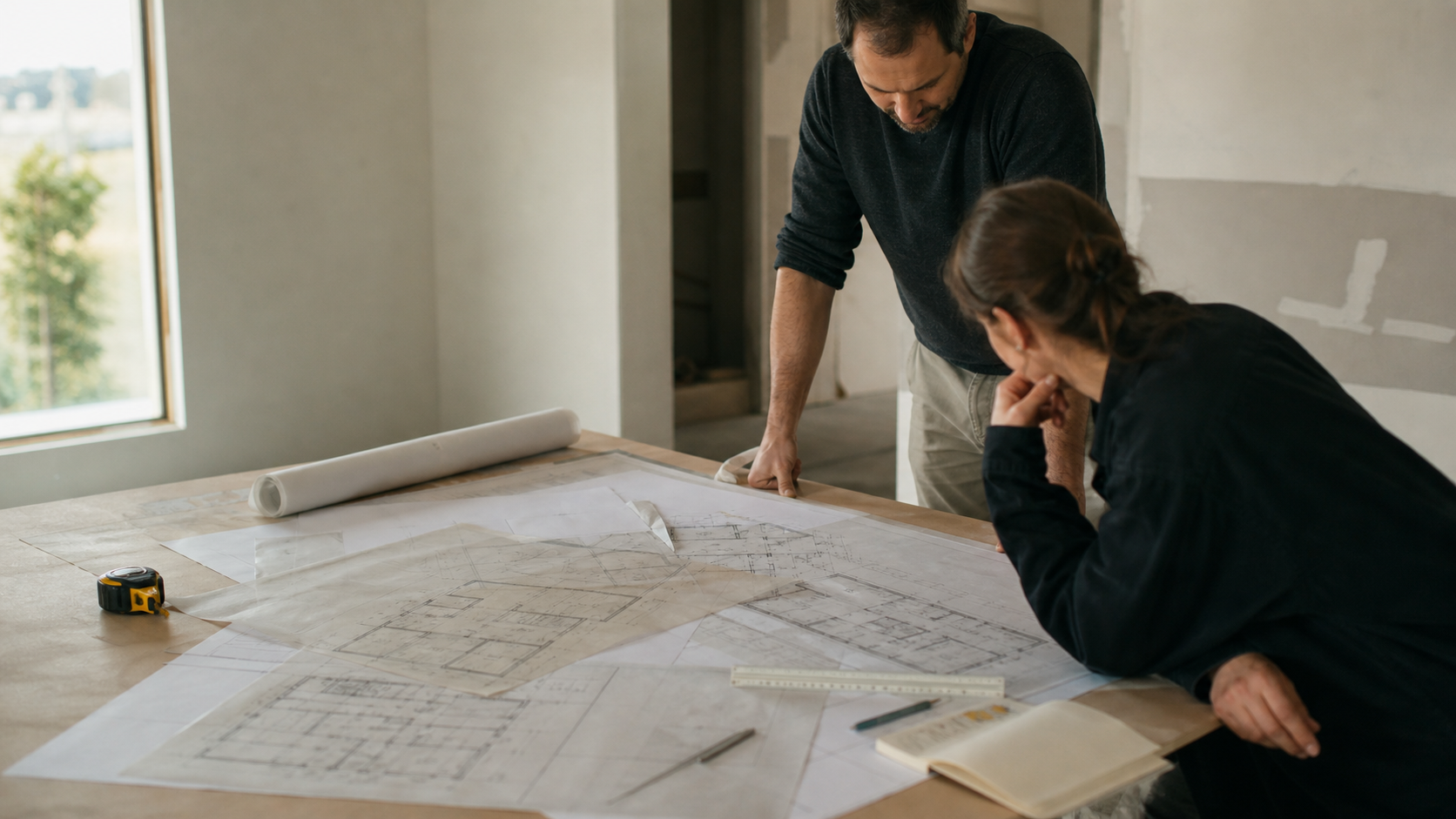
Image by ArchitectureCourses.org. A construction plan review checks whether the house design still works once framing, openings, utilities, and site conditions enter the decision.
The Early Decisions That Get Expensive Later
Most house planning mistakes happen before anyone pours concrete.
They happen when the lot gets picked for the view but not the drainage. When the footprint gets pushed wider without anyone thinking about roof cost, structure, or heat loss. When the kitchen, laundry, and bathrooms end up scattered because the floor plan looked good in isolation.
That is the real job of house planning. Not collecting ideas. Not building a Pinterest board. It is making a series of early decisions that are cheap to change on paper and expensive to fix once the build starts.
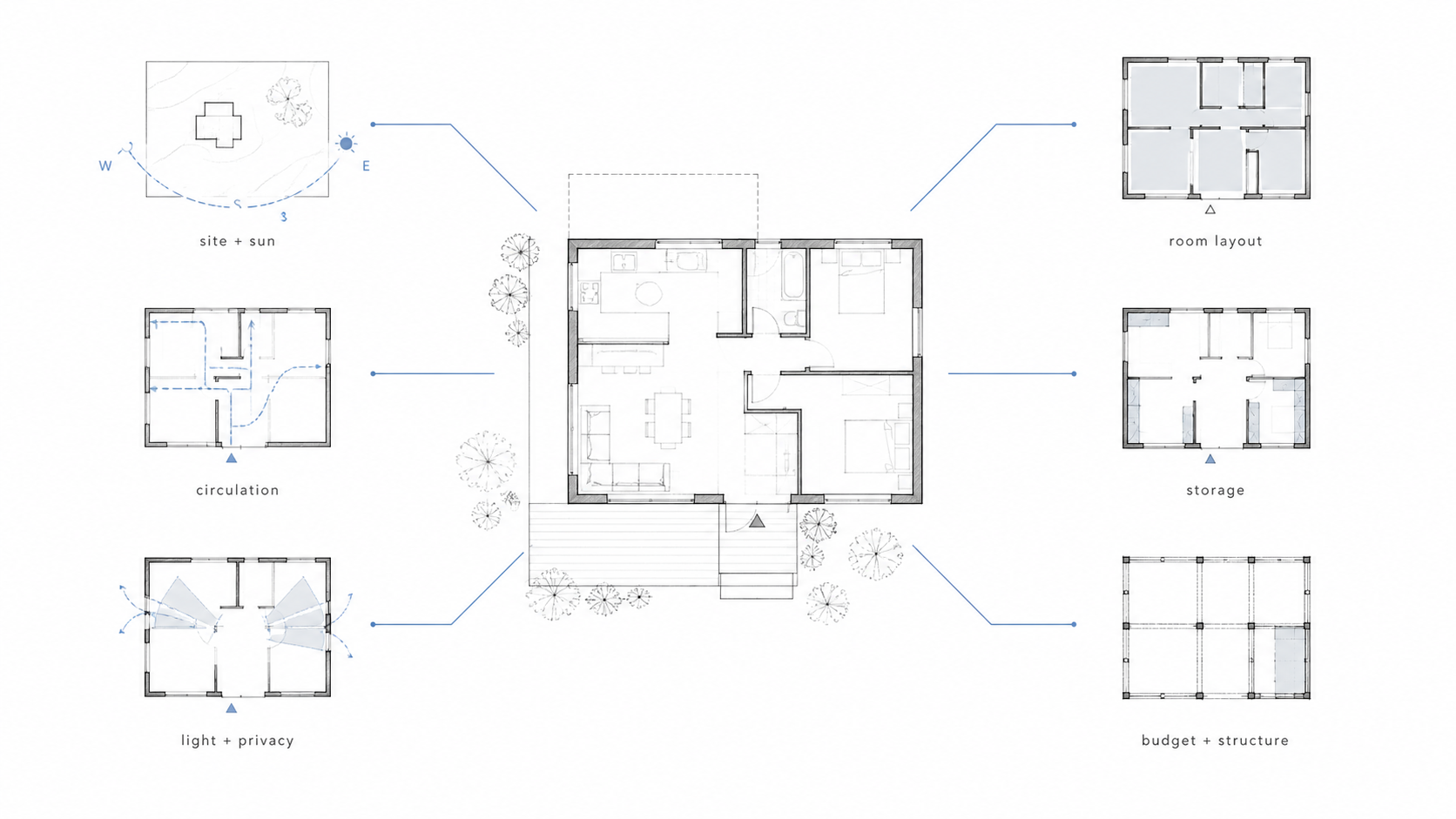
Illustration by ArchitectureCourses.org. House planning works best when site, layout, circulation, light, storage, budget, and structure are coordinated before the design becomes detailed.
If you are still at the broader “can I even do this?” stage, read Building a House first. If you already own land, Building on Your Own Land fits better beside this page.
Start with the land
A good house plan cannot rescue a bad read of the site.
Most buyers say they want a “nice lot,” but that usually means one of two things: good views or a quiet street. Both matter. Neither tells you enough.
You need to know four things early:
- how water moves across the land
- where the sun gets harsh
- what the soil can support
- how far utilities are from the build area
A beautiful lot with poor drainage can cost you more than a less dramatic site that behaves well. A long utility run can quietly wreck the budget before framing starts. A slope that looked manageable from the road can turn into stepped foundations, retaining walls, and more excavation than expected.
One common mistake is falling in love with the “front” of a site and never really studying the back. Then the first hard rain shows where the water actually wants to go.
This is why site work deserves real attention before room planning gets serious. Site Analysis, Site Preparation, and Foundations, Soil Analysis, and Site Investigation are the useful next reads if the land is still the big unknown.
Footprint first
Room lists come too early in most house-planning articles.
Clients jump to “three bedrooms, two baths, office, mudroom, pantry” before anyone has asked what kind of building shape makes sense. That is backwards.
The footprint sets a lot of the budget. A simple shape is usually cheaper to build, easier to roof, easier to insulate, and easier to keep dry. Every bump-out, corner, offset, and dramatic roof move adds work somewhere else.
A compact rectangle is not always the answer. But a complicated plan should have a reason. “It looked more interesting” is not a reason once you are paying for extra foundation, extra framing, extra roof edges, and more exterior wall.
| Decision | What usually happens | What works better |
|---|---|---|
| Wider footprint | More roof span, more foundation, longer utility runs | Go wider only if the site or layout clearly earns it |
| Lots of corners | Higher labor, harder detailing, more thermal weak points | Keep the shape simple and let materials or openings do the work |
| Too many small projections | Looks busy and costs more than expected | Use one strong move instead of six little ones |
A calm plan usually ages better too.
The hallway tax
Some square footage works for you. Some just sits there, heated and paid for.
This is where planning gets more useful than generic “open concept vs traditional” advice. A lot of homes lose usable area to circulation that does not earn its keep.
Long hallways. Oversized foyers. Stair landings that feel grand on paper but dead in real life. Corners you walk through but never use. They all cost money the same way bedrooms cost money. The difference is you do not really live in them.
A 160-square-foot hallway is still 160 square feet you framed, floored, painted, cooled, and cleaned.
That does not mean circulation should disappear. It means it should be doing something. Bringing light in. Creating privacy between noisy and quiet zones. Framing a view. Making the house easier to understand.
When circulation does none of that, it becomes tax.
Keep the wet rooms close
This is one of the least glamorous parts of house planning, and one of the most useful.
Kitchens, bathrooms, laundry rooms, utility rooms, and sometimes mudrooms work better when they are planned as a group instead of scattered across the building. Not always packed tightly together. Just close enough that the plumbing, drainage, venting, and hot-water runs stay sensible.
One common miss is the powder room placed right off the dining space because it was convenient on plan. It is convenient until the door opens and everyone at the table knows exactly where it leads.
Another one shows up later. The upstairs bathroom gets pushed to the far corner for symmetry, but the main plumbing stack stays near the kitchen core. The plan still works on paper. The pipe runs get longer, coordination gets messier, and the cost creeps up for no real gain.
Wet rooms need two things at once: plumbing logic and social logic.
Give daylight a job
People talk about “natural light” as if more is always better.
It is not.
Good house planning gives daylight a role. Morning light in breakfast spaces. Soft stable light in work areas. Controlled west sun in living spaces that would otherwise overheat. Private light in bathrooms. Borrowed light where a corridor would feel blind without it.
A west-facing glass wall can look amazing in a rendering and become miserable in July. A bedroom that faces the wrong direction may be bright when you do not want it and dim when you do.
The smartest plans do not just count windows. They decide which rooms deserve the best light and which rooms can live with less.
If you are still weak on that side of design, Natural Lighting in Architectural Design is worth opening before the layout gets locked.
The best side of the house
Not every room deserves the best light, the best view, or the quietest edge of the site.
That sounds obvious, but a lot of bad plans happen because every room gets treated as equally important. They are not.
Living rooms, kitchens, and daily-use spaces should usually get the side with the best light and the strongest connection to the yard. Bedrooms need quiet more than drama. Utility rooms, bathrooms, storage, and garages can take the less generous side if that helps protect the main rooms.
One simple planning move is to use the “hard” side of the site for the rooms that need less from it. A hot west edge, a noisy street edge, or the side with weak views can often carry bathrooms, closets, stairs, laundry, and service spaces. Then the better side of the house stays free for the rooms you actually live in.
People rarely regret giving the best part of the site to the rooms they use every day. They do regret wasting it on circulation, oversized bathrooms, or spaces that stay empty most of the week.
Storage, mechanicals, and the boring things
These are the things people keep underplanning because they are not fun to discuss early.
Storage is one. Not theoretical storage. Real storage. The place where the vacuum goes. The place where wet boots go. Holiday boxes. Luggage. Sports gear. Cleaning supplies. Tools. Extra chairs. Dog food. Printer. All the things nice renderings never show.
Mechanical space is another. Water heater. HVAC equipment. Manifolds. Electrical panel. Future maintenance access. A house feels much more “custom” when those things are planned properly and much less “custom” when they are shoved wherever space was left over.
Then there is the outside edge of the house. Trash bins. Hose bibs. Condensers. Deliveries. Meter locations. Places to store outdoor equipment. These are small decisions until they pile up into a back door that always looks messy.
The quality of a house is often decided by the spaces nobody posts online.
Plans lie. Sections tell the truth.
Here is a rule that saves real trouble: do not trust the floor plan alone.
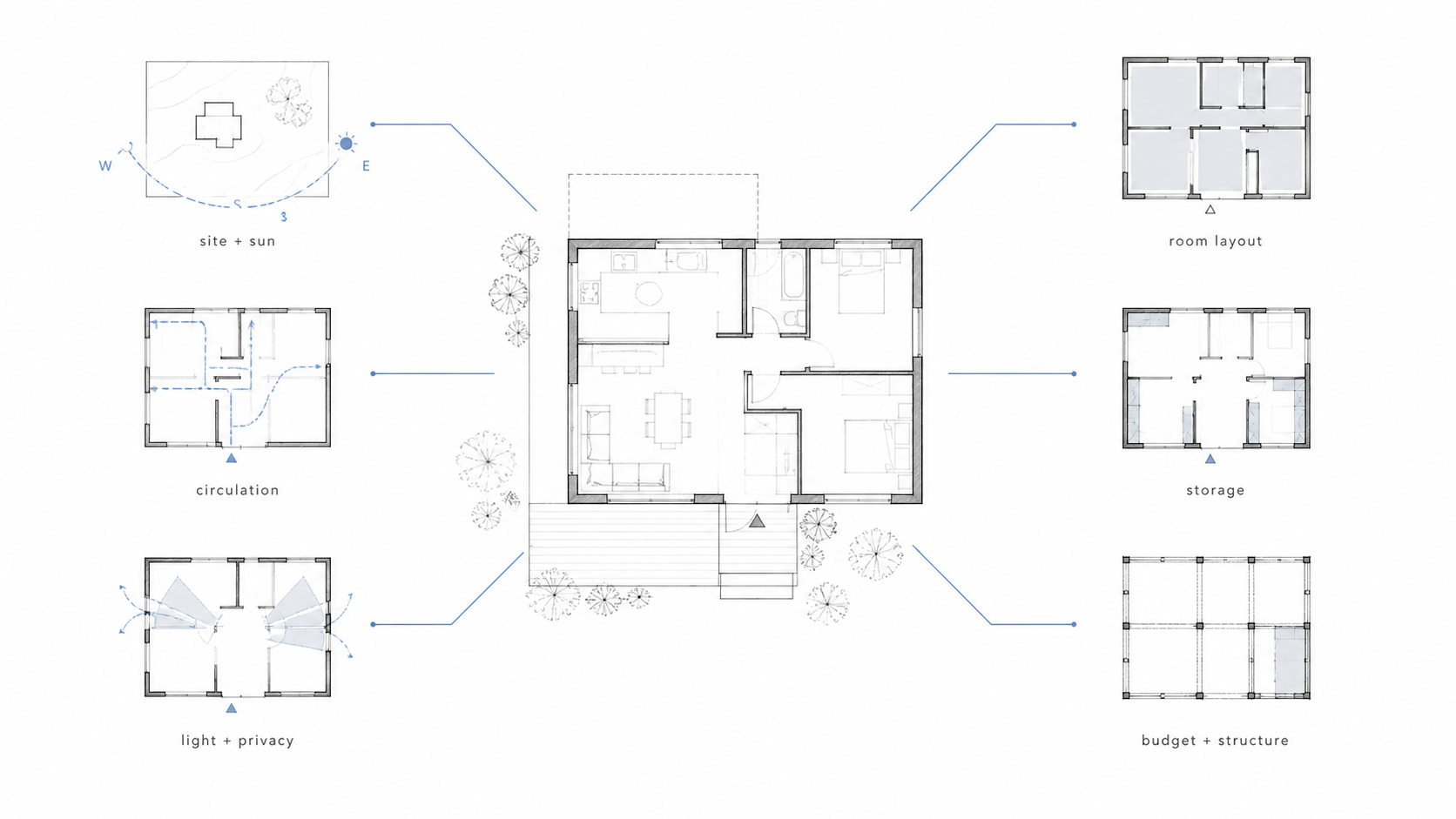
A floor plan can look clean and still fail once the house is cut in section.
That is where ceiling height problems show up. Stair headroom. Awkward roof volumes. Strange window proportions. Low beams crossing a room at the wrong point. Dark interior zones that looked fine from above. You cannot see those things properly in plan.
Stairs are where this goes bad most often. On paper they fit. In section they steal headroom or force an ugly landing. The problem is not the stair drawing. The problem is that nobody checked the vertical consequences early enough.
I have seen this happen in otherwise decent plans: a stair tucks neatly under a roof slope, everyone is happy in plan view, then the section shows the headroom collapsing exactly where the stair should feel easiest to use. At that point the fix is never elegant. The landing shifts, the roof changes, or a room beside it loses useful space.
Ask for these three things before you get too attached to a layout:
- a real site plan
- at least one useful building section
- a simple furniture test in the main rooms
Those three drawings catch a lot.
Custom plan or stock plan?
This should not be treated like a status question.
Custom plans are not automatically smarter. Stock plans are not automatically cheap junk. The right choice depends on the land, the complexity, and how unusual your needs are.
| Use this | When it makes sense | What to watch |
|---|---|---|
| Stock plan | Flat or simple site, standard family needs, tighter budget | May need real adjustment once the lot and climate get involved |
| Modified stock plan | You need a head start but still want some tailoring | Easy to over-edit until you lose the value of starting with stock |
| Custom plan | Difficult site, specific lifestyle, unusual climate, strong design goals | Needs discipline or the plan grows in cost faster than expected |
A narrow infill lot, a sloped site, a view lot, or a house with serious privacy demands usually earns more custom work. A straightforward suburban build on a regular lot often does not need full reinvention.
Spend early. Save later.
This is the budgeting mistake behind a lot of painful builds.
People try to save money at the stage where changes are cheapest.
They rush site investigation. They skip good pre-construction pricing. They spend too little time on layout testing. Then they end up paying later in change orders, redesign, extra site work, or expensive fixes that were visible earlier if someone had slowed down.
The cheap places to make changes are sketches, diagrams, rough plans, and early consultant review.
The expensive places are excavation, framing, waterproofing, structural steel, and anything that has already been installed.
So yes, watch the design budget. But underplanning is not thrift. It is just delayed spending.
Cost of Building Your Own House, Cost Breakdown of Building a House, and Pre-Construction Steps You Need to Know fit naturally here because this is where planning and money start crossing into each other.
Questions to answer before the first architect meeting
Not “what style do I like?” first.
Start here instead:
- What parts of daily life annoy me in my current home?
- Which rooms do I use hard and which ones barely matter?
- What is my land likely to make difficult?
- Do I want a compact house that works hard or a larger one with more separation?
- Where am I willing to simplify to protect the budget?
Then add the style questions.
That changes the meeting. The conversation gets more real, faster.
What works better here
| Common move | Better move | Why |
|---|---|---|
| Pick rooms first | Study site and footprint first | The site and building shape control more cost than the room names do. |
| Spread wet rooms out | Cluster them with intention | Shorter runs, better service logic, fewer awkward compromises later. |
| Rely on floor plans only | Check sections early | Vertical mistakes stay hidden too long in plan view. |
| Spend least during planning | Spend where changes are still cheap | Paper mistakes cost less than built mistakes. |
| Design for photos | Design for chores, noise, weather, and storage | That is what determines whether the house still feels good in five years. |
FAQ
What is the first step in house planning?
Start with the land or, if you do not own land yet, the type of site you are realistically going to build on. A lot of planning advice gets abstract too early.
Should I design the rooms first or the footprint first?
The footprint first. Room planning matters, but the shape of the building affects cost, structure, roof complexity, insulation, and how the house sits on the site.
How much contingency should I plan for?
Enough that a real problem does not stop the project. Many people use 10 to 15 percent as a working buffer, but difficult sites and custom houses often need more caution than simple builds do.
Can I use a stock plan if my lot is sloped?
Sometimes, but be careful. A stock plan can save time on a simple lot. On a sloped site, it often needs enough revision that the “cheap” plan stops being cheap. That is where people waste money twice: once on the plan, then again on adapting it badly.
What part of house planning gets underestimated most often?
Three things usually get shortchanged: site work, circulation, and the boring support spaces. People plan the visible rooms first. Then they realize the hallway is too long, the stair is awkward, the laundry is in the wrong place, and the mechanical room is too small. Those are not finishing problems. Those are planning problems.
Read this next
If you already own the site, go to Building on Your Own Land.
If you need the broader construction overview, use Building a House.
If the site is still the risky part, open Site Analysis and Site Preparation.
And if the budget side is starting to tighten the design, use Cost of Building Your Own House and Cost Breakdown of Building a House.