
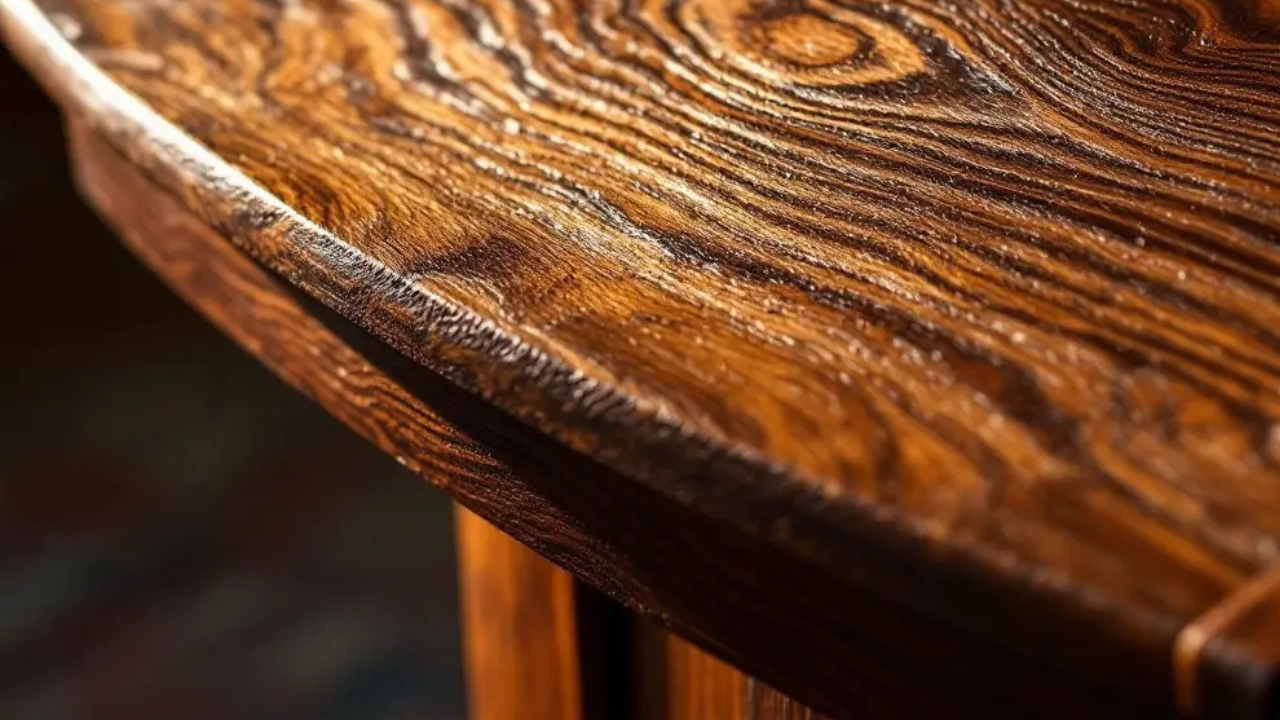
🌳 What Mahogany Really Is
Physical Properties of Mahogany Wood: Mahogany stands out as a tropical hardwood recognized for its rich, reddish-brown color and straight, consistent grain. People in woodworking circles often talk about it in almost reverent tones. The reason? It’s a material that hits a sweet spot between beauty, workability, and durability. It’s not just about looks, though—there’s substance behind that warm, attractive color.
The term mahogany can actually apply to different species from the Swietenia genus (like Swietenia macrophylla, commonly known as Honduran or genuine mahogany) and sometimes to other lookalike woods. In this discussion, we’ll focus mostly on Honduran mahogany (often seen as the gold standard) while acknowledging that other variants exist. If you’ve ever seen a timeless antique piece or a classy guitar body, there’s a good chance it was mahogany.
Why People Choose Mahogany
1. Aesthetic Appeal

Image: Elegant mahogany pedestal desk with chairs, highlighting rich wood tones and detailed craftsmanship in a sophisticated space.
Its reddish-brown hue deepens over time into a more profound, darker shade, giving furniture or paneling that “aged with grace” vibe. That color also polishes up elegantly, leaving a surface that looks luxurious but doesn’t feel ostentatious.
2. Balanced Strength
Mahogany isn’t the densest wood on the planet, but it’s no pushover either. It’s got enough compressive and tensile strength to handle moderate loads while remaining workable. More on that in a bit.
3. Workability
If you enjoy shaping, carving, or intricate detail work, you’ll love how mahogany cuts and sands with minimal grain tearing. It’s also known for gluing well, so those complicated joinery projects go more smoothly than with some other hardwoods.
4. Dimensional Stability
Ever had a piece of wood warp or crack because of humidity changes? Mahogany resists that more effectively than many other species, so it’s a safer bet for areas with temperature or moisture fluctuations.
5. Natural Resistance
This wood is less prone to rot and pests than, say, pine or maple, so it’s a favorite for boat trims, outdoor furniture, or humid climates—though it’s not fully rot-proof like teak.
🌱 Where Does Mahogany Grow?
True mahogany hails from regions in Central and South America, particularly Honduras, Brazil, and parts of Peru. When you see terms like Cuban mahogany or Dominican mahogany, these refer to other species within the same Swietenia group, though they’re often rarer. The main takeaway is that the growth environment influences density and coloration somewhat, but the overarching qualities remain consistent across genuine mahogany variants.
This is also where sustainability comes into play. Because these are tropical species, deforestation concerns and responsible forestry matter. Many wood suppliers now offer FSC-certified or PEFC-certified mahogany from plantations or well-managed forests to keep it from becoming an environmental problem.
Understanding Mahogany’s Physical Properties
Let’s break down some aspects that define any wood’s performance: density, strength, hardness, stability, and durability. We’ll add some numbers to give you a practical sense of what mahogany can handle.
1. Density (Specific Gravity)
- Average Specific Gravity: Typically around 0.52 to 0.60 (on a 12% moisture content basis). That translates to a wood that’s not too heavy to move around but still has decent heft.
- Density Range: Roughly 500–650 kg/m³ (31–41 lb/ft³).
Why It Matters:
- Higher density often correlates with greater strength and hardness. Mahogany’s moderate density provides a good compromise: it’s strong enough for structural uses yet not a chore to plane or saw.
- If you plan to make a large piece of furniture—like a dining table—mahogany’s weight is manageable enough to assemble and transport without special rigs.
Real Example
A buddy of mine crafted large mahogany bookshelves for a library. The end result was sturdy yet not so heavy that the floor beams needed reinforcement. That’s the sweet spot of mahogany’s density.
2. Strength
Mahogany’s strength metrics typically appear as:
- Modulus of Rupture (MOR): About 10,000 to 12,000 psi.
- Modulus of Elasticity (MOE): Typically 1.1 to 1.3 million psi.
- Compressive Strength (Parallel to Grain): Around 5,500 psi.
These numbers mean it’s reliable for load-bearing furniture, moderate structural components, and musical instruments that need to endure tension (like guitar necks). However, if you’re building something extremely high-load, like a large-scale beam, you might consider a denser hardwood or engineered wood alternative.
Why Strength Matters:
- Furniture: Chairs, tables, cabinets. You want them to hold weight and endure daily use.
- Interior Trim: Baseboards, moldings, or railings. Mahogany stands up to knocks and bumps quite well, so it won’t dent easily.
- Doors: A mahogany door isn’t just pretty; it also resists warping under normal stress.
Quick Tip: Even if mahogany is strong, the direction of load and grain alignment still matter. Because wood is anisotropic, strength differs along and across the grain.
3. Hardness (Janka Rating)
Janka Hardness on genuine mahogany hovers around 800 to 900 lbf (pound-force). That places it below teak or hard maple but above many softwoods. It’s enough to handle routine knocks without wearing down too fast.
Practical Implications
- Flooring: Some people love mahogany floors for that warm color. At 800–900 lbf, it might dent if you drop something super heavy, but normal foot traffic shouldn’t be a big issue.
- Carving and Finishing: The moderate hardness makes it a dream for carvers—tough enough for detail, not so hard that your tools dull quickly.
If you want a rock-hard surface (like a busy commercial floor), you might choose something with a higher Janka rating (like hickory or ipe). But for most home or office applications, mahogany’s hardness suffices.
4. Dimensional Stability
Mahogany shrinks less than many other hardwoods when losing moisture. That translates into fewer problems with warping or swelling once it’s properly seasoned.
Tangential Shrinkage: About 4–5%.
Radial Shrinkage: About 2–3%.
Lower numbers mean less movement, making it a top pick for projects in environments with moderate humidity swings. If you live somewhere with four distinct seasons—especially with dry winters—mahogany has your back more than, say, beech or birch.
Real Experience
I once built a pair of mahogany cabinet doors for a client’s bathroom. Even with the moisture from hot showers, those doors stayed stable over time, only needing a minor re-finish after about five years.
5. Durability Against Rot & Insects
Mahogany has moderate to high natural durability against decay and insects. While not as bulletproof as teak or ipe, it’s generally more robust than oak or walnut in resisting termites. For outdoor applications, it’s wise to use a protective sealant or regular oil treatment, but the wood’s inherent qualities reduce the risk of rotting from the inside out.
Fun Note
Some boat builders used to rely heavily on mahogany for decks and trim due to this inherent durability. That said, you’ll still want to keep up on maintenance if it’s going to be in contact with standing water or exposed to direct weather extremes.
⚙️ Chemical Composition & Its Effects
Cellulose, Hemicellulose, and Lignin—these are the typical main components in wood. Mahogany also contains a variety of extractives that lend it color and some natural repellence to pests. While not as oily as teak or cedar, these compounds do help it stave off decay better than your average hardwood.
Why Chemical Makeup Matters:
- Reaction to Finishes: Some wood species with high oil content can cause adhesion issues with paint or certain glues. Mahogany typically cooperates nicely with various stains, sealants, and adhesives.
- Color Changes: Over time, the color deepens or “mellows,” a process partly driven by exposure to light and oxidation of these extractives.
🚧 How Mahogany Performs in Different Applications
It’s one thing to know the stats, but how does it hold up in real projects? Let’s examine a few everyday scenarios:
1. Furniture Making

Image: A mahogany dining table with matching chairs in a luxurious wooden room, highlighting rich textures and expert craftsmanship.
Why it’s great:
- Easy to cut and chisel—thanks to that moderate hardness.
- Stable—less warping for things like tabletops or cabinet doors.
- Visually appealing—the color and grain look classy.
Potential drawbacks:
- Cost can be higher than local hardwoods in some regions.
- It’s sometimes overshadowed by exotic species if you’re aiming for a truly unique grain pattern.
2. Musical Instruments

Mahogany is a staple in acoustic guitars, electric guitar bodies, and even some drum shells. Why? It produces a warm, resonant tone with good midrange frequencies.
Key points:
- Workability for shaping necks or guitar bodies.
- Stable enough to handle string tension.
- Aesthetic in natural-finish guitars, often seen in Les Paul style bodies with a mahogany back.
3. Architectural Millwork
Things like moldings, wainscoting, or window frames benefit from mahogany’s stability and elegance.
Observation: Some high-end restaurants and hotels love that classic “mahogany trim” look. It’s subtle but exudes an upscale ambiance. Even after years of wear, it can be re-polished to almost new.
4. Boat Building & Outdoor Structures
While teak might be the rockstar for marine applications, mahogany has also been used historically for planking and decorative trim on boats.
Tips:
- Regular sealing keeps water infiltration at bay.
- Good for seats, rails, or interior cabins—especially in places where you want a fine finish.
5. Flooring
If you don’t mind a bit of care, mahogany floors can be a showstopper. Expect a medium hardness, so you might see small dings over time, but the overall warmth and color can overshadow that.
Maintain with:
- Occasional re-coating with polyurethane or a suitable hardwood floor finish.
- Protective pads under furniture legs if you’re cautious about scratches.
Related: Advantages and Disadvantages of Mahogany Wood: Is It Worth It?
📏 Sizing and Machining Concerns
Sawing & Planing:
- Mahogany’s consistent grain reduces tear-out. Setting your planer knives at the right angle will produce smooth boards with minimal fuzz.
Sanding & Finishing:
- Grit progression from 120 → 180 → 220 works wonders. After 220, mahogany can show a satin-like sheen even before finishing.
Router & Carving:
- Intricate details hold up well. Just ensure your bits are sharp.
Glue & Joint Strength:
- Wood glue, epoxy, or polyurethane adhesives all stick well to mahogany. Avoid leaving oily surfaces if the wood is freshly planed—lightly sanding the contact area can improve adhesion.
🏷️ Cost & Availability
Genuine mahogany can be pricier than local hardwoods like oak or maple in North America or ash in Europe. But for many, the longevity, beauty, and workability justify the cost. The cost also ties to sustainability: responsibly harvested mahogany typically comes with certifications like FSC or PEFC, which might push the price up but ensures the forest it came from is well-managed.
Regional Substitutes
- African Mahogany (Khaya spp.) has a similar look but is generally more available and cheaper. The color is a bit different, and density can vary.
- Sapele or Utile: Both often marketed as “mahogany-like” with decent stability and color. Not a perfect match but somewhat close.
🌐 Sustainability: Credible Sources and Ethical Concerns
Mahogany, especially genuine Honduran mahogany, has faced significant deforestation issues in the past. Buying from reputable dealers who can trace their supply chain is crucial if you care about preserving forests.
Official Resources:
- Forest Stewardship Council (FSC): https://fsc.org
- PEFC: https://pefc.org
- CITES (Convention on International Trade in Endangered Species) lists certain mahogany species for regulated trade.
When you see an FSC label on mahogany boards, it signals that the logging area is managed responsibly, replanting is done, and local ecosystems are less disrupted.
🏆 Standout Trait: Warm, Reddish-Brown Color That Deepens Over Time
One thing that sets mahogany apart from many hardwoods is how gracefully it ages. The color can shift from a lighter, more golden-brown to a deeper red-brown over several years. Exposure to light, air, and finishing oils often catalyzes this effect.
Pro Tip: If you’re aiming for a consistent color from day one, consider UV-blocking finishes or keep all pieces stored similarly before final assembly. That helps ensure your table top, legs, and aprons age more uniformly.
◼ Real-Life Example: Antique Mahogany Work Table

Image: A vintage mahogany work table, blending durability and timeless design for functional and stylish use.
Mahogany furniture isn’t just about abstract qualities like “hardness” or “rich color.” It comes to life when you see a mahogany antique work table—the kind that makes you pause because of its timeless aura and obvious craftsmanship. Picture a reddish-brown surface that has gently darkened over the years, showcasing subtle patina changes. Beyond the aesthetics, this piece stands sturdy thanks to mahogany’s density and interlocked grain.
● Rich Appearance
A well-aged mahogany table often presents a deep tone that’s unusually warm. That hue doesn’t come just from stain; it’s the wood’s natural reaction to oxygen and sunlight, revealing darker undertones over decades. The result? A table that can anchor an entire room, especially in study areas or living spaces that crave a focal point.
● Durability for Generations
Antique work tables were once used daily—perhaps for writing letters, drafting household accounts, or even crafting small items. Mahogany’s hardness meant that the tabletop wouldn’t dent easily under moderate stress. If you inherit or purchase one today, you’ll find it still stands firm, likely with minimal wobbling or cracking. It’s the kind of piece that can continue traveling through future generations.
● Smooth Finish and Intricate Carvings
Mahogany’s fine, straight grain allows for clean, precise detailing. That means ornate edges, carved legs, or inlay work can pop rather than fade into the background. Run your hand along a polished mahogany surface and you’ll see why antique collectors adore it—it’s seamless, almost velvety to the touch.
● Timeless Design
Antique mahogany tables carry a sophistication that modern knockoffs rarely replicate. Even if your decor leans contemporary, a well-placed vintage mahogany piece can inject soul into a minimalistic setting. The color, sheen, and craftsmanship speak of history and artistry—something fast-manufactured items can’t match.
✏ Why This Matters in Real Life: When you walk into a room and see a mahogany antique desk or work table, it usually sparks curiosity. People might run their fingers over the wood, noticing the subtle grain or tiny dings that hint at stories past. As a homeowner or designer, integrating a statement piece like this can elevate your interior’s mood—whether it’s a home office that feels a bit more regal or a living room that embraces a classic, comforting vibe.
⚙ Practical Takeaway: If you come across a genuine antique mahogany table—perhaps at an estate sale or inherited from family—appreciate that it’s more than just “old furniture.” It’s a living testament to mahogany’s durability and beauty. Maintenance usually involves light dusting, occasional re-waxing, and staying mindful of moisture levels. Treated properly, it can remain the showpiece of a home for decades more, continuing to tell its story in rich, warm tones.
See also: Advantages and Disadvantages of Mahogany Wood: Is It Worth It?
In-Focus: Mahogany in Guitar Building
🎸 A Closer Look at a Beloved Use Case
Many of us have seen or played guitars with mahogany bodies or necks. Why do luthiers and major guitar brands pick this species so often?
- Midrange Warmth: Mahogany-bodied guitars often have a pronounced midrange, giving a full-bodied tone that suits rock, blues, and even mellow jazz.
- Stability vs. Weight: It’s not as heavy as maple, so your shoulder thanks you during long gigs. It also handles string tension well, resisting warping when properly dried.
- Carving Friendly: For those sleek contour shapes, you can shape mahogany with relative ease, achieving smooth curves without frequent tear-out.
- Finish Options: Whether you love a transparent satin or a glossy poly finish, mahogany’s grain complements both. Some prefer the open-grain look, where you can see the pores, while others fill it for a glass-like surface.
Takeaway: The “mahogany sound” is a genuine phenomenon in the guitar world. That combination of moderate density, stable grain, and warm resonance is prized by both large manufacturers and independent luthiers.
Handy Formulas for Working with Mahogany
Below are a couple of practical equations that might help if you’re doing something structural or simply want to estimate shrinkage or load capacity. No advanced math degree needed—just the basics. 🎉
1. Moisture Content (MC) Calculation
- W_wet: The weight of the wood when it’s fresh or at a certain humidity.
- W_dry: The weight after it’s oven-dried or at equilibrium with a known environment.
Why it Matters: Mahogany’s stable, but it still expands or contracts with moisture changes. Checking MC helps you know if your board is ready to be used in furniture or if it needs more seasoning.
2. Bending Stress (Modulus of Rupture)
- F = Max load before failure.
- L = Span of the beam.
- b = Width of the piece.
- d = Depth or thickness.
Why it Matters: For shelves or beams, you can test how big a load mahogany can handle without snapping. This helps you choose the right dimensions.
3. Basic Shrinkage Estimate
- = The change in dimension.
- = Shrinkage coefficient for that wood.
- = Change in moisture content.
- = Original dimension.
Why it Matters: If your shop humidity is drastically different from the final environment, you can predict how much a board might shrink or expand.
FAQ: Common Questions About Mahogany
1. Does mahogany still require sealing if it’s already rot-resistant?
Yes, it does. While mahogany naturally resists decay better than some woods, a sealant or finish helps it maintain color, reduce surface checking, and prolong overall life.
2. Is African mahogany the same as Honduran mahogany?
They’re similar but not identical. African mahogany (Khaya spp.) has comparable color and grain patterns but can differ slightly in density and color consistency. They’re both used as “mahogany” in the market, but genuine Honduran mahogany is from the Swietenia genus.
3. Can I use mahogany for outdoor decks?
Sure, many people do. Be mindful that direct sunlight and rain can cause it to gray or degrade over the years if unprotected. Regular oiling or finishing is recommended.
4. Why do guitar makers love mahogany for necks and bodies?
It’s about tonal warmth, midrange projection, and good stability. It offers a balanced weight—comfortable for extended playing sessions.
5. Are there any environmental concerns with mahogany?
Yes. Overharvesting in past decades led to restrictions. Seek out FSC or PEFC-certified sources to ensure sustainable and legal supply.
6. Will a mahogany floor scratch easily?
At around 800–900 lbf on the Janka scale, it’s moderately scratch-resistant. High heels or pet nails might leave marks over time, so a protective finish or rugs in high-traffic zones help.
7. Can I stain mahogany a different color?
Absolutely. It takes stains well, though many folks prefer a clear finish to highlight its natural color. If you’re going for a darker shade, testing on a scrap piece is wise because the wood already has a rich hue.
8. What’s the best glue for mahogany furniture?
Most standard woodworking glues (PVA, hide glue, epoxy) work fine. Just ensure the surface is free of dust and oils.
Top Books on Amazon for Mahogany & Woodworking Enthusiasts
If you want a deeper dive into mahogany’s properties or general woodworking, these books can guide you:
- "Understanding Wood" by Bruce Hoadley
- Reason to Buy: It offers thorough insights into wood anatomy and behavior, helpful if you want to see how mahogany compares to other species.
- Highlight: Clear diagrams, easy-to-read style, good reference for novices and pros.
- "The Essential Woodworker" by Robert Wearing
- Reason to Buy: Mastering joinery is simpler with this text. Mahogany’s great for learning advanced joints—this book helps you do them well.
- Highlight: Step-by-step instructions and close-up illustrations of key techniques.
- "The Complete Manual of Woodworking" by Albert Jackson & David Day
- Reason to Buy: If you want an all-encompassing guide, from tool usage to finishing, it has you covered.
- Highlight: Compares how different woods behave under the same methods, so you see why mahogany excels in certain tasks.
- "The Genius of Japanese Carpentry: Secrets of an Ancient Woodworking Craft" by Azby Brown
- Reason to Buy: Even though it focuses on Japanese timbers, the precision techniques can be applied to mahogany.
- Highlight: Gorgeous photos, plus tips on minimalist design that can emphasize mahogany’s natural beauty.
- "Fine Woodworking's Best Tips on Finishing"
- Reason to Buy: Perfect finishes make mahogany pop. This book compiles finishing tips that prevent blotching or color inconsistencies.
- Highlight: Real woodworker anecdotes, troubleshooting issues, and product recommendations.
Each of these bestsellers can deepen your knowledge about working with all kinds of hardwoods, mahogany included. They’re well-regarded by the woodworking community for being practical references you’ll pull off the shelf repeatedly.
Resources & References
For more official data—like mechanical properties tables, sustainability reports, and import regulations—check out these:
- USDA Forest Products Laboratory: fs.usda.gov
Comprehensive research on wood species in the Western Hemisphere. - Canadian Wood Council: cwc.ca
Includes data on wood usage in cold climates. - European Committee for Standardization (CEN): cen.eu
Oversees wood standards across the EU, covering strength gradings and more. - American Wood Council (AWC): awc.org
In-depth engineering guides for wood construction. - Forest Stewardship Council (FSC): fsc.org
Certification authority ensuring sustainable logging. - Programme for the Endorsement of Forest Certification (PEFC): pefc.org
Another big player in verifying responsibly sourced timber.
These references add weight to your research. Whether you’re confirming load calculations or verifying a source’s sustainability claims, they’re the places to look for the most accurate and current data.
Final Thoughts: Working with Mahogany Like a Pro
Mahogany is one of those woods that keeps drawing people back—rich color, reliable stability, and a smooth workability that makes every project feel rewarding. There’s a reason seasoned woodworkers swear by it.
🔹 New to mahogany? Don’t overwhelm yourself with a massive build right away. Start with something simple—maybe a coffee table, a floating shelf, or a decorative box. These smaller projects let you get familiar with the way mahogany cuts, sands, and takes stain before you dive into something more advanced.
🔹 Refining your skills? Over time, challenge yourself with more ambitious builds—cabinetry, a guitar body, or even a handcrafted mahogany porch swing. You'll notice how the wood deepens in color and character with age, making each piece more stunning over time.
🔹 Enjoy the process. Mahogany isn’t just about the finished product—it’s about the experience of shaping it. Experiment with different finishes, test how it reacts to tools, and appreciate how the grain interacts with light.
🔹 Think longevity. Mahogany’s strength, durability, and resistance to warping mean that your work won’t just look great—it’ll last. Each cut, joint, and finish adds to your skillset, making your next project even better.