

The Complete 2025 Guide to Softwoods: Properties, Uses & Real Applications
Softwoods built the modern world.
They frame houses, line shelves, build decks, and show up in everything from DIY sheds to engineered skyscrapers. They’re fast-growing, affordable, and easy to work with—which is exactly why architects and builders rely on them every day.
Forget the myth that softwoods are weak. Many are tougher than some hardwoods and far more practical when speed, cost, and sustainability matter.
MUST READ
“Understanding Wood” by R. Bruce Hoadley
This is the reference for working with wood—including growth patterns, softness, workability, and durability of softwoods vs hardwoods.
🔗 Check Price on Amazon
🔹 SOFTWOOD BASICS
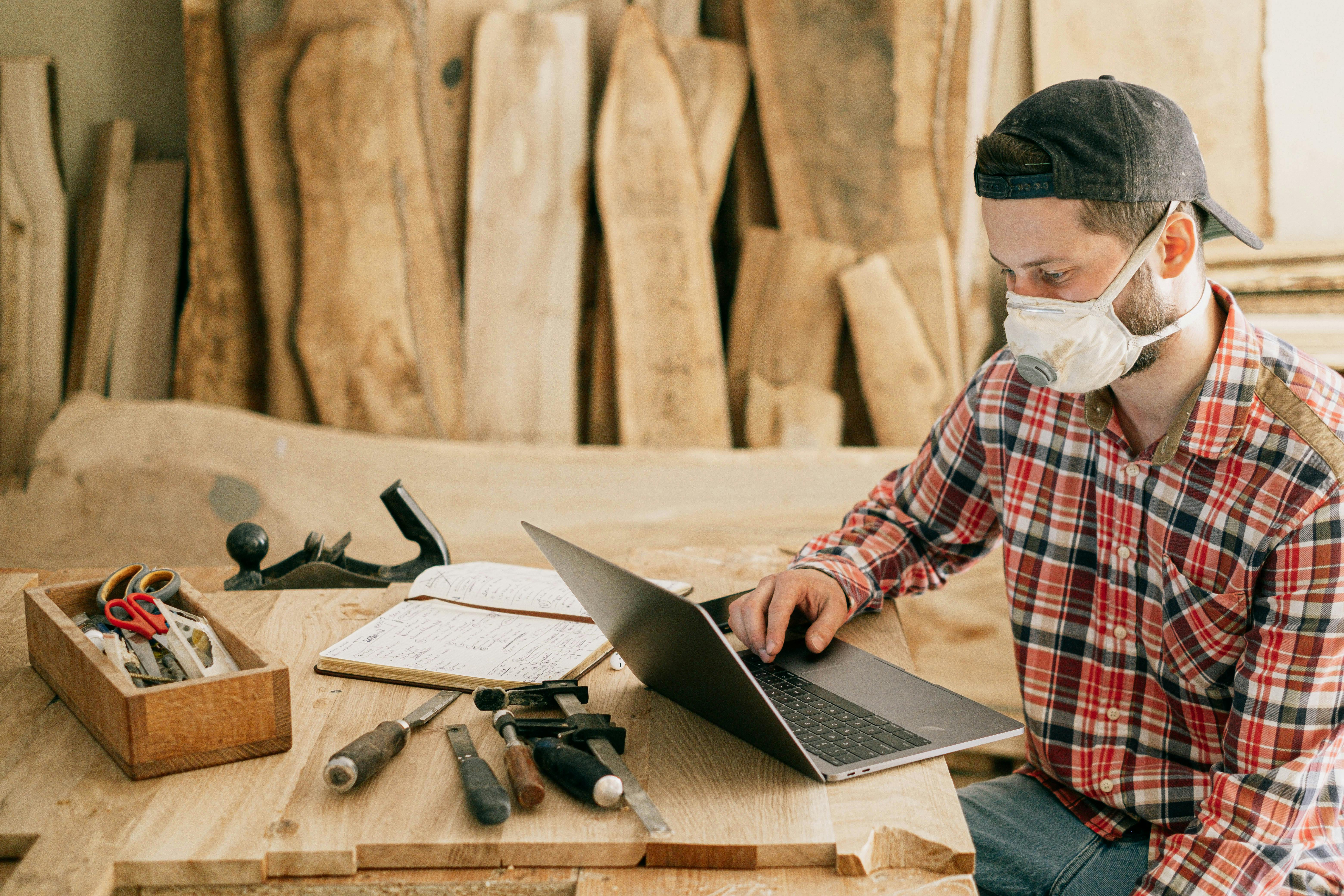
What Actually Makes a Softwood?
It’s not about hardness. It’s about biology.
-
Softwoods come from conifers (pine, fir, spruce, cedar).
-
Hardwoods come from broadleaf trees (oak, maple, teak).
Some softwoods, like Douglas fir or southern yellow pine, are denser than so-called hardwoods like balsa. So the real difference is how the trees grow, not how hard the wood feels.
Why Builders Use Softwoods
-
Grows fast → Steady supply, lower cost
-
Easy to cut and shape → Great for framing, furniture, and prefab
-
Available everywhere → Found in nearly every region and lumberyard
From framing lumber to shiplap siding, softwoods keep construction moving without breaking the bank.
Where They Grow
-
Pine dominates in the U.S., Europe, and Asia
-
Fir and spruce stretch across Canada and northern forests
-
Cedar and hemlock show up in the Pacific Northwest
-
Larch grows strong in colder parts of Europe and Russia
You’ll find a conifer adapted to almost every climate. That makes softwoods one of the most local, renewable, and eco-friendly materials you can use.
MUST READ
The Complete Manual of Woodworking: A Detailed Guide to Design, Techniques, and Tools for the Beginner and Expert
What You’ll Learn: Clear breakdowns of common softwood species, including how to cut, sand, stain, and finish pine, fir, cedar, and more. Includes tables for density, workability, and tool tips.
🔗 Check Price on Amazon
🔹 WOOD PROPERTIES
Softwoods in Practice: What Builders Actually Use

IMAGE: Cedar trees growing on a mountain, representing a prominent softwood with natural resilience and distinctive scent.
Cedar, pine, fir, spruce—if you’ve built anything, you’ve touched softwood.
These conifer-based woods grow fast, work easy, and form the backbone of everything from house frames to shelves. They're not just cheap alternatives to hardwood—they’re smart, sustainable materials that keep construction moving.
What Counts as a Softwood?
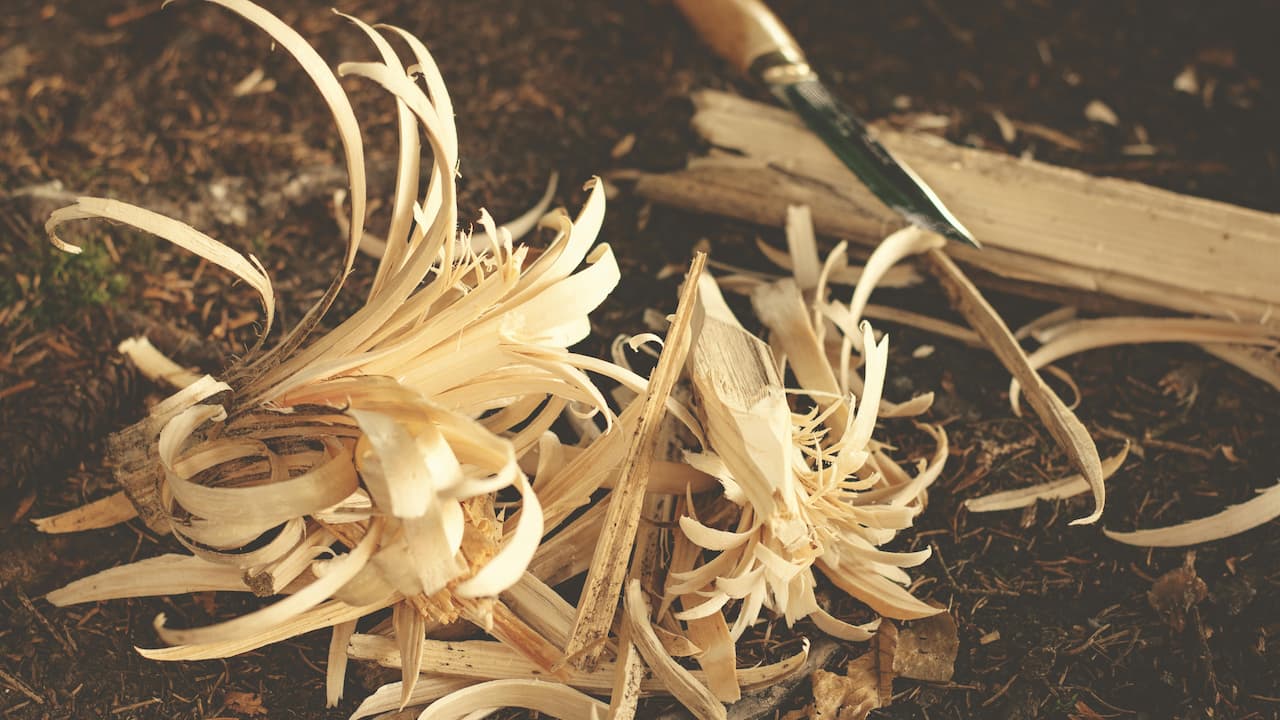
Image: Softwood, known for its ease of use, is ideal for construction, furniture making, and a range of woodworking projects.
Softwoods come from gymnosperms—mostly coniferous trees that produce seeds in cones. Think pine, fir, spruce, cedar, hemlock, larch.
They dominate:
-
House framing, joists, trusses
-
Low-cost furniture lines and rustic builds
-
Carving and hobby projects (basswood, for example)
-
Paper and pulp industries
Because they grow fast and can be replanted on short cycles, softwoods are a renewable workhorse—especially in green architecture.
Core Properties That Matter
Lightweight and Simple to Work
Softwoods usually weigh less than hardwoods. Easier to haul, lift, and ship. Less blade wear when cutting. Ideal for speed and simplicity.
Grain and Texture
-
Fir and spruce → smooth, clean grain
-
Pine → knotty and rustic
-
Cedar → red tones with light/dark bands
Workability
-
Nails and screws go in easier
-
Easy to saw, plane, or join
-
Watch for sticky resin in pine if it’s not kiln-dried
Strength vs Weight
Not all softwoods are soft. Douglas fir, larch, and southern yellow pine carry serious loads. That’s why they show up in beams, trusses, and subfloors.
Durability
Most softwoods need treatment to last outdoors.
Use pressure-treated versions for decks, posts, or fences.
For indoors, kiln-dried boards keep warping in check.
TRY THIS
Grab a scrap of pine and oak. Feel the weight, look at the grain, and knock on it. That alone will tell you 80% of what matters for basic material choices.
MUST HAVE
General Tools Digital Moisture Meter
Why It’s Useful: Essential for checking moisture content in softwoods before building. Prevents warping, cracking, and finish failures—especially with pine or fir boards.
🔗 View on Amazon
🔹 WOOD SPECIES
Softwood Types and What They’re Good For
You’re not just picking wood—you’re picking the right job for the right species. Here’s what matters, what to look out for, and how each softwood earns its place in real projects.
Common Softwood Species
1. Pine
● Lightweight, cheap, and everywhere.
● Great for framing, shelving, and quick furniture.
● White pine = easy to stain, light-colored.
● Yellow pine = stronger, more resin, used in structural spans.
Field tip: Expect knots and sap. Seal it properly.
2. Cedar
● Naturally resists moisture and insects—no treatment needed.
● Top pick for decks, fences, outdoor chairs, and siding.
● Smells great (think cedar chests).
Field tip: It weathers to gray fast outside—use a finish if you want to preserve the tone.
3. Douglas Fir
● Stronger than it looks—used in beams, joists, floor systems.
● Stable grain, decent weight, and nails well.
● Often used in historic buildings and modern post-and-beam homes.
Field tip: A structural softwood with real backbone.
4. Spruce
● Standard in construction—especially in SPF lumber bundles (Spruce–Pine–Fir).
● Used in sheathing, studs, and plywood cores.
● Sitka spruce = premium option for musical instruments.
Field tip: Clean, light grain—takes paint easily.
5. Hemlock
● Smooth grain, softer than fir or pine.
● Used for trim, molding, and interior doors.
● Not naturally rot-resistant—keep it dry.
Field tip: Ideal for interiors where stability matters.
6. Larch
● Dense, water-tough, and long-lasting.
● Used in cladding, exposed decks, and saunas.
● Golden-brown tone with a fine grain.
Field tip: European builders love it for cold, wet climates.
Less Common and Engineered Softwoods
Tropical Softwoods
Regions like Australia or South America use conifers (like hoop pine) in engineered panels and veneers. These aren’t always available at your local yard but show up in plywood and melamine boards.
Yew and Bog Oak (Misnomers)
Yew is a softwood but behaves like a hardwood—dense, tough, and slow-growing. Bog oak isn’t a softwood at all, but it’s sometimes lumped in due to confusion.
Softwood in Engineered Panels
Most OSB, MDF, and plywood rely on softwood fibers. Thicknesses run from 6mm to 25mm and are used in:
-
Subfloors
-
Roof decking
-
Cabinet backs
-
Furniture carcasses
▪ WHAT TO FOCUS ON
● Match the wood to the job
Cedar = outdoor. Fir = strength. Pine = cheap. Larch = wet areas. Spruce = framing. Hemlock = smooth trim.
● Understand trade-offs
Pine is easy to work but has knots. Cedar needs less maintenance but costs more. Fir is dense but can split under pressure if not pre-drilled.
● Don’t overpay
Lumber yards push what’s in stock. Know what works best for your design, climate, and finish goals—don’t just grab what’s cheapest.
🔹 WOODWORK APPLICATIONS
What Softwood Is Actually Used For
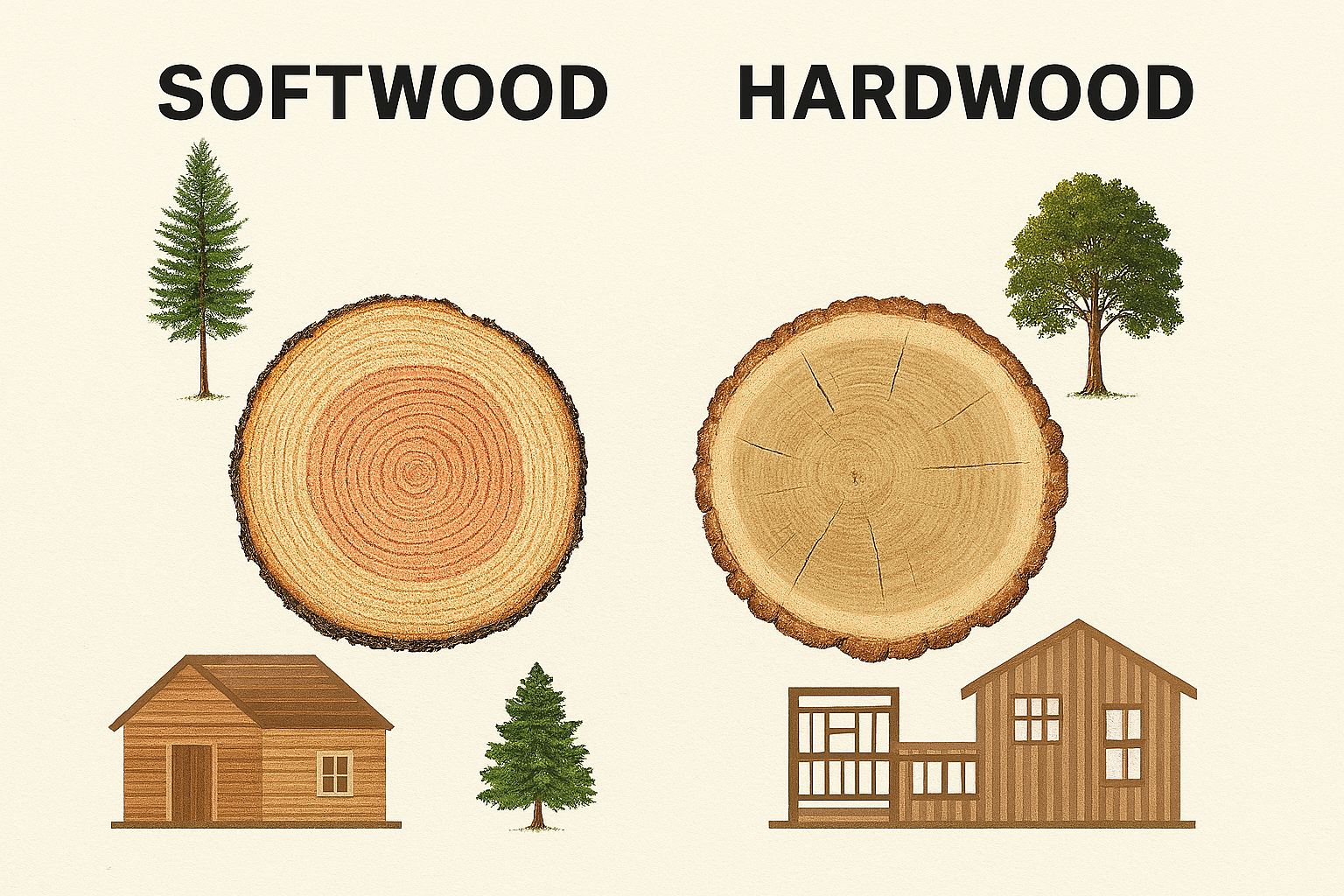
Softwood isn’t just cheap lumber—it’s the backbone of modern construction, furniture, and DIY. Here's how it's actually used, what to look out for, and where different species shine (or fail).
Framing, Sheathing, and Heavy Lifting
Structural Framing
● 2×4s, 2×6s, and roof rafters are almost always softwood—SPF (spruce-pine-fir) is standard.
● Douglas fir takes it further: beams, headers, joists—it's built for load.
● Larch and southern yellow pine are also strong picks in damp zones or heavy spans.
Engineered Sheets
● Softwood plywood (9mm to 25mm) goes under floors, on roofs, and behind siding.
● OSB, sheathing panels, and structural bracing almost always use softwood fibers.
● Even barn-grade “rough sawn” pine or fir shows up in agricultural builds.
Furniture & Interior Projects
Budget Furniture
● Pine is the go-to: cheap, soft, and forgiving for beginners.
● Cedar works outdoors or in storage chests where mold and bugs are a risk.
● For clean indoor builds, hemlock offers a smoother, low-knot option.
Interior Finish Work
● Tongue-and-groove paneling, beadboard, or shiplap = classic softwood use.
● Softwood baseboards and skirting (like torus molding) help unify a room.
● Many people stain pine to mimic walnut or oak for a richer tone without hardwood cost.
Carving, Craft, and Model Work
Carving & Whittling
● Look for “clear” pine or cedar—no knots, smooth grain.
● Basswood (technically a hardwood, but soft) is often grouped with softwoods in carving.
● Western red cedar is great for signs or sculptural outdoor pieces.
Tip: Avoid resin-heavy species for fine work. They’ll gum up your tools.
Firewood & Fast Heat
Burning Softwood
● Not for overnight heating—but perfect for kindling and shoulder seasons.
● Pine, fir, and spruce burn hot and fast if seasoned.
● Creosote buildup is a concern—always mix in hardwood for clean burns.
TRY THIS
Make two versions of the same project:
Use pine for one, cedar for the other. Sand, cut, and finish both.
Feel the difference in smell, texture, and resistance.
You’ll instantly understand why builders don’t treat “softwood” as one thing.
MUST HAVE
Woodworking Basics — Peter Korn
What You’ll Learn: A clean, hands-on introduction to working with softwoods using both hand and power tools. Covers joinery, project setup, and material choice—ideal for anyone using pine, fir, or cedar in real builds.
🔗 Check Price on Amazon
Softwood vs. Hardwood: What Actually Matters
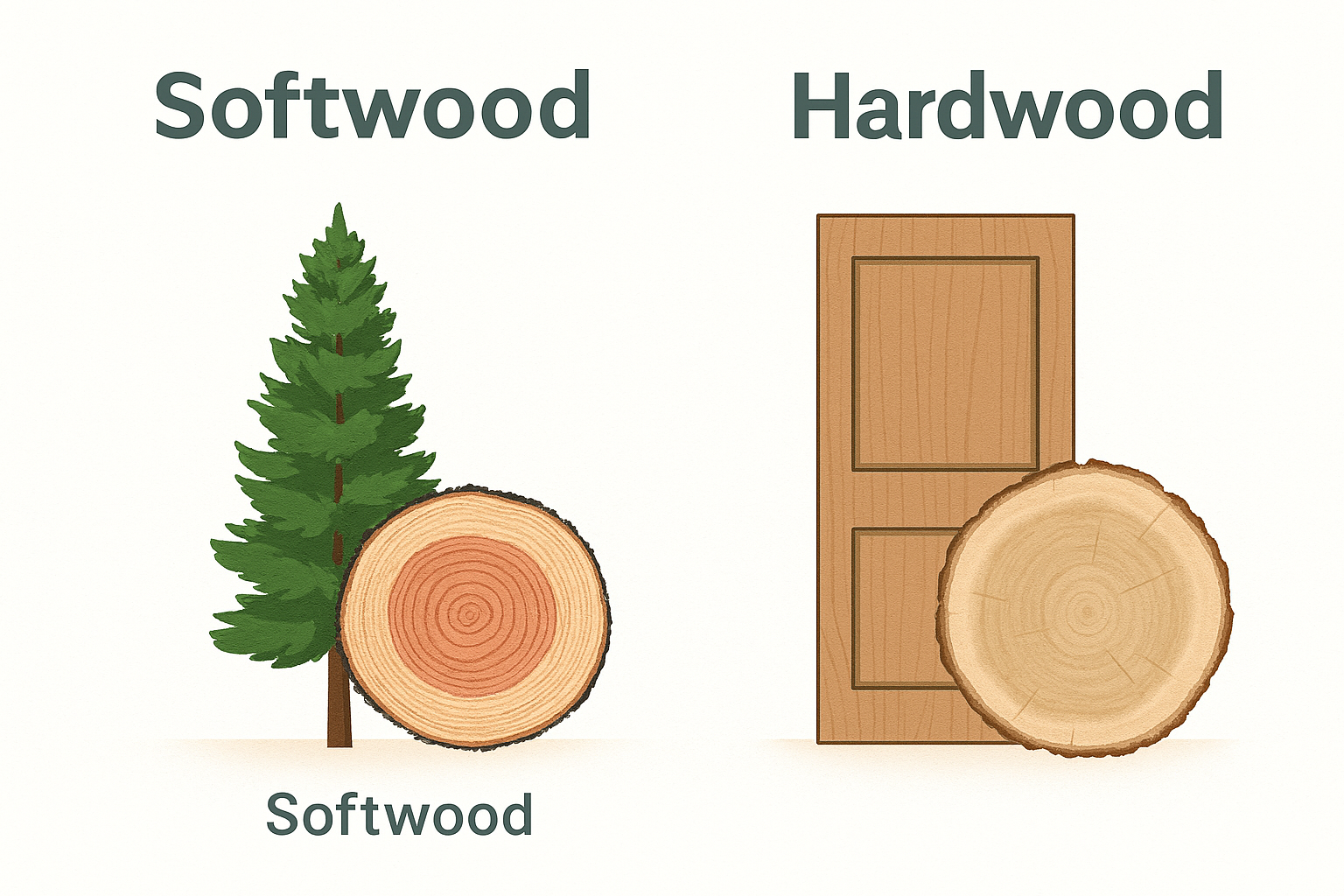
A. The Key Differences
Softwoods grow fast, cost less, and are easier to work with. Hardwoods are denser, pricier, and often chosen for their rich grain or toughness.
Use cases split like this:
-
Softwood → framing lumber, everyday furniture, paneling
-
Hardwood → flooring, cabinets, decorative joinery
Even when it comes to burning:
-
Hardwoods (like oak) burn longer and hotter
-
Softwoods (like pine) catch quickly—better for kindling
Still, don’t write off softwoods. A tough species like Douglas fir or larch can outperform some hardwoods in structure and weather resistance.
RECOMMENDED
The Essential Wood Book — DK Publishing
What You’ll Learn: Clear, visual guide to 100+ wood types, including side-by-side comparisons of softwoods and hardwoods. Covers appearance, workability, durability, and real use in construction and design.
🔗 Check Price on Amazon
B. What to Use Where
● Framing & Construction → SPF (spruce-pine-fir), Douglas fir, or southern yellow pine
● Furniture → Pine for budget pieces, cedar for outdoor builds
● Firewood → Softwoods for kindling, hardwoods for long burn
● Cheap vs Premium → Use cheap pine for temporary forms, save cedar or larch for finish work
Sketch It First:
Before buying anything, sketch your project and mark where strength, appearance, or water resistance matter. Then pick your species. That’s how pros avoid overspending—and how weekend builders avoid warped, moldy regret.
Softwood Treatment & Preservation
Best Treatments for Exterior Use
Softwoods in direct contact with the elements risk rot or insect attack unless protected. Pressure-treated softwood is infused with preservatives to handle moisture and pests. “Green treated softwood” often has a slight tint from these chemicals.
If you prefer fewer synthetic chemicals, you can apply high-quality oil-based or water-repellent sealers to cedar or larch, relying on their inherent resistance. Some owners reapply sealants annually or biannually to maintain color and structural integrity.
Finishing & Staining
If you’re doing garden furniture, you might want a specialized product like “Woca softwood lye” or “Woca lye on pine,” which can lighten or protect the surface. For general indoor usage, a simple polyurethane or wax coat can keep surfaces free from scratches and moisture infiltration.
⚪ Pro Tip: Always read the label on treatments. Some require drying or re-coating times. Also, try finishing a small offcut first to confirm color or absorption levels. This spares you the horror of discovering an awful finish on your entire deck or dining table.
Softwood Pricing, Availability & Market Trends
A. Softwood Costs & Buying Guide
If you step into a local store (like B&Q, Wickes, or Home Depot), you’ll see multiple tiers:
• Basic studs or boards → Great for rough framing, cheap but might have knots or be slightly warped. • Select or clear grades → Fewer knots, more uniform color, but often pricier. • Pressure-treated lumber → Costs more than untreated. If you’re building a fence or raised garden bed, though, it’s worth it.
Buying from “softwood timber merchants” might yield better-quality boards or specific thicknesses. Online orders can be convenient but watch out for shipping fees on large items.
B. Market Trends
• Increased Demand for Sustainable Materials: People want quickly renewable resources, so softwood usage is rising in eco-conscious architecture. • Engineered Innovations: More focus on cross-laminated timber (CLT) or glulam beams, letting conifers stand in for steel or concrete in multi-story structures. • Volatile Pricing: Housing booms or supply chain disruptions can cause spikes, but historically, softwoods remain a cost-friendly option.
Exercise: Browse your local lumberyard or an online supplier’s listings. Compare the prices of different thicknesses (e.g., 18mm vs. 25mm) and treatments. Notice how each factor (grade, dryness, treatment) affects the total cost.
Softwoods & Sustainability in Architecture
Sustainability is not just a buzzword—fast-growing conifers can help meet construction demands with less environmental strain compared to slower-growing hardwood forests. Provided the logging is well-managed, you can harvest pine or fir multiple times in the same area over a few decades.
• Renewability & Fast Growth: Some pines can reach maturity in 20–40 years, much quicker than an oak tree might. That’s a big plus for carbon offset. • Energy Efficiency: Softwood insulation or wood-based fiber panels can reduce heating/cooling requirements, further lowering a home’s carbon footprint. • Challenges: Durability can be an issue if you skip proper treatment, and monoculture conifer plantations may reduce biodiversity if not planned carefully.
⚖ Idea: If sustainability matters to you, look for “green softwood suppliers” with certifications (FSC or PEFC). This way, you ensure that the forest is responsibly replanted and that local ecosystems aren’t overexploited.
Advanced Applications of Softwoods
Engineered Wood Products: CLT & More
Cross-laminated timber (CLT) is turning heads in modern architecture. By layering boards of spruce or pine at alternating angles, builders can create enormous panels that serve as load-bearing walls, floors, or roof structures. These panels drastically reduce construction time and environmental impact.
Glulam beams, made of laminated boards, can span large distances and carry considerable loads. Both CLT and glulam highlight how “softwood planed timber” can evolve into high-performance components that break the “soft means weak” stereotype.
Softwoods in Modern Architecture
Some contemporary designs use cedar or larch facades, leaving them to weather into a silvery patina. Exposed beams of Douglas fir or hemlock can bring warmth to open-concept interiors, bridging a modern aesthetic with a natural vibe.
Try: If you’re curious about advanced wood solutions, look up local projects using cross-laminated timber. Reading real-world case studies on tall timber buildings can inspire you to think beyond conventional steel or concrete approaches.
IN FOCUS
Redwood for Outdoor Construction
Redwood is sometimes overlooked amid the broader discussion of pines, firs, and cedars, yet it stands out for outdoor applications like decking, pergolas, and garden structures. If you crave something naturally resistant to decay and insects, Redwood is a premium softwood option – even if it’s not always the cheapest on the market. In many climates, it can handle the constant moisture, UV exposure, and day-to-day wear that tears through untreated or lower-quality boards. Plus, Redwood often has fewer pitch pockets than pine, making it less likely to ooze sap in hot weather.
Why Redwood?
-
Durability and Rot Resistance
Redwood contains natural oils and tannins that help ward off decay. Think of it as a built-in defense system that other species, like standard pine, might lack unless they’re pressure-treated. If you’re building a raised vegetable bed or an outdoor dining table, Redwood’s ability to resist fungi and insects can save you from frequent repairs. -
Easy Machining and Finishing
Despite its moderate density, Redwood cuts and planes smoothly. The grain is usually straight, so you don’t fight random swirling that can cause tear-out. Plus, Redwood takes finishes evenly – a big advantage if you want to stain or oil it for color consistency. -
Less Warping Under the Sun
Properly dried Redwood doesn’t twist or warp as drastically as some other conifers. It still needs a protective coat for best results, but once sealed, it maintains a stable shape under the scorching sun or during seasonal shifts.
Practical Suggestion: If Redwood is available in your area, try building a small outdoor bench or coffee table. Compare how it weathers over six months with a similarly built pine project. That real-life experiment will showcase Redwood’s extra resilience and color retention.
Essential Formulas for Softwood Use
Choosing the right boards is one thing; understanding how they’ll behave under load, moisture shifts, or expansions is another. Below are some simplified formulas to help you plan more confidently.
- Moisture Content (MC) Calculation
MC (%) = [(W_wet – W_dry) / W_dry] × 100- W_wet: Weight of wood in its current state
- W_dry: Weight after oven-drying
- Why It Matters: Softwoods like cedar or pine can fluctuate in size as humidity changes. If you measure moisture content, you’ll know if the board is stable enough for precise builds like cabinetry.
- Shrinkage Estimate
ΔD = α × (ΔMC) × D₀- ΔD: Change in dimension (inches or mm)
- α: Shrinkage coefficient for the species (available from official tables)
- ΔMC: Change in moisture content (from 20% to 10%, for instance)
- D₀: Original dimension
- Why It Matters: If you’re installing interior trim or hardwood floors, a big MC drop can cause gaps or cracks. For softwoods like fir, a moderate coefficient ensures less dramatic movement compared to some hardwoods, but you still want to do the math if precision is crucial.
- Basic Beam Load (for Simple Span)
W = (5 × E × I) / (384 × L³)- W: Maximum load (pounds or Newtons)
- E: Modulus of Elasticity (depends on species)
- I: Moment of inertia (bd³/12 for rectangular beams)
- L: Length of the span
- Why It Matters: Good for rough-checking a softwood joist or beam. If you’re planning a deck or small footbridge with conifer boards, you can see if the dimension and species are sufficient.
⚙ Tip: These formulas are simplified. For major structural elements or commercial builds, consult an engineer who can factor in local codes and additional safety margins.
Best-Selling Woodworking Books
(and Why They’re Worth Buying)
Navigating the world of softwoods can be easier when you have a solid reference or two. Below are top sellers that many pros and enthusiasts swear by:
-
“Understanding Wood” by Bruce Hoadley
- Why Buy? It breaks down wood anatomy, strength properties, and finishing methods with clarity. Great if you want to see how softwoods differ from hardwoods at a microscopic level.
-
“The Essential Woodworker” by Robert Wearing
- Why Buy? Perfect for building foundational hand-tool skills. Softwoods are simpler to shape with planes, chisels, and saws. This book covers joinery in a down-to-earth style.
-
“Fine Woodworking’s Best Tips on Finishing” (From Fine Woodworking Magazine Editors)
- Why Buy? Offers practical advice on stains, oils, sealers, and topcoats. Excellent if you want to master finishing pine, cedar, or fir without blotches or dull spots.
-
“The Complete Manual of Woodworking” by Albert Jackson & David Day
- Why Buy? An all-in-one reference spanning tools, materials, techniques, and project ideas. It outlines which conifer species suit different tasks (like framing vs. furniture) and covers basic engineering concepts.
-
“Woodworker’s Guide to Wood” by Skill-Based Authors
- Why Buy? Shows an atlas of species, clarifying grain patterns, typical densities, and mechanical properties. Perfect for quickly comparing, say, larch vs. hemlock if you’re unsure which better suits your deck.
Suggestion: Flip to each book’s sections on conifer species or finishing advice. The real gems are often the troubleshooting tips that teach you how to handle knots, pitch pockets, or the occasional warp after you bring your boards home.
FAQ
- What are 5 examples of softwood? Pine, Cedar, Fir, Spruce, Hemlock.
- What is the hardest softwood? Yew is famously dense. Douglas fir, larch, or southern pine also compete in certain metrics.
- Best softwoods for furniture? Cedar if it’s exposed to moisture, pine if budget and indoor usage matter. Douglas fir for robust frames or floors.
- Is pine a softwood? Yes, and probably the most widely used conifer in lumberyards globally.
- Is teak a softwood? No, teak is a tropical hardwood beloved for its oily, rot-resistant properties.
- Is plywood a softwood? It can be. Plywood is sometimes made with conifer veneers, but you can also find hardwood-based plywood.
- What’s the best treatment for outdoor softwood? Pressure treatment combined with a UV-protective stain or sealant if you want color retention.
● Check: Compare how people around you use pine or cedar. Are they painting it, sealing it, or leaving it raw? Observing real projects (like a neighbor’s fence or a friend’s deck) can spark practical insights.
Conclusion
Softwoods might seem humble at first glance, but once you look at the wide range of species (pine, cedar, fir, spruce, hemlock, larch) and the modern engineering solutions built around them, it’s clear they’re more than “second-tier lumber.” They offer a fantastic balance of affordability, ease of use, and environmental friendliness—especially when drawn from responsibly managed forests.
→ Key Takeaways on Softwoods ←
- Versatile & Sustainable: Fast-growing conifers mean lower costs, a predictable supply, and less burden on old-growth forests.
- Broad Range of Uses: Construction frames, indoor/outdoor furniture, carvings, firewood, and beyond.
- Treatment Extends Lifespan: Pressure-treat pine for fences, or pick cedar/larch for weather resistance.
- Engaging Innovative Fields: CLT and glulam highlight that conifers can scale to major architectural feats.
A final piece of advice is to match your chosen softwood to the project’s demands—whether it’s structural strength, aesthetic warmth, or outdoor resilience. If you keep moisture levels and the right treatment in mind, a conifer-based board can last for decades.
Our last suggestion: build a small bench or a window planter using pine or cedar. Apply a suitable finish, watch how it weathers or holds up in daily life. That real-world experience is your best teacher, guiding future decisions about which species or treatment suits your style, budget, and environment.
Safe building, happy crafting, and enjoy the countless possibilities that softwoods offer in 2025 and beyond. 🏗️
Related
- Wood Essentials: Free Masterclass Course
- High Density Fiberboard (HDF): 2025 Comprehensive Free Course
- High Density Fiberboard Prices: Understanding HDF Prices
- Low Density Fiberboard (LDF): Everything You Need to Know
- Main Types of Softwoods: Differences, Benefits, and Applications
- Engineered Wood: What is Engineered Wood?: The basics of engineered wood, its composition, and why it's a popular choice in modern design.
- Primary differences between hardwoods and softwoods
- Common uses of hardwoods in architectural design
Sources & References
If you want accurate, up-to-date data on softwood properties, logging standards, or building codes, these official resources are invaluable:
-
Forest Stewardship Council (FSC)
- fsc.org
- Oversees responsible forestry practices to ensure your softwood is harvested sustainably.
-
Programme for the Endorsement of Forest Certification (PEFC)
- pefc.org
- Another major certifier that aims to protect conifer forests while supporting legal, ethical logging.
-
USDA Forest Products Laboratory
- fs.usda.gov
- Provides research papers and technical data on everything from species-specific strength values to moisture control.
-
American Wood Council
- awc.org
- Offers design values, load tables, and best practices for wood-based construction across the U.S.