

Hempcrete gets confusing because the name makes it sound like concrete.
It is not concrete. It is not structural by itself. It is not poured like a slab, reinforced like a wall, or used as a foundation material. Hempcrete is a hemp-lime wall infill used around a structural frame.
That does not make it weak or useless. It just means it has to be understood correctly. A good hempcrete wall can help with insulation, moisture buffering, acoustic comfort, thermal steadiness, and low-carbon construction. A bad hempcrete wall is usually the result of poor detailing, rushed drying, wrong finishes, or treating it like a miracle material.
What hempcrete is
Hempcrete, also called hemp-lime, is made from hemp hurd, a lime-based binder, and water. Hemp hurd is the woody inner core of the hemp stalk. The binder coats the hurd and holds the wall body together as it dries and cures.
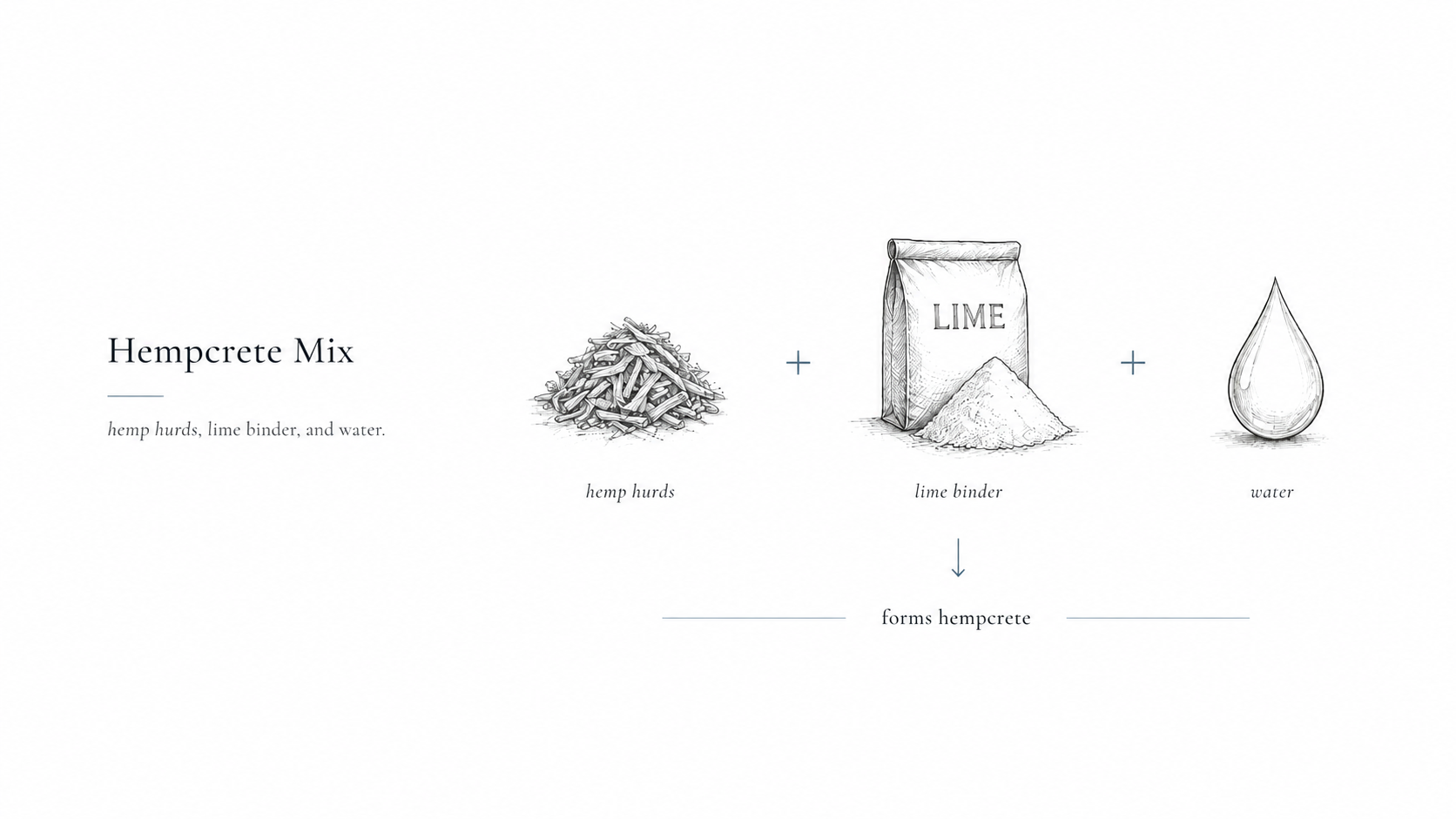
In most buildings, hempcrete is placed around a timber frame or another structural frame. The frame carries the building. The hempcrete fills the wall.
That is the first rule. Hempcrete is not there to replace beams, columns, concrete, blockwork, or a structural wall. It is closer to insulation and wall infill, but it behaves differently from fiberglass, mineral wool, or rigid foam because it forms a thick, monolithic, vapor-open wall body.
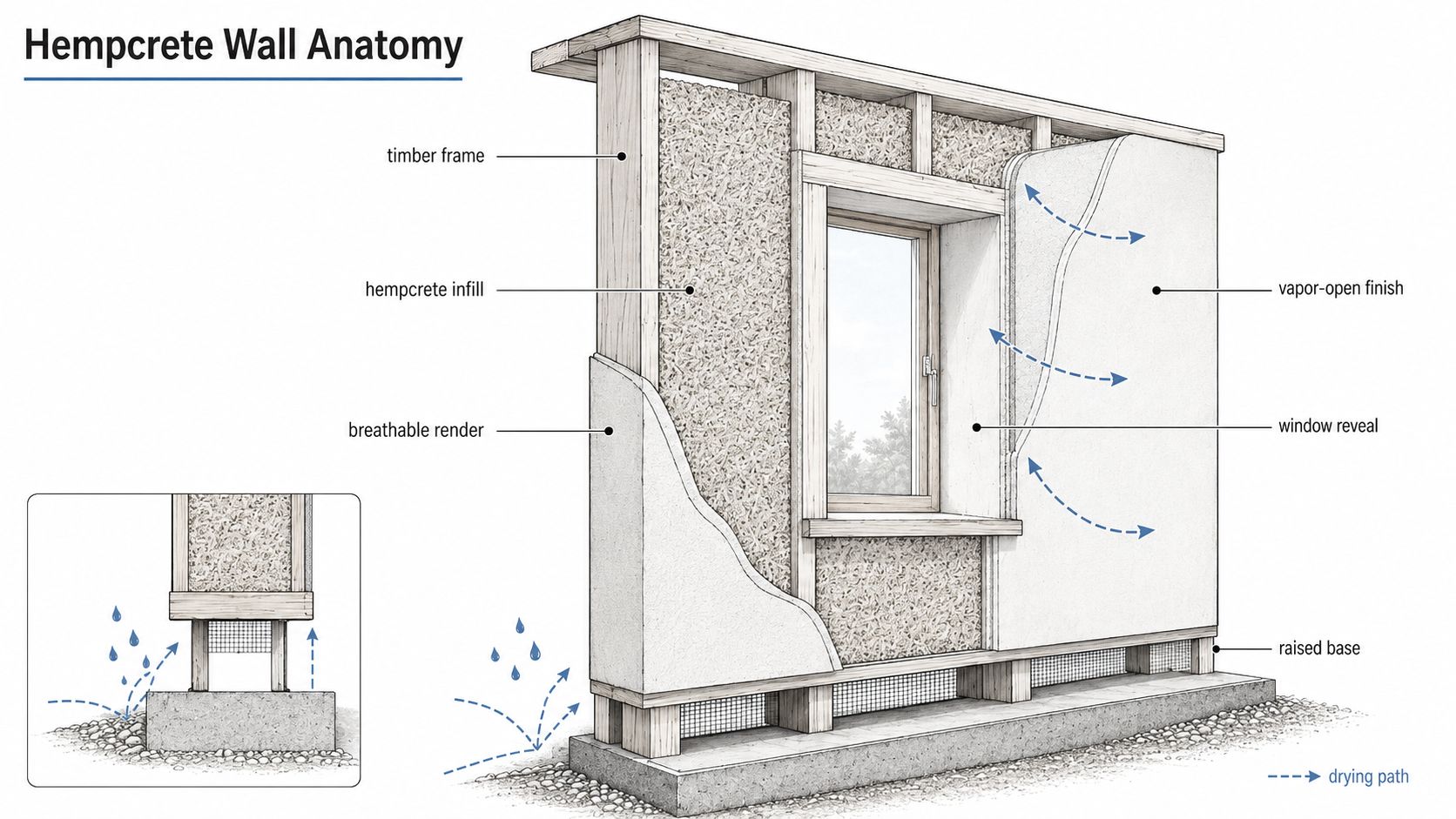
The best way to read a hempcrete wall is as a system. The frame, wall thickness, binder, drying time, base detail, window openings, service penetrations, render, and interior finish all affect whether the wall works.
What hempcrete does well
Hempcrete can make a wall feel more solid and steady than a standard framed cavity. It stores some heat, buffers humidity, and softens daily temperature swings. It can also improve acoustic comfort because the wall has depth and a porous internal structure.
The environmental argument is also real, but it needs careful wording. Hemp stores carbon as it grows, and hemp-lime walls can support lower-carbon construction. Whether a project is truly carbon-negative depends on the binder, transport, wall thickness, finishes, construction method, and full life-cycle calculation.
So the honest claim is this: hempcrete can be part of a low-carbon wall strategy. It should not be sold as automatically carbon-negative in every project.
What hempcrete does badly
Hempcrete does not like being rushed.
Cast-in-place hempcrete contains water, and that water has to leave the wall before finishes are applied. The surface can look dry before the wall is ready. If the schedule treats hempcrete like a standard framed wall, the project can get into trouble.
It also does not like bad moisture detailing. Hempcrete can buffer vapor, but it should not sit in standing water, constant splashback, or a wall assembly that cannot dry. The base of the wall, roof overhangs, flashing, exterior render, interior finish, and drying path matter.
It is also not always cheap. The wall may need thicker framing, trained labor, formwork, special binder, drying time, breathable finish materials, and code review. That does not mean it is a bad choice. It means it should be priced as a wall system, not as a bag of insulation.
How hempcrete works in a wall

The hemp hurd gives the wall its light, porous body. The lime-based binder holds the hurd together. Water makes the mix workable and activates the binder, but too much water slows the job down.
The finished wall works because it has trapped air, thickness, vapor openness, and enough mass to slow temperature swings. That is why the finish matters. Hempcrete should usually be paired with breathable plasters, renders, or compatible wall finishes that let the assembly dry.
Breathable does not mean leaky. A good hempcrete wall still needs rain control, air control, flashing, drainage, and careful detailing around openings. The wall should manage vapor, not invite water.
Where hempcrete makes sense
Hempcrete is strongest when the project can accept thicker walls, slower sequencing, and careful detailing.
It can work well in custom homes, natural-building projects, low-energy houses, small buildings, additions, and some retrofits. It is especially useful when the goal is not just R-value, but a wall that feels quiet, stable, vapor-open, and lower in synthetic material use.
It also suits projects where the owner understands the trade-off. Hempcrete can be beautiful and high-performing, but it asks for patience. If the job needs fast dry-in, thin walls, cheap labor, and standard trade sequencing, hempcrete may not be the right wall system.
Where hempcrete fails
Hempcrete usually fails for ordinary reasons.
- The project treats it like structural concrete.
- The crew uses a generic mix instead of a tested binder system.
- The wall is closed before it has dried enough.
- The exterior finish blocks drying.
- The base of the wall is exposed to splashback or trapped moisture.
- Electrical and plumbing routes are not planned before placement.
- The local code path is not checked early.
None of those are mysteries. They are planning mistakes. Hempcrete is not hard because the ingredients are complicated. It is hard because the wall depends on sequence, drying, and compatible finishes.
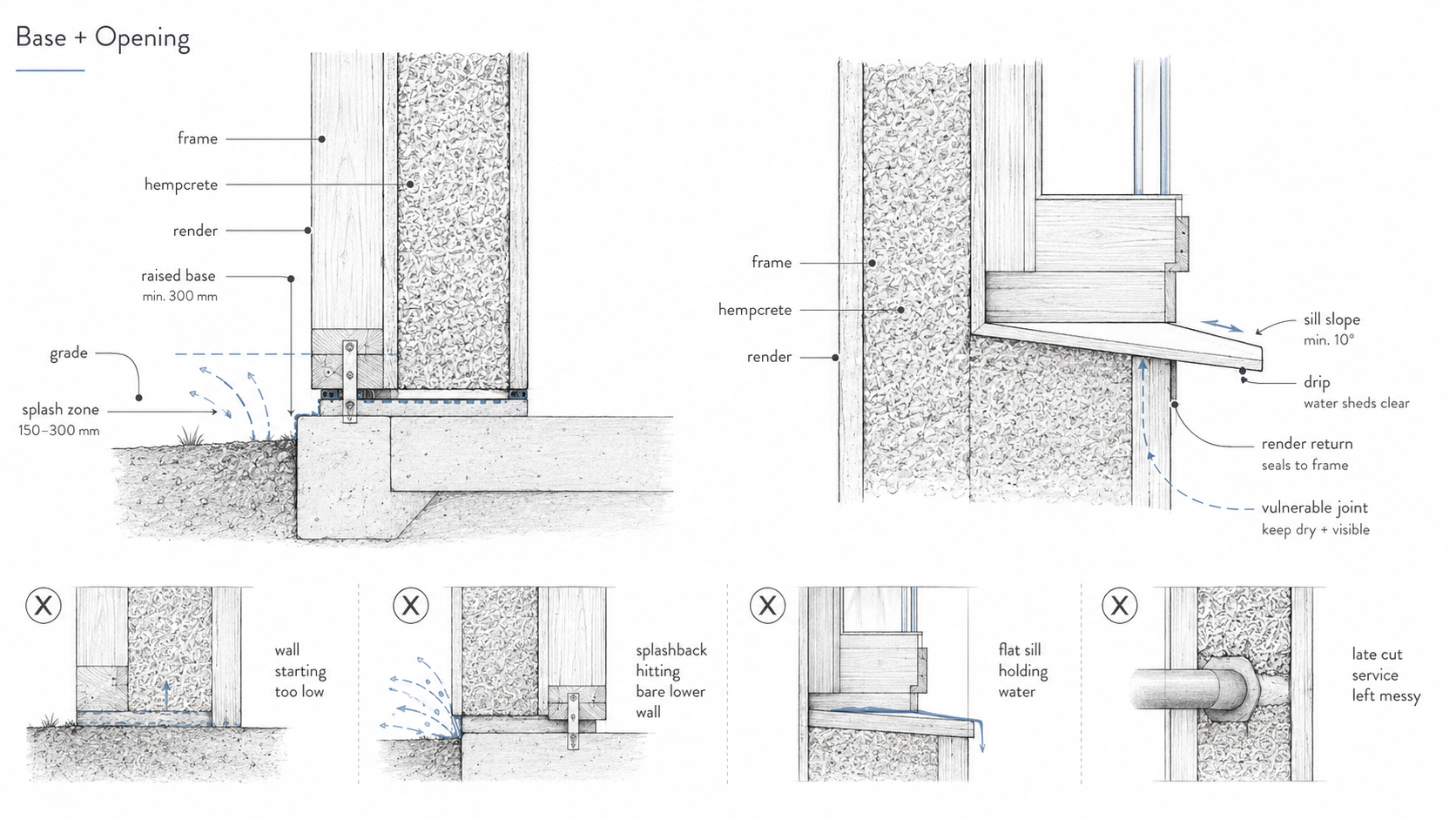
The base and openings deserve special attention because they are where small mistakes become long-term problems. A raised base, sloped sill, drip edge, protected lower wall, and clean render return matter more than another paragraph about how green the material is.
Hempcrete is not one product
People often talk about hempcrete as if it is one thing. It is better to think of it as a family of hemp-lime wall systems.
| System | How it works | Main issue |
|---|---|---|
| Cast-in-place hempcrete | Mixed on site and placed into formwork around a frame | Needs formwork, labor, and drying time |
| Sprayed hempcrete | Applied mechanically by trained crews | Needs equipment and specialist knowledge |
| Hempcrete blocks | Manufactured units installed more like masonry | Depends on local supply and system details |
| Hemp-lime panels | Prefabricated panels brought to site | Less site drying, but more planning upfront |
Those systems are related, but they are not interchangeable. A cast-in-place wall has different risks than a block or panel system. A project should choose the method before deciding cost, schedule, wall thickness, and finish strategy.
Hempcrete versus hemp insulation
Hempcrete and hemp insulation are not the same thing.
Hemp insulation usually means batts or flexible insulation products made from hemp fiber. Those products fit more easily into conventional framed walls. They are closer to fiberglass, mineral wool, cellulose, or wood-fiber insulation in how the wall is assembled.
Hempcrete is different. It creates the wall infill itself. It changes wall thickness, drying time, labor, finishes, and sometimes the whole construction sequence.
If the goal is a simpler swap inside a standard framed wall, hemp insulation may be the better choice. If the goal is a thick vapor-open wall body with more mass and a natural-material system, hempcrete may make more sense.
Hempcrete compared with other natural materials

Hempcrete is often compared with straw bale, rammed earth, bamboo, and low-carbon concrete alternatives. Some of those comparisons are useful, but only if the materials are being compared by job.
| Material | Useful comparison | Main difference |
|---|---|---|
| Straw bale | Natural insulation and thick wall construction | Different moisture, plaster, and bale-handling details |
| Rammed earth | Natural material and thermal mass | Rammed earth is heavy mass; hempcrete is light infill |
| Bamboo | Bio-based construction material | Bamboo may be structural; hempcrete usually is not |
| Geopolymer concrete | Low-carbon construction discussion | Concrete alternative, not insulation infill |
| Ferrock | Carbon-focused concrete alternative | Structural-material conversation, not hemp-lime wall infill |
The worst comparison is “hempcrete versus concrete” without context. Concrete is often doing structural, slab, or foundation work. Hempcrete is usually doing wall-infill and insulation work. They are not solving the same problem.
Code and approval matter
Hempcrete is becoming easier to discuss with building officials, but that does not mean every project gets automatic approval.
The 2024 International Residential Code includes Appendix BL for hemp-lime construction. Local adoption still matters. Some jurisdictions may accept that path. Others may require an alternative-material review, engineering, tested assembly information, or product documentation.
That question should be asked early, not after the frame is up and the crew is ready to mix.
The project team should know the structural frame, wall thickness, fire expectations, finish system, moisture strategy, and inspection path before construction starts.
Drying time is part of the cost
Drying time is where many hempcrete projects get mispriced.
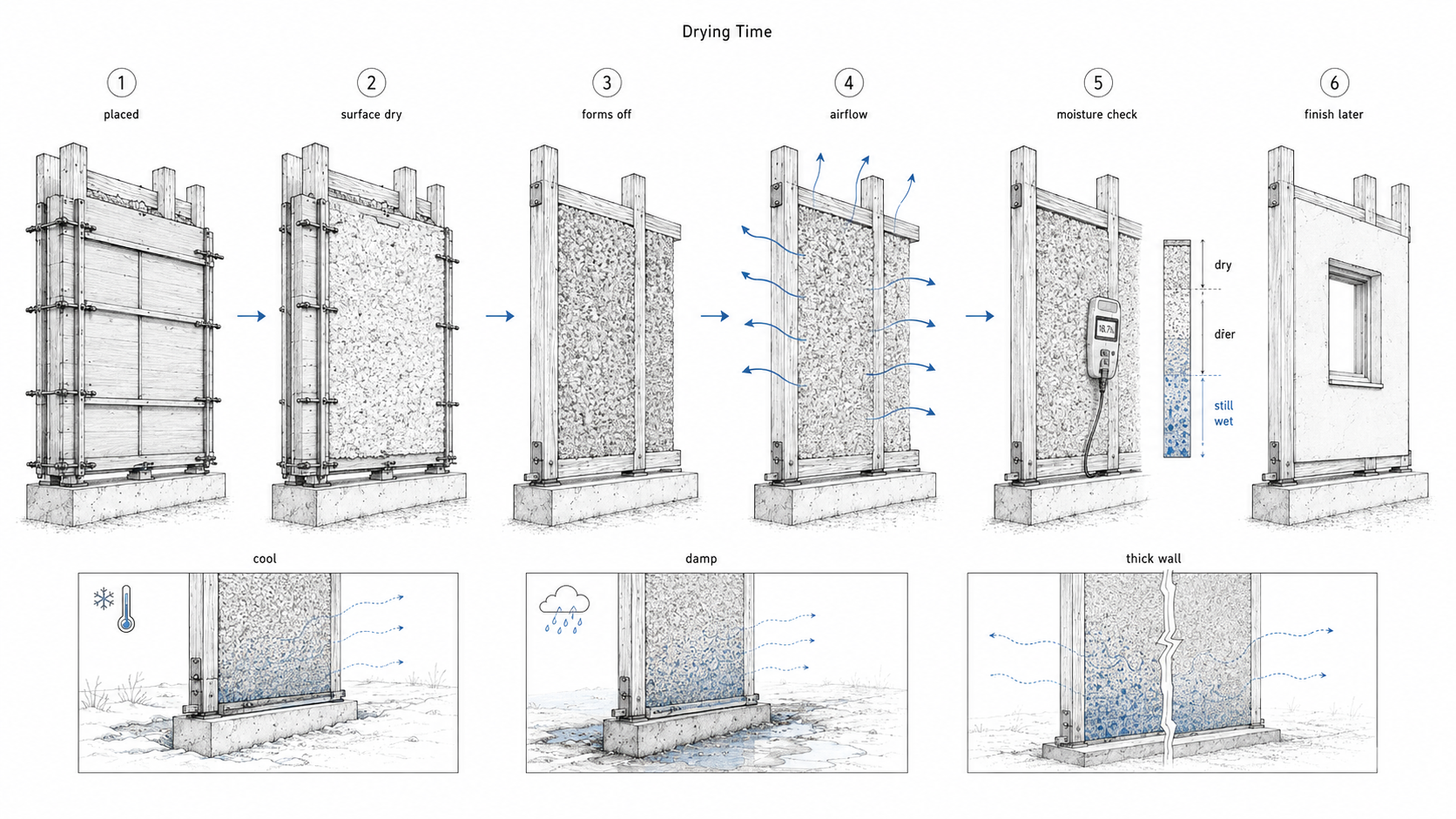
The wall may feel dry at the surface before it is ready for finish. Thick walls, cool weather, poor airflow, damp seasons, dense mixes, and rushed schedules all make drying harder.
If the builder, owner, and finish trades do not understand that, hempcrete gets blamed for a scheduling mistake. The wall was not late. The schedule was wrong.
This is why panelized or block systems can be attractive. They may reduce some site drying risk. They do not remove the need for good detailing, but they can change the construction sequence.
Where hempcrete is being used
Hempcrete has more history in some regions than others. France and the United Kingdom have longer experience with hemp-lime construction, especially in natural building and retrofit work. Australia, New Zealand, Canada, and the United States also have active hemp-building communities, but local practice still varies.
The local conditions matter more than the global trend. A project with trained installers, nearby hemp supply, a known binder system, and a clear code path is not the same as a project trying to force the first hempcrete wall through a jurisdiction that has never reviewed one.
That does not mean early projects are impossible. It means they need more documentation, better team coordination, and less guessing.
When hempcrete is a good choice
Hempcrete is worth considering when most of these are true:
- The project can accept thicker walls.
- The structure is carried by a proper frame.
- The wall can use breathable finishes.
- The base can be protected from standing water and splashback.
- The schedule allows drying time.
- The local code path is understood early.
- The owner values comfort, material health, and embodied-carbon goals enough to price the full wall system honestly.
When hempcrete is probably the wrong choice
Hempcrete is probably the wrong choice when the project needs speed above everything else.
It may also be wrong when wall thickness is tight, the crew has no experience, the budget is already stretched, the wall is below grade, or the jurisdiction has no clear approval path.
That is not a failure of hempcrete. It is just a mismatch. Good sustainable design does not mean forcing one material everywhere. It means using the right wall system for the project.
The future of hempcrete
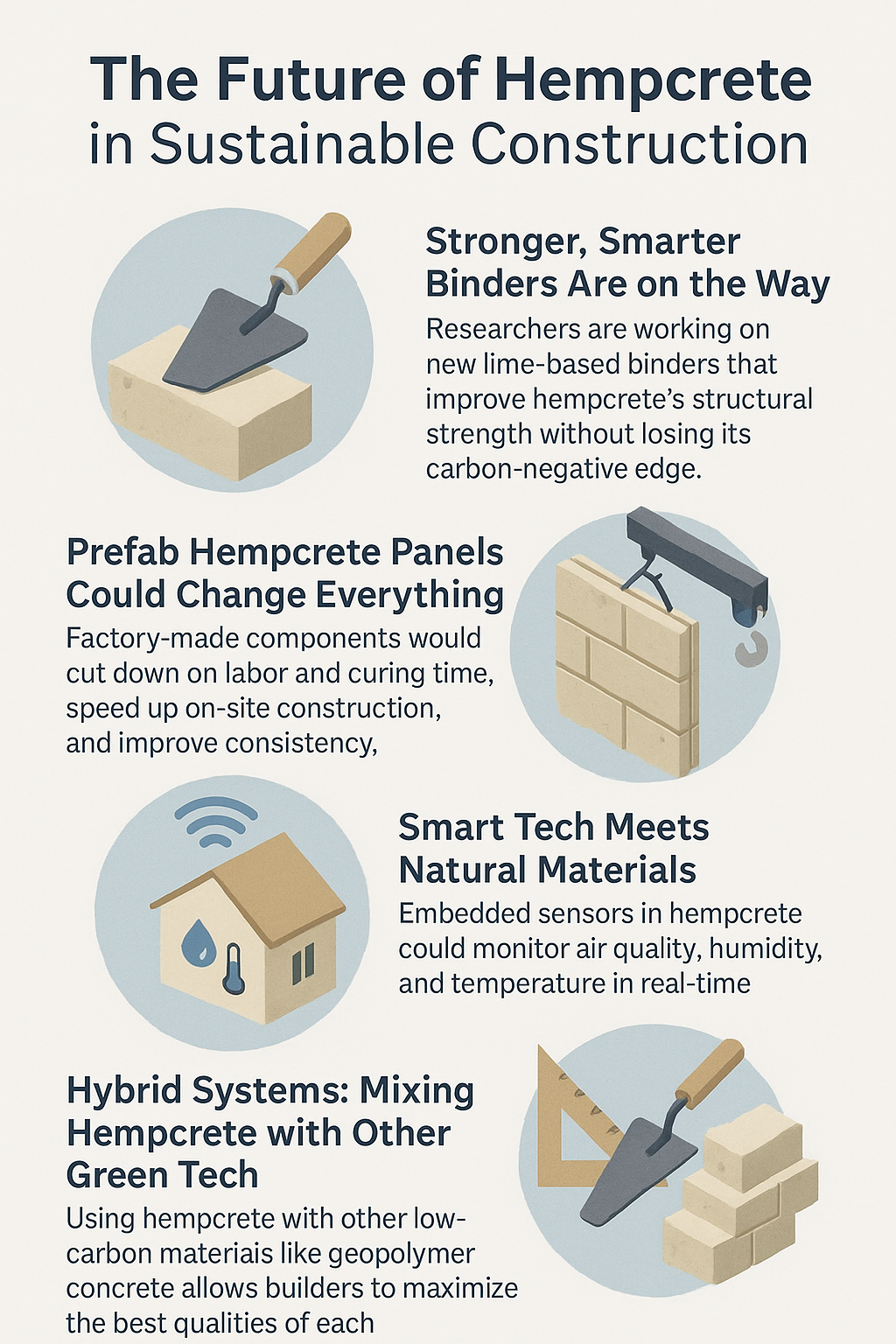
The future of hempcrete is not that every building suddenly uses it. Construction does not change that way.
The realistic path is better binders, more panelized systems, clearer code adoption, trained crews, and better project examples. That is enough. Hempcrete does not need to replace every insulation or wall system to matter. It only needs to be used where its strengths fit the building.
FAQ
Is hempcrete load-bearing?
No. In normal residential wall use, hempcrete is nonstructural infill around a timber frame or another structural frame. The frame carries the building loads.
Is hempcrete the same as concrete?
No. Hempcrete is much lighter and weaker than structural concrete. It is used for wall infill, insulation, moisture buffering, and thermal steadiness, not foundations, slabs, beams, or structural walls.
Is hempcrete carbon-negative?
Sometimes it may be, depending on the full life-cycle calculation. The claim depends on hemp source, binder, transport, wall thickness, finish materials, and accounting method. It is safer to describe hempcrete as a low-carbon wall strategy unless the project has actual carbon data.
Does hempcrete need a frame?
Usually yes. The frame carries the structure, and the hempcrete fills around it. The exact frame design depends on the building, code path, engineering, and wall system.
Can hempcrete get wet?
Hempcrete can buffer moisture vapor, but it should not be treated as waterproof. It still needs roof protection, flashing, drainage, breathable render, and a dry base detail.
Does exterior hempcrete need render?
Usually yes. Exterior hempcrete normally needs a breathable protective render or compatible finish that protects the wall from weather while still allowing drying.
How long does hempcrete take to dry?
It depends on wall thickness, binder, density, airflow, season, and climate. Cast-in-place hempcrete can feel dry at the surface before it is ready for finishes.
Is hempcrete good for cold climates?
It can be, but only with climate-specific wall thickness, airtightness, rain control, thermal-bridge control, and drying strategy. Cold-climate success depends on the whole assembly.
Is hempcrete expensive?
It can cost more than standard cavity insulation if you compare only material cost. The fair comparison is the whole wall system: frame, infill, labor, formwork, drying time, finish, comfort, and carbon goals.
What is the biggest mistake with hempcrete?
The biggest mistake is treating it like a simple green substitute for conventional walls. Hempcrete needs the right frame, binder, density, moisture strategy, drying time, finish system, and code path.
Read This Next
- How to Make Hempcrete — for mix, sequence, lifts, tamping, shuttering, and drying mistakes.
- Hemp Building Materials — if you are comparing hemp as a material family.
- Natural Building Materials — for the larger breathable-wall context.
- Sustainable Insulation — if the decision is still about the whole envelope strategy.
- Natural Insulation Materials — for insulation choices beyond hempcrete.
- Hemp Insulation — if a hemp batt or simpler framed-wall approach makes more sense.
- Hemp Insulation vs. Fiberglass — for a more conventional insulation comparison.
References
- International Code Council, 2024 International Residential Code, Appendix BL: Hemp-Lime (Hempcrete) Construction.
- YourHome, Australian Government, Hemp masonry.
- US Hemp Building Association, Hemp-lime appendix published in 2024 U.S. model residential housing codes.