

You can usually tell in a few seconds whether a rustic house is the real thing or a costume. The costume version has the beams, the dark stain, and a strip of stone slapped under one window, and it still reads as an ordinary house dressed up to look rugged. The real one looks like it grew where it stands: the roof carries weight, the porch is deep enough to stand under in a storm, the wood and stone actually meet, and the whole house settles into the site instead of sitting on top of it.
That gap is the whole subject. The look is less about props than about getting the house, the materials, the weather, and the rooms to pull in the same direction. Get that right and a plain rural house feels grounded; get it wrong and you have spent real money to make a house look heavy, fake, and harder to fix.
Rustic Is a House System, Not a Theme
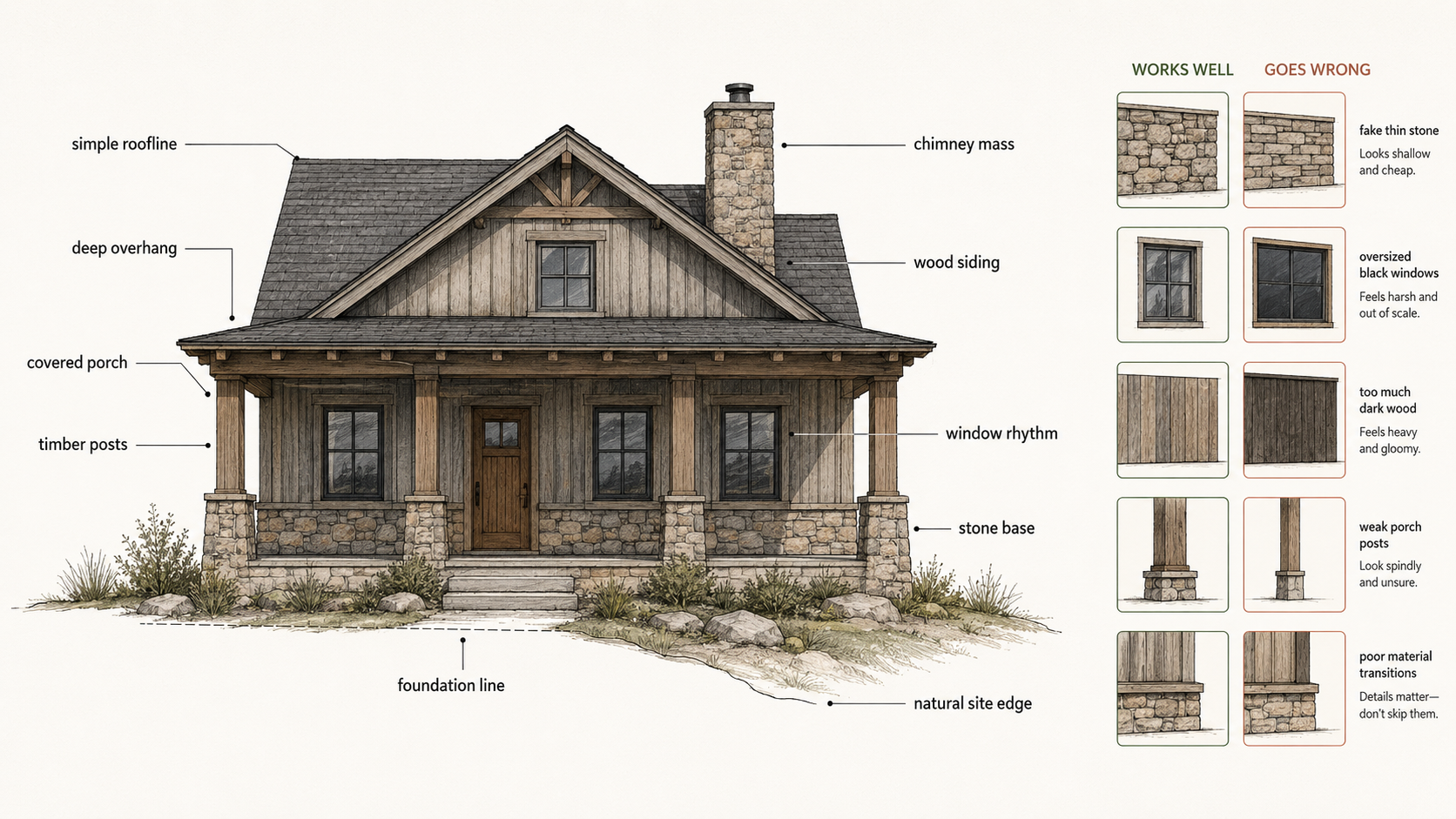
The strongest rustic houses usually start from a few simple decisions: a plain roof shape, honest wall materials, a porch with real depth, a fireplace or chimney heavy enough to look like it belongs, and a yard that does not fight the building. The weak ones start from surface treatment instead, with fake beams, thin stone, oversized black windows, dark stain on everything, and a porch post too skinny to look like it could hold up the roof. That kind of thing does not fail only because it looks bad; it fails because the parts do not carry the same weight.
A rustic house does not have to be a log cabin. It can be a ranch with better siding and a stone base, or a mountain house, farmhouse, lake house, cabin, lodge, or plain rural home with good materials. What ties them together is not a style label but weight, texture, shelter, and a real connection to the land.
Rustic sits inside the larger family of house styles, but it depends more on material, weight, shelter, and site than on decoration. It also overlaps with some traditional home styles, especially when the house uses simple forms, local materials, deep porches, and practical rooms.
Where Rustic Houses Usually Go Wrong
The most common mistake is making the house too dark. Dark siding, dark beams, dark floors, dark cabinets, and black windows can crush a house fast, especially on a wooded lot or in a cloudy climate. Rustic needs shadow, but it also needs relief.
The next is using thin materials where the house needs mass. Stone veneer with exposed thin edges, skinny trim, hollow porch columns, and fake beams tend to look wrong because the eye is expecting weight. Rustic asks for thickness, and where the material cannot give it, the detail has to work a lot harder.
Another is copying cabin details onto the wrong house. A suburban builder home with glued-on brackets and random stone patches does not turn rustic; it turns confused. The base, roofline, entry, windows, and landscape have to agree first.
The last one is ignoring water and the site. Wood siding, stone bases, porch posts, exterior beams, and deep planting beds all become moisture traps when they are detailed badly, and on a wooded, wet, or snowy lot that shows up as rot long before it shows up as charm. The site can push back in other ways too: a lot of rustic houses sit in or near the woods, which is exactly where combustible wood siding, wood decks, and shrubs planted tight to the wall run headlong into wildfire risk and defensible-space guidance. Rustic has to answer the ground it stands on before it answers Pinterest.
Start Outside Before You Buy Interior Pieces
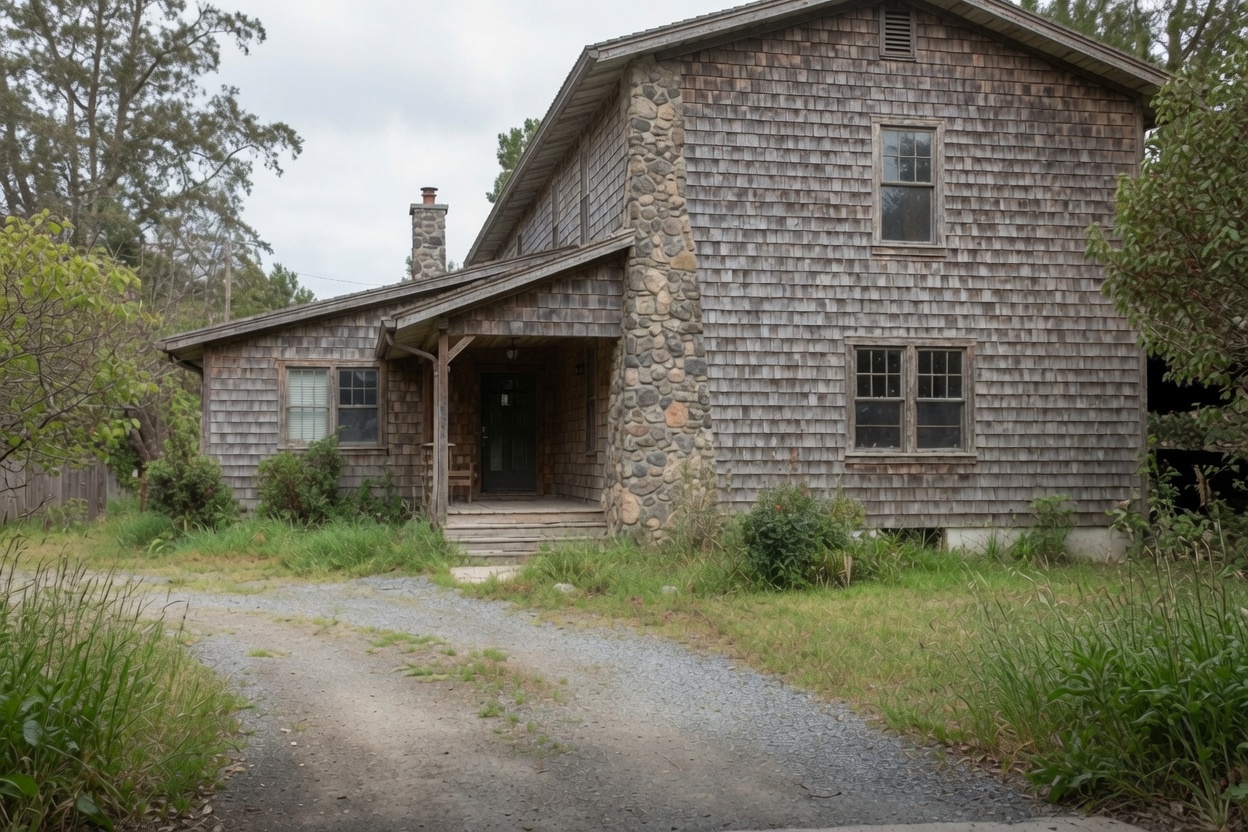
The exterior decides whether the rustic idea is believable. Start with the roof and entry: a simple roofline with real overhangs usually beats a busy roof with too many gables, and a porch should look deep enough to stand under, not like a thin decorative eyebrow.
A useful porch depth often starts around six feet. Less than that can still shelter a door, but it rarely feels like a real outdoor room, and the exact depth depends on the house, the snow load, code, drainage, and how the porch meets the steps and grade.
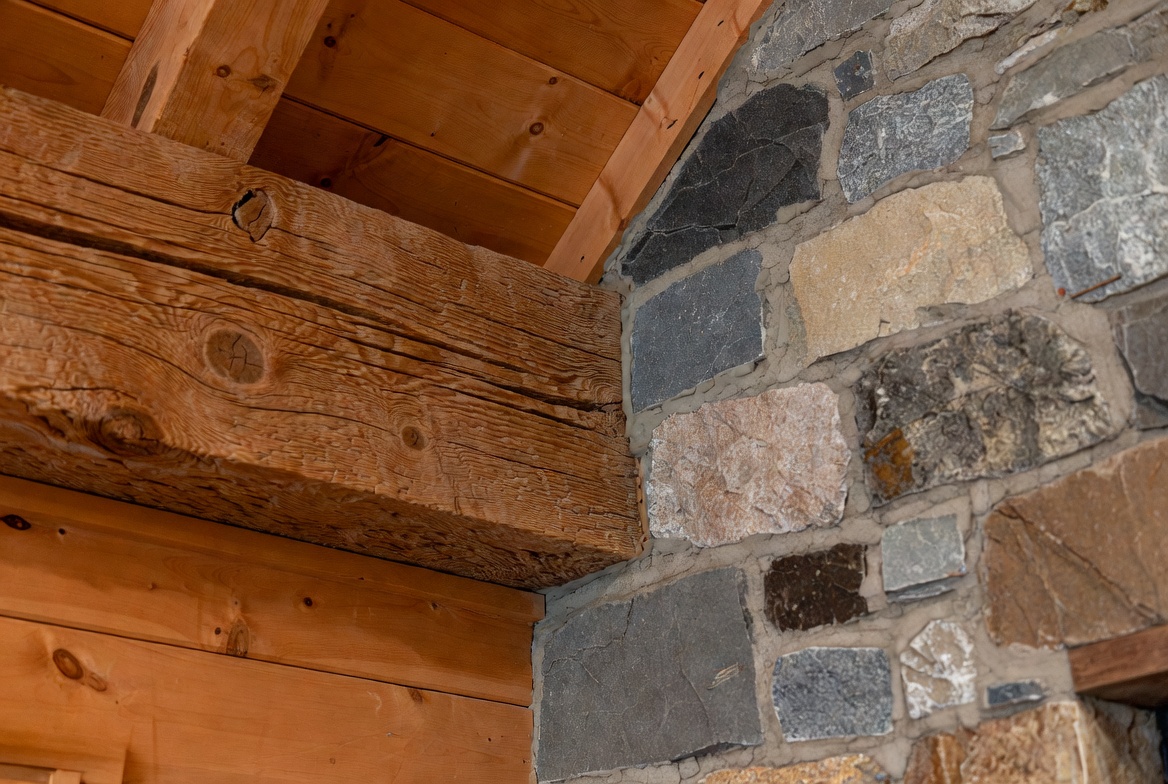
Stone belongs where weight belongs: the base, a chimney, a fireplace wall, a retaining edge, or an entry mass. Random stone patches around a garage or a thin strip under a window tend to make a house look cheaper rather than better, and if the stone is only there to say "rustic," it probably should not be there.
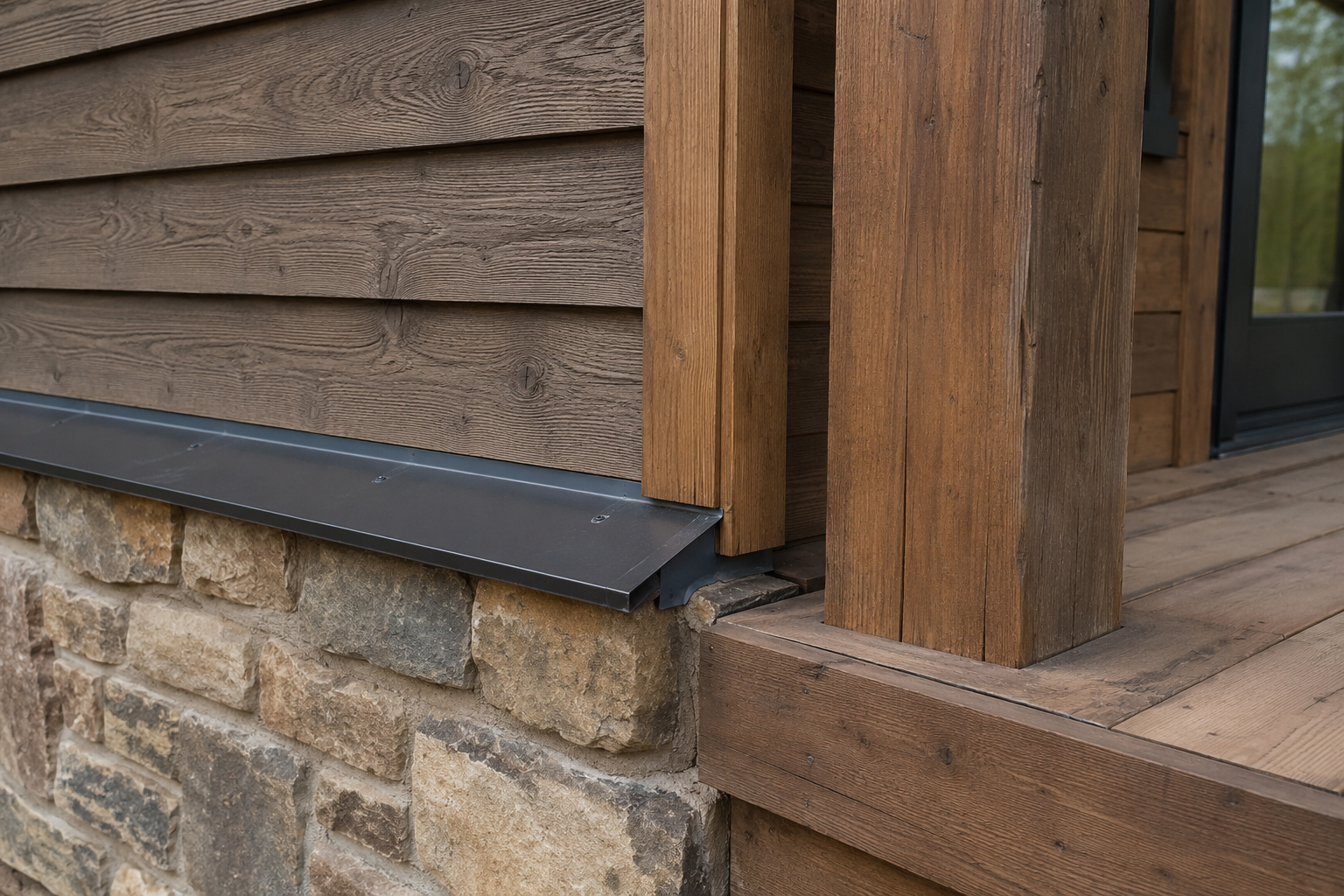
Wood siding works in many forms, board-and-batten, lap, shingles, rough-sawn, reclaimed, or a cleaner stained cladding, but what matters is rarely just the board. It is the corner trim, the flashing, the drainage gap, the bottom clearance, and how the siding meets stone, roof, porch, and grade.
Materials Have to Meet Cleanly
Rustic materials are unforgiving at the joint. Wood and stone can both be beautiful, and the line between them is where cheap work shows first. Water that sits on a ledge, runs behind siding, or disappears into a stone-to-wood joint may hide its damage for a season, and then the paint blisters, the trim cups, the stone edges stain, and the wall starts to look tired.
A clean rustic detail usually needs three things: a visible water break, enough thickness to look believable, and a logical change in plane. Wood should not look like it dives into stone, stone should not look like wallpaper, and trim should not be asked to hide every bad transition.
This is also why rustic renovation runs more than people expect. The visible material is only part of the price; the labor is in the cutting, flashing, backing, fastening, sealing, staining, and tying old work into new without opening a leak path.
This is where the material choices matter. Wood materials need the right finish, clearance, and weather protection. Wood in design can warm the house, but too much of it can make rooms heavy. Stone house design works best when the stone has real weight and a clear reason to be there.
What to Keep Before You Start Replacing Things
The first pass through a rustic house should be a keep-or-fix pass, not a shopping pass. Keep old wood floors if they are stable and repairable. Keep a real stone fireplace if it is safe, properly vented, and not causing moisture or draft trouble. Keep useful built-ins, keep porch mass, and keep windows that still make sense for the room even if the trim needs work.
What you should not keep is bad work that only happens to look old. Rotten beams, failing decks, leaky chimney flashing, soft porch posts, moldy paneling, and siding buried at grade are not character; they are repair bills waiting for a wet month. A rustic update should protect the best permanent parts first, and the finish choices get easier after that.
Rustic Interiors Need Light More Than More Wood
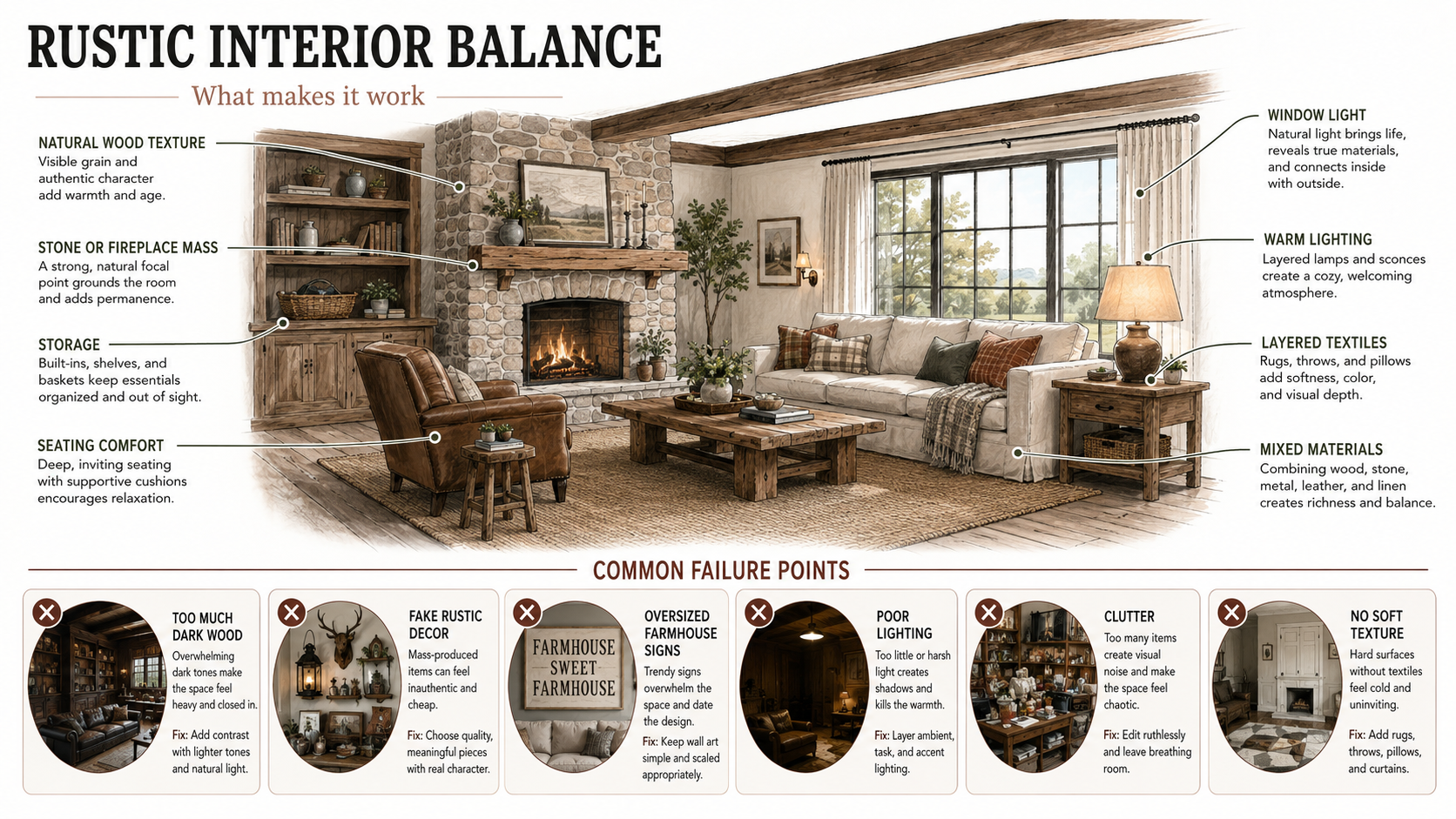
Rustic interiors fail when every surface tries to be the feature. A wood ceiling over a wood floor against a wood wall, with a dark sofa, dark cabinets, dark fireplace, and dark trim, can look warm in one photo and feel heavy every day after. A better rustic room has contrast: heavy beams against a lighter ceiling, a stone fireplace against softer walls, dark leather that works because the windows, rug, sofa, and lamps give the room room to breathe.
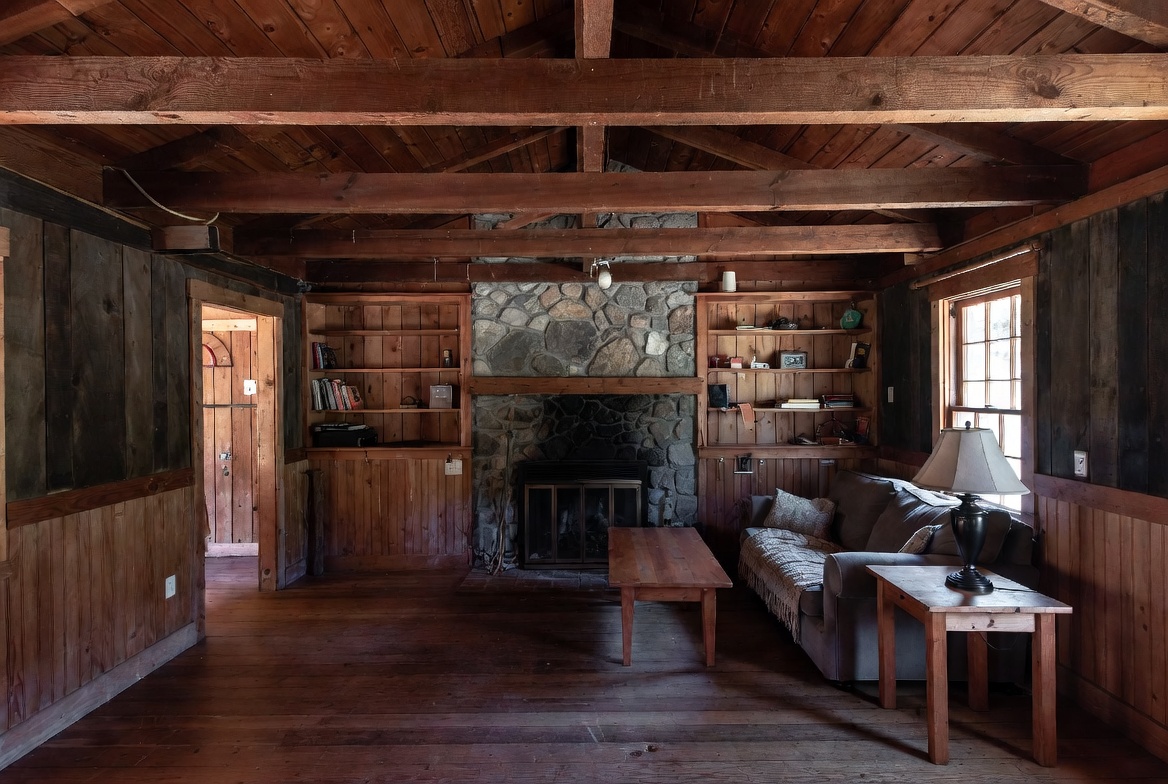
The practical rule is simple. If two large surfaces are already dark or heavily textured, make the third one calmer. A dark floor and a stone fireplace may want lighter walls, a wood ceiling and a wood floor may want a cleaner wall color, and a room with small windows probably wants fewer dark finishes rather than more.
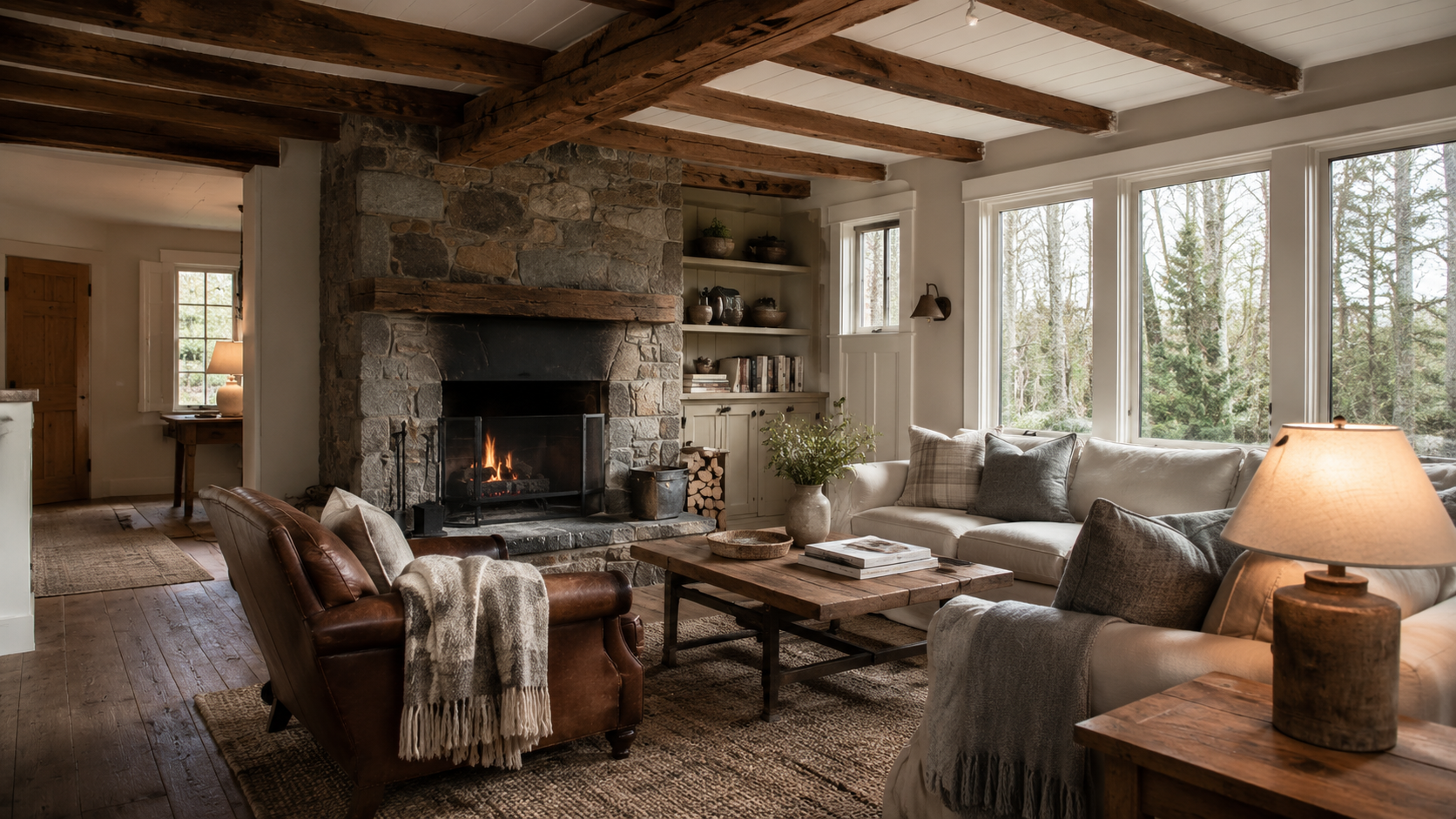
Inside, start with light and layout before finishes. A rustic living room may need better lamps before it needs more wood. A dark kitchen may want lighter counters, cleaner cabinet lines, and under-cabinet lighting before a reclaimed-wood island. If the kitchen is becoming its own project, treat it as a full rustic kitchen remodel, not just a cabinet or island choice. A bathroom may need ventilation and waterproofing before it gets a rustic vanity.
What Makes a Rustic Interior Feel Right
A rustic living room should feel useful before it feels styled: a place to sit, a place to set a cup, enough light to read, storage for daily clutter, and a fireplace or focal wall that does not swallow the room. The best ones balance four things, weight, light, softness, and order:
- Weight: stone, beams, heavy tables, thick shelves, or a fireplace mass.
- Light: windows, pale ceilings, lamps, sconces, and controlled contrast.
- Softness: rugs, throws, curtains, cushions, and fabric that cuts the echo.
- Order: built-ins, baskets, closed storage, and fewer loose decorative objects.
Rustic does not have to mean cluttered, and it does not have to mean bare. The room needs enough material character to feel grounded and enough restraint to stay livable.
Where the Money Goes
Rustic houses get expensive in the permanent parts, not the decorative ones. A homeowner tends to start by thinking about furniture, light fixtures, and wall decor, while the real money is usually in roof work, porch structure, siding repair, stonework, chimney repair, window changes, flooring, custom carpentry, and any lighting plan that needs electrical work.
A beam is not expensive because it looks rustic. It is expensive because it may need structural review, lifting, fastening, fire blocking, finish work, and clean integration into the ceiling. A stone fireplace is not expensive only for the stone; it is expensive for the weight, the hearth rules, the venting, the clearances, the masonry skill, and the way it has to tie into the room.
| Rustic feature | What makes it costly | What to check first |
|---|---|---|
| Wood siding | Prep, rot repair, flashing, staining, and corner details | Bottom clearance, drainage, sun exposure, and existing sheathing |
| Stone base or fireplace | Masonry labor, backing, ledges, weight, and transitions | Water path, structure, chimney condition, and veneer thickness |
| Exposed beams | Structural review, lifting, fastening, finish matching, and ceiling repair | Whether the beam is structural, decorative, or hiding something |
| Rustic kitchen | Cabinetry, flooring, lighting, counters, and appliance integration | Natural light, cabinet layout, venting, and whether wood tones overload the room |
| Rustic bathroom | Tile, waterproofing, ventilation, custom vanity work, and stone details | Moisture control, fan size, waterproofing method, and cleanable surfaces |
The Detail That Shows Up Three Weeks Later
A rustic house can look finished on day one and start to wear on the owner by week three. The fireplace is handsome, but the room goes dark at four in the afternoon. The reclaimed boards are beautiful, and they also catch dust and snag cloth. The stone wall photographs well, while its rough edge at the floor is a nuisance to clean. The black windows look sharp from the street and fight the softer room from inside. The big rustic coffee table is a great piece that nobody can walk around.
So it helps to think like a contractor here rather than a mood board. Rustic materials have texture, and texture catches dust. Stone adds mass, and mass drives the layout. Wood moves with humidity. Dark stain hides some dirt and shows every scratch and bit of lint. Rough surfaces look natural and clean harder. Heavy furniture gives a room weight and can strangle circulation in a small one.
The protective move is to test the room by daily use instead of by the photo. Walk the path from the kitchen to the sofa. Sit where the lamp will actually be. Check the sightline to the TV or the fireplace. Open the window coverings and see what the light does. Stand at the entry and find the first thing that already feels too heavy.
Rustic, Farmhouse, Cabin, and Lodge Are Not the Same
These styles overlap, but treating them as one bucket pushes a project in the wrong direction, because the wrong label leads to the wrong details.
| Style | What it leans on | Where it goes wrong |
|---|---|---|
| Rustic | Wood, stone, texture, shelter, site, and natural wear | Too dark, too fake, or too much surface distressing |
| Farmhouse | Simple forms, practical rooms, painted wood, porches, and utility | Oversized signs, forced shiplap, and staged decor |
| Cabin | Compact plans, wooded setting, fireplace focus, and simpler living | Small rooms overloaded with dark wood and bulky furniture |
| Lodge | Large volumes, heavy beams, stone fireplaces, and big gathering rooms | Scaled-down lodge details pasted onto a normal house |
| Rustic industrial | Wood, brick, metal, concrete, and heavier lighting | Cold rooms with hard surfaces, echo, and not enough softness |
Rustic farmhouse can work, rustic industrial can work, and modern rustic can work; the project just has to know which direction is leading. A simple rural form usually leans farmhouse, while exposed brick, steel, and heavier fixtures lean industrial. If the room starts leaning toward brick, black metal, and concrete, compare it with Scandinavian industrial interior design before the rustic side gets too cold.
Exterior Updates That Help Most
A rustic exterior usually improves fastest when the weak points get fixed in order.
- Clean up the entry. The front door, porch depth, steps, lighting, and path should read clearly from the driveway.
- Fix the base. Stone, skirting, exposed foundation, and planting beds need to look intentional and drain correctly.
- Simplify the color story. Most rustic exteriors need fewer colors, not more. Two main tones and one accent are enough for many houses.
- Control the planting. Tall grass and natural planting can work, but plants touching the siding invite moisture, pests, and maintenance trouble.
Weathered siding can be beautiful when it is controlled, and it can also be a warning. Gray boards, stain variation, and rough texture are not automatically problems; soft boards, open joints, failed stain, trapped leaves, and plants growing against the wall are, and those need inspection before any design decision.
Interior Updates That Help Most
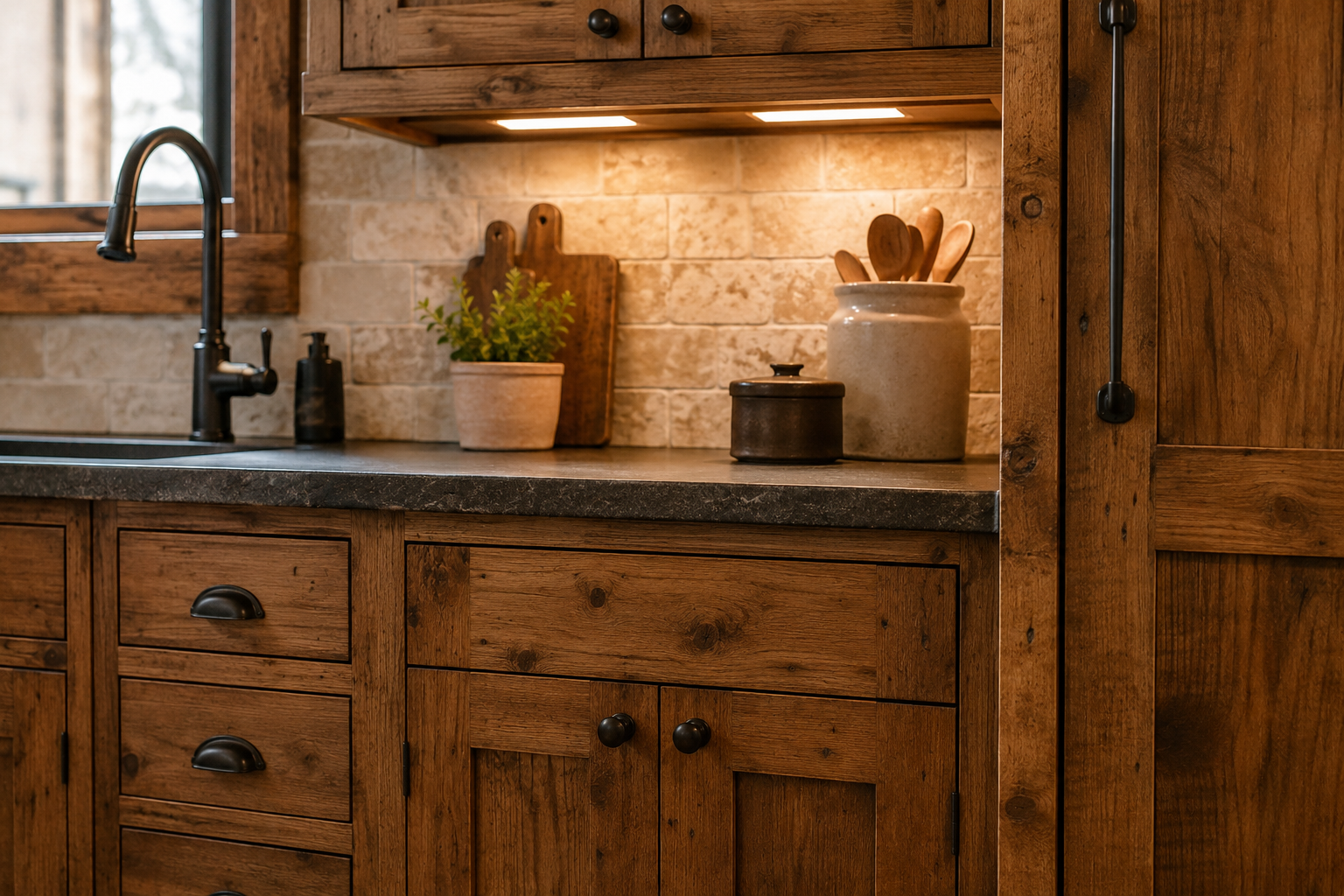
Inside, start with light and layout before finishes. A rustic living room may need better lamps before it needs more wood. A dark kitchen may want lighter counters, cleaner cabinet lines, and under-cabinet lighting before a reclaimed-wood island. If the kitchen is becoming its own project, treat it as a full rustic kitchen remodel, not just a cabinet or island choice. A bathroom may need ventilation and waterproofing before it gets a rustic vanity.
Use wood where people see and touch it, stone where mass helps the room, textiles where hard surfaces have made it cold, and storage where rustic decor has quietly turned into clutter. That order matters, because rustic rooms carry more visual weight than modern ones, and one wrong move can make the whole room feel smaller.
What to Skip
Skip the fake beams that do not line up with anything, the thin stone slapped onto one small wall, the barn door where a normal swing or pocket door works better, the giant word signs, and the distressed finishes that read as manufactured from six feet away.
Skip dark stain as the default answer, too. Dark wood can be excellent, but it needs light, contrast, and ceiling height, and in a low room with small windows it can make the space feel shorter and older in the wrong way.
And skip "rustic" materials in a bathroom until the waterproofing is solved, because wood near showers, rough stone behind sinks, and reclaimed surfaces around water turn into maintenance problems when they are chosen for looks first.
The Best Order for a Rustic House Update
The safe order is not glamorous, but it keeps money from being wasted:
- Water first: roof, gutters, grading, flashing, chimney, decks, and siding clearance.
- Structure second: porch posts, beams, decks, stairs, floors, and fireplace or chimney concerns.
- Light third: windows, lamps, sconces, ceiling color, and how dark finishes affect the room.
- Materials fourth: siding, stone, flooring, trim, cabinetry, and beams.
- Furniture and decor last: seating, rugs, tables, art, hardware, and smaller objects.
That order stops the project from becoming a pile of rustic purchases sitting on top of a house that still has drainage problems, awkward rooms, weak light, or bad material transitions.
Make Sure Rustic Is Actually You
Rustic is not a style to try on lightly, and it is not for everyone. A lot of people decide they want it because they liked a friend's cabin or a photo, which is a fine reason to go visit and a poor reason to commit. The house that suited your friend had their site, their light, their budget, and their patience for upkeep, and none of that transfers to yours. Wanting the feeling you had in someone else's living room is not the same as wanting to live inside that decision every day.
And that is what rustic really is: a decision that keeps deciding for you. Once the house commits to wood, stone, weight, and earth tones, everything that comes into it afterward has to answer to that. The lamp, the sofa, the appliances, the art, even the gifts your family and friends pick out for you: a bright plastic thing or a sleek chrome fixture will look wrong in the room, and you will either live with the clash or quietly swap it out. It governs your future buying, not just your renovation, and almost nobody thinks that far ahead while falling for a photo.
It is also genuinely hard to pull off. Everything on this page, the weight, the joints, the light, the water, has to line up, and half-doing it drops you straight into the fake, heavy, expensive-to-fix territory this page keeps warning about. There is not much comfortable middle ground between rustic done right and rustic worn as a costume.
None of that is a reason to walk away. Done properly, rustic is one of the most satisfying directions there is, because a house that truly settles into its materials and its site stays calm in a way trendier styles never manage. The point is only this: make sure it is a considered direction and not a mood you caught once at somebody else's place. If you understand what it costs, what it asks of you, and what it will keep asking long after the work is done, and you still want it, then it is worth doing right.
When Rustic Is the Right Direction
Rustic is a good direction when the house already gives you something to build on: a wooded site, a stone chimney, a strong porch, wood ceilings, old floors, simple massing, a rural setting, or a room that can carry heavier materials. It is a poor one when the whole plan is to make an ordinary room look "rustic" with props, because the house has to do some of the work, and so do the light and the site.
The best rustic houses do not read as decorated so much as settled. The materials look like they belong, the rooms still work, the exterior can take the weather, and nothing looks pasted on.
FAQ
What makes a house rustic?
A rustic house uses natural-feeling materials, heavier forms, texture, shelter, and a stronger connection to the site. Wood, stone, porch depth, roof shape, light, and landscape matter more than rustic decor.
Do rustic houses have to be log cabins?
No. A rustic house can be a cabin, ranch, farmhouse, lake house, mountain house, lodge, or rural home. The key is how the materials, roof, porch, rooms, and site work together.
Why do rustic houses sometimes look fake?
They look fake when the rustic parts are only surface decoration: thin stone, fake beams, random dark stain, glued-on brackets, or cabin details added to a house that was never designed for them.
What is the biggest mistake in rustic interiors?
Too much dark wood. Rustic rooms need light, contrast, softness, and storage. If the floor, walls, ceiling, cabinets, and furniture are all dark or heavy, the room can feel smaller and harder to live in.
What should you fix first in a rustic house update?
Start with water, structure, light, and material junctions. Roofs, gutters, grading, flashing, porches, siding clearance, windows, and stone-to-wood transitions matter before furniture or decor.