
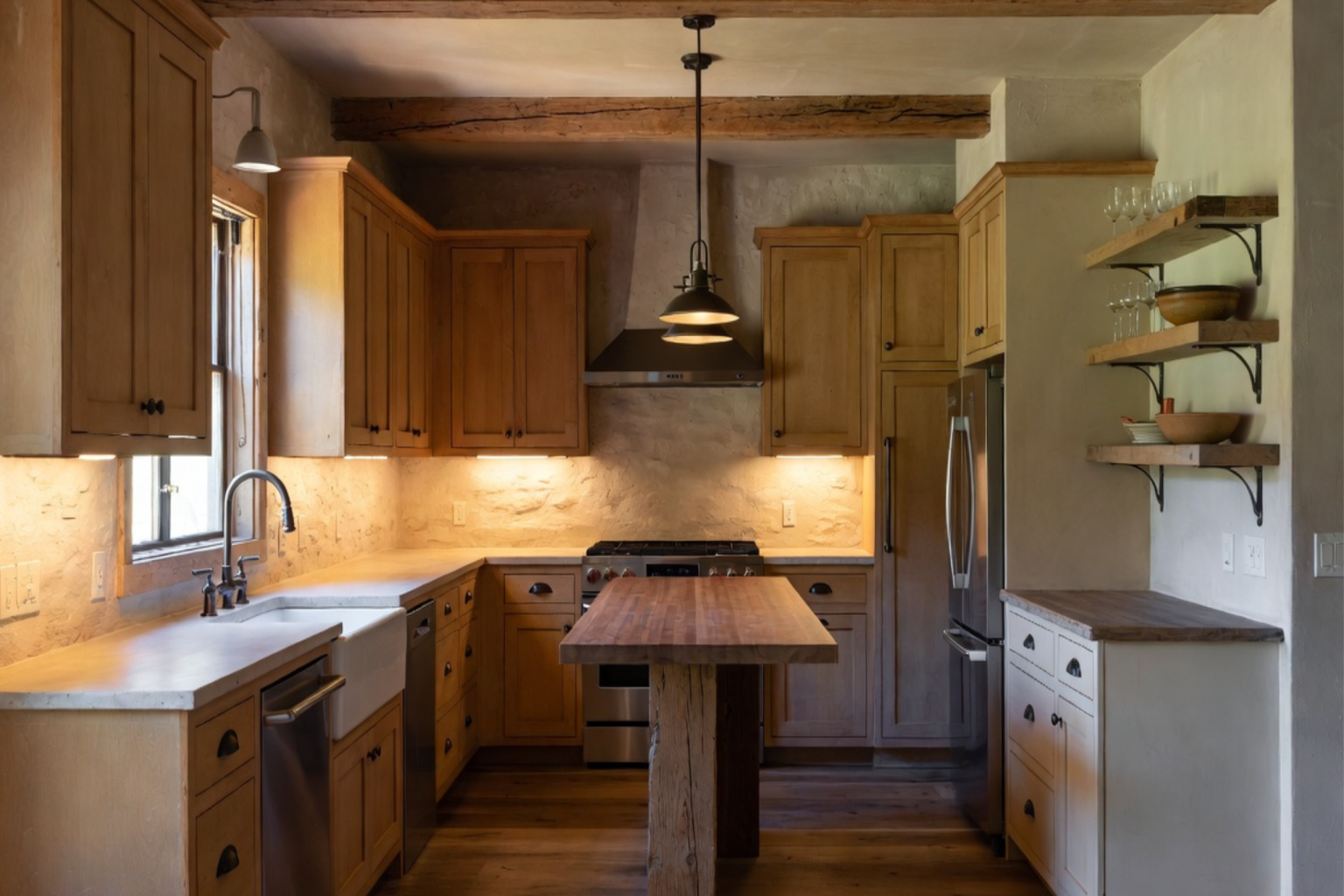

A rustic kitchen can be one of the most satisfying rooms in a house. Done well, it does not read as trendy so much as settled, with wood, stone, light, storage, and daily use all sharing the room without fighting each other. Done casually, it turns into one of the hardest rooms to live with.
Part of why is that a rustic kitchen controls more decisions than most people expect. The cabinets, counters, lights, stools, hardware, shelves, flooring, and wall color all have to agree, and so, eventually, do the dishes, the small appliances, and the cutting board left out on the counter. If one person in the house wants clean and modern and another wants cabin warmth, the room can turn into a tug-of-war fast. It is worth being honest up front about whether this is a style you want to live inside every day, or one you liked in a photo, a restaurant, or a friend's cabin, because their house, light, budget, and tolerance for texture may be nothing like yours. Get it right and it stays beautiful for a long time; get it wrong and it goes dark, busy, expensive, and hard to change.
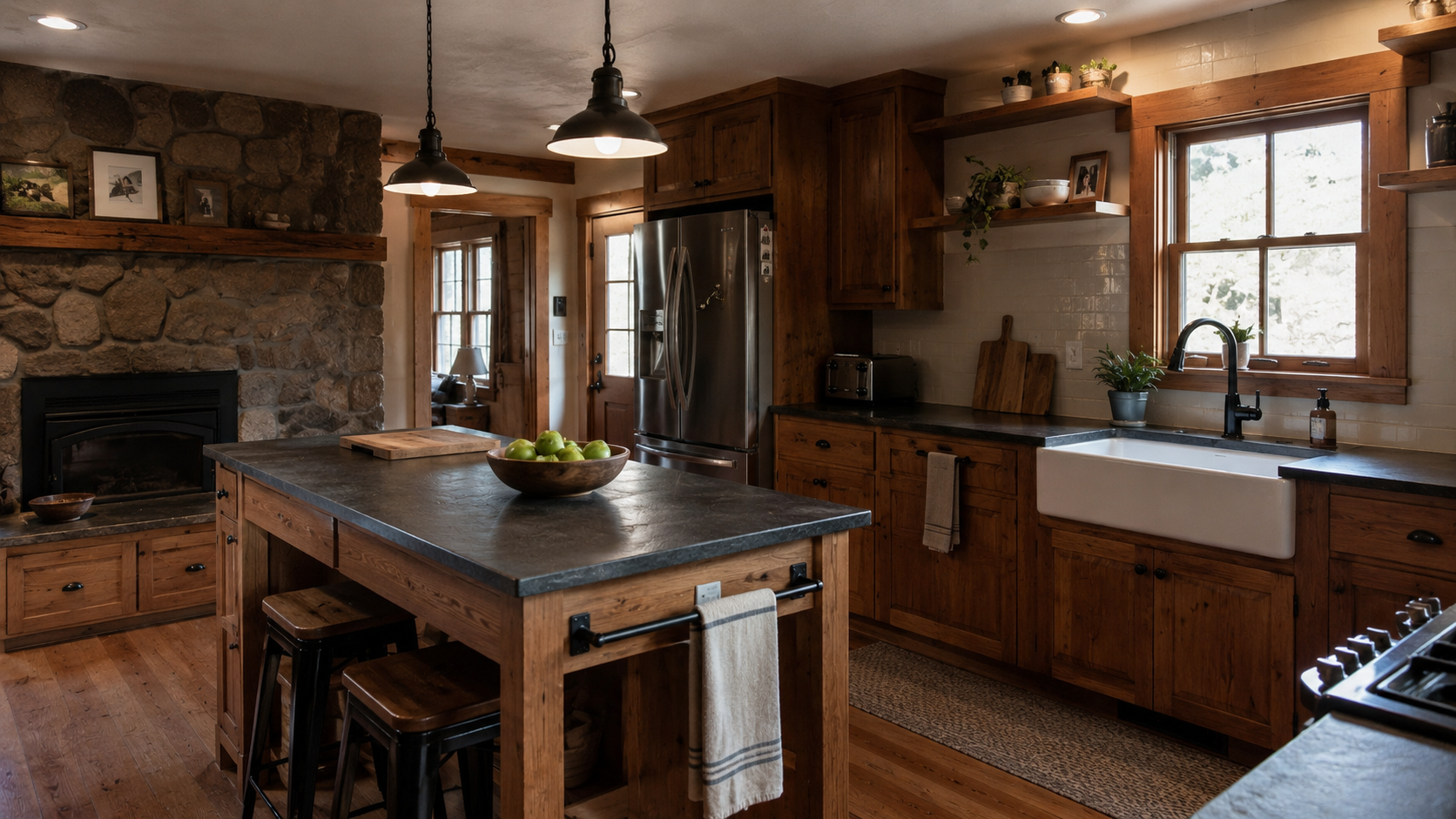
Before You Commit to a Rustic Kitchen
Rustic is not just a finish package; it is a discipline the whole room has to keep. The kitchen wants fewer stray purchases, not more, because a shiny appliance, a bright plastic bin, a glossy stool, or a cool-gray backsplash can break the room faster than you would think.
None of that means the kitchen has to look like an old lodge. Modern rustic can be clean, rustic farmhouse can be light, and a small rustic kitchen can absolutely work, but each one needs a clear balance set before the visible pieces get bought. The best rustic remodels start from use, the cooking path, the storage, the light, the cleanup, the ventilation, and the durable surfaces, and let the wood and stone come in after that without taking over.
The Wrong Starting Point Is Cabinets
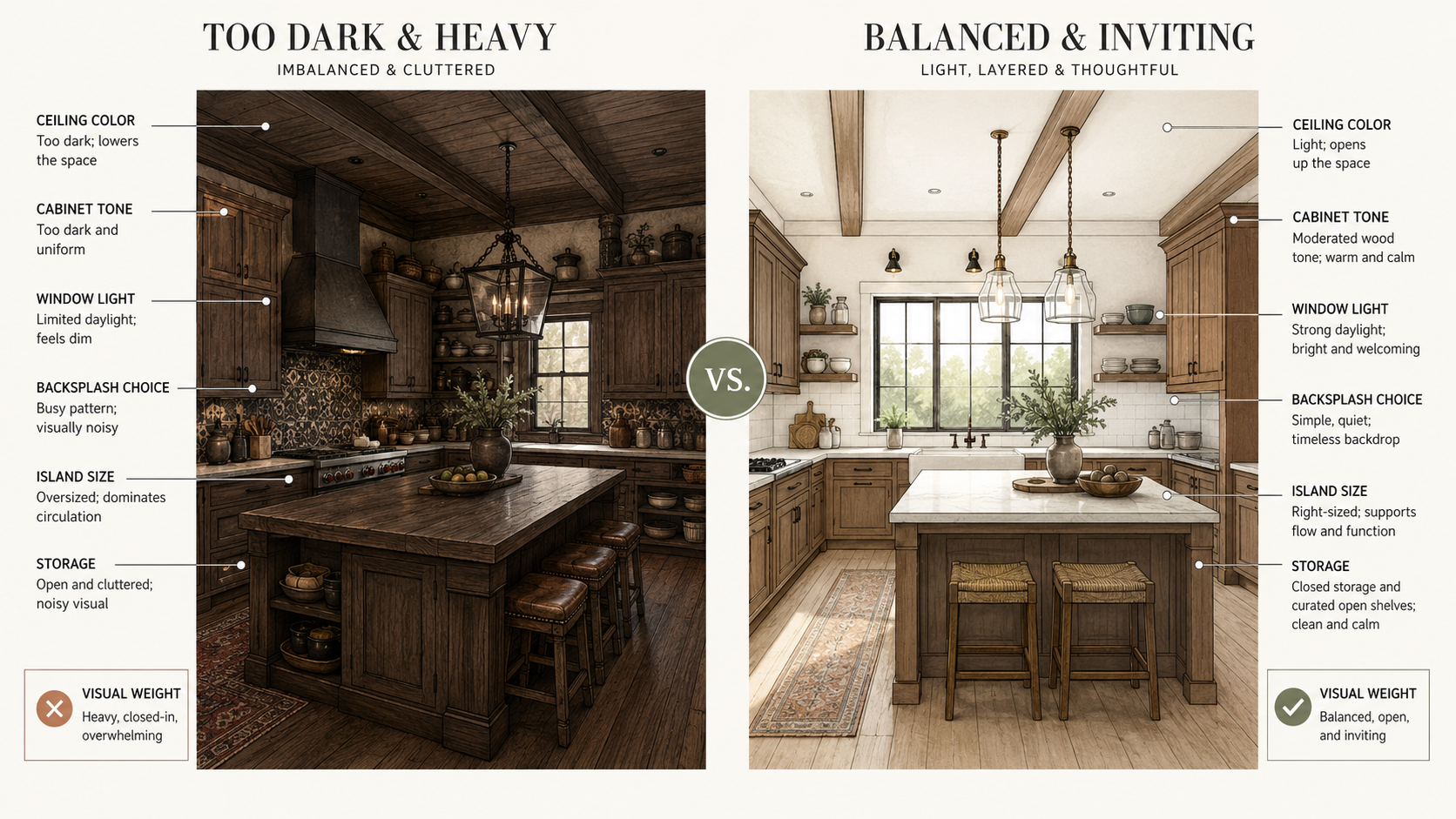
Cabinets are usually the first thing people want to choose, and in a rustic kitchen that is often a mistake, because cabinets carry so much visual weight. Dark knotty cabinets under heavy crown, next to open shelves, a wood island, a wood floor, and a wood ceiling, can look finished in a showroom and suffocating at home, photographing well from one angle and feeling heavy every morning.
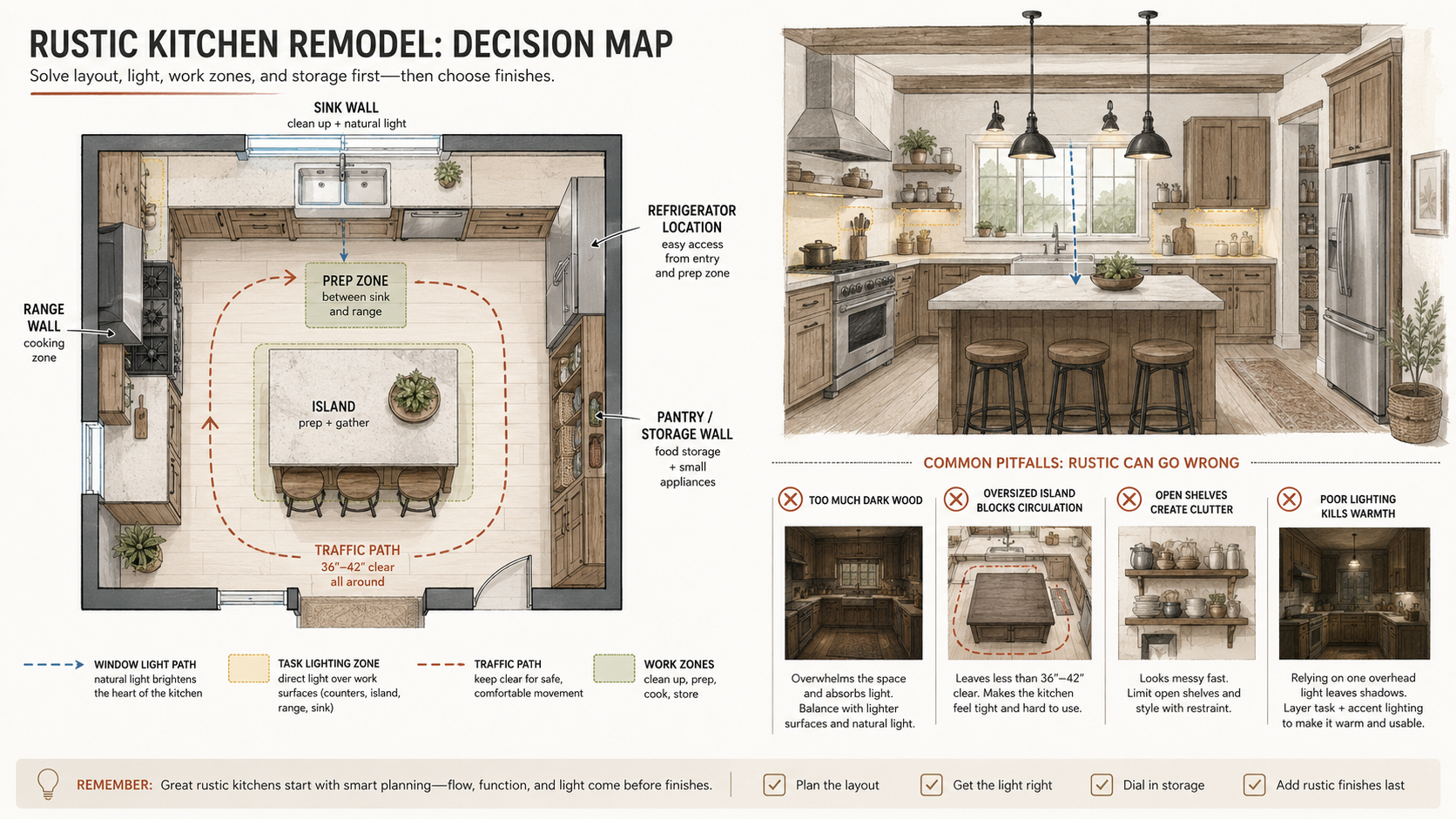
Settle the layout before the cabinet style: the sink wall, the range wall, the landing space beside the fridge, the island size, the storage wall, the trash pullout, the dishwasher swing, the main walking path, the window light, the task lighting, and the venting. Those are the choices that decide whether the kitchen works, because a rustic kitchen is still a kitchen, and the style will not rescue a bad work triangle, a blocked walkway, thin counter space, or storage so short that the daily clutter ends up living on the open shelves.
Where Rustic Kitchens Usually Go Wrong
The most common failure is sheer weight, when too much dark wood, too many strong grains, too many black fixtures, too much open shelving, and too much stone texture all pile up at once. Every piece can be attractive on its own and still add up to a tired room.
Next is fake age. Manufactured distressing, random barn boards, rough shelves with no real storage behind them, boxed-in fake beams, and "farmhouse" signs can date a kitchen faster than a plain cabinet ever would.
Then there is poor light. Rustic materials soak up visual energy, so a kitchen with dark cabinets, dark counters, and a low ceiling needs far more light than a white one, and a single pendant over the island is not a lighting plan.
The last one is ignoring cleaning. Rough wood near cooking grease, open shelves beside the range, textured stone behind the sink, and dark grout under the coffee station all look great on day one, and three months later the upkeep tells the truth.
Rustic Is Hard Because Balance Is Hard
A rustic kitchen has to hold several opposites at once:
- Warm but not brown: wood should give warmth without making every surface the same color.
- Old but not fake: the room can show age without looking like a themed set.
- Heavy but not cramped: beams, stone, and thick counters need space and light around them.
- Simple but not empty: rustic kitchens need useful objects, not decorative clutter.
That is what makes the room satisfying when it works: it feels earned, with real texture, weight, comfort, and use. It is also unforgiving, and when the balance is off the mistake is visible every single day.
Wood Tone Controls the Whole Room
Wood tone is the quiet boss of a rustic kitchen. Once the cabinets, floor, island, shelves, beams, and trim are set, every later decision has to answer to them. A medium cabinet can take a darker counter as long as the walls and ceiling stay lighter, while a dark cabinet usually wants a lighter backsplash, stronger daylight, and simpler hardware. A reclaimed-wood island works best when the perimeter cabinets stay calm, and a wood ceiling often calls for painted cabinets or a lighter floor to keep the room from closing in.
The flooring is part of this, not separate from it. A wood floor under wood cabinets and a wood ceiling is the fastest route to the "too much wood" problem, so a stone, tile, or lighter floor can be the thing that keeps the room breathing. The mistake is picking every wood piece because it reads "rustic," when the better move is choosing one or two dominant wood moments and letting the rest of the kitchen support them. If the room already has wood floors, exposed beams, or stained trim, the cabinet choice has to respect what is there, because another strong wood tone can add warmth or start a fight.
Cabinets Decide Whether the Kitchen Looks Solid or Cheap
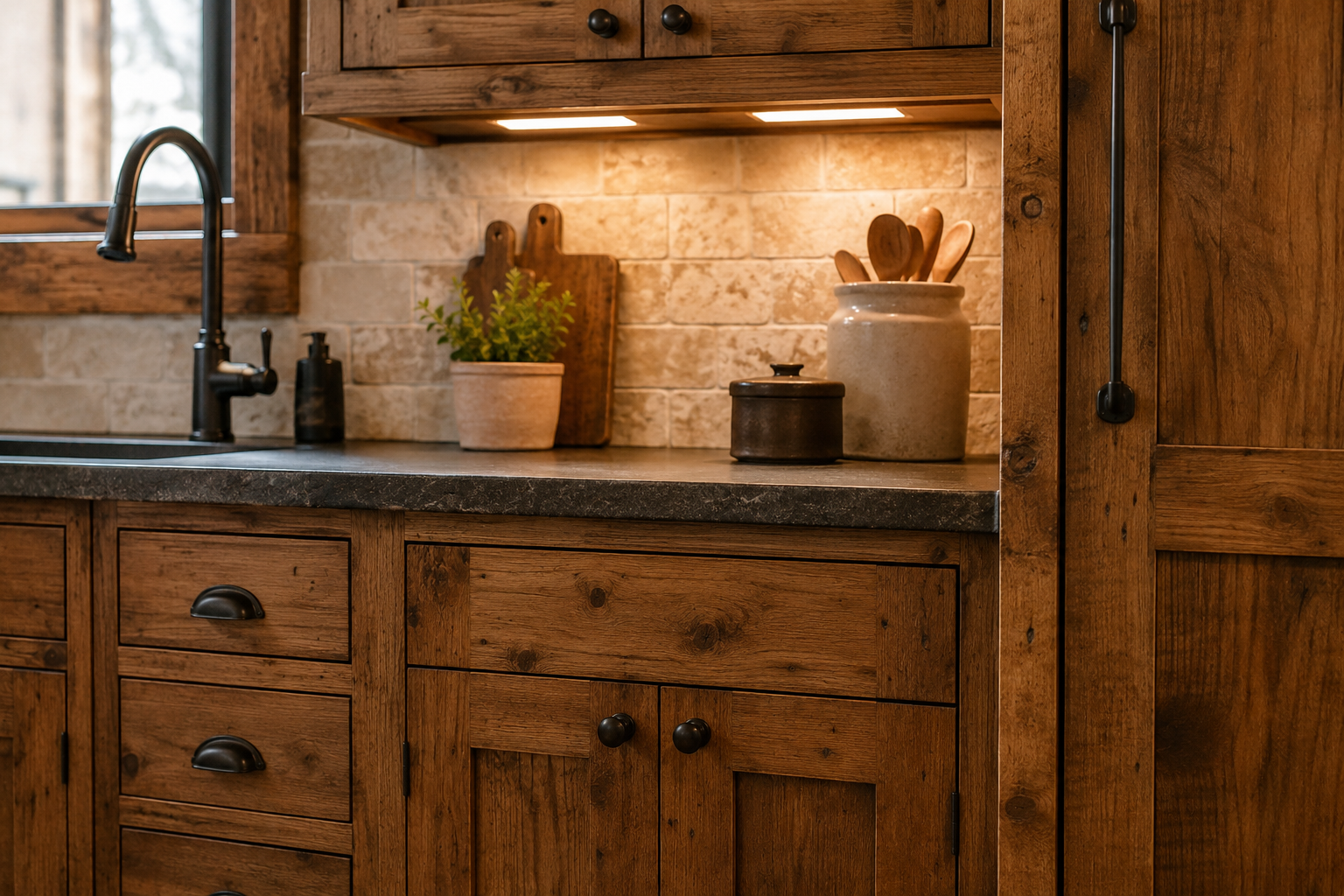
Rustic cabinets do not have to look rough. In a lot of houses the best rustic cabinet is a clean wood one with visible grain, good proportions, simple hardware, and a finish that ages without looking dirty. The trap is making every door a statement, since heavy knots, deep distressing, dark glaze, thick trim, and busy hardware overload the room fast, and it only gets worse in a small kitchen, a low-ceiling kitchen, or a room short on daylight.
Cabinet quality shows at the edges: the door rails, end panels, toe kicks, filler strips, crown, hardware alignment, and the way the cabinet meets the counter and backsplash. Rustic does not hide sloppy work; if anything it makes sloppy work louder.
Open Shelves Are Not Free Storage
Open shelves suit rustic kitchens because they show off useful things, the dishes, bowls, jars, boards, and mugs, but they also expose every weak purchase in the room. Let them become a display for random decor and the kitchen looks staged; load them with too many daily items and the wall goes noisy; put them beside the range and they collect grease; leave them as raw unsealed wood and cleaning becomes a chore.
Use open shelves where they help the room breathe, and keep closed storage for the ugly daily work, the food packaging, the plastic containers, the spare mugs, the small appliances, and the cleaning supplies that do not deserve to be part of the view.
Lighting Has to Be Planned, Not Added Later
Rustic kitchens need layered light. Daylight comes first, then a ceiling layer, task light, island light, under-cabinet light, and sometimes sconces or in-cabinet lighting, with the warmth coming from controlled light rather than from making every finish darker. Under-cabinet lighting earns its place here, because rustic counters and backsplashes throw shadow, and a wood shelf above a counter can darken the exact spot where the work happens.
Pendants should suit the scale of the island. Oversized lanterns, black metal cages, and heavy glass shades can all work, and they can also block sightlines and crowd the room, so let the fixture support the kitchen rather than announce the style.
The Island Can Make or Break the Remodel
Rustic kitchens tend to grow oversized islands, because a big wood island feels like the heart of the room. That works in a large kitchen and becomes a daily obstacle in a tight one. A comfortable aisle usually wants about 36 inches at a minimum and closer to 42 where people cook, pass, load the dishwasher, or open appliances, though the real number depends on the layout, the appliance doors, the stools, the family, and whether more than one person cooks at once.
An island should earn its footprint with prep surface, seating, storage, a trash pull, a microwave, or serving space. If it exists only because the photo looked good, it takes more from the room than it gives.
Backsplash and Countertops Need Restraint
The backsplash is where a lot of rustic kitchens get busy. Stone, brick, patterned tile, handmade tile, dark grout, heavy cabinets, wood shelves, and black hardware can all be good materials, and they do not all belong on the same wall. A quieter backsplash usually makes the wood look better, and a calmer counter lets the cabinets carry the room, while a simple stone or plaster texture can work well when the light is good and the cleanup zone is practical. Behind the range and the sink, cleanability decides everything, so rough texture in the splash zone needs a real maintenance plan. Rustic should never mean hard to wipe down.
Appliances Are the Hardest Thing to Keep Rustic
Appliances are the part of a rustic kitchen most likely to break the spell, because a big slab of stainless steel is the opposite of warm wood and aged stone. There are really three ways to handle it, and choosing one on purpose beats fighting it later. You can hide the big boxes, with a panel-ready refrigerator and dishwasher that wear cabinet fronts and disappear into the run, which is the cleanest look and the priciest. You can let a single appliance be the honest modern moment, where one stainless range against wood and plaster reads as intentional rather than accidental, as long as it is the only loud metal in the room. Or you can lean into warmer metals, with a range or hood in blackened steel, brass, or copper instead of stainless.
The range hood is worth real thought, since it sits at eye level, usually near the center, and it is big enough to set the tone for the whole room. A wood, plaster, metal, or stone hood can become the kitchen's best rustic feature, while a bare stainless chimney hood tends to fight everything around it. The sink and faucet pull the same way: an apron-front farmhouse sink with a bronze, black, or aged-brass faucet is one of the most rustic-friendly plumbing choices there is, and it hides a lot of daily mess besides. The smaller machines matter too, so give the microwave a drawer or a cabinet home instead of a stainless box on the counter, and keep the toaster, kettle, and coffee maker off the open shelves where they turn into visual noise.
When Rustic Is Not the Right Kitchen Style
Do not force rustic onto a kitchen that wants something else. If you love bright white surfaces, glossy finishes, hidden appliances, thin profiles, and a low-maintenance visual field, a full rustic kitchen may just frustrate you. And if your household buys a lot of colorful appliances, plastic containers, modern gadgets, and decorative gifts, the rustic look will need constant editing to hold together.
That editing is the real commitment, and it is worth naming: a rustic kitchen does not only shape what you buy during the remodel, it shapes what you keep buying afterward. It can feel restrictive or it can feel peaceful, and the difference is mostly whether you chose it clearly or drifted into it because one photo looked warm.
How a Rustic Kitchen Changes What You Buy
A rustic kitchen quietly changes how the room behaves. In a clean modern kitchen a single odd object can vanish, because the room is simple enough to absorb it. In a rustic kitchen every object joins the texture instead, so a bright package on an open shelf, a stainless toaster on a wood counter, a cool-gray plastic bin, or a glossy white appliance can shout much louder than it would anywhere else.
That is not a reason to avoid the style, it is a reason to go in understanding it. A good rustic kitchen works like a filter: it says yes to some things and no to others, it rewards patience, and it punishes impulse buying. It is also where gifts get awkward, because a decorative kitchen item that would be harmless in another room may simply not fit here, and that sounds trivial right up until the counters and shelves fill with things that break the room one at a time. The practical answer is to plan storage for the life you actually live rather than the photo you liked: closed storage to keep the daily noise out of sight, and a few open spots for the pieces that genuinely belong.
Rustic Kitchen Remodel Order
The safest order is not the prettiest one:
- Fix the room first: layout, aisles, appliance swings, window light, ventilation, and electrical needs.
- Choose the wood strategy: decide which surfaces carry wood and which stay quiet.
- Set the lighting plan: daylight, ceiling light, task light, island light, and under-cabinet light.
- Pick cabinets and counters together: so grain, color, edge, and cleanup all work.
- Add rustic detail last: shelves, stools, hardware, rugs, art, pottery, and smaller objects.
That sequence keeps the kitchen from turning into a pile of rustic-looking parts with no working center.
What to Spend On and What to Skip
| Spend on | Why it matters | Be careful with |
|---|---|---|
| Cabinet construction | Rustic kitchens show bad edges, fillers, and finish work quickly. | Fake distressing and heavy glaze. |
| Lighting | Wood, stone, and darker counters need more controlled light. | One oversized pendant pretending to be a full lighting plan. |
| Ventilation | Grease and smoke are harder to live with near wood shelves and textured surfaces. | Open shelves beside the range. |
| Counter and backsplash junctions | The joint decides whether the kitchen looks clean or patched together. | Rough materials in heavy water or grease zones. |
| Storage | Closed storage keeps the rustic look from becoming clutter. | Too many exposed dishes, jars, and decorative pieces. |
Modern Rustic, Rustic Farmhouse, and Cabin Rustic
These are close relatives, not the same kitchen:
| Kitchen direction | What it does well | Where it fails |
|---|---|---|
| Modern rustic kitchen | Balances clean lines with wood, stone, and warm texture. | Can go cold if the rustic pieces are too few or too decorative. |
| Rustic farmhouse kitchen | Works well with practical storage, painted finishes, wood counters, and simple hardware. | Can date with signs, forced shiplap, and too much staged decor. |
| Cabin rustic kitchen | Feels strong in wooded settings, smaller homes, and fireplace-centered plans. | Can go too dark when the walls, ceiling, floor, and cabinets are all wood. |
| Industrial rustic kitchen | Can handle wood, brick, metal, and heavier fixtures. | Can feel hard, cold, and loud without textiles, warm light, and softer surfaces nearby. |
Pick one direction to lead. Trying to run all four at once, because every saved photo had one detail you liked, is how the room loses its center.
A Good Rustic Kitchen Is Worth the Trouble
None of this is an argument against rustic kitchens. It is an argument against casual ones. When the balance lands, the style is hard to beat, warm without being soft, durable without feeling cold, full of character without needing constant decoration, and at home in an old house, a rural house, a cabin, a lodge, a farmhouse, a ranch renovation, or a modern house that just needs more texture.
It only has to be chosen with open eyes. Rustic kitchens are satisfying precisely because they demand decisions, and the wood tone, the light, the storage, the work zones, and the materials all have to agree. That agreement is the work, and once you get it right, the kitchen feels like it has always belonged there.
FAQ
What makes a kitchen rustic?
A rustic kitchen uses natural-feeling materials such as wood, stone, warm metal, textured surfaces, and simple durable details. The room should feel grounded and usable, not staged with fake age.
What is the biggest mistake in rustic kitchen design?
The biggest mistake is using too much dark wood, heavy texture, open shelving, black hardware, and stone at the same time. The kitchen starts to feel dark, busy, and hard to clean.
Are rustic kitchens hard to maintain?
They can be. Rough wood, open shelves, textured backsplashes, dark grout, and heavy stone can collect dust, grease, and marks. Good lighting, closed storage, ventilation, and cleanable surfaces matter.
Should rustic kitchen cabinets be dark?
Not always. Dark cabinets need strong light, simpler counters, and quieter walls. Many rustic kitchens work better with medium wood, painted cabinets, or one strong wood feature instead of dark wood everywhere.
Can a small kitchen be rustic?
Yes, but the rustic details need control. Use lighter walls, good task lighting, closed storage, one main wood tone, and fewer heavy surfaces so the room does not feel smaller.