
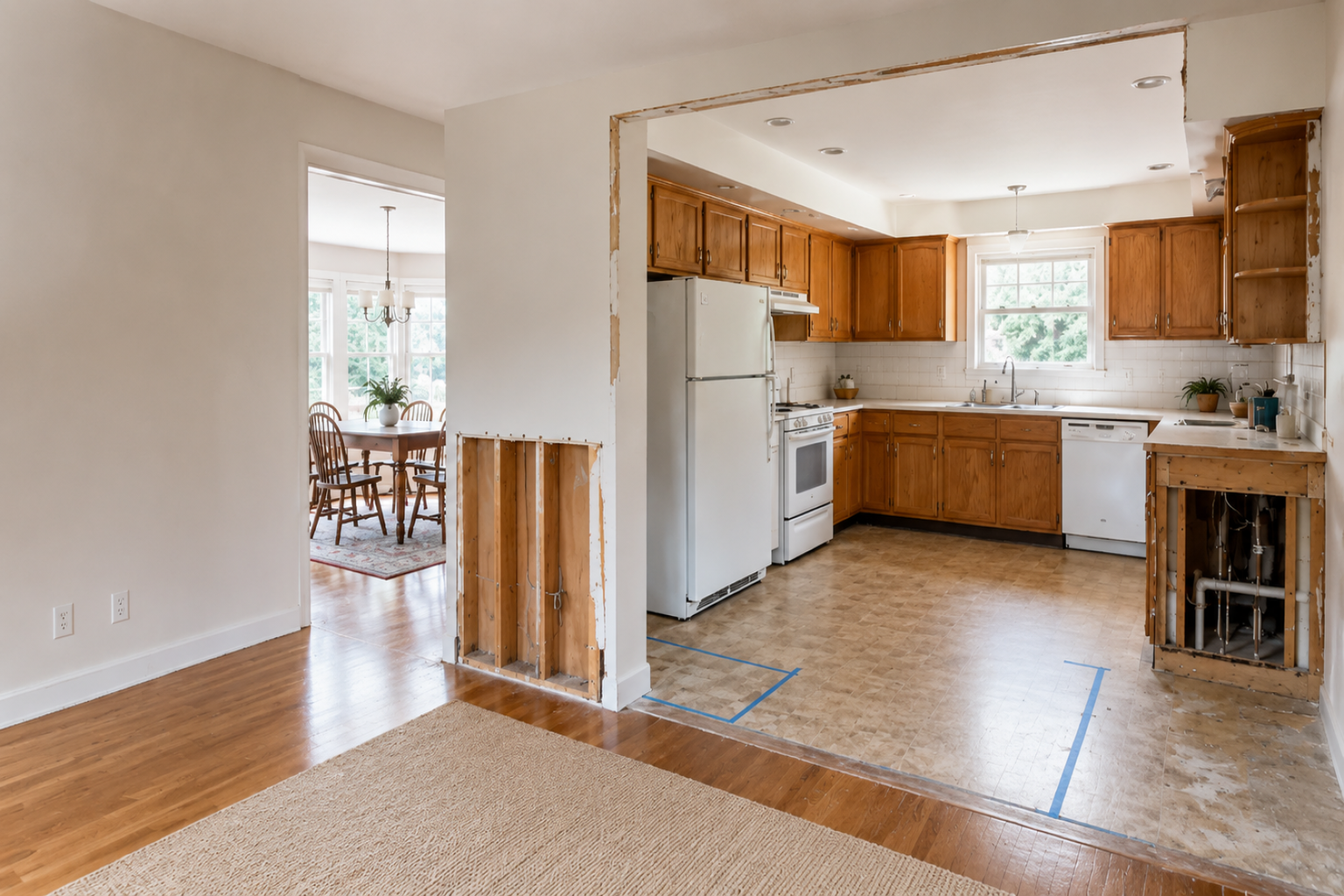


You walk a ranch kitchen, count the cabinets, look at the little square of floor, and the number in your head is low. It is a small room. How expensive could it be?
Then the plan grows a little. Take that wall down so the kitchen sees the living room. Move the sink under the window. Lose the soffit. And the floor — may as well run the new floor into the dining room while it is open, so it does not stop in a line where the wall used to be.
None of that is cabinets and tile. Cabinets and tile are the easy part to price. The cost lives in the other stuff: the wall, the plumbing, the wiring, the ductwork, and making the old house meet the new work cleanly enough that nobody can see the seam.
Same Size, Different Price
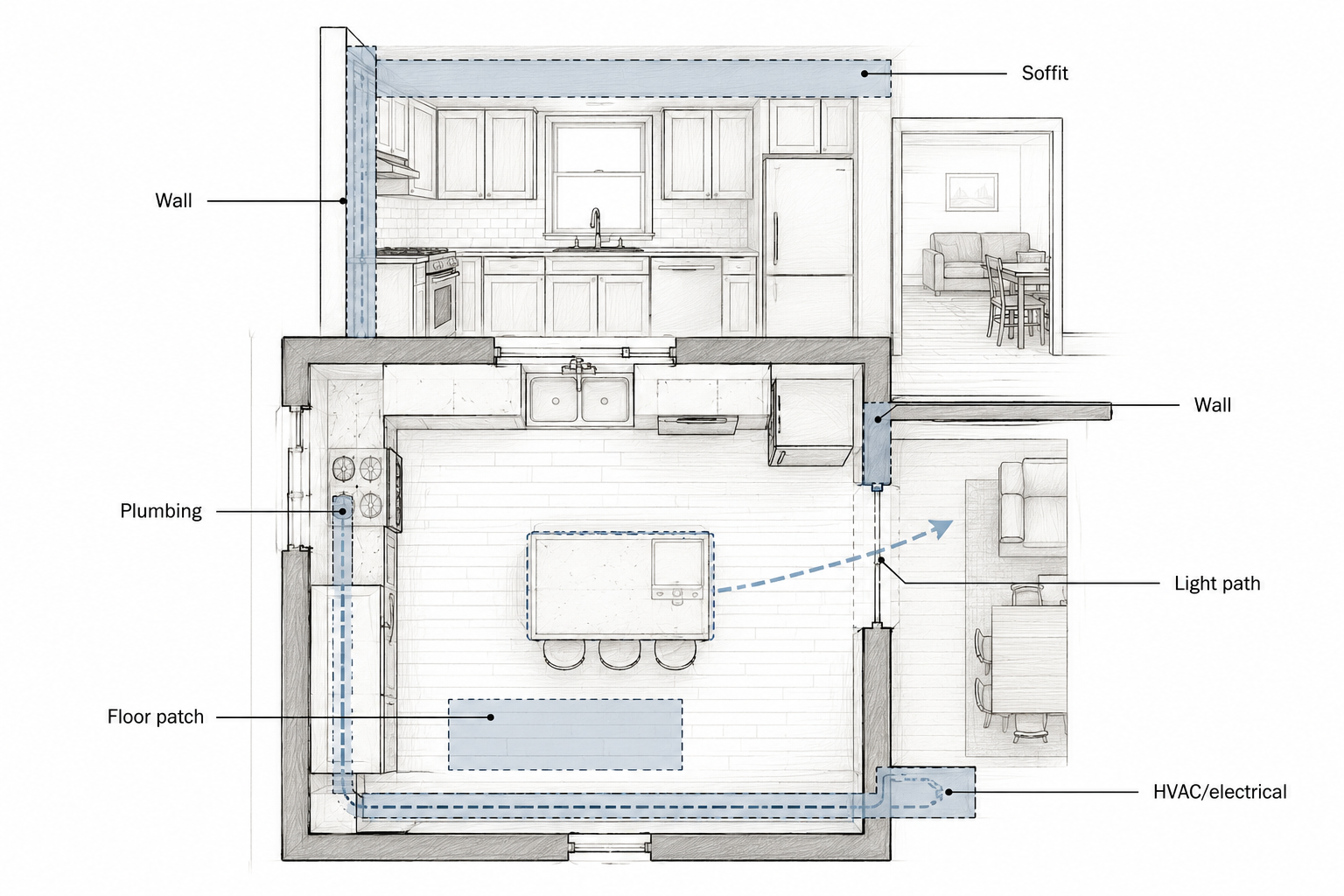
The kitchen can stay the same size while the price changes, because walls, soffits, plumbing, flooring, HVAC, electrical, and light-path decisions all change the scope. Illustration by ArchitectureCourses.org.
Two ranch kitchens can be the same size and price completely differently.
One keeps the sink, stove, refrigerator, walls, ceiling, window, and floor where they are. That job is mostly cabinets, counters, lighting, paint, appliances, and surface repair.
The other removes a wall between the kitchen and living room, shifts the sink to a new window, cuts back a soffit, adds an island, patches hardwood across an old cabinet line, moves outlets, and turns up a duct inside the wall that was supposed to disappear. Same footprint. Different job.
I would price the layout first and the finishes second. If the layout is not settled, the cabinet allowance is just a guess wearing a nice number.
The Real Variable Is How Far the Work Leaves the Kitchen
Most cost guides price the kitchen by what you do inside it. In a ranch, the better question is how far the work is forced to leave the room.
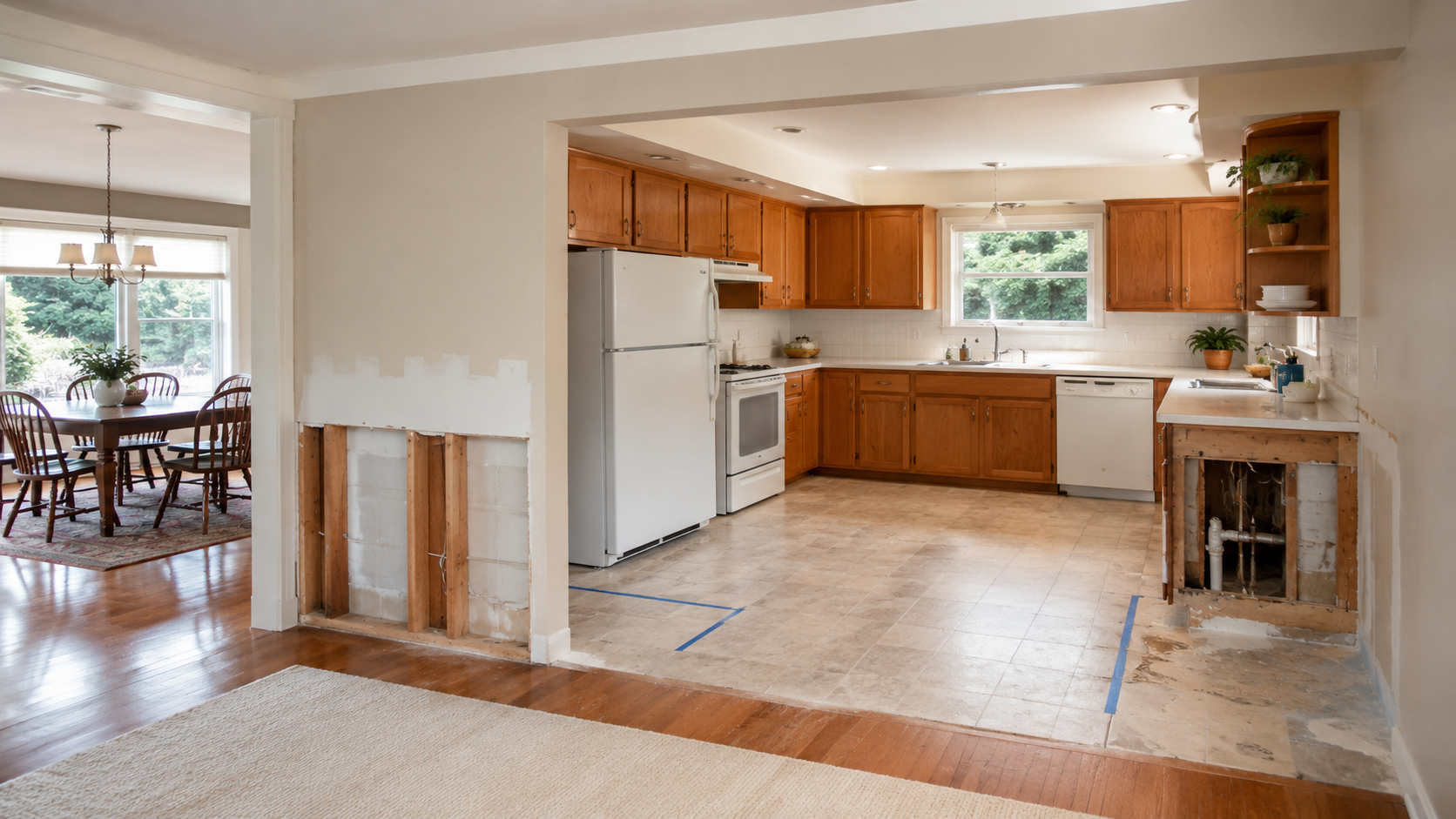
A ranch kitchen can look like a cabinet job at first, but wall openings, floor transitions, plumbing, drywall, and adjacent-room repairs are often what change the real scope. Image by ArchitectureCourses.org.
A ranch kitchen is rarely a sealed box. It usually opens to the dining area on one side, a hallway on another, and the living room past a half-wall or a soffit. That puts it at the hinge of the whole main floor. The work inside the kitchen can stay cheap. What gets expensive is the part that crosses the doorway into a room you were not planning to touch.
Every decision in the kitchen has a radius. A new floor that stops at the kitchen threshold is one price. A new floor that has to run into the dining room and down the hall so there is no scar at the opening is another, and it usually drags trim, transitions, and repainting along with it. Smooth one wall and you may have to blend it into the living-room wall it shares. Move a return or a duct hidden in a kitchen soffit and the fix can surface in the ceiling of the next room.
That is why two ranch kitchens with identical cabinets and counters can land thousands apart. The cheaper one kept its mess inside four walls. The expensive one quietly annexed two more rooms.
| Kitchen decision | Stays in the kitchen when | Crosses into the next room when |
|---|---|---|
| Flooring | The existing floor already ends at a doorway or a transition strip you are keeping | The kitchen is open to dining or living and a new floor would visibly stop mid-room, so it has to run into the adjacent space |
| Wall opening | A short partition comes out and the patch is contained to the kitchen side | The wall is shared, so drywall, paint, and trim have to blend onto the living-room face too |
| Soffit or ceiling | The soffit is empty and the ceiling repair stays above the cabinets | A duct or return reroutes and the ceiling work, or a new bulkhead, shows up in the hall or dining room |
| Plumbing wall | The sink stays on its existing wall | The wall is shared with a bath or laundry, and the move disturbs the room on the other side |
| Lighting and electrical | New circuits and fixtures stay on the kitchen ceiling and walls | The panel or a shared circuit forces work in adjacent walls, or the new kitchen light makes the next room look dim and it gets pulled in too |
Before pricing anything, draw the kitchen with the three or four rooms it touches and mark every decision that would cross one of those lines. The ones that stay inside the kitchen sit close to the published cost ranges. The ones that cross a line are where a ranch kitchen quietly turns into a main-floor remodel.
None of this argues for keeping the kitchen closed. An open ranch kitchen is often the right call. It just means the opening should be something you priced on purpose, not a line you find out you crossed after the floor is half torn up.
Ranch Kitchen Cost Planning Ranges
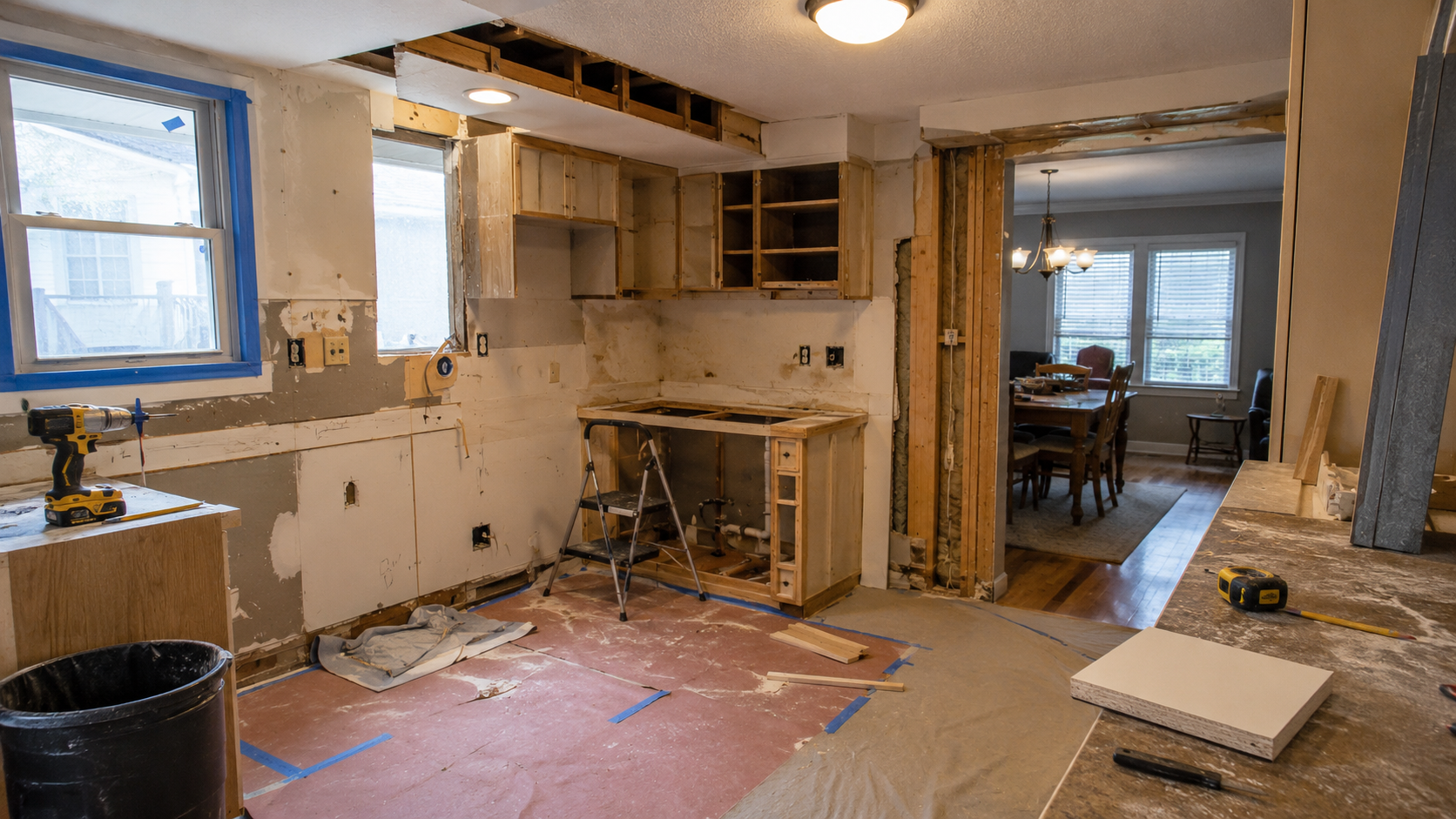
Ranch kitchen remodel costs start moving before the cabinets arrive, when soffits, wall patches, old wiring, plumbing, flooring, and layout openings get exposed. Image by ArchitectureCourses.org.
Use these as early planning ranges only. Local labor, cabinet quality, structural work, old wiring, plumbing access, appliance choices, and floor repair can move a ranch kitchen out of these bands fast.
| Scope | Planning Range | What Usually Changes the Price |
|---|---|---|
| Surface refresh | $8,000–$18,000 | Paint, hardware, lighting, minor repairs, maybe counters or appliance swaps |
| Same-layout remodel | $18,000–$45,000 | New cabinets, counters, sink, faucet, appliances, floor repair, lighting, backsplash |
| Layout repair | $35,000–$75,000 | Cabinet layout changes, small wall opening, electrical updates, floor patching, soffit decisions |
| Wall-removal remodel | $55,000–$110,000+ | Structural opening, beam, ceiling repair, duct or electrical relocation, flooring, larger cabinet package |
| High-end full gut | $100,000+ | Custom cabinetry, major wall changes, premium appliances, stone, new windows or doors, deeper mechanical work |
The lower numbers usually keep the room where it is. The higher numbers start changing walls, systems, and the rooms next door.
The Wall Is the First Expensive Question
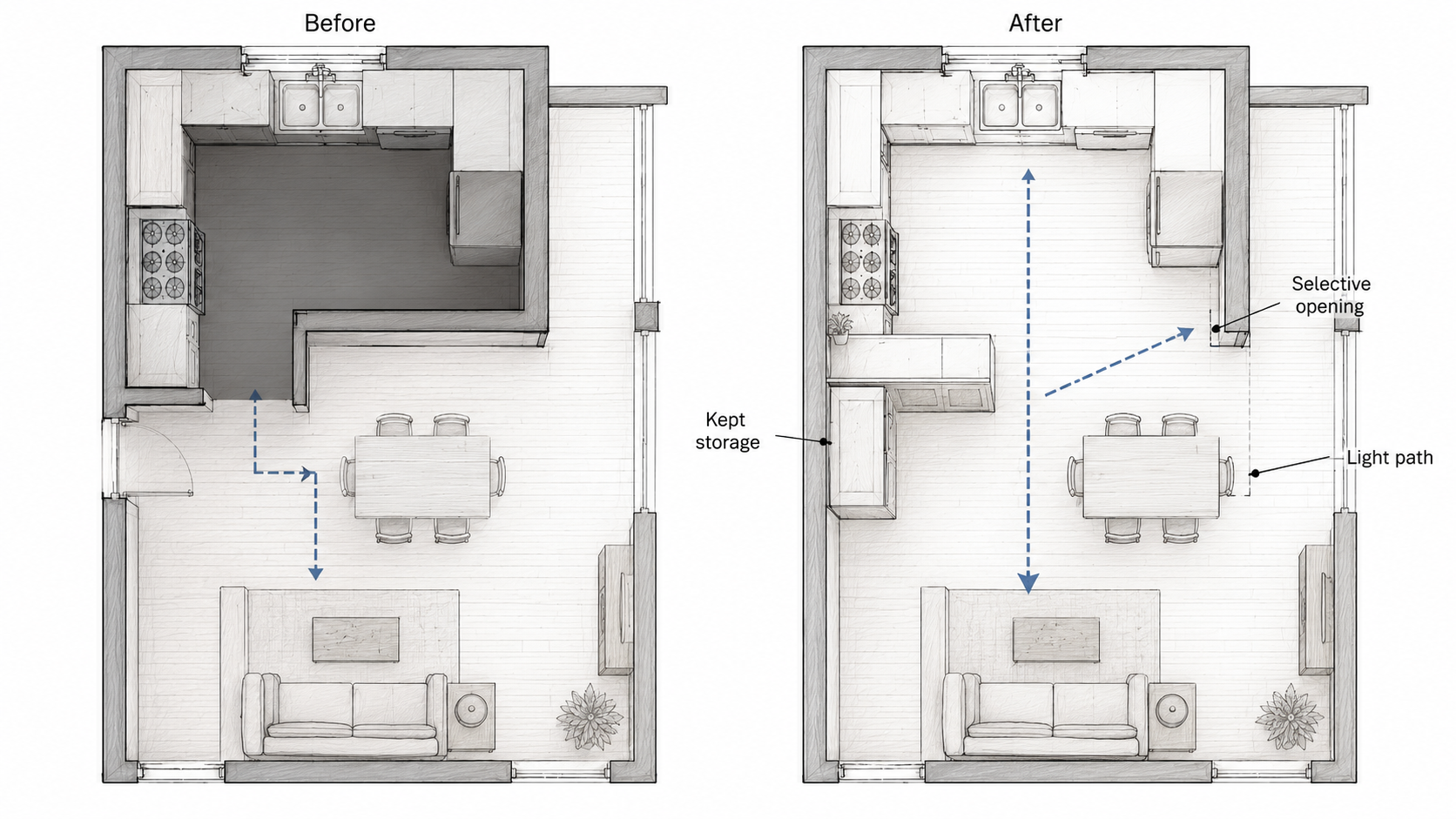
The smarter ranch kitchen remodel opens the right part of the wall, so light and movement improve without losing every useful storage surface. Illustration by ArchitectureCourses.org.
A ranch kitchen wall can be cheap trim work, or it can be the line that carries the whole ceiling.
Do not price “open concept” as if every wall is the same. A short non-bearing partition may come out with patching, electrical cleanup, and floor repair. A bearing wall can need temporary support, a beam, posts or point loads, ceiling repair, permits, and sometimes engineering. The beam might hide in the ceiling, or it might sit below it and change how the whole room reads.
The expensive mistake is approving the kitchen layout before anyone knows what the wall does. Design the cabinets, island, lighting, and flooring around an opening that later needs a visible beam or post, and the drawing starts over — money spent before demolition even begins.
Before removing a kitchen wall, read how to tell if a wall is load-bearing in a single-story house. For the broader structural difference, see load-bearing vs non-load-bearing walls.
Cabinet Layout Costs More Than Cabinet Style
Cabinet style gets most of the attention, when the layout is what actually moves the cost. A straight cabinet replacement stays fairly controlled if the sink, range, refrigerator, window, and doorways all stay put. The minute the layout changes, the cabinet package starts dragging other trades behind it.
Move the sink and plumbing follows. Move the range and electrical or gas may follow. Add a pantry wall and the lighting changes. Add an island and the floor plan has to prove the aisles work. Pull the uppers to lighten the room and that storage has to land somewhere else, usually in more expensive lowers, drawers, or a pantry cabinet.
In a ranch, the cabinet layout also decides how the next room feels. Open the kitchen too much and the living room gets better light but worse furniture placement. Keep too many uppers and the kitchen stays dark. The layout has to solve both rooms, or the remodel just moves the irritation from one to the other.
For the layout side of this problem, see ranch house kitchen layout problems and better fixes.
Moving Plumbing Is Rarely One Line Item
The sink move is where a simple plan gets expensive.
A sink is not just a base cabinet. It needs supply lines, drain slope, venting, a trap location, a relationship to the dishwasher, a disposal if you use one, shutoffs, and access. In an older ranch, the existing plumbing may run through a wall or floor cavity that does not cooperate with the new drawing.
Moving the sink to an island often costs more than people expect, because the drain and the venting get harder out in the middle of the floor. Moving it to a new window can mean cutting cabinets around the sill height, patching an exterior wall, reworking the electrical near the sink, and solving the backsplash edges. And if the kitchen shares a plumbing wall with a bath or laundry, one small kitchen move can disturb the room behind it.
I leave the plumbing wall alone until it gives me a real reason to move it. If the existing sink wall already allows a usable layout, decent light, and clean appliance placement, moving it just to make the drawing feel new is money you will not see again.
Soffits Are a Cost Decision
Old ranch kitchens are full of soffits, and you cannot tell from the room which kind you have. Some are empty boxes. Some hide ducts, wires, plumbing, uneven ceiling framing, or the scars of an old cabinet line. Until one is opened, it is a guess.
Removing an empty soffit can make the kitchen feel taller and cleaner in an afternoon. Removing a working one can trigger duct rerouting, electrical work, ceiling repair, drywall blending, and a cabinet redesign. The bad version is ordering cabinets for a full-height layout and then finding something expensive inside the soffit — now the choices are ugly filler, change orders, delayed cabinets, or a redesigned wall.
So I open a test hole before the cabinet order is final. That one ugly inspection cut can save a much uglier bill later.
Island or Peninsula?
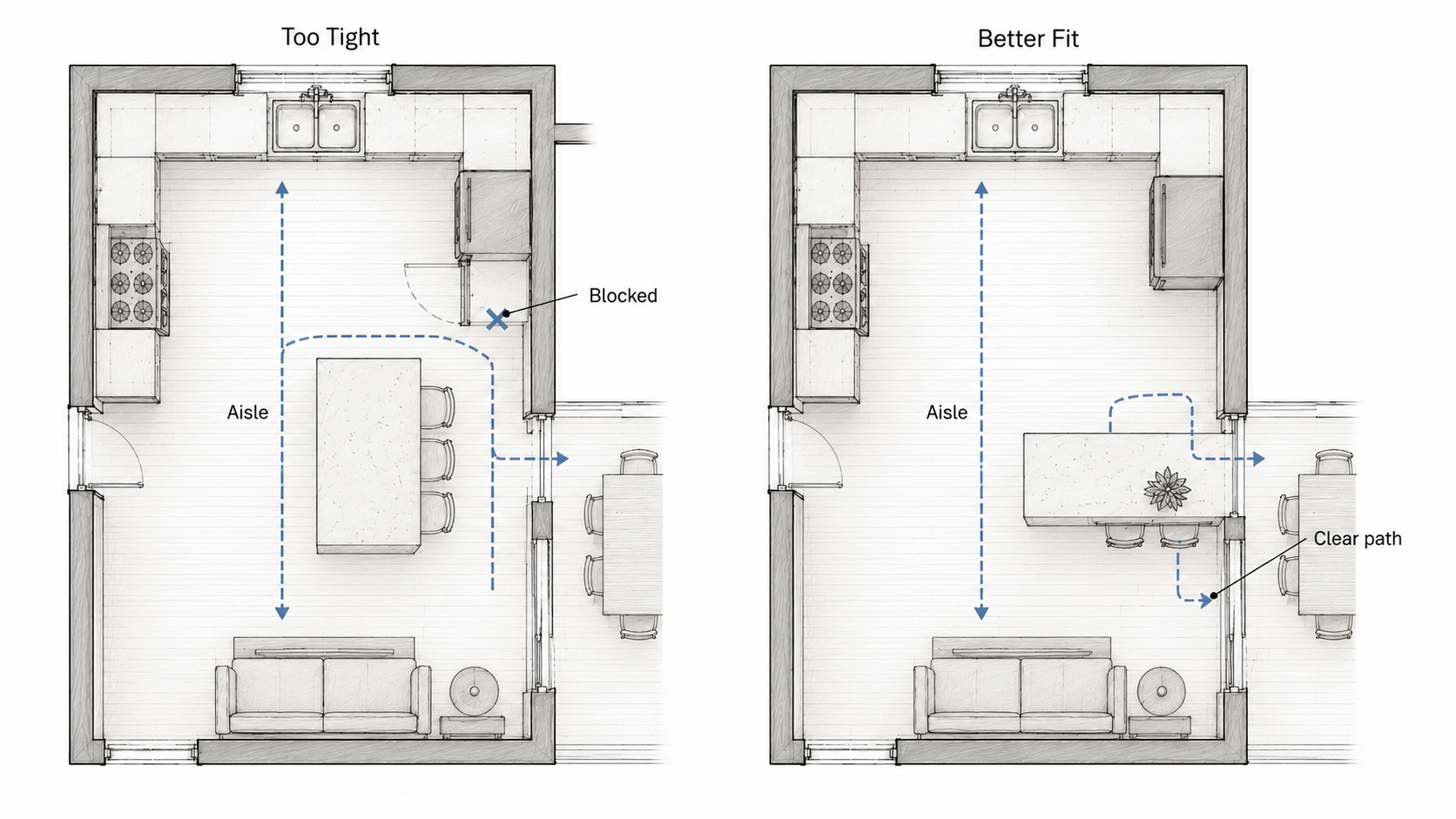
In a small ranch kitchen, an island can cost more and work worse when the aisles cannot carry circulation on all sides. Illustration by ArchitectureCourses.org.
An island is not automatically the better ranch move.
Small ranch kitchens often look better on the drawing than they work in the room. The island fits the plan, but the refrigerator door hits the aisle, the dishwasher blocks the sink zone, the path from the garage cuts across the cook’s back, and a stool overhang quietly eats the only clear route to the dining table.
A peninsula can be cheaper and work better when the room is narrow. It adds counter, storage, and a visual opening without needing clearance on all four sides. It can also turn into a fence if it runs too long or sits between the kitchen and the room it was meant to connect.
| Choice | Use It When | Cost Risk |
|---|---|---|
| Island | The room has enough clear aisle space on all sides | Electrical, flooring, tight aisles, oversized cabinet package |
| Peninsula | The kitchen is narrow but needs more counter and storage | Can block circulation if it runs too long |
| No island | The existing footprint is too tight | Resale photos may look less trendy, but daily use may improve |
| Small movable worktable | The kitchen needs flexibility more than built-in cabinetry | Less storage, but fewer floor and electrical complications |
The Floor Patch Tells on the Remodel
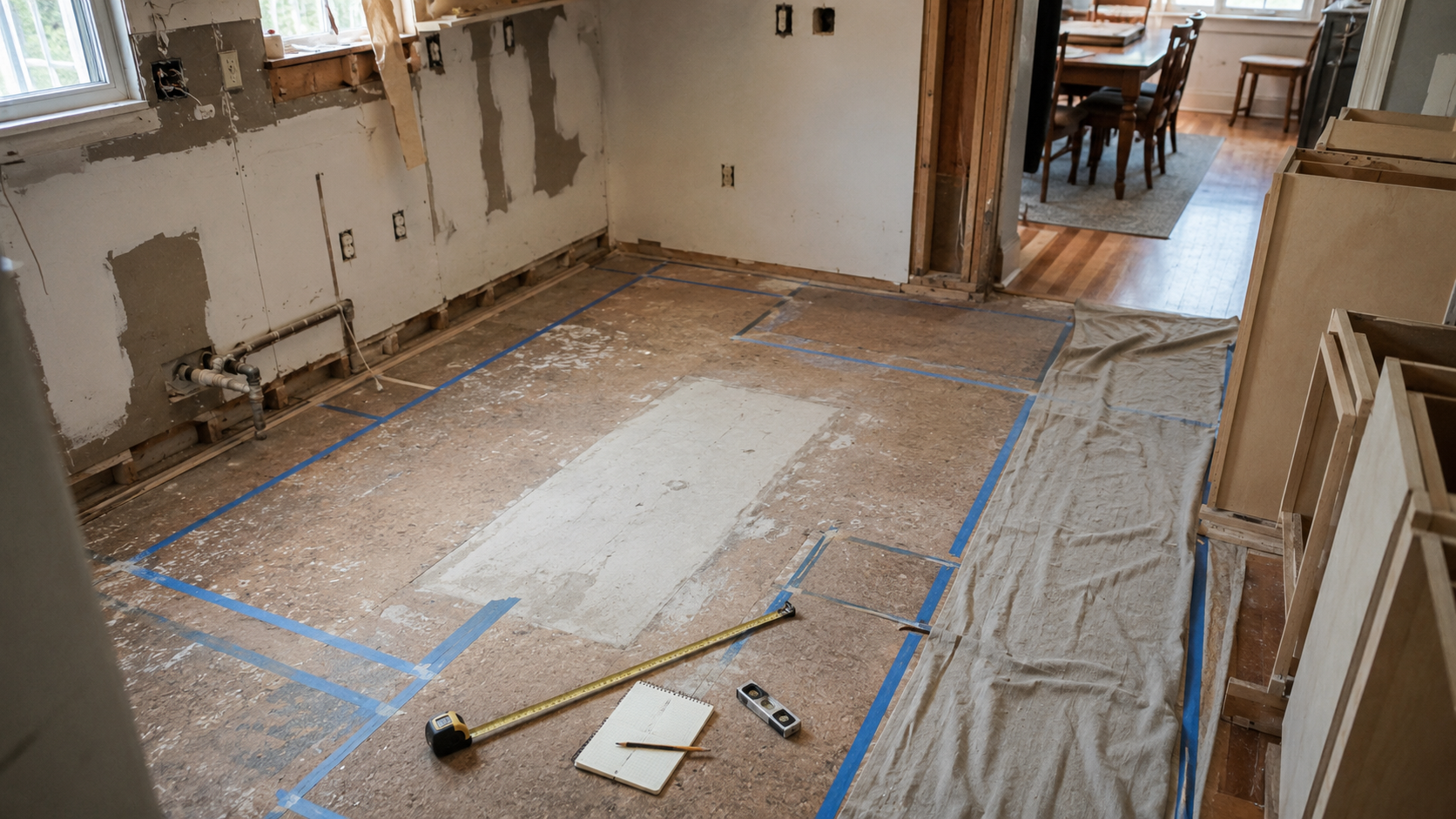
The floor patch and taped cabinet layout show what has to be priced before new cabinets lock the kitchen into place. Image by ArchitectureCourses.org.
The floor is where the old kitchen leaves its fingerprints. Remove a wall and the flooring may stop where the wall used to be. Pull the cabinets and the floor can disappear underneath them. Move the island and the patched area can sit in the middle of the room like a map of the old layout. Older hardwood, stacked vinyl, or discontinued tile only makes the patch harder to hide.
This is what pushes a kitchen job past the kitchen. If the room opens to dining or living space, the new floor may have to run farther than planned so the opening does not read as a scar — which can mean refinishing the next room, feathering hardwood, replacing more flooring, or living with a transition strip exactly where the remodel was supposed to feel open.
So price the floor before you celebrate the wall coming out.
Electrical and HVAC Find the Weak Spots
Old ranch kitchens were not built for today’s load — the appliances, the lighting plans, the vent hoods, the coffee stations, the under-cabinet lights, the microwave drawers, the charging zones, the island outlets.
That does not mean every kitchen needs a full electrical overhaul. It means the electrical plan should be checked before the cabinets lock the walls in place. Outlets, circuits, fixture locations, fan and hood requirements, appliance specs, and panel capacity all feed the real number.
HVAC can be just as much trouble. A wall you planned to remove may hide a return. A soffit may carry a duct. A low ranch ceiling may leave no clean way to move air without a visible compromise. A beautiful cabinet elevation is not a mechanical plan.
The fix is not to guess. Open what needs opening, trace the route through the attic or the crawlspace or basement, and find out where the wires, ducts, vents, and pipes will go before the final cabinet drawing gets approved.
Permits Can Change a Small Kitchen Job
A ranch kitchen can cross the permit line without looking like it has. Replacing cabinet doors is one kind of project. Moving electrical, changing plumbing, taking out a bearing wall, adding a beam, rerouting a hood, or opening a ceiling is another. The finished kitchen can look like a simple update while the inspection side involves structure, circuits, ventilation, fire blocking, and plumbing access.
Ask before signing: which parts of this kitchen need permits, who pulls them, and what happens if the inspector calls for work outside the original finish scope. A cheap quote gets expensive when code shows up after demolition.
The Quote Usually Changes After Demolition
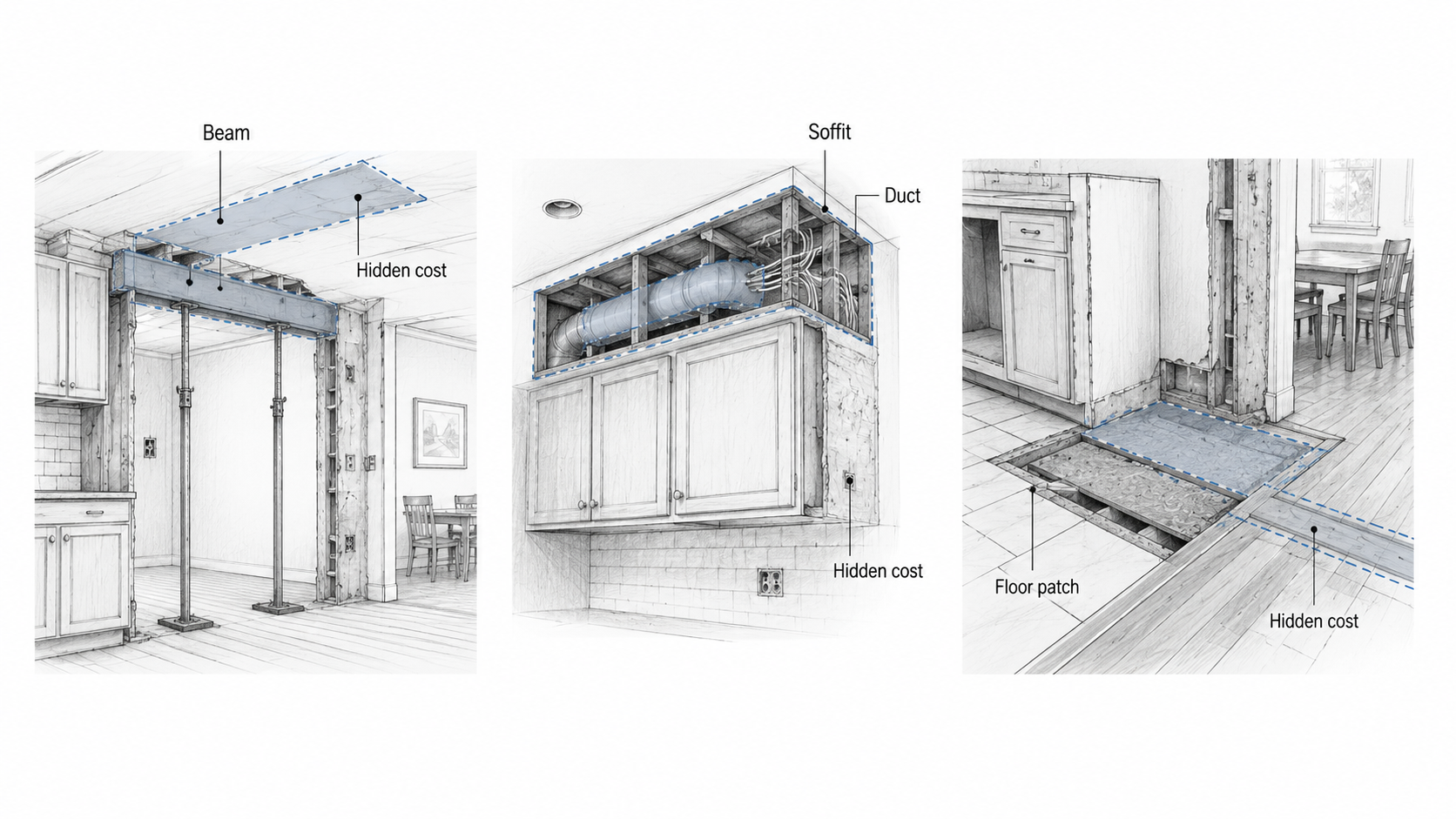
The quote often changes after demolition, because walls, soffits, ducts, wiring, beams, and floor patches hide work that cannot be priced cleanly from the finished kitchen. Illustration by ArchitectureCourses.org.
This is the part that catches people after they have already signed.
A kitchen quote may include cabinets, counters, labor, and a wall opening. It may not include beam engineering, floor feathering, asbestos testing, old-wiring corrections, a panel upgrade, duct relocation, plumbing vent changes, drywall blending into the living room, or repainting a ceiling past the kitchen. It may just say “patch as needed,” which can mean almost anything once the room is open.
This is not always contractors hiding the ball. A ranch kitchen simply has too many old conditions buried under cabinets, soffits, flooring, and walls, and nobody can price every hidden one perfectly off a clean walk-through.
So ask the uncomfortable question first: what falls out of scope if the wall, the soffit, the floor, or the plumbing chase opens badly? If the answer is vague, the first price is not the project price. It is the entry fee.
Where Ranch Kitchen Remodels Waste Money
Most of the waste in a ranch kitchen goes to the parts that photograph well.
| Money Goes Here | Usually Better Spent On |
|---|---|
| Oversized island | Clearer aisles, better landing space, right-sized storage |
| Moving sink for looks | Keeping plumbing and improving light, counter runs, and storage |
| Full wall removal | Smaller opening, pass-through, or beam planned before cabinets |
| Premium backsplash | Electrical, lighting, floor patching, and wall repair |
| Removing every soffit | Testing first, then deciding whether the ceiling work is worth it |
The expensive move is spending on the part that shows up in pictures while the layout, the lighting, the storage, or the floor patch still fails.
The Cheaper Remodel May Be the Smarter One
A smaller ranch kitchen remodel can beat a bigger one.
Keep the sink wall if it works. Use a peninsula instead of forcing an island into a room that cannot carry one. Open one useful stretch of wall instead of the whole run. Keep a good window. Spend on lighting, storage, and floor repair before decorative tile.
The expensive remodel is not always the better one. Sometimes it is just the one that moved more things.
What to Price Before Cabinets Go In
Cabinets make the remodel feel real. They also lock the room.
Before the order is final, price the wall decision, the plumbing move, the appliance locations, the soffit condition, the floor patch, the lighting plan, the panel and circuit needs, the hood or ventilation route, and how the new kitchen meets the dining or living room.
If the kitchen shares a wall with a bath, a laundry, or an old plumbing chase, check it before that wall closes up. Small plumbing moves get expensive once cabinets and backsplash are sitting over the access.
For whole-house budgeting, see cost to remodel a ranch house.