
Most “renewable energy for buildings” conversations start in the wrong place: “Can I put solar on it?”
You can. But if the building leaks air, the roof is near end-of-life, the electrical panel is undersized, or the utility connection is a mess, you’ll spend real money to get a disappointing result.
This guide is the version that survives real buildings: constraints, trade-offs, and the stuff people only learn after the invoice.
- What actually works (by building type and site)
- Common failure modes: undertones in marketing claims, not enough design, bad install, bad assumptions
- Solar, wind, geothermal, biomass — plus when “none of the above” is the right answer
- A practical checklist + FAQ based on what owners keep getting stuck on
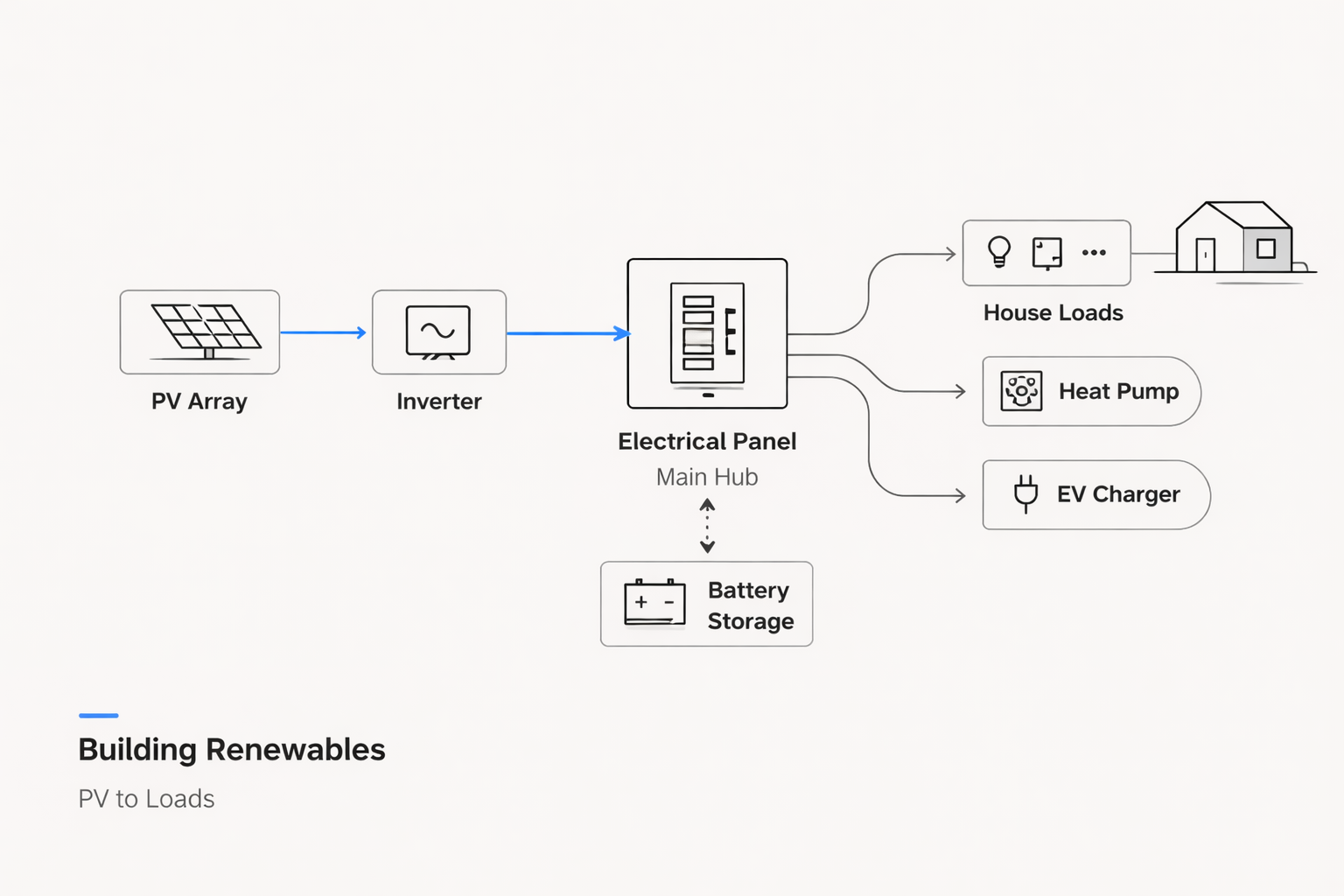
Simple mental model: PV → inverter → panel → loads (battery is optional).
Step zero: reduce the load before you generate
This is the part that’s boring and saves the most money.
If you’re planning PV, geothermal, or any on-site generation, do a quick load reality-check first: air leaks, insulation gaps, old duct losses, lighting, and equipment. The smaller your energy demand, the smaller (and cheaper) your renewable system can be.
If you want the broader “whole house” sustainability picture (not just gadgets), park this for later: eco-friendly house planning.
Solar PV: the workhorse
(when the roof and utility cooperate)
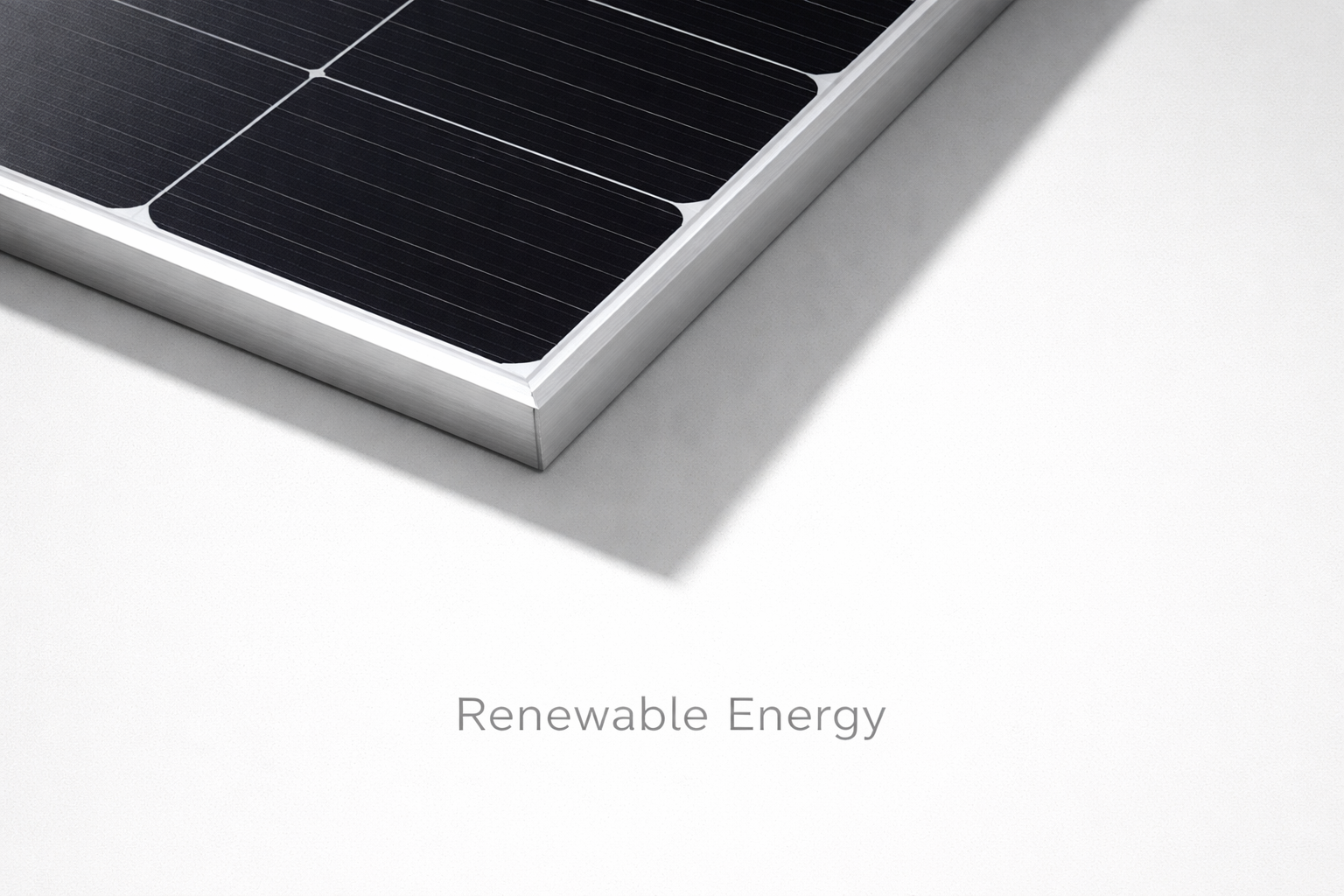
Solar is popular because it’s modular, scalable, and predictable when the basics are right. Most complaints come from the basics not being right.
Where solar wins
- Good solar access (low shading, decent roof orientation)
- A roof with years left (don’t pay to remove and reinstall panels later)
- Simple electrical path (panel capacity, space for breakers, clean interconnection)
- Daytime loads (offices, schools, homes with EV charging or heat pumps)
What bites later (common regrets)
- Shading was “minor” on the site visit, then it kills production in the shoulder seasons.
- Roof replacement timing: panels go up, roof fails early, everyone’s mad.
- Interconnection delays: the system is installed, but you’re waiting on utility approvals to actually operate.
- “Battery solves it”: batteries solve some problems (backup, time shifting). They don’t magically fix a bad PV design.
Decision rule: if you can’t get a clean answer on shading, roof life, panel capacity, and utility interconnection, you’re not ready to sign anything yet.
FIELD PICK
Solar Electricity Handbook (design + sizing)
Good for sanity-checking quotes and understanding what the installer should be explaining.
Wind on buildings: the idea is better than the reality
(most of the time)
Small wind turbines on buildings look great in renderings. Real wind in cities is turbulent, blocked, noisy, and inconsistent. That’s why “building-mounted wind” shows up in lists… and then quietly disappears from the final design.
When it can make sense
- Exposed sites: coastal, ridgelines, open plains, industrial edges — not typical dense neighborhoods.
- Enough clearance: above turbulence zones, not tucked behind parapets and nearby towers.
- You’re okay with maintenance: moving parts, vibration checks, shutdowns.
A real-world cautionary example
London’s Strata SE1 became famous for integrated turbines — and also for the practical headaches (noise and limited operation). It’s a good reminder: the marketing image is not the operating reality.
Bottom line: if you’re urban/suburban and looking for ROI, wind is usually not your first pick. Spend your design energy on envelope + electrification + solar.
Geothermal (ground-source heat pumps)
Boring, expensive up front, excellent when it fits
People mix up “geothermal power plant” and “geothermal heat pump.” For buildings, we’re usually talking about ground-source heat pumps: moving heat with the ground loop as a stable heat source/sink.
Where ground-source shines
- Buildings with big heating/cooling loads (schools, larger homes, multi-unit, offices)
- Projects that can plan drilling properly (access, soil/rock conditions, loop field layout)
- Owners who will stay long-term (the payback is usually not “quick”)
What bites later
- Under-designed loop fields (systems that struggle in peak seasons)
- Bad drilling assumptions (rock, groundwater, access constraints)
- Installer scarcity in some regions — the best design is useless without competent execution.
Practical move: treat geothermal like structural work. You want real design, not a rule-of-thumb sales pitch.
District energy, trigeneration, and “central plant” thinking
Not every building needs its own “hero system.” In dense areas, shared systems can be more efficient and easier to maintain — especially for mixed-use developments.
One Central Park (Sydney) is a known example of a precinct-scale approach with a central thermal plant serving the development (not “every unit has its own everything”). The lesson isn’t “copy that exact system.” It’s that centralized plant decisions change what you even need on the roof and in each unit.
Biomass: serious heat, serious operations
Biomass makes sense where fuel supply is stable and someone is paid to run the system: campuses, district heating, rural institutional buildings, some industrial cases.
For most single-family homes, biomass is rarely the “easy sustainable win” people imagine — it’s fuel storage, delivery logistics, ash cleaning, and local air-quality rules.
Where it works
- District heating / campuses (consistent loads, dedicated maintenance staff)
- Regions with strong fuel supply (pellets/chips) and sensible storage space
What bites later
- Fuel moisture and storage problems (clumping, feeding issues, performance swings)
- Maintenance reality (ash handling, cleaning cycles, parts)
- Permitting and neighbors (smoke/particulates are not a theoretical issue)
Middlebury College’s biomass system is a useful “institution-scale” example: it works because the project is sized, operated, and maintained like infrastructure — not like a consumer appliance.
How to choose: a simple decision map
- Single-family, typical suburban roof: envelope fixes + heat pump (if applicable) + solar PV is the common backbone.
- Multi-family / dense urban: central plant options, shared systems, and utility constraints often matter more than roof gadgets.
- Campus / institutional: geothermal and biomass become realistic if you have staff and predictable loads.
- Wind: only if the site is actually windy and the turbine location is engineered for real airflow.
If you’re comparing “green materials” alongside energy systems, keep these handy for the rest of the design stack:
Checklist: before you sign a renewable energy contract
- Roof: condition, remaining life, and any planned replacement timeline.
- Shading: not guessed — actually assessed.
- Electrical: panel capacity and any upgrade cost.
- Utility: interconnection process, timelines, and any export limits.
- Design documents: you should see a layout, not just a price.
- Warranty clarity: equipment vs workmanship vs production estimates.
- Maintenance plan: who services what, and how often.
- Permits and inspections: who owns it end-to-end.
- Future plans: EV, heat pump, addition/renovation — does the system still make sense?
FAQ
(the questions people keep circling back to)
Should I do solar before improving insulation?
Usually no. If the building is leaky, fix the load first. Smaller system, better comfort, fewer regrets.
Do solar panels work on cloudy days?
Yes, but output drops. The bigger issue is often shading, roof orientation, and whether the system is sized honestly for your site.
Are batteries worth it?
Worth it if you need backup power or you’re managing time-of-use rates and you understand the economics. Not worth it as a band-aid for a bad PV plan.
Is small wind worth it for a house?
Only on truly windy, exposed sites. In most neighborhoods, turbulence and low average wind make it a poor ROI compared to PV.
Is geothermal “better” than air-source heat pumps?
It can be, especially for big loads and long-term owners, but the upfront cost and installation quality matter a lot. It’s an infrastructure decision.
Is biomass carbon-neutral?
It depends on fuel sourcing, system type, and local air-quality constraints. Operationally, it’s also more hands-on than most people expect.
RECOMMENDED TOOL
The Renewable Energy Handbook
Useful as a broad reference when you’re comparing systems and trying to ask better questions.
Explore further
Government + official bodies (programs, standards, calculators)
These are the places I send people when they want the “real rules” (not marketing). Incentives and eligibility change all the time, so treat this as your starting point and double-check what applies in your country/region.
United States
- U.S. Department of Energy (DOE) — Solar Energy (EERE): basics, program links, and technical explainers.
- DOE — Tax credits & savings: the federal-facing page that points you to current incentives and how they’re structured.
- NREL — PVWatts calculator: quick solar production estimates (useful for sanity-checking installer numbers).
Canada
- Natural Resources Canada (NRCan) — Energy efficiency for homes: the main hub for residential efficiency + programs.
- NRCan — Canada Greener Homes Initiative: program status + official guidance (even if parts are paused/closed, the “what counts” info is still useful).
United Kingdom
- GOV.UK — Boiler Upgrade Scheme: official eligibility and how the grant works.
- Ofgem — Boiler Upgrade Scheme: scheme oversight and details from the regulator side.
Australia
- Clean Energy Regulator — Small-scale Renewable Energy Scheme (SRES): the official reference for STCs and eligibility basics.
- Australian Government YourHome: building science, passive design, and practical guidance that actually holds up on-site.
New Zealand
- EECA (Energy Efficiency and Conservation Authority) — Your home: practical guidance + links to NZ programs and advice.
European Union
- European Commission — Energy performance of buildings: policy direction and updates that filter down into national rules.
International / intergovernmental
- International Energy Agency (IEA) — Buildings: data and sector overviews (useful when you want numbers, not vibes).
- IRENA — World Energy Transitions Outlook: broader context on electrification, renewables, and what’s actually scaling.