


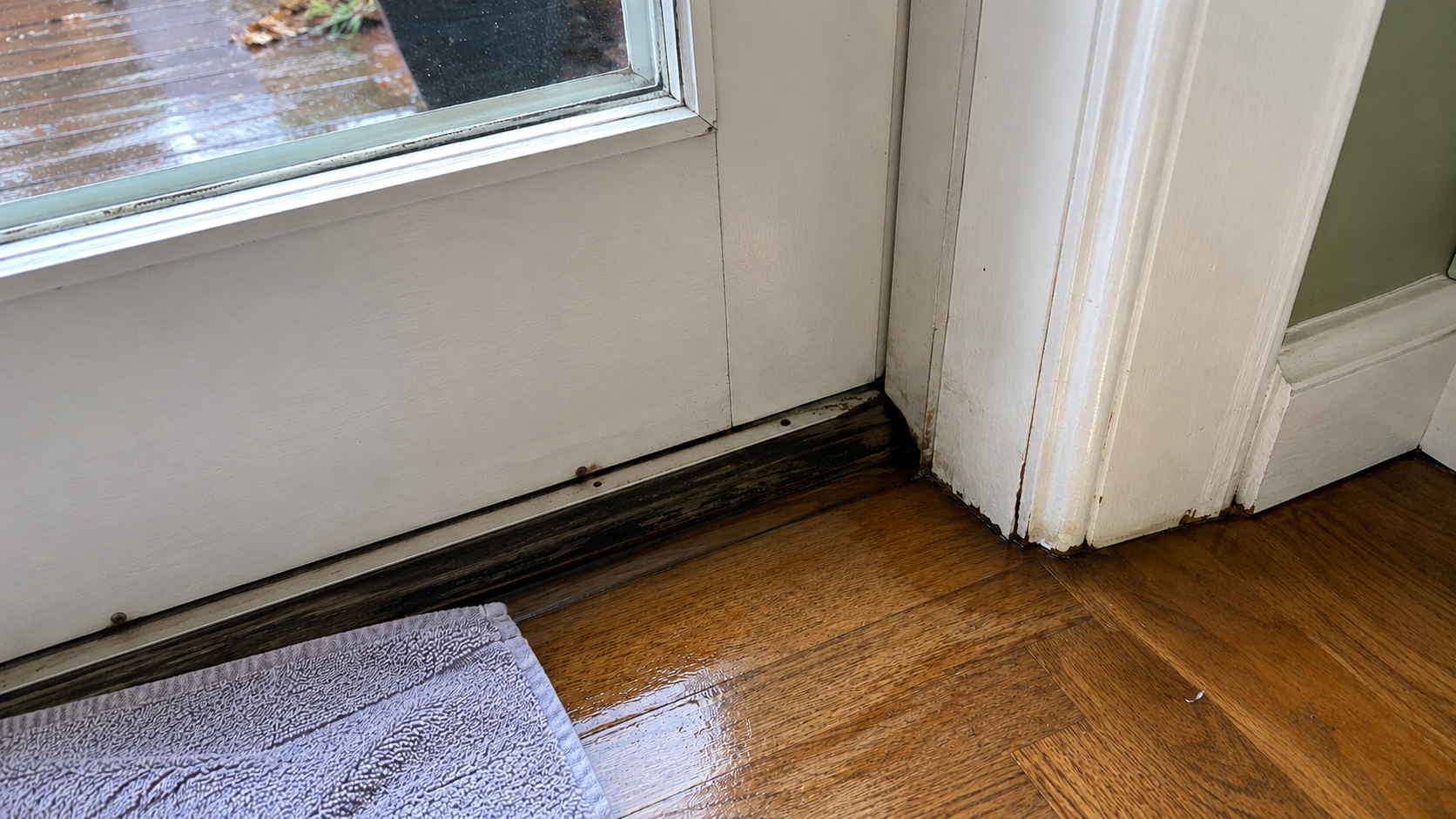
A leaking Masonite exterior door should not be judged from the outside first. Start inside, where the water shows up.
Water at the bottom of the door, a damp corner near the jamb, a stain below the glass, or a draft along the latch side can all look like “the door is bad.” Sometimes the door slab is not the problem. The leak may be coming through a worn sweep, a loose threshold, a bad sill seal, a missing drainage path, a glass insert, a sloped landing, or a wall detail around the frame.
Find the water pattern before buying parts
Do not start with caulk. Do not start by ordering a new door. Start by finding where the water appears after rain.
Wipe the area dry, then inspect during or right after the next rain. Look at the interior floor, the threshold, the lower jamb corners, the weatherstrip, the glass insert, the casing, and the wall below the door. A leak that appears only during wind-driven rain is different from a leak that appears every time the porch gets wet.
Mark the wet spot with painter’s tape or a pencil line. Take a photo. Then check whether the water is at the center of the threshold, one corner, the latch side, the hinge side, below the glass, or above the head trim. That first clue matters.
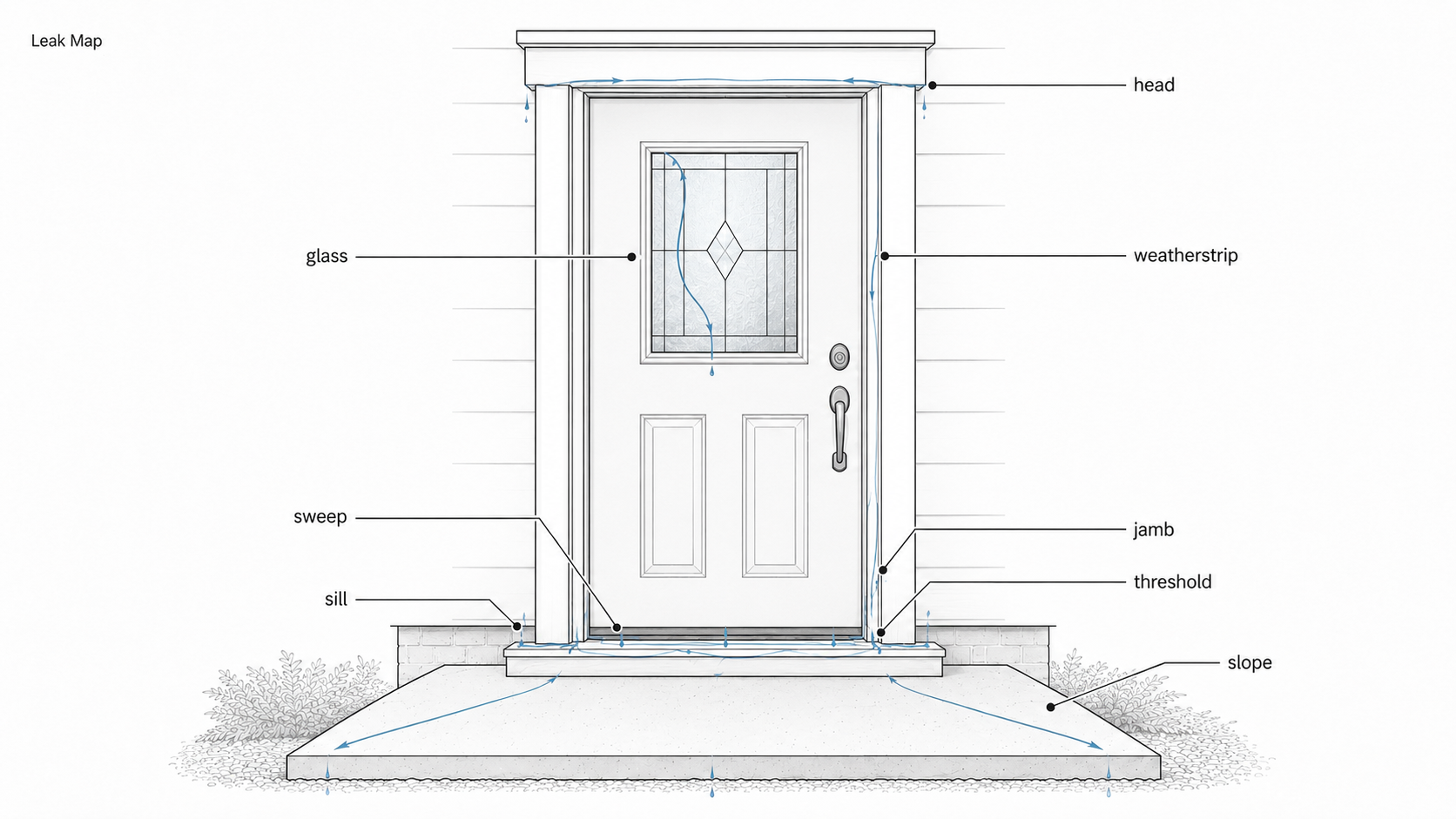
| Where the water shows up | Check this first | What it may mean |
|---|---|---|
| Center of the threshold | Door sweep and threshold contact | The sweep may be worn, torn, too high, or missing contact |
| One lower corner | Jamb, sill corner, weatherstrip end | Water may be entering at the corner pad, frame joint, or sill end |
| Below the glass insert | Glass frame and insert seal | The glass system may be leaking, not the threshold |
| Along the latch side | Weatherstrip and door alignment | The door may not be compressing the seal evenly |
| Under interior flooring near the door | Sill pan, subfloor, threshold support | Water may be getting below the unit before appearing inside |
| Above the door | Head flashing, trim, siding, wall opening | The leak may be from the wall above, not the door bottom |
Check the sweep before the threshold
The sweep is the flexible part at the bottom of the door slab. It is supposed to close the small gap between the moving door and the fixed threshold. If the sweep is torn, flattened, too short, clogged with dirt, or no longer touching the threshold, water and air can get through even when the rest of the door is fine.
Close the door and look from inside with a flashlight. If you can see daylight under the slab, the sweep is not doing its job. If one side touches and the other side does not, the door may be out of adjustment, the threshold may be uneven, or the frame may no longer be square.
A replacement exterior door sweep can be a simple repair when the old sweep is the clear failure. Match the style and size carefully. Do not buy a random sweep and force it into a door it was not made to fit.
The threshold may need adjustment, not replacement
Some exterior thresholds can be adjusted. Others cannot. Some have visible screw covers. Some are fixed. Before loosening anything, check the door instructions for the exact unit and look closely at the threshold design.
If the threshold is adjustable, a small change can improve sweep contact. Too high, and the door becomes hard to close. Too low, and the sweep may not seal. If the threshold is crooked, damaged, cracked, loose, or separated from the sill below, adjustment will not solve the real problem.
Do not keep raising the threshold to stop water if the exterior landing is pushing water toward the door. That can make the door hard to latch and still leave water entering at the corners.
The sill and subfloor are where small leaks become expensive
The sill is the bottom support area under the door unit. It is easy to ignore because most of it is hidden by the threshold, trim, and flooring. That hidden area is also where a slow leak can cause the worst damage.
If water gets under the threshold and into the subfloor, the first sign may be soft flooring, swollen trim, dark staining, or a musty smell near the entry. By the time the floor feels soft, the repair may no longer be a sweep or weatherstrip job.
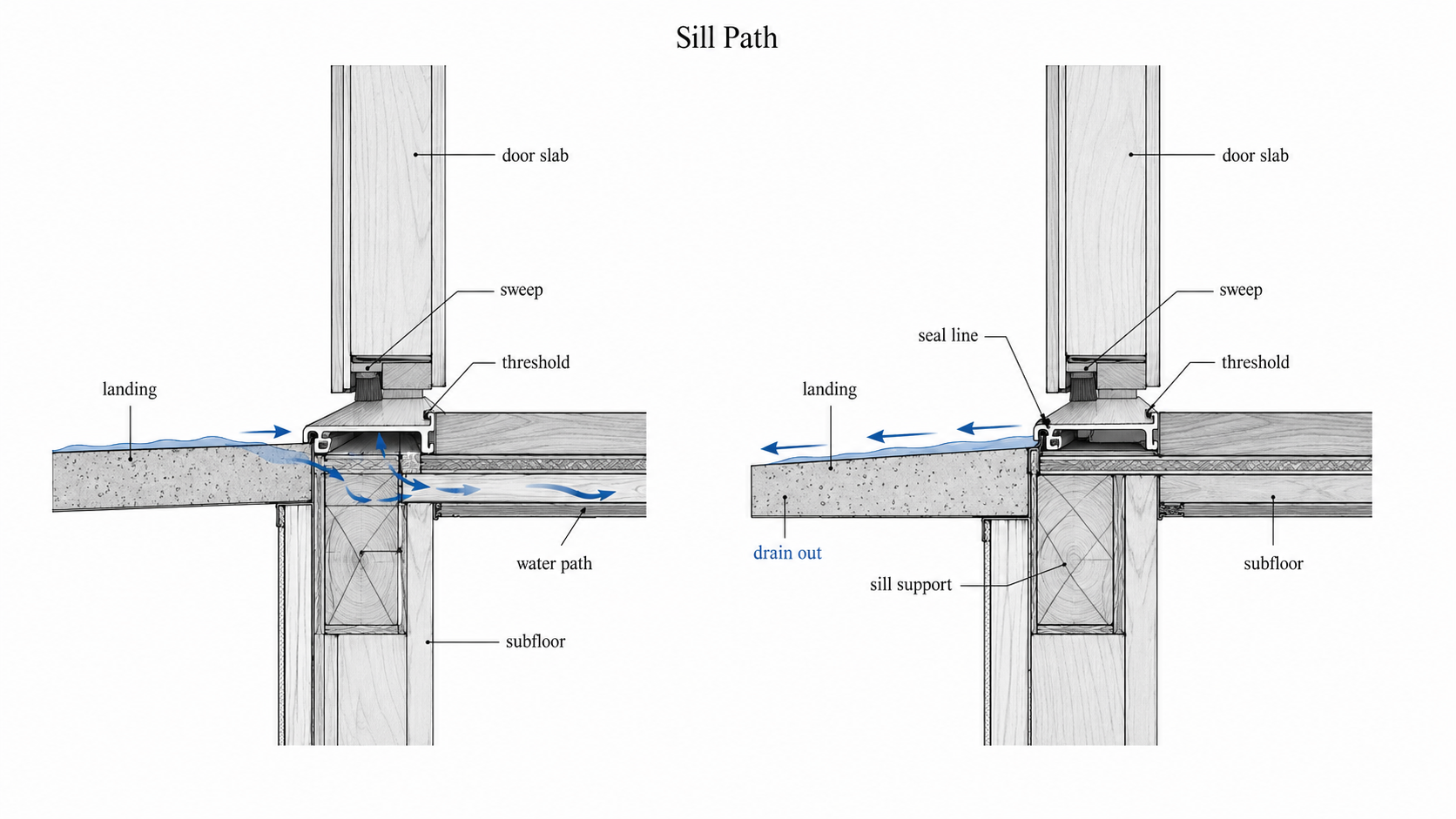
Press gently near the interior floor at the threshold. Check both lower jamb corners. Look for swollen paint, brittle caulk, separated trim, dark screw heads, soft wood, or flooring that moves. These are signs that water may be getting into the assembly, not just past a worn rubber seal.
If you find soft framing, sill rot, or wet subfloor, stop treating the job as a minor door adjustment. That is a repair scope issue. The door may need to come out so the sill area can be rebuilt and protected correctly.
Corner leaks are usually not random
Water at one lower corner is one of the most common exterior door complaints. It often shows up where the vertical weatherstrip meets the threshold. That joint is small, but it does a hard job. Wind, splashback, poor landing slope, a tired sweep, and door movement all meet there.
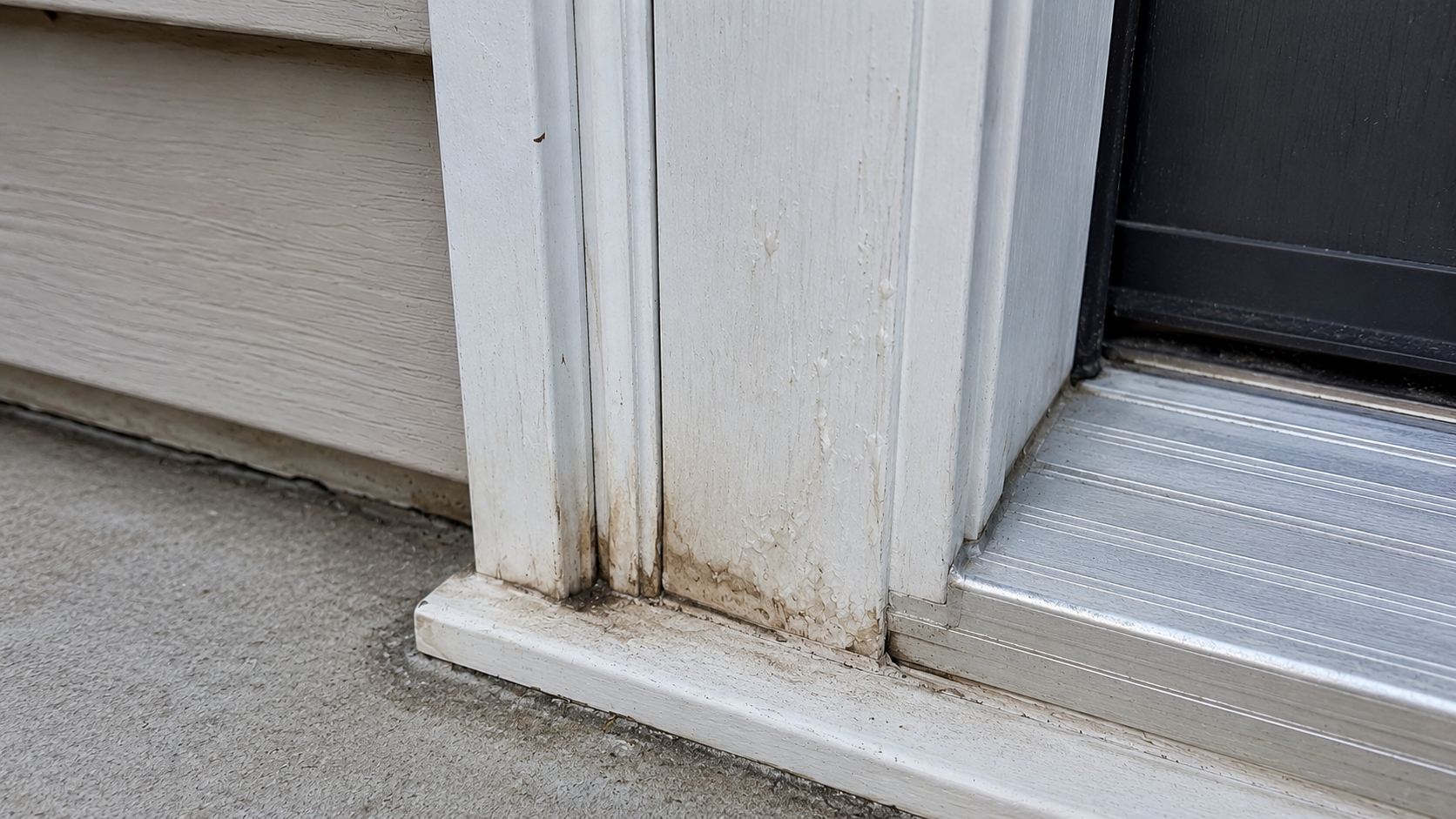
Check the corner pad, if the door has one. Check whether the weatherstrip is crushed, pulled away, cut short, or missing contact near the bottom. Check whether the threshold end is sealed to the jamb. Check whether water from the exterior landing is splashing against that exact corner.
A bead of caulk over the corner may hide the leak for a while, but it can also trap water if the real path is below the threshold. The better repair depends on the route the water is taking.
Do not ignore the exterior landing
A door can leak because the porch, step, patio, or landing is sending water toward it.
Stand outside during rain or use a gentle hose test from a safe distance. Do not blast the door with a pressure washer or hard stream, because that can force water into places normal rain would not reach. Watch where water collects. A landing should not hold water against the threshold. It should not slope back toward the house. It should not allow snow, leaves, or debris to sit tight against the door bottom.
If water is ponding outside the threshold, replacing the sweep may help only a little. The entry needs a drainage fix. That may mean correcting a low spot, cleaning debris, improving the exterior slope, adding cover, repairing cracked concrete, or rebuilding a bad transition.
Glass insert leaks look like door leaks
Some Masonite exterior doors include glass inserts, depending on the model. Water below or beside the glass does not always come from the threshold. It may enter around the glass frame, collect inside the insert area, and show up lower on the slab.
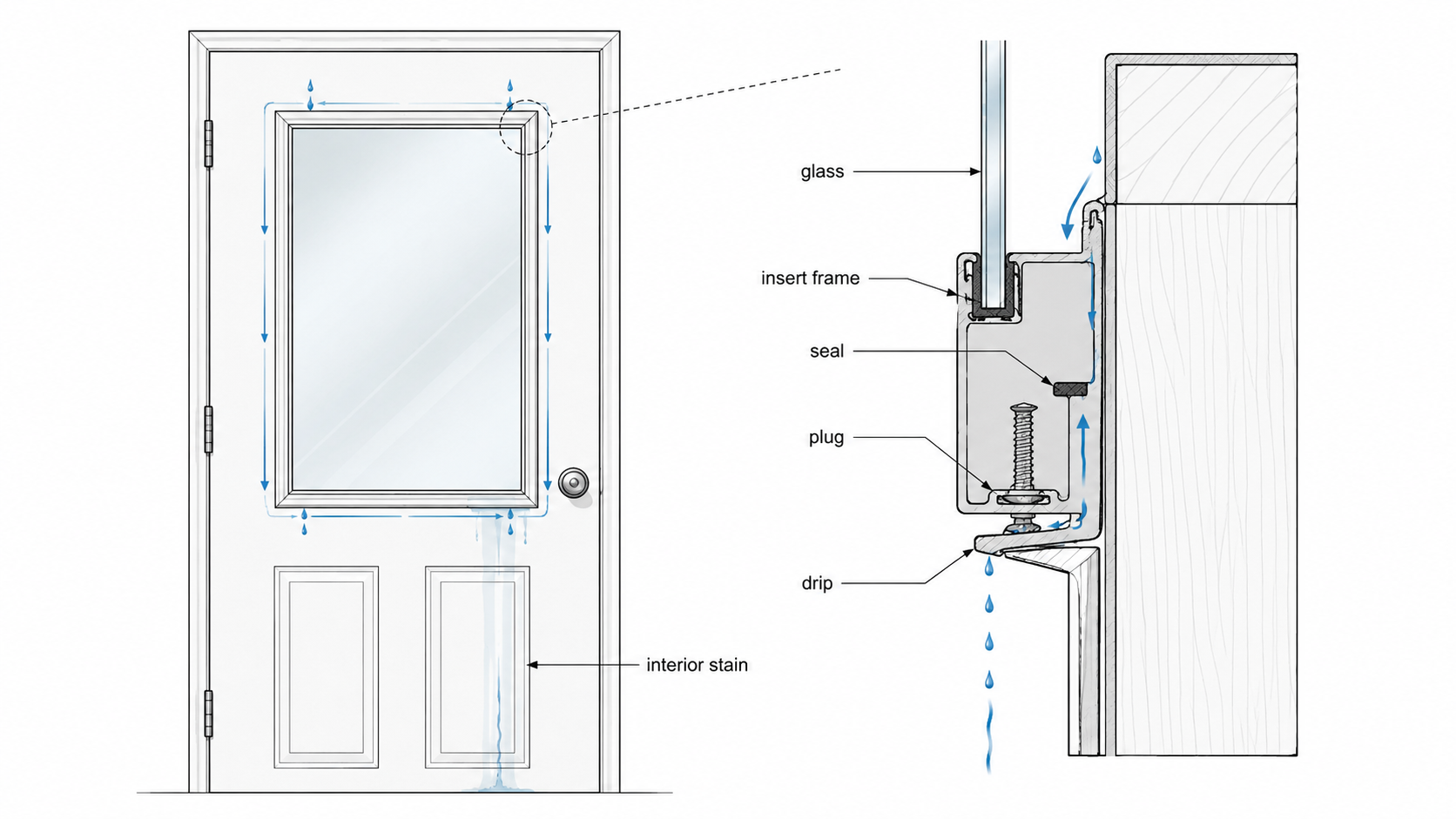
Look for staining below the glass, fogged glass, moisture between panes, loose trim around the insert, missing screw plugs, cracked glazing, or water trails on the interior face of the door. If the water begins at the glass, do not waste time adjusting the threshold.
A glass insert repair is different from a door-bottom leak. Depending on the door and glass type, the repair may involve a replacement insert, a glazing component, or the whole slab. If the glass has failed internally, caulking the outside may not solve it.
Weatherstrip problems can feel like leaks or drafts
Weatherstrip should compress evenly when the door closes. If it is torn, flattened, missing, painted stiff, or pulled out of its kerf, the door can leak air and sometimes water.
Close the door on a thin piece of paper at different points around the frame. If the paper slips out easily on one side but not another, the seal pressure is uneven. That does not automatically mean the weatherstrip is bad. It may mean the door is not sitting square in the frame.
A simple kerf-style entry door weatherstrip can help when the original seal is clearly worn or damaged. Match the profile. A thicker seal that does not fit the frame can make the door hard to close without fixing the leak.
Paint and exposed edges can change the diagnosis
A leak is not always a hole where rain is pouring through. Sometimes the door has been taking on moisture slowly because the finish failed, the top or bottom edge was left exposed, or the paint film no longer protects the slab and edges.
Check the bottom edge, top edge, hinge edge, latch edge, and any cut or drilled areas. Look for swelling, soft spots, peeling paint, dark seams, or a door that rubs after wet weather. If the slab changes shape after rain, the problem may not be only the sweep or threshold.
This matters because replacing weatherstrip will not fix a moisture-damaged door edge. The repair may involve refinishing, sealing exposed edges, correcting the water source, or replacing the slab if the damage is already too far along.
Installation problems can defeat a good door
A new prehung exterior door can still leak if the opening, sill support, shims, sealant, or flashing was wrong.
The frame must be set square, plumb, and supported. The threshold needs a stable base. The bottom of the unit needs a reliable seal. The wall opening around the frame needs to manage water, not trap it. If the door was installed into a crooked opening and then covered with trim, the leak may not show up until the first hard rain.
This is why “it is a Masonite door” is not enough information. A Masonite slab in a poor opening can leak. A good prehung unit can leak if the sill was not supported or sealed. A worn older door can leak because the sweep and weatherstrip are simply done.
Repair or replace?
The right repair depends on what failed. Replace small wear parts when the structure is sound. Consider replacing the whole unit when the frame, sill, glass system, or opening has failed.
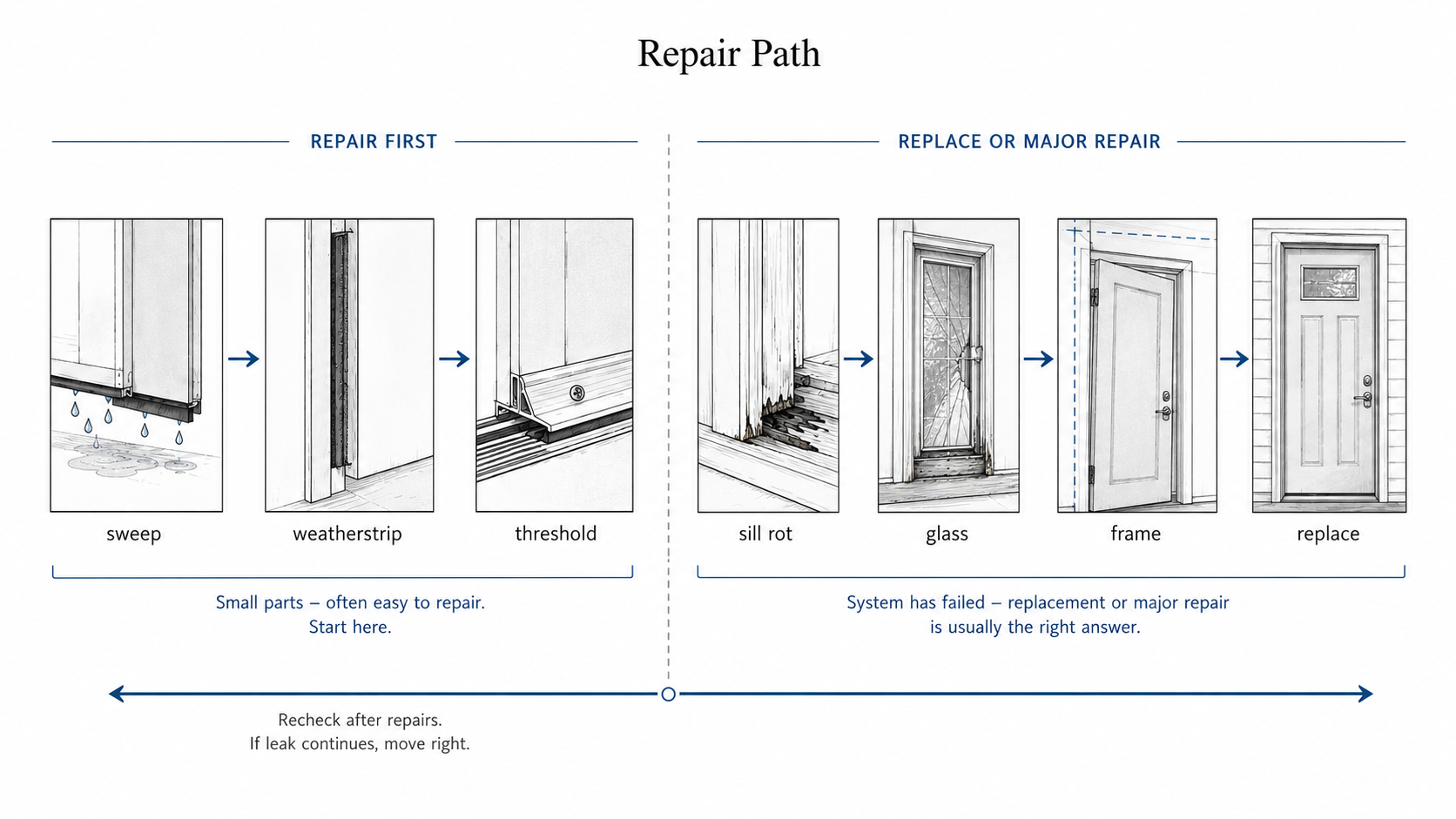
| Condition | Usually repair first | Replacement becomes more likely when |
|---|---|---|
| Worn sweep | Replace sweep with matching profile | Door bottom is damaged or no longer straight |
| Loose or damaged weatherstrip | Replace weatherstrip and check door alignment | Frame is twisted or no longer holds a seal |
| Threshold contact problem | Adjust threshold if designed for adjustment | Threshold is loose, cracked, unsupported, or leaking below |
| Water at lower jamb corner | Check corner pad, weatherstrip, sill end, and landing slope | Jamb or sill is soft, rotten, or repeatedly wet |
| Glass insert leak | Inspect insert frame and glass warranty options | Glass seal has failed or insert system cannot be repaired cleanly |
| Soft sill or subfloor | Open the area and repair damaged material | The door unit may need to be removed to rebuild the base correctly |
The hidden cost is what the leak already touched
The door part may not be the expensive part.
A sweep is small. Weatherstrip is small. A tube of exterior sealant is small. The cost changes when water has already reached the sill, subfloor, sheathing, flooring, casing, or framing around the opening.
That is what homeowners discover late. The visible leak was a few drops at the threshold. The real repair became removing trim, pulling flooring, rebuilding the sill, resetting the door, repainting, and fixing the exterior landing. A slow door leak is not just annoying. It can become a hidden framing and finish repair.
Be careful with caulk
Caulk is useful when it seals the correct joint. It is damaging when it blocks drainage or hides a path that should be open.
Do not smear caulk across every seam around the threshold and call it fixed. First find the water path. Exterior-grade sealant can help at trim joints, threshold-to-jamb gaps, and certain exterior seams, but it should not trap water under the sill or cover weep paths where the assembly needs to drain.
Keep a quality exterior door and window sealant on hand, but use it only after the failed joint is identified.
When to call an installer
Call a pro when the leak is below the threshold, the sill feels soft, the frame is twisted, water appears inside the wall, the landing slopes toward the house, or the door has to be removed to inspect the damage.
A handy homeowner can often replace a sweep or weatherstrip. Rebuilding a sill, resetting a prehung exterior door, correcting flashing, or repairing rot around the opening is different. That work affects the building envelope.
If you are still choosing the door
If water has not entered yet and you are still deciding what to buy, start with the broader Masonite doors review. If you are comparing exterior brands before ordering, see JELD-WEN vs Masonite exterior doors. This page is for the repair moment, when water has already shown up and the question changes from “which door should I buy?” to “what is actually leaking?”
For the broader door category, use the doors and windows section. Exterior doors, interior doors, patio doors, French doors, and replacement hardware do not fail in the same way, even when the measuring habits look similar.
FAQ
Why is my Masonite exterior door leaking at the bottom?
The most common areas to check are the door sweep, threshold contact, lower jamb corners, sill support, and exterior landing slope. Water at the bottom does not always mean the door slab is defective.
Can I fix a leaking Masonite door with caulk?
Sometimes, but only if the leak is at a joint that should be sealed. Caulk can make things worse if it traps water under the threshold or hides a sill problem. Diagnose the water path first.
Should I replace the sweep or the whole door?
Replace the sweep first when the door, frame, sill, and threshold are sound and the sweep is clearly worn. Consider a larger repair or replacement when the sill is soft, the frame is distorted, or water is getting under the unit.
What if water is coming from the glass insert?
Water below a glass insert may come from the insert frame, glazing edge, or failed insulated glass unit. A threshold adjustment will not fix that. Check the glass system and warranty information for the exact door.
Can bad paint or unfinished edges make a Masonite exterior door leak?
Poor finishing can let moisture affect the slab or edges, especially at the top, bottom, or drilled areas. If the door swells, rubs, or shows peeling paint after wet weather, check the finish and exposed edges instead of only replacing the sweep.
Can an exterior landing make the door leak?
Yes. A porch, patio, or step that slopes toward the door can hold water against the threshold. The sweep may get blamed even though the real problem is water being directed into the opening.
Is a draft the same as a leak?
No, but they often share causes. A draft may come from worn weatherstrip, poor latch-side compression, a warped frame, or a threshold gap. If wind-driven rain follows the same gap, it can become a water leak.
When should I stop troubleshooting and replace the door?
Stop small-part troubleshooting when the sill, subfloor, frame, or glass system has failed. At that point, the repair is no longer just a sweep or weatherstrip job.
The door is only one part of the leak
A Masonite exterior door can only perform as well as the opening around it. The sweep, threshold, sill support, frame, glass insert, weatherstrip, landing slope, and installation details all share the job.
Find the water pattern first. Repair the small wear parts when they are the clear failure. Open the scope when water has reached the sill or frame. The expensive mistake is replacing the visible door slab while the real leak path stays hidden underneath.