
Some ruins get smaller the closer you get to them. This one does the opposite.
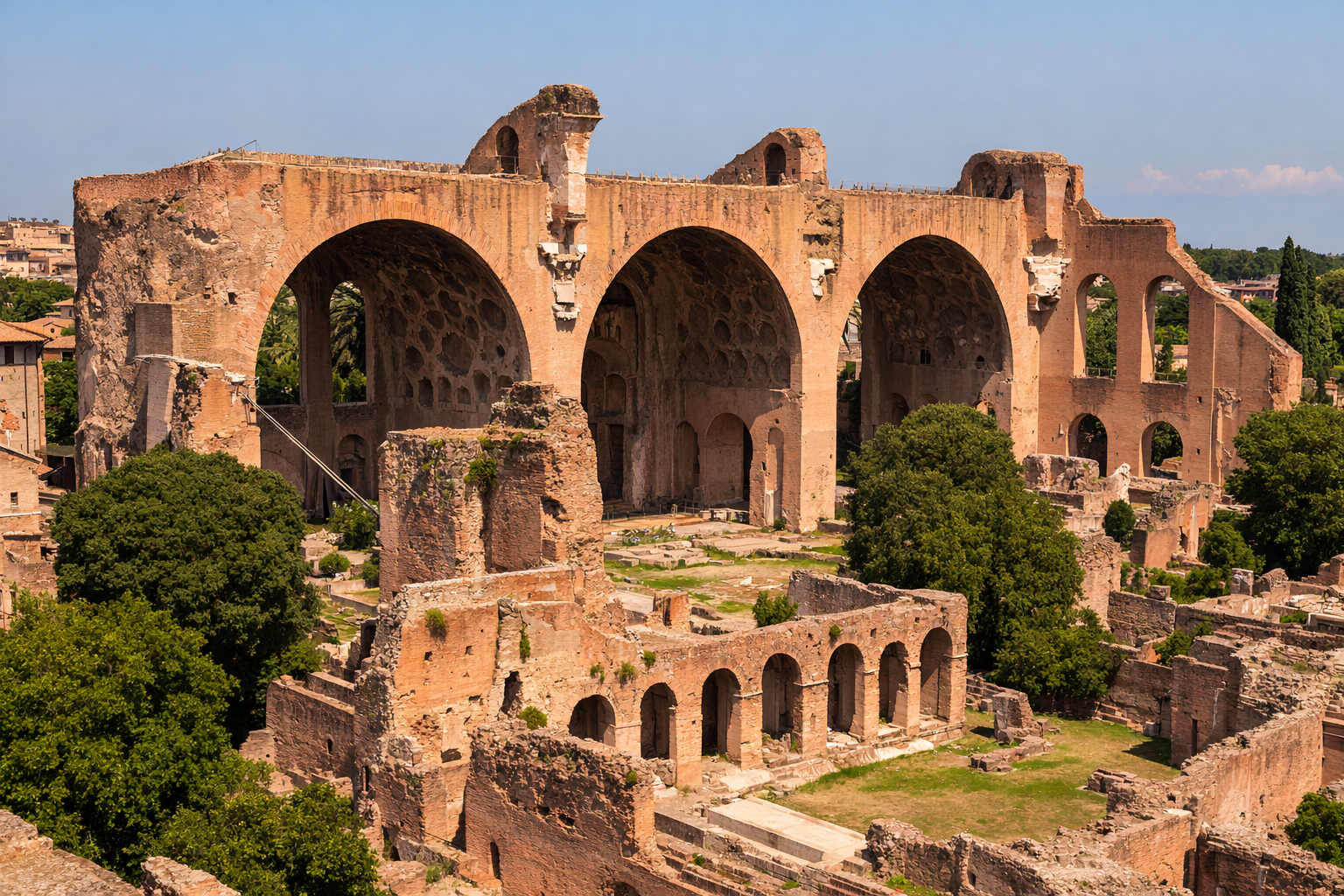
The Basilica of Maxentius still feels oversized even in pieces. You walk into the Roman Forum thinking you are about to look at another broken wall, another fragment, another famous plan you half remember from school. Then those vaults show up. And the scale is not subtle.
That is really the reason to care about it. The Basilica of Maxentius, also called the Basilica of Maxentius and Constantine or the Basilica Nova, is not just important because of the emperors attached to it. It matters because it shows late Roman architecture pushing interior space, concrete construction, and imperial display right to the edge.
This is not the calm, columned Roman classicism people usually picture first. It is heavier than that. More engineered. More ambitious. A building that feels less like a polite civic hall and more like Rome trying to prove it could still outbuild everybody.
If you want the wider background first, this page on ancient Roman architecture is the right starting point. The basilica makes more sense once you see how Roman builders kept moving from column-and-beam language toward much bigger interior volumes.
It Was a Civic Hall, Not a Temple
The word basilica throws people off now, because it sounds religious. Here, it was not. In Roman use, a basilica was a public building. Legal business, administration, commerce, official presence. That kind of work.
So the point was not private comfort or ritual atmosphere. The point was scale, order, circulation, and authority. You were supposed to feel the building doing a public job inside the Forum, which is why this companion piece on Roman Forum architecture helps if you want the urban setting around it.
Started by Maxentius, Finished by Constantine
Construction began under Maxentius around A.D. 308, and the building was completed under Constantine after Maxentius was defeated. That split matters because both names stuck to it, which is why the building keeps appearing under slightly different titles depending on the book, guide, or museum label you are reading.
It also helps explain the building’s mood. This was not a modest urban improvement project. It was imperial construction in the Roman Forum, at the point where architecture and political messaging were still inseparable.
Why It Feels Different From Earlier Roman Work
A lot of earlier Roman civic architecture still leans on the familiar language people expect: rows of columns, clear trabeated order, façades doing a lot of the visual work.
This building shifts the emphasis inward.
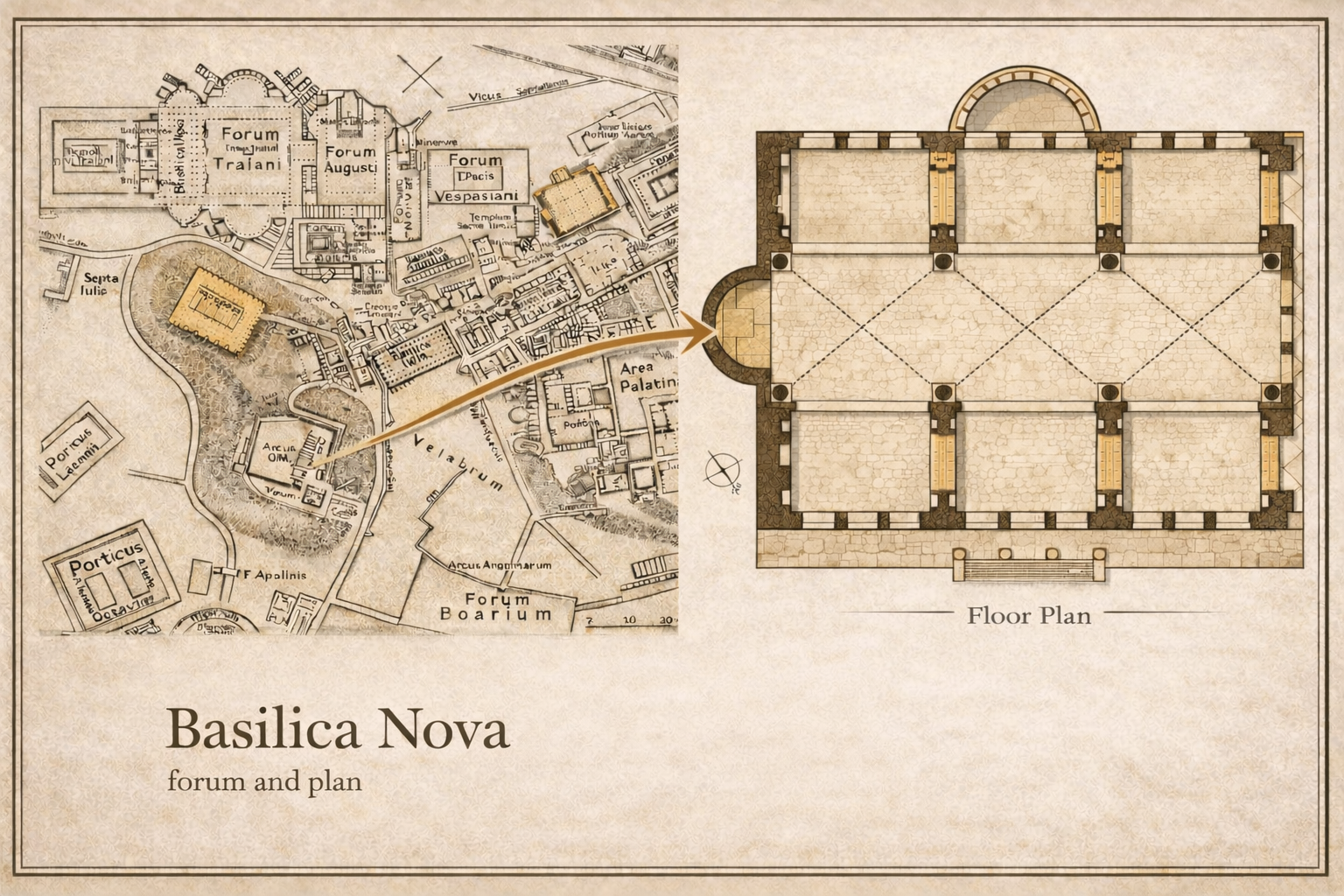
The real drama was the interior volume. A huge central nave. Giant concrete vaults. Side bays opening off it. Massive piers doing the structural work that columns would have handled in a lighter system. It has more in common with the great imperial bath halls than with the quieter basilicas that came before it.
That is one reason the Basilica of Maxentius still reads as startlingly advanced. It feels like Roman concrete stopped pretending to be stone post-and-lintel architecture and started behaving like its own thing.
The Vaults Are the Whole Story
If you strip the building down to the one feature that matters most, it is the vaulting.
The central nave was covered by three enormous groin vaults. The side aisles used great barrel-vaulted bays. That combination is what gave the building its weight, its height, and its strange late-Roman confidence.
And honestly, this is where the ruin still wins. Even with much of the structure gone, the surviving north aisle is enough to show the ambition. The coffering, the thickness, the way the vaults hang over the space. It still looks serious.
You can feel the engineering before you start analyzing it. Read this next: groin vaults. It helps explain why this system mattered so much once Roman builders started chasing bigger uninterrupted interiors.
MUST READ
Roman Architecture by Frank Sear. Dense, but very good when you want the building logic, not just the postcard version.
It Was Huge Even by Forum Standards
This was the largest building in the Roman Forum, roughly 100 by 65 meters overall, with a central nave about 80 meters long, 25 meters wide, and around 35 meters high. Those numbers help, but only up to a point.
The better way to put it is simpler: the building was designed to overwhelm the ordinary scale of the Forum around it. It was not trying to blend in. It was trying to dominate the space and reset the visual hierarchy nearby.
The Plan Was More Controlled Than the Ruin Looks Now
Ruins can make old buildings look messier than they were. The Basilica of Maxentius is a good example.
What survives today feels fragmentary, but the original plan was disciplined. A vast central nave ran east-west and ended in an apse. Side bays opened off the main volume. The structure was organized, clear, and deliberate even if the architectural effect was dramatic.
That is worth noticing because the ruin can trick people into reading the building as pure mass. It was not. It was a carefully ordered big room, not just a pile of heroic concrete.
What Survives Now
Not enough to make the building easy. Enough to make it unforgettable.
The north aisle is the main survivor, and that is where the scale still lands properly. Much of the central nave is gone, largely because earthquakes did the long work of finishing what time had already started. But the surviving vaults are enough to show the building’s structural logic and its intended force.
There was also a colossal image of Constantine associated with the apse, and fragments of that figure survive today in the Capitoline Museums. Even that detail tracks with the rest of the building. Nothing here was meant to feel ordinary.
Why Architects Keep Coming Back to It
Because the Basilica of Maxentius is one of those buildings where structure, space, and political ambition all show up at once.
It is Roman, obviously, but it also feels like a warning shot toward later monumental interior architecture. Big enclosed volume. Heavy masonry logic. Vaulting used for emotional effect, not just coverage. The idea that public architecture could be experienced as sheer spatial force. That is the part that lasts.
It also helps that the ruin is honest. You do not need a perfect reconstruction to understand the point. The surviving concrete still tells on the building. It still tells you how large the room was, how hard the vaults were working, and how much faith Rome had in engineered mass by this stage. One more thing: Roman architecture and engineering is useful here, because this building really is where construction technique and public image lock together.
MUST READ
Ten Books on Architecture by Vitruvius. Dry in spots, yes, but it still gets you close to how Roman builders thought about proportion, material, and site.
How to Read the Basilica on Site
The first mistake is looking at it like a façade. The real architecture is not in the front view. It is in the surviving volume.
Start with the north aisle. That is where the scale still lands. Look at the height of the remaining vaults, the thickness of the piers, and how much weight the structure was clearly built to carry. This is the part that still explains the building better than any plan does.
Then pay attention to what is missing. The open space where the central nave once stood matters almost as much as the surviving concrete. You are reading absence here too. The ruin makes more sense once you imagine the lost groin vaults spanning that central volume.
Do not get stuck on ornament. This is not that kind of building. What survives best is the structural ambition: huge enclosed space, heavy support, and Roman concrete being used at a scale that still feels aggressive.
Also useful: look at how the basilica sits in relation to the Forum around it. It was not designed to disappear into the background. It was built to dominate its part of the site and to feel bigger than the urban fabric around it.
The Real Thing to Notice
A lot of famous Roman buildings are remembered for their exterior image. The Basilica of Maxentius is different.
Its reputation lives in interior scale, structural ambition, and the feeling that the room was trying to outgrow the old column-and-beam world. That is why the ruin still matters. Not because it is tidy. Not because it is complete. Because even broken, it still feels bigger than most buildings that survived intact.
FAQ
Who built the Basilica of Maxentius?
It was begun under the emperor Maxentius and finished under Constantine after Maxentius was defeated.
Is the Basilica of Maxentius the same as the Basilica of Constantine?
Yes. The building is commonly called the Basilica of Maxentius and Constantine because construction started under one ruler and finished under the other.
Why is it also called the Basilica Nova?
Basilica Nova means “new basilica.” It is another historical name for the same building.
What made the building architecturally important?
Mainly its enormous interior, its use of groin and barrel vaults, and the way it pushed Roman concrete construction into a much more monumental interior experience.
Was it the biggest building in the Roman Forum?
Yes. It was the largest structure built in the Forum.
What part is still standing?
The north aisle survives best, and that is where you still read the scale of the vaulting most clearly.