

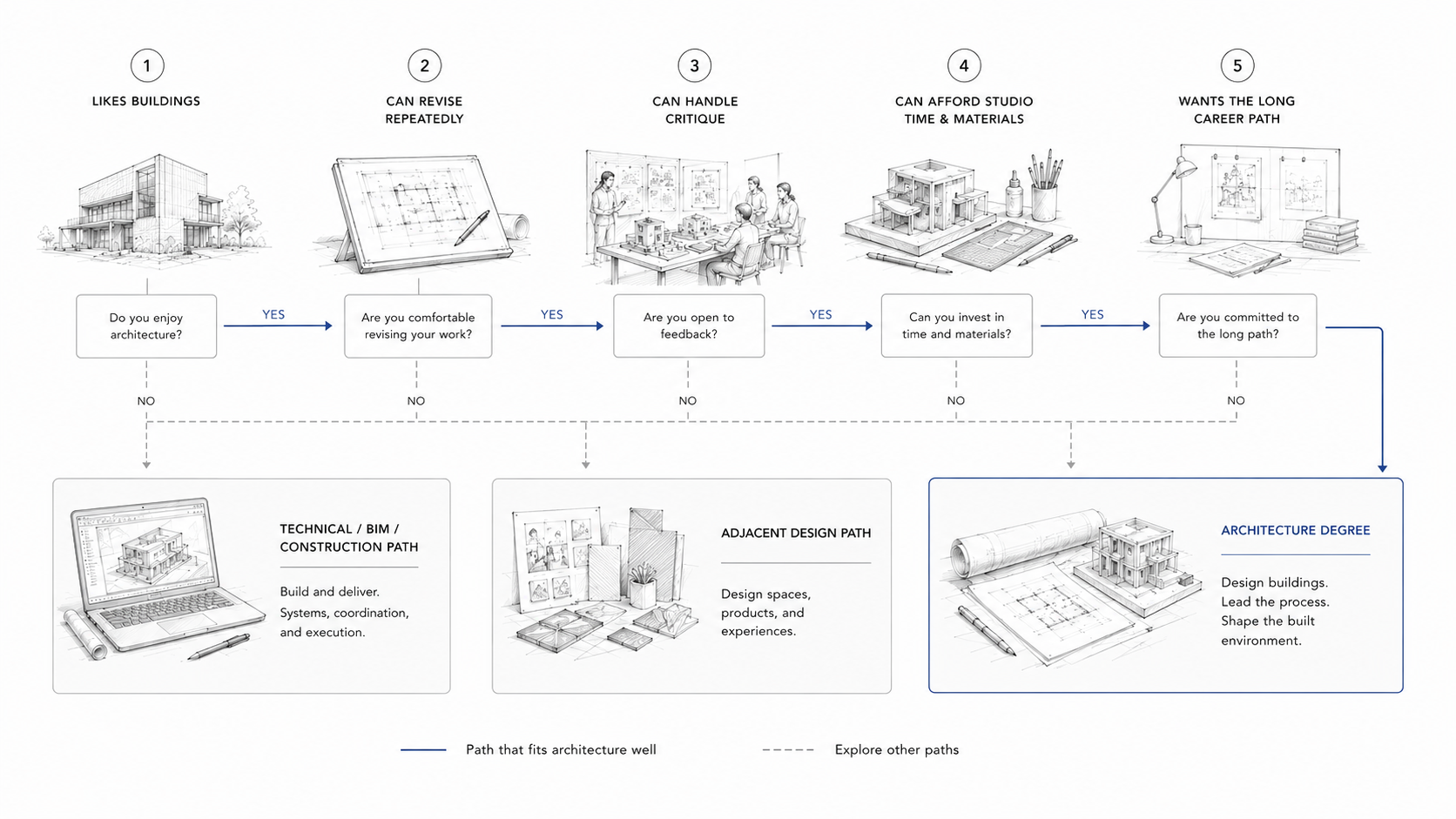
Liking buildings is a weak test.
It helps. It is not enough.
Architecture school is not mainly walking around beautiful cities, sketching famous buildings, and having big design ideas. It is revision. It is critique. It is drawings that do not work yet. It is models that fail. It is learning how to explain a decision after someone has marked half the board in red.
The wrong student does not always hate architecture. Sometimes the wrong student loves the image of architecture and hates the work behind it.
The Work Is Mostly Revision
The clean final board hides the real work.
Architecture school runs on change. You draw something, test it, get feedback, find the problem, redraw it, build a model, cut it apart, move the stair, fix the section, lose the idea, find a better one, and then explain why the new version is stronger.
That cycle repeats until the deadline wins.
A person who needs the first idea to be right will struggle. A person who can stay interested after the third bad version has a better chance.
The question is not “Am I creative?” Plenty of creative students hate architecture school.
The better test is this:
Can you keep working after the first version fails?
The Critique Problem
Architecture students live with feedback.
Some of it is useful. Some of it is vague. Some of it is too sharp. Some of it sounds smart but does not help the drawing. Learning which comments matter is part of the education.
A critique is not the same as a grade on a math test. It can feel more personal because the work came from your decisions. The plan, the model, the drawing style, the section, the argument — all of it sits on the wall in front of other people.
That can sting.
The student who survives is not the one who never feels embarrassed. The student who survives can separate the work from the ego long enough to make the next version better.
Drawing Helps, But It Does Not Save You
Drawing skill is useful. It is not the whole thing.
A student who draws beautifully may still struggle with space, structure, sequence, proportion, circulation, or basic decision-making. A student who starts with rough drawings may improve quickly if they think clearly and revise without panic.
Architecture uses drawing as a thinking tool.
That matters. If drawing is only decoration to you, school can feel harsh. Plans, sections, diagrams, and models are not presentation extras. They are how the project gets tested.
A pretty perspective can hide a bad plan for a while. A section usually tells the truth faster.
The Time Problem Shows Up First
Studio expands.
A normal class can often be managed with reading, assignments, and exam prep. Studio does not behave that way. A model breaks. A file crashes. A pin-up moves closer. A drawing needs another pass. A critic asks for a section you did not plan to draw.
Architecture students do not only spend time in class. They spend time deciding.
That is the part families miss. The hours are not just labor hours. They are judgment hours: where the wall goes, how the stair works, why the entry belongs there, how light enters, what the section proves, why the idea should survive.
If you need a clean weekly schedule, architecture may fight you.
The Money Does Not Arrive as One Big Bill
Architecture school costs are sneaky because they arrive in pieces.
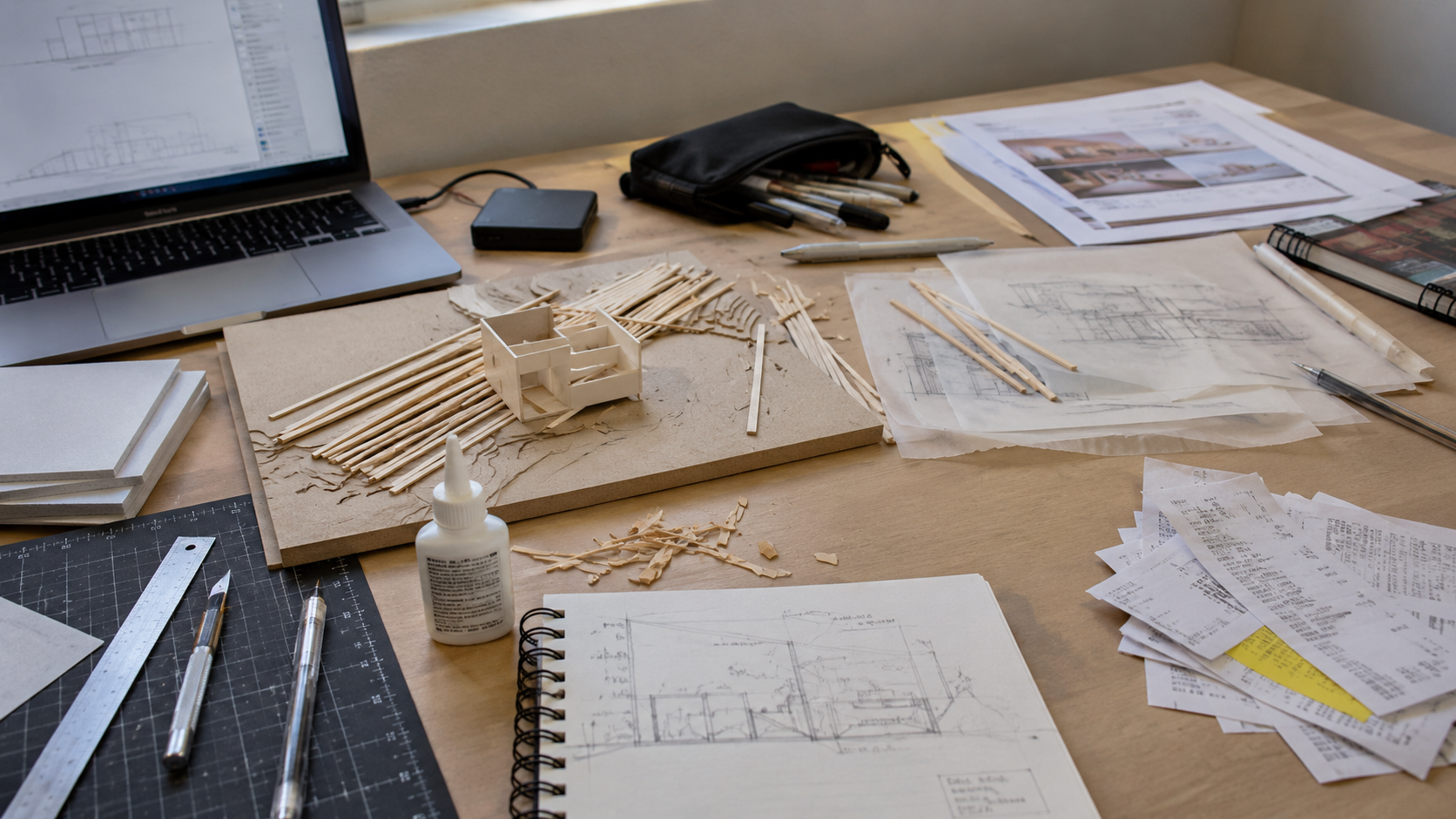
The tuition number is obvious. The smaller costs repeat: blades, glue, boards, chipboard, basswood, prints, software, storage, laptop power, backup drives, transport, site visits, and the occasional replacement tool bought because something broke at the worst time.
One purchase feels small. A semester of them does not.
| Cost | Why it matters | What to check |
|---|---|---|
| Model materials | Studio projects may need repeated physical models, not one final model. | Ask current students what they spend in a normal semester. |
| Printing | Pin-ups, reviews, and portfolios can make printing a recurring cost. | Check whether the school has affordable print access. |
| Computer power | Weak hardware slows drawing, modeling, rendering, and file handling. | Look at real software requirements, not only the minimum specs. |
| Lost work time | Studio deadlines can make part-time work harder during review weeks. | Be honest about how much paid work you need to survive. |
The First Month Tells You a Lot
The first month of architecture school can feel wrong even for students who belong there.
That is the confusing part.
You may feel slow. You may not understand the feedback. Your model may look weak beside someone else’s. Your drawing may not say what you thought it said. A project that felt clear at midnight can look thin on the wall the next morning.
That does not automatically mean you should quit.
The better test is what happens after the bad review. Do you want to hide from the project, or do you start seeing the next move? Do you hate the correction, or do you understand why the correction matters? Do you only want praise, or do you want the work to get sharper?
Architecture is a poor fit for someone who needs constant reassurance. It can be a good fit for someone who can take a hit, study the problem, and go back to the desk.
The Career Is Slower Than the Brochure
The degree does not turn a student into an architect overnight.
The professional path can include a professional degree, internship or supervised experience, exams, and licensure steps depending on the country. The early office years can feel less glamorous than school. Junior staff may spend long stretches on drawings, model coordination, code research, markups, schedules, details, renderings, or small pieces of a larger project.
That work is not fake architecture.
It is how practice is learned. But it can disappoint students who thought the job would feel like a permanent design studio.
A person who only wants big ideas may feel trapped. A person who can find interest in how a wall, stair, detail, window, permit comment, drawing set, or client limit changes the project may have a better future in the field.
Good Signs
Some signs are worth taking seriously.
You may be a good fit for architecture if you enjoy improving an idea after criticism. You do not need to love every critique. You need to use it.
You may also fit if you like working between different kinds of problems. Architecture is visual, technical, social, spatial, legal, financial, and practical. A student who only wants one clean lane may get frustrated.
Another good sign is curiosity about how things are made. Not only how they look. How the roof drains. How the wall meets the ground. Why a stair lands there. Why a room feels wrong even when the plan looks balanced.
A strong architecture student is not always the best artist in the room. Sometimes it is the student who keeps asking why the drawing does not work yet.
Bad Signs
The warning signs are not moral failures. They are fit problems.
| If this sounds like you | What it may mean | Better test before committing |
|---|---|---|
| You mostly like finished buildings and interiors. | You may like architecture as a viewer more than as a worker. | Try drawing, modeling, and revising one small room layout several times. |
| You hate feedback on creative work. | Studio culture may feel personal and exhausting. | Take a class with critique before choosing a long degree path. |
| You need quick financial return. | The early architecture path may feel too slow. | Compare architecture with construction management, BIM, or technical programs. |
| You want pure design control. | Practice may frustrate you because clients, codes, budgets, and consultants shape the work. | Look at real construction documents and office roles, not only student portfolios. |
Try the Small Version First
Do a small test before choosing a large path.
Pick a simple space: a tiny studio apartment, a small café, a bedroom with storage, or a one-room library. Draw the plan. Draw one section. Make a rough model. Then change the design three times because of a constraint: less money, less space, worse light, a blocked door swing, a stair that does not fit, or a window that lands in the wrong place.
The first version does not matter much.
The third version tells you more.
If the repeated revision makes you angry in a dead way, pay attention. If it makes you annoyed but curious, that is different. Architecture is full of annoyed curiosity.
Architecture May Be Close, But Not Exact
Some students are near architecture but not quite inside it.
That is useful to know early.
A student who likes technical drawing, software, coordination, and details may fit architectural technology, BIM, drafting, or construction documentation. A student who likes rooms, finishes, furniture, and atmosphere may fit interior design or interior architecture. A student who likes cities, policy, housing, and public space may fit planning or urban design. A student who likes job sites, sequencing, budgets, and delivery may fit construction management.
Those are not backup lives.
They are different paths with different kinds of work.
The expensive mistake is forcing yourself into architecture when the part you love belongs somewhere nearby.
Parents Should Not Judge by Talent Alone
A talented student can still be wrong for architecture.
Good grades, good drawings, and good taste do not answer the whole question. The path also asks for stamina, feedback tolerance, time control, money control, and patience with slow professional growth.
That matters because families sometimes encourage architecture after seeing a student draw well or enjoy buildings. That is a thin signal.
A better signal is how the student handles revision. Give them a design problem with constraints. Let the first idea fail. See whether they become sharper or shut down.
Before You Apply
Do not apply only because architecture sounds impressive.
Check the degree type first. A professional architecture degree, pre-professional degree, drafting program, interior design route, and planning path can lead to very different futures. Start with Types of Architecture Degrees: Which Path Is Right for You? if the degree names are still confusing.
Then look at schools through fit, not status. A famous school can be wrong if the cost, studio culture, or degree route does not match you. Best Architecture Schools: What Rankings Miss is the better next read if you are already comparing names.
If you are applying soon, check the admissions side too: portfolio, grades, prerequisites, and transfer rules. Architecture Degree Entry Requirements belongs before the application panic, not after it.
FAQ
How do I know if architecture is right for me?
Architecture may be right for you if you can handle revision, critique, long projects, spatial thinking, and practical constraints. Liking buildings helps, but the stronger test is whether you enjoy improving a design after it fails.
Do I need to be good at drawing to study architecture?
Drawing helps, but it is not the only test. Architecture schools use drawing to think, test space, explain ideas, and show decisions. A student who draws roughly but thinks clearly can improve. A student who draws beautifully but cannot revise may struggle.
Is architecture school hard?
Yes, mainly because studio takes time and feedback can feel personal. The work is not hard in only one way. It asks for design thinking, organization, software skill, model making, writing, presentation, and patience with repeated changes.
What if I like buildings but hate studio?
Then architecture may not be the right path, or you may need an adjacent field. Look at interiors, planning, architectural technology, BIM, visualization, construction management, preservation, or real estate development. Liking buildings can lead to more than one career.
Is architecture worth it financially?
It can be, but it is not the fastest financial path. Architecture school can be expensive, and the early career may move slowly. Students who need a quick return should compare the full path with technical, construction, BIM, and design-adjacent routes before committing.
Should I study architecture if I am unsure?
Do a smaller test first. Take a design class, build a portfolio project, shadow an office if possible, or compare degree types. If the uncertainty is about the work, test the work. If the uncertainty is about the career path, read How to Become an Architect before choosing a degree.
What is the biggest mistake students make before choosing architecture?
They choose the image of the field before testing the work. The better move is to test revision, critique, time pressure, cost, and the long career path before committing to the degree.
Read Next
If degree names are confusing, read Types of Architecture Degrees: Which Path Is Right for You?.
If you are already comparing schools, read Best Architecture Schools: What Rankings Miss.
If you want the full career route, read How to Become an Architect.
If the country matters, read Architecture Schools by Country: What to Check Before You Apply.