

A ranking can make a bad decision look safe.
The famous school looks impressive. The studio photos look serious. The alumni page looks successful. Then the student arrives and finds the program is too theoretical, too expensive, too isolated, too harsh, or not the right path toward licensure.
That is the problem with “best architecture schools” lists. They make architecture programs look easy to compare. They are not.
A strong school for one student can be the wrong school for another. The best choice depends on the degree type, accreditation, studio culture, cost, internship access, faculty support, location, and the kind of work the student wants after graduation.
Use rankings to find names. Do not use them to make the decision.
Best Does Not Mean Famous

A famous architecture school can open doors. It can also hide problems.
Prestige does not tell you how studio is taught. It does not tell you how much students spend on models and printing. It does not tell you whether faculty give useful feedback. It does not tell you whether graduates leave with strong technical skills or only dramatic portfolio images.
A school name may help on a resume. It will not make weak work strong. It will not fix a bad fit. It will not remove debt. It will not turn a pre-professional degree into a professional licensure path.
The better question is simple:
What does this school help students become?
That answer matters more than where the school appears on a ranking page.
The First Filter Is Accreditation
Before judging studio culture, rankings, or campus life, check whether the degree does the job you need it to do.
In the United States, students who want the cleanest licensure path usually look for a professional architecture degree accredited by the National Architectural Accrediting Board. That can include a B.Arch, M.Arch, or D.Arch, depending on the school.
Do not assume every architecture degree is a professional degree.
A Bachelor of Science in Architecture, Bachelor of Arts in Architecture, architectural studies degree, environmental design degree, or design studies degree may be useful. It may also be pre-professional. That means the student may still need an accredited M.Arch before moving toward licensure.
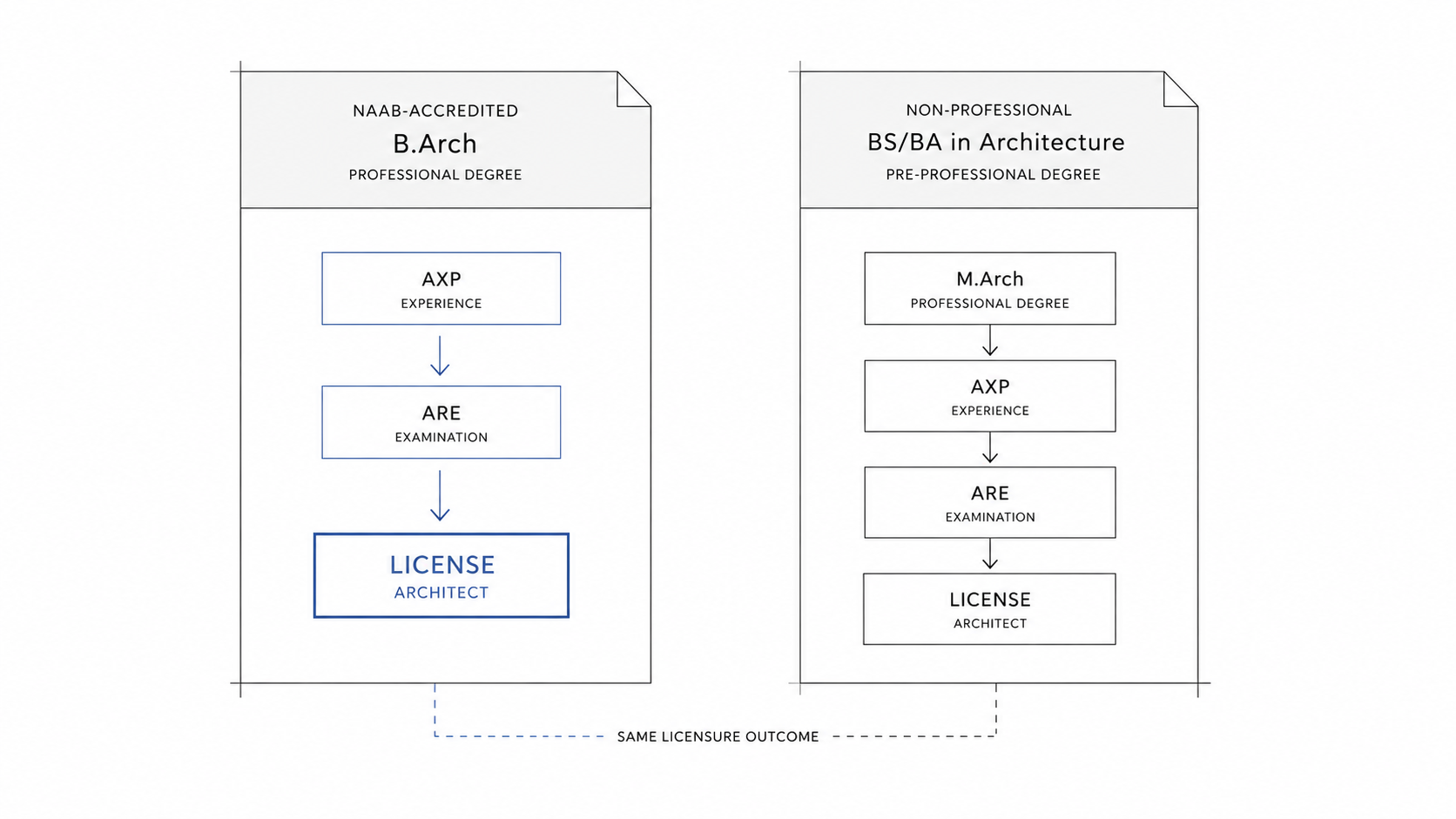
Useful starting point: NAAB accredited programs.
For the full U.S. licensure path, check NCARB’s licensing steps. NCARB explains the education, experience, exam, and jurisdiction requirements.
In Canada, students should check CACB-accredited professional architecture programs. In the UK, students should check the current RIBA and ARB route. These rules can change, so official pages matter more than old forum answers or school marketing.
Useful starting points: CACB accredited programs, RIBA becoming an architect, and ARB registration routes.
For non-U.S. students, check the licensing body in the country where you plan to work before assuming a foreign degree will be accepted.
The Quick School Filter
A good school should answer basic questions clearly. If the school makes you dig too hard, slow down.
| What to check | Good sign | Warning sign |
|---|---|---|
| Degree type | The program clearly states whether it is professional, pre-professional, technical, or post-professional. | The page uses “architecture” everywhere but does not explain what the degree qualifies you to do. |
| Accreditation | The school links to official accreditation or recognition information. | The school uses vague words like “industry-ready” but avoids the professional route. |
| Studio culture | Student work shows process, critique, revision, and clear design thinking. | Everything looks like polished renders with little evidence of how the work was developed. |
| Internships | The school can name where recent students interned and how they got those positions. | The school talks about careers but gives no clear office, alumni, or co-op pathway. |
| Cost | The school is honest about tuition, materials, software, housing, and studio expenses. | The school sells prestige but avoids total cost and debt pressure. |
| Portfolio outcome | Graduates leave with work that shows thinking, drawings, process, and technical growth. | The work looks dramatic but thin, with little evidence of structure, detail, site, or construction logic. |
What Famous Schools Are Good For
Famous architecture schools are not useless. They often have strong faculty, visiting critics, alumni networks, libraries, lectures, research labs, and design culture.
Schools such as MIT, Harvard GSD, Cornell, Berkeley, Columbia, Yale, Rice, Michigan, SCI-Arc, University of Toronto, Waterloo, McGill, UBC, UCL, the AA, Delft, ETH Zurich, Politecnico di Milano, NUS, RMIT, and the University of Melbourne are names students often compare.
But a list of famous names does not tell you enough.
One school may be stronger for computation and research. Another may be better for urban design. Another may be more experimental. Another may be more practice-oriented. Another may have stronger co-op access or local firm connections. Another may be famous but expensive in a city where housing costs break the budget.
That is why the “best” school cannot be separated from the student’s goal.
Rankings Hide the Fit Problem
Rankings flatten architecture education into one score.
That score may be based on reputation, academic surveys, research output, employer opinion, selectivity, or other factors. Some of that can be useful. None of it tells you whether the school fits your working habits, budget, portfolio needs, or licensure route.
A student who wants a strong technical foundation may suffer in a school that rewards theory more than building logic. A student who wants experimental design may feel trapped in a program that is mostly practical and conservative. A student who needs close faculty support may struggle in a large program where access is limited. A student who needs internships may regret a school with weak firm connections.
The school can be excellent and still wrong for the student.
Studio Culture Is the Real Campus Tour
Architecture school is built around studio. That is where the school’s real personality shows.

Some studios push hard and teach well. Some push hard and waste students. Some reward clear thinking. Some reward performance. Some teach revision. Others mainly teach students to defend weak ideas with better words.
Visit final reviews if you can. Look at student boards. Watch how critics speak. Notice whether students explain decisions clearly or hide behind jargon. Notice whether the work shows site, structure, light, circulation, material logic, and a reason for the design.
A good studio does not need to be gentle. It needs to be useful.
Hard critique can help a student grow. Vague critique only burns time. A school that celebrates exhaustion but does not teach better judgment is not strong. It is just demanding.
The First-Year Shock
Architecture school often feels different after the first month.
The student who was strong in high school may no longer be the best in the room. The student who drew well may struggle to explain ideas. The student who loved buildings may discover that architecture school is less about liking buildings and more about making decisions under pressure.
That shock is normal.
The danger is choosing a school that gives no support through it. First year should teach students how to see, draw, test, revise, and explain. It should not only sort students into winners and losers.
Ask how the school supports first-year students. Ask whether students get desk critiques, peer review, drawing help, software support, and clear feedback. Ask how many students leave the program after the first year and why.
A school that cannot answer those questions may not understand where students struggle.
The Internship Pipeline Is Part of the School
A school is not only a place to take classes. It is also a bridge to offices.
That bridge can be strong or weak.
A strong school helps students meet firms, alumni, public agencies, construction offices, visiting critics, and portfolio reviewers. It may have co-op, summer placements, career fairs, firm visits, or faculty with active practice connections.
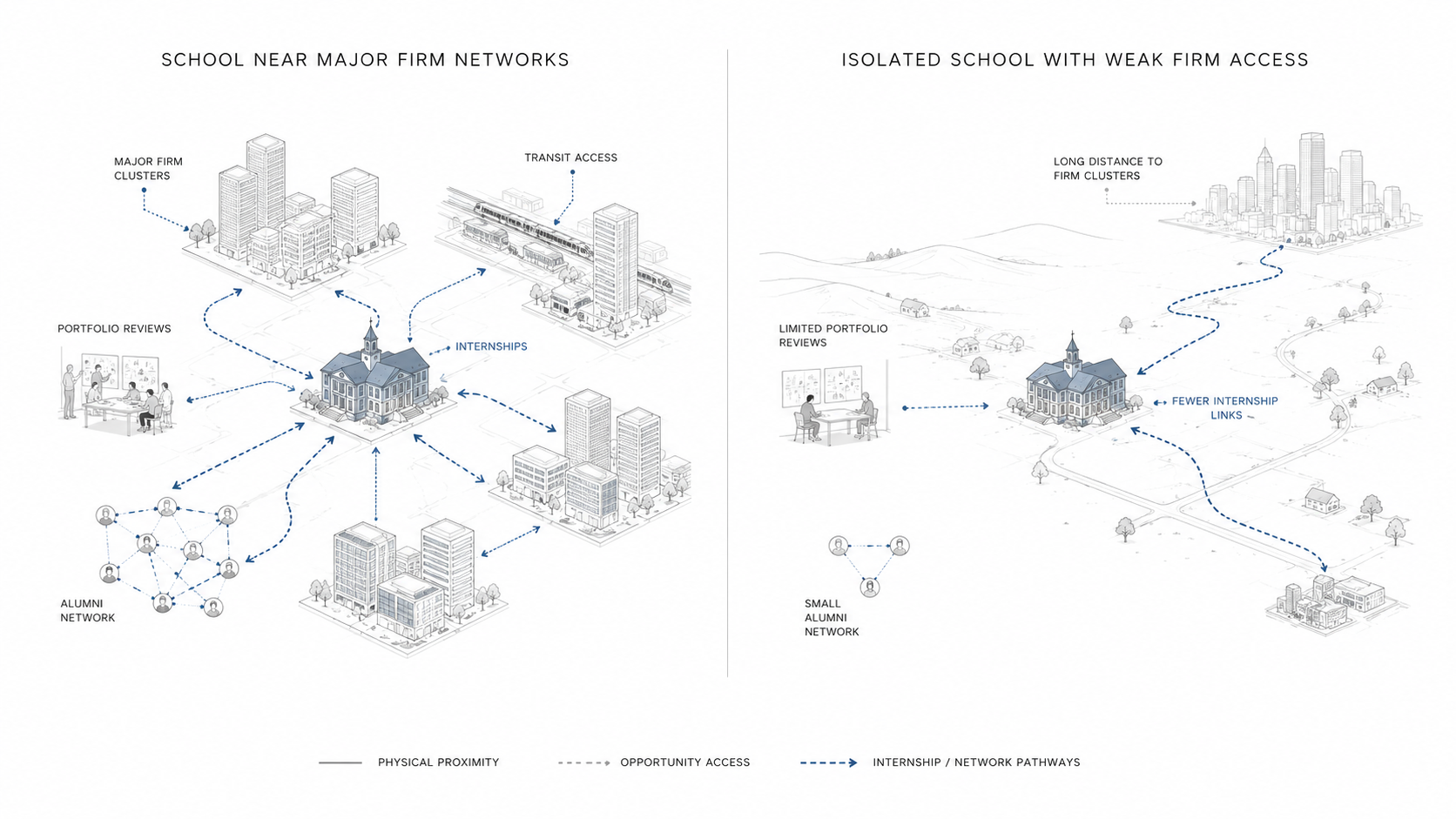
A weak school may talk about careers but leave students to figure everything out alone.
This matters because a student who works in an office during school learns what drawings are for. They see deadlines, consultant comments, codes, budgets, clients, site problems, and the difference between a studio image and a buildable project.
Ask this before applying:
Where did last year’s students intern, and how did they get those positions?
If the answer is vague, the school may be selling the idea of architecture without showing the path into practice.
The Cost Nobody Puts in the Ranking
Tuition is only the first number.

Architecture students also pay for models, printing, software, hardware, storage, supplies, transport, site visits, books, portfolio materials, and sometimes better computers. They also pay with time. Studio can make part-time work harder, especially during final reviews.
A cheaper school can become expensive if the city is costly. A famous school can become risky if debt forces the graduate into jobs they do not want. A local school can be the better choice if it keeps debt low and has strong firm connections.
Do not compare sticker prices only. Compare the full student life cost.
| Cost | What students forget | Why it matters |
|---|---|---|
| Tuition | Fees, studio charges, required technology, and yearly increases | The advertised number may not show the full bill. |
| Housing | Rent near campus, transit, safety, and late-night studio access | A cheaper school in an expensive city may not be cheap. |
| Materials | Models, prints, blades, boards, glue, paper, storage, and replacement tools | Small purchases repeat all semester. |
| Software and hardware | Laptop power, subscriptions, backup drives, rendering needs, and repairs | Weak equipment can slow studio work and cost more later. |
| Lost work time | Studio deadlines can crowd out part-time jobs | Students may need more savings than expected. |
Where Students Waste Tuition
The biggest waste is not always choosing a bad school. It is choosing a good school for the wrong reason.
Students waste money when they chase a name without checking the degree path. They waste time when they enter a pre-professional program and assume it is the same as a professional degree. They waste effort when they build portfolios that look polished but do not show thinking. They waste energy when they stay in a studio culture that rewards exhaustion more than learning.
Another common waste is ignoring location. A school in a city with active firms, public projects, lectures, internships, and alumni access may give a student more openings. A quieter school may be better for focus and cost, but only if it still connects students to practice.
The school’s job is not only to inspire students. It should help them move from student work to real work.
Portfolio Outcomes Matter More Than Promises
Do not judge a school by its best marketing image. Judge it by recent student work.
Look for process. Look for sketches, study models, site thinking, plans, sections, structure, material choices, and revisions. A portfolio full of final renders can look impressive and still hide weak design thinking.
A strong architecture school teaches students to make decisions visible. The work should show how the idea changed, why the building is shaped that way, how people move through it, how it meets the ground, how it handles light, and how it might be built.
Ask to see a range of work, not only prize-winning projects.
The average student work often tells you more than the school’s top project.
Faculty Access Can Beat Prestige
Some students need the famous name. Others need better access to teachers.
A smaller or less famous program may give students more direct feedback, smaller studios, closer mentoring, and stronger day-to-day support. A famous school may offer a larger network but less personal attention. Neither is automatically better.
Ask how studio sections work. Ask who teaches first-year design. Ask whether full-time faculty are available or whether students mostly see visiting critics. Ask how often students get desk critiques. Ask whether students can get help before a project goes off track.
A brilliant critic who appears twice a semester may not help as much as a steady teacher who catches weak decisions early.
Different Schools Produce Different Architects
Architecture schools have personalities.
Some produce strong conceptual designers. Some produce careful technical thinkers. Some produce urban designers. Some are strong in sustainability. Some are strong in computation. Some are better for construction logic. Some are better for theory, history, or research.
That difference should shape the decision.

| School strength | Best fit | Watch for |
|---|---|---|
| Conceptual design | Students who like arguments, theory, experimental form, and speculative projects | Weak technical grounding if the program does not balance design with buildings. |
| Technical practice | Students who want building systems, details, BIM, construction documents, and office readiness | Less room for experimental design if the culture is too practical. |
| Urban design | Students interested in cities, public space, housing, transport, policy, and planning | Less focus on small-building design or residential work. |
| Sustainability | Students interested in climate, energy, materials, reuse, and environmental performance | Marketing language that sounds green but lacks technical depth. |
| Digital fabrication and computation | Students interested in parametric tools, robotics, modeling, fabrication, and research | Portfolio work that becomes tool-driven instead of architecture-driven. |
When a Top School Is the Wrong School
A top school can still be the wrong choice.
It may cost too much. It may push a design culture that does not fit the student’s strengths. It may be famous but weak in the city or country where the student wants to work. It may reward conceptual performance when the student needs technical skill. It may have strong reputation but poor daily support.
Prestige helps when it connects to the student’s path. It becomes noise when it replaces the path.
A less famous school with the right accreditation, strong studio teaching, lower debt, better faculty access, and useful internships can be the better decision.
That is not settling. That is choosing the school that will actually work.
The School Visit Should Feel Slightly Uncomfortable
A school visit should not only impress you. It should give you questions.
Look at the walls. Are the projects only beautiful, or do they show thought? Look at the studio. Are students working with some control, or does the place feel broken? Listen to a review. Are critics teaching, or only performing? Ask students what they wish they knew before enrolling.
Do not only ask admissions staff. They are there to recruit.
Ask current students about the parts nobody sells: the worst course, the hardest semester, the cost of printing, the quality of feedback, the software support, the studio hours, and whether they would choose the same school again.
The best answer is not always cheerful. A useful student will tell you what is hard and why they stayed anyway.
What Employers Care About
Employers may notice the school name. They still hire the person and the work.
A strong portfolio, clear drawings, good communication, software competence, internship experience, curiosity, reliability, and basic building knowledge matter. A famous school can help get attention, but weak work loses that attention fast.
Students who want office work should leave school with more than images. They need plans, sections, diagrams, process work, models, technical thinking, and the ability to explain decisions without hiding behind design language.
Employers can teach office standards. They have less patience for graduates who cannot think through a problem, take feedback, organize drawings, or meet deadlines.
A Better Shortlist Method
Do not build one dream list. Build three lists.
First, make a safe list. These are schools with the right degree path, realistic cost, clear accreditation, and decent student support.
Second, make a stretch list. These are more selective, expensive, or famous schools that may be worth it if the funding, fit, and portfolio outcome are strong.
Third, make a practical list. These are schools with lower debt, better location, stronger internship access, or closer faculty support.
Then compare the lists against the kind of architect, designer, researcher, or technical professional you want to become.
The best school is the one that keeps the future open without wasting years, money, or energy.
Questions to Ask Before You Apply
Use these questions before trusting any ranking.
- Is the degree professional, pre-professional, technical, or post-professional?
- Is the program accredited or officially recognized for the path I want?
- What do recent student projects look like before final rendering?
- How often do students get useful desk critiques?
- Where did last year’s students intern?
- What do students spend on printing, models, software, tools, and housing?
- How many students leave after first year?
- Do graduates work in the type of offices or fields I care about?
- Does the school teach building logic, or only design language?
- Would current students choose the same program again?
Books That Test Your Interest
A book will not choose the school for you. It can help you see whether the work of architecture still interests you after the romance wears off.
A useful starting point is Architecture: Form, Space, and Order by Francis D.K. Ching. It teaches basic design language, spatial order, and how architects think through form and space.
Another useful book is 101 Things I Learned in Architecture School. It is short, direct, and easy to read before committing to a long program.
Do not buy books as decoration. Use them to test whether you enjoy the work behind the image.
FAQ
What is the best architecture school?
There is no single best architecture school for every student. A strong choice depends on accreditation, cost, studio culture, location, internship access, faculty support, and the kind of work you want after graduation. A famous school may be right for one student and wrong for another.
Are rankings useful for architecture schools?
Rankings are useful for finding names, not for making the final decision. They rarely show studio culture, debt pressure, faculty access, transfer risk, internship quality, or how students actually learn.
Should I choose the most prestigious architecture school I get into?
Not automatically. Prestige can help, but it should not override cost, accreditation, program fit, location, and portfolio outcomes. A less famous school with better support and lower debt may be the smarter choice.
What should I look for in student work?
Look for process, not only final images. Strong student work should show sketches, diagrams, models, plans, sections, site thinking, structure, material choices, and revision. Pretty renders alone are not enough.
How important is NAAB accreditation in the United States?
For students who want the cleanest U.S. licensure path, NAAB accreditation is important. Many jurisdictions require a professional degree from a NAAB-accredited program, though some offer alternate paths. Check the official NAAB and NCARB pages before applying.
Do smaller architecture schools ever beat famous ones?
Yes. A smaller school can be better if it offers strong teaching, good studio feedback, lower debt, better faculty access, and practical internships. The right school is the one that helps the student build strong work and move toward the right career path.
What is the biggest mistake students make when choosing an architecture school?
The biggest mistake is choosing by name alone. Students should check the degree type, accreditation, total cost, studio culture, internship pipeline, student work, and graduate outcomes before they commit.
Read Next
If you are still comparing degree types, read Types of Architecture Degrees: Which Path Is Right for You?.
If you need the full path from school to license, start with How to Become an Architect and How to Become a Licensed Architect?.
If you are preparing an application, read Architecture Degree Entry Requirements.
If you are comparing school systems by country, read Architecture Schools by Country: What to Check Before You Apply.