
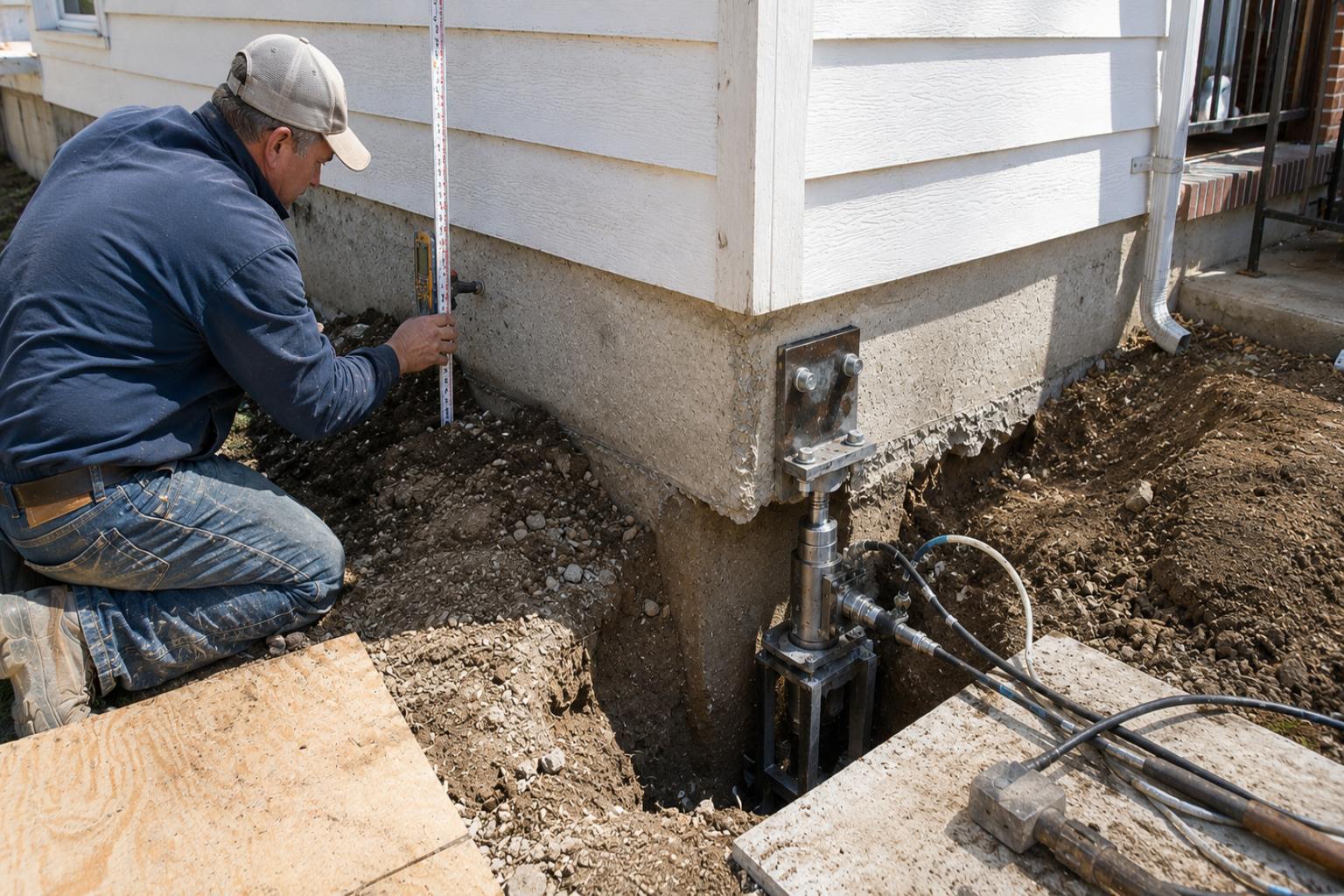


Foundation lifting has no fixed price because the phrase covers four different jobs. Foam under a sunken patio slab runs a few thousand dollars. Steel piers under a settled corner run into the tens of thousands. Raising the whole house onto a new foundation is a six-figure project once utilities, stairs, porches, and site work land on the invoice.
I have read enough lifting quotes to notice the word often means whatever the sales truck carries. That is the first problem. The second is that this is the repair category where people get scammed — not always by fraud, often by a sales process that fits every house to the product on the truck. A few cracks or one low elevation reading becomes a whole-perimeter pier system before anyone has proved what is moving, or why.
Before comparing prices, compare the diagnosis, the promised result, and the exclusions. The ranges below are 2026 planning numbers: what each version of lifting costs, what the quote leaves out, and how to pay the right amount instead of the biggest one.
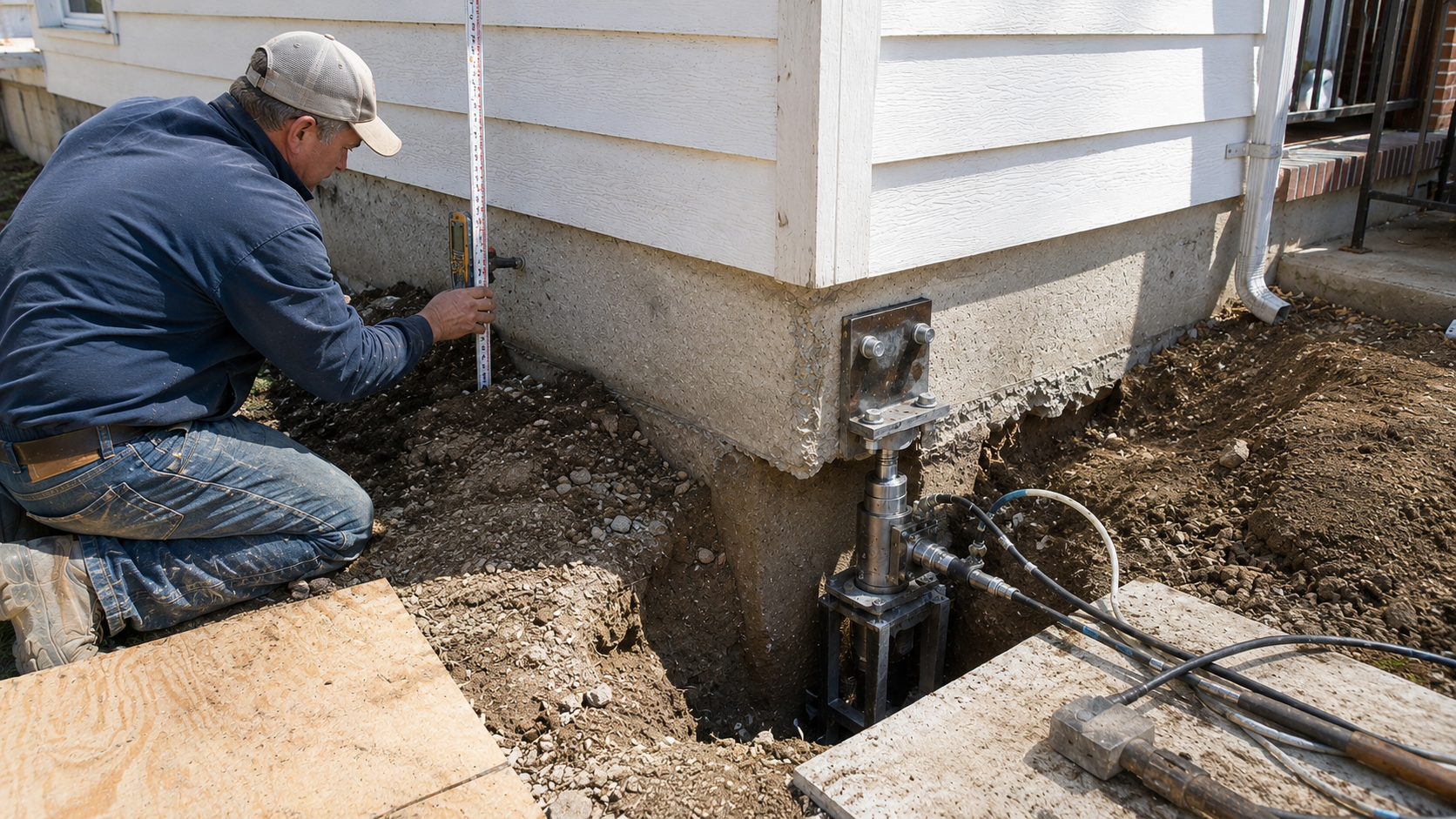
2026 US pricing note: The ranges below are planning ranges, not bids. They assume an ordinary detached house, normal access, no emergency mobilization, and no unusual historic, coastal, hillside, seismic, or environmental restrictions. Local labor, soil, permits, engineering, utility work, finish damage, and the amount of elevation recovery attempted can move the final price sharply.
What “Foundation Lifting” Means in a Contractor Quote
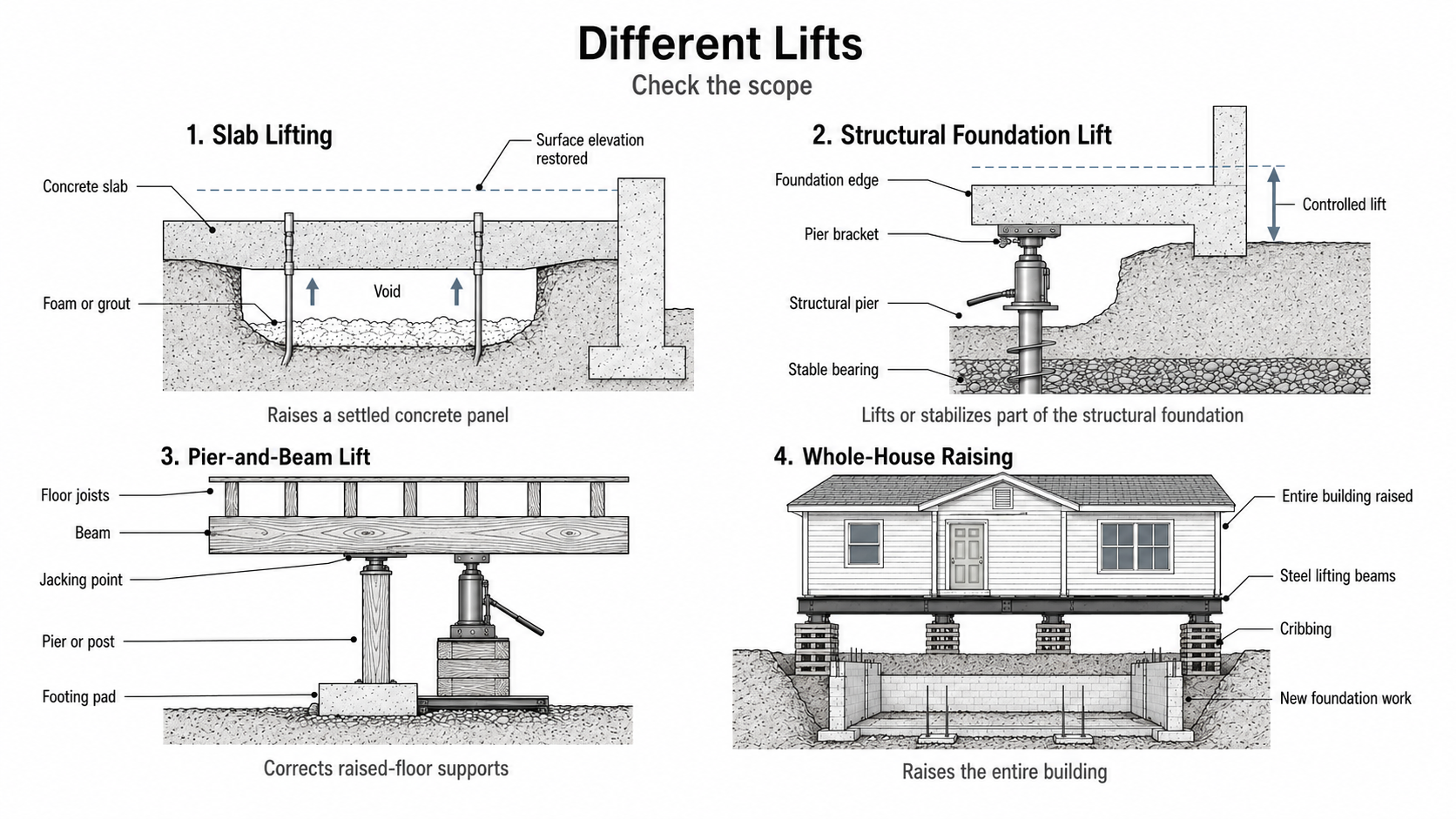
Before pricing anything, pin down what exactly is being lifted. One contractor prices foam under a sunken patio slab. The next is installing steel piers to stabilize a settled corner. A third is leveling a pier-and-beam floor from the crawl space, and a house-moving outfit is quoting steel beams, cribbing, disconnected utilities, and a new foundation.
| Contractor language | What is moving | Typical method | Correct cost category |
|---|---|---|---|
| Slab lifting | A driveway, patio, garage floor, walkway, or other concrete panel | Grout, mudjacking, polyurethane foam, or void filling | Concrete leveling |
| Foundation stabilization | A settled structural foundation edge or wall | Push piers, helical piers, underpinning, brackets, or other engineered supports | Structural foundation repair |
| Foundation lifting | A settled structural area where elevation recovery will be attempted | Piers plus controlled hydraulic lifting and monitoring | Structural pier installation plus lift risk |
| House leveling | A raised wood floor system, beams, posts, piers, pads, or crawl-space supports | Shimming, post adjustment, new supports, beam or joist work, and moisture correction | Pier-and-beam or crawl-space repair |
| House lifting or house raising | The entire building | Steel beams, synchronized jacks, cribbing, temporary support, and utility disconnection | Whole-house raising |
| Flood elevation | The entire building and often its utility systems | Whole-house raising onto a taller compliant foundation, piers, piles, or columns | Flood-mitigation project |
A detached concrete panel that has dropped over a void is usually a concrete leveling problem. A settled foundation carrying the house is structural. A sagging floor over a crawl space belongs in the pier-and-beam repair category. If steel beams and cribbing will carry the complete building while the old foundation is removed, the stronger guide is house lifting.
Foundation Lifting Cost at a Glance
These July 2026 US planning ranges are deliberately broad. They separate the work by method and scale rather than pretending every lift belongs in one national average.
| Project | 2026 US planning range | What the range generally includes | What it commonly excludes |
|---|---|---|---|
| Small slab lifting or void filling | $700–$5,000 | One or several accessible nonstructural concrete panels; drilling, grout or foam injection, basic hole patching, and ordinary mobilization | Structural foundation repair, drainage reconstruction, badly broken slab replacement, engineering, interior finishes, and major excavation |
| Structural pier installation | $1,000–$3,500 per pier; often $8,000–$30,000 for a localized project | Typical exterior excavation, pier and bracket, installation, load transfer, basic backfill, and stabilization at the repaired locations | Engineering, permits, interior demolition, plumbing tests, concrete replacement beyond a rough patch, flooring, landscaping, and drainage |
| Pier-and-beam leveling | $1,000–$10,000 for adjustment or localized support work; $10,000–$25,000+ when framing, piers, moisture, or access are extensive | Crawl-space access, elevation checks, selected shimming or support adjustment, and limited pier or post work | Widespread beam or joist replacement, rot remediation, drainage, encapsulation, plumbing, finish repairs, and reconstruction |
| Partial structural foundation lift | $15,000–$50,000+ | Multiple structural supports, staged hydraulic lifting, elevation monitoring, and an attempted recovery over part of the house | Guaranteed perfect leveling, plumbing damage, interior piers unless listed, extensive concrete cutting, finishes, connected porches or additions, and drainage correction |
| Lift the house for foundation replacement | $20,000–$100,000+; a new basement or difficult site can reach $150,000+ | Varies widely; the lower end may include lifting and temporary support, while broader estimates may include portions of foundation reconstruction | Never assume utilities, excavation, new foundation, stairs, porches, waterproofing, drainage, temporary housing, finishes, and landscaping are included unless itemized |
| Flood elevation or major whole-house raising | $20,000–$80,000+ for elevation work; complete projects may exceed $100,000–$200,000 | Whole-building lift and new elevated support arrangement at the stated scope | Elevation certificates, design, floodplain approval, utility relocation, flood openings, stairs, decks, enclosure limits, accessibility work, and complete site restoration |
Access assumption: The lower portions of these ranges assume exterior work with reasonable equipment access, ordinary soil handling, and no deep interior demolition. Interior piers beneath finished rooms, tight crawl spaces, neighboring buildings, pools, mature landscaping, rock, high groundwater, and difficult utility conflicts increase cost.
Engineering and permits: Small nonstructural slab work may not require structural engineering, although local rules still apply. Structural foundation lifting, underpinning, whole-house raising, and flood elevation commonly require engineering, permits, inspections, or specialized documentation. Do not assume those services are included in a contractor’s unit price.
Occupancy: Many localized exterior pier projects can be performed while the house remains occupied, subject to the contractor’s safety plan and utility conditions. Interior structural work may close rooms temporarily. A whole-house lift normally requires the building to be vacated and disconnected from utilities.
For a broader first-pass estimate that includes cracks, walls, drainage, crawl spaces, and other repair categories, use the foundation repair cost calculator. It is a planning tool, not a substitute for diagnosis.
Stabilization Is Not the Same as Lifting
The sentence that saves homeowners the most money in this business: a contractor can stabilize a foundation without returning it to its former elevation.
Stabilization transfers load to supports intended to resist additional settlement at the repaired locations. Lifting goes further. It attempts to recover some of the elevation already lost, and that attempt adds labor, equipment time, monitoring, and risk to the structure above.
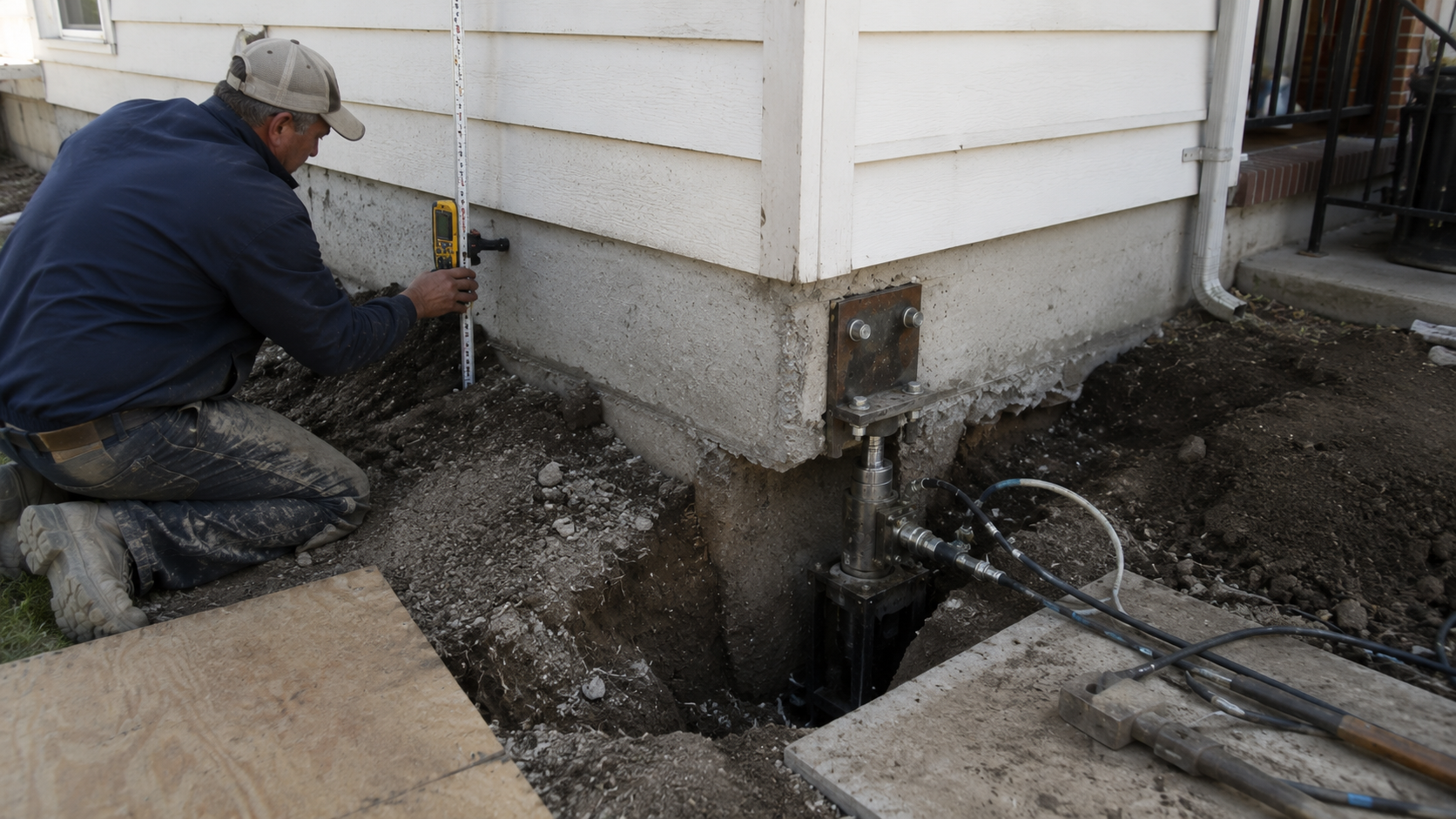
The practical lift may stop before the floor becomes perfectly level. Masonry can resist movement. A slab may bind against stable portions of the house. Plumbing may begin to show stress. Tile, drywall, cabinetry, windows, doors, porches, and additions may not move together. The contractor or engineer may decide that additional lifting creates more risk than benefit.
A serious proposal should state one of the following:
- Stabilization only: support the structure near its current elevation.
- Limited lift attempt: attempt partial elevation recovery while monitoring the structure and stopping at practical limits.
- Defined elevation objective: work toward recorded target elevations under an engineered plan, without promising that every finish or opening will return to its original position.
Do not accept sales language such as “we will level the house” when the contract only promises stabilization. The elevation objective, measurement method, repair area, and limitations should appear in writing.
Small Slab Lifting and Void Filling
Slab lifting usually applies to a driveway, patio, walkway, garage floor, porch slab, or other concrete panel that lost support below it. Contractors may inject cementitious grout or polyurethane foam through drilled holes to fill voids and move the slab toward the desired elevation.
For accessible nonstructural concrete, a reasonable 2026 planning range is about $700 to $5,000, with small jobs often affected by minimum mobilization charges. Large slabs, difficult access, deep voids, extensive foam volume, repeated injection points, drainage work, and broken concrete push the price upward.
This range assumes:
- the slab is still suitable for lifting rather than replacement
- the house structure is not the moving element
- ordinary drilling and patching are included
- the contractor can reach the work without major demolition
- no structural engineer, deep excavation, or utility relocation is required
It excludes replacement of badly cracked concrete, correction of active erosion, major drainage work, foundation underpinning, and interior finish restoration.
A slab that supports load-bearing walls is not automatically an ordinary foam-lifting job. Neither is a low floor that continues through several rooms with sticking doors and wall cracks. Those conditions require structural diagnosis before a surface-lifting method is selected.
Structural Pier Installation and Partial Foundation Lifting
Structural piers are installed to transfer foundation loads through weak or moving near-surface soil to deeper resistance or suitable bearing. Common residential systems include push piers and helical piers, although the correct system depends on the structure, loads, soil, access, installation criteria, and engineering — not the soil name or the contractor’s preferred product.
Current US planning figures commonly place installed residential piers around $1,000 to $3,500 each. That unit price is useful only after the quote defines what it includes. A six-pier exterior stabilization project and a 16-pier project with interior access, concrete cutting, plumbing tests, and a monitored lift cannot be compared by pier price alone.
A localized exterior project may land around $8,000 to $30,000. A broader partial lift with numerous supports, interior work, staged elevation recovery, engineering, testing, and restoration can reach $15,000 to $50,000 or more.
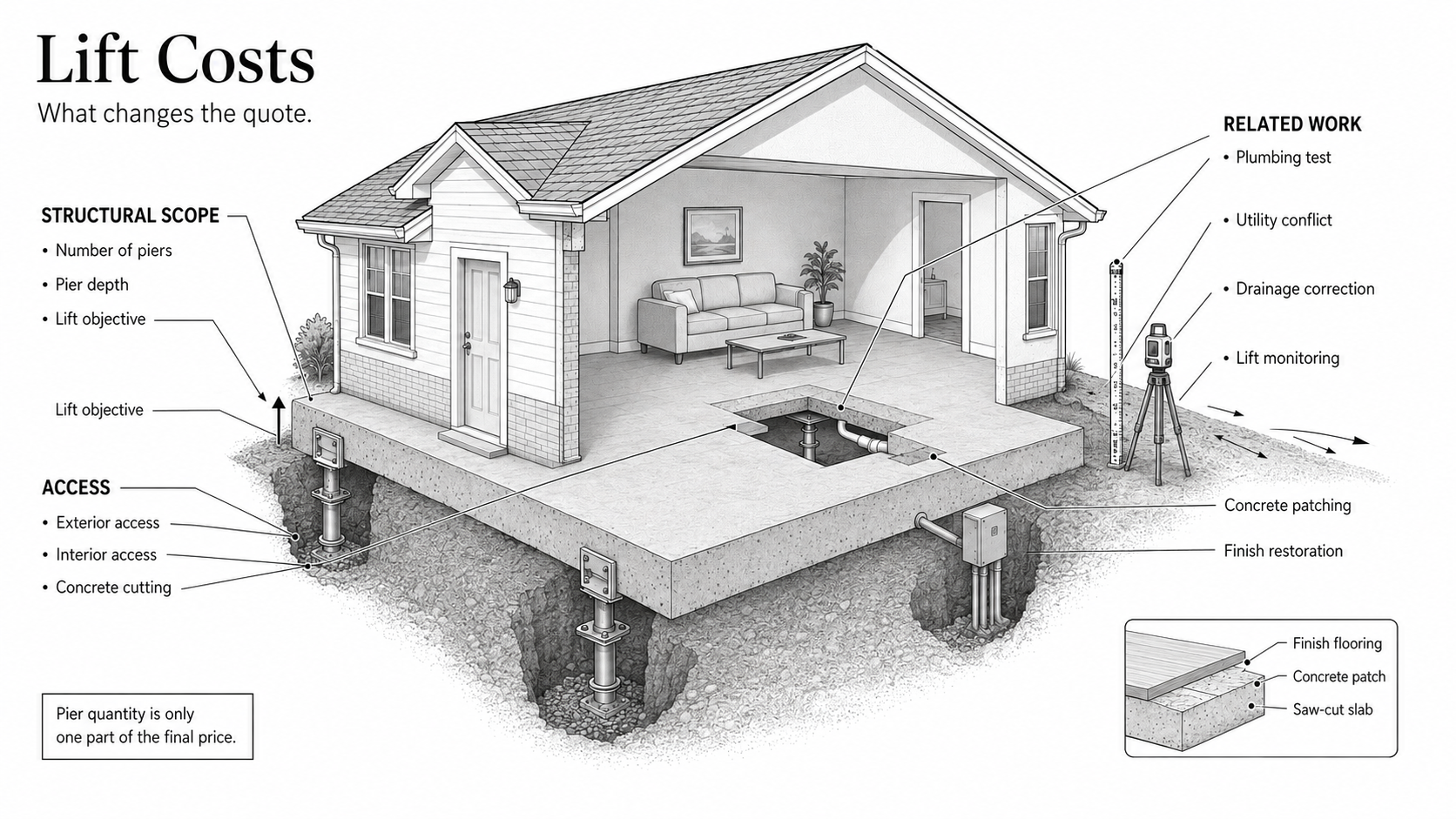
What raises the structural-lifting price
- Foundation type: Slab-on-grade, stem wall, basement, and pier-and-beam houses transfer loads differently and give the crew different access to the failed area.
- Pier count: More affected foundation length normally means more support locations.
- Interior piers: Finished floors may need to be removed, concrete cut, soil excavated, and the slab patched.
- Installation depth or resistance: Deeper or more difficult installation can increase steel, equipment time, and verification work.
- Lift objective: Stabilization is usually less disruptive than an aggressive attempt to recover elevation.
- Plumbing risk: Under-slab water and drain lines can be stressed by foundation movement and by the lift itself.
- Utilities and obstructions: Gas, electric, sewer, water, HVAC lines, patios, pools, driveways, and additions can block normal access.
- Engineering and permits: Requirements vary by jurisdiction, and drawings, inspections, and closeout documentation may be priced separately from the permit fee.
- Restoration: A rough concrete patch is not the same as replacing finished flooring, cabinetry, tile, drywall, or landscaping, and backfill does not automatically include sod, irrigation, or paving.
- Water and drainage: Piers may support the structure, but they do not correct runoff, plumbing leakage, erosion, or recurring moisture changes on their own.
The proposal should show every pier location on a plan. It should also identify whether each location is exterior or interior and whether the unit price includes excavation, bracket installation, load transfer, lift attempt, backfill, concrete patching, cleanup, and follow-up measurements.
Pier-and-Beam or Crawl-Space Leveling
A pier-and-beam house is not leveled the same way as a concrete slab foundation. The floor may be low because of settled pads, cracked piers, poor shims, undersized posts, sagging beams, damaged joists, rot, plumbing leakage, wet soil, or an incomplete load path.
Simple reshimming or localized adjustment may fall around $1,000 to $5,000. Leveling several areas, replacing selected supports, or adding beam support may run $5,000 to $10,000. Projects involving numerous new piers, beam or joist replacement, rot, tight access, drainage, or moisture correction can reach $10,000 to $25,000 or more.
These ranges assume the contractor can work within an accessible crawl space and the house can generally remain occupied. They do not automatically include encapsulation, widespread framing replacement, mold remediation, plumbing, drainage, flooring, drywall, or finish repairs.
Do not pay to “level the floor” until the contractor explains what failed below it. A new jack post placed on weak soil or an inadequate pad may improve the floor temporarily while leaving the underlying support problem intact. The dedicated guides to pier-and-beam foundation repair and crawl-space foundation repair cover the load path, wood damage, moisture, pads, posts, beams, and joists in greater depth.
When Foundation Lifting Means Raising the Whole House
Whole-house raising is a different construction operation. Steel beams are inserted beneath the building, lifting points are coordinated, the structure is carried on cribbing or another temporary support system, and utilities must be disconnected or protected. The old foundation may then be repaired, replaced, or extended.
The lift operation alone is often planned around $10,000 to $40,000. Lifting the house and replacing the foundation commonly reaches $20,000 to $100,000 or more. Creating a new basement, working on a difficult site, handling masonry construction, or rebuilding extensive connected work can push the complete project beyond $150,000.
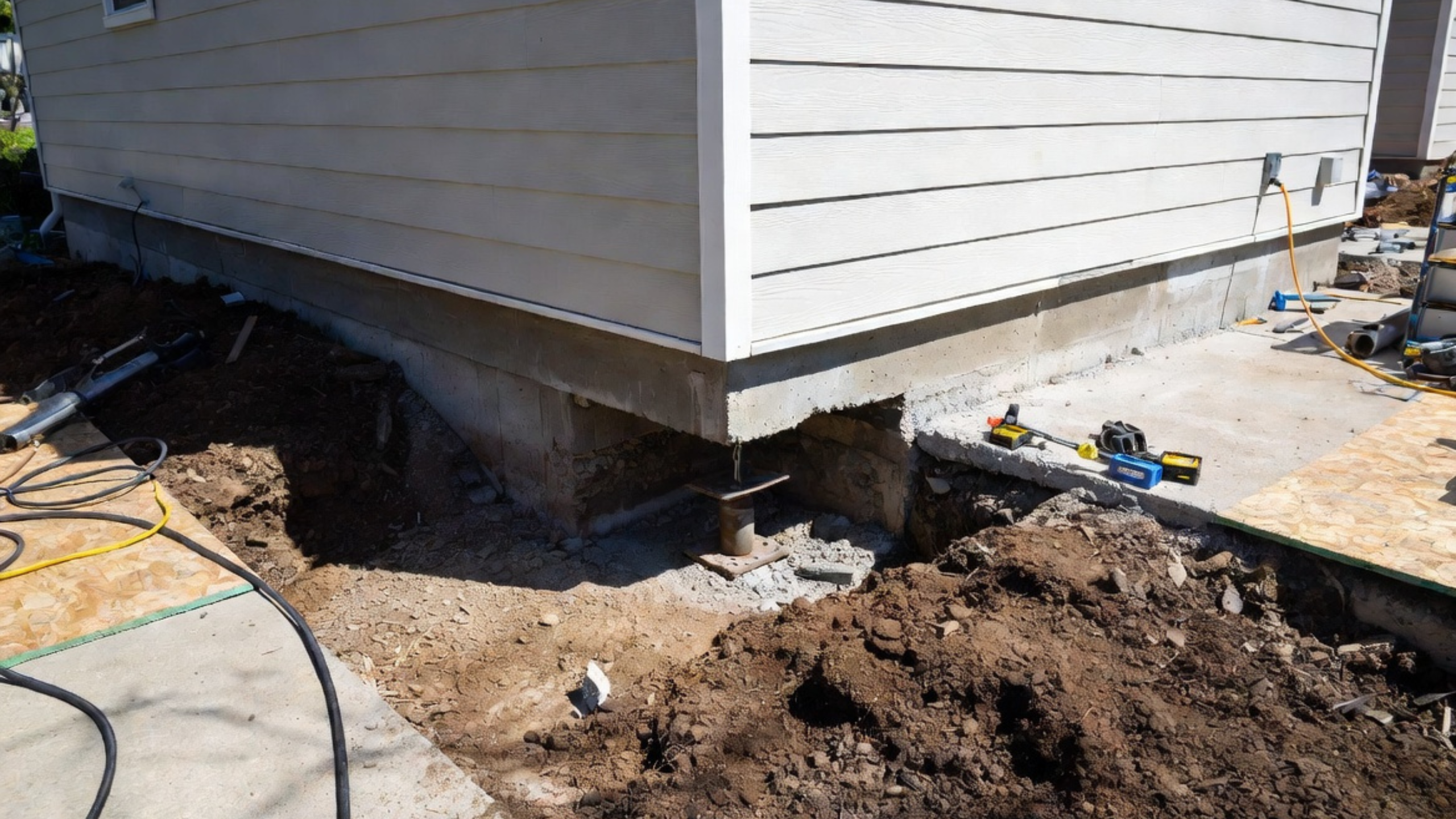
A house-lifting quote may exclude:
- structural engineering and drawings
- permits and inspections
- utility disconnection and reconnection
- excavation and soil disposal
- the new foundation itself
- waterproofing, drainage, insulation, and backfill
- stairs, landings, decks, porches, chimneys, and additions
- temporary housing and storage
- interior and exterior finish repair
- landscaping, paving, fences, and site access restoration
If the proposal includes lifting the complete building on steel beams and cribbing, compare it through the whole-house lifting guide, not the localized pier prices above.
Flood Elevation Is a Separate Project
Raising a house for flood protection runs on a different rulebook than foundation repair. The project may need a defined flood-protection elevation, floodplain approval, an elevation certificate, compliant foundation or pile design, protected service equipment, flood openings where required, new stairs and landings, and restrictions on how enclosed space below the elevated floor can be used.
A preliminary 2026 planning range for elevation work is roughly $20,000 to $80,000 or more. Complete flood-elevation projects can exceed $100,000 to $200,000 after engineering, foundation construction, utilities, access, stairs, porches, enclosure work, site restoration, and local requirements are included.
The house normally cannot remain occupied while it is disconnected, lifted, supported, and reconnected. Coastal exposure, pile work, masonry construction, limited equipment access, high required elevation, attached garages, and heavily connected additions can raise the cost substantially.
Flood-elevation decisions should be coordinated with the local floodplain administrator and building department. A contractor’s lifting price is only one part of the compliance and reconstruction budget.
Build Your Own Estimate Before the Sales Pitch
A homeowner who walks into the first sales appointment with a written number is much harder to oversell. The math is not complicated.
- Classify the job. Use the table at the top of the page: nonstructural slab, structural piers, pier-and-beam leveling, or whole-house raising. Everything downstream depends on the category.
- Measure the affected area. Many residential pier layouts place supports roughly every 5 to 8 feet along an affected foundation run, but spacing depends on the foundation type, loads, soil, repair system, and engineering. The point is not to design the repair yourself. The point is to notice when a small settled area turns into a suspiciously large pier count.
- Multiply and add the line items. Take the affected length, estimate the pier count, and price it at $1,000 to $3,500 per pier. Then add what the unit price rarely covers: an engineering evaluation at $500 to $1,500, a permit if the jurisdiction requires one, pre-lift and post-lift plumbing tests at a few hundred dollars each, and a restoration allowance of 10 to 15 percent for concrete, flooring, and landscaping.
Worked out: eight exterior piers at $1,500 is a $12,000 headline. With engineering, two plumbing tests, permits, and a restoration allowance, the realistic project is closer to $15,000 to $17,000. When a proposal comes in far below your own arithmetic, the missing money is in the exclusions. When it comes in far above, the extra money is usually in pier count — and pier count is exactly the number that needs proof.
Know where the published prices come from before leaning on them. Most online foundation cost data is compiled by contractors and lead-generation platforms, and both do better when you request quotes. The numbers reflect booked jobs. Nobody publishes a dataset of the houses that only needed monitoring, a drainage fix, or nothing at all, so price research alone cannot tell you whether your house belongs in that group. Only a diagnosis independent of the sale can.
How Homeowners Get Sold the Wrong Foundation Lift
Not every incorrect recommendation is deliberate fraud. Some come from poor inspection, inexperienced estimating, or a salesperson trying to fit every house to the system the company installs. The financial result can still be the same: the homeowner pays for the wrong repair, more repair than the house needs, or a lift that does not deliver what was implied.
A localized problem becomes a whole-house repair
A contractor finds movement at one corner and proposes piers around most or all of the house. The homeowner is shown cracks and elevation differences but is not given a clear explanation of which areas are actively moving, which slopes may be old, or why every proposed support is necessary.
A localized settled section may justify six supports, while the sales proposal includes 20 or 30 around the entire perimeter. Whole-perimeter underpinning can be appropriate, but the evidence should support it. The quote should map every proposed location and explain what the repaired area is expected to achieve.
Stabilization is sold as guaranteed leveling
The salesperson talks about closing cracks, straightening floors, and making every door work again. The contract promises only stabilization.
Those are not the same result. Even when lifting is attempted, the contractor may stop because plumbing, masonry, framing, tile, or connected additions begin to resist the movement. A homeowner can pay a lifting price and receive a stabilization result unless the written objective is clear.
The contractor sells the method it has
Ask a push-pier company what your house needs and the answer is usually push piers. Foam contractors find foam problems, helical installers find helical problems, and crawl-space companies find posts to add.
Any of those systems can be legitimate in the correct application. The pattern I see most often is diagnosis done backward: the company starts with its product and then finds a reason to sell it. Foam injected beneath a slab with an unresolved structural problem, crawl-space posts installed over weak bearing or rotted framing, structural piers proposed for a detached panel that needed ordinary slab leveling — each one is the truck deciding the diagnosis.
A free inspection becomes a high-pressure sales appointment
A free contractor inspection is generally part of a sales process. That does not make it dishonest, but the person inspecting the house may benefit when the homeowner signs the repair contract.
Warning signs include:
- claiming the house is in immediate danger without documenting why
- offering a large discount that expires the same day
- refusing to leave the measurements or proposed pier plan
- using cracks alone as proof that a major lift is necessary
- insisting that only one proprietary system can repair the house
- dismissing an independent engineer before reviewing the engineer’s findings
- pushing financing documents before the homeowner obtains another opinion
- asking for a large upfront payment unrelated to delivered materials or completed work
A genuinely unsafe condition may require prompt action. The contractor should still be able to document the condition, identify the affected area, and put the recommendation in writing.
The low quote leaves out the expensive work
A contractor may advertise a low price per pier while excluding much of the work needed to reach, lift, test, and restore the structure. Common exclusions include engineering, permits, interior floor removal, concrete cutting, plumbing tests, damaged utilities, flooring, tile, drywall, masonry, porches, stairs, decks, excavation, soil disposal, landscaping, drainage correction, temporary housing, and post-repair monitoring.
A quote for ten piers is not necessarily a quote for a completed ten-pier project. Compare the finished scope, not the unit price alone.
Financing makes the repair look smaller
A large repair may be presented as an affordable monthly payment rather than a total cost. The homeowner signs the construction agreement and financing documents during the same appointment without fully understanding the interest rate, fees, lien or security terms, loan length, or total amount repaid.
Separate the repair decision from the financing decision. Ask for the cash price, financed price, annual percentage rate, all fees, payment term, prepayment rules, and total repayment amount. Do not sign blank documents or allow sales pressure to replace comparison shopping.
The lifetime warranty covers less than expected
A prominent lifetime or transferable warranty may cover only the installed pier or bracket. It may exclude movement elsewhere, cosmetic damage, plumbing, drainage, soil changes, interior finishes, additional lifting, access costs, or adjustments outside the repaired area.
Some warranties require registration, transfer fees, drainage maintenance, periodic inspections, or payment for service visits. Read the actual warranty and ask what happens if movement occurs beside, between, or beyond the repaired supports.
The project starts, then the change orders begin
Another pattern is a low initial price followed by escalating claims after excavation begins: unexpected soil, deeper supports, interior locations, utility conflicts, additional piers, or emergency stabilization. Some of those findings are legitimate, and from the homeowner's side there is often no way to verify a mid-project soil claim from the edge of the pit. The best available protection is procedural: the contract should explain how changed conditions are documented, priced, and approved before extra work proceeds.
Protect yourself before signing
For a major structural lift, a whole-house proposal, or sharply conflicting estimates, obtain an evaluation from a qualified professional who is not being paid to sell the repair system. Require a written diagnosis, elevation map, proposed support locations, method justification, lift objective, practical tolerance, complete exclusions, plumbing responsibilities, payment schedule, change-order process, and full warranty.
Do not allow the person selling the repair to be the only person defining the problem.
Pay the Right Amount, Not the Lowest Price
Cheap and expensive both have failure modes in this category. The cheap quote fails through exclusions, change orders, or a method that has to be redone. The expensive quote fails by buying more piers than the movement justifies — paying more purchases more steel, not more certainty.
The right amount is the one tied to a mapped scope: supports where movement is documented, monitoring where it is not, drainage correction where the water evidence points, and nothing priced against fear. A proposal that cannot connect each pier to a measured elevation problem is not a better deal at any price.
One heuristic covers most disputes: when two quotes disagree by more than ten times the price of an engineer's report, buy the report. A $500 to $1,500 independent evaluation is the cheapest item on the table when contractors are $15,000 apart, and it is the only line item whose author earns the same fee whether you repair or not.
What a Complete Foundation-Lifting Quote Should Include
A serious estimate should let you compare scope line by line. Ask for:
- the diagnosed movement pattern and suspected cause
- a dated foundation-elevation plan or measurement map
- the exact foundation area included
- pier or support type, count, and locations
- exterior and interior access points
- installation or termination criteria
- stabilization-only or attempted-lift objective
- expected practical elevation recovery and stated limitations
- engineering responsibility
- permit and inspection responsibility
- utility location and protection
- pre-lift and post-lift plumbing tests
- concrete cutting and patch definition
- flooring, tile, drywall, masonry, cabinet, trim, and paint exclusions
- porch, deck, stair, garage, chimney, and addition exclusions
- drainage work and soil restoration
- cleanup and landscaping limits
- monitoring and follow-up schedule
- payment milestones
- change-order rules
- warranty coverage area, exclusions, transfer conditions, and service fees
Ask the contractor to show the difference between the base price and a reasonable finished-project allowance. A quote that ends at the installed pier may be thousands of dollars below the amount needed to restore the house and site.
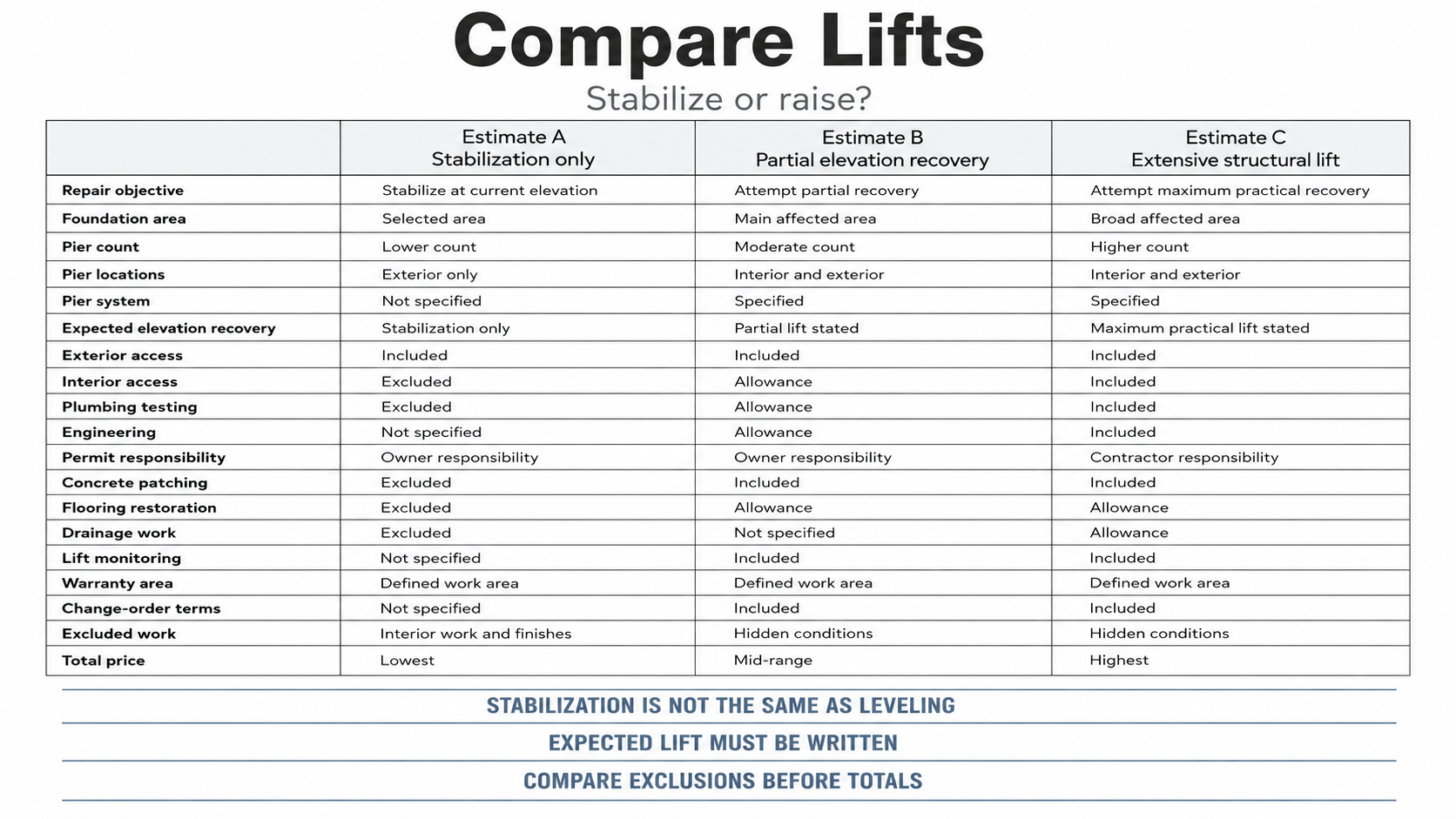
How to Compare Three Foundation-Lifting Estimates
Do not line up three totals and circle the lowest one. First determine whether all three contractors priced the same result.
| Comparison item | Estimate A | Estimate B | Estimate C |
|---|---|---|---|
| Repair objective | Stabilize at current elevation | Attempt partial elevation recovery | Attempt extensive structural lift |
| Foundation area | One exterior corner | One side plus selected interior area | Multiple sides and interior support line |
| Pier locations | Exterior only | Exterior plus limited interior | Exterior and interior |
| Engineering | Not specified | Allowance | Included or separately contracted |
| Plumbing tests | Excluded | Post-lift only | Pre-lift and post-lift |
| Concrete and flooring | Rough patch only | Concrete patch; flooring excluded | Defined restoration allowance |
| Monitoring | Final reading | During lift and final reading | During lift, final plan, and follow-up |
| Warranty area | Installed supports only | Repaired foundation area | Must be confirmed in written warranty |
The lowest estimate may be entirely reasonable if stabilization is the correct objective. It is not equivalent to a proposal that includes interior supports, attempted elevation recovery, testing, engineering, and restoration. Compare the proposed outcome before negotiating the price.
What Homeowners Find After the Foundation Has Been Lifted
The structural operation may be finished while the house is not. Lifting changes relationships that developed slowly as the building settled. Drywall, tile, cabinets, pipes, doors, windows, stairs, porches, decks, garages, and additions may respond at different times.
Some effects appear during the lift. Others show up after the building is loaded normally again, after plumbing is used, after rain changes the surrounding soil, or after seasonal movement returns.
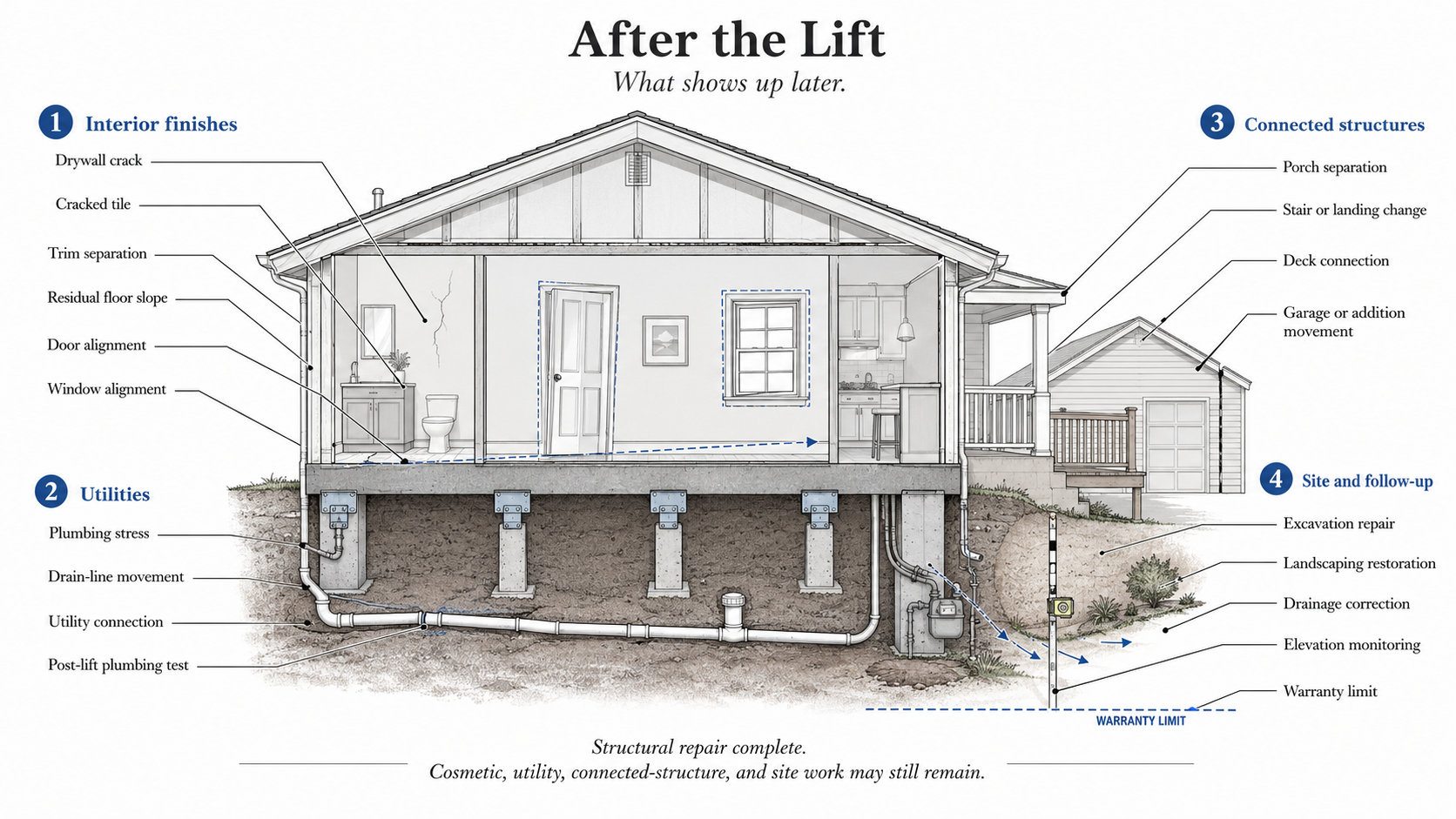
Cracked drywall, tile, trim, or masonry
Old cracks may narrow while new cracks appear elsewhere. Tile and stone tolerate little movement. Trim joints can open, cabinet lines can shift, and masonry may not follow the recovered foundation elevation cleanly. Cosmetic repair is often excluded from the structural contract.
Doors and windows may move out of alignment
A sticking door may improve, remain unchanged, or begin rubbing at another edge. Window operation can change as openings move. Do not assume every opening will return to factory alignment after a partial structural lift.
Plumbing and utility stress may appear later
Water and drain lines may already have been stressed by settlement. Lifting changes their position again. A post-lift test matters, but a problem may become visible only after normal use. The contract should state the testing method, timing, and responsibility for repairs.
Porches, stairs, decks, garages, and additions may separate
Connected structures may sit on different footings or have different movement histories. Lifting the main house can change step heights, landings, flashing, deck connections, porch roofs, garage transitions, and joints between additions.
The result may be improved, not perfectly level
A practical lift tolerance is not the same as restoring every floor to zero slope. Older framing may have permanent deflection. Some areas may never have been perfectly level. The repair objective should be based on structural performance and documented elevations, not a vague promise that a ball will never roll across the floor.
Excavation and landscaping still need restoration
Pier pits, access routes, removed shrubs, damaged irrigation, compacted soil, broken paving, and disturbed grading may remain after structural work. Backfill can settle later and create low spots that collect water beside the foundation.
Drainage can still cause future movement
Structural supports do not correct roof runoff, poor grading, downspout discharge, erosion, plumbing leakage, or water collecting beside the house on their own. If the moisture pattern remains, unsupported areas can continue moving even when the repaired supports perform as intended.
Monitoring and warranty limits matter
The contractor may take final readings and leave, or the scope may include a follow-up visit after the structure has gone through normal loading or a seasonal cycle. The warranty may cover only the installed supports — not movement between supports, connected structures, finishes, drainage, or plumbing.
Protective action before signing
Before work begins, obtain:
- dated photographs of every room, exterior wall, porch, stair, deck, garage transition, and existing crack near the repair area
- a pre-lift elevation map with identifiable measurement points
- a written stabilization or lifting objective
- the expected practical tolerance and conditions that may stop the lift
- written responsibility for plumbing and utility testing
- a list of excluded finishes and connected structures
- a post-lift elevation record and follow-up schedule
- the complete warranty, including exclusions and service charges
Do not sign until the contract explains what happens after the hydraulic equipment is removed.
Who Should Be Involved
The correct team depends on project scale.
- Structural engineer: evaluates structural movement, framing or foundation behavior, repair objectives, and design where required.
- Foundation repair contractor: installs localized structural systems such as piers, brackets, underpinning, or crawl-space supports.
- Concrete leveling contractor: lifts or stabilizes suitable nonstructural slabs with grout or foam.
- House-moving or lifting contractor: raises the entire building on temporary beams and support systems.
- Plumber: tests and repairs water, drain, and sewer systems where movement may have caused stress.
- Surveyor or elevation professional: may be involved in flood elevation, property constraints, or required documentation.
- Building official or floodplain administrator: confirms local permit, inspection, flood, and occupancy requirements.
The engineer and contractor do not perform the same role. For a major or disputed repair, an independent evaluation can help separate diagnosis from sales.
What Not to Repair Yet
Do not rush to patch every drywall crack, retile the floor, plane doors, reset windows, or rebuild exterior transitions before the structural work and early monitoring are complete.
Some openings will change during the lift. Backfill may settle. Plumbing tests may reveal additional work. The final practical elevation may differ from the original sales expectation. Finish repairs performed too early can crack or require adjustment again.
Document the existing damage, complete the structural operation, obtain final measurements, perform required testing, correct drainage, and allow the agreed observation period before spending heavily on cosmetic restoration.
FAQ
How much does it cost to lift part of a foundation?
A localized structural pier project commonly falls around $8,000 to $30,000 in 2026 US planning terms. A broader partial lift involving numerous supports, interior access, monitoring, testing, and restoration can reach $15,000 to $50,000 or more. The quote must state whether the work includes stabilization only or attempted elevation recovery.
How much does each foundation pier cost?
Current residential planning figures commonly fall around $1,000 to $3,500 per installed pier. That unit price may exclude engineering, permits, interior demolition, concrete replacement, plumbing, finishes, drainage, landscaping, and monitoring. Compare the complete project scope.
Is stabilization cheaper than lifting?
Usually. Stabilization transfers load to new or improved supports without requiring aggressive elevation recovery. Attempted lifting adds hydraulic work, monitoring, time, and risk to plumbing, finishes, masonry, and connected structures.
Does installing piers automatically level the house?
No. Piers can be installed to stabilize the foundation near its current elevation. Lifting may be attempted afterward, but the structure may not safely or practically return to its original position.
Is slab lifting the same as foundation lifting?
No. Lifting a detached driveway, patio, walkway, or garage slab with grout or foam is generally concrete leveling. Lifting a structural foundation that carries the house may require piers, underpinning, engineering, permits, and controlled load transfer.
Can I remain in the house during foundation lifting?
Many localized exterior pier projects can be completed while the house remains occupied, subject to contractor safety procedures and utility conditions. Interior work may close rooms. Whole-house raising normally requires the house to be vacated and disconnected from utilities.
Can foundation lifting damage plumbing?
Yes. Plumbing may already be stressed by settlement, and lifting changes pipe positions again. Ask who performs pre-lift and post-lift testing, what is tested, and who pays if damage is found.
Will drywall and tile repair be included?
Often not. Structural contracts commonly exclude cosmetic finishes unless they are itemized. Require a written list covering drywall, paint, tile, flooring, cabinets, trim, masonry, and exterior finishes.
Does foundation lifting fix drainage problems?
No. Piers or supports can stabilize structural loads, but runoff, poor grading, erosion, plumbing leakage, and recurring moisture changes may still require separate correction.
Should I hire an engineer before getting quotes?
An independent engineer is especially useful when the proposed repair is expensive, the estimates conflict sharply, the contractor recommends whole-perimeter work, the structure may be unsafe, or the salesperson is the only person defining the problem.
Is foundation lifting covered by homeowners insurance?
Coverage depends on the cause of damage and the policy. Gradual soil movement, settlement, poor drainage, and maintenance issues are commonly treated differently from sudden covered events. Obtain a written coverage decision from the insurer rather than relying on a contractor’s statement.
Read This Next
Official sources and 2026 pricing references
- International Code Council — 2024 IRC Chapter 4: Foundations
- International Code Council — 2024 IEBC Chapter 4: Repairs
- OSHA — 1926.305: Jacks, Blocking, and Securing Raised Loads
- FEMA — Elevating Your House
- Federal Trade Commission — How to Avoid a Home Improvement Scam
- HomeGuide — 2026 Concrete Leveling Cost
- Angi — 2026 Foundation Repair Cost Data
- HomeGuide — 2026 House Lifting Cost