
Nature’s Blueprint: How Organic Forms Drive Better Parametric Design
Parametric design gets marketed like it was born in a lab. In truth, the best parametric ideas came from trees, shells, bones, rivers, coral, dunes, and insects long before we had Rhino or Grasshopper. Nature figured out how to adapt, distribute force, grow efficiently, and respond to time and climate billions of years before any engineer opened a laptop. That is why the designers who study natural forms do more than create pretty blobs. They design smarter buildings and tighter systems that work under stress and age.
This guide breaks down how architects and designers use nature as a parametric framework. Not as a metaphor. As a working model. You will see how teams reverse-engineer shell spirals, termite vents, cellular grids, and plant geometries into structures that behave like organisms. Then we look at how the right software turns that logic into real parts and assemblies.
Why Nature Is the Quiet Engineer Behind Most “Futuristic” Designs
Nature doesn’t draw plans. It codes behaviors. Waves break based on wind and gravity. Leaves arrange toward light. Clamshells form to resist pressure. Every form has a story. Parametric design tools let you build the same way. You set the rules, assign inputs, and let the geometry shift to fit.
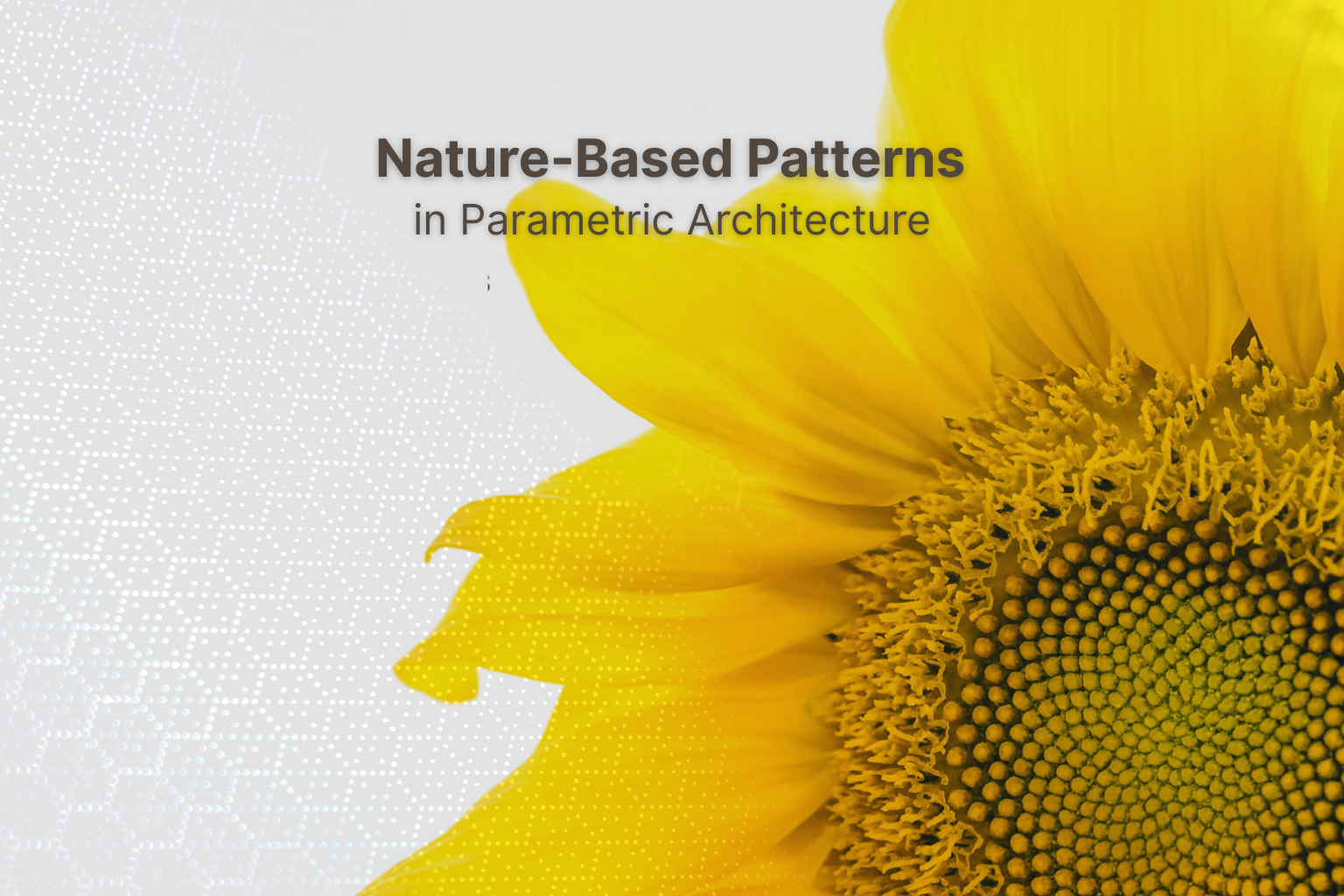
When designers copy nature, they are not copying shapes. They are copying the feedback loop. Structure reacts. Input shifts. Output recalculates. A façade changes based on wind load. A stair layout stretches or tightens based on room width. That is the same logic a sunflower uses when it spirals out.
If you want more foundational logic, see this intro to parametric architecture.
Three Real Projects Where Nature Was the Script
1. The Eden Project, Cornwall
Those geodesic domes are not just “cool shapes.” They are built on the same geometry found in carbon molecules and soap bubbles. Why? Because both maximize surface area while using the least material.
The domes were prototyped in Rhino, then optimized using scripts that tested different compound curves and panel layouts. The final skin is a lightweight membrane inflated between a steel frame, like skin stretched over a skeleton. The parametric script kept updating until every hexagon hit pressure and light targets.
2. Gherkin Tower, London
The tower vents like a termite mound. Cool air enters at the base. Warm air escapes through spiraled openings at the top. No one “invented” this strategy. Termites did. The team modeled air movement in Grasshopper, then cut vent bands into the structure at angles that matched natural airflow.
3. Lotus Dome, Michael Hansmeyer
Hansmeyer fed fractal math into a parametric script. It read like a coral reef growing in time. The system multiplied one form into thousands. No detail was drawn by hand. Patterns emerged the same way frost builds on glass. That's why it feels alive, not designed.
If you want a classic breakdown of adaptive geometry, the case study in this Heydar Aliyev deep dive is worth reading.
How to Pull Nature Into Your Parametric Workflow
1. Start With Observation, Not Software
Study why a shell spirals. Why kelp bends the way it does. Why pine cones open and close. Do not start by modeling. Start by sketching. The rules in parametric work only make sense when your brain sees the pattern first.
2. Reverse-Engineer the Pattern
Translate what you saw into a parametric rule. Example: “Each layer rotates 6 degrees and increases size by 4%.” That is how you build a spiraled ramp or a ribbed ceiling without forcing curves.
3. Pick the Right Toolstack
- Rhino + Grasshopper: best for organic building skins and non-repeatable patterns
- Fusion 360: clean for industrial work like fixtures or small assemblies
- CATIA: built for aircraft and stadiums where curvature accuracy matters
A basic comparison is here: parametric tools for architects and engineers.
Field Notes From a Small Office
A 3-person studio in Halifax spent months trying to design a wood roof that looked “natural.” Nothing worked. Every curve read like a math trick until they studied the underside of oyster shells. They found repeating ribs that thickened under pressure and thinned at the edge. The team fed that rule into Grasshopper. Now the ribs grow where the roof needs to carry snow and taper where it meets daylight. It saved 14% in material and the beams read like they grew there.
Good parametric design does not look like a blob. It looks like it belongs.
The Palm House Test
Real talk. If your parametric design cannot pass the “Palm House Test,” it is not ready.
Palm House Test: Would the thing you designed look like it could survive in a Victorian botanical garden, surrounded by palm trees, water vapor, and cast iron ribs? If yes, it has life. If no, it is a render, not architecture.
Nature + structure + time. That is the test. The Alhambra passes. Frei Otto’s tents pass. Anything that needs a sci-fi background to make sense does not.
If you want to see how that thinking jumps from walls to chairs, this furniture and facade crossover guide is solid.
MUST READ
Elements of Parametric Design
The only book that explains what “a parameter” really is. Reads like field notes from someone who broke enough models to learn the rules. Good if you want to stop copying scripts and start writing them.
Why it earns a spot: Helps you debug ideas before they break the model.
Natural Patterns You Can Steal Today
- Dragonfly wings: triangulated stress map for large spans
- Cactus ribs: shading + load response in one move
- Golden ratio shells: scalable stair logic without redesigning each step
- Honeycomb grids: reduce panels, hold strength, build fast
Each one above has been used in curtain walls, roofs, shading fins, and seating. None of them are “new.” The math just caught up.
Want more case-backed examples? see these real parametric builds.
FIELD PICK
AAD: Algorithms-Aided Design
Studio classic. Screenshots match the current UI. You can build full workflows from site massing to fabrication. Nothing else hits both concept and construction this clean.
Use case: Great for people who hate reading and want pictures that match real output.
Working With AI and Natural Logic
Generative modeling does what nature does. It evolves forms based on limits. AI won’t “design” your building. It will show 1,000 variations fast and push you to explain why one is better. Only humans answer that.
If you're curious how AI already mixes with parametric facades, there’s a good breakdown here: AI and parametric architecture in practice.
Materials You Should Not Ignore
- CLT panels cut with organic curves: less waste than straight plywood ribs
- 3D-printed sand: for formwork or permeable facade blocks
- Thin shell concrete: reacts well to force-driven modeling
A good intro to what materials survive real fabrication is here: parametric brick and hybrid facades.
FAQ
Why does nature matter in parametric work?
Because nature solved structural, environmental, and spatial problems long before buildings existed. Copying that logic saves time and materials.
Do I need to know code?
You need to understand rules, not languages. Grasshopper is visual. Once the logic makes sense, scripting becomes a tool, not a requirement.
Which software is best for organic forms?
Rhino + Grasshopper. If you need precision for large spans, CATIA. If you need clean mechanical thinking, Fusion 360 works.
Is AI replacing parametric tools?
No. AI proposes. Parametrics control. You still need to set the rules.
Can this work in small projects?
Yes. Screens, stairs, benches, pergolas, trusses. Anything modular responds well to driven logic.
Final Word
Nature is not an aesthetic filter. It is an engineer. Your job is to listen and translate. When you combine living geometry with good software, you do not get “patterns.” You get structure that breathes, bends, and survives. That is the point of parametric design. Not curves. Not renders. Control.