
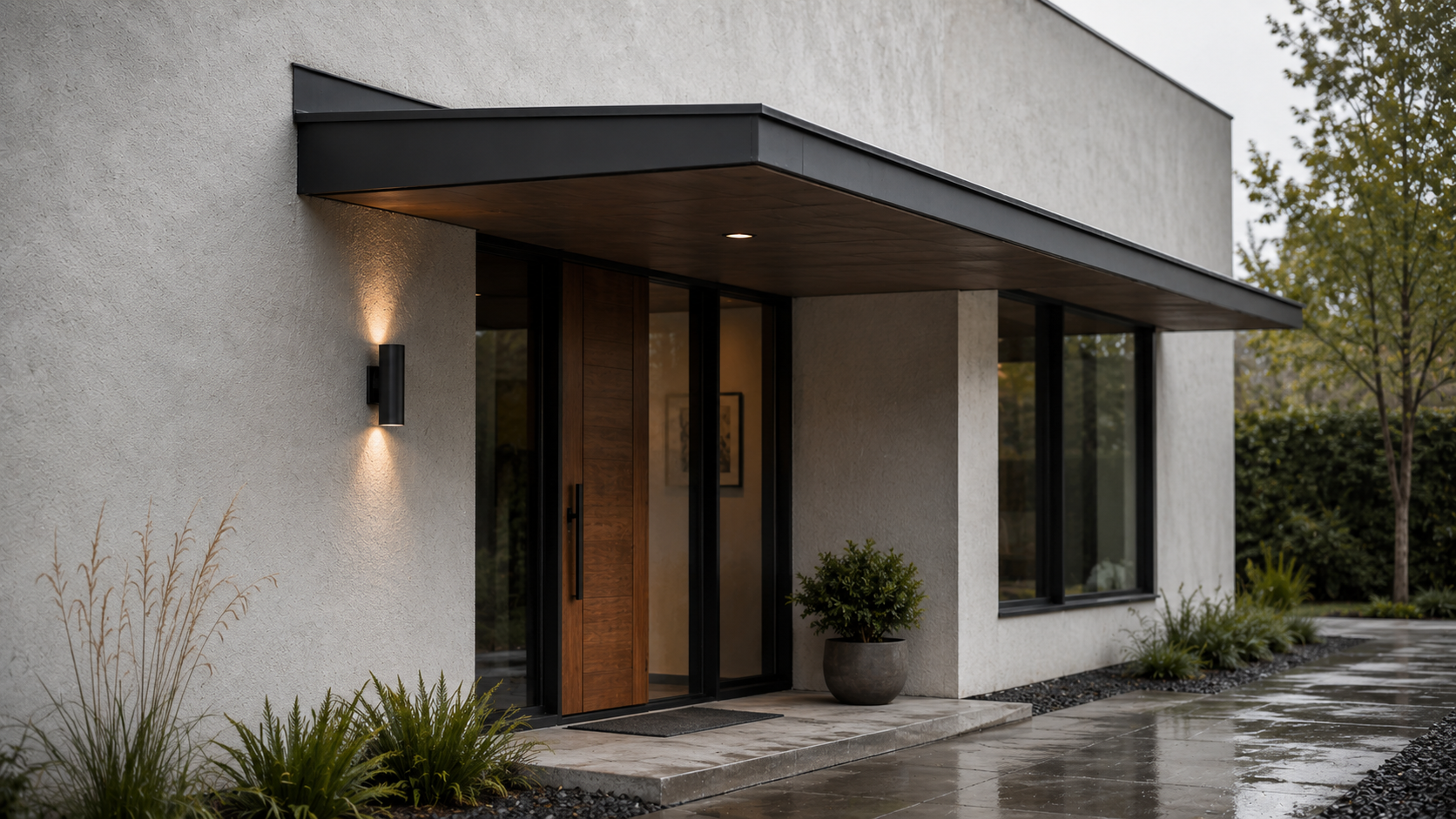
Image by ArchitectureCourses.org. A cantilever canopy looks simple from the outside, but the real work happens inside the wall connection, anchors, frame depth, and drainage edge.
Cantilever canopies look lighter than they really are.
There are no front posts, so the structure feels clean. That is the appeal. But removing the posts does not remove the load. It sends the load back into the wall.
That hidden connection is where most cantilever canopy problems begin.
The canopy sags. The wall stains. The edge holds water. The anchors loosen. The frame twists during wind. Or the whole thing simply looks wrong because the projection is deeper than the structure can visually support.
A good cantilever canopy works because the hidden structure is doing serious work behind a calm exterior.
What Makes a Cantilever Canopy Different
A normal canopy can send load down into front posts. A cantilever canopy cannot. The support has to travel back into the wall, roof structure, steel frame, or reinforced backing behind the finish.
That changes the job completely.
A shallow projection over a side door may be simple. A deep modern canopy over a storefront or main entry is not the same problem at a larger size. The farther the canopy projects outward, the harder the wall connection has to work.
Thin appearance does not mean low force. Sometimes it only means the structure has been hidden well. Sometimes it means the structure has been underbuilt.
The Load Goes Back Into the Wall
The critical force in a cantilever canopy is not at the front edge. It is back at the connection.
The outer edge creates leverage. The wall plate, anchors, and hidden backing resist that turning force.
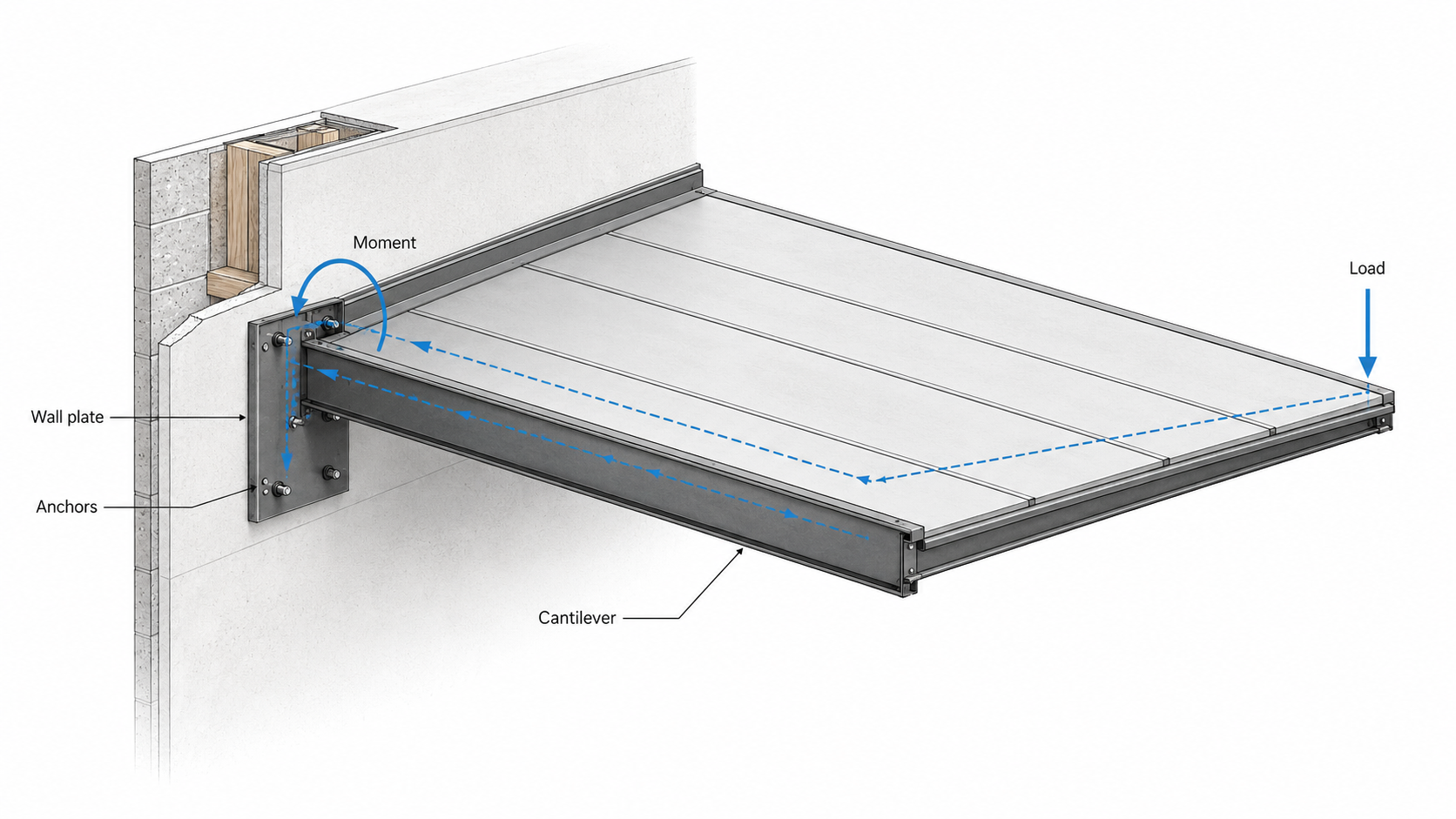
Illustration by ArchitectureCourses.org. A cantilever canopy pushes the critical force back into the wall plate, anchors, and structural backing, not down into front posts.
This is why weak wall plates fail. This is why shallow brackets bend. This is why undersized anchors eventually loosen or stain the wall around them.
A lot of failed cantilever canopies do not collapse. They just slowly deform for years. The front edge drops slightly. Water stops draining cleanly. One brown rust streak appears below a bolt. Staining shows up where water sits against the wall.
The canopy still exists, but the detail is already failing.
The Wall Connection Matters More Than the Canopy
The visible canopy is only half the job.
The hidden wall condition matters just as much:
- structural backing
- anchor spacing
- wall plate thickness
- waterproofing
- flashing
- cladding thickness
- drainage plane
A canopy fixed into weak backing or finish material is already compromised before weather even arrives.
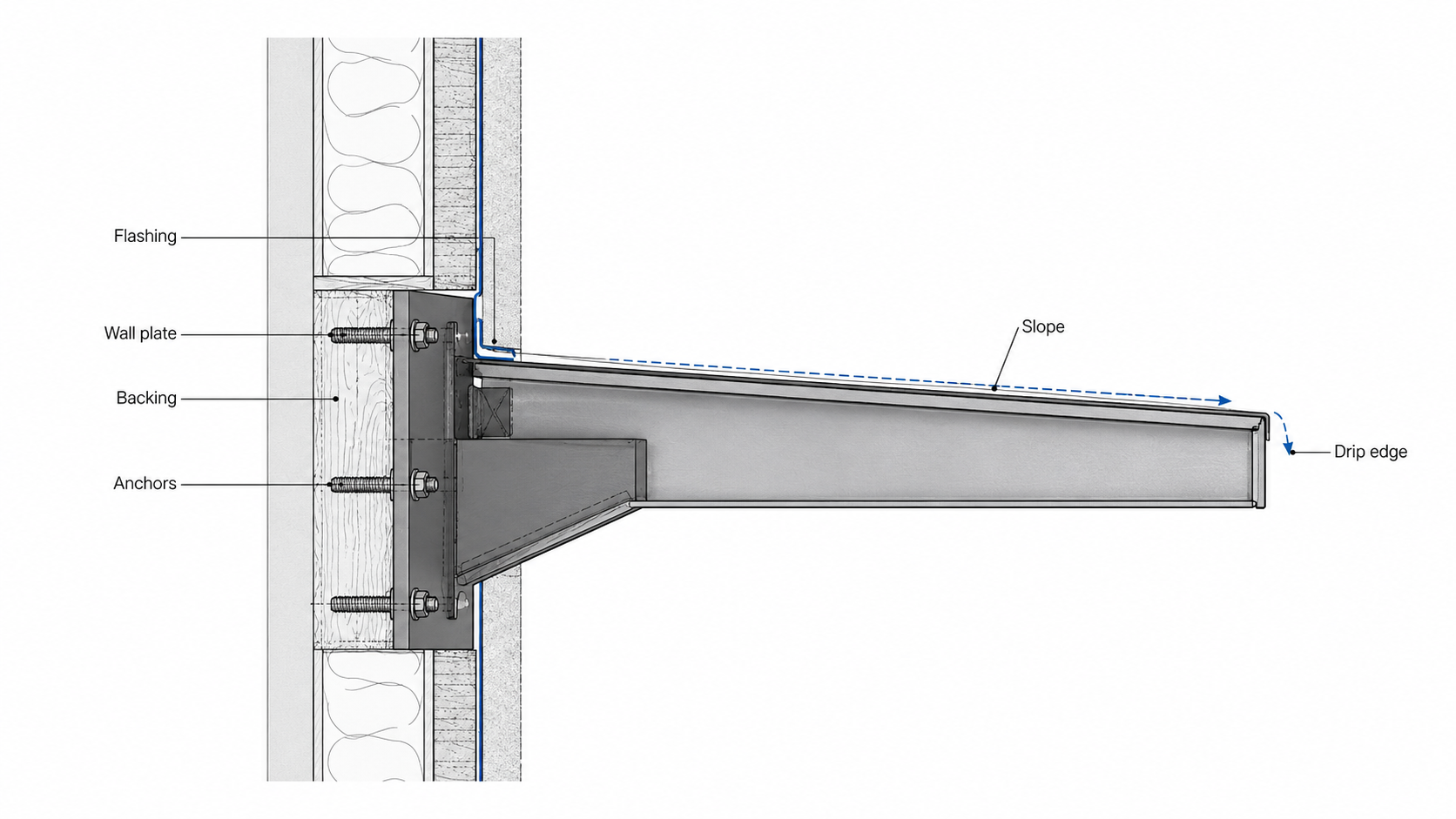
Illustration by ArchitectureCourses.org. A cantilever canopy depends on the hidden wall backing, anchor bolts, flashing, roof slope, and drip edge as much as the visible frame.
On framed walls, the canopy should connect into studs, blocking, headers, steel backing, or another real structural member. On masonry, the anchors and embedment depth need to suit the wall itself, not just the surface finish.
Stucco and siding make mistakes harder to see because the failure often starts behind the finish. Flashing matters for that reason. If water gets trapped behind the wall plate, the connection can deteriorate slowly without obvious warning.
Projection Is Where These Canopies Go Wrong
Projection depth controls shade, rain protection, visual balance, frame depth, anchor demand, and bending force.
Too shallow and the canopy barely works. Too deep and the canopy starts asking too much from a thin frame or weak wall condition.
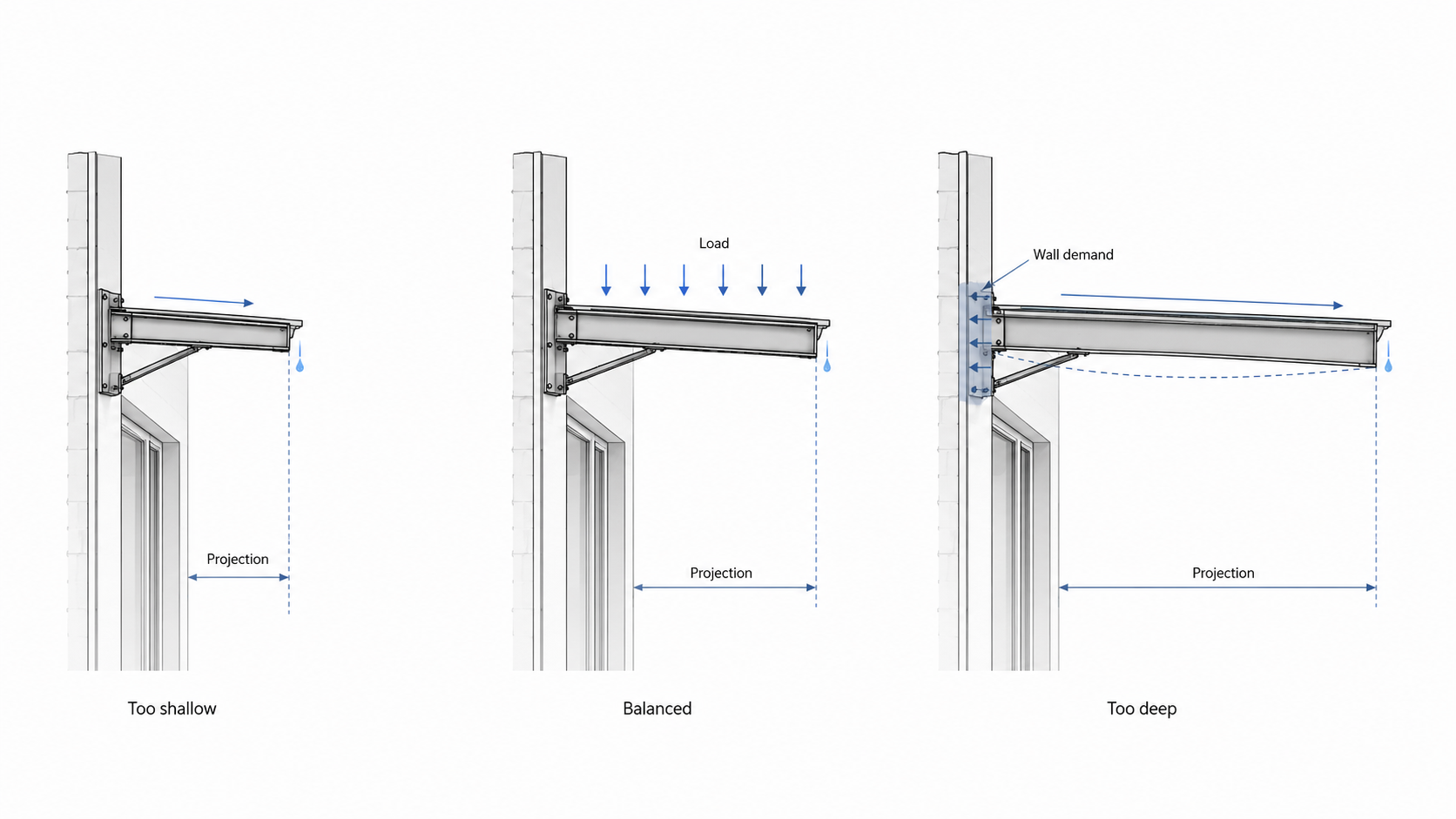
Illustration by ArchitectureCourses.org. Canopy projection is a balance: too shallow barely protects the opening, while too deep increases wall demand, bending risk, and connection stress.
A lot of modern cantilever canopies try to look extremely thin while projecting too far outward. The proportions may work in a rendering, but the built result often starts to sag visually once the structure is simplified for budget reasons.
The deeper the projection gets, the more honest the structure has to become.
| Projection Depth | What Usually Happens |
|---|---|
| Too shallow | Weak weather protection and almost no shade benefit |
| Balanced | Good shelter, believable proportions, manageable structure |
| Too deep | Higher bending force, heavier wall demand, sag risk |
Drainage Is Usually Treated Too Late
A cantilever canopy is still a roof edge.
Many canopy details are drawn around appearance first and water movement second. That works on paper. It does not work once water starts sitting at the back edge or collecting near the wall plate.
The canopy should slope away from the wall or move water clearly toward a controlled edge. Flat-looking canopies often hold more water than expected, especially once deflection begins.
Then the staining starts.
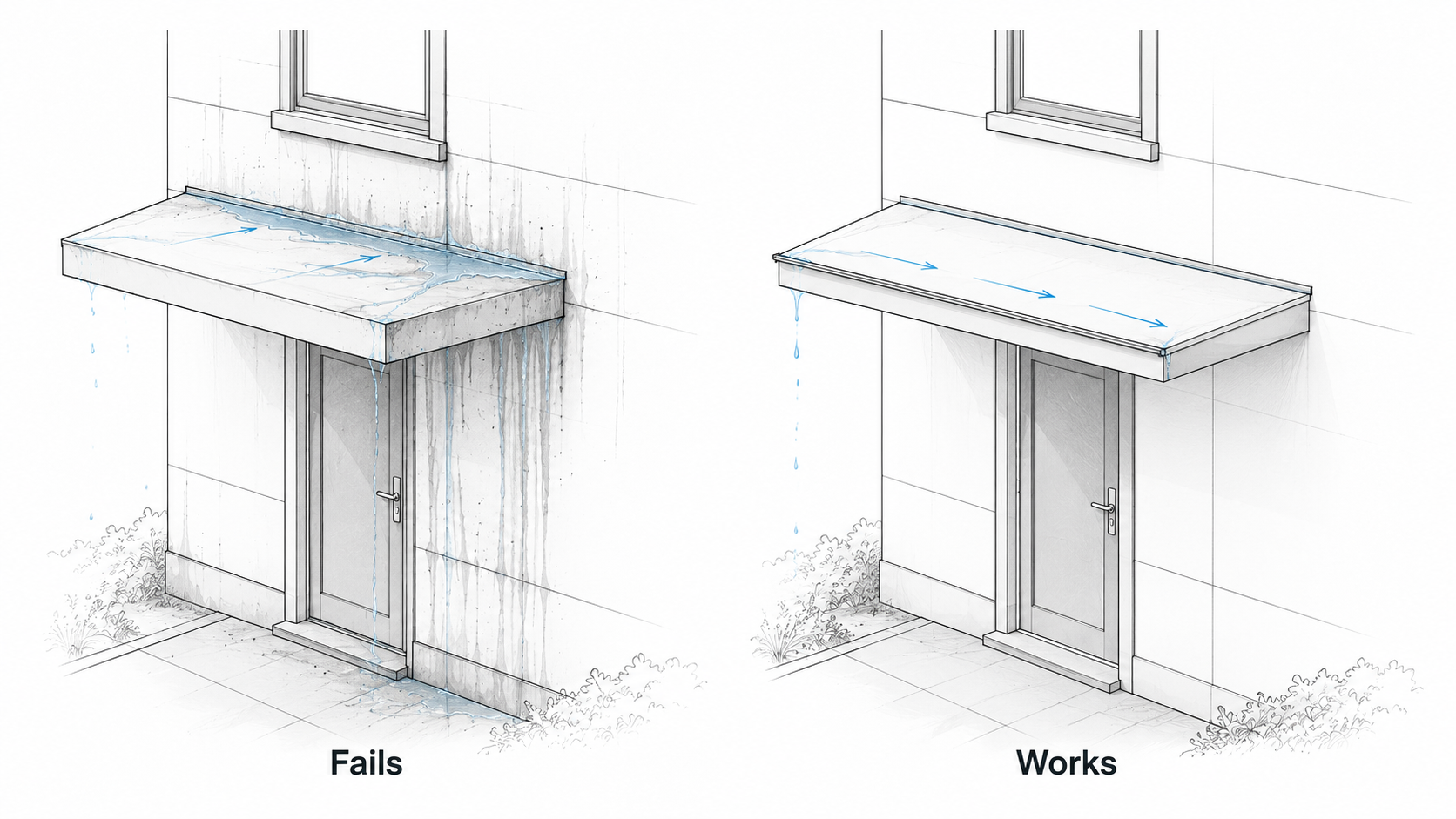
Illustration by ArchitectureCourses.org. A canopy needs slope, edge control, and a drip line so water moves away from the wall instead of staining the entry.
The dangerous condition is water moving back toward the wall plate. Once water reaches the connection repeatedly, the wall finish, sealants, fasteners, and backing all start aging faster.
Sealant alone is not enough. A proper canopy detail usually needs slope, a drip edge, flashing, controlled runoff, and clean edge geometry.
Good canopy drainage should look almost boring. Water leaves the edge. It does not cling to the underside, track back to the wall, or dump onto the sill below.
Thin Frames Get Exposed Fast
Modern canopies often try to hide structure visually.
Sometimes that works. Sometimes the frame becomes unrealistically thin because the rendering looked cleaner that way.
The problem appears later:
- vibration during wind
- visible sag
- oil-canning metal panels
- water holding at the edge
- twisting during snow load
A canopy does not need to look heavy, but it usually needs more depth than minimalist concept images suggest. Snow load, glass weight, lighting, long spans, and deep projections all push the frame toward more structure, not less.
Wrong vs Right
A lot of cantilever canopy failures are predictable before construction even begins.
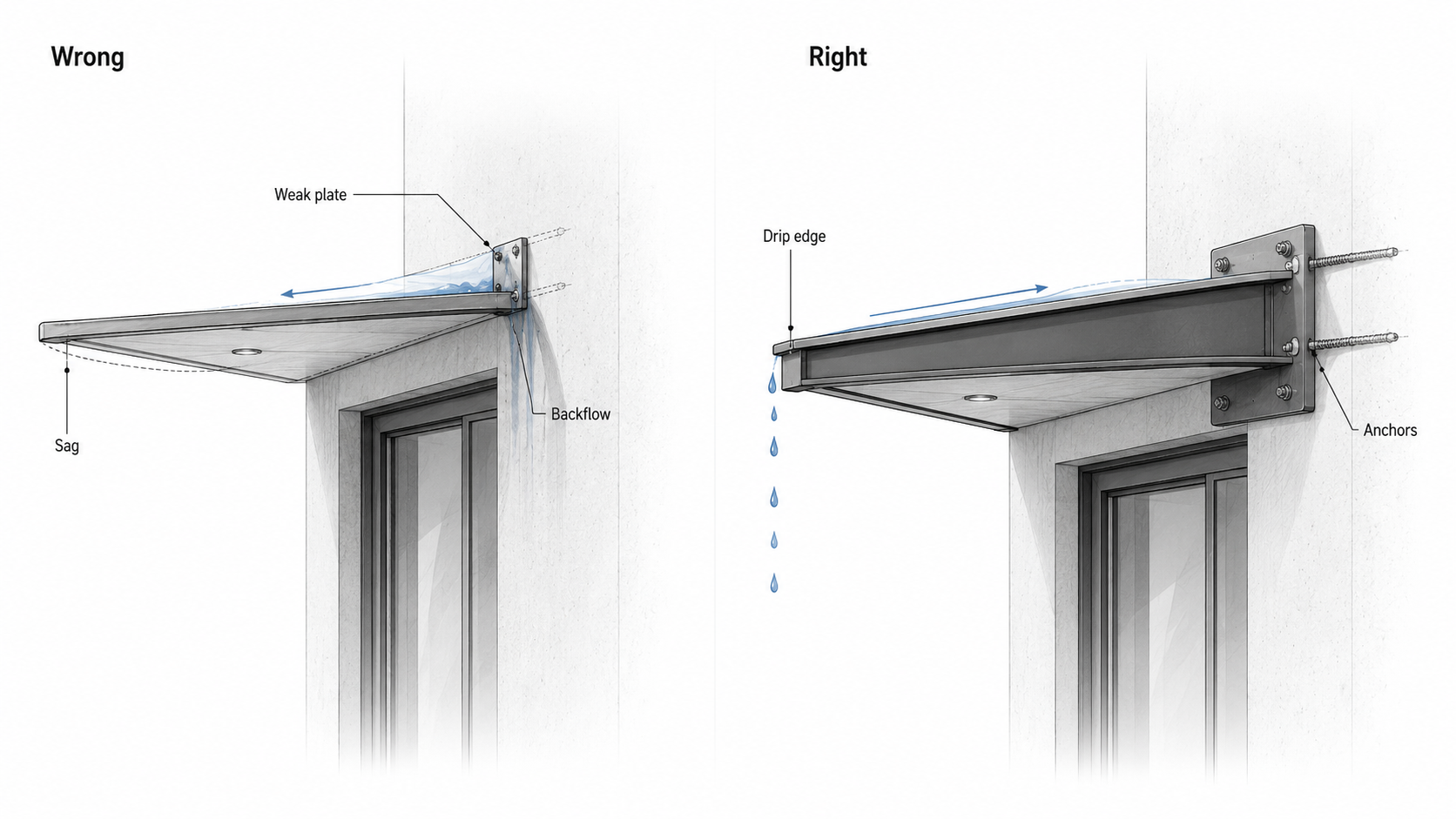
Illustration by ArchitectureCourses.org. A cantilever canopy fails when the wall plate, anchors, slope, and drip edge are too weak to move load and water away from the facade.
| Weak Detail | Better Detail |
|---|---|
| Tiny wall plate | Deeper reinforced plate with proper backing |
| Flat roof edge | Slight slope with drip edge |
| Decorative thin frame | Frame depth matched to projection |
| Generic fasteners | Anchors matched to wall structure |
| Water draining toward wall | Controlled runoff away from facade |
Where Cantilever Canopies Make Sense
These canopies make the most sense when the project benefits from open space underneath.
Good uses include modern entries, storefronts, walkways, transit shelters, minimal residential entrances, and tight urban sites where front posts would block movement or look clumsy.
They make less sense when the wall structure is weak, projection depth gets excessive, snow load is high, or the budget forces the frame to become too thin.
Sometimes front posts are simply the better decision. That is not a failure of design. It is the structure telling the truth.
Some Materials Hide Problems Better Than Others
Steel is usually the strongest choice for cantilever conditions because it handles bending and projection better than lighter systems. It also allows cleaner welded plate connections.
Aluminum can work well on lighter canopies, but the frame often needs more depth than people expect once projection increases.
Glass can look excellent, especially with hidden steel support, but it raises the structural and drainage demands quickly. The canopy may look light, but the support work is not light.
Polycarbonate works best for smaller utility conditions where daylight matters more than architectural refinement. It can be useful, but it rarely carries the same visual weight as a well-detailed steel or glass canopy.
Small Product Note: A basic polycarbonate canopy kit can work for modest side-door or backyard conditions, but deeper cantilevered canopies usually need stronger framing and better wall support than small kits provide.
Buildability Matters More Than Renderings
A lot of canopy details look convincing in renderings because the difficult parts stay hidden.
Then construction begins.
The contractor still has to align the frame, waterproof the wall, install flashing, hide fasteners cleanly, maintain drainage slope, and lift the heavy parts safely. That is where overly delicate canopy concepts start breaking apart.
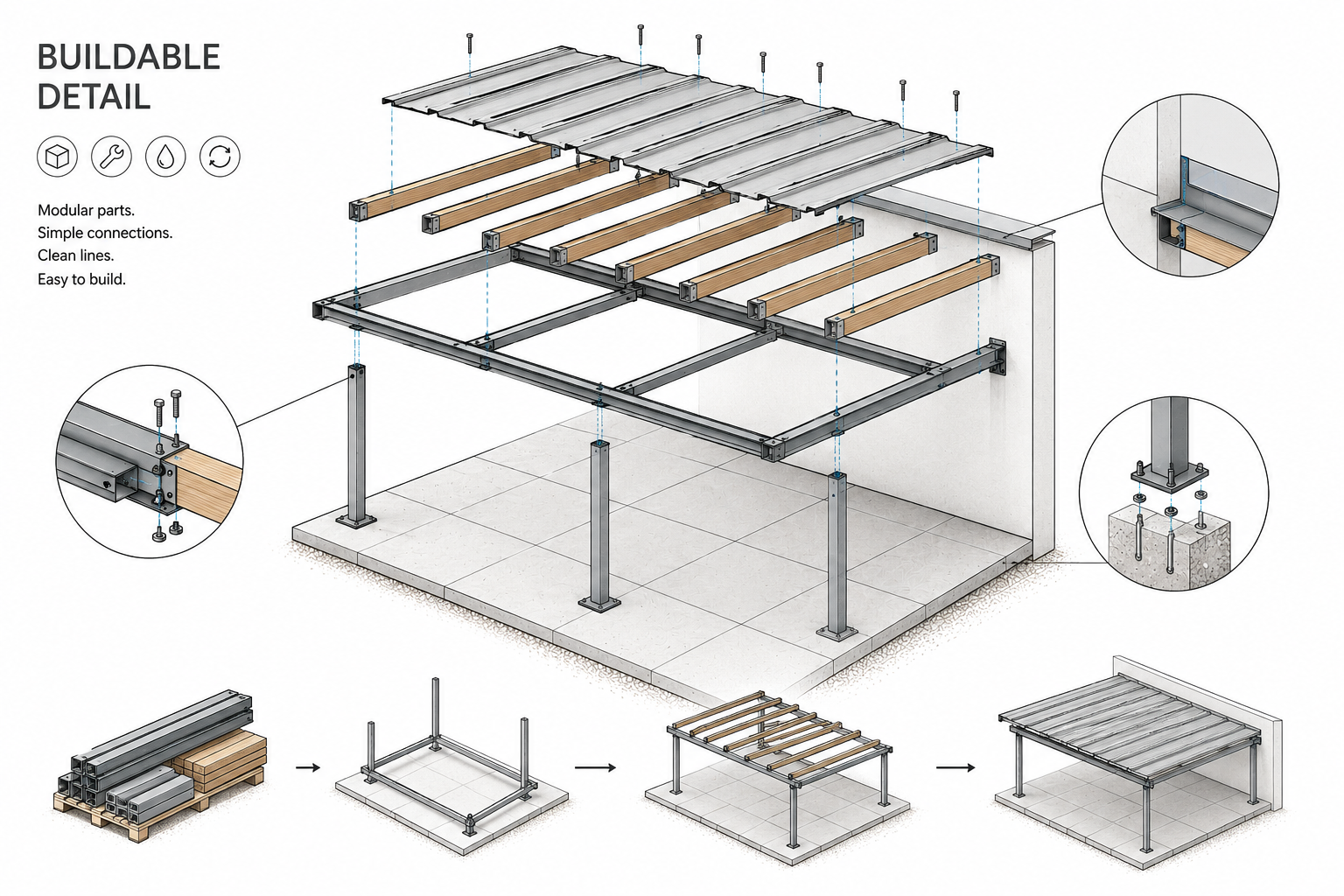
Illustration by ArchitectureCourses.org. A modular canopy system is easier to align, waterproof, assemble, and maintain when the frame, panels, and anchor points are designed as coordinated parts.
Good cantilever canopy design usually comes from simplifying the real construction problems instead of hiding them.
The Best Cantilever Canopies Feel Calm
The strongest cantilever canopies usually do not look dramatic.
The structure feels believable. The edge drains cleanly. The projection fits the opening. The frame depth feels proportional. The wall connection looks intentional instead of decorative.
The canopy simply feels settled.
That calm appearance usually comes from good hidden structure, not from removing structure entirely.
Field Pick: Why Buildings Stand Up by Mario Salvadori is still one of the clearest books for understanding load paths, leverage, bending, and structural behavior without turning into a heavy engineering textbook.
Problems People Usually Ask About
What is a cantilever canopy?
A cantilever canopy projects outward without front support posts. The structure transfers the load back into the wall connection, anchors, and structural backing.
Why do cantilever canopies sag?
Sag usually comes from weak frame depth, excessive projection, poor structural support, weak anchors, or long-term deflection under load.
Are cantilever canopies expensive?
Usually more expensive than simple post-supported canopies because the wall connection and structure need to work harder.
Can a cantilever canopy leak?
Yes. Most leaks happen near the wall connection, flashing, fasteners, or back edge where water gets trapped against the facade.
What material works best?
Steel is usually the strongest choice for deeper projections. Aluminum works for lighter conditions. Glass and polycarbonate change the structural and drainage demands significantly.
Do cantilever canopies need engineering?
Large projections, heavy materials, public entrances, snow regions, and commercial canopies often do.