
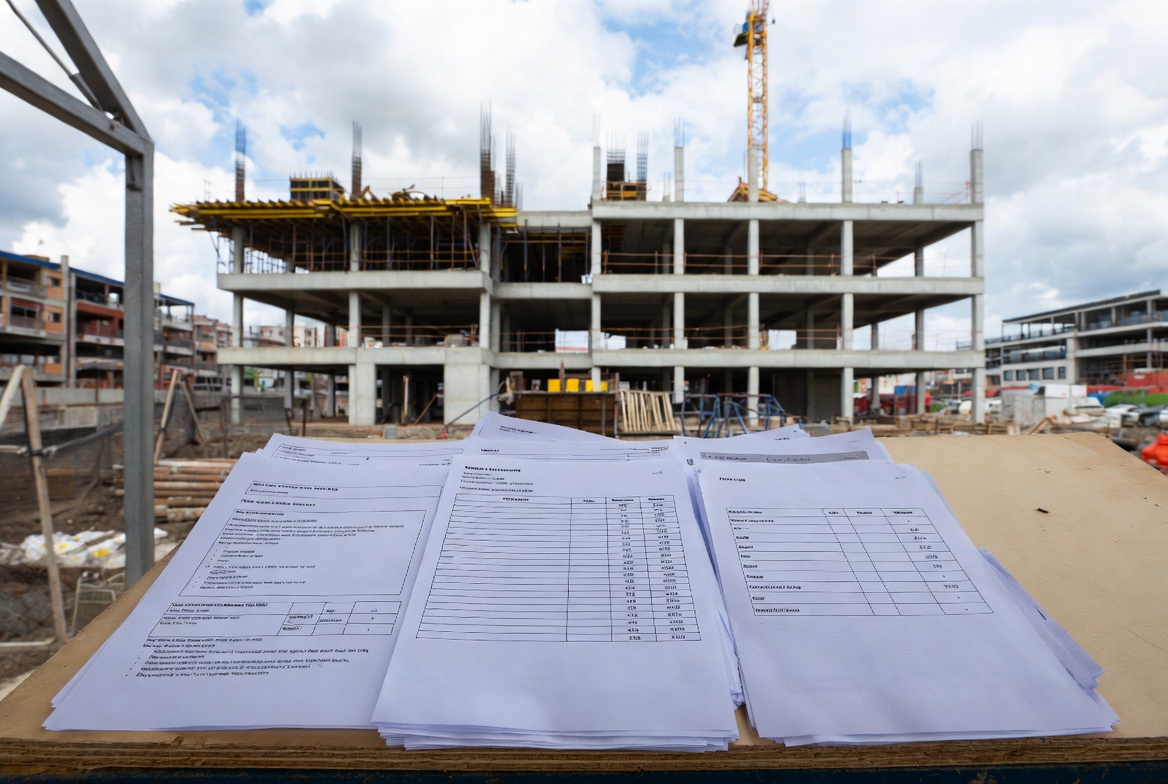
Construction bidding is how owners turn drawings, specifications, and scope into a contractor selection.
The process looks simple from a distance. Issue the package, collect prices, compare them, award the job. On real projects, it is not that clean. A bid can come in low because the contractor is efficient. It can also come in low because the scope is muddy, the schedule assumptions are weak, or a bidder priced around uncertainty differently than everyone else. That is why the bid process matters. It is not just a way to collect numbers. It is supposed to produce numbers that mean something.
This guide explains how the construction bid process actually works: what tendering means, how bidding differs from estimating, what an RFP is doing, how public and private bidding differ, where subcontractor bidding fits, and what usually goes wrong before a project ever reaches contract award.
What This Guide Covers
- What bidding and tendering mean in construction
- The main stages of the construction bid process
- The difference between bids, tenders, RFPs, and RFQs
- Public vs private construction bidding
- General contractor bidding vs subcontractor bidding
- Design-bid-build vs design-build procurement
- The mistakes that make bid results hard to trust
What Bidding and Tendering Mean in Construction
In construction, bidding is the process of pricing and submitting an offer to perform the work under a defined set of documents and conditions. Tendering is the broader procurement process around that offer: inviting bidders, issuing documents, handling questions, receiving submissions, evaluating them, and moving toward award.
In the U.S., people usually say bid process, bid phase, procurement, or RFP more often than they say tender. In other markets, and on some public-sector work, tender is more common. The vocabulary changes. The underlying process is similar.
That matters because a lot of searches in this topic cluster mix these terms together: construction tender, bid process construction, tender process construction, contractor tender, construction contract bidding, bidding phase construction, and procurement and tendering in construction. They overlap, but they are not always interchangeable.
If the job is still being structured at a bigger level, construction project development and preconstruction planning are the right companion pages. Bidding only works well when the project has been packaged properly first.
The Bid Process Is Supposed to Produce Comparable Prices
This is the main point people miss.
A construction bid process is not just a way to collect numbers. It is supposed to produce numbers that can actually be compared. That means bidders need a clear enough scope, a coordinated enough set of documents, enough time to price the package properly, and a fair process for questions, clarifications, addenda, and submission.
When that breaks down, the project still gets prices. They just stop being clean. One bidder carries more risk. One excludes something another included. One assumes owner-furnished equipment is outside the contract. Another carries it. One bidder prices around gaps in the documents with contingency. Another prices aggressively and plans to sort the problems out later.
That is why the lowest number is not always the clearest number.
The Main Stages of the Construction Bid Process
The exact path depends on whether the job is public or private, negotiated or competitive, design-bid-build or design-build, but the basic sequence is usually familiar.
- Choose the procurement route
- Prepare the bid or tender package
- Invite bidders or advertise the opportunity
- Hold a pre-bid meeting, site visit, or question period where needed
- Issue addenda and clarifications
- Receive bids or proposals
- Level and evaluate the submissions
- Select the preferred bidder or proposer
- Complete award and contract formation
That sequence looks straightforward on paper. The quality of the result depends on how well each step is handled.
Bid Documents vs RFPs vs RFQs
These terms get mixed together constantly, so it helps to separate them cleanly.
| Document Type | What It Is Used For | What the Owner Is Usually Looking For | When It Fits Best |
|---|---|---|---|
| Invitation for Bids / Tender | Formal request for a price based on defined documents | Comparable pricing on a clear scope | When the design is sufficiently complete and the owner wants direct price competition |
| RFP | Request for proposals, often including technical and commercial review | More than price alone; may include approach, team, schedule, and qualifications | When best value matters more than low bid alone |
| RFQ | Request for qualifications | Capability, experience, capacity, and suitability | When the owner wants to shortlist qualified teams before detailed pricing |
| Subcontractor Bid Package | Trade-specific request for pricing | Comparable trade coverage for GC pricing or buyout | When general contractors are pricing the job or buying out work after award |
In public sealed bidding, the rules are often tighter. In private work, the owner may have more flexibility to weigh qualifications, approach, and commercial terms differently. Either way, the core question stays the same: what exactly is being asked for, and how will it be evaluated?
What Goes Inside a Construction Tender Package
A construction tender package is only as good as the information inside it. Weak packages produce defensive bidding. Clean packages produce clearer competition.
A typical package may include:
- instructions to bidders
- form of bid or proposal form
- drawings
- specifications
- scope description
- contract conditions
- insurance and bonding requirements
- alternates
- allowances
- milestones or schedule constraints
- site logistics notes where needed
- addenda issued during the bid period
That sounds routine. It is also where a lot of bid packages start failing. The drawings are not coordinated. The allowances are too vague. The alternates are not described well enough to price consistently. The schedule looks more optimistic than real. The site access assumptions are too light. The owner is still asking the market to price uncertainty as if it were clarity.
Then the bid spread comes back wide and everybody acts surprised.
Public Bidding vs Private Tendering
Public and private construction bidding overlap, but they do not behave exactly the same way.
Public procurement usually operates inside more formal rules around advertising, bidder eligibility, sealed bids, public opening, evaluation standards, and award procedure. Private bidding can be formal too, but it is often more flexible about shortlist selection, negotiations, proposal format, and how price is weighed against other factors.
| Issue | Public Construction Bidding | Private Construction Bidding |
|---|---|---|
| Bid rules | Usually more formal and regulated | Usually more flexible |
| Award basis | Often low bid or defined best-value criteria | Can be low bid, negotiated, relationship-based, or best value |
| Bidder list | Often publicly advertised or formally prequalified | Often shortlist-based |
| Clarifications | Typically controlled tightly through formal addenda | Can be more interactive, depending on the owner |
| Post-bid negotiation | Often limited | More common |
If you are working in public construction, the process is often less forgiving because the rules are already doing part of the control work. In private work, the flexibility can help, but it also creates more room for sloppy scope definition, uneven bidder treatment, or post-bid drift if the owner is not disciplined.
Open, Selective, Negotiated, and Two-Stage Tendering
Not every tender process is the same. The route matters because it changes who bids, how much design information exists, and how the owner evaluates submissions.
| Tender Type | How It Works | Use This When | Avoid This When |
|---|---|---|---|
| Open tender | Any eligible bidder can submit | You want broad competition and the scope is well defined | You need tighter bidder control or the package is too complex for a wide-open field |
| Selective tender | Only invited or prequalified bidders submit | You want stronger bidder quality and a more manageable field | You have not screened the list well enough |
| Negotiated tender | The owner negotiates with one contractor or a small number of contractors | Speed, continuity, or complexity makes pure competition less useful | You need a strictly public-style competitive process |
| Two-stage tender | Early contractor involvement begins before the final contract sum is fully fixed | The project is complex, phased, or needs builder input during development | You expect a fully fixed low-bid result from incomplete design |
People search “types of bidding in construction” because these routes feel similar from the outside. They are not. The tender route changes the kind of pricing you can expect and the quality of comparison you can trust.
Design-Bid-Build vs Design-Build Bid Process
This comparison matters because the procurement logic changes with the delivery system.
In design-bid-build, the owner’s design team develops the design first, then the construction package is priced by contractors. The contractor is bidding a defined design package. This route works best when the design is far enough developed to support clean competition.
In design-build, the owner is procuring design and construction together. The proposal is not just a build price on a completed drawing set. It may include qualifications, design approach, technical response, and commercial terms as part of a broader best-value selection process.
| Issue | Design-Bid-Build | Design-Build |
|---|---|---|
| Who designs | Owner’s design team before bid | Design-builder after award or as part of proposal development |
| What is being priced | Completed or nearly completed design package | Criteria, requirements, and proposed solution |
| Common evaluation emphasis | Price and responsiveness | Best value, qualifications, approach, and price |
| Best fit | When design clarity is high and price competition is the priority | When integration, speed, or single-point responsibility matter more |
Do this instead of this: choose the procurement route that fits the project’s design maturity and risk profile, instead of forcing a low-bid process onto a package that is still too unresolved to price cleanly.
General Contractor Bidding vs Subcontractor Bidding
The bid process often gets explained as if only owners and general contractors are involved. That leaves out half the real work.
General contractors usually bid or tender to the owner. Subcontractors usually bid to the general contractor. Those two layers are connected, but they do not behave the same way.
The GC is pricing the whole job, often using trade pricing, supplier quotes, self-performed work, general conditions, fee, risk, and schedule assumptions. A subcontractor is pricing a narrower scope: concrete, steel, drywall, electrical, glazing, roofing, mechanical, and so on.
That is why subcontractor tendering gets messy fast when the trade boundaries are weak. If one bidder assumes firestopping is included and another excludes it, the prime bid quality starts slipping before the owner ever sees the number. If temporary weather protection, embedded items, startup support, or delegated design scope are not split clearly, the GC’s total may look clean while the trade coverage under it is shaky.
That is also why searches for subcontractor bidding sites or free subcontractor bidding sites are only solving part of the problem. A bid board can help outreach. It does not fix muddy scope.
The Pre-Bid Period Is Where a Lot of the Real Work Happens
Some owners treat the pre-bid period like a waiting room between issuing the package and opening prices. That is not what it is.
The pre-bid period is where bidders are trying to understand the documents, visit the site, identify gaps, price risk, qualify assumptions, and decide whether the opportunity is worth chasing seriously. It is also where owners and consultants learn whether their package is as clear as they thought it was.
The pre-bid stage often includes:
- site visits
- pre-bid meetings
- question periods
- clarification requests
- addenda
- trade outreach by general contractors
- internal scope reviews and leveling preparation
Weak owners treat bidder questions like nuisance noise. Better owners treat them as early warning signals. If five bidders ask the same thing, the package probably has a real gap.
| Do This | Instead of This | Why |
|---|---|---|
| Issue written addenda for scope or interpretation changes | Rely on verbal answers from the meeting | Written addenda keep bidders aligned and defensible |
| Level recurring bidder questions early | Assume the market will price around the gaps consistently | They usually will not |
| Allow enough bid time for real review and trade pricing | Rush the tender period and expect comparable numbers anyway | Short bid windows increase omissions and qualifications |
| Clarify alternates and allowances cleanly | Leave bidders to guess what is included | Guessing produces false bid spreads |
What Bid Evaluation Is Supposed to Do
Bid evaluation is not just sorting prices from low to high.
It is supposed to answer a harder question: which submission is responsive, responsible, complete enough, and commercially trustworthy enough to support award under the owner’s procurement rules?
In public low-bid work, evaluation may be more constrained. In private work or RFP-based procurement, evaluation may include scope alignment, exclusions, qualifications, staffing, schedule approach, alternates, and past performance.
That is why bid leveling matters. If one bidder included winter protection and another excluded it, the price difference does not mean much yet. If one bidder assumed owner-furnished equipment and another carried it, the comparison is still dirty. If one bidder priced around an incomplete detail and another carried a contingency, the owner still does not have a real apples-to-apples view.
The owner’s problem at this stage is not “who is lowest?” It is “what do these prices actually contain?”
What Usually Breaks the Construction Bid Process
Not one giant failure. Usually a stack of ordinary mistakes.
- The bid package is incomplete. The drawings and specifications do not support clean pricing.
- The bidder list is wrong. Too broad, too weak, or too unbalanced.
- Trade scope is muddy. General contractors are carrying different assumptions underneath the prime bid.
- Addenda come too late. The market does not have enough time to price the changes properly.
- The owner chases the lowest number without leveling scope.
- The schedule constraints are unrealistic. Bidders price around the fantasy in different ways.
- Alternates and allowances are vague. Comparable pricing disappears fast.
- The procurement route does not fit the design maturity. The owner wants low-bid certainty from an unresolved project.
That is the real pattern. The process looks formal. The weak parts are still ordinary.
Where Software Fits and Where It Does Not
This topic cluster also pulls in searches like bidding construction software, bid management software construction, general contractor bidding software, and tendering software construction.
Those tools can help. They just do not fix a weak process by themselves.
Software can improve:
- bidder invitations
- document distribution
- addenda tracking
- due-date reminders
- subcontractor outreach
- leveling records
- proposal organization
What it does not fix:
- a weak scope package
- a bad bidder list
- unclear trade boundaries
- late design changes
- owner indecision
- an unrealistic schedule
That is the useful distinction. Software can make the process cleaner. It cannot make an immature package mature or a vague scope clear.
Do This Instead of This
When the bid process is starting to go sideways, the better move is usually obvious in hindsight. Better to make it obvious earlier.
| Do This | Instead of This | Why It Is Better |
|---|---|---|
| Prequalify bidders when the job is complex | Invite everyone and hope the market sorts itself out | Complex packages need capable bidders, not just more bidders |
| Issue a clean, coordinated package before tender | Push out half-resolved documents to hit a date | Rushed bid sets usually come back as qualifications and claims later |
| Level bids on scope and exclusions before selecting | Take the low number at face value | The lowest price is only useful if the scope is comparable |
| Use design-build or a negotiated route when the project is still too unresolved for true low-bid competition | Force a low-bid route onto an immature design | The wrong procurement route creates fake pricing confidence |
| Track subcontractor scope coverage under the GC bid | Assume the prime bid is solid because the total looks fine | Weak trade coverage distorts prime bid results fast |
What People Get Wrong
The detail that gets missed most often is this: the bid result is only as good as the package and process behind it.
People act as if the market will clean up whatever the owner left unclear. Sometimes the market does the opposite. It prices uncertainty in inconsistent ways, adds qualifications, and gives the owner a spread of numbers that look useful until the leveling starts. By then, time has already been spent on comparison work that should have been protected earlier by better procurement setup.
That is why bidding is not just a late project phase. It is a test of how well the project was packaged before it reached the market.
What To Do Next
Preconstruction planning is the right next read if the real problem is not the tender itself, but how the project is being packaged before procurement starts.
Construction project development helps if you want the bigger sequence around feasibility, design maturity, procurement route, and contract formation.
Construction planning and scheduling matters once the bid phase starts colliding with milestone dates, work release, and how the project will actually be sequenced after award.
FAQ
What is the bid process in construction?
The construction bid process is the sequence used to invite, receive, evaluate, and award prices or proposals for construction work. It usually includes preparing the package, inviting bidders, handling questions and addenda, receiving submissions, evaluating them, and moving toward contract award.
What is tendering in construction?
Tendering is the broader procurement process around construction bidding. It includes issuing the package, managing bidder communication, receiving tenders, evaluating them, and selecting a contractor or design-build team.
What is the difference between a bid and a tender?
A bid is the submitted price or offer. A tender is the wider process around soliciting, receiving, and evaluating that offer. In many conversations the terms overlap, but they are not exactly the same thing.
What is a construction RFP?
A construction RFP is a request for proposals. It is commonly used when the owner wants more than price alone, such as technical approach, qualifications, schedule, staffing, or design response.
What are the main types of bidding in construction?
Common routes include open tendering, selective tendering, negotiated tendering, and two-stage tendering. Design-bid-build and design-build also change how bidding works because they change what is being procured and how submissions are evaluated.
How is subcontractor bidding different from general contractor bidding?
Subcontractor bidding is trade-specific and usually flows to a GC or CM. General contractor bidding is broader and usually responds to the owner’s tender or proposal request. The GC price often depends heavily on the quality and coverage of subcontractor bids underneath it.
What usually causes bad bid results?
Incomplete documents, vague trade scope, late addenda, unrealistic schedule constraints, weak bidder selection, and poor bid leveling are some of the most common causes.
Is the lowest construction bid always the best choice?
No. The lowest number is only meaningful if the bid is responsive, responsible, and comparable in scope to the others. A low price built on exclusions, weak assumptions, or incomplete trade coverage can cost more later.
Official sources
- FAR Part 14 – Sealed Bidding
https://www.acquisition.gov/far/part-14 - FAR 52.214-19 – Contract Award, Sealed Bidding, Construction
https://www.acquisition.gov/far/52.214-19 - FAR Part 36 – Construction and Architect-Engineer Contracts
https://www.acquisition.gov/far/part-36 - FAR Subpart 36.3 – Two-Phase Design-Build Selection Procedures
https://www.acquisition.gov/far/subpart-36.3 - WBDG – Project Managers' Guide for Design and Construction
https://www.wbdg.org/FFC/AF/AFDG/ARCHIVES/pmguide.pdf - SBA – Federal Contracting Guide
https://www.sba.gov/federal-contracting/contracting-guide - SBA – Prime and Subcontracting
https://www.sba.gov/federal-contracting/contracting-guide/prime-subcontracting