

Image by ArchitectureCourses.org. This post-and-beam home interior shows exposed timber posts, beams, knee braces, and vaulted roof framing used as both structure and interior character.
Post and beam homes look simple from the outside. Big timbers. Open rooms. Maybe a wall of glass. Then the quotes show up and the simple part is over.
This is where people get sold a fantasy. The frame is only one part of the build. The visible structure is doing real work, which means mistakes do not hide well. A cheap kit can stop looking cheap once you add engineering, foundation work, crane time, insulation strategy, roof detailing, and all the ordinary house parts that still have to be paid for.
That does not make post and beam a bad idea. It just means you should know what you are buying before you fall for the beams.
Quick Check
| If you want | Post and beam makes sense when | It starts going wrong when |
|---|---|---|
| Open rooms and exposed structure | You are willing to pay for real spans, real detailing, and cleaner finish work | You expect stick-frame pricing with heavier members and fewer places to hide mistakes |
| A kit home | You know exactly what the kit includes and what it does not | You treat the kit price like the finished-house price |
| A rustic look | You want the structure to stay visible and carry the design | You only want decorative beams and do not need a real frame |
| Energy efficiency | You plan the wall and roof system properly, often with SIPs or a well-detailed enclosure | You assume thick timbers alone will solve insulation and air sealing |
| A DIY-friendly build | The building is small, simple, and the crew actually knows what it is doing | The frame is large, custom, heavy, or being improvised on site |
What It Is
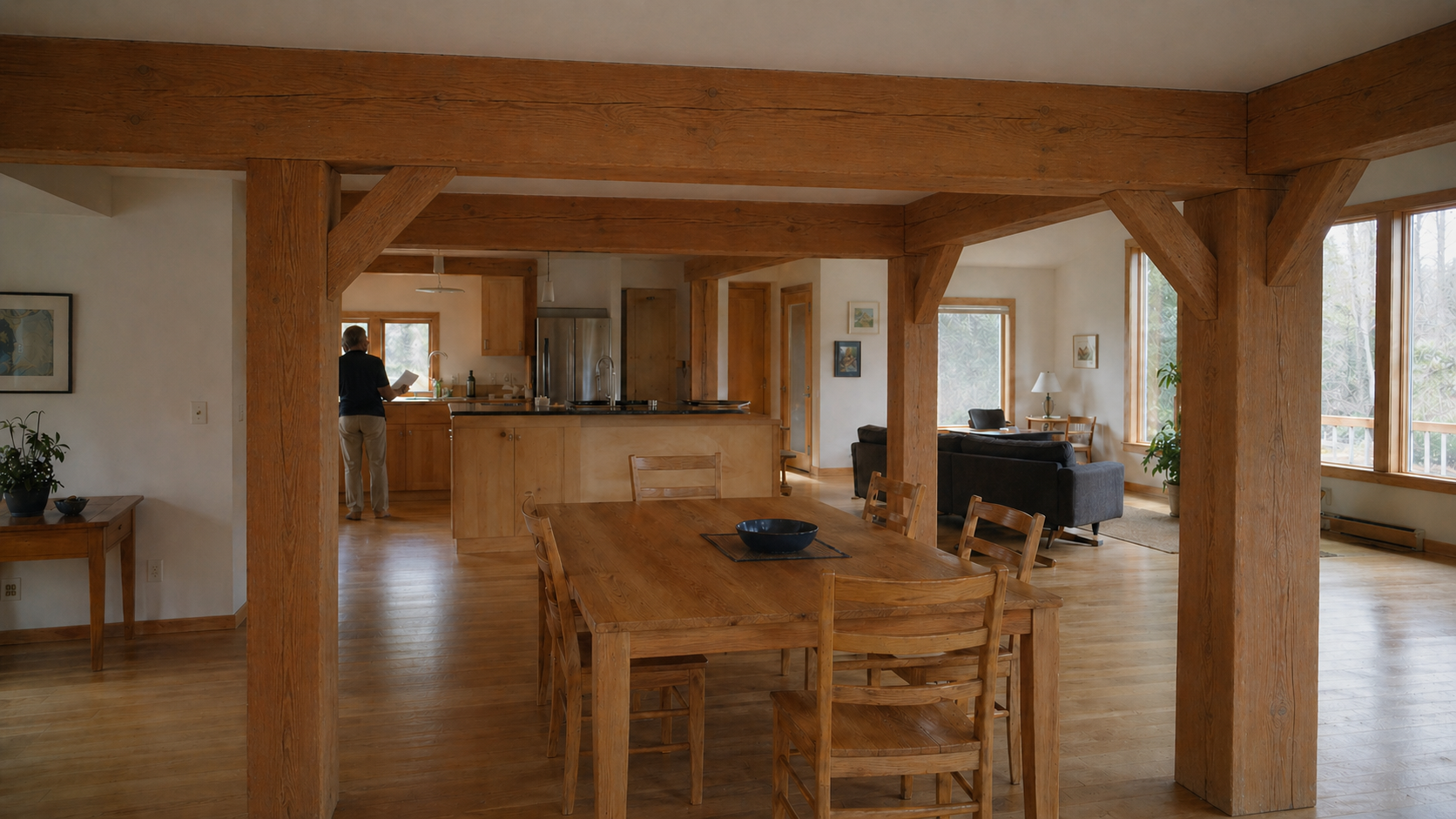
Image by ArchitectureCourses.org. Exposed posts, beams, and knee braces help define the open interior of a post-and-beam home while keeping the structural frame visible.
Post and beam is a structural system built around vertical posts and horizontal beams. The frame carries the load. The walls usually fill in between it.
That matters more than people think. In a normal stick-framed house, the wall does more of the routine structural work and drywall can cover a lot. In a post and beam house, the frame is right there in front of you. You keep getting reminded whether the proportions were good, whether the joints were clean, and whether the layout made sense.
Also useful: Types of Framing Construction helps place post and beam next to platform framing, timber framing, and post-frame so you do not mix up systems that only look similar from a distance.
Post and Beam vs Timber Frame
People mix these up all the time because both use heavy wood and exposed structure.
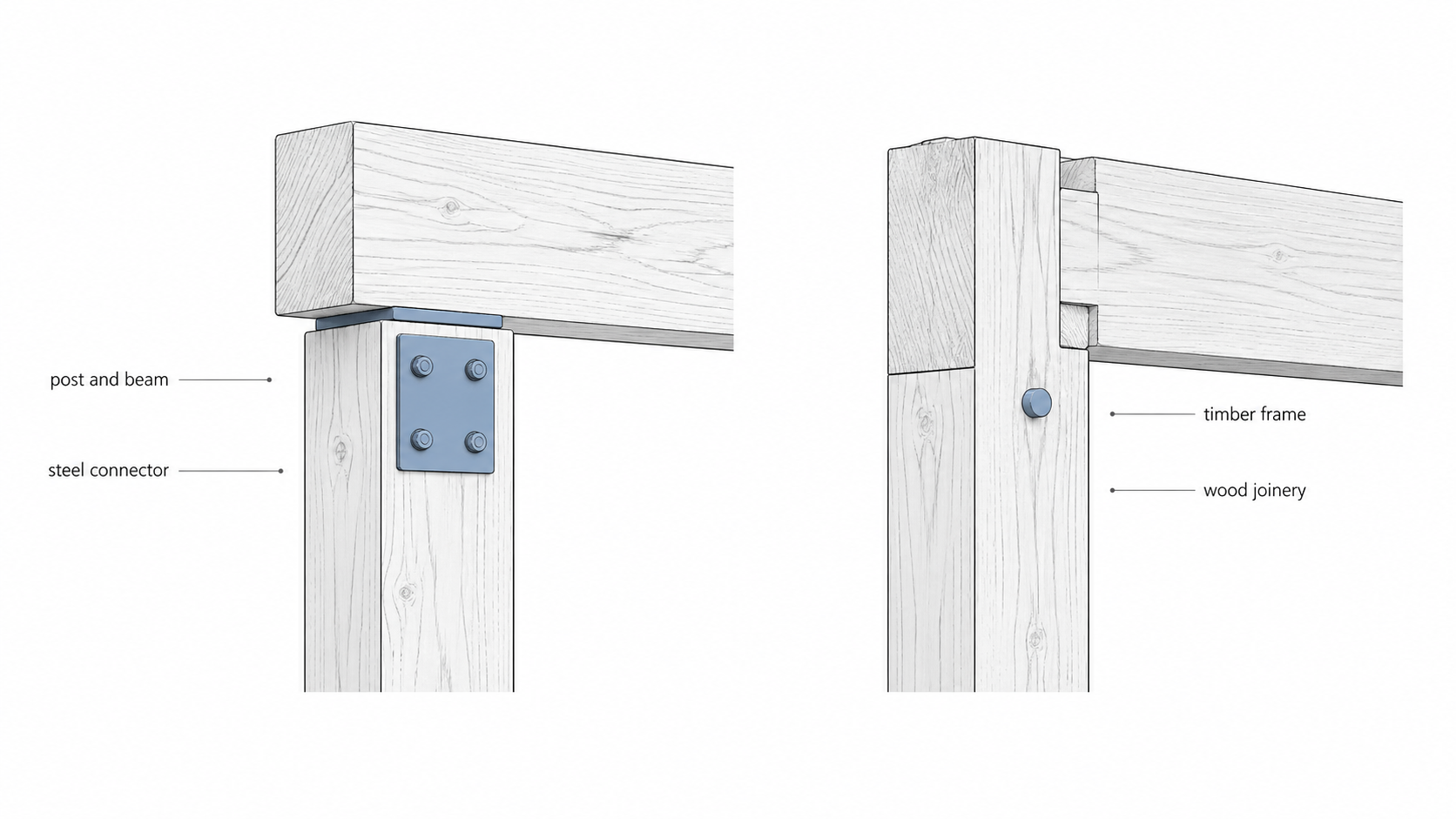
Illustration by ArchitectureCourses.org. Post-and-beam construction often uses visible steel connectors, while timber framing relies more on traditional wood joinery and pegged connections.
Timber framing leans harder on traditional joinery. Mortise and tenon. Pegs. Housed joints. More old-school craft in the frame itself. Post and beam usually accepts steel plates, bolts, concealed connectors, or hybrid connections because speed and adaptability matter more.
That changes the look a bit. It changes the build process a lot.
| System | Usually uses | Best fit |
|---|---|---|
| Timber frame | Traditional wood joinery | Craft-driven builds, restoration-minded work, exposed joinery |
| Post and beam | Heavy members plus steel or hybrid connectors | Modern homes, simpler kit workflows, faster structural assembly |
| Post-frame | Posts, simpler framing, often more utilitarian construction | Barns, shops, agricultural buildings, lower-cost utility structures |
If what you really want is the older joinery-heavy version, say that early. A lot of buyers think they want post and beam, then realize later they were picturing a true timber frame the whole time.
Kits
This is where the language gets slippery.
Some kits include the structural frame, shop drawings, and hardware. Some add roof framing. Some include SIPs. Some include almost nothing beyond the cut timber package and a plan set. A few look cheap because they leave out the expensive parts on purpose.
Ask for the actual package list. Not the brochure version.
- Does the kit include only the timber frame, or the full shell?
- Are roof panels included?
- Are windows and doors included?
- Is engineering included for your jurisdiction, or just generic drawings?
- Are connectors, fasteners, and anchor details included?
- Who is responsible for crane planning and raising?
- What is still on you: foundation, roofing, insulation, mechanical, electrical, plumbing, finishes?
The frame package is often the clean, photogenic part of the quote. The real money usually shows up in everything around it.
Before you go further, compare this page with Post and Beam Homes 101 if you want the broader overview first and this page feels closer to the buying decision.
What the Kit Price Usually Leaves Out
This is the part buyers should read twice.
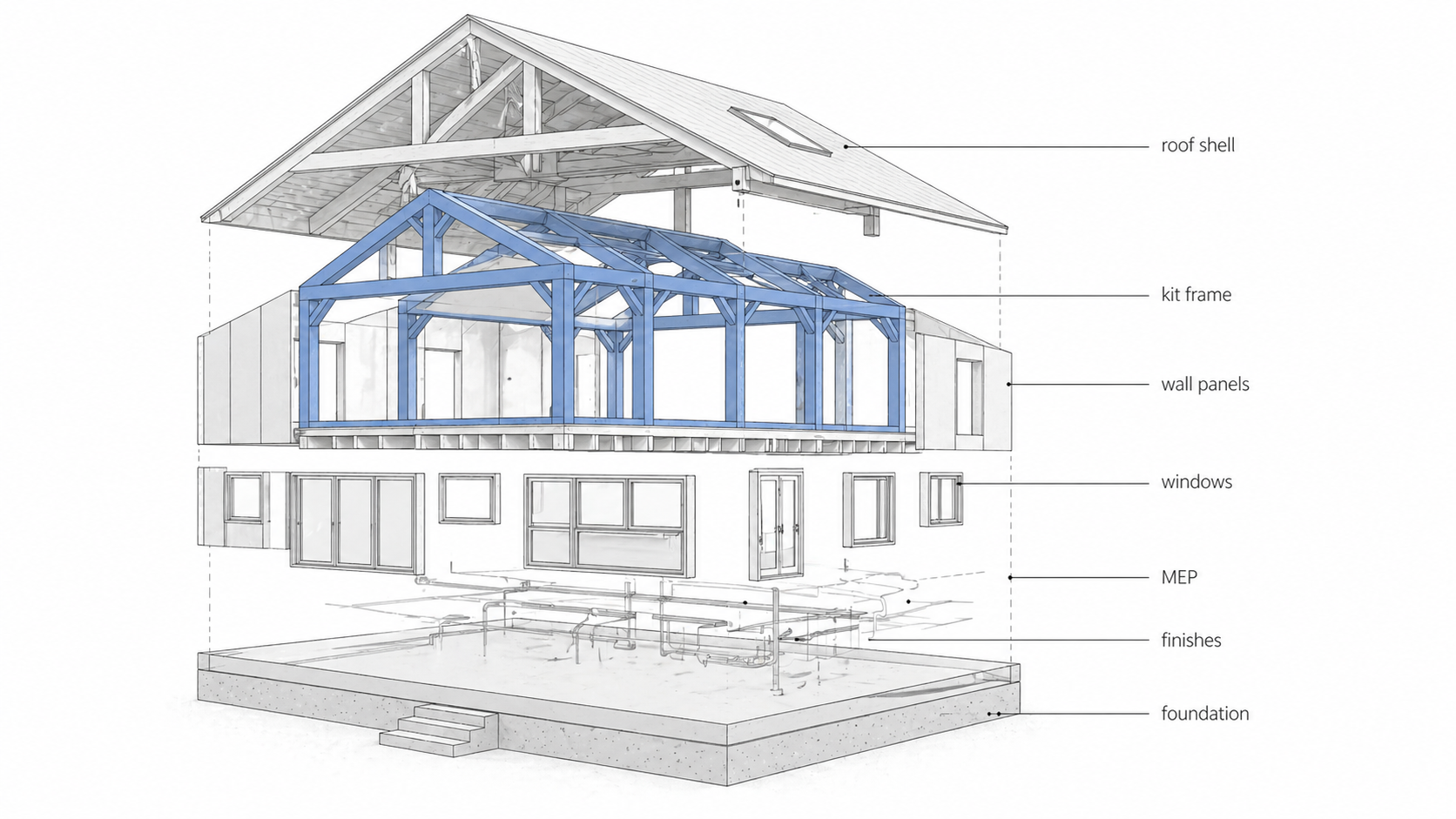
Illustration by ArchitectureCourses.org. A post-and-beam kit usually covers the timber frame package, while the foundation, enclosure, windows, mechanical systems, and finishes are separate cost layers.
A posted kit number can sound manageable. Then you realize it does not include excavation, frost-depth footings, slab or piers, crane rental, insulation, roofing, plumbing, electrical, drywall, interior walls, kitchen, baths, permits, engineering revisions, or site access problems. Suddenly the “affordable” kit is only the start of the bill.
That does not mean the companies are lying. It means people hear “house kit” and mentally upgrade it to “house.” Those are different things.
Typical cost pressure points:
- foundation complexity
- long-span beams
- roof shape and overhangs
- SIP package or other enclosure system
- custom glazing
- remote-site delivery and crane access
- finish level
The ugly surprise is usually not the timber. It is the moment the exposed frame forces the rest of the house to be cleaner and better detailed too.
Wood Choice
Species changes price, movement, and character.
Douglas fir stays common because it is strong, available, and makes sense for a lot of structural work. Oak gives you weight and a more traditional feel, but the budget goes up. Cedar and hemlock can make sense in some conditions, especially where decay resistance or local availability helps, but the right answer depends on the member, the exposure, and the supplier.
Then there is engineered timber.
Glulam is often the cleaner answer for longer spans and more predictable performance. LVL can make sense where the beam is not the visual star and consistency matters more than romance. Solid timber still matters when the point is visual weight, traditional expression, or a certain kind of exposed structure.
The mistake is treating all of these like versions of the same thing. They are not.
If you are comparing beam materials seriously, Tie Beams helps clarify where roof restraint and beam roles get mixed up in open timber builds.
Spans Change Everything
This is where the beautiful open room either works or starts getting expensive fast.
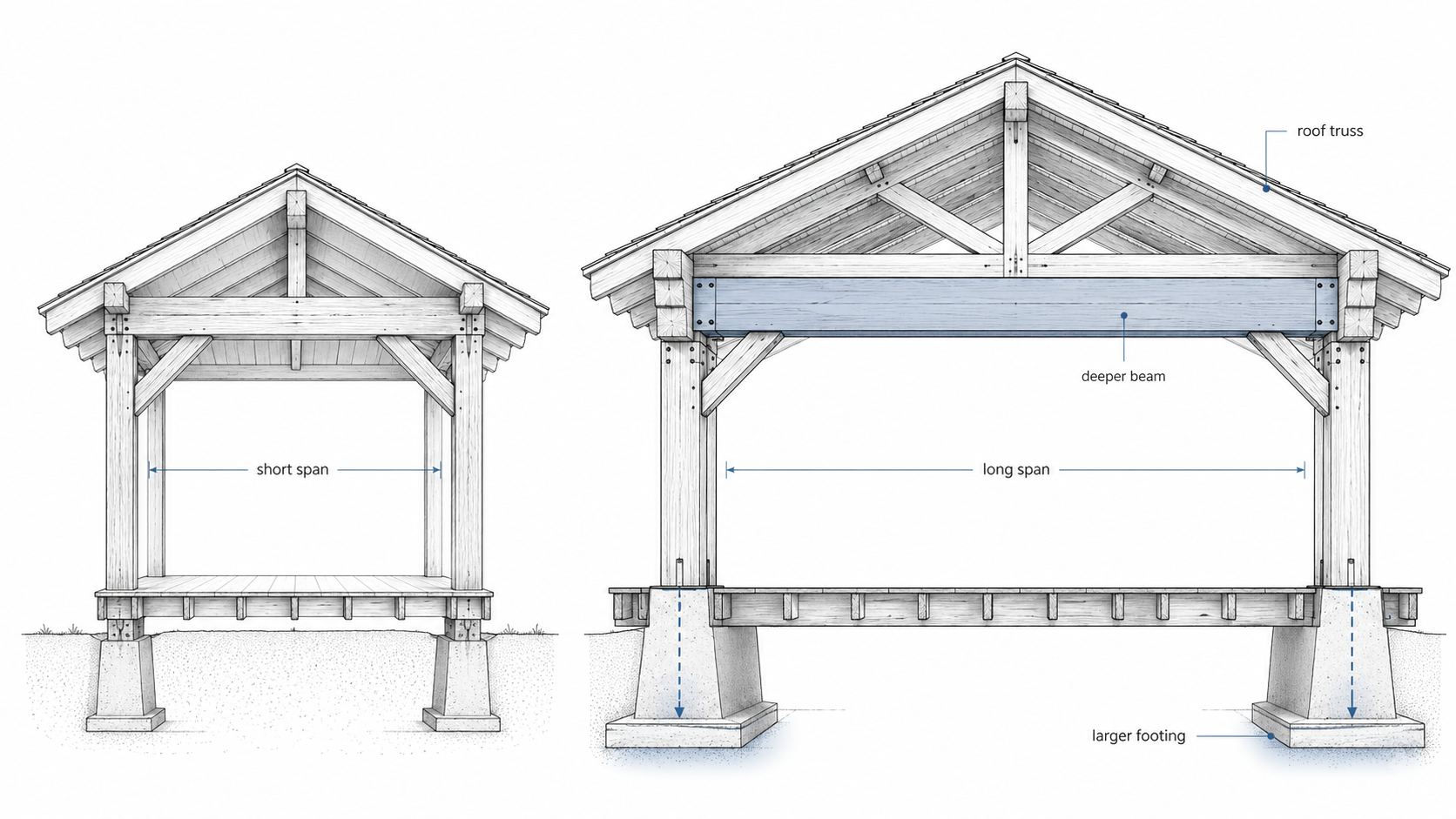
Illustration by ArchitectureCourses.org. Longer post-and-beam spans usually need deeper beams, more careful roof framing, and larger foundations under the concentrated loads.
Big open post and beam interiors are possible because the loads are being pushed into fewer, heavier members. But fewer supports means each remaining member matters more. Beam depth goes up. Connection design gets fussier. Foundations get more serious under the concentrated loads. Roof strategy gets less forgiving.
That is why a post and beam cabin and a post and beam great room are not the same level of problem even if the brochure treats them like cousins.
If the roof is doing long, visible work above the frame, Roof Trusses is worth opening too. A lot of modern post and beam houses are really a conversation between the frame below and the roof system above it.
Foundations
Heavy frames want honest foundations.
You can build post and beam on slabs, piers, crawl spaces, or full basements. The right answer depends on site, frost depth, drainage, access, and the load concentrations under the posts. But the one thing you do not get to do is treat the foundation like a generic afterthought because the frame package looked tidy on paper.
Posts need anchorage. Moisture control matters at the base. Layout accuracy matters more than people think because the frame above does not like forgiving bad geometry later.
Related reading: Building Foundations is the better next stop if the site, footing type, or frost-depth questions are still unsettled.
What People Get Wrong
They buy the look and underprice the shell. Exposed structure makes ordinary finish shortcuts harder to hide.
They assume the timbers are the energy strategy. They are not. The enclosure still has to work.
They choose a complicated roof too early. Fancy roof geometry pushes cost into engineering, flashing, craning, and labor fast.
They do not ask enough about movement. Wood checks. Wood shrinks. Wood moves. That part is normal. Bad detailing around it is the problem.
They let the frame and the plan drift apart. A frame grid that does not cooperate with the room layout will keep punishing the house all the way through the build.
They think DIY means “we will figure it out.” Small simple kits can be DIY-friendly. Large custom frames are something else.
Do This Instead
| Do this | Not this | Why |
|---|---|---|
| Get the full materials list before paying a deposit | Trust the brochure rendering | The rendering will not tell you what is missing from the package |
| Choose the enclosure system early | Treat insulation and air sealing like later finish work | Post and beam houses get awkward fast when the frame and wall system were never coordinated |
| Ask where the hardest lift or raise day happens | Assume the builder will sort out crane logistics later | Access and crane time can change the whole budget |
| Budget for engineering revisions | Assume a generic kit drawing will pass unchanged | Local code, snow, wind, and seismic demands change real jobs |
| Keep the first build simple if you are owner-building | Start with a wide-span custom frame full of glass and roof breaks | The hard part is rarely cutting timber. It is coordinating the whole building around it |
Who This Works For
It works well for people who want the frame to be the architecture. Not an effect. The actual structure.
It also works for builders who understand that the exposed frame sets the standard for the rest of the job. Once the timbers are doing the visual work, cheap trim, sloppy drywall edges, weak window placement, and awkward lighting all look worse.
It is a weaker fit for buyers who mainly want the rustic look at the lowest possible price. In those cases, a simpler framed house with selected exposed members may be the more honest answer.
FAQ
Is post and beam more expensive than stick framing?
Usually yes. The frame, the detailing, and the finish standard tend to push the cost up.
Can a kit be owner-built?
Sometimes. Small simple ones, yes. Big custom ones, only if the crew really knows what it is doing.
Are checks in exposed timber a structural failure?
Usually no. Wood checking is normal. The question is where it is, how deep it is, and whether the member was detailed properly in the first place.
Can post and beam be modern?
Of course. Some of the cleanest modern houses use heavy timber better than fake rustic houses do.
What usually matters more than buyers expect?
Foundation accuracy. Roof detailing. And the wall system around the frame.