

You can stand at the rack, pick the cheapest sheet that looks flat and smooth, get it home, and not find out you bought wrong until the shelf bows or the bottom edge swells six months later. MDF does that. It looks finished before it has done anything, which is most of the reason people trust it too early.
There are good reasons to buy it. It is flat, it takes paint cleanly with no grain telegraphing through the finish, and it costs less than a lot of panel alternatives. For painted cabinet parts, built-ins, wall panels, and furniture components, it is often the right call. For shelves under load, floor-level trim, damp rooms, or anything where you need it to behave like plywood, it is usually the wrong one. The number that decides which way it goes is not the board price. It is the thickness, sheet size, and grade you are about to trust.
What This Covers
- The MDF sheet sizes most people actually buy
- How common thicknesses like 6mm, 9mm, 12mm, 18mm, and 25mm behave in real work
- Why 18mm is the thickness most cabinet and shelf work lands on
- What really changes MDF board prices
- Why MDF splits when you screw into it, and how to stop it
- Where MDF works well and where it starts failing early
- When you should stop shopping MDF and buy something else
Where MDF Earns Its Place, and Where It Doesn't
Start by clearing up what MDF is not. It is not cheap plywood, and it is not structural. A smooth face and a dense feel in the store tell you nothing about whether it will hold up in the spot you are putting it.
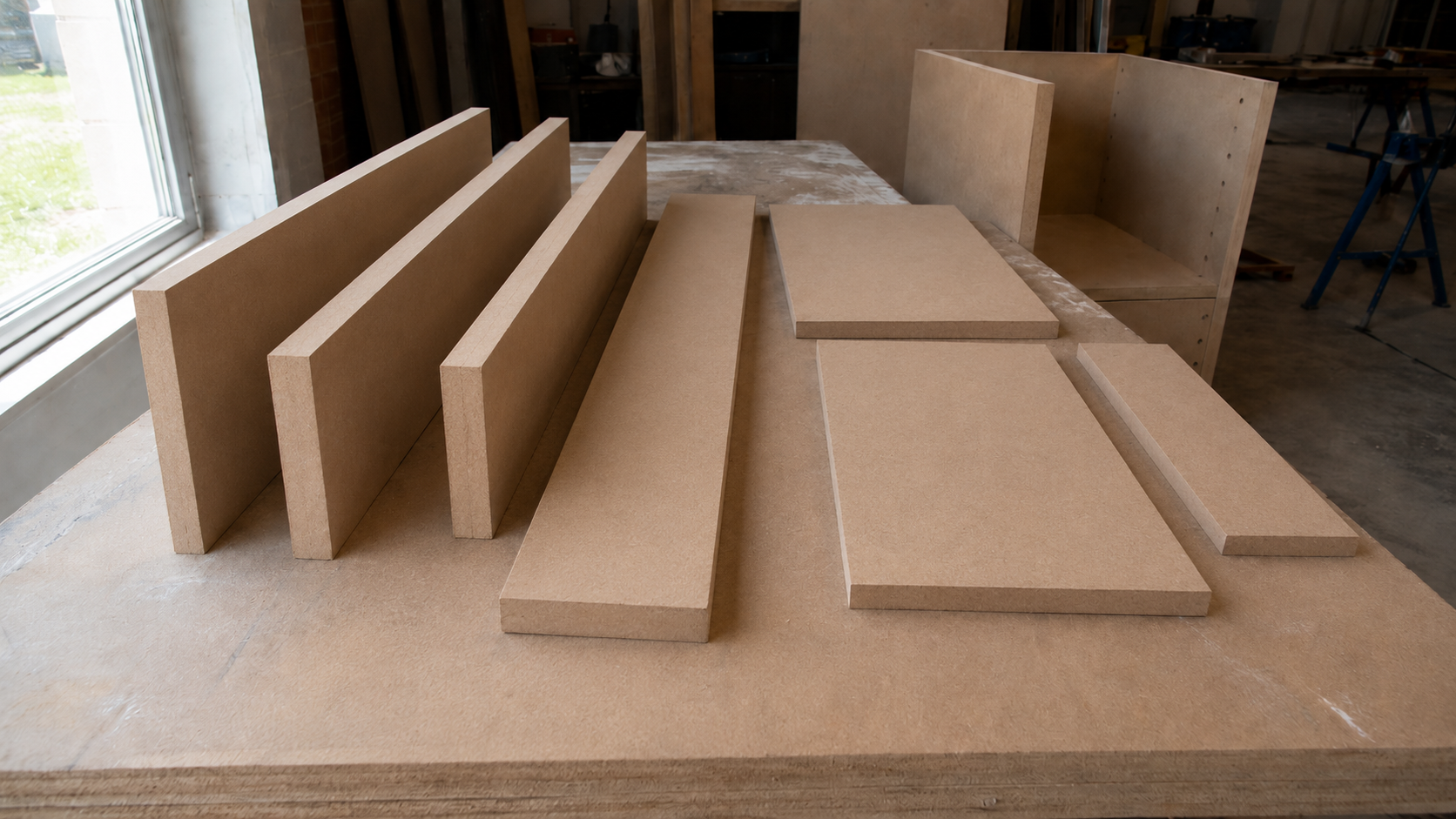
Where it works best is dry interior work that needs a flat, paint-friendly surface: cabinet parts, painted built-ins, furniture panels, drawer fronts, routed trim details, wall paneling, templates, and shop fixtures. If you are still deciding between MDF and the wider family of sheet goods, read wood materials for construction and design before you narrow it down.
Where it gets risky is anywhere with repeated moisture, hard edge abuse, long unsupported spans, or fasteners driven near a weak edge. The failures that follow are not dramatic. A shelf sags over a year. A cabinet side swells along the floor. A cut edge goes fuzzy and drinks paint. A screw blows out an edge because nobody drilled a pilot. Boring, slow, and almost always avoidable.
If you want the bigger family tree before you commit, Engineered Wood Explained: Types, Benefits, and Installation is the right place to step back first.
MDF Board Sizes: What You See in Stores
Most buyers do not need a theory lecture here. They need to know what sizes show up on the rack and what those sizes change once the board leaves the store.
In normal buying, MDF comes as small project panels, half sheets, full sheets, or oversized special-order panels from a cabinet or millwork supplier. For most home projects the 4 ft x 8 ft sheet is still the default, and it is what most cut plans assume.
| Common MDF size | Where it shows up | Best use | What people get wrong |
|---|---|---|---|
| 2 ft x 4 ft | Project panel racks | Templates, backs, small repairs, drawer parts, one-off details | Paying project-panel pricing for work that should have come from a full sheet |
| 4 ft x 4 ft | Retail sheet goods sections | Small furniture parts, closet pieces, compact work areas | Assuming it is automatically cheaper after waste is counted |
| 4 ft x 8 ft | The standard full sheet | Cabinet sides, shelving parts, built-ins, panel work, painted furniture | Buying before checking the cut plan and how the sheet will get home |
| Oversized or cut-to-size panels | Cabinet shops and commercial suppliers | Long runs, fewer seams, production work, custom layouts | Treating custom sizing like stock-sheet pricing |
Sheet size alone does not tell you much. A 4x8 sheet can be the best value or the wrong buy depending on thickness, waste, handling, and whether the panel is standard MDF, moisture-resistant MDF, or a decorative finished product. If the question is really about the format rather than MDF itself, compare it against a broader 8x4 board guide before you buy.
One detail that catches people: the nominal sheet name does not always match the exact delivered size. Some panels run slightly oversized, which helps with trimming in a shop but means your cut list should be based on the sheet you actually have, not the label on the invoice.
MDF Thickness: Where the Good and Bad Decisions Start
A lot of MDF mistakes are really thickness mistakes. People shop by price first and worry about stiffness after the sheet is cut, which is backwards. Thickness controls stiffness, weight, edge durability, and how forgiving the panel will be once it is in use, and getting it wrong tends to make everything downstream more annoying.
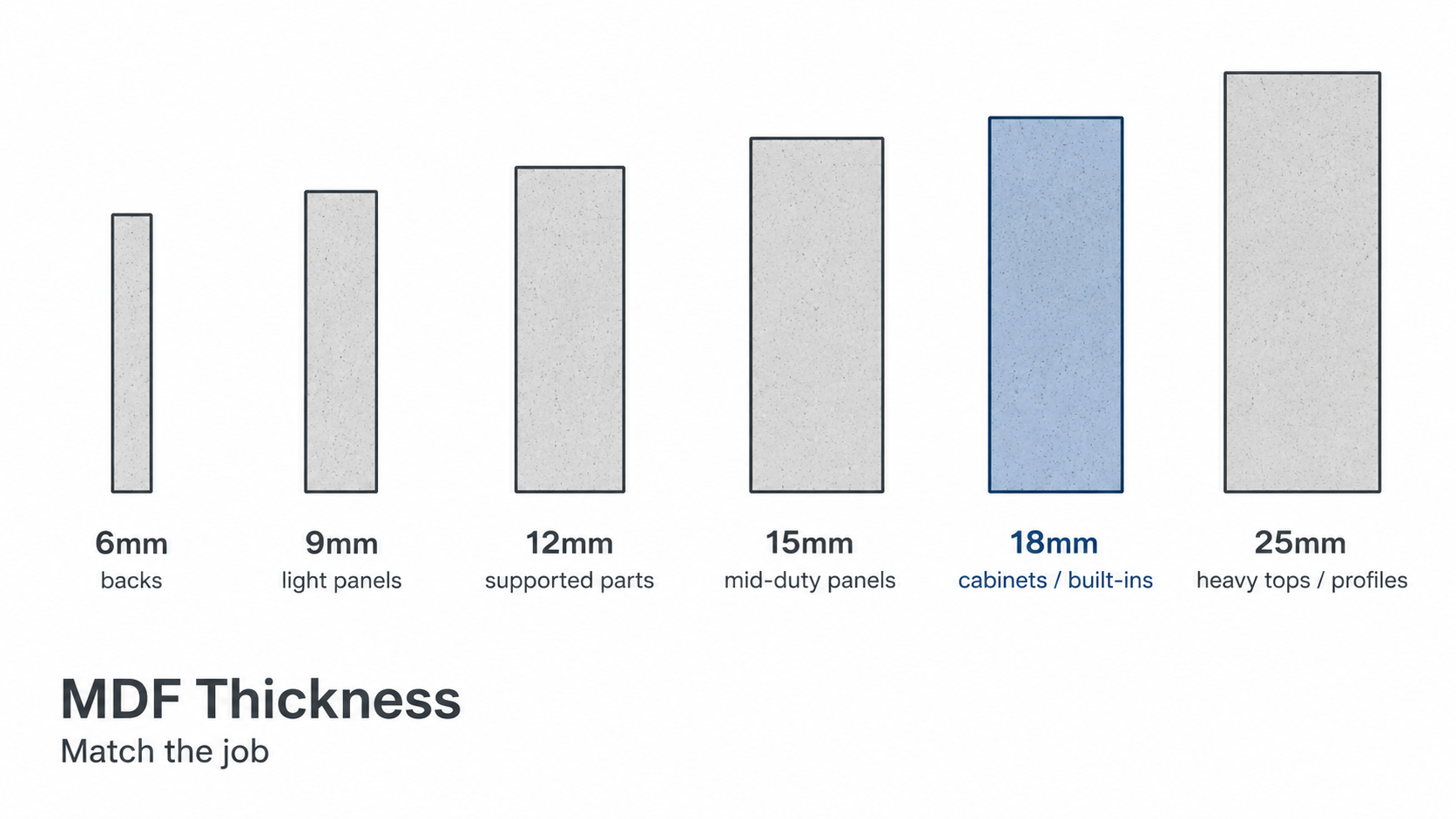
| Thickness | Good use | Skip it for |
|---|---|---|
| 6mm / about 1/4 in. | Back panels, skins, templates, light cabinet backs, drawer bottoms | Shelves, doors, heavy-wear parts |
| 9mm / about 3/8 in. | Light partitions, modest backers, secondary panels | Long spans, heavy furniture parts |
| 12mm / about 1/2 in. | Light cabinet parts, utility panels, supported boxed components | Deep shelves, tops, anything expected to stay stiff without help |
| 15mm / about 5/8 in. | Mid-duty interior panels where 1/2 in. feels light and 3/4 in. feels excessive | Heavy shelving or damp-prone trim details |
| 18mm / about 3/4 in. class | Cabinet bodies, painted shelving, furniture panels, built-ins | Long unsupported shelves or floor-level moisture risk |
| 25mm / about 1 in. | Heavy tops, deep profiles, chunky built-ins, specialty millwork | Projects where weight and handling are already a problem |
Most of the time the real question is finding the thinnest sheet that will still behave once it is installed. That is where redo work comes from. A 12mm sheet looks like the smarter price right up until the shelf flexes, the edge gets battered, or the finish telegraphs every weak spot in the panel, and then the cheap sheet turns out to be the expensive one.
Why 18mm MDF Gets Used So Much
Eighteen-millimeter MDF is the thickness most cabinet and built-in work lands on, and in North American buying it overlaps with the nominal 3/4-inch class. The label flips between metric and imperial depending on the supplier, but it is the same working panel used for the same things:
- Cabinet boxes
- Built-in shelving
- Closet systems
- Painted furniture panels
- Bench carcasses
- Wall panel details
It is the thickness where people stop expecting the panel to just look smooth and start expecting it to feel solid under load. Usually it does, within reason. It still will not carry a long unsupported shelf, and it still swells at the bottom if it sits against a wet floor, so 18mm is not a free pass. It is just the point where MDF starts behaving like something you can build a carcass out of. If the supplier is listing a nearby nominal size instead, keep 19 mm 8x4 board prices in a separate comparison rather than treating every sheet as the same product.
What Actually Changes MDF Board Prices
"MDF board price" sounds like one number, but the category hides several different products. Raw standard MDF, moisture-resistant MDF, fire-rated MDF, veneered MDF, melamine-faced board, high-gloss decorative panels, and cut-to-size pieces are not the same buy and do not belong in the same price conversation.
| What affects MDF price | What it does to cost | Why it matters |
|---|---|---|
| Thickness | Thicker sheets cost more, fast | You are paying for more material, more weight, and a more useful panel |
| Sheet size | Project panels often cost more per square foot than full sheets | Convenience rarely gives you the best value |
| Grade | MR, FR, and exterior-grade products cost more than standard interior MDF | You are buying a performance property, not just a board |
| Face finish | Melamine-faced, veneered, and high-gloss products push cost up | You may save finishing labor, but you have left commodity-sheet pricing |
| Cut-to-size service | Adds a clear premium | You are paying for labor, handling, and reduced shop time |
| Local availability | Varies a lot by region and supplier | Freight, stock depth, and supplier type move the number more than people expect |
The useful way to shop is not to chase one figure. It is to compare the exact panel you need by thickness, sheet size, grade, finish, and square-foot value. Dense fiberboard comparisons move into a different price lane again, so use high-density fiberboard prices when the product is HDF rather than MDF.
What MDF Pricing Looks Like in Practice
For a rough anchor, a standard 3/4-inch 4x8 sheet of plain interior MDF commonly lands somewhere around $40 to $55 at the big-box stores, with moisture-resistant, fire-rated, and decorative-faced panels climbing well above that. Treat that as a ballpark that swings with region, supplier, and the week. Price the exact panel you need rather than the category, because that range hides products that are not really competing with each other.
Format matters more than brand. Small project panels feel cheap because the ticket is small, but per square foot they are often the worst way to buy MDF unless the job is genuinely tiny. Full sheets usually give better value. Moisture-resistant panels, decorative-faced products, and cut-to-size orders each sit in their own lane.
There is a second cost most people forget, and it is weight. A full 3/4-inch sheet runs roughly 80 to 100 pounds, noticeably heavier than plywood of the same thickness, because MDF is a uniform, void-free panel all the way through. That weight is the quiet reason a 4x8 sheet can be the wrong buy even when it is the best value on paper. A full sheet flexes under its own weight when you lift it, which chips edges and throws off a careful cut, and if you cannot move it, break it down, or get it up a staircase cleanly, a cut-to-size order or a couple of half sheets can save you more in handling and rework than they add to the invoice. The cheapest sheet is not cheaper if a third of it ends up as offcuts or the edges get damaged before it is even installed.
Standard MDF vs Moisture-Resistant MDF vs Decorative Panels
Standard MDF is the normal interior board most buyers mean. It works well in dry rooms when the edges are sealed and the spans make sense.
Moisture-resistant MDF is a different buy, and the better choice for kitchens, laundry rooms, and bathrooms where humidity is part of the job. It is not waterproof. It just gives you more tolerance before swelling and damage show up.
Fire-rated MDF is spec-driven. High-gloss, melamine-faced, and veneered MDF are finish-driven. Once you move into any of those, you are paying for performance, finish, or both, and you are no longer comparing simple commodity sheets.
| Product type | Use this when | Avoid this when |
|---|---|---|
| Standard MDF | Dry interior painted work, cabinet parts, built-ins, wall panels, furniture components | The job will see regular moisture, floor-level wetting, or rough abuse |
| Moisture-resistant MDF | You need better humidity tolerance in kitchens, baths, or laundry rooms | You are treating it like exterior material or waterproof board |
| Decorative-faced MDF | You want a finished surface and less finishing labor on site | You are comparing it to raw sheet pricing like it is the same buy |
| Specialty rated products | The project has a specific performance or code-driven requirement | You are paying for properties the job does not need |
Here is the part nobody can settle for you. In a genuinely wet spot, a vanity cabinet that catches splash or a laundry base on a floor that occasionally floods, plenty of trades will tell you to skip moisture-resistant MDF altogether and run plywood or even marine ply, because MR-MDF still gives way eventually if water keeps reaching it. Others use MR-MDF in those same rooms for years with no trouble, because their rooms are humid, not wet. The catch is that there is no clean line where humid turns into wet, and the panel will not warn you which one your room is until the damage is done. I lean toward plywood when there is any standing-water risk and MR-MDF when it is only humidity, but that is a judgment call, not a rule, and reasonable builders land on opposite sides of it.
Where MDF Fails First
MDF fails in predictable ways, and predictable is good, because predictable failures are the ones you can design around.
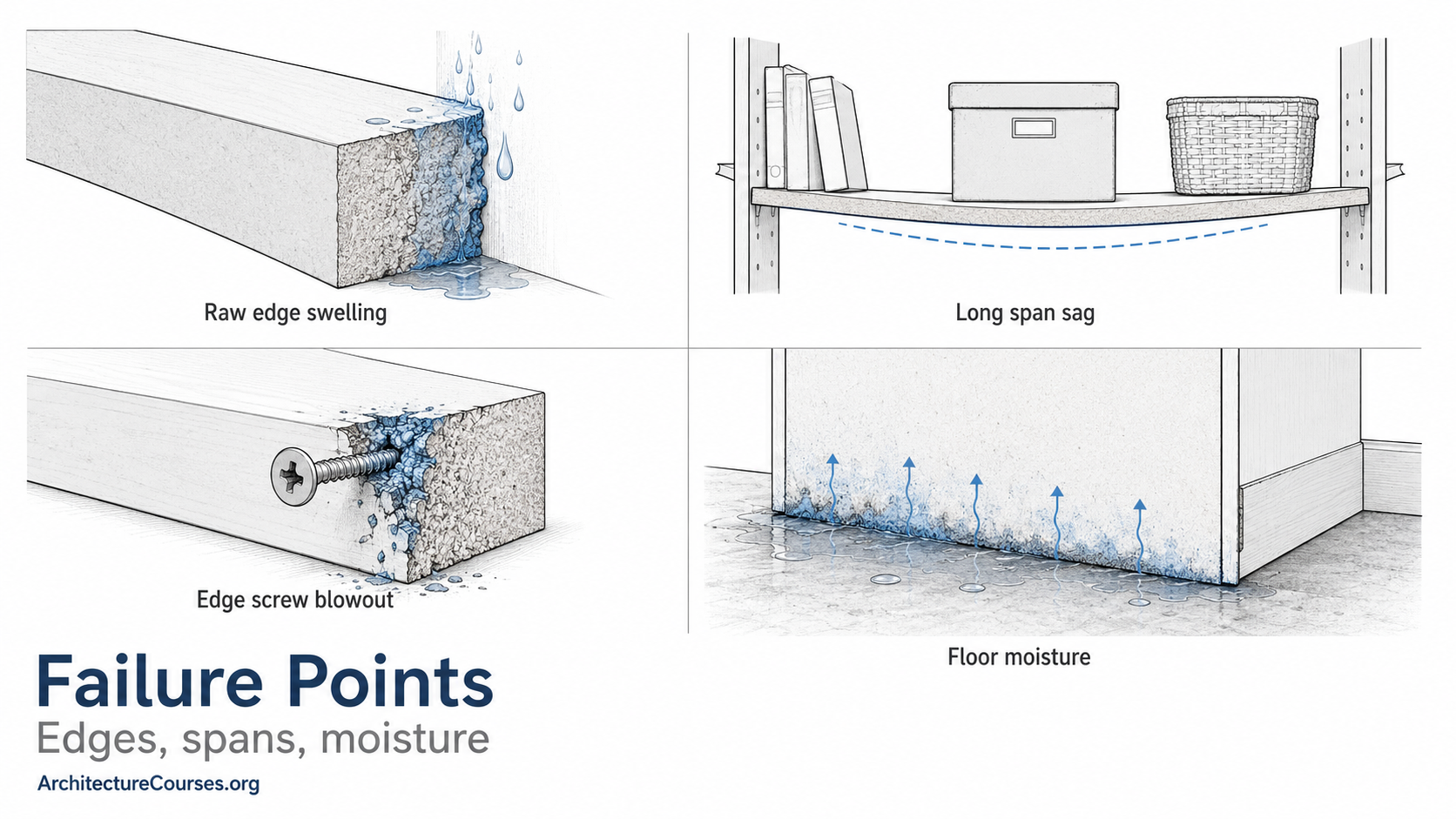
- It swells at raw cut edges after repeated moisture exposure.
- It sags on long shelves when nobody shortens the span or stiffens the front edge.
- It gets chewed up around fasteners driven carelessly near edges.
- It loses its good face fast when the edges are not sealed before painting.
- It breaks down at the bottom of cabinets or panels that sit too close to wet floors.
- It turns into a handling problem because thicker sheets get heavy in a hurry.
I once took apart a sink base where the bottom edge had been wicking moisture off the floor for a couple of years. The panel still looked fine from across the room, but the bottom two inches had gone soft enough to crush between two fingers. None of that is mysterious. MDF holds up when it is supported under load, sealed at the edges, and kept in a dry room, and it lets go slowly when it is not, usually after the part is already installed and painted, which is the worst possible time to find out.
Screwing Into MDF Without Splitting It
This is the part the store display skips, and it is where a lot of first MDF projects go wrong. MDF has no grain. A screw cannot follow a fiber path the way it does in solid wood or plywood, so instead of cutting through, it wedges the compressed fibers apart. Drive one carelessly and you get a bulge on the face over the screw, a stripped hole, or a split running down the edge.
The faces of a sheet are denser than the core, so a screw into the face holds reasonably well. The edge is the problem. Screw straight into a raw edge and you are driving into the soft middle of the panel, which strips easily and splits the sheet. I have split more than one cabinet side learning that. The screw goes in clean, then the face mushrooms up over the shank and the part is done.
A few habits keep it from happening. Drill a pilot hole, always on edges, and keep fasteners back from the edge, with roughly 3/4 in. a safe minimum. Use coarse-thread or straight-shank screws rather than tapered wood screws, because the taper acts like a wedge and does the exact thing you are trying to avoid. For edge joints that have to hold, cabinet carcasses and shelving that carries weight, confirmat screws are worth the trouble. They are built for engineered panels, they run in a stepped bit, and they grip far harder than a wood screw ever will. If you are joining two 3/4-in. pieces edge-to-face, use a longer screw than you would in solid wood, drill a pilot slightly larger than the screw's core so the threads still bite but the body does not split the panel, and do the last few turns by hand.
Do This Instead of This
| What people commonly do | Better move |
|---|---|
| Buy standard MDF for a bathroom vanity side | Use moisture-resistant MDF and keep it clear of wet floor exposure |
| Use 18mm MDF for a long bookshelf with no stiffener | Shorten the span, add nosing, add support, or choose a stiffer panel |
| Shop only by the cheapest MDF sheet price | Shop by thickness, sheet size, grade, finish, and square-foot value |
| Treat 4x8 as the automatic best buy | Check waste, handling, access, and cut sequence first |
| Drive a wood screw straight into a raw edge | Pilot the hole, set back from the edge, and use coarse-thread or confirmat screws |
| Prime the face and ignore the edges | Seal the edges first, then finish the whole part |
| Store sheets leaning in a damp garage | Store them flat, dry, and out of moisture swings |
Buying MDF Online vs Buying It Local
Buying MDF online is mostly about convenience, not raw price. It can make sense when you need a specific thickness, a decorative face, or a cut-to-size service your local yard does not stock.
But MDF is heavy, edge damage in transit is common, and vague listings make bad comparisons look better than they are. For standard raw MDF, local buying is still better a lot of the time, because you can check the face, inspect the edges, and see whether the sheet was stored badly before you load it.
What To Check Before You Buy MDF
A lot of bad MDF purchases happen because people stop at thickness and price. That is not enough.
- Check the exact thickness, not just the shorthand in the title.
- Check whether the board is standard, moisture-resistant, decorative-faced, or something more specialized.
- Check the actual sheet size if the job is tight on cuts or seams.
- Check the condition of the edges before you bring the sheet home.
- Check how the board will get from the store to the shop without damage.
- Check whether the job really wants MDF at all.
That last one matters more than people think. A lot of frustration with MDF is not because MDF is bad. It is because the job wanted plywood, HDF, solid wood, low-density fiberboard, or a different panel system from the start.
MDF vs HDF vs Plywood
A lot of MDF regret is really a product-selection problem.
MDF is the better choice when you want a smooth, uniform painted surface and the panel is not being asked to do structural work. If your question is really about denser fiber panels, thinner hard-wearing board, or panel-family differences, High Density Fiberboard (HDF) is the next useful comparison.
Plywood is the better choice when the job needs more stiffness, better screw holding, or more abuse tolerance. It is not as smooth out of the gate for painted finishes, but it is often the safer buy once spans get longer or the room gets rougher.
Sometimes the answer is not panel shopping at all. If the project is really about choosing the right material family for durability, finish, and cost, step back to Building Materials Basics or How to Choose the Right Wood for Your Project.
The Detail People Miss
The sheet price is never the expensive mistake. The expensive one is buying the wrong thickness or grade, cutting the whole project, sealing it, painting it, hanging it, and only then watching the shelf bow or the edge swell where daily moisture keeps reaching it. By that point the cheap sheet has cost you a weekend and a redo.
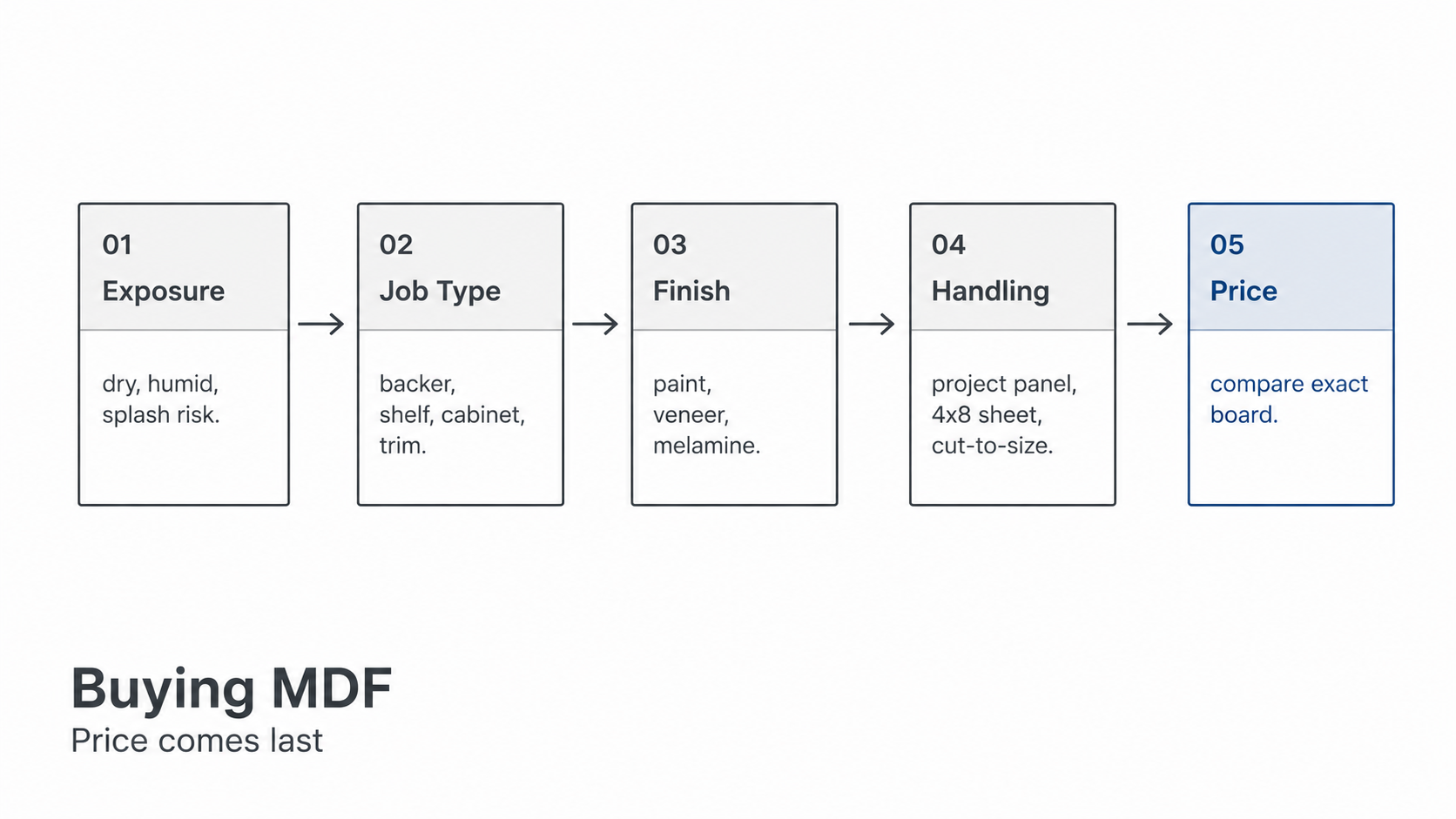
A better order of operations keeps that from happening:
- Define the exposure: dry, humid, splash-prone, or wet-risk.
- Define the job: backer, side panel, shelf, top, face, or routed detail.
- Define the finish: painted, laminated, veneered, or hidden.
- Define the handling: project panel, full sheet, or cut-to-size.
- Then price the exact board.
Read This Next
Use these next if the MDF question turns into a bigger material-choice problem.
- For the broader panel family, start with Engineered Wood Explained.
- For denser fiberboard products, compare High Density Fiberboard (HDF).
- For HDF cost comparisons, see High Density Fiberboard Prices.
- For lower-density fiberboard, use Low Density Fiberboard (LDF).
- For the wider material decision, step back to Building Materials Basics or How to Choose the Right Wood for Your Project.
FAQ
What is the standard MDF board size?
For most residential buyers, the standard MDF sheet is still 4 ft x 8 ft. Smaller project panels and 4 ft x 4 ft sheets are common too, but 4x8 is the default full-sheet format most people mean.
What is the most common MDF thickness for cabinets?
18mm, or the nominal 3/4-inch class, is the most common working thickness for cabinet bodies, shelving parts, and many painted furniture panels.
Is 18mm MDF the same as 3/4-inch MDF?
Not exactly, if you are measuring with calipers. But in practice they are treated as the same working panel, and 18mm and 3/4-inch stock get used interchangeably for cabinet and shelving work.
Why do MDF shelves sag so often?
Because the span is too long, the load is too heavy, or the front edge was left unstiffened. MDF can work for shelving, but it does not like casual long spans.
Is moisture-resistant MDF waterproof?
No. It is better suited to humid interior environments than standard MDF, but it is not the same thing as waterproof or exterior-rated material.
Do I need to drill pilot holes in MDF?
On edges, yes, almost always, because MDF splits when a screw wedges into the soft core. Faces are more forgiving, but a pilot hole and a coarse-thread or confirmat screw will save you from blown edges and stripped holes on anything that has to hold.
Is MDF good for skirting boards and trim?
It can be, especially in dry interior painted work where you want a smooth finish and a stable profile. It is a weaker choice anywhere with repeated wetting, rough impact, or floor-level moisture problems.
Should I buy MDF online?
Only when the listing is precise and the product is worth shipping. MDF is heavy, edge damage is common, and vague listings hide bad comparisons.
What is better than MDF?
That depends on the job. Plywood is better for stiffness and abuse tolerance. HDF can be better when density and surface behavior matter more. Solid wood is better when edge durability, repairability, or natural finish matters.
Official Sources And Institutional Reading
- U.S. Environmental Protection Agency: Formaldehyde Emission Standards for Composite Wood Products
- Electronic Code of Federal Regulations: 40 CFR Part 770, Formaldehyde Standards for Composite Wood Products
- Occupational Safety and Health Administration: Wood Dust
- California Air Resources Board: Composite Wood Products Program
- U.S. Forest Service Research: Wood-Based Composites and Panel Products
- Oklahoma State University Extension: Use of Wood Composite Panels as Substrate for Cabinet Manufacturing