
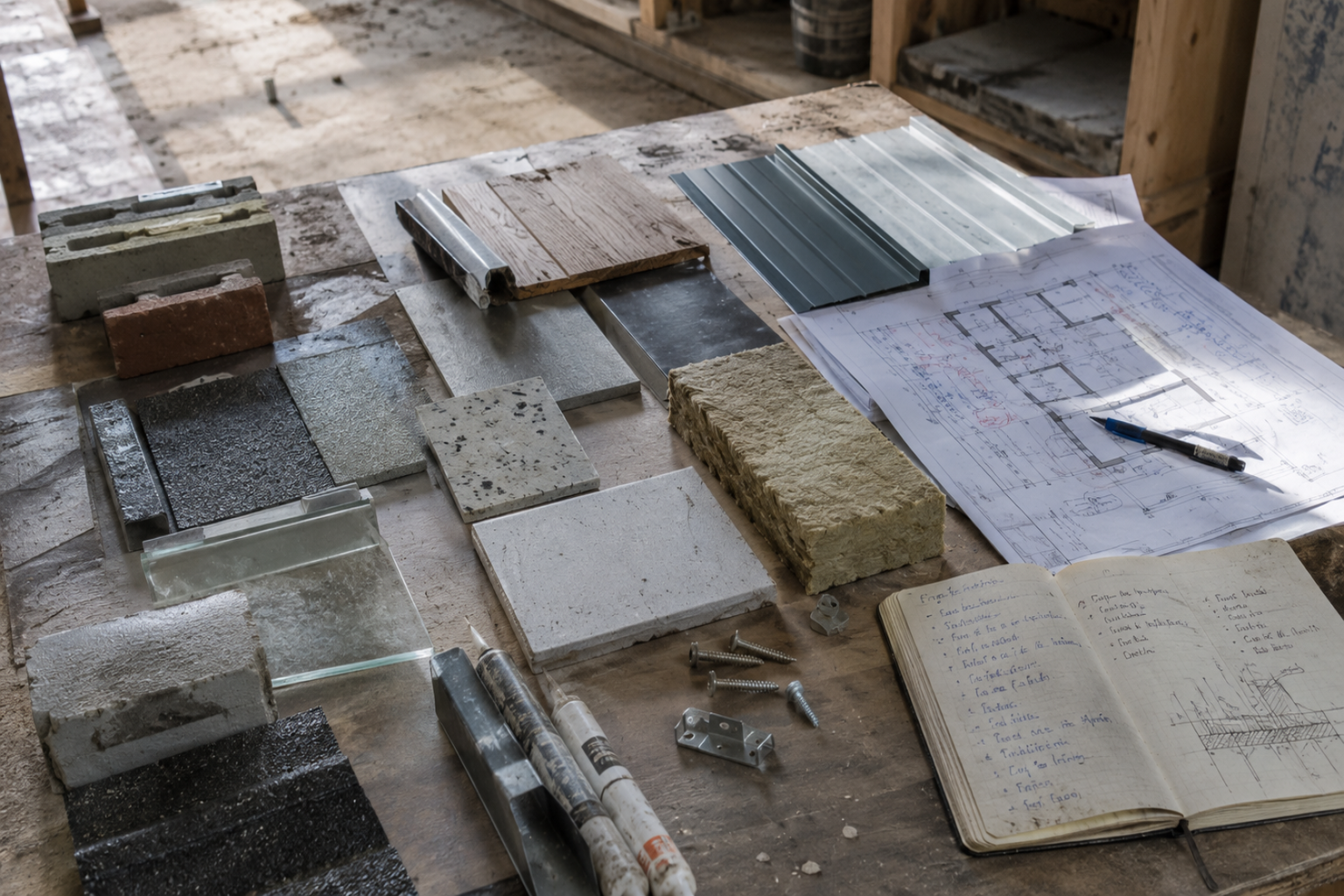
A sample board does not tell you much.
The material still has to live on a floor, wall, roof edge, shower, porch, stair, cabinet face, or exterior corner. It will get wet, cleaned, scratched, heated, walked on, cut, fastened, sealed, patched, and repaired.
Color matters. Price matters. But first check the job.
Where does it go? How does it get wet? What wears it down? Who cleans it? What happens at the edges? Can it be repaired without tearing half the assembly apart?
Approve the material after those answers are clear.
What materials selection really means
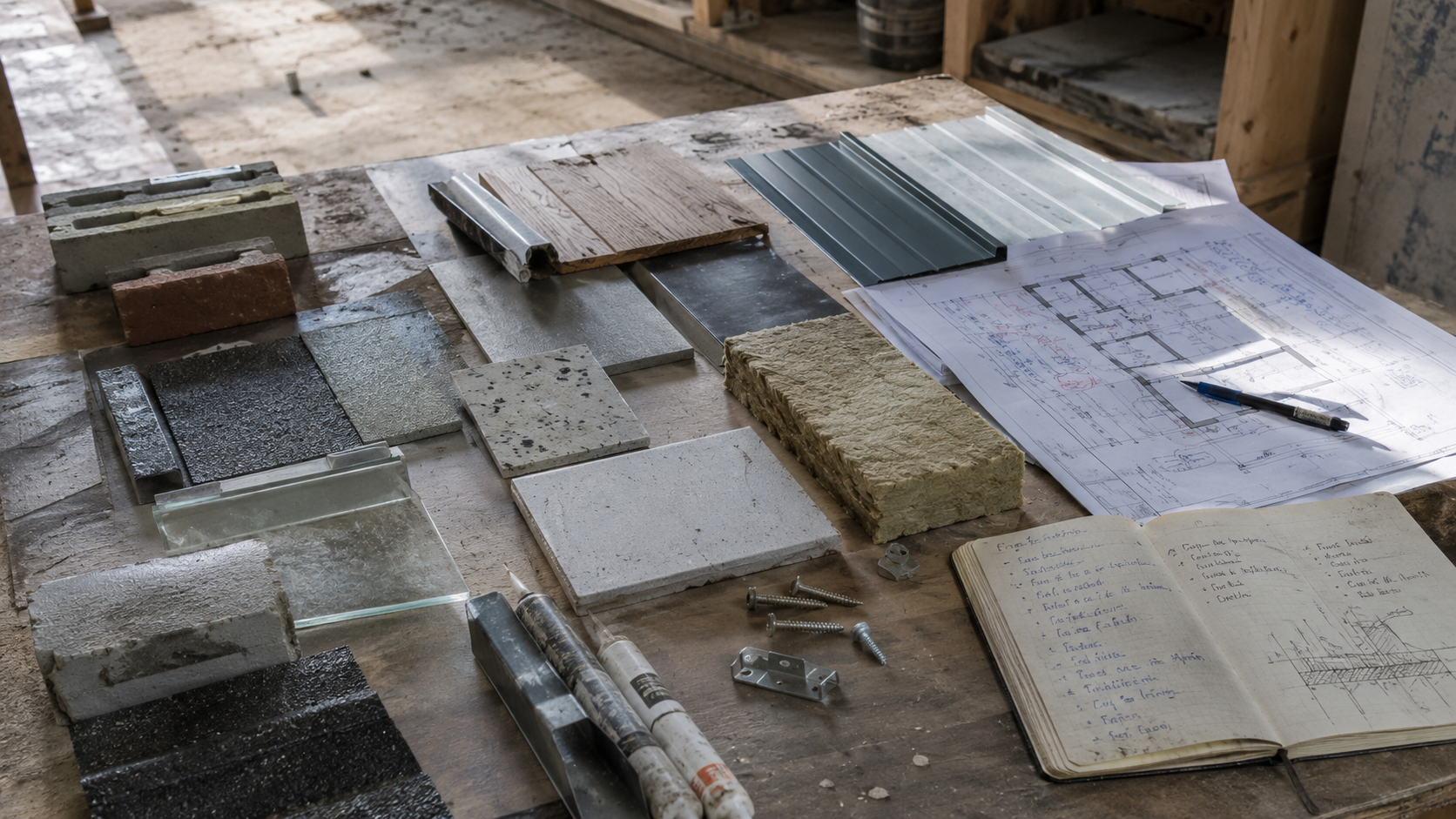
Materials selection is the process of choosing building materials based on use, climate, durability, cost, code, maintenance, appearance, sourcing, and replacement. It is not a shopping step at the end of design.
It affects almost everything: how the building looks, how it ages, how much it costs to maintain, how easy it is to repair, how safe it is, and how much waste it creates when parts wear out.
A good material choice fits the project. A bad one only fits the mood board.
For a broader list of material categories, see the complete list of building materials.
The first question: what can go wrong here?
Start with failure.
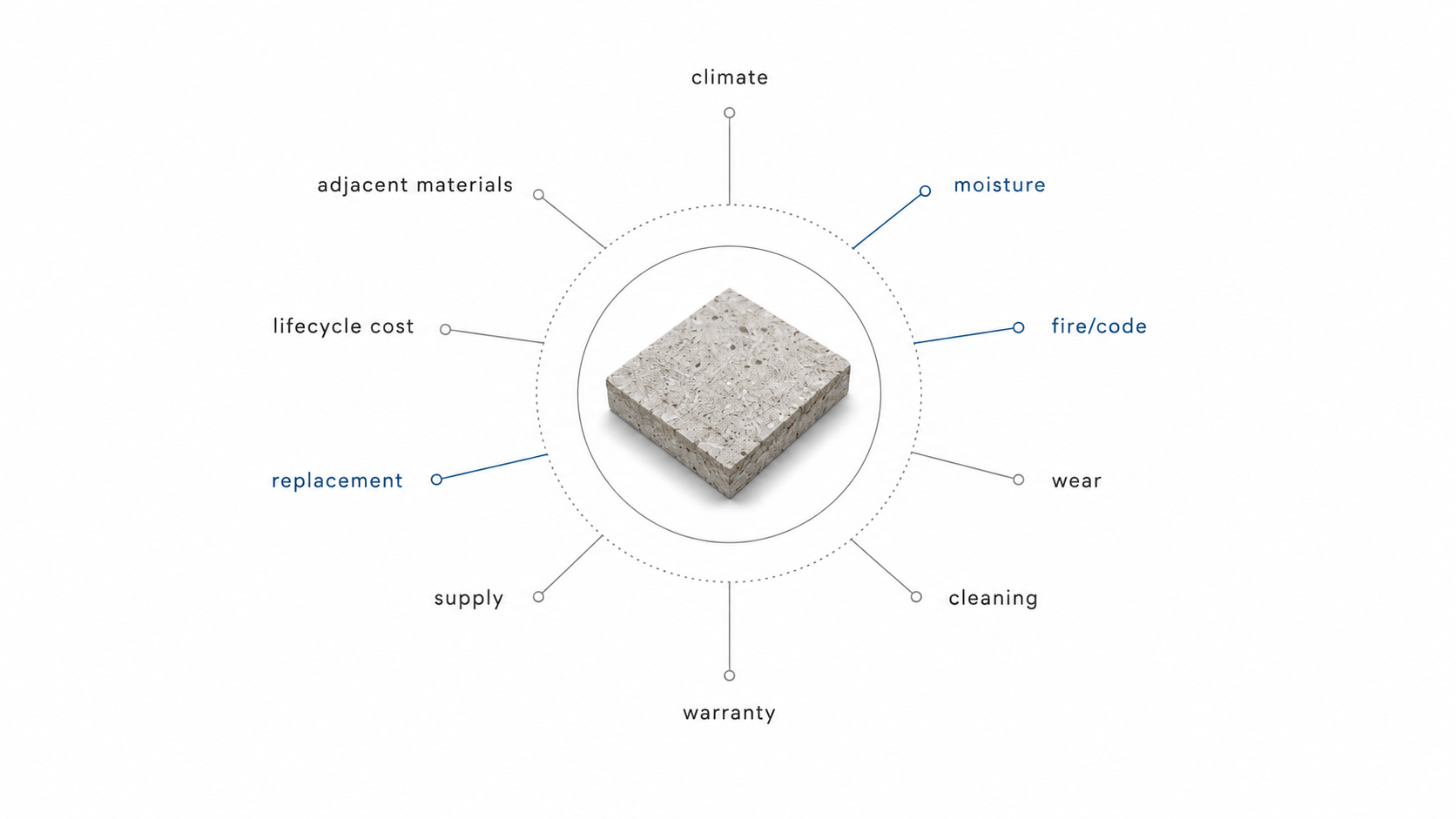
That sounds negative, but it saves money. Every material has a weak point. Wood moves with moisture. Steel can corrode. Stone can stain. Concrete can crack. Tile can chip. Vinyl can dent or fade. Insulation can fail when it gets wet. Sealants age. Paint peels when the surface below it is wrong.
The goal is not to find a perfect material. The goal is to choose a material whose weak point you understand.
| Material decision | Common failure | What to check before approval |
|---|---|---|
| Wood outdoors | Rot, cupping, checking, insect damage, finish failure | Moisture exposure, species, treatment, drainage, end-grain protection, maintenance |
| Stone countertop | Staining, etching, cracking, edge damage | Porosity, sealing, use pattern, edge detail, support below weak areas |
| Metal cladding | Corrosion, oil-canning, denting, galvanic reaction | Coating, fasteners, adjacent metals, salt exposure, panel thickness |
| Floor tile | Cracking, slippery surface, grout staining | Substrate, slip rating, traffic, grout type, movement joints |
| Insulation | Moisture damage, air gaps, compression, fire mismatch | Assembly type, vapor control, fire requirements, installation quality |
A material that fails in a predictable, repairable way may be better than a material that looks perfect until it fails badly.
Looks matter, but they are not enough
Appearance matters. Nobody wants a building that looks accidental.
But appearance is only the first filter. A material also has to handle the work it is being asked to do. A soft floor finish may look warm in a sample, then look tired after six months of chair legs, dogs, grit, and wet boots. A dark exterior panel may look sharp in a rendering, then show every scratch and heat movement line in real sun.
Ask this before approving the finish:
- Will it look good after use, not just before use?
- Will normal cleaning damage it?
- Will scratches blend in or stand out?
- Will sunlight change the color?
- Will water leave stains, swelling, rust, or mold?
Materials are not static. They age. Pick the aging pattern you can live with.
Climate is not a small detail
Climate should control more material decisions than style does.
A material that works in a dry inland climate may fail near the coast. A finish that works in a mild region may crack under freeze-thaw cycles. A wall assembly that performs in one humidity zone can trap moisture in another.
This is where cheap choices get expensive. Porous materials in wet areas, untreated metals near salt air, wrong wood species outside, dark roofing in hot climates, and vapor-closed assemblies in the wrong wall can all create long-term problems.
The mistake is not choosing a “bad” material. The mistake is choosing a material for the wrong exposure.
Use controls the material
Materials should be chosen for the punishment they will take.
A quiet bedroom, a rental kitchen, a school hallway, a restaurant restroom, a garage, and a wet entry do not need the same materials. The traffic, cleaning, impact, moisture, and repair tolerance are different.
A material can be beautiful and still be wrong for the room.
| Location | What usually matters most | Material mistake to avoid |
|---|---|---|
| Entryway | Water, grit, slip resistance, cleaning | Choosing a delicate finish because it looks good dry |
| Kitchen | Heat, stains, water, impact, cleaning | Using surfaces that cannot handle real cooking |
| Bathroom | Moisture, ventilation, slip resistance, mold risk | Picking absorbent or hard-to-seal materials in wet zones |
| Exterior wall | Rain, UV, wind, movement, fasteners | Choosing cladding without thinking about water drainage |
| Commercial corridor | Impact, cleaning, replacement, abuse | Choosing residential-grade finishes for public wear |
If the material cannot handle the use, the design will look old before the building is old.
Code, fire, and safety come before taste
Some material choices are not just design choices. They are safety choices.
Building type, height, occupancy, fire separation, egress, structure, smoke control, and local code can all limit what materials are allowed. A small detached house has different limits than a school, apartment building, restaurant, warehouse, or high-rise.
This matters most with exterior wall systems, insulation, foam plastics, interior finishes, fire-rated assemblies, stairwells, corridors, kitchens, garages, and mechanical spaces.
Do not accept vague language like “fire rated” without asking what was tested. Was it the material? The panel? The full assembly? The exact thickness? The same substrate? The same joint? The same fastener? The same use?
A fire certificate is not a magic pass. It has limits.
For insulation-related choices, start with thermal insulation materials before treating R-value as the only decision.
The hidden issue: adjacent materials
This is one of the material-selection problems people skip.
A material may be fine by itself and still fail beside the wrong neighbor.
Different metals can react with each other. Wood can trap water against masonry. Stone can stain from metal dust. Foam can be damaged by the wrong solvent. Sealant can fail against the wrong surface. A hard floor can crack when the substrate below it moves. A dark cladding panel can heat up and stress nearby sealants or coatings.
Do not ask only, “Is this material good?”
Ask, “What does it touch?”
That one question catches a lot of bad specifications.
The replacement path nobody checks
A material should not be judged only by how it goes in. It should be judged by how it comes out.
Some materials are easy to replace. A damaged plank, tile, panel, or trim board can be removed without tearing apart the building. Others are trapped behind other work. A cheap material in a hard-to-reach place can become expensive because replacement requires demolition.
This matters in roofs, exterior cladding, bathrooms, kitchens, mechanical rooms, floors, decks, and commercial interiors.
Before approving a material, ask:
- Can one damaged piece be replaced?
- Will the same product still be available later?
- Does the finish come in batches that may not match?
- Will repair require removing cabinets, trim, roofing, waterproofing, or equipment?
- Will the replacement look worse than the original damage?
The material with the lower purchase price is not always the cheaper material. Sometimes the cheaper material is the one you can repair without opening half the building.
Lifecycle cost beats sticker price
The lowest material price is rarely the full cost.
The full cost includes delivery, waste, installation time, special tools, skilled labor, finishing, sealing, cleaning, maintenance, repair, replacement, and disposal.
A roof material that costs more upfront may be cheaper if it lasts longer and needs fewer repairs. A floor that costs less may be more expensive if it needs constant refinishing or replacement. A cheap exterior finish may cost more once repainting, water damage, and access equipment are included.
Use this simple test:
If the material saves money only on day one, be careful.
For deeper cost logic, use the materials selection process as a companion page.
Sustainability needs proof, not buzzwords
“Eco-friendly” is not enough.
A sustainable material choice should be checked against real evidence: durability, local availability, recycled content, low emissions, responsible sourcing, repairability, reuse, embodied carbon, and whether the product fits the building assembly.
A material that has a low-carbon story but fails early is not a good environmental choice. Replacing failed materials creates more waste, more transport, more labor, and more cost.
For wood, look for responsible sourcing and chain-of-custody documentation where it matters. For manufactured products, ask whether an Environmental Product Declaration is available. For interior products, check emissions and cleaning requirements.
Sustainability is strongest when the material lasts, can be maintained, and does not create a hidden health, moisture, fire, or repair problem.
For related choices, see sustainable materials and natural building materials.
Availability can break the design
A material that cannot arrive on time is not selected. It is wished for.
Availability affects cost, schedule, warranty, replacement, and contractor coordination. Special-order finishes can be worth it, but only when the schedule and replacement plan can handle them.
Ask these questions early:
- Is the material stocked locally?
- What is the real lead time?
- Can damaged pieces be replaced quickly?
- Are trims, fasteners, adhesives, and accessories available too?
- Will a future repair require importing the same product again?
Local materials are not automatically better, but they often reduce shipping risk and may perform better when they are already proven in the local climate.
Mockups catch problems drawings miss
Samples are useful. Mockups are better.
A small sample tells you color and texture. A mockup tells you how the material meets corners, trims, fasteners, grout, sealant, light, water, and nearby finishes.
Mockups are especially useful for:
- exterior cladding joints
- tile patterns and grout color
- wood stain and finish
- countertop edges
- roof-to-wall transitions
- large-format panels
- flooring beside stairs, cabinets, and thresholds
A mockup can feel slow. It is still faster than removing a bad material after installation.
What to use and what to skip
There is no universal best material. There is only a best material for a specific condition.
| Project need | What works better here | What to be careful with |
|---|---|---|
| Wet entry or mudroom | Durable tile, sealed concrete, textured stone, water-tolerant flooring | Soft wood, slippery polished surfaces, absorbent materials |
| Low-maintenance rental | Replaceable flooring, durable paint, simple fixtures, stain-resistant surfaces | Delicate finishes that need careful users |
| Coastal exterior | Corrosion-resistant metals, durable coatings, proper drainage, salt-aware detailing | Untreated steel, wrong fasteners, porous finishes with no maintenance plan |
| Budget kitchen | Mid-range surfaces with good repair and cleaning behavior | Cheap materials that swell, chip, or delaminate near water |
| High-traffic public space | Impact-resistant walls, durable flooring, easy replacement parts | Residential-grade finishes used because they look good at install |
Material selection checklist
- Define the real use of the space.
- Check climate, moisture, sun, freeze-thaw, salt, heat, and wind exposure.
- Confirm code, fire, structure, slip, and accessibility requirements.
- Ask how the material fails.
- Check what the material touches.
- Compare lifecycle cost, not just purchase price.
- Ask what maintenance is required and who will actually do it.
- Check local availability, lead time, and replacement options.
- Review warranties for exclusions.
- Build a mockup where joints, edges, light, or water matter.
- Keep product data, installation instructions, warranty papers, and final color or finish records.
Red flags
The biggest red flag is a material chosen only because it looks right in a rendering.
Another warning: nobody can explain how it is cleaned, repaired, sealed, fastened, replaced, or warranted. That usually means the decision is not finished.
Be careful when a supplier says a material is “maintenance-free.” Almost nothing in a building is maintenance-free. The honest question is how much maintenance, how often, and what happens if it is skipped.
Be careful when a product is described as “green” but has no clear sourcing, durability, emissions, or lifecycle information.
And be very careful when a material needs perfect installation to survive. Perfect installation is rare. Good material choices allow for real jobsite conditions.
FAQ
What is materials selection in architecture?
Materials selection is the process of choosing building materials based on appearance, performance, cost, climate, code, maintenance, sustainability, and replacement. It connects design decisions to real building behavior.
What is the biggest mistake in choosing building materials?
The biggest mistake is choosing by appearance or price before checking climate, moisture, use, code, and maintenance. Materials fail in real conditions, not on sample boards.
Should I choose the cheapest material?
Sometimes, but only when it still performs well for the location. A cheap material that needs early repair or replacement is not cheap. Compare lifecycle cost, not just purchase price.
Are sustainable materials always better?
No. A sustainable material still has to fit the climate, code, use, installation, and maintenance plan. A low-impact product that fails early can create more waste and cost.
Why do local materials matter?
Local materials can reduce shipping risk, support local supply, and sometimes perform better in the local climate. They are not automatically best, but they are worth checking first.
How do I know if a material is durable?
Look at the use conditions, manufacturer data, warranties, local examples, maintenance needs, and failure history. A mockup or test area helps when the choice is expensive or hard to reverse.
What documents should I keep after choosing materials?
Keep product data sheets, installation instructions, finish codes, batch information, warranties, maintenance guides, certifications, and photos of hidden details before they are covered.
Read This Next
Use the complete list of building materials for a broader overview of common material categories used in construction.
Read materials selection process for the step-by-step method behind choosing, testing, sourcing, and approving materials.
Use sustainable materials when environmental impact, durability, and sourcing are part of the decision.
Read thermal insulation materials before choosing wall, roof, basement, and energy-related assemblies.
Use wood moisture content, acclimation, and movement when wood selection, storage, and installation risk are part of the job.
References
Sources used for this article
- Whole Building Design Guide: Materials
- Whole Building Design Guide: Sustainable Design Objectives
- Whole Building Design Guide: Green Principles for Residential Design
- U.S. Environmental Protection Agency: EPD Basics
- U.S. Green Building Council: Building Product Disclosure and Optimization
- Forest Stewardship Council Canada: Chain of Custody Certification