
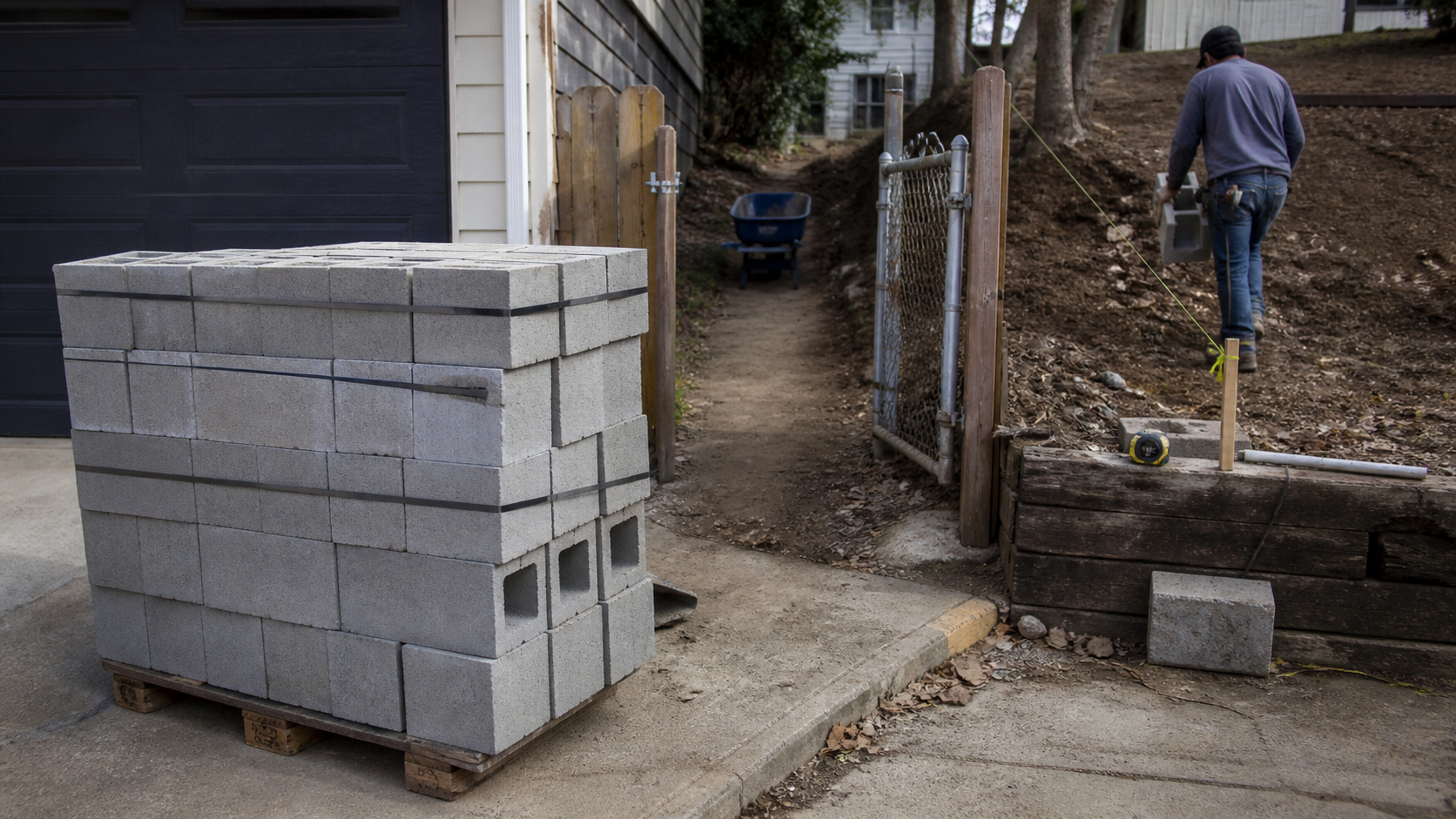
Concrete blocks are cheap until the wall gets priced.
The store tag only answers one question. It does not tell you what the wall will cost once you add mortar, grout, rebar, delivery, waste, pallet deposits, access problems, and labor.
That is where most bad block estimates break. Someone prices one 8 × 8 × 16 block, multiplies by a rough wall count, and thinks the budget is done. Then the delivery fee shows up. Then the footing detail changes. Then the supplier says the pallet cannot be dropped where the wall is being built.
Price the wall, not the block.
Quick 2026 Price Numbers

Illustration by ArchitectureCourses.org. A standard concrete block is commonly described as 8 by 8 by 16 inches, with hollow cells that reduce weight and allow reinforcement or grout when needed.
These are planning ranges for the U.S. market in 2026. Local prices still matter. Concrete block pricing changes by ZIP code, supplier, density, pallet quantity, stock level, and delivery method.
| What You Are Pricing | Useful 2026 Range | What to Remember |
|---|---|---|
| Standard 8 × 8 × 16 hollow concrete block | About $1.25–$3.00 each | The low end usually comes from bulk, yard, or regional pricing. Store pricing changes by location. |
| General concrete block material range | About $1.00–$5.00 each | This broader range includes different sizes, densities, and common retail variation. |
| Split-face 8 × 8 × 16 block | Often $3.00–$5.00 each | You pay for the exposed face. Do not use it where the wall will be hidden. |
| Blocks per square foot of wall | About 1.125 standard blocks before waste | Add 5% to 10% for cuts, corners, breakage, and layout mistakes. |
| Common pallet count | Often 70–90 blocks | Some common 8 × 8 × 16 pallets are listed at 72 blocks. Always ask for the exact product. |
| Basic installed concrete block wall | About $15–$20 per sq ft | Plain wall estimate. Access, reinforcement, and site conditions can move it quickly. |
| Installed CMU block wall | About $19–$24 per sq ft | Use this as a more conservative planning range for CMU work. |
The block itself is rarely the expensive part. The expensive part is getting the right block, in the right quantity, to the right spot, with the right supporting materials.
What One Block Covers
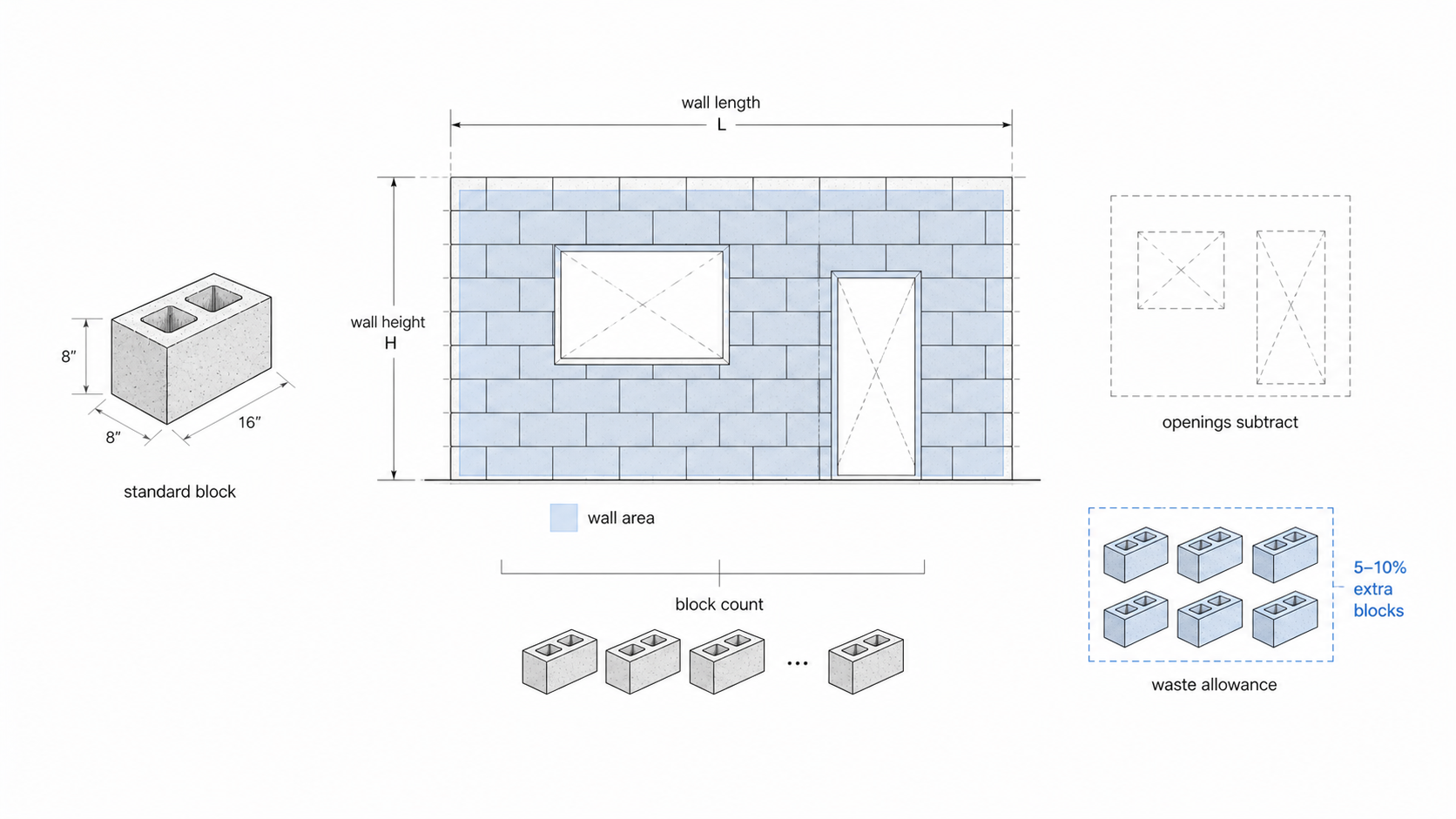
Illustration by ArchitectureCourses.org. Concrete block quantity starts with wall area, subtracts openings, then adds a small waste allowance for cuts and breakage.
A standard 8 × 8 × 16 block covers about 0.89 square feet of wall when laid with normal mortar joints.
The simple estimating rule is:
Wall area × 1.125 = approximate number of standard 8 × 8 × 16 blocks before waste.
A 20-foot wall that is 4 feet high has 80 square feet of wall area.
- 80 × 1.125 = 90 blocks before waste.
- Add 5% waste and you need about 95 blocks.
- Add 10% waste for a first-time job, corners, cuts, or awkward layout and you need about 99 blocks.
Do not count doors, windows, or large openings as solid wall. Do not forget corners, pilasters, bond beams, cap blocks, or half blocks if the layout needs them.
The math is not hard. The mistake is doing it too late, after the truck is already scheduled.
Block Price Is Not Wall Price
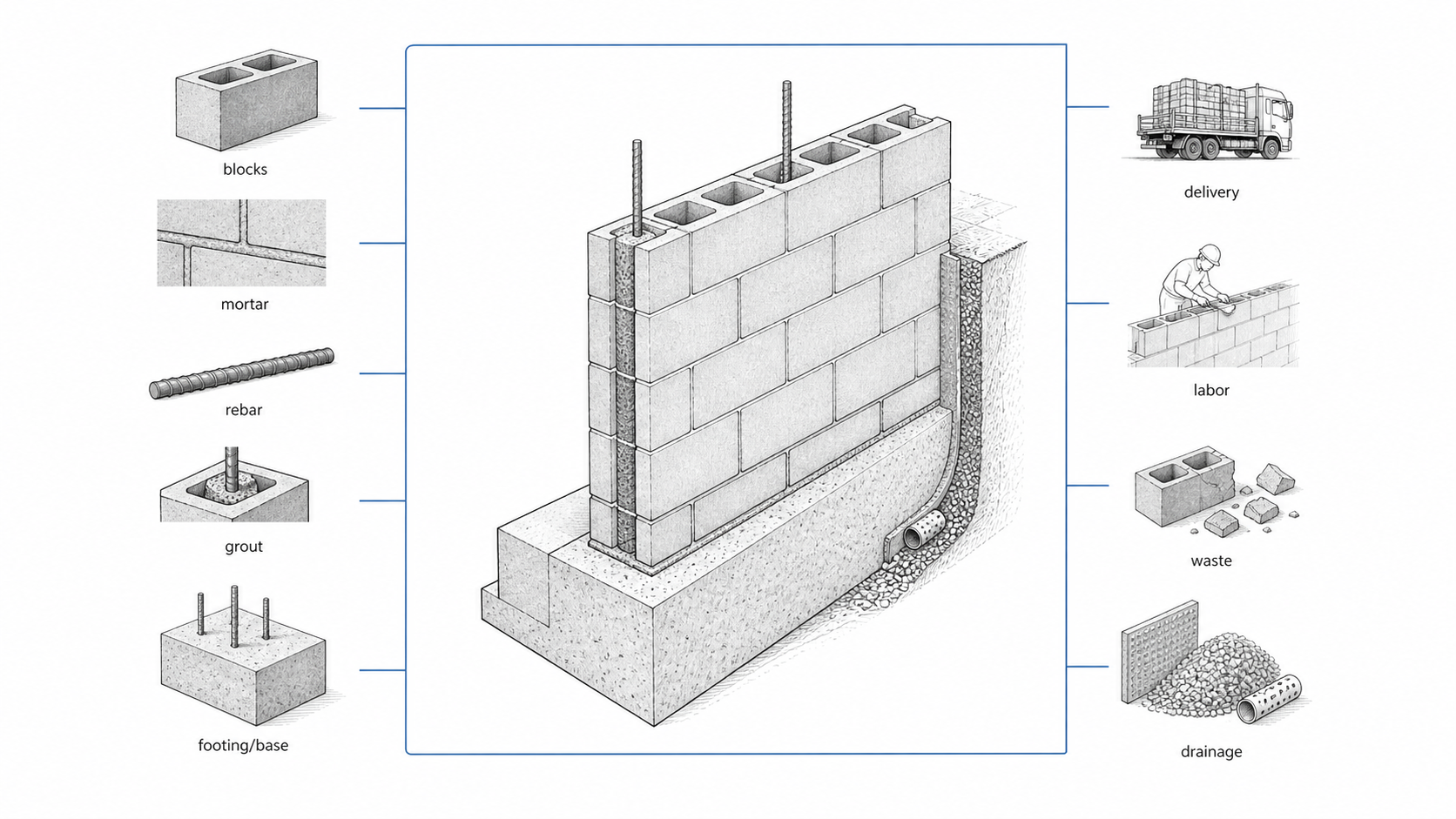
Illustration by ArchitectureCourses.org. A concrete block wall costs more than the blocks alone because the finished wall also includes mortar, reinforcement, grout, footing work, drainage, delivery, labor, and waste.
A block wall is a package. Blocks are only the visible part.
Even a plain wall may need mortar, reinforcing steel, grout, layout line, tools, saw cuts, caps, delivery, and a proper base or footing. A structural wall needs more care. A retaining wall needs drainage. A foundation wall needs reinforcement, waterproofing, and inspection logic.
| Cost Item | Why It Matters | Where It Gets Expensive |
|---|---|---|
| Blocks | The unit cost everyone checks first. | Large walls, special colors, split-face units, lightweight CMU, or local shortages. |
| Mortar | Needed for most standard block walls. | Long walls, slow DIY work, bad mixing, waste, or small-batch buying. |
| Grout | Fills reinforced cells where strength is required. | Bond beams, retaining walls, foundation walls, tall walls, and structural cells. |
| Rebar | Ties the wall together and connects it to footing or bond beam details. | Foundation walls, retaining walls, high-wind areas, seismic areas, or engineered work. |
| Delivery | Concrete blocks are heavy and awkward to move by hand. | Long distance, tight access, lift-gate fees, soft soil, narrow gates, and repeat trips. |
| Labor | Block work is physical, layout-sensitive, and slow when done carefully. | High walls, corners, openings, bad footing, fast schedule, or poor site access. |
For full-house use, read concrete block homes before treating block cost as the house cost. The block shell is only one part of the building.
The Out-the-Door Price
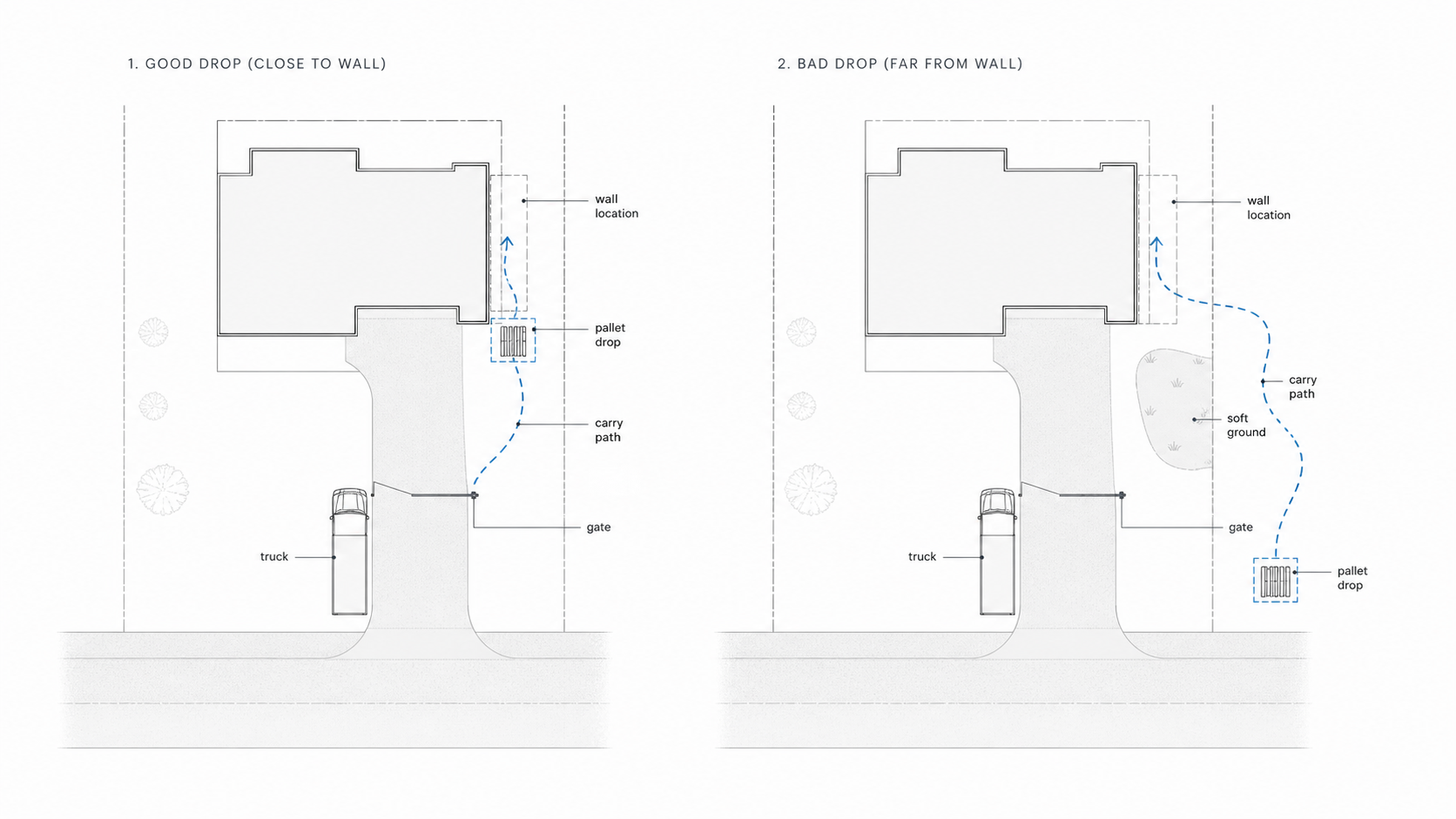
Illustration by ArchitectureCourses.org. Concrete block cost can rise when pallets cannot be dropped close to the wall and every block has to be carried farther by hand.
Ask for the out-the-door price before you compare suppliers.
A store can have a lower shelf price and still cost more after delivery, pallet deposits, fuel charges, taxes, and returns. A masonry yard can look more expensive per block but become cheaper once the order is loaded and delivered in one clean drop.
| Ask For | Why It Matters | Exact Question to Use |
|---|---|---|
| Total delivered price | It exposes delivery, taxes, fuel charges, and deposits. | What is the total price delivered to my site? |
| Pallet count | You need to know how many pallets the order creates. | How many blocks are on each pallet for this exact product? |
| Pallet weight | Weight controls truck choice, drop location, and handling. | What does one loaded pallet weigh? |
| Drop location | Curbside delivery can still leave you with days of hand-carrying. | Will the driver place pallets near the work area or only at the curb? |
| Return policy | Extra blocks are useful only if clean returns are allowed. | Will you take back clean unused blocks, and is there a restocking fee? |
| Bundle pricing | Mortar, rebar, grout, and caps may ride on the same truck. | Can mortar, grout, rebar, and caps be included in the same delivery? |
Do not be shy about asking. Masonry suppliers answer these questions all day. A vague quote helps nobody.
Big-Box Store or Masonry Yard?
The best place to buy concrete blocks depends on how many you need and how hard the delivery will be.
For ten blocks, use the closest store with clean stock. For 700 blocks, call a masonry yard. The price per block may be lower, but the better savings often come from pallet handling, delivery planning, fewer damaged units, and a cleaner order.
| Source | Where It Works | Where It Falls Short |
|---|---|---|
| Home Depot or Lowe’s | Small repairs, test layouts, shed piers, short garden walls, and quick pickup. | Price and availability vary by store. Heavy orders can become awkward. |
| Local Masonry Yard | Pallet orders, full walls, foundation work, repeat buying, and delivery coordination. | May require minimum orders, scheduled delivery, or contractor-style pickup. |
| Contractor Account | Larger walls, house shells, commercial work, and tight schedules. | You may not see the discount directly if it is folded into the contractor’s bid. |
| Used or Leftover Blocks | Low-risk landscape work, temporary site use, garden beds, or noncritical projects. | Mixed sizes, chips, unknown strength, old mortar, and no clean return path. |
Used blocks can be a bargain for the right job. They are usually a bad idea for structural work unless the supplier can verify what they are and the condition is clean.
How to Save Money Without Weakening the Wall
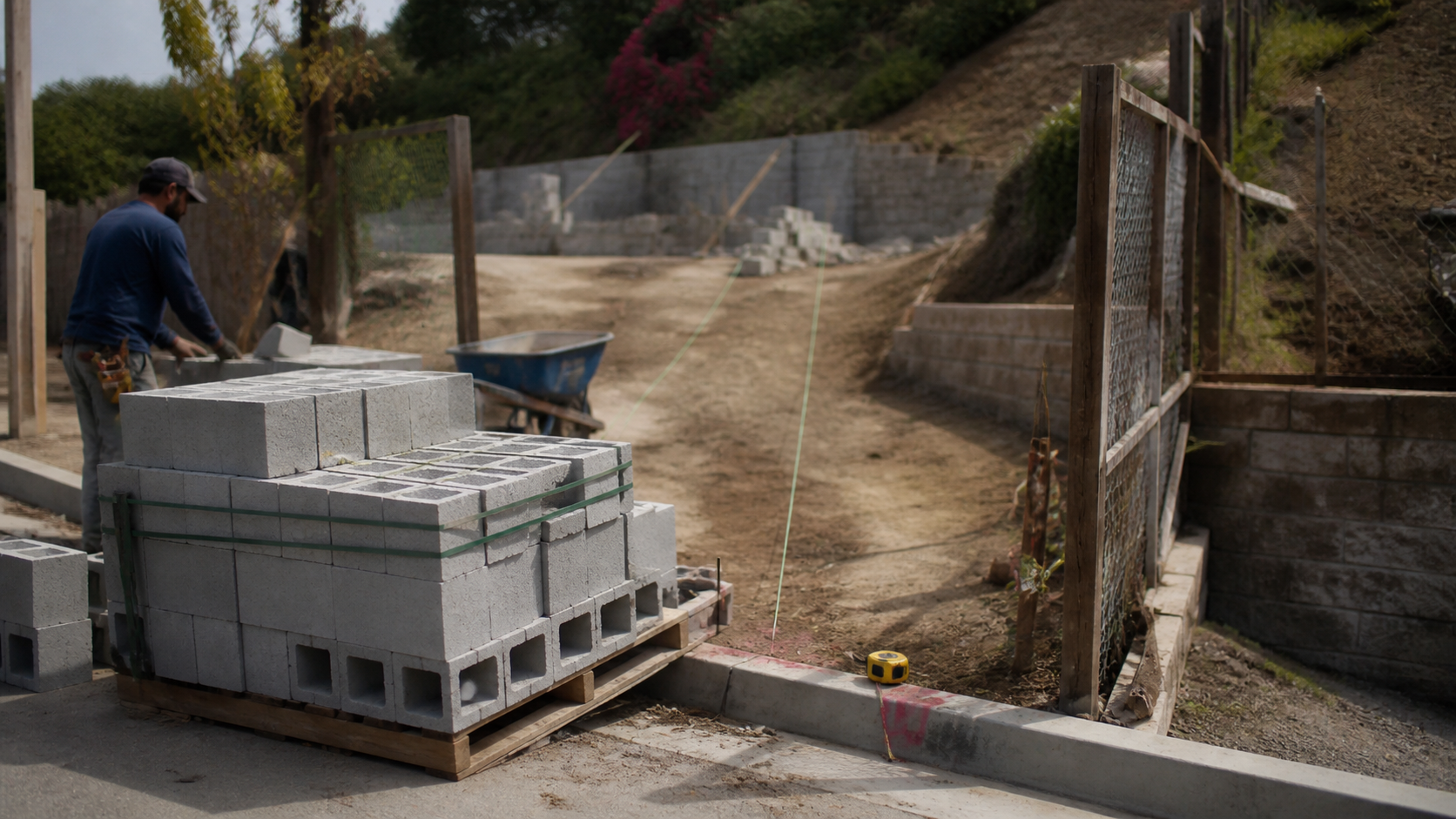
Image by ArchitectureCourses.org. The out-the-door price should include where the pallet can actually be dropped, not just the block price at the supplier.
You can save money on concrete blocks. Just do not save it in the wrong place.
The safe savings come from better sourcing, better delivery planning, and less waste. The bad savings come from skipping reinforcement, buying the wrong block, ignoring drainage, or pretending a structural wall is a weekend garden project.
| Buying Move | Why It Saves Money | What to Watch |
|---|---|---|
| Call three suppliers the same morning | Concrete prices move locally. Same-day quotes are easier to compare. | Use the same block count, same delivery address, and same supporting materials. |
| Ask for pallet pricing | Some yards discount once you buy full pallets. | Do not compare a loose-block price against a pallet price without delivery included. |
| Bundle mortar, grout, rebar, and caps | One truck can be cheaper than several small trips. | Make sure the supplier gives quantities separately so you can check them. |
| Ask about returned or overstock pallets | Clean returned blocks may sell below list price. | Check size, color, chipped corners, and whether the lot is mixed. |
| Use chipped blocks only where cuts are planned | Breakage blocks can be useful if the face will not show. | Do not use damaged units in visible or structural locations without approval. |
| Plan the drop before the truck comes | Good placement reduces hand-carrying and wasted labor. | Measure gate width, slope, soil firmness, overhead wires, and turning space. |
| Return clean leftovers quickly | Some suppliers accept clean unused blocks or refund pallet deposits. | Ask before buying. Policies vary. |
The biggest discount is often not a coupon. It is avoiding the second delivery.
Where Not to Cheap Out
Cheap blocks can still make an expensive wall.
| Do Not Cut Cost Here | What Can Go Wrong | Better Move |
|---|---|---|
| Footing prep | The wall settles, tips, cracks, or becomes hard to keep level. | Start with the footing, soil, and base condition. |
| Reinforcement | The wall may not resist load, wind, soil pressure, or movement. | Follow the plan, local code, or engineer’s detail. |
| Drainage | Retaining and foundation walls can fail from water pressure. | Plan drain pipe, gravel, waterproofing, and backfill together. |
| Load-bearing block quality | Decorative or unknown blocks may not meet the required use. | Ask for load-bearing CMU that meets the needed standard. |
| Delivery access | You pay for delivery and still move blocks by hand for days. | Confirm the drop point before ordering. |
If the wall ties into a footing, start with foundation footings and concrete foundations before ordering pallets. The footing and reinforcement schedule control more than the shelf price.
When Concrete Blocks Are the Wrong Choice
Concrete block is not the answer just because the unit price looks low.
Skip block when the job is too small to justify delivery, when access is too tight for pallets, when the wall is mostly decorative, or when water and soil pressure are the real problem. A poorly drained block retaining wall is not a bargain. It is a repair bill waiting for rain.
| Project Situation | Why Block May Be Wrong | What to Consider Instead |
|---|---|---|
| Small shed base or equipment pad | The block wall may cost more in layout, labor, and delivery than it saves. | A concrete pad, pier blocks, gravel base, or poured footing. |
| Decorative low garden edge | CMU can look heavy and unfinished unless capped or faced. | Pavers, landscape block, stone, brick, or a framed planter. |
| Wet retaining wall site | Drainage, footing, and soil pressure matter more than block price. | Engineered retaining system, proper drainage, or professional wall design. |
| Hard-to-reach backyard | Hand-carrying hundreds of blocks can destroy the budget. | Material that can be staged in smaller loads or built with less handling. |
| Finished visible wall | Plain CMU may need paint, parge coat, veneer, cap, or careful detailing. | Split-face block, brick, stone veneer, stucco, or exposed concrete done intentionally. |
For small slab or pad projects, compare the block approach with concrete pads. Sometimes a pad, pier, or poured footing is cleaner than a block wall.
How Many Blocks Come on a Pallet?
Pallet counts vary by manufacturer, block size, density, and supplier. Many common 8 × 8 × 16 block pallets are around 70 to 90 units. Some common 8 × 8 × 16 pallets are listed at 72 blocks.
Do not assume.
- Ask how many blocks are on the pallet.
- Ask what the loaded pallet weighs.
- Ask whether the pallet deposit is included.
- Ask whether the delivery is curbside or placed near the work area.
The weight is the part people underestimate. A standard 8-inch hollow block often weighs around 30 to 40 pounds. A pallet can weigh well over a ton. A half-ton pickup can hit payload limits before the bed looks full.
Two “cheap” pickup trips can cost more than one clean delivery.
Concrete Block Weight and Handling
Weight changes labor. It also changes delivery, crew fatigue, and how realistic a DIY wall is.
| Block Type | Typical Handling Reality | What It Means for Buying |
|---|---|---|
| 6-Inch Hollow Block | Lighter than common 8-inch CMU. | Easier to handle, but not always suitable for the same wall. |
| 8-Inch Hollow Block | Often around 30–40 pounds each. | Manageable one at a time, brutal by the hundred. |
| 8-Inch Solid Block | Much heavier than hollow block. | Useful in the right location, slow for hand placement. |
| Large Precast Block | Machine-handling territory. | Delivery and equipment matter more than the unit price. |
Lightweight CMU can be worth pricing if the job is labor-sensitive, the wall is tall, or the crew is small. It may cost more per block but reduce fatigue and speed up handling. That does not make it the right block everywhere. Ask what density, strength, and use the supplier is quoting.
Standard Block, Split-Face Block, or Large Precast Block?
Concrete block prices get confusing because people compare different products as if they are the same thing.
| Block Choice | Use It When | Skip It When |
|---|---|---|
| Standard Hollow CMU | You need a basic wall, foundation unit, utility wall, or block shell. | The wall face will be highly visible and appearance matters. |
| Solid Block | You need weight, bearing, cap conditions, or durable site use. | You are hand-carrying a large quantity by yourself. |
| Split-Face Block | The wall face is exposed and texture matters. | The wall will be buried, hidden, painted, parged, or covered. |
| Lightweight CMU | Handling fatigue, upper courses, or labor speed matters. | The supplier cannot verify strength, density, or intended use. |
| Dry-Stack Block | You are using a system designed for it and understand the reinforcement. | You are trying to avoid masonry skill on a structural wall. |
| Large Precast Block | You need barriers, bins, industrial walls, or heavy retaining work. | You cannot provide equipment access or proper base prep. |
For design-focused work, plain gray block can look good when the proportions, bond, joints, caps, openings, and shadows are handled carefully. That is a design question, not just a cost question. For visual use, see concrete in architecture.
Large Concrete Blocks Are a Different Purchase
Large precast blocks are not just bigger versions of hand-laid CMU. They are closer to site equipment than ordinary masonry.
They may be used for retaining walls, loading areas, storage bins, temporary barriers, and industrial yards. Price per block matters, but lifting and access usually matter more.
| Large Block Type | Common Use | Buying Issue |
|---|---|---|
| 2 × 2 × 6 Foot Block | Retaining walls, storage bins, barriers. | Needs machine handling and a prepared drop area. |
| Half Block | Ends, returns, tight layouts, curves. | May cost more per cubic foot than full blocks. |
| Cap or Corner Block | Finished tops, ends, and wall returns. | Often forgotten until the wall is already priced. |
| Interlocking Precast Block | Stacked retaining or storage walls. | Lug shape and system compatibility matter. |
For retaining work, do not shop only by block price. Drainage, base prep, wall height, surcharge loads, and local engineering requirements can control the final cost.
Quick Wall Math Example
Say you want a 20-foot-long concrete block wall that is 4 feet high.
- Wall area: 20 × 4 = 80 square feet.
- Base block count: 80 × 1.125 = 90 blocks.
- Add 5% waste: about 95 blocks.
- Add 10% waste for a first-time job or awkward layout: about 99 blocks.
If the blocks cost $2 each, the block-only cost is about $190 to $200.
That number is not the wall budget. You still need mortar, possible rebar, possible grout, caps if needed, tools, delivery, and any base or footing work. If the wall is retaining soil, drainage and base prep may cost more than the blocks.
What 500 Blocks Can Really Cost
Here is where the shelf price starts losing.
| Line Item | Low Planning Number | Higher Planning Number | Why It Moves |
|---|---|---|---|
| 500 standard blocks | $625 | $1,500 | $1.25 to $3.00 per block depending on source and location. |
| Mortar | Varies by mix and joint size | Varies by waste and crew speed | Supplier quantities should be quoted with the block order. |
| Rebar and grout | Low if only occasional cells are filled | Higher for structural or retaining work | The wall design controls this, not the block count alone. |
| Delivery and deposits | One clean local drop | Multiple trips, lift-gate, tight access, or long distance | Access and distance can erase a cheap unit price. |
| Waste | 5% | 10% or more | Cuts, corners, breakage, and first-time layout mistakes. |
A 500-block order can be a simple pallet purchase or a messy logistics problem. The block count is only the start.
Before You Order
Do the wall math before you call suppliers. A vague order gets a vague quote.
- Measure wall length and height.
- Subtract major openings.
- Multiply wall area by 1.125 for standard 8 × 8 × 16 blocks.
- Add 5% to 10% for waste.
- Ask whether corner, bond beam, cap, or half blocks are needed.
- Ask for mortar, grout, and reinforcement quantities separately.
- Confirm pallet count, pallet weight, deposit, delivery fee, return policy, and drop location.
A good quote should show block count, price per block, pallet count, delivery charge, deposits, taxes, supporting materials, and return policy. If the quote only says “blocks,” ask again.
The Supplier Call Script
This is the shortest way to get a usable quote.
I need a delivered price for standard 8 × 8 × 16 hollow concrete blocks for a wall. Please quote the block count, price per block, pallet count, pallet weight, delivery fee, pallet deposit, return policy, and whether mortar, grout, rebar, and caps can be included in the same delivery.
Then ask one more question:
Is this load-bearing CMU, and does it meet the standard required for structural masonry use?
That question matters because decorative block, landscape block, and load-bearing CMU are not interchangeable. If the wall carries load, retains soil, supports a building, or falls under permit review, the product needs to match the job.
Concrete Block Cost Mistakes
The common mistake is buying the block first and solving the wall later.
That works for a raised planter or temporary site wall. It does not work for a foundation wall, retaining wall, or anything that carries load.
| Mistake | What Happens | Better Move |
|---|---|---|
| Pricing single blocks only | The estimate ignores delivery, mortar, grout, rebar, caps, and waste. | Price the complete wall package. |
| Buying too few blocks | The second trip costs time and may bring a different batch. | Add waste and confirm returns before ordering. |
| Buying only by lowest price | You may get chipped, mixed, weak, or unsuitable units. | Compare product type, condition, strength, and delivery. |
| Ignoring site access | The truck cannot place the pallets where the work is happening. | Measure the driveway, gate, slope, soil, overhead wires, and turning area. |
| Forgetting water | Retaining and foundation walls fail from water pressure and poor drainage. | Plan footing, drainage, waterproofing, and backfill with the wall. |
When Concrete Blocks Are Worth It
Concrete blocks make sense when you need fire resistance, durability, termite resistance, modular layout, reinforced cells, or a wall that can take abuse.
They make less sense when the wall is tiny, the access is terrible, the site is wet without drainage, or the project would be simpler with a poured curb, pier, slab, or framed wall.
Block is not automatically cheap. It is cheap when the job suits block.
FAQ
How much does one standard concrete block cost in 2026?
A standard 8 × 8 × 16 hollow concrete block often costs about $1.25–$3.00 each, depending on location, supplier, pallet quantity, stock level, and delivery method.
How many concrete blocks do I need per square foot?
Use about 1.125 standard 8 × 8 × 16 blocks per square foot of wall before waste. Add 5% to 10% for cuts, corners, breakage, and layout mistakes.
Is a concrete block the same as a cinder block?
People still say “cinder block,” but most common masonry units sold today are concrete masonry units made with cement and aggregates. For pricing and construction, use the supplier’s exact product name and specification.
Are concrete blocks cheaper at a masonry yard?
Often, yes, once you buy pallets. A big-box store can be fine for small repairs. A masonry yard usually makes more sense for a full wall because delivery, forklift handling, bulk pricing, and product advice matter.
Can I build a concrete block wall myself?
You can build small, low-risk walls yourself if you understand layout, mortar, level, plumb, footing support, and drainage. For foundation walls, retaining walls, tall walls, and permitted structural work, get qualified help.
Do concrete block walls need rebar?
It depends on the wall. Many structural walls, foundation walls, retaining walls, and walls in high-wind or seismic areas need reinforcement. Check the plans, local code, or an engineer’s detail before ordering materials.
How heavy is a concrete block?
Many standard 8-inch hollow blocks weigh roughly 30 to 40 pounds, depending on density and manufacturer. Solid blocks and large precast blocks are much heavier.
Are sustainable concrete block alternatives worth considering?
Sometimes. They make more sense when the project can use a verified product with proper strength data, local availability, and code acceptance. Start with sustainable concrete alternatives before assuming every lower-carbon option is ready for the same job.
Resources
- Concrete Masonry & Hardscapes Association: CMU Shapes, Sizes, and Properties
- Concrete Masonry & Hardscapes Association: CMU Weights and Section Properties
- ASTM C90: Load-Bearing Concrete Masonry Units
- Homewyse: Cost to Install a Concrete Block Wall
- Homewyse: Cost to Install a CMU Block Wall