
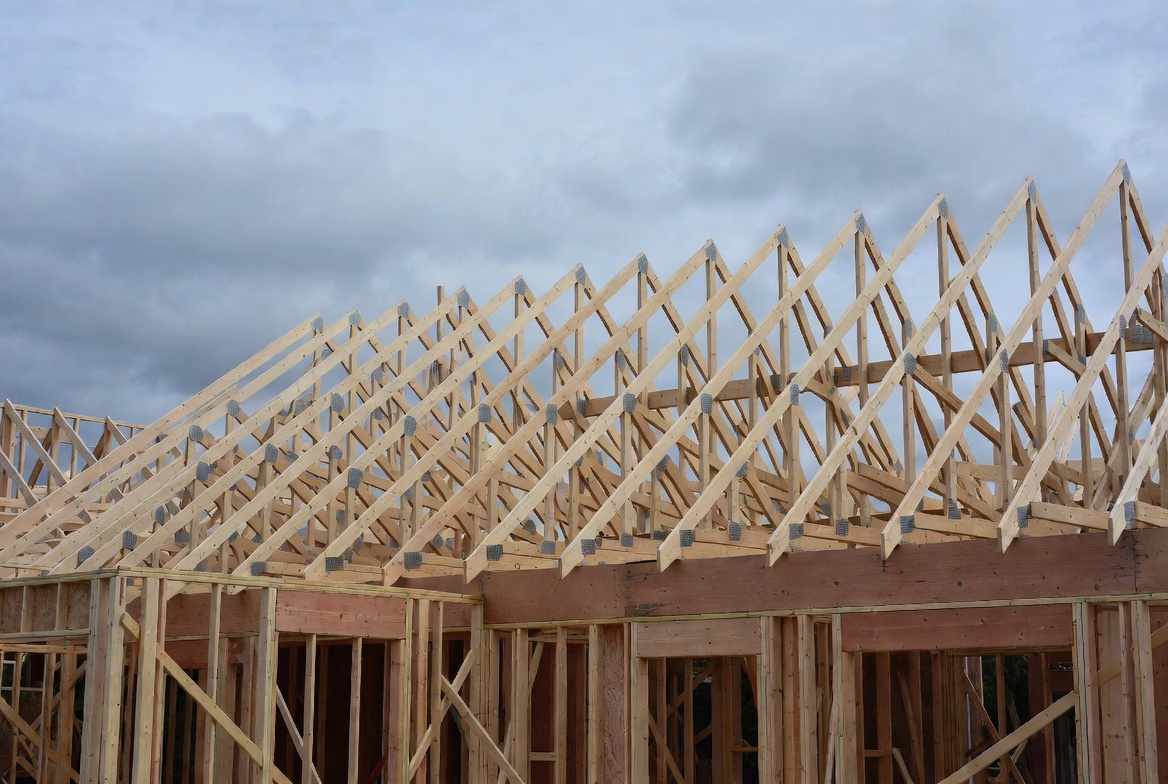
The Standard Roof Truss
A Fink truss is one of the standard roof truss shapes used in house framing. You can spot it by the W-shaped web pattern inside the truss.
It became common for a simple reason: it carries typical residential roof loads efficiently without making the truss unnecessarily complicated. That is why it keeps showing up on houses, garages, barns, and other pitched-roof buildings. It is not right for every span or roof condition, but it is one of the default truss layouts in ordinary wood roof framing.
If you want the broader truss family first, see Types of Trusses. If you are comparing roof systems more generally, use Roof Trusses. If you already know you are staying with Fink trusses, this page is the right place to start.
What a Fink Truss Is

A Fink truss is a pitched roof truss with top chords, a bottom chord, and web members arranged to break the load into smaller triangular paths. In house framing, that usually means a practical, prefabricated roof truss that can cover typical residential spans without interior bearing lines running everywhere.
The main reason builders use it is simple: it gives good strength for the amount of material used. That keeps fabrication practical and makes the truss a good fit for standard roof work.
| Part | What it does | Why it matters |
|---|---|---|
| Top chord | Forms the roof slope and carries compression | Its pitch and depth affect load path and roof shape |
| Bottom chord | Ties the truss together and resists tension | Helps stop the roof from spreading outward |
| Web members | Move loads between chords | Create the W-shaped internal geometry |
| Heel joint | Connects the truss to the bearing wall line | Affects bearing, eave detail, and insulation space |
| Apex joint | Connects the upper ends of the truss | Critical for geometry and load transfer at the peak |
Parts of a Fink Truss

Illustration by ArchitectureCourses.org. Labeled parts of a timber Fink truss, including the top chord, bottom chord, web member, apex joint, gusset plate, and heel joint.
A Fink truss looks simple until you need to read one quickly on site. Then the parts matter.
- Top chords form the sloped roof line.
- Bottom chord forms the lower tie member.
- Web members create the internal W pattern.
- Apex is the high point where the top chords meet.
- Heel joints sit at the bearing ends near the walls.
- Gusset plates or connection plates tie the members together in prefabricated work.
If you want a dedicated breakdown of each piece, use Fink Truss Parts.
Why Builders Use Fink Trusses So Often
They hit a useful middle ground. A Fink truss is more structurally efficient than a very simple truss, but it is still straightforward enough to fabricate, transport, and install on normal residential work.
- Good load distribution: the web layout moves roof loads through short, efficient paths.
- Material efficiency: the geometry gets more work out of a relatively lean layout.
- Fast installation: prefabricated trusses reduce site labor.
- Common roof fit: they work especially well in ordinary pitched-roof houses.
That does not make them universal. If you need open attic space, special vaulted geometry, or very long clear spans, another truss type may fit better.
Where Fink Trusses Work Best
| Use case | Why Fink works | Where it starts to struggle |
|---|---|---|
| Standard house roofs | Efficient, familiar, cost-effective | Limited attic openness because of internal webs |
| Garages and small outbuildings | Clean span with simple roof geometry | May need adjustment for storage or taller interior use |
| Barns and agricultural roofs | Good value for repeated roof bays | Material choice matters more in damp or corrosive settings |
| Light commercial roofs | Useful where span and economy matter | Longer spans may push the design toward double Fink or steel systems |
Fink trusses are most at home in residential and light-building roof framing. When spans get larger or the interior needs change, the roof system often changes with them.
Typical Spans and When Fink Stops Making Sense
This is one of the first questions people ask, and it is usually where the wrong truss gets picked. A standard Fink works well in the ordinary residential range, but once the span gets bigger or the room below needs more openness, the decision changes.
| Condition | Fink truss fit | What to look at next |
|---|---|---|
| Typical house roof span | Usually a strong fit | Keep the Fink if attic openness is not the goal |
| Longer roof span | May need more web capacity | Double Fink Trusses |
| Need for attic room or storage access | Standard Fink starts working against you | Attic truss or another modified truss layout |
| Want a vaulted or more open ceiling line | Standard Fink is usually the wrong choice | Another truss type or a different roof system |
| Industrial or heavier long-span work | Timber Fink may not be enough | Steel truss or another long-span solution |
The point is not that Fink trusses are limited. The point is that they are tuned for a specific range of roof problems. Once the project asks for extra room inside the truss depth or longer clear spans, another layout often becomes the cleaner answer.
Common Fink Truss Variations
Simple Fink Truss
This is the standard form most people mean when they say Fink truss. It is a good fit for ordinary pitched roofs where the goal is practical roof support, not interior openness.
Double Fink Trusses
A double Fink uses more internal webbing to handle longer spans and distribute load more finely. It is a stronger option when the simple version starts running out of room.
Attic and Storage Variants
Some roofs use modified trusses to carve out usable attic space, but that changes the geometry and usually raises cost and design complexity. A standard Fink is not the right truss if the main goal is open room inside the truss zone.
Raised-Heel Versions
A raised heel changes the eave end of the truss so insulation and ventilation work better at the perimeter. That is often a good move in colder climates or energy-focused designs.
Timber or Steel?
Fink trusses can be timber or steel. The geometry is the key idea. The material changes how far the truss can span, how it is connected, how it behaves in moisture, and how it fits the budget.
| Material | Best fit | Main advantage | Main trade-off |
|---|---|---|---|
| Timber | Houses, garages, small barns | Common, workable, cost-effective | More vulnerable to moisture, pests, and movement |
| Steel | Industrial and longer-span work | Higher capacity and durability | Higher cost and more specialized detailing |
If you are comparing materials more directly, see Timber Trusses Explained and Steel Truss Design.
What to Check Before Ordering or Setting Trusses
This is the field side of the decision. A Fink truss can be the right truss and still create problems if the roof package, bearing layout, or service routing was not thought through early enough.
- Confirm the span and pitch before the trusses are ordered. A small change in roof shape can change the whole truss package.
- Check the bearing points. The walls below need to line up with the truss design, not the other way around.
- Decide early whether the attic needs access, storage, or room. A standard Fink is usually not forgiving here.
- Review heel height and insulation needs, especially in colder climates where eave insulation thickness matters.
- Coordinate ducts, vents, and other services before installation. Truss webs are not random pieces you can cut around later.
- Have the bracing plan ready. Trusses are fast to set, but they are not stable if the temporary and permanent bracing sequence is ignored.
- Store trusses properly before installation. Timber trusses left wet, twisted, or poorly supported can show up on the roof already compromised.
Most jobsite frustration around trusses comes from late decisions. The roof truss package should be coordinated before the framing crew is standing there waiting for answers.
Design Points That Matter More Than People Think

A Fink truss is easy to misuse when the conversation stays too general. These are the details that usually decide whether the roof system works cleanly or becomes a problem later.
- Span: longer spans change the whole decision, not just the member sizes.
- Pitch: roof pitch affects geometry, load behavior, and attic usability.
- Loads: snow, wind, roof finish, solar panels, and ceiling loads all matter.
- Bearing points: the truss still needs clear support at the correct locations.
- Bracing: the truss does not work alone once it is standing. Permanent bracing still matters.
- Mechanical routes: ducts and services do not get to ignore the web layout.
If bracing is the issue, go next to Truss Bracing and Roof Support Systems, Types of Truss Bracing, and Truss Lateral Bracing.
Where Problems Usually Start
Most Fink-truss failures do not come from the shape itself. They come from bad assumptions around the shape.
- Using a standard Fink where the owner wanted attic room or vaulted openness.
- Changing roofing weight without checking the truss design first.
- Cutting or drilling truss members casually for mechanical runs.
- Ignoring permanent bracing requirements.
- Storing timber trusses badly before installation and letting moisture get into them.
- Using the wrong truss type for the span and then trying to solve it in the field.
One of the most common mistakes is treating a Fink truss like a flexible framing system that can be altered casually after delivery. It is not. Once the truss is designed, small field changes can create large structural problems.
Bridge and Non-Residential Uses

The Fink pattern did not stay inside house roofs. Versions of it also appear in steel and bridge work because the geometry is efficient.
That said, do not confuse a residential Fink roof truss with a bridge truss just because the diagram looks familiar. Material, connection behavior, span, loading, and support conditions change the whole design problem.
If you need the broader comparison of truss families, go to Truss Design 101 and Roof Truss Details.
Fink Truss vs Other Common Truss Types
| Truss type | Best when | Main limitation |
|---|---|---|
| Fink truss | You need an efficient standard pitched-roof truss | Internal webs limit open attic use |
| King Post Truss | The span is smaller and the roof system is simpler | Less efficient for larger routine roof spans |
| Double Fink Trusses | You need more span than the simple Fink comfortably handles | More material and more complexity |
| Scissor truss | You want interior ceiling height and slope variation | Usually costs more and changes the whole ceiling strategy |
For a broader type comparison, use Types of Trusses.
FAQ
What is a Fink truss used for?
Mostly pitched roof framing in houses, garages, barns, and light commercial buildings where cost and structural efficiency both matter.
What makes a Fink truss different from other roof trusses?
The main difference is the W-shaped web layout, which distributes load efficiently through a relatively simple truss form.
Can a Fink truss create usable attic space?
Not well in its standard form. The web layout usually blocks open attic use, which is why attic trusses or other truss types are used when interior space matters.
Are Fink trusses timber only?
No. Timber is common in houses, but steel versions are also used, especially where span, durability, or environment push the design that way.
Can you modify a Fink truss after installation?
Not casually. Cutting or drilling members without proper engineering can damage the load path and weaken the truss.
When should I use a double Fink instead of a simple Fink?
When span, loading, or structural demand starts pushing past what the simpler layout handles comfortably.
Do Fink trusses still need bracing?
Yes. The truss shape does not remove the need for correct temporary and permanent bracing.