
Construction Liens Explained Like You’re on Site at 6AM
The Street-Level Guide They Should’ve Given You Before You Picked Up a Hammer
I’ve helped homeowners, builders, renovators, and a few poor souls who thought a handshake was a contract. Here are the things nobody tells you, the things you only learn when the concrete cracks, the bill doubles, or a contractor disappears with your deposit.
How to Protect Your Pay, Your Project, and Your Sanity
If you work in construction, plan to build a home, or you’re an architecture student thinking about your future, you’ve probably heard the term construction lien tossed around. But nobody sits you down and tells you the truth: a lien can save your financial life… or wreck it. I’ve been on both sides of this thing—as a designer, a project manager, and a guy who has personally had to fight to get paid—so this guide isn’t academic fluff. It’s the guide I wish someone handed me years ago.
If you're new to building, you might also like: Getting Started With Architecture & Building Careers.
Real-World Lessons: What Building a House Taught Me (the Hard Way)
What "Exactly" Is a Construction Lien?
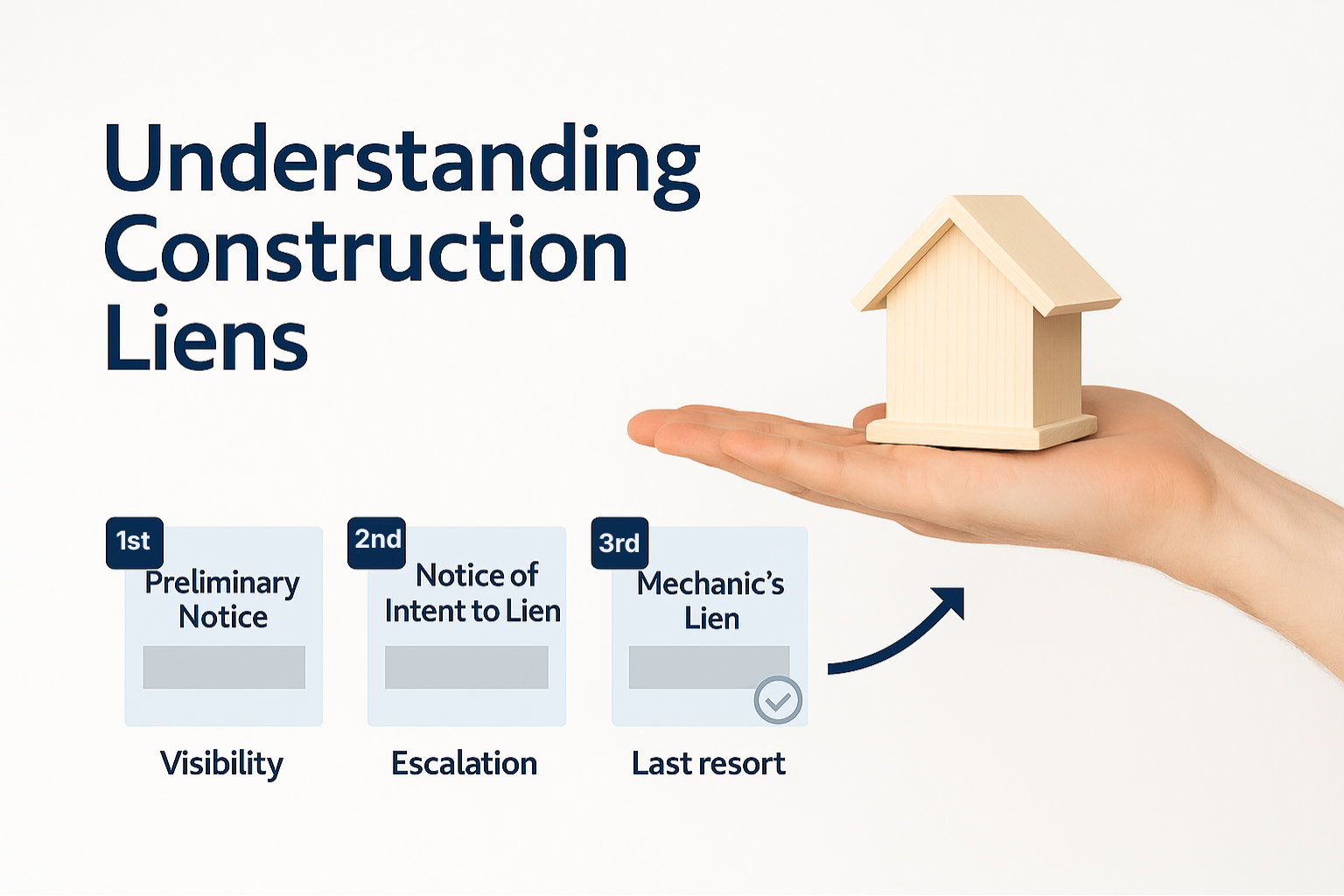
A construction lien (also called a "mechanic’s lien", "builder’s lien", or "contractor’s lien") is basically a legal “hold” placed on a property when someone who worked on that property hasn’t been paid. It’s one of the only protections trades, builders, and suppliers truly have. If you’ve ever been stiffed by a homeowner—or had a contractor run off with your deposit—you know exactly why liens exist.
A lien does two things:
- Stops the owner from selling or refinancing until they pay the outstanding amount.
- Gives you the right to force a sale of the property (in extreme cases) to get paid.
But here’s the important part: A lien is not automatic. You have to file it, and you must follow the legal rules perfectly. Miss a deadline by one day and your rights can vanish—no matter how right you are.
For basics on how building projects are structured, see How Roles Work on a Construction Project.
How Construction Liens Work (In Real-World Terms)
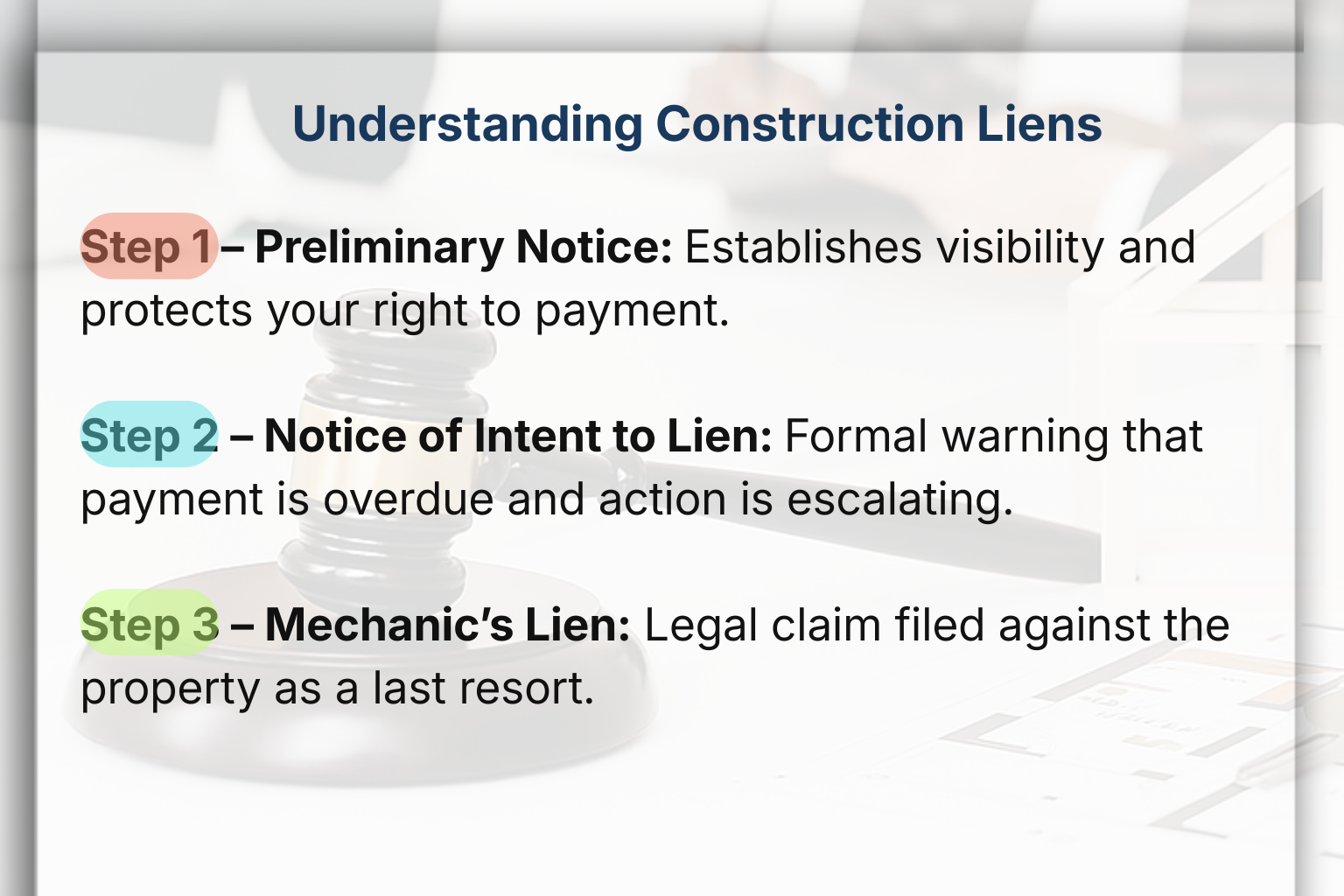
In theory, it’s simple: You did work → you didn’t get paid → you claim a lien → the lien gets recorded on the property title → owner can’t sell or get financing until it’s cleared. In practice? It’s paperwork, deadlines, mistakes, lawyers, and stress.
Who can file a lien?
Depends on the country:
- USA: Contractors, subcontractors, sub-subs, architects, engineers, material suppliers, equipment rental companies.
- Canada: Similar list, but some provinces (BC & Ontario under their Construction Act) have stricter notice timelines.
- UK: No traditional mechanic's lien—uses adjudication, statutory demands & “charging orders” instead.
- Australia: Security of Payment Act lets contractors pause work or claim rapid adjudication—not exactly a lien, but same intent.
- New Zealand: Has a “memorial” process under the Construction Contracts Act—again, different mechanism, same purpose: secure payment.
Wherever you’re building, the core idea remains: A lien gives leverage when someone won't pay.
If you’re in the early stages of planning a build, my guide on construction mortgages & how to finance a build might help you get ahead of this.
RECOMMENDED BOOK: “The Complete Guide to Contracting Your Home” by Larry Haun — hands-down the most “real world” explanation of how money flows on projects.
The One Big Thing Homeowners Don’t Realize (And Contractors Don’t Always Say)
Here’s the hard truth: If a contractor doesn't pay their subcontractor or supplier, the subcontractor can file a lien on YOUR house—even if you already paid the GC. Yep. You can pay your contractor in full, they can vanish… and you’re left with a lien that freezes your property until YOU pay again. This is why I tell every homeowner: Never pay everything upfront. Never pay cash. And never skip lien waivers.
The 3 Documents Homeowners Must Get
- Preliminary Notice: A document from subs/suppliers saying “we’re working on your house and we expect payment.”
- Progress Lien Waivers: Every time you pay the GC, every subcontractor should sign a waiver confirming they’ve been paid.
- Final & Unconditional Lien Waiver: The golden ticket. Without this, don’t release the last cheque. Ever.
If you skip these, you’re basically giving everyone on site a blank cheque with your house as collateral.
For more on choosing the right contractor before you ever reach the lien stage, see How to Choose the Right Foundation or General Contractor.
The Contractor’s Survival Guide to Liens: Rights, Risks & Real Stories From the Field
- Verbal promises mean NOTHING. Your contractor can swear on his mother’s grave that he’ll “take care of it.” If it’s not in writing, it does not exist. I’ve literally had clients owe $18K because they trusted a guy who said “don’t worry about receipts.” Always get it on paper.
- Don’t pay more than 10% upfront — no matter how nice they seem. If a contractor needs 50% on day one “to buy materials,” walk away. Real pros have supplier accounts. Scammers rely on your panic.
- Your inspector is not your enemy. Too many homeowners think inspectors are out to make life hard. Wrong. A good inspector is your free insurance policy. They’ll catch the things you don’t see — the missing joist hangers, the under-nailed subfloor, the mystery plumbing that dumps into the crawlspace.
- If the quote is much lower than everyone else, there’s a reason — and it’s not generosity. Every horror story I’ve ever been called to fix started with, “Well, he was the cheapest.” Cheap = corners cut, no permits, no insurance, and you holding the bag when something fails.
- Never assume your land is build-ready. I’ve seen people buy rural land for “a deal,” only to discover it needed $40K of blasting, soil remediation, or fill. Before you even think about a construction loan, pay for a proper geotechnical report. It’ll save your sanity.
- Your contractor isn’t your project manager — you are. Even if you hire an amazing GC, you still need to check in, ask questions, track change orders, and document everything. The number of times miscommunication created a \$5,000 mistake… I’ve stopped counting.
- Liens appear FAST. I’ve seen homeowners get slapped with a lien because the GC didn’t pay a drywall sub $3,500 — even though the homeowner already paid the GC in full. Lien laws exist to protect trades, but they also mean you can pay twice if you’re not careful. (See: practical contract tips that prevent this mess.)
- Building a house isn’t just construction — it’s a psychological marathon. At some point, you will cry in your car. At some point, you will question your intelligence, your budget, your marriage, your contractor’s life choices, and whether you should’ve just bought a condo. That’s normal. If you push through, the day you turn the key in a house YOU built… unreal.
FIELD PICK: If I could force every homeowner to read one book before signing any construction contract, it would be: The Complete Guide to Contracting Your Own Home – Larry Haun
The Builder’s Side: Why Liens Keep You From Going Broke
If you’re a contractor, you already know: You can do $40k of work, pass inspections, and still end up chasing a homeowner for months. I’ve been there—sending polite emails that turn into firm emails that turn into “I’m filing a lien Friday unless I see the e-transfer.” Most people pay the day they see the lien paperwork. Why? Because a lien threatens the one thing everyone protects: their title.
When should a contractor file?
- Customer stops replying after receiving an invoice
- Multiple promises to pay with no follow-through
- Signs of financial trouble: for sale sign on property, mortgage issues, work slowing down
Big tip from experience: Don’t wait until the last week. File your lien early. Most places give you **30 to 90 days** after last supplying labor or materials.
To understand how builder–client relationships break down, see what different construction roles actually do.
FIELD PICK: “Be a Successful Building Contractor” by R. Dodge Woodson — practical, blunt, and full of real-life scenarios.
Country-by-Country: How Construction Liens Differ (US, Canada, UK, Australia, NZ)
🇺🇸 United States — The Most Aggressive Lien System in the World
In the U.S., liens are serious business. Every state has its own rules, but the general theme is:
- Send a preliminary notice (20–30 days, depending on state).
- File the lien 30–120 days after last work.
- If still unpaid, file a lien foreclosure lawsuit (usually within 90 days of filing the lien).
The US system is harsh but effective—contractors use it all the time because it works. Homeowners fear it because even a $1,000 unpaid invoice can freeze a $900,000 home sale.
🇨🇦 Canada — Fast, Strict, and Title-Trap Heavy
Canada's lien system is like the US but with more paperwork and tighter timelines. For example:
- Ontario: You must file a lien within 60 days of last work, and “perfect” it within 90 days.
- Holdback law: Owners must keep 10% of every invoice until the job is done.
Canada’s system is actually fair to contractors—but you need to be organized or you’ll miss the window. I’ve seen great trades lose $20k–$40k because they filed on day 61 instead of day 60. Brutal.
If you're building in Canada, check out what Canadian architects actually earn — helpful for understanding how fees and cost structures work.
United Kingdom — No “Liens,” but Fast-Track Adjudication
The UK doesn’t have American-style liens, but it does have:
- Statutory Adjudication — a 28-day process to settle payment disputes.
- Payment Notices — required by law, similar to preliminary notices.
- Charging Orders — the closest equivalent to a lien; lets contractors secure debt against a property after a court judgment.
The UK system is faster but can be costly. Lawyers get involved quickly. Good for contractors; stressful for homeowners.
If you’re studying abroad, here’s a clean overview of UK architect pay & career paths.
Australia — The Security of Payment (SOPA) Route
Australia doesn’t rely on liens for payment. Instead, it uses **SOPA**, which is basically: Do the work → issue a payment claim → if unpaid, go to adjudication → get a binding determination fast. If the owner still doesn’t pay, you can suspend work or get a court judgment.
It’s clean. It’s fast. And honestly? I wish the U.S. borrowed this system.
RECOMMENDED BOOK: “How Your House Works” by Charlie Wing — great for anyone dealing with inspections, scopes of work, or build quality issues.
For Homeowners: How to Protect Yourself From Liens (Real Steps I Make My Clients Follow)
Homeowners don’t realize how fast a “simple kitchen reno” can turn into a legal mess. I’ve seen families lose refinancing deals because a drywall subcontractor dropped a $4,800 lien after the GC ghosted them. The family had already paid the GC. But the law didn’t care. They paid twice. Here’s how to make sure that’s never you.
1. Never hire the cheapest GC
Cheap work is expensive later. If a GC is lowballing, they’re either:
- Using unlicensed subs
- Skipping permits (future liens nightmare)
- Counting on “change orders” to make money later
2. Demand a proper contract—not a text message
A contract should list:
- Scope of work
- Payment schedule tied to milestones
- Who is responsible for permits
- Who is hiring each subcontractor
- What happens if work stops or someone doesn’t get paid
Quick tip: if a contractor gives you attitude about contracts, that’s the universe telling you to run.
If you're managing parts of your own build, this intro helps a lot: How to be your own general contractor without losing your mind.
For Contractors: How to Protect Yourself Without Burning Every Bridge
Most contractors only file a lien when they’re already bleeding. But the smart ones protect themselves from day one. Here are the rules I learned the hard way—after losing money, time, and a few too many nights of sleep.
1. Send prelim notices 100% of the time
I don’t care how friendly the client is or how small the job is. If you're in a lien-friendly country (US/Canada), sending a preliminary notice is NOT rude. It’s normal. It tells everyone on the project: “Hey, I’m here, I’m doing work, don’t forget me when you’re cutting cheques.”
2. Never keep working if you're not being paid
I’ve seen contractors keep working because they “didn’t want to look difficult.” Then they’re owed $30k and have 5 days left to file a lien. If payment is late:
✔ Stop work
✔ Send a notice
✔ Give a deadline
You’ll be surprised how fast payment shows up once you pause the job.
For Architecture Students: Why Liens Should Already Be on Your Radar
When you’re in architecture school, liens feel like some boring topic professors rush through. But here’s the “oh damn” moment I had when I got into the real world: Every drawing you stamp puts you on the hook for someone’s real property value. If the GC doesn’t get paid? A lien might drag you into the mess. If YOU don’t get paid for your design work? You can file a lien too.
And with the recent talk in the U.S. about “deprofessionalizing” architecture degrees and reducing available student loan caps, the whole path to licensure is getting more complicated—not less. Student debt + strict licensure + unpredictable clients = a lot of young designers feeling trapped.
Why students MUST understand liens early
- You’ll eventually sign contracts worth hundreds of thousands or millions.
- You’ll be responsible for stamped drawings even if the client stops paying.
- Liens are one of the only tools that protect your time and intellectual property.
More on the bigger education picture here: How licensing really works (and what schools don’t tell you).
MUST READ (for future architects): “The Owner-Builder Book” — still the best real-world crash course on managing a build and avoiding legal/financial traps.
How to File a Construction Lien (Step-by-Step)
Every country has different paperwork, but the steps are almost always:
Step 1 — Track your dates from day one
Every lien law revolves around one question: “When did you last provide labor or materials?” Write this date down. Tattoo it on your forearm if you need to. Miss your deadline and you’re done.
Step 2 — Send a preliminary notice (if required)
In the U.S. and Canada, this is usually due within the first 20–30 days of first working. It’s not a bill. It’s a heads-up.
Step 3 — File the lien with the correct office
- US: County recorder or clerk
- Canada: Provincial land titles office
- UK: No lien—use adjudication or court procedures
- Australia/NZ: Use the official adjudication or payment-claim process
Step 4 — Serve the owner
This is where most people screw up. Serving means legally delivering the documents—not texting them, not emailing them. If you don’t prove service, your lien can be tossed.
Step 5 — Negotiate or enforce
If the owner wants to sell or refinance, they’ll usually pay fast. If not, you move to enforcement (lawsuit or adjudication). And yes—sometimes that means the property actually gets sold to pay you.
MUST READ (Legal basics): “How Your House Works” (great for understanding what you’re actually responsible for)
Common Lien Mistakes That Cost People Thousands
Here’s the painful part: Most lien problems come from simple, avoidable screwups.
- Missing the deadline by one day (happens constantly)
- No proof of service → lien gets tossed in court
- Wrong legal property description
- No written contract (verbal agreements don’t help you)
- Filing the lien against the wrong owner (very common with landlords/tenants)
- Not “perfecting” the lien in time (US & Canada)
Liens don’t forgive mistakes. They don’t care if you’re right. They care if you followed the procedure perfectly.
If you're dealing with structural or foundation work (the most disputed trade), this guide is worth a read: Choosing the right structural repair contractor.
What Happens When a Lien Goes Wrong
I’ll be honest—if you stay in construction long enough, you will either file a lien or face one. Here are the three that stuck with me.
The $18,000 “Second Payment”
Homeowner pays GC → GC doesn’t pay electrician → electrician files lien → homeowner can’t refinance → homeowner is forced to pay AGAIN. He cried in my truck. His GC disappeared. He never got that money back.
The Nice-Guy Carpenter Who Waited Too Long
He finished a basement for $22k. Homeowner delayed payment for weeks. Carpenter didn’t want to be “pushy.” Filed lien on day 62. Deadline was day 60. Lien invalid. He ate the loss. He’s now driving Uber at night to keep up with bills.
The Owner Who Lied About Paying Subs
Owner told the GC “I paid your plumber.” Plumber hadn’t been paid. Plumber filed a lien. GC had to choose:
- Pay the plumber out of pocket, or
- Let his client’s house get liened and get sued
He paid. $14k gone. One fake email from a client wiped out months of profit.
This is why liens matter. They protect your right to get paid.
The Future: How AI, Digital Permitting & New Laws Will Change Liens
Here’s the thing: construction law is slow… but technology isn’t. By 2030, this is where liens are headed:
- Digital, automatic lien rights triggered by contract milestones
- AI auditing to detect payment manipulation early
- Blockchains for title tracking → no more “lost paperwork” excuses
- Unified lien deadlines (the US might eventually standardize rules)
- Stronger consumer protections to avoid double payment disasters
What’s wild is how fast this is evolving. AI already helps estimate projects, draft scopes, and flag risky payment clauses. Within a few years, it’ll probably draft lien notices automatically and file them for you.
If you're curious how tech is reshaping the field, here’s a quick intro: Learning Parametric & Digital Architecture Tools.
The Truth Nobody Tells You
Here’s the part architects, builders, and homeowners almost never say out loud:
- Your dream home can be perfect—and still end in a lien nightmare. I’ve seen million-dollar homes get slapped with a $3k supplier lien and lose buyers.
- Nobody is coming to save you. Not the city, not the GC, not the supplier, not the architect. A lien fight is you vs. a system that runs on deadlines and paperwork.
- Everyone is under pressure. Homeowners are stretched thin. Contractors float payroll week to week. Students enter the field already buried in debt. One missed payment can snowball fast.
- The smartest builders don’t avoid liens… they prepare for them. They assume something will go wrong, and they set up paperwork that saves them later.
- Good people file liens too. Filing a lien doesn’t mean you’re being greedy. It means you’re protecting yourself in a system that wasn’t designed to be fair.
- The Trump loan changes will push more people into risky projects. Less funding → more pressure → more disputes → more liens.
- If you’re a homeowner: the #1 rule is simple—never release final payment without an unconditional lien waiver. Ever.
If you’re a future architect or builder, understanding liens isn’t optional anymore. It’s part of staying alive in this industry.
FAQ
What happens if someone files a lien on my house?
Your property becomes “clouded.” You can’t sell, refinance, or pull certain permits until the lien is paid or legally removed.
Can a subcontractor file a lien even if I paid the general contractor?
Yes. This is the #1 shock for homeowners. Subs and suppliers can lien your property if the GC didn’t pay them—even if you already did.
Do architects or designers really file liens?
Absolutely. In the U.S. and Canada, architects, technologists, and engineers can file liens if they provided drawings or site services and weren’t paid.
Can I fight a lien?
Yes, but you must act fast. You can bond it off, negotiate it down, or challenge it in court if it’s invalid. Deadlines matter.
How long does a lien last?
Varies by country:
• US: Usually 6–12 months unless you file to enforce
• Canada: 90 days to perfect or it expires
• UK/Australia/NZ: Different systems—usually faster resolutions
Can filing a lien ruin my relationship with a client?
Sometimes, yes. But not filing is worse. You can’t pay your crew with “good vibes.” Protect yourself.
Should students actually care about this?
100%. If you plan to get licensed, your work can become tied to a property’s value. Knowing lien basics protects your future self.
Resources
- U.S. Lien Rights – NCS Guide (PDF): https://www.ncscredit.com/education-center/mechanics-lien-laws/
- Ontario Construction Act Guide (Gov’t of Ontario): https://www.ontario.ca/document/construction-act
- BC Builders Lien Guide (Gov’t of BC): https://www2.gov.bc.ca/gov/content/housing-tenancy/construction-industry/builders-liens
- UK Construction Act (Payment & Adjudication): https://www.legislation.gov.uk/ukpga/1996/53/contents
- Australia – Security of Payment Laws (Gov.au): https://www.abcb.gov.au
- New Zealand – Construction Contracts Act: https://www.building.govt.nz