

More Than Just Buildings: 15 Roles Architects Can Play
The Many Faces of Architecture: 15 Career Paths Explained
Not All Architects Are the Same—Here Are 15 You Should Know
Architecture isn’t a one-size-fits-all profession. It’s a field packed with options—some creative, some technical, some hands-on, and some strategic.
Whether you’re into sketching dream spaces, managing massive infrastructure, or experimenting with sustainable design, there’s a type of architecture job built around that strength.
Each role has its own skill set, salary range, and growth path—and some pay more or offer more freedom than others.
Down below, you’ll find 15 types of architects worth knowing, what they actually do, how the career path works, and what kind of money you can expect in regions like the U.S., UK, Canada, Australia, and beyond.
Let’s break it down—because choosing the right path early can change everything.
From Skyscrapers to Ships: 15 Architect Types That Exist Right Now
| Architect Type | Top Focus | Global Salary Range (USD) | Cool Factor |
|---|---|---|---|
| Architect | General building design & planning | $60,000 – $130,000 | Design everything from homes to airports |
| Landscape Architect | Sustainable outdoor space design | $55,000 – $100,000 | Turn boring lots into green oases |
| Interior Architect | Interior spatial layout & structure | $50,000 – $90,000 | Shape how people experience space from the inside |
| Naval Architect | Marine vessels & offshore platforms | $70,000 – $120,000 | You literally design floating cities |
| Civil Architect | Infrastructure & public works | $65,000 – $100,000 | Build the backbone of civilization |
| Building Technologist | Construction technology & sustainability | $50,000 – $90,000 | Make buildings smarter and greener |
| Freelance Architect | Independent practice & flexibility | $50,000 – $120,000+ | Work from anywhere, on your own terms |
| Architectural Technician | Detailed construction documentation | $40,000 – $70,000 | You bring ideas to life with technical accuracy |
| Architectural Drafter | Technical blueprints & schematics | $35,000 – $60,000 | You make blueprints others depend on |
| Architectural Technologist | Tech-driven design performance | $50,000 – $85,000 | Bridge architecture and high-tech tools |
| Architectural Designer | Creative design concepts | $45,000 – $85,000 | Set the vibe and soul of every project |
| Project Architect | Project management & team coordination | $70,000 – $110,000 | Keep complex projects on track and on time |
| Lead Architect | Firm-wide design strategy | $90,000 – $150,000 | You lead entire teams and win the big clients |
| Product Architect | Architectural systems/products | $60,000 – $100,000 | Design clever building products and prefab solutions |
| Architectural Engineer | Structural safety & systems | $70,000 – $115,000 | You're the bridge between art and structural science |
Related: Types of Architecture Jobs and Salaries: Discover High-Paying Opportunities
What Kind of Architect Could You Be? 15 Real-World Specializations
15 Different Types of Architects and What They Really Do
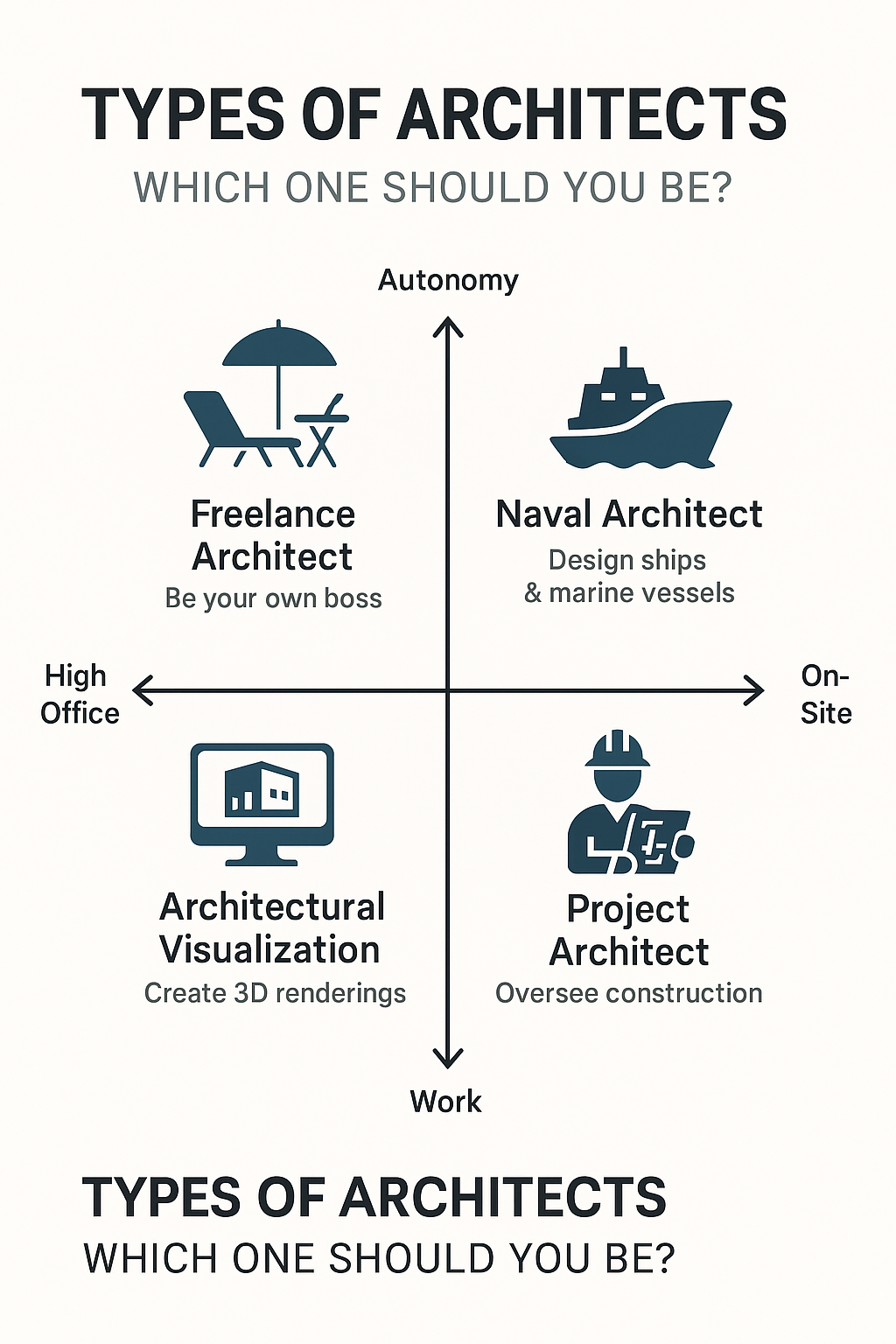
Q: Types of Architects – Which one is the coolest (and which one's the luckiest son of a blueprint-loving gun)?

Let’s just say… not all architects are created equal. Some walk into glass towers with a latte and tablet. Others are up at dawn on construction sites in steel-toe boots. So, who's got the coolest gig? And who's the luckiest?
Coolest Type of Architect?
Naval Architect. Hands down.
Why? Because they design ships. Not just “floating boxes”—we’re talking mega yachts, naval destroyers, submarines, cruise liners... basically architecture that moves, floats, and survives the freaking ocean.
They're also the only architects whose work legally has to float or they’re in serious trouble.
Bonus cool points:
-
Wear a life vest to meetings? ✅
-
Travel to shipyards in Europe or South Korea? ✅
-
Know more about hydrodynamics than most engineers? Also ✅
Runner-up Cool:
Architectural Visualization Experts.
These folks turn boring blueprints into sexy, cinematic walkthroughs. If you've ever seen a “future” building look like a luxury sci-fi resort—these are the digital magicians behind it.
Luckiest Son of a Gun?
Freelance Architects in Bali working poolside on luxury villa designs.
They’re not mythical—they exist.
They pick clients, set their own hours, and when they post a “site visit” on Instagram, it's a cliffside retreat with palm trees.
While others are stuck redlining revisions in a gray office, these architects are sipping iced coffee, reviewing plans from a beachfront coworking space.
But don’t get it twisted:
They earned that luck. It took them years of slogging through corporate firms, late nights, and dodgy client briefs before going rogue. But once they did? Jackpot.
Honorable Mentions:
-
BIM Managers – Paid like kings because they speak fluent “Revit + reality.”
-
Design Directors – Get all the praise when a project wins awards... and someone else fixes the budget mess.
-
Product Architects – Create prefab pods, eco-kits, and stuff that might end up in Elon Musk’s Mars base.
So who’s the coolest?
It’s the one who gets to design what they love, work with people they like, and still has time to cook dinner without passing out.
The real win? Making architecture fit your life—not the other way around.
The Hidden Side of Architecture Salaries

Here’s the truth: most people assume architecture = high pay from day one. Not quite.
Entry-level architects often start off with modest salaries—especially in regions where construction budgets are tight or design isn’t heavily prioritized. The big money? It tends to show up later, once you’ve got experience, specialization, and a bit of strategy behind your choices.
For example, naval architects, BIM specialists, or senior architects in top-tier firms can pull in salaries that rival some tech execs. In places like Dubai, San Francisco, or Zurich, experienced architects regularly earn $150,000+ per year. But in areas like India, South Africa, or the Philippines, even skilled professionals might earn a fraction of that—simply due to location.
Bottom line? Where you work is just as important as what you do—and smart career moves aren’t just about design skills, they’re about geography, timing, and knowing your niche.
In Focus: Why Some Architects Earn Triple the Industry Average
Let’s talk about the quiet truth behind the top-paying architecture roles: they’re rarely advertised, and they almost never go to generalists.
The highest-paid architects tend to fall into one of these three buckets:
● They specialize in high-stakes sectors.
Think: airports, military, luxury towers, or advanced healthcare. These projects demand precision and scale—and firms pay accordingly.
● They blend design with business or tech.
Architects who understand BIM workflows, automation, parametric design, or cost modeling are in demand globally. Add business skills, and you’re not just designing—you’re leading.
● They go global, not local.
Many architects working remotely for firms in New York, London, or Dubai while living in lower-cost regions earn triple what local firms offer. Geography doesn’t limit income anymore—platforms like Upwork, Toptal, and even LinkedIn ProFinder are helping architects land international work without relocation.
So yes—architecture can absolutely be high-paying, but the money doesn’t fall into your lap. It comes to those who plan, pivot, and position themselves smartly in the global market.
The Architect Mindset: What Makes Some People Thrive (While Others Burn Out)
Let’s get real. Architecture isn’t just a job—it’s a long game. And what sets thriving architects apart from the rest isn’t always talent or technical skills. It’s mindset.
If you’re planning a long career in architecture, here’s what actually matters (and what most schools never teach):
✔ Traits of Successful Architects
● Patience + Precision – You’ll revise the same detail 12 times. And it’s part of the process, not a failure.
● Visual Imagination + Logic – It's not about being good at one or the other—you need both.
● Long-Term Grit – Architecture careers build over time. The most successful architects stick with it, even through the slow seasons.
● Strategic Thinking – You’re not just designing for today. You’re planning for climate, cost, context, and people five years from now.
● Humility + Confidence – Take feedback. Lead teams. Let your work speak louder than your ego.
✘ Common Pitfalls (And How to Avoid Them)
▪ Getting stuck doing the same type of project over and over → Diversify early. Try competitions, side gigs, or freelance jobs.
▪ Burning out at a firm with no growth path → Know when to move. Don’t stay at a firm where you’re not learning or advancing.
▪ Thinking you need to know everything → You don’t. Learn just enough to collaborate well, and let the specialists shine.
Bottom Line:
The best architects aren’t perfectionists—they’re problem solvers.
If you love the work, can handle a little chaos, and keep learning, you’ll be just fine.
Related Books for Ambitious Architects
1. The Architecture Student's Handbook of Professional Practice
By: The American Institute of Architects
A must-have if you’re serious about turning school into a career. It covers contracts, firm culture, ethics, and how the profession really works today.
2. Becoming an Architect: A Guide to Careers in Design
By: Lee W. Waldrep
This one’s all about career clarity. It walks you through real roles, alt paths, and how licensure fits into the big picture—without the fluff.
3. How Architecture Works: A Humanist's Toolkit
By: Witold Rybczynski
Not just about buildings—this book explores the “why” behind good architecture. It’s smart, approachable, and a great mindset shift for any architect.
4. Architect + Entrepreneur
By: Eric Reinholdt
Thinking freelance or starting your own studio? This is your playbook for branding, pricing, marketing, and building a modern architecture business.
5. The Future Architect’s Handbook
By: Barbara Beck
Perfect for early explorers. It explains architecture simply and clearly, so anyone—from high school students to curious adults—can see what the job is really about.
FAQ
1. What is the highest-paying architecture job?
● Lead Architects, Naval Architects, and BIM Managers often top the charts.
● High-paying regions: USA, UAE, Switzerland, and Australia.
● Specializing in healthcare, luxury, or government megaprojects can also boost income fast.
2. How long does it take to become a licensed architect?
● Typically 7–10 years, depending on country:
-
5–6 years of education
-
2+ years of supervised experience
-
Passing national exams (like ARE, ARB Part 3, or ExAC)
3. Can you become an architect without a degree?
● In most countries—no.
● You’ll need an accredited degree for licensure in the U.S., UK, Canada, Australia, and EU.
● However, designers, drafters, or technologists can work without full licensure.
4. What’s the difference between an architect and an architectural designer?
● Architects are licensed to manage full projects, sign off on documents, and take legal responsibility.
● Designers focus on visual concepts and cannot legally oversee construction.
5. Can architects work from home?
● Yes, especially in roles like:
-
Freelance design
-
Visualization & rendering
-
Remote BIM coordination
● Site visits and inspections may still require in-person presence.
6. Do architects get paid more in cities?
● Yes. Big cities = bigger projects = higher budgets = higher pay.
● Think: New York, London, Dubai, San Francisco, Toronto, Sydney.
● But rural architects may enjoy lower competition and better work-life balance.
7. Is architecture a good career in 2025?
● Yes—but only if you're adaptable.
● AI tools, sustainable design, and remote workflows are changing the game.
● Architects who evolve with tech and focus on human-centered design will thrive.
8. How do I know if architecture is right for me?
Ask yourself: ● Do you enjoy solving design problems?
● Can you handle long projects and client feedback?
● Are you comfortable with both creativity and technical work?
If yes—you’re on the right path.
9. Can I make 6 figures as an architect?
Absolutely. But: ● You’ll likely need experience + specialization.
● Roles in tech-integrated design, management, or global freelance work hit 6 figures more often.
● High-income architects often work internationally or run their own firms.
Related:
- How to Become an Architect: Steps, Tips, and What You Need to Know
- Why Become an Architect? Discover the Passion, Prestige, and Perks of the Profession
- How to Become a Licensed Architect? The Steps, The Myths, and Whether You Really Need It
- Is Architecture Hard? Yes, But Here's Why It's Worth It!
- Is It Hard to Become an Architect? Absolutely—But Here’s Why It’s Worth It
- Is Architecture Fun? The Excitement and Reality of an Architect's Life
Degrees
- Drafting Associate's Degree Salary: Earning Potential and Career Paths
Architectural Career
- Architect Salary Insights: What You Need to Know
- Architectural Career: Guide for New Professionals
- Types of Architecture Jobs and Salaries: Discover High-Paying Opportunities
- Is Architecture a Dying Profession? The Surprising Truth About Its Future
- Mastering Networking in Architecture: Building Career-Boosting Connections
- Careers in Architecture and Construction: Roles, Salaries, and Paths
- List of Careers in Architecture: With or Without a Degree, There's Something for You
Regional
North America
USA:
- Architect Salary in the United States: Regional Pay Differences
- Architect Salary in New York: Earnings and Expectations
- Architect Salaries in San Francisco, CA: Competitive Pay Rates
- Architect Salary in Los Angeles: Breaking Down the Numbers
Canada:
- Architect Salary in Canada: What You Can Expect to Earn
- Architect Salary in Toronto: How Much You Can Earn
- Architect Salary in Vancouver: Pay Insights for Architects
UK
- Architect Salaries in the United Kingdom: Compensation Trends
- Architect Salary in London, UK: Average Pay for Professionals
Australia
- Architect Salary in Australia: Understanding Pay Scales
- Architect Salary in Sydney: What You Need to Know
United Arab Emirates
- Architect Salary in the United Arab Emirates: High-Paying Roles in Architecture
References & Resources
- NCARB – U.S. Architect Licensing – https://www.ncarb.org
- RIBA – UK Royal Institute of British Architects – https://www.architecture.com
- ARB – UK Architects Registration Board – https://www.arb.org.uk
- CACB – Canadian Architectural Certification Board – https://cacb.ca
- RAIC – Royal Architectural Institute of Canada – https://raic.org
- AACA – Australia Architect Accreditation Council – https://www.aaca.org.au
- UNESCO-UIA Charter for Architectural Education – https://www.uia-architectes.org
- BLS – U.S. Bureau of Labor Statistics (Architects) – https://www.bls.gov
- NAAB – National Architectural Accrediting Board (U.S.) – https://www.naab.org