
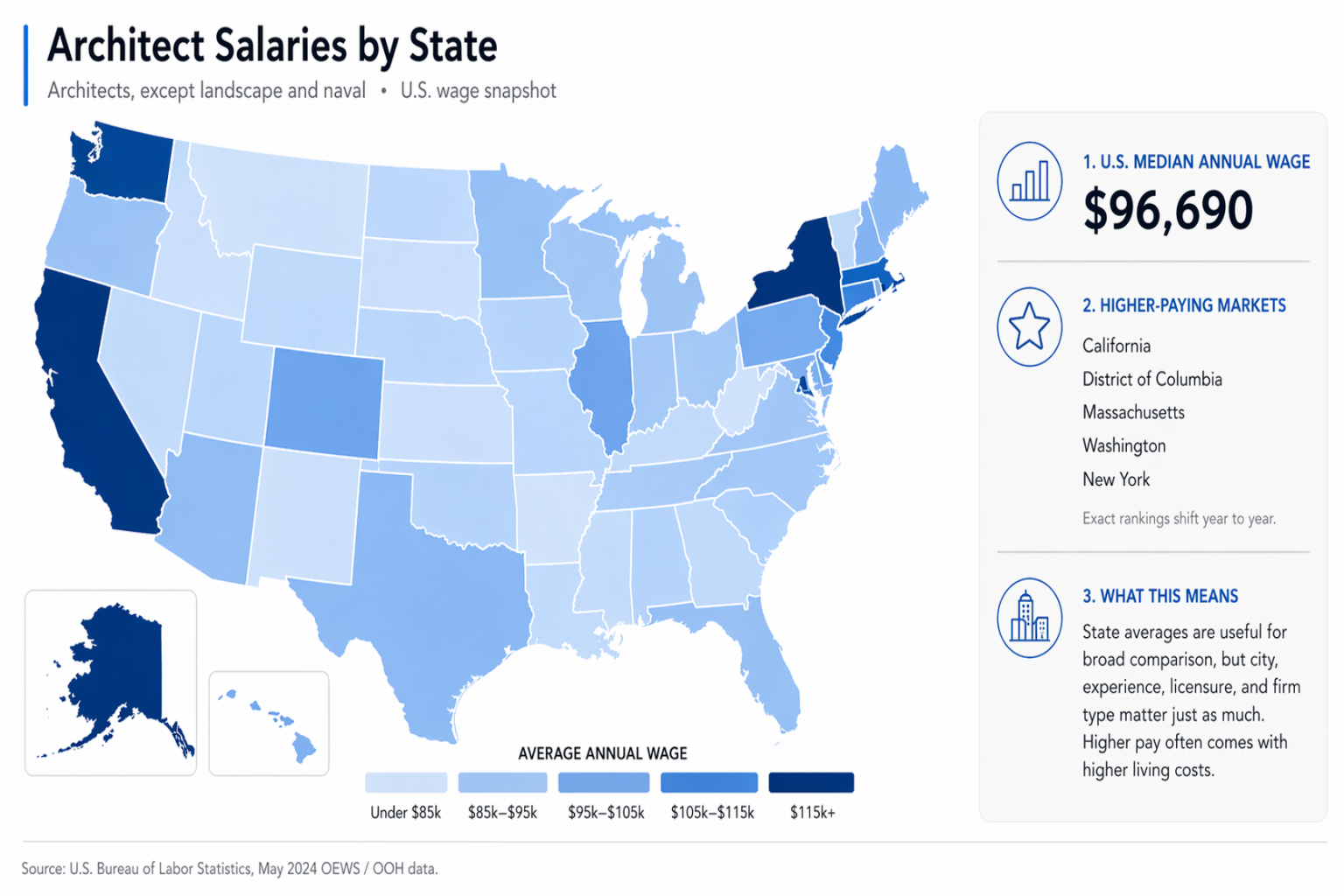
The Bureau of Labor Statistics puts the national median for architects at $96,690 as of May 2024. That number is accurate and it is incomplete. The bottom 10% of the profession earns below $60,510. The top 10% earns above $159,800. Both groups are in that median. A junior drafter in Baton Rouge and a principal at a large firm in Manhattan are counted in the same statistic, and they have nothing useful in common salary-wise.
What actually determines where you land is state, city, firm size, role, and whether you hold a license. This page works through all of those with real numbers.

Illustration by ArchitectureCourses.org. Simple career steps for students, professionals, and job seekers.
Salary figures throughout this page come from the U.S. Bureau of Labor Statistics Occupational Employment and Wage Statistics program (May 2024), the AIA Compensation Survey, and market data from Glassdoor and Indeed where BLS data is not granular enough for specific cities. No source is perfect. The BLS figures exclude self-employed architects and tend to understate what solo practitioners and firm principals actually earn. Where sources conflict, this page uses the more conservative estimate and notes the discrepancy.
The numbers at a glance

Illustration by ArchitectureCourses.org. Architect salary snapshot for the United States, showing median pay, entry-level range, high-end pay, and the main factors that affect earnings.
| Career stage | Typical range | Notes |
|---|---|---|
| Entry-level (0–3 years, unlicensed) | $60,000 – $75,000 | Higher in coastal cities; lower in the South and Midwest |
| Mid-career (4–9 years) | $75,000 – $105,000 | Licensure adds a meaningful step in this range |
| Senior / licensed architect (10+ years) | $105,000 – $145,000 | Project leadership and specialization drive the upper end |
| Principal / firm owner | $140,000 – $200,000+ | Varies widely based on firm revenue, not just experience |
| Architectural / engineering manager | $130,000 – $240,000 | BLS median $167,740 (May 2024); top 10% above $239,000 |
Licensure is the clearest salary dividing line in the profession. Architects who have passed the ARE and hold a state license earn more than unlicensed staff doing similar work — typically 15 to 20 percent more — because they can sign off on construction documents and carry professional liability. Every year spent working toward licensure without completing it is a year at the unlicensed rate.
Salary by state
State-level figures below are from BLS OEWS May 2024 (mean annual wages, NOC 17-1011, excluding landscape and naval architects).
| State | Mean annual wage | Notable context |
|---|---|---|
| California | $120,780 | Highest mean in the country; Bay Area and LA drive the top end |
| District of Columbia | $115,230 | Highest concentration of architect jobs per capita; federal and institutional work dominant |
| New York | $109,160 | NYC accounts for most of this; upstate markets pay significantly less |
| Massachusetts | ~$100,000+ | Boston-Cambridge metro drives the state figure; strong institutional market |
| New Jersey | $97,980 | Proximity to NYC; many architects commute between the two markets |
| Florida | $97,860 | Higher than most people expect; Miami and Tampa push the average up |
| Illinois | $93,210 | Chicago dominates; the rest of the state runs well below the city |
| Texas | $92,950 | No state income tax changes the net position significantly; Austin and Houston lead |
| Washington | ~$95,000+ | Seattle's tech-driven construction market; among the highest concentrations of green building work |
| Colorado | ~$90,000 | Denver growing fast; relatively low state income tax (4.4% flat) |
| Georgia | ~$82,000 | Atlanta is the market; Southern states generally run below coastal peers |
| Ohio, Michigan, Indiana | $72,000 – $80,000 | Midwest markets; lower cost of living offsets lower gross salaries |
| Mississippi, West Virginia, Arkansas | $62,000 – $70,000 | Lowest-paying states; limited large-project volume |
One thing the state-level data does not show: Texas and Florida have no state income tax. An architect earning $92,000 in Texas keeps more of it than one earning $100,000 in California, where state income tax at that bracket runs around 9%. That gap compounds over a career.
Also worth knowing: New York's state average is heavily pulled by NYC. An architect working in Buffalo or Syracuse earns considerably less than the state mean — more in the $70,000–$85,000 range — and lives in a market with different project types, different competition, and different costs.
What drives salary more than state does
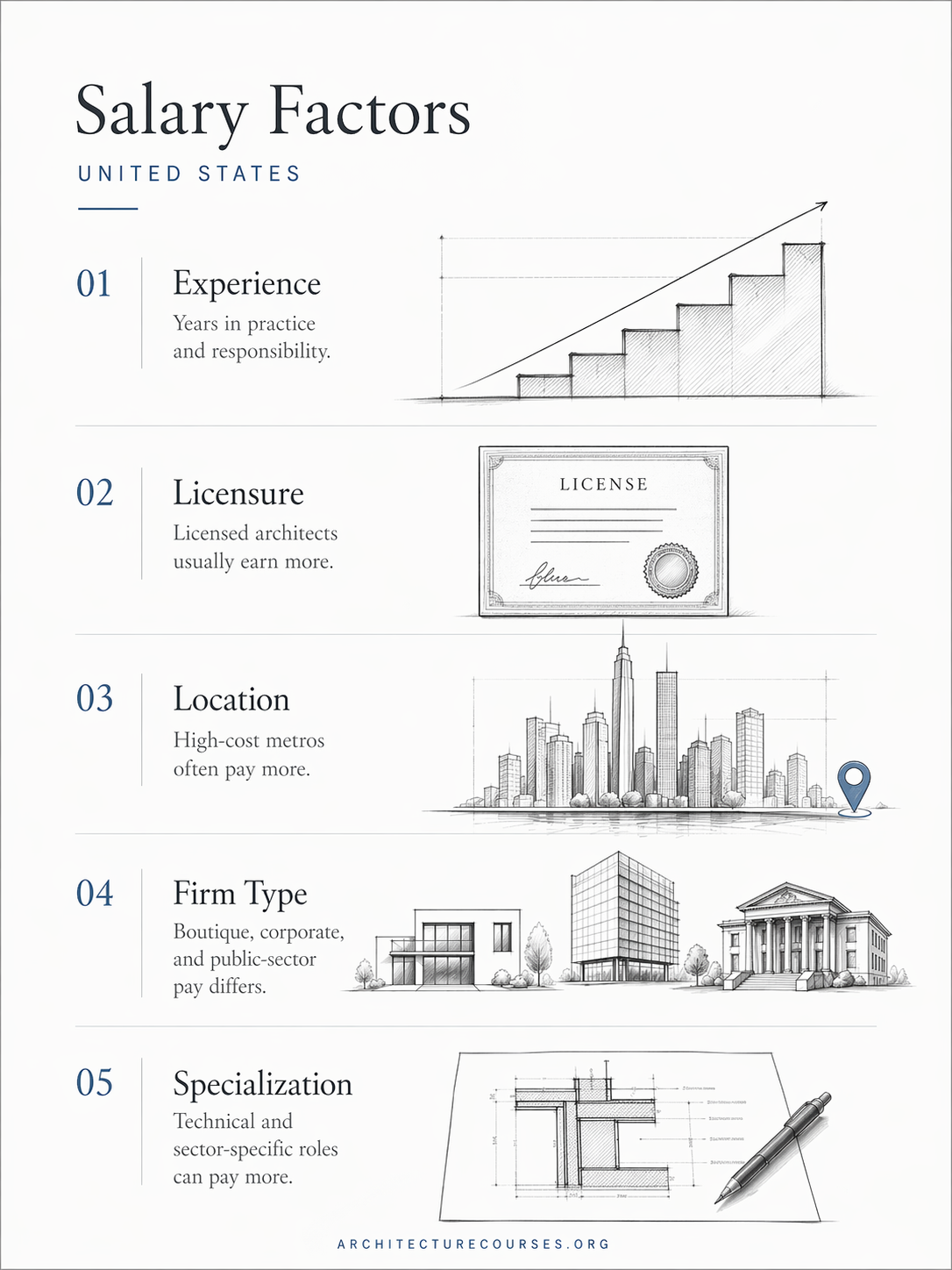
Firm size. Large firms (100+ employees) pay more at every career stage. They run larger projects, have more structured salary bands, and compete harder for talent. The trade-off is less creative autonomy and more production-heavy work. Small boutique firms offer more variety and less money. That is a real choice, not a failure of one option or the other, but most architects in their first decade do not run the comparison explicitly enough.
Licensure. Registration as a licensed architect (RA or AIA) creates a measurable salary step. The process — completing AXP hours, passing the ARE, registering with the state board — takes years. Every year it takes is a year of working at the unlicensed rate for the same work. Firms know what they are saving.
Specialization. At the junior level, specialization matters less. At the senior level, architects with documented experience in healthcare, data centers, institutional work, or large commercial projects negotiate from a fundamentally different position than generalists with the same years of experience. The premium is not small — it can be $20,000 to $40,000 at the same firm and the same title.

Sector. Government and public sector roles pay less than private sector equivalents but offer better job security and benefits. Corporate real estate and developer-side roles often pay more than architecture firm roles. Construction management positions with architectural backgrounds often out-earn practicing architects at the same career stage. Most architects do not consider the last two categories until they are already mid-career.
The parts that are harder to talk about
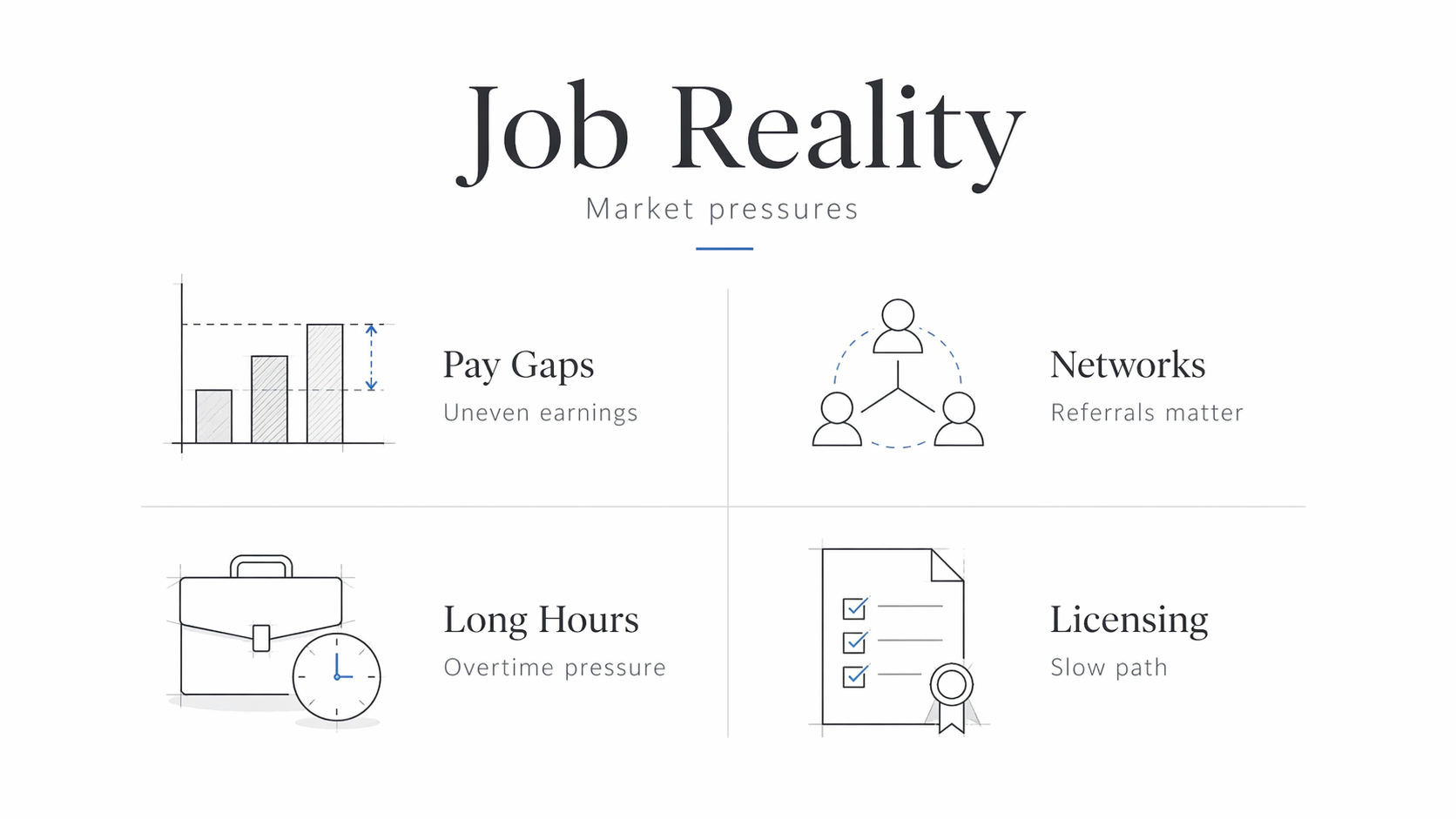
Illustration by ArchitectureCourses.org. Common pressures in architecture careers, including pay gaps, networking, overtime, and licensing.
Gender pay gap. Female architects in the U.S. earn roughly 84 to 88 cents for every dollar earned by male architects in comparable roles, according to AIA survey data. The gap widens at senior levels. It is not explained away by experience or specialization differences. It is a documented and persistent problem in the profession.
Overtime culture. Architecture has one of the stronger overtime cultures in the professional services world. Deadlines drive it. The BLS median figures are based on standard compensation; they do not capture how many hours that compensation actually covers. A $95,000 salary at a firm where 55-hour weeks are standard is not the same as a $95,000 salary at a firm where 40 hours is the norm.
The education-to-salary ratio. Architecture requires five to six years of undergraduate study (a B.Arch) or a four-year undergraduate degree plus a two- to three-year M.Arch, followed by several years of AXP experience before licensure. The entry-level salary at the end of that process — $60,000 to $70,000 — is lower than what engineers, lawyers, or MBAs from comparable programs earn at the same career stage. That gap narrows over time for architects who reach senior and principal levels, but it is real at the beginning and worth knowing before committing to the degree.
Top five states — a closer look

California
California employs more architects than any other state — roughly 15,370 — and pays the highest mean wage at $120,780. The Bay Area concentrates the top end. San Francisco and San Jose both produce salaries well above the state mean, driven by tech campus work and a high cost of living that forces employers to compete on compensation. Los Angeles is the volume market: more architects, more project types, somewhat lower average pay than the Bay Area. State income tax at senior salary levels runs 9 to 10%, which materially reduces the net advantage over Texas or Florida.
New York
New York City is one of the densest architectural markets in the world. The project scale is real — towers, cultural institutions, infrastructure — and the pay reflects it at the senior level. NYC senior architects at large firms regularly exceed $130,000. Entry-level is more modest: $65,000 to $78,000 depending on firm size. The city also adds its own income tax on top of state tax, which costs architects roughly 3 to 4% of gross compared to living in New Jersey and commuting in. Many do exactly that.
Texas
Texas does not have a state income tax. That single fact changes the comparison with higher-salary states more than most people calculate. An architect earning $93,000 in Austin keeps more than one earning $105,000 in San Francisco once state and city taxes are applied. Austin's construction market has been exceptionally active through the early 2020s, though it showed signs of cooling in 2024. Houston runs on a different engine — energy sector commercial work — which is more cyclical but can produce strong project volume when prices are up.
Illinois
Chicago is the market. The state figure ($93,210 mean) is Chicago with some downward pressure from smaller markets outside it. The city has a strong architectural tradition and a real mix of project types — high-rise commercial, institutional, cultural, residential. Illinois has a flat state income tax of 4.95%, which is lower than California and New York but not as favorable as Texas or Florida. Chicago also adds a city income tax layer. Cost of living is considerably more manageable than coastal peers, which helps the net position.
Florida
Florida's mean wage ($97,860) is higher than most people expect for a southern state. Miami drives the top end. The market there runs on luxury residential, hospitality, and high-end commercial work, all of which pay well. Florida also has no state income tax, which gives its salary figures a real boost in net terms. Orlando and Tampa are growing markets. The profession-specific challenge in Florida is hurricane resilience design — buildings here require structural and systems engineering that most other markets do not, which creates demand for architects who understand it.
Roles and what they pay
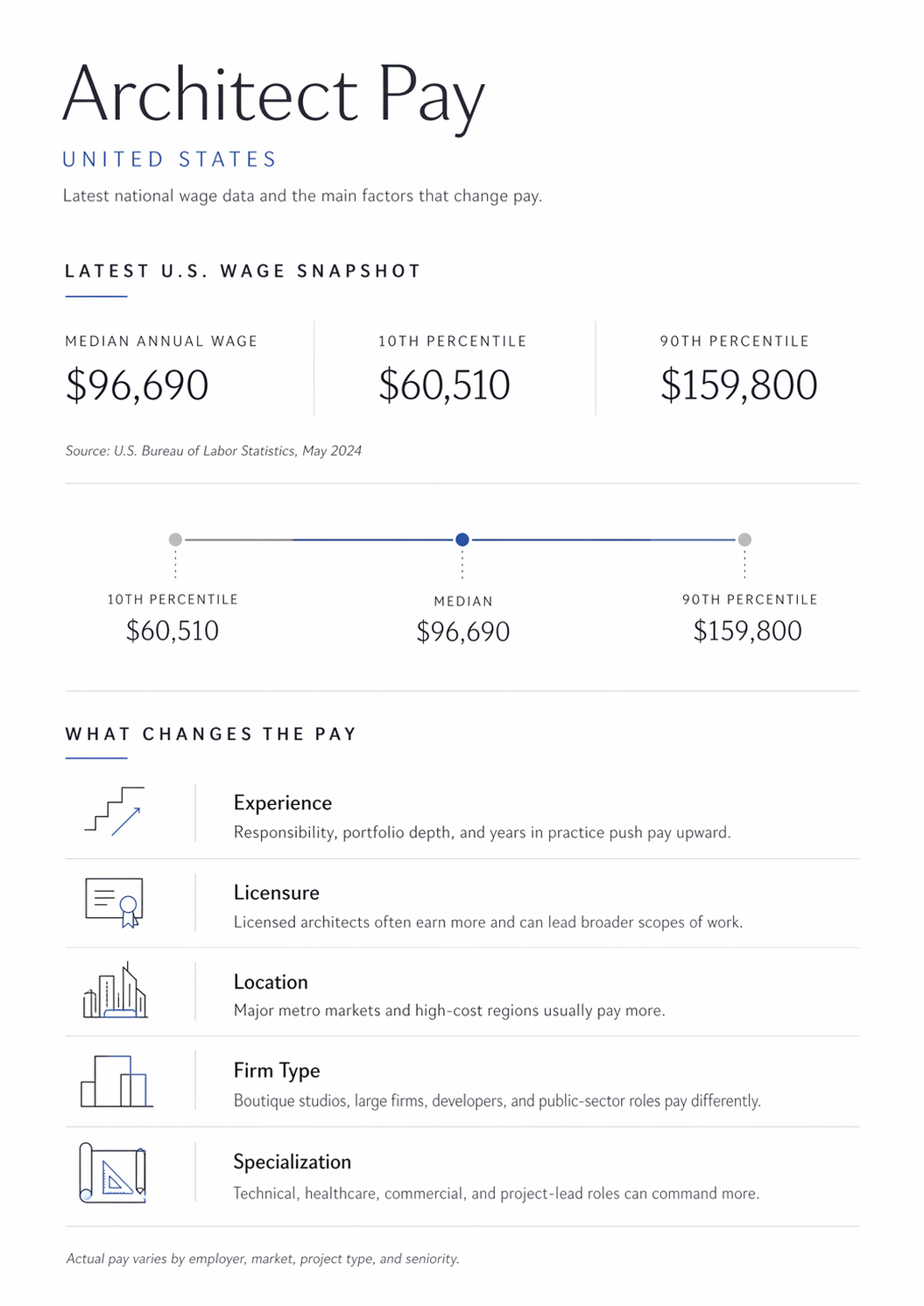
Illustration by ArchitectureCourses.org. U.S. architect pay changes by experience, licensure, location, firm type, and specialization. Wage data: U.S. Bureau of Labor Statistics, May 2024.
| Role | Typical annual range | Notes |
|---|---|---|
| Architectural Drafter | $50,000 – $65,000 | Technical documentation; AutoCAD, Revit; limited design input |
| Architectural Designer | $65,000 – $82,000 | Concept through schematic; typically pre-licensure |
| Architectural Technologist | $68,000 – $85,000 | Technical detailing, specifications, construction documentation |
| Licensed Architect (RA) | $88,000 – $120,000 | Wide range by state, firm size, and project type; licensure is the floor |
| Project Architect | $95,000 – $130,000 | Leads projects from design through construction administration |
| Architectural Project Manager | $110,000 – $145,000 | Manages budgets, schedules, consultants, and client relationships |
| Associate / Principal | $130,000 – $200,000+ | Leadership and business development; may include profit sharing |
| Urban Planner (architecture background) | $75,000 – $100,000 | Government and private sector; BLS median for urban planners was $82,890 (May 2024) |
| Landscape Architect | $65,000 – $100,000 | BLS median $79,660 (May 2024); lower than building architects |
| Naval Architect | $90,000 – $120,000 | BLS median $99,690 (May 2024); niche, limited job openings nationally |
| Sustainable Design Specialist | $85,000 – $115,000 | LEED credentials matter; demand is consistent in California, Pacific Northwest, Northeast |
Project management is the fastest path to the upper end of the range at any firm. The transition from production work to owning client relationships and project budgets is where most salary jumps happen. Waiting for a firm to assign that responsibility takes longer than actively taking it on.
Read this next: 15 Types of Architects and What They Do — a closer look at how roles and specializations differ in practice, not just on paper.
Salary vs. cost of living, by city

Gross salary and net financial position are different numbers. The cities that pay the most are also the most expensive to live in, and the math does not always favor the higher salary. The table below shows a mid-career licensed architect (approximately 6–8 years of experience) in each city. After-tax income estimates account for federal plus applicable state and city income taxes. All cost figures are based on 2024–2025 market data for a single person.
San Francisco
| Expense | Monthly estimate |
|---|---|
| Rent (1BR, mid-city) | $3,200 – $3,500 |
| Groceries | $700 |
| Transit (BART/Muni monthly) | $100 |
| Utilities and internet | $200 |
| Total core expenses | ~$4,200 – $4,500 |
At $100,000 gross (~$5,750/month after California state + federal tax): About $1,250 to $1,550 left after core expenses. That is not a comfortable position for someone who also needs to service student loans, save for a down payment, or maintain a car. San Francisco's housing market is severe enough that many mid-career architects share apartments or live in the East Bay and commute. The salary is real. What you can do with it is constrained.
At $130,000 gross (~$7,300/month after tax): About $2,800 to $3,100 left. Manageable. Homeownership in the city is still not realistic on a single income at this level — median condo prices in San Francisco exceeded $1M through 2024 — but saving becomes possible.
New York City
| Expense | Monthly estimate |
|---|---|
| Rent (1BR, outer boroughs) | $2,500 – $3,000 |
| Rent (1BR, Manhattan) | $4,000 – $5,000 |
| Groceries | $700 |
| Transit (MTA monthly) | $134 |
| Utilities and internet | $200 |
| Total core (outer borough) | ~$3,534 – $4,034 |
New York City adds its own income tax on top of state tax, running roughly 3 to 4% of gross. That costs a mid-career architect earning $95,000 about $2,800 to $3,800 per year compared to living in New Jersey and commuting in. Many architects make exactly that calculation. The MTA handles the commute adequately if you are in a well-connected part of NJ or the outer boroughs.
At $95,000 gross (~$5,700/month after NY state + city + federal tax): Outer borough: about $1,700 to $2,200 left after core expenses. Manhattan: negative without a roommate.
At $120,000 gross (~$7,000/month after tax): Outer borough: about $3,000 left. Manageable. Senior architects at large NYC firms with strong project management experience are in a genuinely good financial position in this city. Junior architects are not.
Boston
| Expense | Monthly estimate |
|---|---|
| Rent (1BR, mid-city) | $2,800 – $3,300 |
| Groceries | $650 |
| Transit (MBTA monthly) | $90 |
| Utilities and internet | $200 |
| Total core expenses | ~$3,740 – $4,240 |
Massachusetts has a flat 5% state income tax — lower than California or New York but still present. Boston's institutional market (universities, hospitals, biotech campuses) creates consistent demand for architects with healthcare and higher education experience, and those architects can command salaries at the top of the state range.
At $95,000 gross (~$5,800/month after MA flat tax + federal): About $1,560 to $2,060 left. Tight but workable for someone without a car (the MBTA covers most of the city adequately). Saving is slow at this level. The city has one of the more expensive rental markets in the country and the housing stock is constrained.
Austin
| Expense | Monthly estimate |
|---|---|
| Rent (1BR) | $1,700 – $2,100 |
| Groceries | $600 |
| Car (payment, insurance, gas — Austin requires a car) | $800 – $1,000 |
| Utilities and internet | $230 |
| Total core expenses (with car) | ~$3,330 – $3,930 |
Texas has no state income tax. That changes the comparison with California and New York significantly. An architect earning $85,000 in Austin keeps about 8 to 10% more of it than one earning $100,000 in California at a comparable federal bracket. Austin also has lower rent than any of the three coastal cities above.
At $85,000 gross (~$5,500/month after federal tax only): About $1,570 to $2,170 left with a car. Austin is not walkable and transit does not cover the city well. A car is a practical necessity for most people, which adds $800 to $1,000 per month to the baseline. Without a car, that $1,570 becomes $2,570 — but without a car in Austin, getting to work is a real problem depending on where you live and work.
Chicago
| Expense | Monthly estimate |
|---|---|
| Rent (1BR, mid-city) | $1,800 – $2,400 |
| Groceries | $600 |
| Transit (CTA monthly) | $105 |
| Utilities and internet | $200 |
| Total core expenses | ~$2,705 – $3,305 |
Chicago is one of the better value propositions for mid-career architects among major U.S. cities. The city has a genuinely good transit system (the L covers most neighborhoods where architects typically live), so a car is avoidable for many people. Illinois has a flat 4.95% income tax, which is less damaging than California or New York. Rent is considerably more reasonable than coastal peers.
At $88,000 gross (~$5,300/month after IL flat tax + federal): About $2,000 to $2,600 left after core expenses. Comfortable by major city standards. Saving is realistic. The city also has a reasonable path to homeownership — a two-bedroom condo in many Chicago neighborhoods can be found in the $350,000 to $500,000 range, which is achievable for a licensed architect who has been saving for a few years.
Houston
| Expense | Monthly estimate |
|---|---|
| Rent (1BR) | $1,400 – $1,800 |
| Groceries | $550 |
| Car (required; city is not walkable) | $800 – $1,000 |
| Utilities and internet (AC is significant) | $280 |
| Total core expenses (with car) | ~$3,030 – $3,630 |
Houston has no state income tax and lower rent than any other major city on this list. The car dependency is total — there is essentially no functional transit for most parts of the city, and this is not likely to change. Utility costs are real: air conditioning in Houston runs more than most people expect before they live there.
At $85,000 gross (~$5,300/month after federal tax only): About $1,670 to $2,270 left with a car. The best net position of any city on this list at this salary level. Houston's energy-sector commercial market pays well when oil is up and contracts when it falls, which is a real career risk that does not apply in coastal markets.
City verdicts side by side
| City | Entry-level (~$68,000) | Mid-career (~$92,000) | Senior (~$125,000) |
|---|---|---|---|
| San Francisco | Very tight. Roommate or East Bay required. | Manageable but slow to save. Ownership is not realistic alone. | Comfortable. Ownership still difficult on one income. |
| New York City | Outer boroughs only. Manhattan not viable alone. | Workable in outer boroughs. City tax is a real cost. | Good position in outer boroughs. Strong project access. |
| Boston | Tight. Transit helps. No car needed. | Manageable. Saving is slow. Rent is the main pressure. | Comfortable. Institutional market is stable and pays well. |
| Austin | Workable without a car. Tight with one. | Good net position. Car necessary. Ownership realistic. | Strong. No state tax helps significantly at this bracket. |
| Chicago | Manageable. CTA covers the city. Better than coastal peers at same salary. | Comfortable. One of the better mid-career cities in the U.S. | Strong. Ownership accessible. Good project variety. |
| Houston | Workable. Car is non-negotiable. AC costs are real. | Best net position of any city on this list at this salary. | Excellent net position. Market volatility is the main risk. |
Freelance and hourly rates

Architects doing independent consulting or freelance residential work typically charge $65 to $100 per hour. Specialists in sustainable design, healthcare, historic preservation, or BIM coordination can charge $100 to $150 per hour or more. Junior architects offering rendering or drafting support to other firms generally land at $45 to $65 per hour.
Freelancing shifts fixed overhead onto the architect directly: professional liability insurance, software (Revit licenses alone run several thousand dollars annually), accounting, marketing, and business administration. For most sole practitioners, those costs total $10,000 to $18,000 per year before any other expense. An hourly rate of $85 does not produce the same net income as an $85,000 salary — the math does not work that way. The comparison needs to account for all of it.
The case for freelancing is control over project selection, direct client relationships, and the ability to capture more of the value of your time on high-margin projects. The case against is inconsistent cash flow, no employer-paid benefits, and the administrative burden of running a business that most architecture programs do not train you to handle.
Career path and salary growth

The path from entry-level to senior pay in architecture is longer than in most comparably credentialed professions. A law school graduate enters the profession and can reach $160,000 to $200,000 within five to seven years at a large firm. An architecture school graduate typically takes ten to fifteen years to reach comparable senior-level compensation, and only a subset of the profession ever does.
That is worth knowing explicitly before spending five or six years in an architecture program.
What accelerates the path:
Get licensed fast. The AXP hours and ARE exams are completable while working. Most firms will support the process. Every year of delay is money left on the table. The pay step at licensure is documented and consistent.
Move toward project management early. Design work does not pay as much as project management at the same experience level, and the gap widens as careers progress. Architects who move into PM roles — owning the schedule, the budget, and the client relationship — reach the upper end of the salary range faster than those who stay in design production.
Pick firm type deliberately. Large corporate firms with large budgets pay more. Developer-side roles and construction management positions with architectural backgrounds often pay more than architecture firms. These are not failures of the profession — they are alternative paths through it.
Negotiate at the right moments. The two points of maximum leverage are when accepting a job offer and when taking on a new title or significant new responsibility. Annual performance reviews are the weakest negotiating position. An offer from a competing firm is the strongest. Both of those are true simultaneously.
Common mistakes
| What people do | What works better | The cost of the mistake |
|---|---|---|
| Compare gross salaries between cities without adjusting for tax and cost of living | Use after-tax, after-rent estimates before making a move | $120,000 in San Francisco and $90,000 in Austin are closer to equal than they look |
| Delay licensure to "build the portfolio first" | Push through AXP and ARE as fast as the process allows | Each unlicensed year costs 15–20% relative to licensed peers doing the same work |
| Stay in design production and wait to be promoted into project management | Actively take on PM responsibility before being asked | The salary gap between a senior designer and a project architect at the same firm can be $20,000 to $35,000 |
| Accept the first offer without negotiating | Negotiate at hire; know the market range before the conversation | First-offer acceptance typically costs $5,000 to $15,000 in year-one salary, which compounds at every subsequent raise |
| Freelance without accounting for overhead costs | Build overhead into your hourly rate from day one | $80/hour looks like $166,000 annually. After real overhead, it is closer to $130,000. After gaps between projects, less. |
FAQ
What is the average architect salary in the United States?
The BLS median was $96,690 in May 2024. The bottom 10% earned below $60,510. The top 10% earned above $159,800. The median is a reasonable starting point but does not tell you much without knowing your state, firm size, and career stage.
Which states pay architects the most?
California has the highest mean wage at $120,780 (BLS May 2024). The District of Columbia is second at $115,230, followed by New York at $109,160. Massachusetts and New Jersey also pay above the national mean. When cost of living is factored in, Texas and Florida move up the rankings significantly because of no state income tax.
How much does an entry-level architect make?
The BLS puts the 10th percentile at $60,510 nationally. In major coastal cities, entry-level pay runs $65,000 to $78,000 depending on firm size. In the South and Midwest, it runs $55,000 to $68,000. These are pre-licensure figures. Getting licensed adds 15 to 20% at most firms.
Is architecture a financially rewarding career?
At the senior level in a major market, yes. At the entry level, not especially — the credential takes longer to earn and the starting pay is lower than comparably demanding professions. The profession is financially rewarding for architects who specialize, get licensed quickly, and move into project leadership. It is less rewarding for those who stay in production roles at small firms throughout their careers.
Do architects make more than engineers?
Generally no. Civil engineers had a BLS median of $101,870 in May 2024. Structural engineers and those in resource sectors earn more. Architects and engineers occupy similar salary ranges at the median, but engineers at the upper end — petroleum, aerospace, electrical — tend to out-earn architects at equivalent experience levels.
How much do freelance architects charge per hour?
$65 to $100 per hour for general consulting and residential work. Specialists in healthcare, sustainable design, or BIM coordination charge $100 to $150 per hour. Junior architects doing production support work charge $45 to $65. Overhead costs run $10,000 to $18,000 annually for most sole practitioners and need to be priced into the rate.
Will AI replace architects?
Not the profession, but it is already changing what junior architects spend their time on. Automated tools handle production drawing, basic rendering, and repetitive documentation faster than people do. That reduces demand for lower-skill production work and raises the premium on design judgment, project leadership, and client management — none of which automated tools currently replace. The profession is shifting, not disappearing.
How long does it take to become a licensed architect in the U.S.?
Typically eight to ten years total: a five- or six-year B.Arch or a four-year undergraduate degree plus a two- to three-year M.Arch, followed by at least three years of AXP experience, then passing the seven-division ARE. Some states have additional requirements. The timeline is long. Starting AXP documentation and exam preparation as early as possible shortens it.
Resources
- The American Institute of Architects (AIA) — AIA Compensation Survey is the most detailed industry-specific salary data available
- National Council of Architectural Registration Boards (NCARB) — licensing requirements by state, AXP program, ARE resources
- Bureau of Labor Statistics — Architects Occupational Outlook — national and state wage data, employment projections
- Boston Society of Architects
- Architect Magazine